DATE :
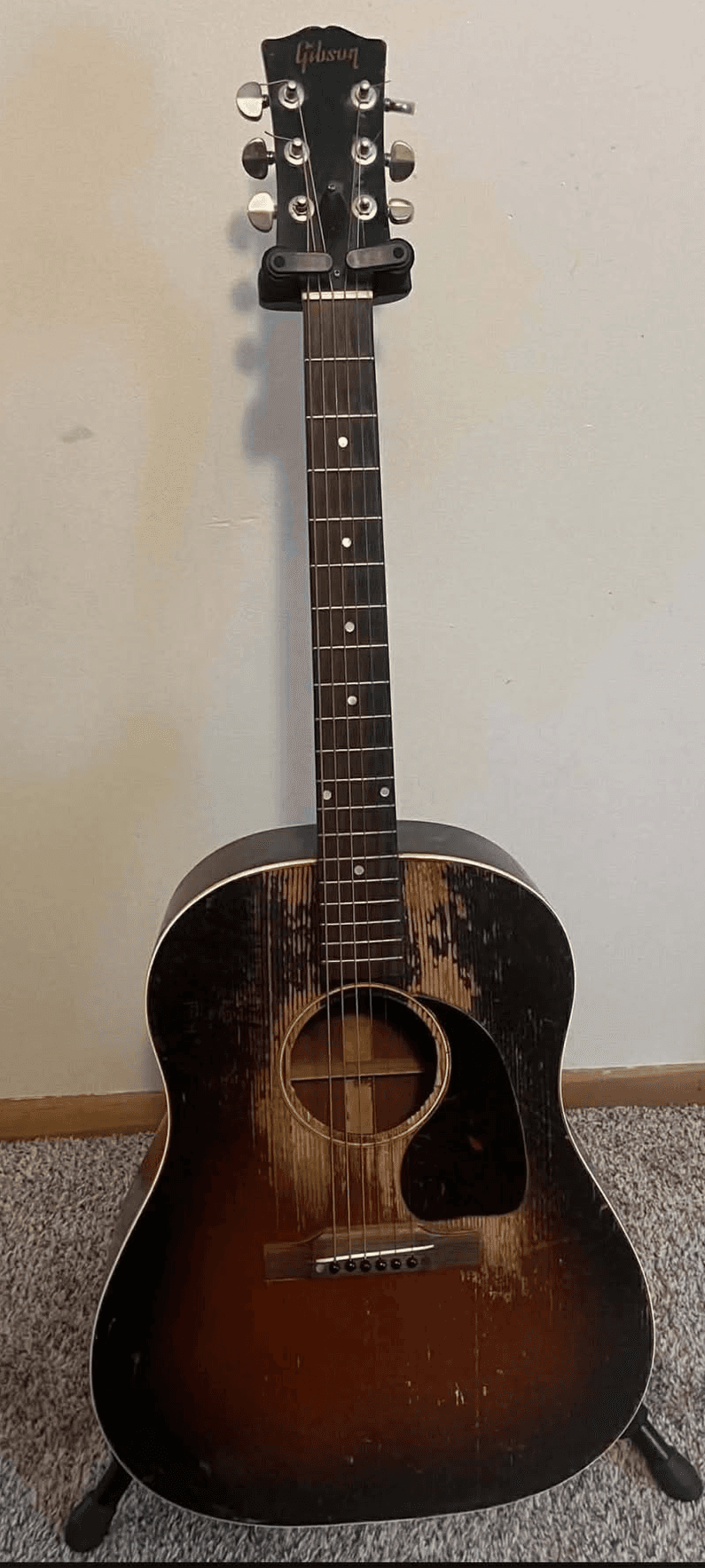
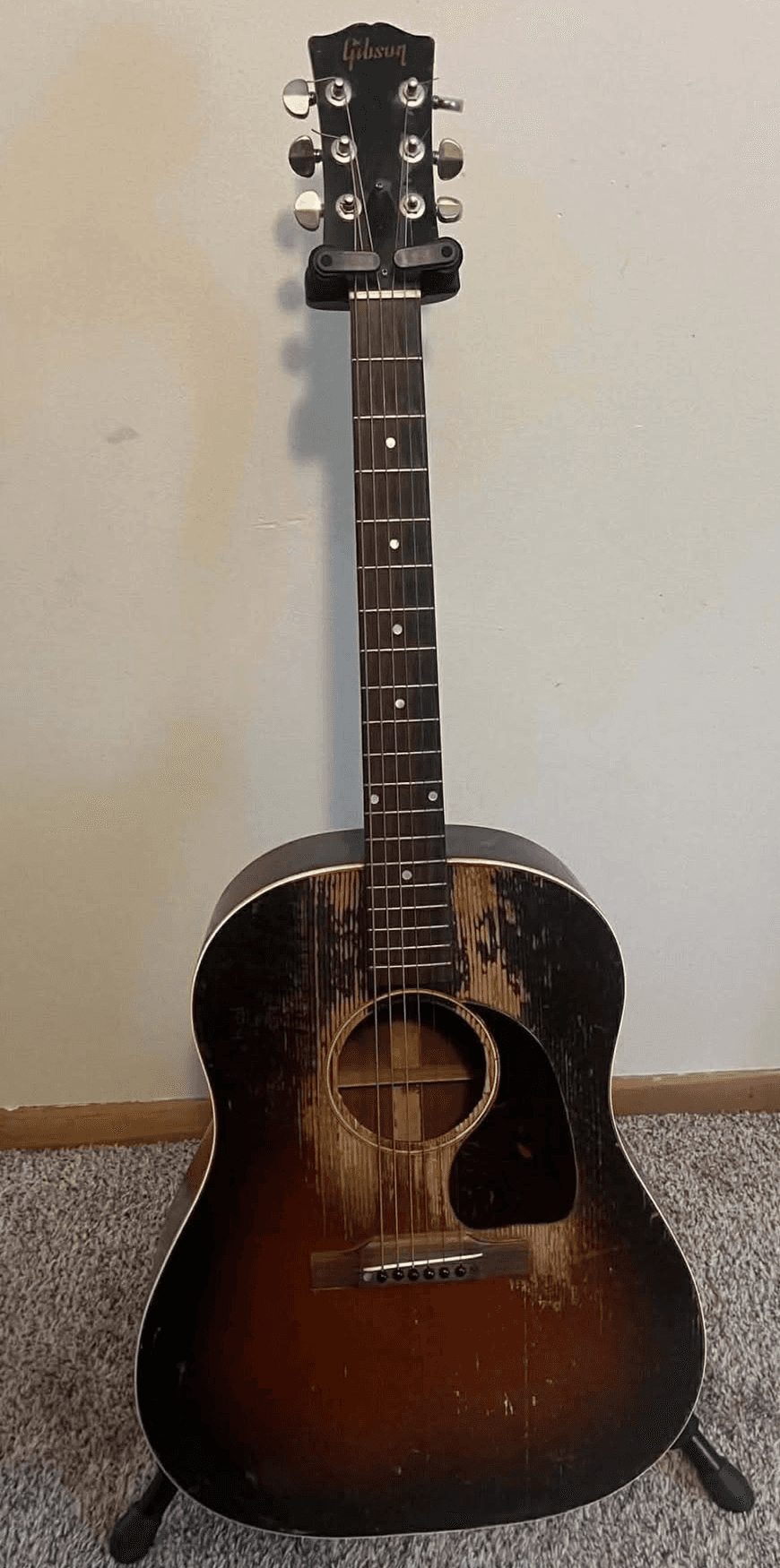
1953 Gibson J-45: The Folk Revival's Workhorse — Round Shoulder Consistency at Mid-Century
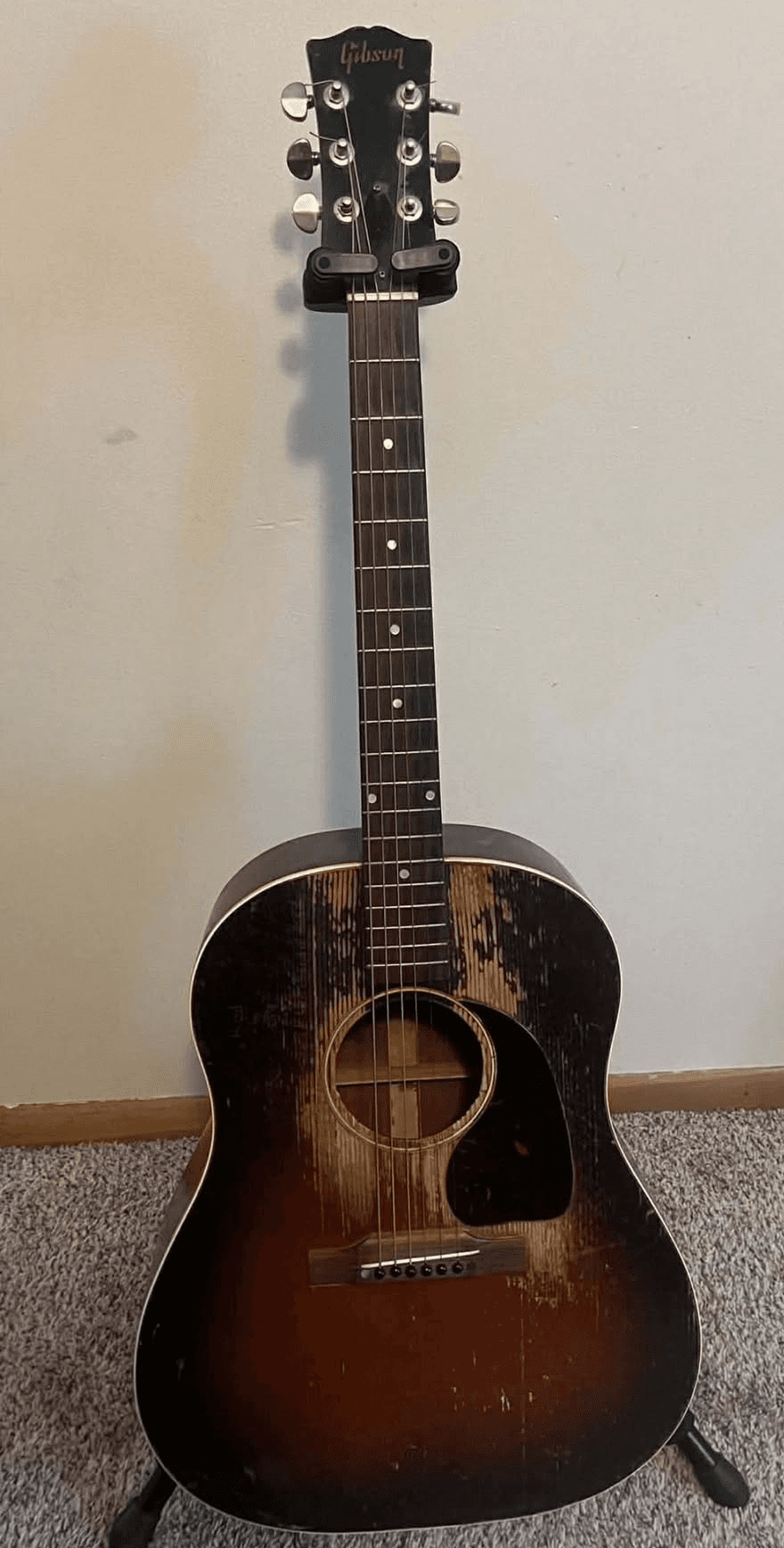
1953 Gibson J-45: The Folk Revival’s Workhorse — Round Shoulder Consistency at Mid-Century
The 1953 Gibson J-45 is a folk-revival workhorse, a round-shoulder dreadnought from the early-fifties years known for consistent build quality and a warm, punchy mahogany voice. Originality of the top, bracing, and tuners, plus overall condition, drives value most. Edgewater Guitars buys vintage Gibson J-45s nationwide with free expert appraisals and same-day cash offers. Call or text (440) 219-3607.
Last Updated: June 2026
What Makes the 1953 Gibson J-45 Significant?
The 1953 Gibson J-45 is the instrument that accompanied the first stirrings of the American folk revival — a cultural moment that would transform the J-45 from a working musician’s tool into an American cultural artifact. By 1953 the instrument had settled into the most consistent production rhythm of its post-war history. The adjustable saddle introduced in approximately 1952 was now fully standardized across production. The round-shoulder dreadnought body had been built long enough for Gibson’s assembly team to execute every element — the bracing, the binding, the finish application, the neck geometry — with practiced confidence. What emerged from the Kalamazoo factory in 1953 was a guitar built with the quiet assurance of mature production: no transitional complexity, no experimental features, no first-year variables. Just the J-45 doing what it was designed to do, built better than it had ever been built before.
The 1953 J-45 benefits from a specific material quality that distinguishes mid-century Gibson acoustics from both the wartime instruments that preceded them and the later production that followed. The spruce tops of 1953 were cut from old-growth Sitka stock that had been accumulated before the most rapid postwar resource depletion began affecting top quality across the industry. The mahogany used for back, sides, and neck was dense, stable, and resonant in a way that increasingly commodity-graded mahogany of later decades would not consistently match. These material qualities are not marketing language — they are audible in the tonal character of instruments from this period, which consistently produce a warmth, depth, and sustain that later examples of nominally identical construction do not always replicate.
The cultural significance of 1953 in the J-45 story cannot be overstated. This is the year Pete Seeger was performing with a J-45 at the center of the emerging folk movement that would produce the Newport Folk Festival, the Kingston Trio, and ultimately Bob Dylan. The tonal character of the J-45 — warm, vocal-forward, naturally compressing under a strumming hand — was exactly what the folk revival needed, and the 1953 examples were the guitars that players of that era were picking up and playing into history. In our experience buying Gibson acoustic guitars across Ohio and the Midwest, 1953 J-45 examples are among the most frequently inherited instruments we evaluate — guitars that were purchased new in the early 1950s by players who became lifelong owners, stored carefully after retirement, and passed to families who recognize their significance but may not fully understand their value.
What makes the 1953 J-45 distinctive:
Adjustable saddle fully standardized throughout production — no transitional variation
Round-shoulder dreadnought body at peak mid-century production consistency
Old-growth Sitka spruce top — material quality that distinguishes this era from later production
Dense, resonant mahogany back, sides, and neck
Ladder bracing — the parallel transverse bracing pattern that defines J-45 acoustic character
Sunburst nitrocellulose finish at mid-century depth and transparency
Original tortoiseshell celluloid pickguard
Kluson Deluxe tuners
Serial numbers on paper label inside the body
Factory Order Number stamped on internal top bracing
If you own a 1953 J-45, you may be sitting on a significant asset. Edgewater Guitars provides free, no-obligation valuations — call (440) 219-3607 or visit edgewaterguitars.com.
What Is a 1953 Gibson J-45 Worth? (2026 Market Values)
Value by Condition and Finish
The 1953 J-45 market in 2026 closely mirrors the 1952 market — the instruments are essentially equivalent in construction, materials, and configuration, and the collector market treats them as closely comparable. The adjustable saddle remains the primary originality variable. Top condition and neck geometry drive the condition hierarchy as they do on all mid-century Gibson acoustics.
Condition | Originality | Relative Value |
|---|---|---|
Excellent (8–9/10) | All original including adjustable saddle, original case | Premium tier |
Very Good (7/10) | All original including adjustable saddle, no case | Strong tier |
Good (6/10) | Adjustable saddle replaced with bone, otherwise original | Mid-to-strong tier |
Good (6/10) | Original saddle, top cracks repaired, neck reset | Mid tier |
Player Grade | Some replacements, heavy wear | Entry-to-mid tier |
Modified | Refin, structural repairs, significant changes | Entry tier |
What Affects the Value of a 1953 J-45?
Adjustable saddle originality: As with the 1952, the factory adjustable saddle is the primary year-specific value variable. All-original examples with the original metal bracket and saddle element intact command a 15–25% premium over examples where the adjustable saddle has been replaced with a conventional unit.
Top material quality: The old-growth Sitka spruce of 1953 production produces tops with tighter grain lines and greater density than the faster-grown Sitka that would increasingly dominate supply in later decades. Tighter grain lines visible on the spruce top — particularly through the soundhole when viewing the underside — are a positive quality indicator that experienced buyers recognize and value.
Top condition: Hairline grain cracks are the most common structural issue. Stable, unrepaired hairlines: 10–20% reduction. Professionally repaired cracks with appropriate cleating: 5–15% reduction. Larger or progressing cracks: 20–35% reduction.
Neck geometry: A properly set neck with correct action is a full-value finding. A neck requiring professional reset: 10–20% reduction reflecting the cost of required maintenance.
Finish integrity: Original sunburst nitrocellulose with appropriate checking and wear is correct and desirable. Refinished examples: 35–50% reduction.
Tuner originality: Original Kluson Deluxe tuners: full value. Replaced modern tuners: 8–12% reduction.
Original case: The original hardshell case adds approximately 10–15% to value.
How 1953 Compares to Other Years
Year | Key Difference | Relative Value | Why |
|---|---|---|---|
1944–1945 | Banner era; Adirondack top; highest collectibility | Substantially higher | Banner premium across all J-45 production |
1950–1951 | Pre-adjustable saddle era; script logo | Similar to slightly higher | Pre-adjustable saddle preferred by some |
1952 | Adjustable saddle introduced | Similar | Essentially equivalent; 1952 first-year novelty marginal |
1953 (this post) | Adjustable saddle fully standardized; peak material quality | Baseline | Fully mature mid-century production |
1954–1957 | Adjustable saddle continues; minor refinements | Similar | No significant distinguishing features from 1953 |
1958–1959 | Cherry sunburst option; production refinements | Similar to slightly higher | Cherry option adds color premium |
Edgewater Guitars consistently pays 30–40% more than typical guitar shops. Get your free valuation: edgewaterguitars.com or (440) 219-3607.
Recent Sales and Auction Results
All-original 1953 J-45 instruments in excellent condition appear at specialist dealers and through estate sales with moderate frequency. The instrument’s cultural association with the early folk revival supports strong buyer interest across both player and collector markets. Contact Edgewater for current market context specific to your instrument’s condition.
How to Identify an Authentic 1953 Gibson J-45
Serial Numbers
Range for 1953: Ink-stamped on the paper label inside the body, visible through the soundhole
Location: White paper label inside the body
Important caveat: Gibson acoustic serial numbers in this era are not perfectly sequential and overlap between model types. The Factory Order Number is the more reliable primary dating reference.
Factory Order Number (FON)
Format for 1953: Batch letter followed by production number — the batch letter series advances through the year and helps narrow production within 1953
Location: Stamped on the top bracing inside the body — visible through the soundhole with a mirror and light, typically on the transverse brace below the soundhole
Importance: The FON combined with construction details provides the most reliable 1953 dating confirmation
Key Visual Identifiers
Body shape: Round-shoulder dreadnought — gently curved shoulders at the neck joint, wider lower bout than upper, the distinctive J-45 silhouette unchanged from 1952
Adjustable saddle: Metal bracket assembly in the bridge through which the saddle threads — fully standardized throughout 1953 production. No variation within the year.
Spruce top grain: Old-growth Sitka spruce — tight, even grain lines visible on the top surface and through the soundhole. Grain lines spaced 1–2mm or less indicate old-growth stock.
Pickguard: Tortoiseshell celluloid, single-ply — aged to amber-brown with slight edge shrinkage consistent with 70-plus years
Finish: Sunburst nitrocellulose — amber to brown burst at edges, transparent center revealing spruce grain
Headstock: Crowned headstock with Gibson script logo in gold and crown MOP inlay
Tuners: Kluson Deluxe, single-ring, plastic oval buttons
Fingerboard: Rosewood with dot inlays
Label: White paper label inside body with Gibson logo, J-45 designation, and serial number
Bracing: Ladder bracing pattern — visible through soundhole as parallel transverse braces
Spruce Top Grain Assessment
The old-growth Sitka spruce of 1953 production is one of the most valuable and least-understood quality markers on mid-century Gibson acoustics:
Grain line spacing: Original 1953 tops typically show 10–20 grain lines per inch at the treble side of the top near the bass side of the soundhole — tight grain indicating slow growth and greater density
Grain consistency: Original old-growth tops show consistent, even grain lines with minimal run-out — the grain runs parallel to the top edge without significant deviation
Color and figure: Old-growth Sitka has a specific creamy-white to slightly amber color that darkens uniformly with age — the 1953 top should show warm, even aging across its entire surface without blotchy or inconsistent coloration
Stiffness: Old-growth tops are stiffer per unit weight than younger growth — an experienced evaluator can identify this characteristic through tap tone assessment
Adjustable Saddle — 1953 Full Standardization
The adjustable saddle of 1953 production shows the fully standardized configuration that would continue through the mid-1950s:
Bracket material: Nickel-plated metal bracket showing appropriate aging — light surface oxidation, wear at the adjustment screw head from decades of potential use
Saddle element: The saddle piece within the bracket may be original synthetic material or may have been replaced with bone or modern synthetic during maintenance — the bracket itself is the primary authenticity marker
Adjustment mechanism: The flat-head screw at the base of the bracket shows appropriate aging — a fresh-looking screw on an aged bracket indicates it has been replaced
Bridge routing: The bridge has a specific routing pattern to accommodate the adjustable bracket — this routing is visible if the saddle is removed and confirms original adjustable saddle design even if the bracket has been removed
Red Flags: How to Spot Fakes and Refinishes
Square shoulders on a claimed 1953 J-45: The 1953 J-45 has round shoulders. Square shoulders indicate a different model or a different year.
Adjustable saddle removed without bridge routing evidence: If the saddle slot shows no evidence of the original bracket routing, either the bridge has been replaced or the instrument is not a 1952–1960s J-45.
Refinished sunburst: Original 1953 sunburst has a specific depth and transparency. UV examination reveals refinishing.
Wrong label: The label should show J-45 designation and period-appropriate printing style. A Dove or Hummingbird label on a claimed J-45 indicates mislabeling or label replacement.
Modern bracing: If top bracing is visible through the soundhole, it should show ladder bracing consistent with the period — not modern scalloped X-bracing indicating a replaced top.
Neck reset evidence undisclosed: Finish disturbance at the neck heel indicates a reset has been performed — a positive maintenance finding that should be disclosed.
Loose or buzzing braces: Any brace rattle or buzz through the soundhole warrants closer inspection — loose braces are a maintenance issue that should be addressed before playing and that affects value modestly.
In our experience evaluating 1953 J-45 instruments from the Ohio and Midwest region, the most significant valuation gap we consistently identify involves the spruce top grain quality — sellers rarely know whether their top is tight-grained old-growth or later faster-grown Sitka, but experienced buyers in the current market specifically seek the tighter grain of earlier production. We assess grain quality during every in-person evaluation as a positive or neutral value factor.
Not sure what year your J-45 is or what condition the top bracing is in? Edgewater offers free in-person authentication. Call (440) 219-3607 or visit edgewaterguitars.com.
1953 Gibson J-45 Specifications
Specification | Detail |
|---|---|
Body Style | Round-shoulder dreadnought |
Body Wood — Top | Sitka spruce — solid, old-growth stock |
Body Wood — Back and Sides | Mahogany — solid |
Bracing | Ladder bracing — parallel transverse pattern |
Neck Wood | Mahogany |
Fingerboard | Rosewood with dot inlays |
Neck Profile | Medium C — comfortable mid-century Gibson acoustic profile |
Nut Width | 1-11/16” (approximately 1.687”) |
Scale Length | 24.75” |
Frets | 19 to body, 20 total |
Bridge | Rosewood with fully standardized adjustable saddle bracket |
Saddle | Adjustable metal bracket assembly with synthetic or bone saddle element |
Nut | Bone or synthetic |
Tuners | Kluson Deluxe, single-ring, plastic oval buttons |
Pickguard | Tortoiseshell celluloid, single-ply |
Finish | Nitrocellulose lacquer — sunburst standard |
Headstock | Crowned with Gibson script logo and crown MOP inlay |
Truss Rod | Adjustable |
Label | White paper label with model and serial number |
Weight Range | Typically 4.0–5.0 lbs |
Case | Brown or black hardshell case |
Original Retail Price | Approximately $97.50 (1953 catalog) |
What Does a 1953 Gibson J-45 Sound Like?
Tonal Profile
The 1953 J-45 produces the fully resolved mid-century J-45 voice — warm, focused, and naturally compressing in a way that makes it one of the most immediately satisfying acoustic guitars to play in an accompaniment context. The old-growth Sitka spruce top of 1953 production is central to this tonal character. Stiffer per unit weight than younger-growth Sitka, the old-growth top responds to pick and finger attack with a crispness and clarity that younger, less dense tops do not consistently produce. The fundamental is clear and immediate; the sustain is warm and controlled.
The mahogany back and sides of 1953 production — dense, stable material from old-growth stock — contribute a midrange warmth and sustain that balances the spruce top’s clarity perfectly. The combination produces the tonal quality most commonly described by players as “vocal” — a natural frequency emphasis in the midrange that sits naturally under and around a singing voice without competing with or drowning it. This quality made the J-45 the instrument of choice for the folk revival’s singer-songwriters and remains the reason players specifically seek mid-century examples over later production.
The ladder bracing pattern contributes a specific resonance freedom — ladder-braced tops flex more uniformly across their width than X-braced tops, producing an even, warm response that distributes energy broadly rather than concentrating it. The practical result is a guitar that sounds full and resonant at modest playing volumes — ideal for intimate performance and recording contexts where the player does not need maximum projection.
How Construction Details Affect Tone
The fully standardized adjustable saddle of 1953 produces the same marginally different tonal coupling characteristic noted in 1952 — the metal bracket introduces a vibrational path between string and bridge that differs from conventional bone saddle coupling. Players who have compared adjustable and conventional saddle versions of the same instrument typically describe the conventional bone saddle as producing a more direct, warmer attack; the adjustable bracket version as slightly more complex and metallic in the initial transient. Neither is objectively superior — the preference is player-specific.
The medium C neck profile of 1953 production is particularly well-suited to the open chord voicings and capo work that define folk guitar technique. The comfortable playing feel — wider than a vintage Fender, narrower than a classical guitar — has a naturalness that reflects Gibson’s accumulated experience with neck profiles that professional players found workable across extended playing sessions.
Notable Recordings
The 1953 J-45 sound is at the center of the earliest recordings of the American folk revival. Pete Seeger’s recording work from this era captures the specific tonal character — warm, vocal-forward, naturally present without being aggressive — that made the J-45 the defining instrument of American folk music. Woody Guthrie, whose association with the J-45 is among the most documented in acoustic guitar history, was using instruments of this type through this period. The tonal quality of old-growth Sitka over dense mahogany, ladder-braced and finished in thin nitrocellulose lacquer, is directly audible in the foundational recordings of American roots music from this period.
Common Issues and Modifications That Affect Value
Adjustable saddle removed: The same common modification as on the 1952 — conventional bone or synthetic saddle installed. Value impact: 15–25% reduction. The bridge routing evidence of the original bracket remains visible when the saddle is removed.
Top cracks: The most common structural issue. Stable hairline cracks: 10–20% reduction. Repaired cracks with appropriate cleating: 5–15% reduction. Progressing or open cracks: 20–35% reduction.
Neck reset required: Forward neck rotation from decades of string tension. Neck requiring professional reset: 10–20% reduction. A professionally reset neck is a positive playing condition finding.
Refinished top or body: Refinished examples lose 35–50% of value. Mid-century sunburst refinishes are common on instruments that experienced significant finish crazing.
Replaced tuners: Original Kluson Deluxe replaced with modern equivalents: 8–12% reduction; reversible if originals are retained.
Replaced pickguard: Original tortoiseshell celluloid replaced with modern reproduction: 5–10% reduction.
Bridge replacement: Original rosewood bridge replaced with modern equivalent or different species: 10–15% reduction.
Top brace regluing: Professionally reglued loose braces with appropriate materials: minimal value impact. Improper adhesives: 10–15% reduction.
Loose or lifted pickguard: Common condition issue on celluloid pickguards as the adhesive ages — a lifted but not removed pickguard is a minor condition note rather than a significant value impact (3–5% reduction).
Finish crazing or checking: Original nitrocellulose checking is correct and desirable. Excessive crazing that has penetrated to bare wood: 5–10% reduction depending on extent.
In Edgewater’s experience with 1953 J-45 instruments, the combination of original adjustable saddle with loose but unrepaired top braces — both very common findings on unplayed stored instruments — is one of the most satisfying evaluations we conduct. Sellers who have stored these guitars carefully often present instruments with original everything intact, where the only issues are maintenance items rather than modifications. An all-original 1953 J-45 with loose braces requiring regluing is a far more valuable instrument than a modified example in playing condition.
Selling Your 1953 Gibson J-45: Your Options Compared
Selling Option | Typical Offer | Timeline | Fees/Costs | Risk Level | Best For |
|---|---|---|---|---|---|
Edgewater Guitars | 30–40% above shop offers | Immediate cash | None | Low — expert authentication included | Owners wanting fair value without hassle |
Local Guitar Shop | Wholesale pricing (lowest) | Same day | None direct, but lowest price | Low | Convenience over value |
Reverb / eBay | Variable — potentially higher | Weeks to months | 5–15% platform fees + shipping | High — fraud, damage, disputes | Experienced sellers comfortable with risk |
Auction House | Variable | 3–6 months | 15–25% seller premium | Medium | Exceptional all-original examples |
Private Sale | Variable | Unpredictable | None | High — authentication burden on you | Sellers with existing buyer network |
The 1953 J-45’s value is driven by factors — adjustable saddle originality, top grain quality, structural integrity — that require in-person examination to assess accurately. A local shop that evaluates the instrument visually without examining the bridge system, checking the top grain, or assessing the neck geometry will consistently undervalue an all-original example. Edgewater’s evaluation process addresses all three dimensions before any offer is made.
We travel anywhere in Ohio, Michigan, Pennsylvania, Indiana, or West Virginia for high-value instruments. Our process moves from first contact to cash in hand in 24–72 hours.
Ready to find out what your 1953 Gibson J-45 is worth? Get your free, no-obligation valuation: edgewaterguitars.com or call (440) 219-3607.
Frequently Asked Questions About the 1953 Gibson J-45
Q: What is a 1953 Gibson J-45 worth in 2026? A: Value is driven by adjustable saddle originality, top condition, neck geometry, and overall originality. All-original examples with intact adjustable saddle in excellent condition represent the premium tier. Contact Edgewater Guitars for a free valuation specific to your instrument’s condition and configuration.
Q: How is the 1953 J-45 different from the 1952? A: The 1953 and 1952 are essentially equivalent instruments — the same adjustable saddle configuration, the same materials, the same construction methods. The 1953 represents the adjustable saddle system fully standardized versus the 1952 where standardization was in progress. In practice the two years are treated as equivalent in the collector market and differ only in the specific production batch characteristics that the Factory Order Number reveals.
Q: What is old-growth Sitka spruce and why does it matter for my J-45? A: Old-growth Sitka spruce is harvested from trees that grew slowly over hundreds of years in old-growth forests — producing wood with tight, even grain lines, high stiffness-to-weight ratio, and exceptional tonal clarity. By the 1950s Gibson was still drawing on old-growth Sitka stock; later production would increasingly rely on faster-grown plantation Sitka that is less dense and less stiff. The practical effect is a top that responds more crisply to playing and produces a more complex, sustaining tone. Tight grain lines on the spruce top — 10 or more per inch — are the visual indicator of old-growth quality.
Q: How do I find the Factory Order Number on a 1953 J-45? A: Look through the soundhole with a mirror and flashlight — the FON is typically stamped on the top brace below the soundhole, running across the instrument’s width. The stamp takes the form of a batch letter followed by a production number. Combined with the serial number on the paper label, the FON provides confident year dating.
Q: Is the adjustable saddle on a 1953 J-45 worth keeping? A: From a collector perspective, yes — all-original examples with the original adjustable saddle command a 15–25% premium over examples where it has been replaced. From a playing perspective, many players prefer a conventional bone saddle for its more direct tonal coupling. Both perspectives are valid — the decision depends on whether you prioritize collector completeness or playing character. If you are considering selling, do not remove the adjustable saddle before having the instrument evaluated.
Q: Does Edgewater Guitars buy 1953 Gibson J-45 instruments? A: Yes. We actively purchase 1953 J-45 instruments in all conditions — all-original, saddle-modified, player-grade, and instruments requiring maintenance. We pay 30–40% more than local guitar shops and provide immediate cash payment. Call (440) 219-3607 or visit edgewaterguitars.com.
Q: What structural maintenance does a 1953 J-45 typically need? A: The three most common maintenance requirements on instruments of this age are professional neck reset (correcting forward neck rotation from decades of string tension), top brace regluing (correcting loose braces from humidity fluctuation), and top crack repair (stabilizing hairline cracks that have developed in the spruce). None of these is a catastrophic condition — all are routine acoustic guitar maintenance that a qualified luthier addresses regularly. Their presence affects value proportionally and should be disclosed but does not make the instrument worthless.
Q: How long does it take to sell a vintage guitar to Edgewater? A: Typically 24–72 hours from initial contact to cash in hand. We provide a preliminary valuation promptly, arrange in-person evaluation for high-value instruments, and make an immediate cash offer with no obligation.
Related Resources
Gibson Serial Number Lookup Tool — edgewaterguitars.com/guitar-serial-number-lookup/gibson
How to Date Your Vintage Gibson J-45: Complete Authentication Guide — edgewaterguitars.com
How to Date Your Gibson Acoustic Guitar: Complete Identification Guide (1930s–1970s) — edgewaterguitars.com
1952 Gibson J-45: Value, ID & Selling Guide — edgewaterguitars.com
1954 Gibson J-45: Value, ID & Selling Guide — edgewaterguitars.com
1944 Gibson Banner J-45: America’s Wartime Acoustic Legend — edgewaterguitars.com
Sell Your Gibson Guitar: Complete 2026 Guide — edgewaterguitars.com
Sell Your Guitar to Edgewater — edgewaterguitars.com
Related posts: 1952 Gibson J-45 | 1954 Gibson J-45 | 1950 Gibson J-45 | 1958 Gibson J-45
Sell your 1953 Gibson J-45
Edgewater Guitars buys vintage Gibson J-45s and other vintage Gibsons nationwide. We give free, honest appraisals and fair same-day cash offers, with local pickup or insured nationwide shipping. Call or text (440) 219-3607 or request a free estimate.
How much is a 1953 Gibson J-45 worth?
As a real reference point, Edgewater recently paid $6,100 for a clean, all-original 1953 Gibson J-45. Condition, originality, and finish move that figure up or down, so the most accurate number for your specific guitar is a free appraisal. Send a few photos and the serial number and we will give you an honest assessment.
Where can I sell a 1953 Gibson J-45?
Edgewater Guitars buys them directly, nationwide, with same-day cash offers and no obligation. You can also date yours with our Gibson serial number lookup.