DATE :
1952 Gibson Les Paul Goldtop: The Birth of a Legend — First Year of Production
1952 Gibson Les Paul Goldtop: The Birth of a Legend — First Year of Production
The 1952 Gibson Les Paul Goldtop was the first year of the Les Paul, the gold-finished solidbody that launched Gibson’s most storied electric line. Edgewater Guitars buys vintage Gibson Les Pauls nationwide with free expert appraisals and same-day cash offers. Call or text (440) 219-3607.
Last Updated: May 2026
What Makes the 1952 Gibson Les Paul Goldtop Significant?
The 1952 Gibson Les Paul Goldtop is where the story begins. It is the first production year of what would become arguably the most influential solidbody electric guitar ever made — a model that would define rock and roll, blues, and popular music across seven decades and counting. Understanding the 1952 instrument is essential to understanding everything that followed, because the original design — with its trapeze tailpiece, P-90 pickups, and gold finish — is meaningfully different from the versions that collectors most actively pursue today, and that distinction directly affects how these instruments are valued and authenticated.
The 1952 Les Paul was not the immediate sensation it would later become. Gibson’s president Ted McCarty and his team developed the instrument partly in response to Fender’s Telecaster, which had been selling since 1950 and demonstrating that a solidbody electric guitar had a commercial future. Les Paul himself had been experimenting with solidbody designs for years — his homemade “Log” prototype dates to the early 1940s — and his endorsement gave Gibson’s new instrument both credibility and a name. The production instrument that resulted was a genuine collaboration between Gibson’s manufacturing capabilities and Les Paul’s vision for a sustaining, feedback-resistant solidbody.
What makes the 1952 instrument specifically significant — beyond being the first year — is its trapeze tailpiece design. The strings on a 1952 Les Paul wrap under the tailpiece rather than over it, a configuration that Les Paul himself had advocated because it allowed the player’s picking hand to rest on the tailpiece without muting the strings. In practice, most players found this arrangement awkward, and Gibson replaced it with the stud-mounted wraparound bridge and tailpiece in 1953. The trapeze tailpiece is the defining feature that identifies a genuine 1952 instrument and distinguishes it from every subsequent year of Les Paul production. In our experience buying vintage Gibson instruments across Ohio and the Midwest, the 1952 trapeze tailpiece Les Paul is among the rarest and most historically significant instruments we encounter — many sellers who own one do not fully understand what they have.
What makes the 1952 Goldtop distinctive:
First production year of the Gibson Les Paul — the instrument that defined the solidbody electric guitar’s future
Trapeze tailpiece with strings wrapping under — found only on 1952 production and earliest 1953 examples
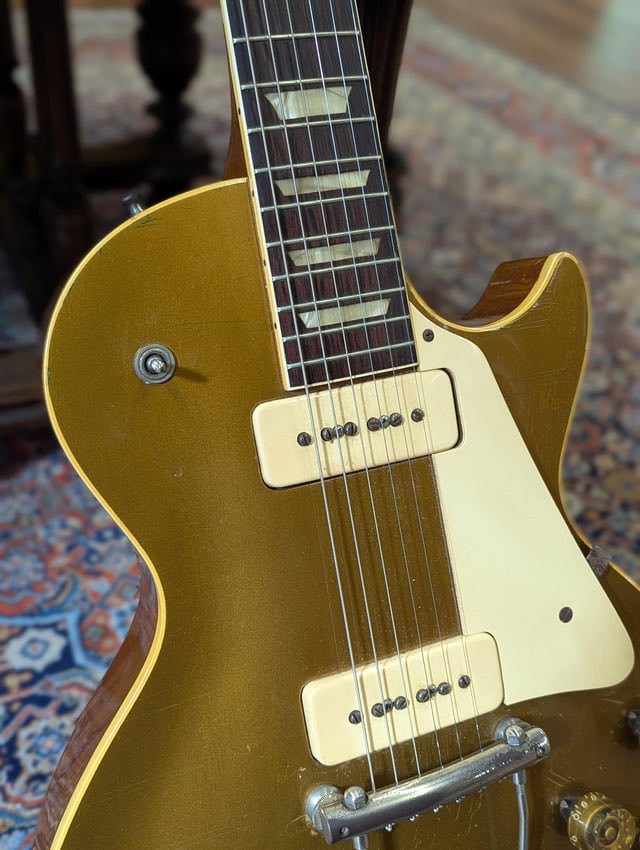
Two P-90 “Soap Bar” pickups in cream — the original Gibson single-coil design
Deep V neck profile — substantially chunkier than any subsequent Les Paul neck
Gold finish applied over a bronze powder undercoat — the original “Goldtop” formula
Brazilian rosewood fingerboard with dot inlays — trapezoidal inlays not yet adopted
Speed knobs with gold caps and silver inserts — the original Les Paul control knob design
Kluson Deluxe single-ring tuners with plastic oval buttons
Unbound neck — binding came later in the production run
Serial numbers in the 0xxx–2xxx range stamped on the back of the headstock
If you own a 1952 Les Paul Goldtop, you may be sitting on one of the most historically significant electric guitars ever made. Edgewater Guitars provides free, no-obligation valuations — call (440) 219-3607 or visit edgewaterguitars.com.
What Is a 1952 Gibson Les Paul Goldtop Worth? (2026 Market Values)
Value by Condition and Finish
The 1952 Les Paul Goldtop market operates differently from later burst-era instruments. The trapeze tailpiece is not universally admired as a playing instrument — the under-strung configuration is genuinely awkward for many players — which means the 1952 is valued more as a historical artifact and first-year collectible than as a player’s instrument. All-original examples command a significant premium over modified or converted instruments. The gold finish on 1952 examples has typically aged to a distinctly different tone than later Goldtops — deeper, more amber, with the bronze powder undercoat sometimes showing through heavy wear areas.
Condition | Originality | Relative Value |
|---|---|---|
Excellent (8–9/10) | All original including trapeze tailpiece, original case | Premium-plus tier |
Very Good (7/10) | All original, trapeze intact, no case | Premium tier |
Good (6/10) | Original except converted to wraparound tailpiece | Strong tier |
Good (6/10) | Original parts, trapeze intact, finish wear | Mid-to-strong tier |
Player Grade | Some replacements, heavy wear | Mid tier |
Modified | Converted tailpiece, non-original pickups, refin | Entry-to-mid tier |
What Affects the Value of a 1952 Goldtop?
Trapeze tailpiece originality: The trapeze tailpiece is the single most important originality factor specific to the 1952. Many 1952 instruments were converted to the 1953 wraparound tailpiece by their original owners — a modification that was common at the time and that Gibson dealers sometimes performed as a service. A converted 1952 with filled or modified tailpiece holes retains significant value but at a meaningful discount to a trapeze-intact example.
Originality overall: All-original examples — trapeze tailpiece, P-90 pickups, speed knobs, Kluson tuners, original wiring — command a 45–65% premium over heavily modified instruments.
Finish integrity: The original gold finish on 1952 instruments is a nitrocellulose lacquer with bronze powder mixed into the top coats. Authentic aged examples show amber yellowing, wear through to the mahogany on high-contact areas, and a characteristic depth of color that refinished examples cannot replicate convincingly. Refinished instruments lose 40–60% of value.
Neck condition: The deep V neck profile of 1952 — the most pronounced neck shape of the entire Les Paul run — is both a historical marker and a player characteristic. A neck with no repairs and original frets at playable height commands full value.
Original case: The original brown or black alligator-pattern hardshell case adds approximately 10–15% to value and is difficult to source separately.
Pot codes: Original potentiometers should date to 1951 or 1952. Centralab (code 134) was the primary pot manufacturer for Gibson in this era.
How 1952 Compares to Other Years
Year | Key Difference | Relative Value | Why |
|---|---|---|---|
1952 (this post) | Trapeze tailpiece; first year; dot inlays | Baseline — first-year premium | Historical significance of first production year |
1953 | Wraparound stud tailpiece introduced; some trapeze remain early in year | Similar to slightly lower | Wraparound more practical; less first-year novelty |
1954 | Tune-o-matic bridge introduced late in year; some with stop tailpiece | Similar | Further refinement toward the “modern” Les Paul |
1957 | PAF humbuckers introduced mid-year — transforms the instrument entirely | Substantially higher | Humbucker introduction is the defining moment of Les Paul history |
1958–1960 | Cherry Sunburst finish; PAF humbuckers; “Burst” era | Highest tier of all Les Paul production | The most valuable production guitars ever made |
Edgewater Guitars consistently pays 30–40% more than typical guitar shops. Get your free valuation: edgewaterguitars.com or (440) 219-3607.
Recent Sales and Auction Results
All-original 1952 Les Paul Goldtops with intact trapeze tailpieces in excellent condition are rare at major auction — perhaps two or three appear at Heritage Auctions or comparable venues in any given year. When they do appear in documented all-original condition, they achieve results firmly in the premium tier of vintage Gibson electrics. Converted examples — trapeze removed and wraparound installed — sell at a meaningful discount but remain strong performers. Contact Edgewater for current market context specific to your instrument’s condition and originality.
How to Identify an Authentic 1952 Gibson Les Paul Goldtop
Serial Numbers
Range for 1952: Approximately 0xxx–2xxx (five digits, ink-stamped on the back of the headstock)
Location: Back of headstock, ink stamp
Format: Five digits with no prefix — e.g., “01234” or “1856”
Important caveat: Gibson serial numbers in this era are not perfectly sequential and the ranges overlap between years. A number in the 0xxx–2xxx range is consistent with 1952 but requires cross-referencing with the Factory Order Number and pot codes for confident dating.
Factory Order Number (FON)
The Factory Order Number is stamped or written inside the body — visible through the treble-side f-hole or pickup cavity on some examples — and provides a more reliable date reference than the serial number alone for early 1950s Gibsons.
Format for 1952: A batch letter followed by a production number — e.g., “A” series
Location: Inside the body, visible through the pickup routing or with a mirror and light through the control cavity
Cross-reference: FON plus serial number together provide the most reliable 1952 dating confirmation
Potentiometer Codes
Gibson used Centralab potentiometers (code 134) as the primary supplier in the early 1950s.
How to decode: Manufacturer code (3 digits) + year (2 digits) + week (2 digits)
Example: 134-5-22 = Centralab, 1952 (the “5” representing the last digit of 1952… note: Gibson pot codes in this era used a single digit for year) — see note below
Gibson pot code note: Early 1950s Gibson pot codes sometimes used a single digit for the year rather than two digits. A Centralab pot reading 134-2-xx has a year code of 2 — consistent with 1952. Cross-reference with FON for confirmation.
Expected codes for 1952: Centralab pots dated to 1951 or 1952 are correct. Pots from 1953 or later indicate modification.
Location: Inside the control cavity, accessible by removing the back plate or through the cavity opening
Key Visual Identifiers
Tailpiece: Trapeze design with strings wrapping under — the single most definitive 1952 identifier. The trapeze is mounted at the base of the body with two mounting screws and has a distinctive art deco appearance with a raised center bar.
Pickups: Cream P-90 “Soap Bar” single-coil pickups — rectangular with rounded ends, cream plastic covers, two mounting screws per pickup positioned within the pickup frame
Knobs: Speed knobs — gold cap with silver insert — not the top hat or reflector knobs of later production
Inlays: Dot inlays on Brazilian rosewood fingerboard — not the trapezoidal inlays introduced in later years on standard Les Paul models
Neck profile: Deep V shape — the most pronounced V of any Les Paul production year, substantially chunkier than later C-profile examples
Headstock: “Les Paul Model” silkscreened in gold on the headstock — thin, delicate lettering
Tuners: Kluson Deluxe, single-ring, plastic oval buttons
Binding: Body binding only — neck binding was not standard on 1952 production
Gold finish: Aged to deep amber-gold with bronze powder visible at wear points — not the cleaner gold of later refinishes
Factory Markings and Stamps
Inside body: Factory Order Number stamped or written — visible through pickup cavity or with mirror through control cavity
Back of headstock: Ink-stamped serial number
Pickup cavities: Some examples show pencil dates or assembly notations inside the routed cavities
Neck heel: May show pencil notes from assembly
Trapeze Tailpiece Authentication
The trapeze tailpiece is the primary 1952 authentication marker and requires specific examination:
Mounting holes: Two screws at the base of the body, slightly inset from the edge — original holes show aged wood and appropriate patina around the screw seats
String wrap direction: Strings pass over the bridge and wrap under the tailpiece bar — the opposite of every subsequent Les Paul tailpiece configuration
Hardware patina: Original nickel-plated trapeze hardware shows appropriate aging — yellowing, light oxidation, wear at string contact points
Conversion evidence: Many 1952 instruments had the trapeze removed and a wraparound tailpiece added. Evidence includes filled holes at the original trapeze mounting positions and additional drilling for the stud-mounted wraparound posts. This conversion is historically documented and does not indicate fraud — it was a common period modification.
Red Flags: How to Spot Fakes and Refinishes
Wrong tailpiece with no evidence of conversion: A wraparound or tune-o-matic bridge on a claimed 1952 without evidence of original trapeze mounting holes indicates either a replaced tailpiece without proper examination or a misrepresented instrument.
Trapezoidal fingerboard inlays: Dot inlays are correct for 1952. Trapezoidal inlays indicate either a later instrument or a replaced fingerboard.
Top hat or reflector knobs: Speed knobs are correct for 1952. Top hat or reflector knobs indicate replacements or a later instrument.
Non-P-90 pickups: PAF humbuckers were not introduced until mid-1957. Any 1952 Les Paul with humbuckers has replacement pickups.
Wrong serial number format: A 1952 serial number should be five digits, ink-stamped on the back of the headstock. A different format indicates either a different year or a replaced headstock.
Refinished gold: Original 1952 gold finish has a specific depth and aging character that is very difficult to replicate convincingly. A refinish in gold typically looks cleaner, more uniform, and lacks the bronze powder character of the original. UV examination confirms refinishing.
Modern wiring: Original 1952 wiring used cloth-covered wire. Plastic-insulated wire inside the control cavity indicates replaced electronics.
In our experience evaluating early Les Paul Goldtops from the Ohio and Midwest region, the trapeze-to-wraparound conversion is by far the most common modification we encounter on 1952 instruments. It is important to understand that this conversion does not make the guitar a fraud or significantly compromise its historical identity — it was a contemporary modification, often performed by Gibson dealers, that reflected players’ practical preferences. The value impact is real but proportional, and a converted 1952 with all-original electronics is still a historically significant and valuable instrument.
Not sure what you have? Edgewater offers free authentication — our team has evaluated numerous early Gibson Les Paul instruments. Call (440) 219-3607 or visit edgewaterguitars.com.
1952 Gibson Les Paul Goldtop Specifications
Specification | Detail |
|---|---|
Body Wood | Mahogany back, carved maple top |
Neck Wood | Mahogany, glued set neck |
Fingerboard | Brazilian rosewood, approximately 12” radius |
Inlays | Dot inlays |
Neck Profile | Deep V shape — the most pronounced V of any Les Paul production year |
Nut Width | 1-11/16” (approximately 1.687”) |
Scale Length | 24.75” |
Frets | 22, medium vintage wire |
Pickups | Two P-90 “Soap Bar” single-coil, cream covers, Alnico V magnets |
Tailpiece | Trapeze — strings wrap under the bar |
Bridge | Rosewood or plastic saddle integral to trapeze assembly |
Tuners | Kluson Deluxe, single-ring, plastic oval buttons |
Controls | Two volume, two tone, three-way toggle switch |
Knobs | Speed knobs — gold cap with silver insert |
Pickguard | Gold-painted plastic, single-ply |
Finish | Nitrocellulose lacquer, gold (bronze powder formula) on top; dark back and sides |
Weight Range | Typically 8.5–10.5 lbs |
Case | Brown or black alligator-pattern hardshell case |
Original Retail Price | Approximately $210.00 (1952 catalog) |
What Does a 1952 Gibson Les Paul Goldtop Sound Like?
Pickup Specifications and Tonal Profile
Pickup type: P-90 “Soap Bar” single-coil
DC Resistance: Approximately 7.5–8.5k ohms per pickup
Magnet type: Alnico V
Bobbin material: Fiber
Potting: Typically lightly potted with wax
Coil configuration: Single-coil — not humbucking
The P-90 pickup that defines the tonal character of the 1952 Les Paul is a fundamentally different animal from the PAF humbuckers introduced in 1957. The P-90 is a single-coil design — louder and more aggressive than Fender’s single-coil designs, with a fuller midrange, more output, and a pronounced upper-midrange bite that is entirely its own character. It is noisier than a humbucker — 60-cycle hum is audible at idle — but the musical character of the P-90, particularly in the bridge position, is a defining element of early rock and roll, blues, and the raw energy of late 1940s and 1950s electric guitar. The neck P-90 produces a round, full, jazz-capable tone that rewards both chord playing and single-note lines.
How Construction Details Affect Tone
The trapeze tailpiece of the 1952 affects tone in a specific and measurable way. With strings wrapping under the bar, the break angle over the bridge is reduced compared to wrap-over and tune-o-matic configurations — less downward pressure on the bridge saddles means slightly less coupling between string and body. The practical result is a somewhat airier, less compressed sustain than the 1953 wraparound configuration produces. Players who have compared trapeze and wraparound 1950s Les Paul instruments directly describe the trapeze version as having more “bloom” on the attack and a slightly more open, less tight low end. This is not universally preferred — the wraparound’s tighter coupling was why Gibson made the change — but it is a real and identifiable tonal characteristic.
The carved maple top over mahogany back construction — unchanged across all Les Paul production years — contributes the characteristic combination of mahogany warmth and maple brightness that defines the Les Paul’s fundamental tonal identity. The deep V neck profile transmits vibration differently than the C profiles of later years, with some players reporting a more resonant, fuller fundamental from the greater wood mass of the V shape.
Notable Recordings
The P-90-equipped Les Paul sound of the early 1950s is documented in the work of Les Paul himself — the multi-tracking pioneer whose recordings with Mary Ford defined what was possible with the electric guitar as a studio instrument. Les Paul’s guitar playing on recordings like “How High the Moon” (1951) and “The World Is Waiting for the Sunrise” (1951) demonstrates the P-90 Les Paul’s capability for singing sustain, clear articulation, and the warmth that would make it a defining instrument. While these recordings predate the 1952 production model, they represent the sound that the production instrument was built to achieve.
Common Issues and Modifications That Affect Value
Trapeze-to-wraparound conversion: The most common 1952-specific modification. The original trapeze tailpiece was replaced with a 1953-style wraparound on many instruments — sometimes by Gibson dealers, sometimes by players. Evidence includes filled original tailpiece mounting holes and additional drilling for wraparound stud posts. Value impact: 20–30% reduction from a trapeze-intact example. This is a historical modification, not a fraud indicator.
Replaced P-90 pickups: P-90s were frequently replaced with PAF humbuckers in the late 1950s and 1960s — an era upgrade that many players considered an improvement at the time. Value impact: 25–35% reduction. Original P-90s retained and included in the sale reduce the impact to approximately 15%.
Refinished top: The gold finish is the most commonly refinished surface on early Les Paul Goldtops. Refinish in correct gold: 40–55% reduction. Non-original color: 60–70% reduction.
Replaced tuners: Kluson Deluxe originals frequently replaced with Grovers. Value impact: 10–15%; fully reversible if originals retained.
Replaced knobs: Speed knobs frequently replaced with top hat or reflector knobs from later production years. Value impact: 5–10%; easily reversible.
Refretted neck: Professional refret with correct vintage wire: 5–10% reduction. Modern jumbo or medium-jumbo wire: 10–15% reduction.
Headstock repair: Even professionally repaired headstock breaks reduce value by 25–40%. Gibson headstocks from this era are prone to breakage due to the headstock angle — inspect carefully.
Replaced fingerboard: A replaced fingerboard eliminates one of the primary original wood elements and the original dot inlay configuration. Value impact: 30–45% reduction.
Added pickup routing: Any additional body routing beyond original P-90 cavities significantly reduces value — 30–45% depending on size and intent.
In Edgewater’s experience with early Les Paul Goldtops, the combination of a trapeze conversion and replaced pickups — both very common — still leaves an instrument with genuine historical significance and meaningful value. Sellers often underestimate what they have because the guitar does not match the mental image of a “valuable Les Paul” — which most people associate with the sunburst humbucking versions. The 1952 Goldtop is a fundamentally different instrument that derives its value from historical primacy rather than tonal legend.
Selling Your 1952 Gibson Les Paul Goldtop: Your Options Compared
Selling Option | Typical Offer | Timeline | Fees/Costs | Risk Level | Best For |
|---|---|---|---|---|---|
Edgewater Guitars | 30–40% above shop offers | Immediate cash | None | Low — expert authentication included | Owners wanting fair value without historical knowledge required |
Local Guitar Shop | Wholesale pricing (lowest) | Same day | None direct, but lowest price | Low | Convenience over value |
Reverb / eBay | Variable — potentially higher | Weeks to months | 5–15% platform fees + shipping | High — fraud, damage, disputes | Experienced sellers comfortable with risk |
Auction House | Variable | 3–6 months | 15–25% seller premium | Medium | All-original exceptional examples |
Private Sale | Variable | Unpredictable | None | High — authentication burden on you | Sellers with existing collector network |
The 1952 Les Paul Goldtop is an instrument where historical knowledge is directly proportional to offer quality. A local shop that primarily deals in player-grade instruments may not recognize a 1952 trapeze tailpiece Les Paul for what it is — or may recognize it but lack access to the collector market that drives its true value. Edgewater’s knowledge of early Gibson production, our access to the national collector market, and our ability to authenticate accurately means our offers reflect the instrument’s actual market position.
We travel anywhere in Ohio, Michigan, Pennsylvania, Indiana, or West Virginia for high-value instruments — and a genuine all-original 1952 Les Paul Goldtop unquestionably qualifies. Our process moves from first contact to cash in hand in 24–72 hours.
Ready to find out what your 1952 Gibson Les Paul Goldtop is worth? Get your free, no-obligation valuation: edgewaterguitars.com or call (440) 219-3607.
Frequently Asked Questions About the 1952 Gibson Les Paul Goldtop
Q: What is a 1952 Gibson Les Paul Goldtop worth in 2026? A: Value depends primarily on trapeze tailpiece originality and overall condition. All-original examples with intact trapeze tailpiece in excellent condition represent the premium tier. Converted examples — trapeze removed, wraparound installed — sell at a meaningful but not catastrophic discount. Contact Edgewater Guitars for a free valuation specific to your instrument’s condition and originality.
Q: How do I identify a 1952 Les Paul versus a 1953 or later instrument? A: The trapeze tailpiece is the primary identifier — 1952 instruments have a trapeze with strings wrapping under the bar. Serial numbers in the 0xxx–2xxx range on the back of the headstock support the 1952 date. Dot inlays, speed knobs, P-90 pickups, and an unbound neck are all consistent with 1952. Cross-reference with the Factory Order Number and pot codes for confident dating.
Q: What is the trapeze tailpiece on a 1952 Les Paul? A: The trapeze tailpiece is an art deco-styled metal assembly mounted at the base of the body in which the strings pass over the bridge and wrap under a raised cross bar before being anchored. It was designed so the picking hand could rest on the tailpiece without muting. Gibson replaced it with the stud-mounted wraparound in 1953 after player feedback indicated the under-strung configuration was awkward in practice.
Q: Is a 1952 Les Paul with a converted wraparound tailpiece still valuable? A: Yes — significantly so. The conversion was a common contemporary modification often performed by Gibson dealers. A 1952 Les Paul with converted tailpiece but original P-90 pickups, pots, wiring, and tuners retains most of its historical significance and value. The discount relative to a trapeze-intact example is real but proportional.
Q: What pickups does a 1952 Les Paul have? A: Two P-90 “Soap Bar” single-coil pickups with cream covers. The P-90 was Gibson’s primary pickup design at the time — a high-output single-coil with a distinctive aggressive midrange character. PAF humbuckers were not introduced until mid-1957.
Q: What serial numbers are on 1952 Gibson Les Paul Goldtops? A: Approximately 0xxx–2xxx, five digits, ink-stamped on the back of the headstock. These ranges overlap with early 1953 production — always cross-reference with the Factory Order Number and pot codes for confident dating.
Q: How do I find the Factory Order Number on a 1952 Les Paul? A: The FON is stamped or written inside the body and is typically visible through the pickup routing cavity or with a mirror and flashlight through the control cavity opening. It takes the form of a batch letter followed by a production number. The FON combined with the serial number provides the most reliable 1952 dating confirmation.
Q: Does Edgewater Guitars buy 1952 Gibson Les Paul Goldtops? A: Yes. The 1952 Les Paul Goldtop is among the most historically significant instruments we purchase. We buy all conditions — all-original trapeze examples, converted instruments, player-grade guitars, and modified examples. We pay 30–40% more than local guitar shops and provide immediate cash payment. Call (440) 219-3607 or visit edgewaterguitars.com.
Q: How does the 1952 Les Paul sound different from later Les Pauls? A: The 1952 Les Paul has P-90 single-coil pickups rather than the PAF humbuckers introduced in 1957. The P-90 is louder, more aggressive, and has more upper-midrange bite than the humbucker — noisier but rawer and more percussive. The trapeze tailpiece also contributes a slightly more open, less compressed sustain than the wraparound or tune-o-matic configurations of later years.
Q: Should I attempt to restore the trapeze tailpiece on my converted 1952 Les Paul before selling? A: No. Do not attempt any restoration, modification reversal, or parts sourcing before having the instrument professionally evaluated. Improper restoration can permanently alter the instrument’s authentication profile and reduce value. Edgewater evaluates the instrument in its current condition and provides an accurate offer reflecting what it actually is.
Related Resources
Gibson Serial Number Lookup Tool — edgewaterguitars.com/guitar-serial-number-lookup/gibson
How to Date Your Gibson Les Paul: Complete Vintage Authentication Guide — edgewaterguitars.com
The Gibson Les Paul Custom: Complete Guide to the Black Beauty Era (1954–1960) — edgewaterguitars.com
Original Gibson PAF Pickups: The Holy Grail of Electric Guitar Electronics — edgewaterguitars.com
The Differences Between Les Paul Juniors from 1954–1962: A Vintage Guide — edgewaterguitars.com
Sell Your Gibson Guitar: Complete 2026 Guide — edgewaterguitars.com
Sell Your Guitar to Edgewater — edgewaterguitars.com
Related posts: 1953 Gibson Les Paul Goldtop | 1954 Gibson Les Paul Standard | 1955 Gibson Les Paul Goldtop | 1957 Gibson Les Paul Goldtop
Recently Purchased: 1952 Gibson Les Paul Goldtop Case Study
A seller in Youngstown, Ohio contacted Edgewater after inheriting a Goldtop Les Paul from his grandfather’s estate. The guitar had a wraparound tailpiece — the conversion having been made at some point decades ago — and the seller had been told by two local shops that it was “just an old Les Paul, nothing special.” One shop had offered a figure consistent with a 1960s student model, apparently not recognizing the early production features.
We evaluated the instrument in person. The serial number, Factory Order Number, and pot codes all aligned to 1952 production. The original trapeze mounting holes were visible beneath the pickguard, confirming the wraparound conversion history. The P-90 pickups were original — confirmed by construction details and DC resistance measurements. The speed knobs, Kluson tuners, and original wiring were all intact. The gold finish showed appropriate aging with bronze powder visible at several wear points — consistent with original finish.
Our offer recognized the full historical significance of the instrument as an authenticated 1952 first-year Les Paul with original electronics, adjusted proportionally for the tailpiece conversion and player-grade finish wear. It exceeded both local shop quotes by a very significant margin.
Edgewater Guitars specializes in purchasing premium vintage guitars throughout Ohio, Michigan, Pennsylvania, Indiana, and West Virginia. We travel to you for high-value instruments. Contact us today for your free, no-obligation valuation: edgewaterguitars.com | (440) 219-3607.
Sell your 1952 Gibson Les Paul Goldtop
Edgewater Guitars buys vintage Gibson Les Pauls and other vintage Gibsons nationwide. We give free, honest appraisals and fair same-day cash offers, with local pickup or insured nationwide shipping. Call or text (440) 219-3607 or request a free estimate.
How much is a 1952 Gibson Les Paul Goldtop worth?
As a real reference point, Edgewater recently paid $17,000 for a clean, all-original 1952 Les Paul Goldtop. Condition, originality, and finish move that figure up or down, so the most accurate number for your specific guitar is a free appraisal. Send a few photos and the serial number and we will give you an honest assessment.
Where can I sell a 1952 Gibson Les Paul Goldtop?
Edgewater Guitars buys them directly, nationwide, with same-day cash offers and no obligation. You can also date yours with our Gibson serial number lookup.
See also: Vintage Gibson Les Paul Standard Value Guide (1952-1960)