Sell Your Gretsch Guitar
"I gave Gavin a call about my Gretsch and he met me with cash the same afternoon. Highly recommended."
Pierce Hoffmann
Edgewater Guitars buys vintage and rare Gretsch guitars from sellers nationwide, with free expert appraisals and same-day cash offers. Based in Valley City, Ohio near Cleveland, we travel across Ohio and the region for valuable pieces and pay fair top dollar. Call or text (440) 219-3607 for a no-obligation offer.
What Gretsch guitars we buy
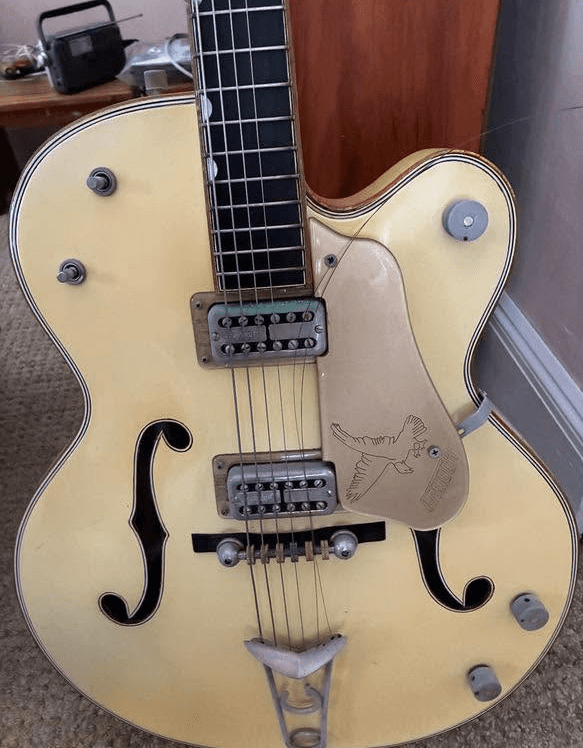
We focus on vintage Gretsch from the 1950s and 1960s, the era most prized by players and collectors, and we also consider rare or high-end newer models case by case. We are actively buying:
White Falcon and White Penguin, the most prized models
6120 Chet Atkins Hollow Body and Nashville
Country Gentleman and Tennessean
Duo Jet, Jet Firebird and Silver Jet solid bodies
Country Club and Anniversary archtops
Models with DeArmond or Filter’Tron pickups
Vintage Gretsch in original finish and hardware
What we have paid for vintage Gretsches
Real prices reflect specific guitars in specific condition, so yours may differ. These are recent Edgewater purchases:
1955 Gretsch White Falcon: we paid $37,000
1959 Gretsch 6120 Chet Atkins Hollow Body: we paid $8,600
1962 Gretsch Country Gentleman: we paid $3,600
1957 Gretsch Duo Jet: we paid $7,100
1963 Gretsch Tennessean: we paid $3,450
1958 Gretsch Country Club: we paid $2,690
Why sell your Gretsch to Edgewater
Edgewater is run by two owner-operators with more than 15 years each buying and appraising vintage guitars, backed by 137 five-star Google reviews. Because we buy, we give straight appraisals and never inflate a value to win a sale. You get a free appraisal, a fair same-day cash offer, and local in-person pickup or insured nationwide shipping.
How selling works
Send a few photos and the serial number for a free appraisal.
Get a fair, no-obligation cash offer, usually the same day.
Meet locally for a cash pickup, or we arrange prepaid insured shipping.
Get paid.
Real reviews from Gretsch sellers
No pressure to buy or sell. I gained a free education and a better knowledge of my instrument, with a reasonable breakdown of cost and value. Transparency and honesty. I genuinely trust Stephen.
Winston Woodward
These guys are the best and really know their stuff. Gavin was extremely detailed and helpful in appraising my gear. Very highly recommended.
Brian Troiano
The entire transaction was seamless. Gavin was prompt, professional and fair with his offer.
Kathy Elias
How do you determine what my guitar is worth?
We evaluate each instrument based on brand, model, year, condition, originality, rarity, and current market demand. Our extensive knowledge of the vintage guitar market allows us to make competitive offers based on real-world values.
Do you buy guitars in any condition?
Yes! While mint condition guitars command premium prices, we purchase instruments in all conditions, including those with modifications, wear, or damage. Even project guitars can have value.
Do I need to clean or repair my guitar before selling it?
No, please don't make any repairs or even clean vintage instruments before contacting us. Original condition, even with dust, grime, or minor issues, is often preferable for accurate valuation. Improper cleaning can actually damage valuable finishes on vintage instruments.
How do I know if my vintage guitar is valuable?
Guitars built before 1970 by Gibson, Fender, Martin, Gretsch, Rickenbacker and Epiphone hold the highest value, especially Les Paul, SG, ES-335, Stratocaster, Telecaster, J-45, D-28 and Jazzmaster models. Key factors are the year of manufacture, the model, condition, originality and rarity of finish. An all-original example with its original finish and hardware commands a premium; replaced parts, a refinish or a repaired headstock lower the offer. The fastest way to find out is to send us a few photos and the serial number for a free, no-obligation estimate.
Do you offer more for guitars with original cases?
Yes, original cases, especially for vintage instruments, can significantly increase value. 'Case candy' such as original paperwork, warranty cards, tags, and accessories also adds value. Keep everything together when selling for maximum return.
What payment methods do you offer?
We offer several secure payment options including cash (for in-person transactions), certified check, bank wire transfer, PayPal, or direct deposit. For high-value instruments or collections, we can accommodate special arrangements to ensure your comfort and security.
Will you travel to my location to purchase guitars?
Yes, for valuable instruments or collections, we regularly travel throughout Ohio, Michigan, Pennsylvania, Indiana, and West Virginia. For exceptional pieces, we may travel nationally. This service is complimentary for instruments meeting certain value thresholds.
How long does the entire selling process take?
For most guitars, the entire process from initial contact to payment can be completed within 1-3 days. For rare or extremely valuable instruments requiring in-person evaluation, the timeline might extend to a week. We pride ourselves on efficiency and respect for your time.
What makes a guitar "vintage"?
Generally, guitars 30+ years old are considered vintage, with those from certain golden eras (1950s-1960s for many electric guitars, pre-1945 for acoustic instruments) being especially desirable. However, specific brands and models may be considered vintage or collectible from different periods based on construction changes, company ownership transitions, or historical significance.
Do modifications decrease my guitar's value?
Modifications typically do decrease value for collectible vintage instruments, with the impact varying based on the extent and reversibility of the changes. Original parts, finishes, and electronics command premium prices on vintage instruments. However, some professional modifications on player-grade instruments may have minimal impact, and certain period-correct modifications on specific models (like Parsons-White B-benders or Bigsby additions) can occasionally increase value.
Tools & Resources