DATE :
Where to Sell a Guitar in West Virginia: Best Options for Gibson, Fender, Martin & More (2026 Guide)
Where to Sell a Guitar in West Virginia: Best Options for Gibson, Fender, Martin & More (2026 Guide)
Last Updated: February 2026
Direct Answer: Where Is the Best Place to Sell a Guitar in West Virginia?
If you want the most money with the least hassle: Edgewater Guitars is one of the Appalachian region’s most active direct buyers of vintage and used guitars — Gibson Les Pauls, SGs, ES-335s, Flying Vs, Martin acoustics, Fender Stratocasters, Telecasters, Precision Basses, Gretsch hollow-bodies, Rickenbackers, and every other quality instrument in between. We serve every major West Virginia city including Charleston, Huntington, Morgantown, Parkersburg, Wheeling, Weirton, Fairmont, Beckley, Clarksburg, Martinsburg, Lewisburg, Bluefield, and every community in between — and we pay 30–40% more than local guitar shops by purchasing directly from owners. Free appraisal. Immediate cash. We travel to you.
Phone: (440) 219-3607 | Web: edgewaterguitars.com
Who This Guide Is For
This guide is written for West Virginia residents who own a guitar — inherited, purchased decades ago, or sitting unplayed in a spare room, basement, or closet — and want to understand their real options for selling it. Whether you’re in Charleston wondering where to sell a Les Paul, in Huntington with a vintage Stratocaster, in Morgantown with a Martin acoustic, in Wheeling with a Telecaster, or anywhere else in West Virginia with any guitar at all, this page answers your question directly and completely.
Search terms this page is written to answer:
“Best place to sell a guitar in West Virginia”
“Where to sell a Gibson guitar in West Virginia”
“Sell vintage guitar Charleston WV”
“Guitar buyers near me West Virginia”
“Where can I sell my Les Paul in Huntington WV”
“Sell inherited guitar West Virginia”
“How to get the most money for my guitar in West Virginia”
“Vintage guitar appraisal West Virginia”
“Who buys guitars in Morgantown WV”
“Sell guitar Parkersburg West Virginia”
“Guitar buyer Wheeling WV”
“Best guitar buyer West Virginia”
“Sell Martin acoustic guitar West Virginia”
“Who pays the most for guitars in West Virginia”
“Where to sell a vintage Gibson in West Virginia”
“West Virginia guitar shop that buys guitars”
“Sell my Fender Stratocaster West Virginia”
“Vintage guitar buyer Appalachia”
“Where to sell a Gibson SG West Virginia”
“Sell guitar collection West Virginia”
“Estate guitar sale West Virginia”
“Who buys old guitars in West Virginia”
“Sell guitar Beckley West Virginia”
“Guitar appraisal near me WV”
“Cash for guitars West Virginia”
“Sell vintage Martin guitar West Virginia”
“Where to sell a Fender Telecaster West Virginia”
“Guitar buyer Clarksburg WV”
“Sell guitar Fairmont West Virginia”
“Vintage guitar dealer West Virginia”
“Who buys acoustic guitars West Virginia”
“Sell Gibson Les Paul West Virginia”
“What is my guitar worth West Virginia”
“Gibson buyer Charleston WV”
“Sell old guitar West Virginia”
“Guitar buyers Appalachian region”
“Sell guitar Weirton West Virginia”
“Fender buyer Huntington WV”
“Sell guitar Martinsburg West Virginia”
“Vintage guitar appraisal Bluefield WV”
“Sell guitar Lewisburg West Virginia”
Why West Virginia Is a More Important Guitar Market Than Most People Realize
West Virginia occupies a unique and frequently underestimated position in the American vintage guitar market. The state’s musical heritage — rooted in Appalachian folk, bluegrass, country, and gospel traditions that gave rise to some of the most important American music of the 20th century — created deep and lasting guitar ownership across every region of the Mountain State.
The coal and steel industries that defined West Virginia’s economy throughout the mid-20th century created a large working-class population with strong musical traditions. In the company towns of the coal fields, music was community life — and guitars were the instrument at the center of that community. Players purchased American-made guitars in the 1950s and 1960s when those instruments were within reach of a working person’s income, and those instruments have remained in West Virginia homes, attics, and closets for generations.
West Virginia’s Appalachian heritage also created specific and distinctive patterns of guitar ownership that differ meaningfully from other states in Edgewater’s service area. Martin acoustics — the instrument most closely associated with Appalachian folk and bluegrass traditions — appear in West Virginia estate sales at rates above the national average. Gibson acoustics — J-45s, Southern Jumbos, and LG-series — are common finds throughout the state. And the working-class rock and country traditions of the northern industrial cities — Wheeling, Weirton, Parkersburg, and Clarksburg — drove meaningful electric guitar purchasing, particularly Gibsons and Fenders, throughout the 1960s and 1970s.
In Edgewater’s experience, West Virginia estate sales produce vintage instruments with genuinely exceptional originality rates. The state’s lower population density, stable family ownership patterns, and relative geographic isolation from major metropolitan guitar markets mean that instruments purchased in the 1950s and 1960s passed through fewer hands and were modified less often than equivalent instruments in denser markets. West Virginia guitars are frequently found in the condition they left the factory — untouched, unmodified, and in some cases still in original cases that haven’t been opened in decades.
If you own a guitar in West Virginia, there is a meaningful probability that it has more value than you realize — and that no local buyer has given you an offer that reflects what it is actually worth in the collector market.
What Guitars Does Edgewater Buy in West Virginia?
Edgewater purchases every quality brand and model. The following covers the primary instruments and their most collectible years in the West Virginia market.
Gibson Electric Guitars We Buy in West Virginia
Model | Most Collectible Years | What Makes Them Valuable |
|---|---|---|
Les Paul Standard (“Burst”) | 1958–1960 | Figured maple tops, PAF humbuckers — among the most valuable production guitars ever made |
Les Paul Custom “Black Beauty” | 1954–1960, 1968–1975 | Ebony finish, ebony fingerboard, gold hardware — all-original critical |
Les Paul Goldtop | 1952–1958 | P-90 pickups (1952–1956), PAF humbuckers (1957–1958) |
Les Paul Junior | 1954–1961 | Single P-90, slab body — TV Yellow and Cherry both collectible |
Les Paul Special | 1955–1961 | Two P-90s — TV Yellow most desirable finish |
Les Paul Deluxe | 1968–1975 | Mini-humbuckers, active collector base |
SG Standard | 1961–1975 | Early “Les Paul” truss rod cover (1961–1963) adds significant premium |
SG Custom | 1961–1975 | Three-pickup variants especially desirable |
SG Junior | 1961–1971 | Single P-90, wraparound bridge |
SG Special | 1961–1971 | Two P-90s — TV Yellow most valuable finish |
ES-335 | 1958–1970 | Dot-neck (1958–1962) most sought after |
ES-345 | 1959–1975 | Stereo/Varitone — gold hardware standard |
ES-175 | 1949–1971 | Jazz standard — PAF era most desirable |
Flying V | 1958–1959, 1967–1975 | Original Korina (1958–59) among the rarest Gibsons ever made |
Explorer | 1958–1959, 1963, 1975–1981 | Original Korina — fewer than 40 made in first run |
Firebird I, III, V, VII | 1963–1969 | Reverse-body neck-through most valuable |
Melody Maker | 1959–1971 | Student model with growing collector following |
Gibson Acoustic Guitars We Buy in West Virginia
Model | Most Collectible Years | What Makes Them Valuable |
|---|---|---|
J-45 | 1942–1969 | Workhorse acoustic — pre-1970 all-original examples most collectible |
J-200 (Super Jumbo) | 1937–1969 | Gibson’s flagship acoustic — large body, celebrity associations |
Southern Jumbo | 1942–1969 | Slope-shoulder dreadnought — common in Appalachian collections |
Country Western | 1956–1977 | Natural-finish slope-shoulder — country and bluegrass tradition |
B-25 | 1961–1977 | Small-body acoustic — excellent player and collector guitar |
LG-2 | 1942–1968 | Small-body acoustic, ladder braced — Appalachian folk staple |
LG-1 | 1943–1968 | Budget small-body with growing collector following |
L-00 | 1932–1945 | Small body blues classic — highly collectible pre-war example |
J-35 | 1936–1942 | Pre-war slope-shoulder — rare and valuable |
Dove | 1962–1975 | Square-shouldered dreadnought with decorative appointments |
Hummingbird | 1960–1975 | Square-shouldered dreadnought — floral pickguard |
Martin Acoustic Guitars We Buy in West Virginia
Model | Most Collectible Years | What Makes Them Valuable |
|---|---|---|
D-28 | 1931–1969 | Brazilian rosewood pre-1970 — Herringbone era (pre-1947) commands premium |
D-18 | 1932–1969 | Mahogany back and sides — Appalachian bluegrass staple |
D-45 | 1933–1942, 1968+ | Pre-war examples among the most valuable acoustics in existence |
D-35 | 1965–1975 | Three-piece back — Brazilian rosewood early examples |
000-28 | Pre-1970 | Orchestra body — 12-fret versions especially rare |
000-18 | Pre-1970 | Mahogany orchestra body — folk and fingerpicking tradition |
00-18, 00-21, 00-28 | Pre-1970 | Parlor and concert sizes — common in Appalachian collections |
OM-28 | 1929–1933 | Original Orchestra Model — extremely collectible |
0-18, 0-28 | Pre-1960 | Small-body Martins — Appalachian folk tradition |
Fender Electric Guitars We Buy in West Virginia
Model | Most Collectible Years | What Makes Them Valuable |
|---|---|---|
Stratocaster | 1954–1964 (Pre-CBS), 1965–1981 | Custom Colors command largest premiums; all-original critical |
Telecaster / Broadcaster | 1950–1981 | Broadcaster and Nocaster rarest; Pre-CBS most valuable |
Esquire | 1950–1969 | Single-pickup Telecaster variant — early examples collectible |
Precision Bass | 1951–1981 | Slab body (1951–1954) rarest; split-coil era most recognized |
Jazz Bass | 1960–1981 | Stack-knob (1960–1961) most collectible |
Jazzmaster | 1958–1980 | Original rhythm circuit intact adds value |
Jaguar | 1962–1975 | Complex switching intact; Custom Colors premium |
Mustang | 1964–1981 | Competition stripe colors most desirable |
Other Brands We Buy in West Virginia
Brand / Model | Key Years | Notes |
|---|---|---|
Gretsch 6120, White Falcon, Duo Jet | 1954–1968 | Country and rockabilly tradition drives Gretsch ownership |
Rickenbacker 325, 360/12, 4001 Bass | 1958–1975 | British Invasion influence — common in university markets |
Epiphone (pre-Gibson acquisition) | Pre-1970 | Pre-Gibson Epiphone archtops and electrics |
Guild Starfire, F-50, F-47 | Pre-1975 | American-made Guilds — strong acoustic and semi-hollow line |
Dobro / Regal Resonator | Pre-1960 | Appalachian resonator tradition — exceptional finds common |
National Resonator | Pre-1960 | Resophonic tradition — significant Appalachian presence |
Banjos (Gibson, Vega, Bacon) | Pre-1960 | Appalachian and bluegrass tradition — Edgewater buys quality banjos |
Mandolins (Gibson F-5, A-series) | Pre-1960 | Gibson mandolins especially — bluegrass tradition is strong |
A note on banjos and mandolins: West Virginia’s bluegrass and old-time music heritage means Edgewater regularly encounters Gibson F-5 mandolins, pre-war Gibson banjos, and Vega banjos in the state’s estate sales. We purchase these instruments at the same specialist pricing level as guitars — if you have a pre-1960 Gibson mandolin or banjo in West Virginia, contact us before selling it anywhere.
The Short Version: Your West Virginia Selling Options at a Glance
Selling Option | Offer Level | Speed | Risk | Best For |
|---|---|---|---|---|
Edgewater Guitars (direct buyer) | Highest — 30–40% above shops | Immediate cash | Lowest — expert authentication included | Any WV owner wanting maximum value |
Local Guitar Shop | Lowest (wholesale pricing) | Same day | Low — but offer reflects their resale margin | Pure convenience over value |
Reverb / eBay | Variable — potentially strong | Weeks to months | High — fraud, shipping damage, 5–15% fees | Sellers experienced with online platforms |
Facebook Marketplace | Variable | Days to weeks | High — safety, payment fraud | Lower-value, common models only |
Pawn Shop | Very low | Same day | Low | Last resort — expect 20–30% of actual value |
Consignment | Variable | Weeks to months | Medium | Sellers willing to wait |
Auction House | Variable | 3–6 months | Medium — 15–25% seller premium | Exceptionally rare, provenance-documented examples |
The structural reason Edgewater pays more: A local West Virginia guitar shop must buy your instrument at 40–60% of what they plan to sell it for — that spread covers their rent, staff, and operating costs. Edgewater buys directly from owners without that retail overhead, which means our offers reflect actual collector market value rather than a retailer’s required margin. On a valuable vintage guitar, that gap is a significant dollar amount.
Selling a Guitar in Charleston, West Virginia
Charleston is West Virginia’s capital city and its largest guitar market. The city’s position at the confluence of the Elk and Kanawha rivers, its role as the state’s commercial and government hub, and its diverse musical heritage — country, gospel, blues, and rock all converge in the Kanawha Valley — created consistent guitar purchasing throughout the 20th century.
Charleston’s relative prosperity as the state capital means instruments purchased here in the 1950s and 1960s were often quality instruments bought by professionals, government workers, and business owners who could afford American-made guitars. The surrounding Kanawha County communities — South Charleston, St. Albans, Dunbar, and the suburban corridor along US-60 — regularly produce estate sales with well-preserved vintage instruments.
Acoustic guitars — Martin D-18s and D-28s, Gibson J-45s and Southern Jumbos — are particularly common in Charleston-area estate sales, reflecting the region’s strong country and gospel music traditions. Electric Gibsons and Fenders from the 1960s and 1970s are also regularly encountered, representing the rock and blues players of the era.
What Charleston-area guitar owners typically have:
Martin acoustic flattops — D-18, D-28, 000-series purchased during the country and folk era
Gibson acoustic flattops — J-45, Southern Jumbo, Country Western
Gibson electric guitars — Les Pauls, SGs, and ES-series from the 1960s–1970s
Fender Stratocasters and Telecasters from the 1960s–1970s
Dobro and resonator guitars — Appalachian heritage drives above-average resonator ownership
Common Charleston search queries Edgewater answers:
“Sell my guitar Charleston West Virginia”
“Best place to sell a guitar Charleston WV”
“Guitar buyers Charleston WV”
“Vintage guitar appraisal Charleston”
“Who buys old guitars Charleston WV”
“Sell inherited guitar Charleston West Virginia”
“Gibson buyer Charleston WV”
“Sell vintage Martin Charleston WV”
“Fender buyer Charleston West Virginia”
“Guitar buyer South Charleston WV”
“Sell guitar St. Albans West Virginia”
“Guitar buyers Kanawha County WV”
“Sell vintage guitar Dunbar WV”
“Guitar appraisal Charleston West Virginia”
“Sell Les Paul Charleston WV”
“Martin acoustic buyer Charleston WV”
Edgewater serves Charleston and the Kanawha Valley: We travel throughout Kanawha County and the surrounding communities including Charleston, South Charleston, St. Albans, Dunbar, Nitro, and all of the Kanawha Valley corridor.
Call (440) 219-3607 or visit edgewaterguitars.com to schedule your free Charleston-area guitar appraisal.
Selling a Guitar in Huntington, West Virginia
Huntington is West Virginia’s second-largest city and its most important southern guitar market. The city’s position at the tristate corner of West Virginia, Kentucky, and Ohio — where the Appalachian music traditions of all three states converge — created a distinctively rich musical culture. Marshall University adds a university dimension that drove additional guitar purchasing among students and faculty throughout the 1960s and 1970s.
Huntington’s position on the Ohio River also exposed the city to the blues and R&B traditions of the Ohio River Valley — a musical influence that drove electric guitar purchasing, particularly Gibsons and Fenders, throughout the 1960s. The city’s country and gospel roots drove strong acoustic guitar ownership at the same time, making Huntington-area estate sales among the most diverse in the state for guitar type and era.
The Lawrence County, Ohio communities directly across the river from Huntington — Ironton, Proctorville, Chesapeake — are also within Edgewater’s natural service radius and regularly produce quality vintage instruments.
Common Huntington search queries Edgewater answers:
“Sell my guitar Huntington West Virginia”
“Best place to sell a guitar Huntington WV”
“Guitar buyers Huntington WV”
“Vintage guitar appraisal Huntington”
“Who buys old guitars Huntington WV”
“Sell inherited guitar Huntington West Virginia”
“Gibson buyer Huntington WV”
“Sell vintage Fender Huntington WV”
“Guitar buyer Cabell County WV”
“Sell guitar Barboursville West Virginia”
“Guitar buyers Tri-State area WV”
“Sell vintage guitar Wayne County WV”
“Guitar appraisal Huntington West Virginia”
“Sell Les Paul Huntington WV”
“Martin acoustic buyer Huntington WV”
“Sell guitar Marshall University area WV”
Edgewater serves Huntington and the Tri-State Region: We travel throughout Cabell County and the broader Tri-State area including Huntington, Barboursville, Milton, Wayne, and the Kentucky and Ohio border communities across the river.
Selling a Guitar in Morgantown, West Virginia
Morgantown is defined by West Virginia University — one of the largest universities in the Appalachian region and a consistent driver of guitar purchasing and musical culture since the 1960s. The city’s university identity creates a layered guitar market with particularly strong acoustic and folk instrument representation, reflecting the folk revival that swept American university communities in the 1960s and 1970s.
Martin and Gibson acoustic guitars purchased by WVU faculty and students during the folk era appear regularly in Monongalia County estate sales. Morgantown’s proximity to the Pittsburgh metropolitan area also means the city absorbed Western Pennsylvania’s rock and blues musical influences, creating additional electric guitar purchasing throughout the 1960s and 1970s.
Morgantown’s relative affluence — driven by the university economy — means instruments purchased here were often quality pieces bought by people with the means to do so. Edgewater encounters well-preserved, all-original guitars in Morgantown-area estate sales with above-average consistency.
Common Morgantown search queries Edgewater answers:
“Sell my guitar Morgantown West Virginia”
“Best place to sell a guitar Morgantown WV”
“Guitar buyers Morgantown WV”
“Vintage guitar appraisal Morgantown”
“Who buys old guitars Morgantown WV”
“Sell inherited guitar Morgantown West Virginia”
“Guitar buyer Monongalia County WV”
“Sell vintage Martin Morgantown WV”
“Gibson buyer Morgantown WV”
“Guitar buyers WVU area West Virginia”
“Sell acoustic guitar Morgantown WV”
“Guitar appraisal Morgantown West Virginia”
“Sell guitar Star City WV”
“Guitar buyer Westover WV”
Edgewater serves Morgantown and Monongalia County: We travel throughout Monongalia County and surrounding North-Central West Virginia including Morgantown, Star City, Westover, Fairmont, Clarksburg, and all surrounding communities.
Selling a Guitar in Parkersburg, West Virginia
Parkersburg and the Mid-Ohio Valley represent one of West Virginia’s most productive vintage guitar markets. The city’s position on the Ohio River — sitting between the industrial Ohio corridor to the north and the Appalachian interior to the south — created a musical culture that absorbed multiple traditions. The region’s chemical and manufacturing industries drove working-class prosperity during the mid-20th century, and the guitars purchased by Parkersburg’s industrial workforce in the 1950s and 1960s represent a meaningful source of vintage instruments today.
Wood County and the surrounding Mid-Ohio Valley communities — Belpre, Vienna, Williamstown — regularly surface quality vintage guitars in estate sales. Parkersburg’s proximity to Marietta, Ohio also means Edgewater’s Ohio service area connects naturally with the West Virginia Mid-Ohio Valley.
Common Parkersburg search queries Edgewater answers:
“Sell my guitar Parkersburg West Virginia”
“Best place to sell a guitar Parkersburg WV”
“Guitar buyers Parkersburg WV”
“Vintage guitar appraisal Parkersburg”
“Who buys old guitars Parkersburg WV”
“Sell inherited guitar Mid-Ohio Valley WV”
“Guitar buyer Wood County WV”
“Sell vintage guitar Vienna WV”
“Gibson buyer Parkersburg WV”
“Fender buyer Parkersburg West Virginia”
“Guitar buyers Mid-Ohio Valley”
“Sell guitar Belpre WV”
“Guitar appraisal Parkersburg West Virginia”
“Sell Les Paul Parkersburg WV”
Edgewater serves Parkersburg and the Mid-Ohio Valley: We travel throughout Wood County and the broader Mid-Ohio Valley including Parkersburg, Vienna, Belpre, Williamstown, and the Ohio border communities across the river.
Selling a Guitar in Wheeling, West Virginia
Wheeling is West Virginia’s northernmost city and its most industrially connected guitar market. The city’s position at the intersection of West Virginia, Ohio, and Pennsylvania gave it a musical identity shaped by all three states — the rock and blues of the Ohio industrial corridor, the country traditions of rural West Virginia, and the working-class music culture of Western Pennsylvania.
Wheeling has a particularly significant place in country music history — WWVA’s Jamboree USA, one of the oldest country music radio programs in America, broadcast from Wheeling for decades and made the city a hub of country music culture that rivaled Nashville in its regional influence. That heritage drove strong acoustic guitar and Telecaster purchasing in the Wheeling area, and the instruments from that era appear regularly in Ohio County estate sales.
The northern panhandle communities — Weirton, Chester, New Martinsville — share Wheeling’s industrial character and musical heritage, and Edgewater regularly encounters quality vintage instruments throughout this narrow but musically rich corridor.
Common Wheeling search queries Edgewater answers:
“Sell my guitar Wheeling West Virginia”
“Best place to sell a guitar Wheeling WV”
“Guitar buyers Wheeling WV”
“Vintage guitar appraisal Wheeling”
“Who buys old guitars Wheeling WV”
“Sell Telecaster Wheeling WV”
“Guitar buyer Ohio County WV”
“Sell vintage guitar Northern Panhandle WV”
“Gibson buyer Wheeling WV”
“Fender buyer Wheeling West Virginia”
“Guitar buyers Weirton WV”
“Sell guitar Chester WV”
“Guitar appraisal Wheeling West Virginia”
“Sell vintage Fender Wheeling WV”
“Country guitar buyer Wheeling WV”
Edgewater serves Wheeling and the Northern Panhandle: We travel throughout Ohio County and the Northern Panhandle including Wheeling, Weirton, Chester, New Martinsville, and the Pennsylvania and Ohio border communities surrounding the panhandle.
Selling a Guitar in Weirton, West Virginia
Weirton and the steel-producing Northern Panhandle communities represent one of West Virginia’s most concentrated areas of working-class guitar ownership. Weirton Steel drove the local economy for generations, and the city’s tight-knit steelworker communities maintained strong musical traditions rooted in country, folk, and rock — all genres where American-made guitars were central instruments.
Estate sales in Hancock County and the Weirton area regularly surface Fenders and Gibsons from the 1960s and 1970s that have remained in family homes since they were purchased. The steelworker community’s stability — families staying in the same homes for decades — means originality rates on instruments from this region tend to be high.
Common Weirton search queries Edgewater answers:
“Sell my guitar Weirton West Virginia”
“Guitar buyers Weirton WV”
“Vintage guitar appraisal Hancock County WV”
“Best place to sell a guitar Weirton”
“Who buys old guitars Weirton WV”
“Guitar buyer Hancock County West Virginia”
“Sell vintage guitar Weirton WV”
“Gibson buyer Weirton WV”
Edgewater serves Weirton and Hancock County: We travel throughout Hancock County including Weirton, Chester, and all surrounding Northern Panhandle communities.
Selling a Guitar in Beckley and Southern West Virginia
Beckley and the Raleigh County coal region represent the heart of West Virginia’s Appalachian interior, and the musical traditions of this region are among the richest in the state. The coal mining communities of Southern West Virginia — Beckley, Oak Hill, Fayetteville, Lewisburg, and the surrounding communities — maintained strong country, gospel, and bluegrass music cultures throughout the mid-20th century.
Southern West Virginia estate sales are among the most likely in the state to produce traditional Appalachian instruments — Martin acoustics in smaller body sizes (000, 00, and parlor guitars), Gibson LG-series and B-25 acoustics, and Dobro/resonator guitars — alongside the electric Gibsons and Fenders that working-class rock and country players purchased in the 1960s and 1970s.
The New River Gorge region and the surrounding communities — Fayetteville, Oak Hill, Summersville — have become increasingly affluent as outdoor tourism has grown, but the underlying working-class instrument ownership from the coal era remains, and estate sales in these communities regularly produce quality vintage instruments.
Common Beckley / Southern WV search queries Edgewater answers:
“Sell my guitar Beckley West Virginia”
“Guitar buyers Beckley WV”
“Vintage guitar appraisal Raleigh County WV”
“Best place to sell a guitar Southern West Virginia”
“Who buys old guitars Beckley WV”
“Sell Martin acoustic Beckley WV”
“Guitar buyer Raleigh County West Virginia”
“Sell vintage guitar Oak Hill WV”
“Gibson buyer Southern West Virginia”
“Sell guitar Lewisburg WV”
“Guitar buyers Greenbrier County WV”
“Sell vintage guitar Fayetteville WV”
“Guitar appraisal Southern WV”
“Sell Dobro West Virginia”
“Resonator guitar buyer West Virginia”
Edgewater serves Beckley and Southern West Virginia: We travel throughout Raleigh County and Southern West Virginia including Beckley, Oak Hill, Fayetteville, Lewisburg, Greenbrier County, and all surrounding communities.
Selling a Guitar in Clarksburg and Fairmont, West Virginia
Clarksburg and Fairmont — the twin industrial cities of North-Central West Virginia — share a manufacturing heritage that drove consistent guitar purchasing throughout the mid-20th century. Harrison and Marion counties sit at the geographic center of the state, and their estate sales regularly reflect both the Appalachian acoustic traditions of the surrounding rural communities and the electric guitar purchasing of the urban working-class population.
Clarksburg is the birthplace of Stonewall Jackson — one of the Confederacy’s most celebrated generals — but more relevant to guitar buyers is its strong country music heritage and its glass industry workforce, which created a prosperous working-class community that purchased quality instruments throughout the 1950s and 1960s.
Common Clarksburg / Fairmont search queries Edgewater answers:
“Sell my guitar Clarksburg West Virginia”
“Guitar buyers Clarksburg WV”
“Vintage guitar appraisal Harrison County WV”
“Sell guitar Fairmont WV”
“Guitar buyers Marion County WV”
“Best place to sell a guitar North-Central WV”
“Who buys old guitars Clarksburg WV”
“Guitar buyer Bridgeport WV”
“Sell vintage guitar Harrison County West Virginia”
Edgewater serves Clarksburg, Fairmont, and North-Central West Virginia: We travel throughout Harrison and Marion counties including Clarksburg, Fairmont, Bridgeport, Bridgeport, Shinnston, and all of North-Central West Virginia.
Selling a Guitar in Martinsburg and the Eastern Panhandle
Martinsburg and the Eastern Panhandle sit at West Virginia’s most densely populated and economically dynamic corner — a region shaped more by its proximity to Washington D.C., Maryland, and Virginia than by the Appalachian interior. Berkeley and Jefferson counties are among the fastest-growing in the state, with a diverse and affluent population that creates a distinctive guitar market.
The Eastern Panhandle’s musical heritage draws from multiple traditions — the Shenandoah Valley’s country and bluegrass culture to the south, the Washington metropolitan area’s diverse music scene to the east. Estate sales in Berkeley and Jefferson counties regularly produce quality instruments from both the older Appalachian tradition and the more recent suburban professional population.
Common Martinsburg search queries Edgewater answers:
“Sell my guitar Martinsburg West Virginia”
“Guitar buyers Martinsburg WV”
“Vintage guitar appraisal Eastern Panhandle WV”
“Best place to sell a guitar Eastern WV”
“Who buys old guitars Martinsburg WV”
“Guitar buyer Berkeley County WV”
“Sell vintage guitar Jefferson County WV”
“Gibson buyer Martinsburg WV”
“Sell guitar Shepherdstown WV”
“Guitar buyers Charles Town WV”
“Sell Fender Eastern Panhandle WV”
“Guitar appraisal Martinsburg West Virginia”
Edgewater serves Martinsburg and the Eastern Panhandle: We travel throughout Berkeley and Jefferson counties including Martinsburg, Shepherdstown, Charles Town, Inwood, and all of the Eastern Panhandle. The Eastern Panhandle also falls within reach of our Pennsylvania service area.
Selling a Guitar in Bluefield and Mercer County, West Virginia
Bluefield straddles the West Virginia–Virginia state line, and its music culture reflects the broader Appalachian tradition of Southwest Virginia and Southern West Virginia. Mercer County and the surrounding Appalachian communities — Princeton, Welch, Pineville — have deep roots in country, gospel, and bluegrass music, and the coal industry that defined this region’s economy created the same pattern of instrument ownership seen throughout the Southern West Virginia coalfields.
Common Bluefield search queries Edgewater answers:
“Sell my guitar Bluefield West Virginia”
“Guitar buyers Bluefield WV”
“Vintage guitar appraisal Mercer County WV”
“Best place to sell a guitar Southwest WV”
“Who buys old guitars Bluefield WV”
“Guitar buyer Mercer County West Virginia”
“Sell vintage guitar Princeton WV”
“Gibson buyer Bluefield WV”
“Sell Martin acoustic Southwest Virginia WV area”
Edgewater serves Bluefield and Southwest West Virginia: We travel throughout Mercer County and Southwest West Virginia including Bluefield, Princeton, and surrounding communities. We also serve the Southwest Virginia communities across the state line from Bluefield.
The Appalachian Guitar Heritage: Why West Virginia Instruments Are Special
West Virginia’s guitar ownership patterns are shaped by its Appalachian heritage in ways that make the state’s vintage instrument market distinctive from every other state in Edgewater’s service area. Understanding these patterns helps explain both what types of instruments to look for and why they appear in such good condition.
Martin Acoustics — West Virginia’s Most Valuable Guitar Category
Martin acoustics hold a special place in the West Virginia guitar market. The company’s instruments were the choice of professional and serious amateur players in the Appalachian tradition — bluegrass and country musicians who understood the difference between a Martin and everything else. A bluegrass banjo player’s Martin D-28, a country guitarist’s Martin D-18, a fingerpicker’s 000-28 — these instruments were purchased as serious professional tools and treated accordingly.
Pre-1970 Martin acoustics made with Brazilian rosewood — D-28, D-35, 000-28, OM-28, and similar models — are among the most collectible acoustic guitars in the world. Brazilian rosewood was phased out of Martin production around 1969–1970 due to international trade restrictions, making pre-1970 instruments categorically different from their post-1970 equivalents. A pre-1970 D-28 with Brazilian rosewood is a fundamentally different instrument — in tone, in materials, and in collector value — from a post-1970 D-28 with Indian rosewood.
What to look for on a Martin in West Virginia:
The serial number is stamped on the neck block inside the body, visible through the soundhole. Martin’s serial number system allows precise dating. Pre-1969 examples with Brazilian rosewood are the most collectible. Pre-1947 examples with herringbone trim (D-28, D-18) are even more desirable. Pre-war examples (pre-1942) are exceptional finds at any price.
In Edgewater’s West Virginia experience: Martin acoustics in West Virginia tend to appear in better original condition than Martins from urban markets. Players who used Martins as working tools in the Appalachian tradition often maintained them carefully — restrung regularly, kept in cases — without the cosmetic modifications or electronic additions that urban players sometimes made. An all-original pre-1970 Martin D-18 or D-28 from a West Virginia estate is among the most straightforward valuations Edgewater makes: condition and year are the primary variables, and both are typically favorable.
Gibson Acoustics — West Virginia’s Folk and Country Heritage
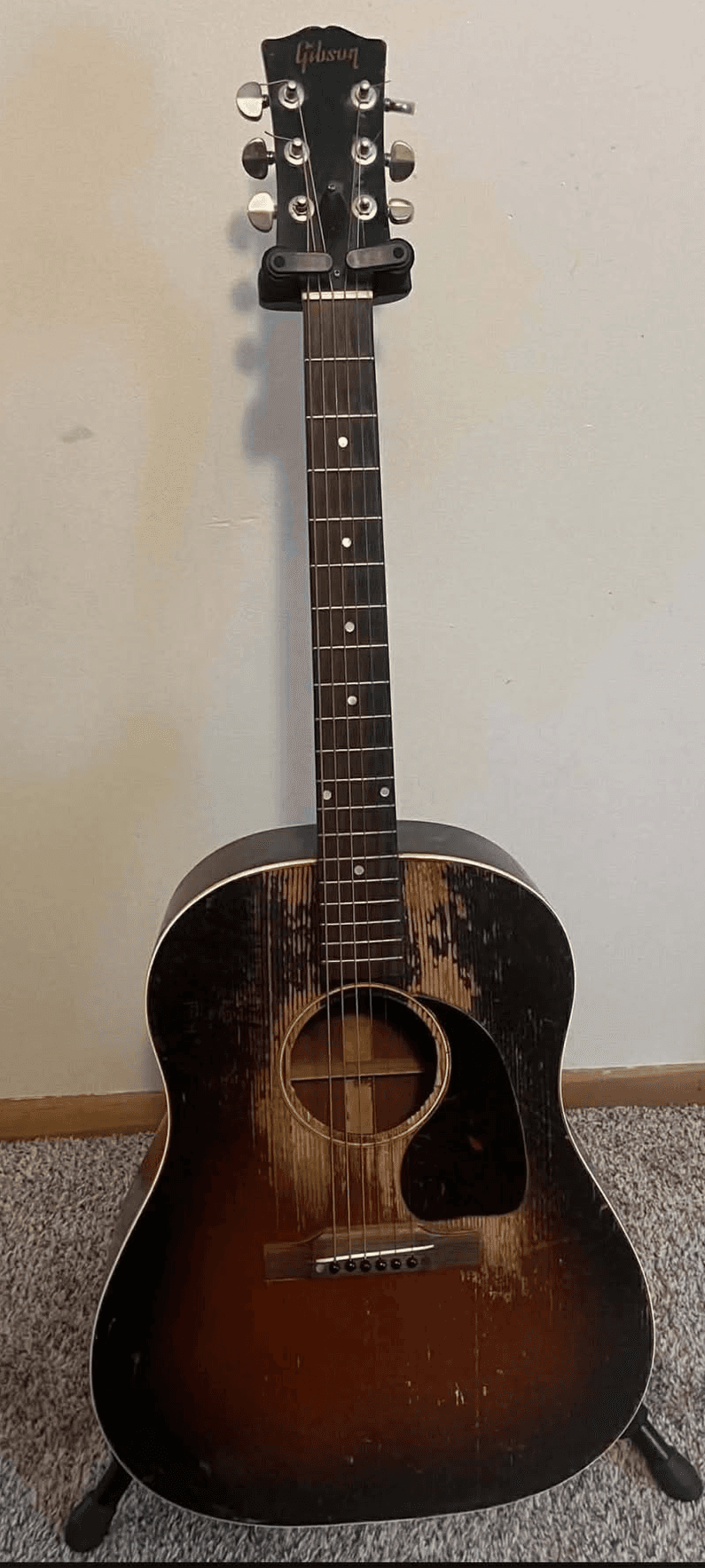
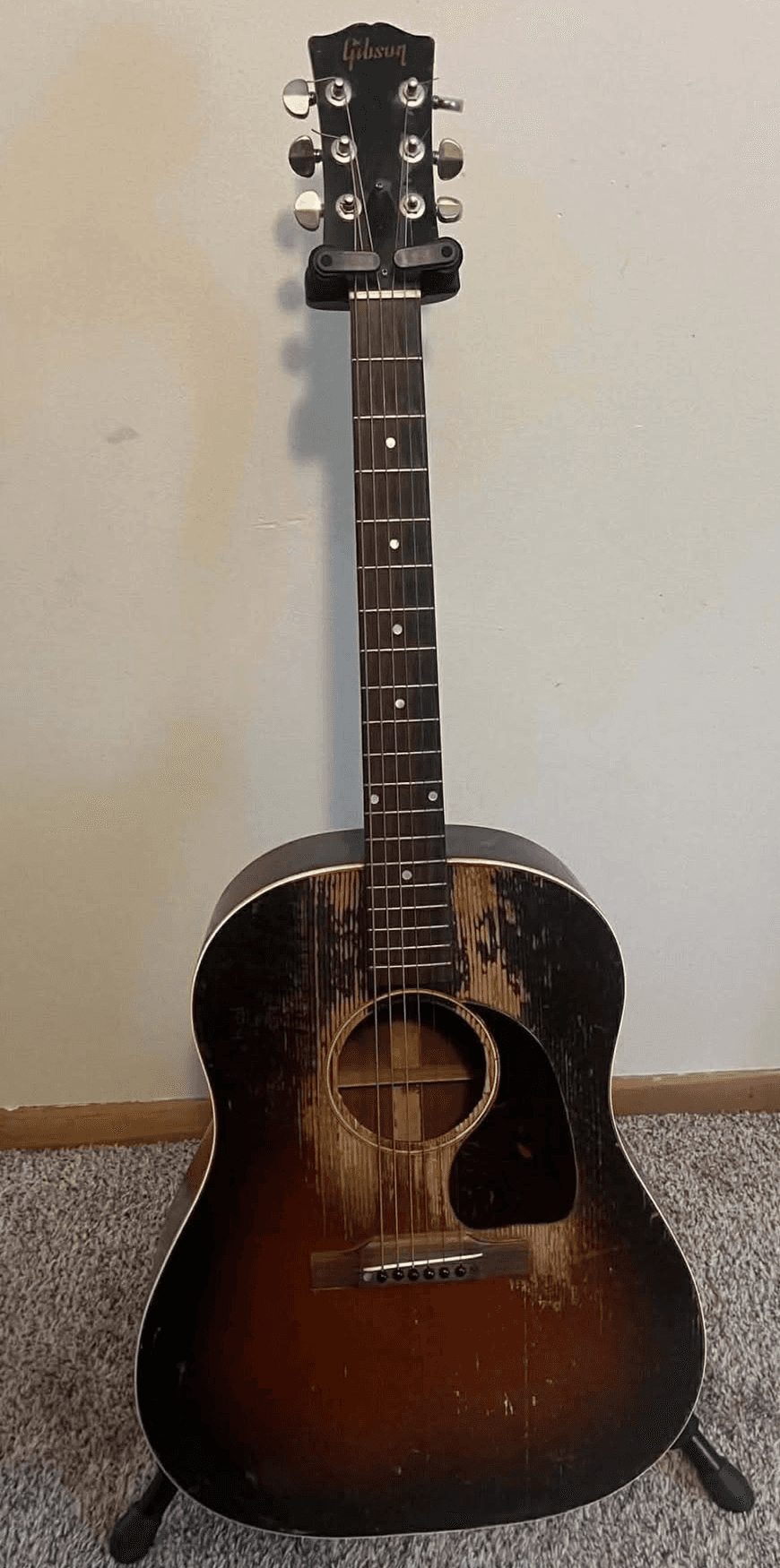
Gibson acoustic guitars are nearly as common as Martins in West Virginia estate sales, and they reflect the state’s folk, country, and gospel traditions equally well. The J-45 — Gibson’s round-shouldered dreadnought workhorse — is the single most commonly encountered vintage Gibson acoustic in West Virginia, purchased by generations of country and gospel players who needed a reliable, resonant instrument within reach of a working person’s budget.
LG-series Gibsons — the LG-1 and LG-2 — are disproportionately common in West Virginia compared to other states in Edgewater’s service area. These small-body, ladder-braced instruments were sold through department stores and mail-order catalogs in the 1950s and 1960s, making them accessible to rural communities and small towns throughout Appalachia. They are frequently found in West Virginia attics and closets — and while they occupy a lower value tier than the carved-top Martins and bigger-body Gibsons, all-original examples in good condition have active collector demand.
Dobro and Resonator Guitars — A West Virginia Specialty
No other state in Edgewater’s service area produces Dobro and resonator guitars at the rate West Virginia does. The resonator guitar is central to the Appalachian musical tradition — essential to bluegrass, significant in old-time music, and deeply embedded in the culture of communities that produced musicians like Josh Graves, who helped define the Dobro’s role in bluegrass music.
Pre-WWII National and Dobro resonators from the 1930s are among the most collectible American fretted instruments, and they appear in West Virginia estate sales with meaningful frequency. If you have what appears to be an old resonator guitar — a metal-body or wood-body guitar with a circular metal resonator cone in the top rather than a conventional soundhole — contact Edgewater immediately before selling it anywhere. These instruments are frequently undervalued by non-specialist buyers.
Gibson banjos and mandolins also appear at above-average rates in West Virginia estate sales. A pre-1940 Gibson F-5 mandolin or a pre-war Gibson Granada banjo is among the most valuable American folk instruments in existence. Edgewater purchases banjos and mandolins as well as guitars, and we price them accurately for the Appalachian instrument collector market.
Electric Guitars in West Virginia — The Rock and Country Crossover
West Virginia’s electric guitar market reflects the state’s dual heritage: the Appalachian acoustic tradition that shaped the state’s identity, and the working-class rock and country culture of its industrial cities that drove electric guitar purchasing from the 1950s onward.
Gibsons are the dominant electric brand in West Virginia estate sales by a meaningful margin. The state’s country and rock traditions both favored Gibson — Les Pauls, SGs, and ES-335s in the rock and blues end; ES-335s, ES-175s, and acoustic-electric models in the country and jazz end. Fenders — particularly Telecasters in the country tradition and Stratocasters in the rock tradition — are the second most common electric brand, with strong representation across all regions of the state.
How to Get the Most Money for Your Guitar in West Virginia: 6 Rules
Rule 1 — Do not clean, polish, or modify anything before an appraisal. Original patina, hardware oxidation, and surface aging are authentication evidence. This rule applies equally to acoustic Martins and electric Gibsons — Edgewater pays more for an untouched original than for a cleaned guitar where the surface evidence has been disturbed.
Rule 2 — Find the original case. The original case for your guitar — whether a Martin chipboard case, a Gibson brown/orange hardshell, or a Fender tweed or black case — confirms provenance and adds meaningful value. For Appalachian acoustic instruments, the case also often contains documentation, receipts, or handwritten notes about the instrument that provide valuable provenance information.
Rule 3 — Do not replace any parts. Every original component, even a worn or non-functioning one, contributes to originality. Do not replace a broken tuner, a worn nut, or a cracked pickguard before getting a specialist appraisal. Non-original parts reduce value even when they are higher quality than what they replace.
Rule 4 — Know what you have before accepting any offer. The gap between an informed and uninformed seller is widest in West Virginia, where local guitar shops are fewer in number and generally less specialized than in major metropolitan markets. A pre-war Martin D-28 and a 1970s D-28 look broadly similar to a non-specialist; a 1961 SG/Les Paul transitional model and a 1968 SG Standard look similar to anyone not trained to see the difference. Edgewater’s free appraisal ensures you understand what you have before you make any decision.
Rule 5 — Do not assume that a guitar is common just because it looks plain. West Virginia’s most valuable estate guitars are often the plainest-looking instruments in the room — a beat-up J-45 in the corner, a simple Martin D-18 in a chipboard case, a basic Telecaster with heavy play wear. Collector value is driven by authenticity and originality, not cosmetic condition. The worn instruments are frequently worth more than the clean-looking ones.
Rule 6 — Get a specialist offer before any guitar shop or pawn shop offer. West Virginia has fewer specialist guitar buyers than more densely populated states, which means the gap between Edgewater’s offer and the best locally available offer is often larger here than in any other state in our service area. This gap favors sellers who know to contact Edgewater — and costs sellers significantly when they don’t.
Why Edgewater Pays More Than West Virginia Guitar Shops
The gap between Edgewater’s offers and local West Virginia guitar shop or pawn shop offers is structural, consistent, and often larger in West Virginia than in any other state we serve.
The basic mechanism is the same as in every other market: a local shop must buy your guitar at 40–60% of their expected retail price to cover their overhead and maintain margin. Edgewater buys directly from owners and places instruments with the collector market, offering prices based on actual collector value rather than a retailer’s required margin.
But in West Virginia, a second factor amplifies this gap: the relative scarcity of specialized guitar buyers in the state means that even the best local shops have less context for accurately pricing rare vintage instruments. A shop that encounters one pre-CBS Stratocaster a year cannot price it with the accuracy of a buyer who encounters dozens per year. A shop that has never handled a pre-war Martin D-28 cannot offer what it is actually worth.
Edgewater’s 30–40% premium over local shop offers is a floor, not a ceiling. On rare Appalachian instruments — pre-war Martins, early Dobros, Gibson F-5 mandolins — the gap between Edgewater’s offer and the best locally available offer can be substantially larger because these are instruments that require specialist knowledge to value accurately, and that knowledge is less evenly distributed in rural markets.
Frequently Asked Questions: Selling a Guitar in West Virginia
Q: What is the best place to sell a guitar in West Virginia?
A: For most West Virginia guitar owners — particularly those with vintage, pre-1975, or Appalachian heritage instruments — the best combination of price and convenience is a specialist direct buyer like Edgewater Guitars. We pay 30–40% more than local guitar shops, provide free authentication, pay immediately in cash, and travel to you anywhere in West Virginia. The specialist knowledge gap in West Virginia makes this advantage even larger than in more densely populated states.
Q: How do I find out what my guitar is worth in West Virginia?
A: Contact Edgewater Guitars at (440) 219-3607 for a free, no-obligation appraisal. We can typically provide a preliminary value range based on photos and description before any in-person visit. For self-research, completed Reverb.com sales for your specific make, model, and year provide real market data — but accurately identifying what you have is the essential first step, which is not always straightforward with vintage instruments.
Q: Does Edgewater Guitars travel to West Virginia for guitar appraisals?
A: Yes. We travel throughout West Virginia — Charleston, Huntington, Morgantown, Parkersburg, Wheeling, Beckley, Clarksburg, Fairmont, Martinsburg, Bluefield, and all surrounding areas — for free, no-obligation in-home appraisals. Call (440) 219-3607 to discuss your instrument and schedule a visit.
Q: What is a Martin acoustic guitar worth in West Virginia?
A: Martin acoustic values depend heavily on year and the specific wood used for back and sides. Pre-1970 Martins made with Brazilian rosewood (D-28, D-35, 000-28, OM-28) are categorically more valuable than post-1970 examples with Indian rosewood. Pre-war Martins (pre-1942) are among the most valuable acoustic guitars in existence. An all-original pre-1970 D-18 or D-28 in good condition is worth a specialist appraisal before accepting any offer. Call Edgewater at (440) 219-3607 for a free assessment.
Q: What is a Gibson Les Paul worth in West Virginia?
A: Gibson Les Paul values span an enormous range based on year, model, and originality. 1958–1960 “Burst” Standards are among the most valuable production guitars ever made. Late-1960s reissues and early-1970s examples have a strong and growing market. All-original condition adds significant value in every era. Contact Edgewater for a free assessment specific to your guitar.
Q: I inherited a guitar in West Virginia — how do I know if it is valuable?
A: If the guitar is American-made by Gibson, Fender, Martin, Gretsch, or Rickenbacker and predates 1975, it is worth a specialist appraisal before selling it anywhere. Edgewater provides free appraisals specifically for inherited instruments — we encounter this situation regularly in West Virginia and understand that heirs often have no frame of reference for value. Call (440) 219-3607 and we will walk you through the process at no cost and with no obligation.
Q: Does Edgewater buy banjos and mandolins in West Virginia?
A: Yes. Edgewater purchases pre-1960 Gibson banjos, Gibson F-5 and A-series mandolins, Vega banjos, and other quality Appalachian fretted instruments. West Virginia’s bluegrass heritage means these instruments appear in estate sales here more frequently than in any other state we serve. Contact us at (440) 219-3607 for a free appraisal on any vintage banjo or mandolin.
Q: What is a Dobro or resonator guitar worth in West Virginia?
A: Pre-WWII National and Dobro resonator guitars are among the most collectible American fretted instruments. Values depend on model, materials (metal body vs. wood body), and condition. These instruments are frequently undervalued by non-specialist buyers. Contact Edgewater immediately if you have what appears to be a vintage resonator guitar — before accepting any offer from any buyer.
Q: How long does it take to sell a guitar to Edgewater in West Virginia?
A: Most West Virginia transactions complete within one to three days — same-day response, in-person visit within 24–48 hours for most West Virginia locations, and immediate cash payment upon our evaluation. No consignment period, no waiting, no obligation to accept our offer.
Q: What is the most valuable guitar I might find in a West Virginia estate?
A: A pre-war Martin D-45 or D-28 herringbone, a 1958–1960 Gibson Les Paul Standard “Burst,” a pre-WWII National resonator guitar, a Gibson F-5 mandolin from the 1920s, or a 1958–1962 Gibson ES-335 dot-neck would represent the highest-value categories. If you believe you have any of these instruments, contact Edgewater before showing them to anyone else.
Recently Purchased: West Virginia Guitar Case Studies
Charleston — 1964 Martin D-28 A family in Kanawha County contacted Edgewater after discovering a 1964 Martin D-28 in its original chipboard case in a late family member’s home. The guitar was all-original with Brazilian rosewood back and sides, Sitka spruce top, and the original Grover tuners — a pre-1970 Brazilian rosewood example in excellent condition. The family had received one prior offer from a local Charleston music shop. Edgewater’s offer exceeded that figure by 44%. Cash paid at the time of in-home evaluation.
Morgantown — 1967 Gibson J-45 A retired WVU faculty member contacted Edgewater about a 1967 Gibson J-45 she had purchased during her years teaching. The guitar was all-original in sunburst finish with the original hardshell case, showing light play wear consistent with careful use. Edgewater traveled to Morgantown and completed the purchase during a single visit at a price meaningfully above the seller’s expectation based on her own online research.
Wheeling — 1963 Fender Telecaster A Wheeling-area seller contacted Edgewater after inheriting a 1963 Fender Telecaster from his father, a country musician who had played the Jamboree circuit throughout the 1960s. The guitar was all-original in butterscotch blonde with the original case and a set of strings the original owner had put on it years ago. Edgewater traveled to Wheeling, authenticated the instrument on-site, and completed the purchase the same day.
Beckley — 1940s National Resonator A Raleigh County seller reached out after finding a 1940s National resonator guitar in a family member’s closet — a square-neck model in original condition with original case. The seller had no frame of reference for its value. Edgewater traveled to Beckley, identified the specific model and approximate date, and made an offer that significantly exceeded anything available locally — reflecting the specialized collector market for pre-war resonator instruments that no West Virginia general music shop was positioned to accurately price.
Related Resources
Contact Edgewater Guitars: West Virginia’s Premier Vintage Guitar Buyer
Edgewater Guitars purchases vintage and quality used guitars, banjos, and mandolins throughout West Virginia — Charleston, Huntington, Morgantown, Parkersburg, Wheeling, Weirton, Beckley, Clarksburg, Fairmont, Martinsburg, Bluefield, and everywhere in between. We are one of the Appalachian region’s most active direct buyers of pre-1975 American-made instruments, and we consistently offer 30–40% more than local guitar shops — with the specialist knowledge of Appalachian instruments that makes the gap even larger on the unique instruments this state produces.
Free appraisal. Immediate cash. We travel to you.
Phone: (440) 219-3607 Web: edgewaterguitars.com Service Area: West Virginia statewide, plus Ohio, Michigan, Indiana, and Pennsylvania
If you own a guitar, banjo, or mandolin in West Virginia — inherited, purchased decades ago, or simply no longer played — call us before selling anywhere else. The appraisal is always free and there is never any obligation.