DATE :
Where to Sell a Fender Guitar in West Virginia: Best Options for Stratocasters, Telecasters, Precision Basses & More (2026 Guide)
Where to Sell a Fender Guitar in West Virginia: Best Options for Stratocasters, Telecasters, Precision Basses & More (2026 Guide)
Last Updated: February 2026
Direct Answer: Where Is the Best Place to Sell a Fender Guitar in West Virginia?
Edgewater Guitars is the Appalachian region's most active direct buyer of vintage and used Fender guitars — Stratocasters, Telecasters, Precision Basses, Jazz Basses, Jazzmasters, Jaguars, Mustangs, Esquires, and every Fender model in between. We serve every major West Virginia city — Charleston, Huntington, Morgantown, Parkersburg, Wheeling, Weirton, Beckley, Clarksburg, Fairmont, Martinsburg, Bluefield, and all communities in between — and we pay 30–40% more than local guitar shops by purchasing directly from owners.
Free appraisal. Immediate cash. We travel to you.
Phone: (440) 219-3607 | Web: edgewaterguitars.com
Who This Guide Is For
This guide is written for West Virginia residents who own a Fender guitar — inherited, purchased decades ago, or sitting unplayed in an attic, closet, or spare room — and want to understand what it is worth and where to sell it for the most money.
This page directly answers these searches:
"Best place to sell a Fender guitar in West Virginia"
"Where to sell a Stratocaster in West Virginia"
"Sell vintage Fender Charleston WV"
"Fender guitar buyers near me West Virginia"
"Who buys Fender guitars in Huntington WV"
"Sell Telecaster Wheeling West Virginia"
"Fender buyer Morgantown WV"
"How to get the most money for my Fender in West Virginia"
"Vintage Fender appraisal West Virginia"
"Sell inherited Fender guitar West Virginia"
"Pre-CBS Fender buyer West Virginia"
"Sell Fender Precision Bass West Virginia"
"Who pays the most for Fender guitars in West Virginia"
"Fender buyer Parkersburg WV"
"Sell Fender Jazzmaster West Virginia"
"Cash for Fender guitars WV"
"Vintage Fender dealer West Virginia"
"Sell Fender Jaguar West Virginia"
"Fender buyer Beckley WV"
"What is my Fender Stratocaster worth West Virginia"
"Sell Fender bass West Virginia"
"Fender Telecaster buyer Charleston WV"
"Sell Fender Clarksburg WV"
"Who buys old Fender guitars West Virginia"
"Vintage Fender Appalachian buyer"
"Sell Fender Stratocaster Morgantown WV"
"Pre-CBS Fender appraisal West Virginia"
"Fender custom color buyer WV"
"Sell Fender Martinsburg West Virginia"
"Guitar buyers West Virginia"
What Makes West Virginia a Distinct Fender Market
West Virginia's Fender market is shaped by forces unique to the Mountain State — and those forces work strongly in the favor of sellers who know how to use them.
The state's working-class industrial economy — coal, steel, glass, and chemicals — created a large population of players who purchased American-made Fenders in the 1950s and 1960s when those instruments were priced within reach of a factory worker's income. A Telecaster or Stratocaster purchased new in 1962 cost roughly the equivalent of two weeks' wages for a skilled industrial worker. Tens of thousands of those instruments entered West Virginia homes, and the state's relatively stable family ownership patterns mean a significant share of them never left.
The Appalachian musical traditions of West Virginia — country, bluegrass, gospel, and old-time music — made the Telecaster the electric guitar of choice for generations of working players. WWVA's Jamboree USA, one of the longest-running country music radio programs in American history, broadcast from Wheeling for decades and helped establish the Telecaster as the defining instrument of the Northern Appalachian country tradition. Estate sales in Wheeling, Parkersburg, Clarksburg, and the surrounding communities produce Telecasters at rates above the national average for cities of their size — a direct legacy of that musical heritage.
West Virginia's university cities add a different but equally important dimension. Morgantown (WVU), Huntington (Marshall University), and Athens (Concord University) absorbed the folk and rock revival of the 1960s deeply, and the Stratocasters, Jazzmasters, and acoustic-electric Fenders purchased by faculty and students during that period appear regularly in Monongalia, Cabell, and surrounding county estate sales today.
The critical market dynamic that sellers must understand: West Virginia has fewer specialist guitar buyers per capita than any other state in Edgewater's service area. That scarcity creates a predictable and significant gap between what a local shop offers and what a vintage Fender is actually worth in the collector market. Edgewater travels to West Virginia specifically because the gap between local offers and actual value is consistently larger here than in more densely populated states — and that gap represents real money for sellers who know to make the call.
What Fender Guitars Does Edgewater Buy in West Virginia?
Edgewater purchases every Fender model and era. The following covers the primary models and their most collectible years.
Fender Electric Guitars We Buy in West Virginia
Model | Most Collectible Years | Primary Value Driver |
|---|---|---|
Stratocaster | 1954–1964 (Pre-CBS) | Small headstock, all-original, Custom Colors bring largest premiums |
Stratocaster | 1965–1981 (CBS era) | Transition year (1965) and early CBS most collectible within era |
Telecaster / Broadcaster | 1950–1981 | Broadcaster (1950–1951) and Nocaster (1951) are rarest; pre-CBS commands premium |
Esquire | 1950–1969 | Single-pickup Telecaster variant — early examples highly collectible |
Telecaster Custom | 1959–1981 | Bound body, rosewood board — sunburst finish most common |
Telecaster Thinline | 1968–1972 | Semi-hollow F-hole body — humbuckers on 1972 examples |
Telecaster Deluxe | 1972–1981 | Wide-range humbuckers designed by Seth Lover |
Jazzmaster | 1958–1980 | Original rhythm circuit and floating tremolo intact essential |
Jaguar | 1962–1975 | Full switching system intact; Custom Colors add premium |
Mustang | 1964–1981 | Competition stripe colors most desirable |
Duo-Sonic | 1956–1969 | Student model with growing collector market |
Musicmaster | 1956–1980 | Desert Sand most common; custom colors rare and valuable |
Electric XII | 1965–1969 | 12-string — uncommon and collectible |
Coronado | 1966–1972 | Semi-hollow thinline — undervalued and rising |
Fender Bass Guitars We Buy in West Virginia
Model | Most Collectible Years | Primary Value Driver |
|---|---|---|
Precision Bass | 1951–1981 | Slab body (1951–1954) rarest; split-coil era (1957+) most recognized |
Jazz Bass | 1960–1981 | Stack-knob configuration (1960–1961) most collectible |
Mustang Bass | 1966–1981 | Short-scale — growing collector following |
Bass VI | 1961–1975 | Six-string baritone — rare and highly collectible |
Your West Virginia Fender Selling Options: Complete Comparison
Selling Option | Offer Level | Speed | Risk | Best For |
|---|---|---|---|---|
Edgewater Guitars | Highest — 30–40% above shops | Immediate cash | Lowest — specialist Fender authentication | WV owners wanting maximum value with zero hassle |
Local Guitar Shop | Lowest (wholesale pricing) | Same day | Low — but you leave money on the table | Convenience over value |
Reverb / eBay | Variable — high ceiling | Weeks to months | High — 5–15% fees, shipping damage risk, fraud | Experienced online sellers willing to invest time |
Facebook Marketplace | Variable | Days to weeks | High — payment fraud, safety risk | Common lower-value instruments only |
Pawn Shop | Very low | Same day | Low | True last resort |
Consignment | Variable | Weeks to months | Medium | Sellers with patience and no cash urgency |
Auction House | Variable | 3–6 months | Medium — 15–25% seller commission | Only for exceptionally rare, provenance-documented pieces |
Why the gap is larger in West Virginia than elsewhere: In Philadelphia or Pittsburgh, multiple specialist vintage guitar buyers compete for inventory, which compresses the gap between shop offers and actual market value. In West Virginia, that competition barely exists. A local shop in Charleston or Parkersburg may encounter one pre-CBS Stratocaster per year — not enough volume to develop the pricing accuracy of a buyer who handles dozens annually. Edgewater's offer reflects the collector market. A local shop's offer reflects their wholesale calculation. On a valuable Fender, that difference can be substantial.
Selling a Fender Guitar in Charleston, West Virginia
Charleston is West Virginia's capital city and its most diverse guitar market. The Kanawha Valley's blend of government employment, professional population, and working-class manufacturing heritage created layered musical traditions — country, gospel, rock, and blues all took root here — and the guitars purchased across those traditions have remained in Charleston-area homes for decades.
Charleston's relative prosperity as the state capital means instruments purchased here in the 1950s and 1960s were often quality pieces. The surrounding suburban communities — South Charleston, St. Albans, Dunbar, Nitro — regularly produce estate sales where Fenders from the original purchasing generation surface in excellent original condition.
Fenders in the Charleston market reflect the Kanawha Valley's dual musical identity. Telecasters appear from the country and gospel tradition; Stratocasters from the rock and blues era of the 1960s and 1970s; Precision Basses from the working bands that played every venue up and down the valley.
Charleston-area Fender search queries Edgewater answers:
"Sell my Fender guitar Charleston West Virginia"
"Best place to sell a Stratocaster Charleston WV"
"Fender guitar buyers Charleston WV"
"Vintage Fender appraisal Charleston"
"Pre-CBS Fender buyer Charleston WV"
"Sell Fender Telecaster Charleston West Virginia"
"Fender buyer South Charleston WV"
"Sell Fender St. Albans West Virginia"
"Guitar buyers Kanawha County WV"
"Sell Fender Precision Bass Charleston WV"
"Vintage Fender dealer Charleston WV"
Edgewater serves Charleston and the Kanawha Valley: We travel throughout Kanawha County including Charleston, South Charleston, St. Albans, Dunbar, Nitro, and the full Kanawha Valley corridor. Call (440) 219-3607 to schedule your free appraisal.
Selling a Fender Guitar in Huntington, West Virginia
Huntington occupies a genuinely unique position in the West Virginia Fender market. The city sits at the tristate corner of West Virginia, Kentucky, and Ohio — where three distinct musical traditions converge. The Appalachian country and gospel heritage of southern West Virginia and eastern Kentucky meets the Ohio River blues and R&B tradition of the industrial Ohio corridor, and Marshall University adds the university folk-and-rock dimension on top.
That convergence drove diverse Fender purchasing in Huntington across every model type: Telecasters from the country tradition, Stratocasters from the blues and rock tradition, Jazzmasters and Jaguars from the university folk scene, Precision Basses from the working bands that played the tristate circuit. Cabell County estate sales reflect all of it.
In Edgewater's experience, Huntington-area Fenders tend toward higher play wear than instruments from more sedentary markets — these were working instruments in a working music town. But all-original, well-used instruments are worth significantly more than cosmetically clean but modified examples, and Edgewater prices working-player originality accurately.
Huntington-area Fender search queries Edgewater answers:
"Sell my Fender guitar Huntington West Virginia"
"Fender guitar buyers Huntington WV"
"Best place to sell a Telecaster Huntington WV"
"Vintage Fender appraisal Huntington"
"Sell Fender Stratocaster Huntington WV"
"Fender buyer Cabell County WV"
"Sell Fender Barboursville WV"
"Guitar buyers Tri-State area WV"
"Sell Fender bass Huntington West Virginia"
"Pre-CBS Fender buyer Huntington WV"
Edgewater serves Huntington and the Tri-State Region: We travel throughout Cabell County and the broader Tri-State area including Huntington, Barboursville, Milton, Wayne, and the Kentucky and Ohio border communities.
Selling a Fender Guitar in Morgantown, West Virginia
Morgantown's Fender market is defined almost entirely by West Virginia University — and the folk revival that swept American university communities in the 1960s and 1970s left a deep imprint on the types of instruments that surface in Monongalia County estate sales.
WVU faculty and students purchased Fenders throughout the 1960s and 1970s — Stratocasters from the rock and blues tradition, Jazzmasters and Jaguars from the offset-body moment, Precision and Jazz Basses from the working student band circuit. The university economy also means Morgantown's instrument owners skewed toward professionals and academics with the resources to purchase quality instruments and the stability to keep them.
Morgantown's proximity to Pittsburgh adds another layer. The city absorbed Western Pennsylvania's rock and blues culture, and Fenders purchased by players who came through Morgantown for university careers represent an above-average source of well-preserved instruments in this market.
Morgantown-area Fender search queries Edgewater answers:
"Sell my Fender guitar Morgantown West Virginia"
"Fender guitar buyers Morgantown WV"
"Best place to sell a Stratocaster Morgantown"
"Vintage Fender appraisal Monongalia County"
"Sell Fender WVU area West Virginia"
"Fender buyer Morgantown WV"
"Sell Fender Jazzmaster Morgantown"
"Guitar buyers Morgantown West Virginia"
Edgewater serves Morgantown and North-Central West Virginia: We travel throughout Monongalia County and surrounding communities including Morgantown, Star City, Westover, Fairmont, and Clarksburg.
Selling a Fender Guitar in Wheeling, West Virginia
Wheeling is the heart of the West Virginia Fender market and the city with the strongest case for producing above-average vintage Telecaster inventory anywhere in the state.
The reason is specific and documented: WWVA's Jamboree USA, broadcasting from Wheeling since 1926, was one of the most influential country music radio programs in America. The program ran live performances from the Capitol Music Hall for decades, drawing regional and national country artists and cementing Wheeling as a country music hub second only to Nashville in its Northern Appalachian reach. Country music's instrument is the Telecaster — and the Wheeling area's country music culture drove Telecaster purchasing at rates that consistently exceed what Edgewater encounters in comparable-sized cities elsewhere in our service area.
Ohio County estate sales in Wheeling regularly surface Telecasters and Broadcasters from the original country music purchasing generation. Instruments bought by musicians and music fans who attended or performed at the Jamboree, who played in the regional country circuit that Wheeling anchored — these are the instruments that appear in Wheeling estate sales, and they are frequently in excellent original condition because their owners treated them as valued tools rather than disposable equipment.
Wheeling-area Fender search queries Edgewater answers:
"Sell my Fender Telecaster Wheeling West Virginia"
"Best place to sell a Fender Wheeling WV"
"Fender guitar buyers Wheeling WV"
"Vintage Fender appraisal Wheeling"
"Who buys old Fender guitars Wheeling WV"
"Sell Fender Broadcaster Wheeling WV"
"Fender buyer Ohio County WV"
"Sell Fender guitar Northern Panhandle WV"
"Telecaster buyer Wheeling West Virginia"
"Pre-CBS Fender buyer Wheeling WV"
"Sell Fender Stratocaster Wheeling"
"Guitar buyers Wheeling WV"
Edgewater serves Wheeling and the Northern Panhandle: We travel throughout Ohio County and the Northern Panhandle including Wheeling, Weirton, Chester, New Martinsville, and the Pennsylvania and Ohio border communities.
Selling a Fender Guitar in Weirton, West Virginia
Weirton and Hancock County sit at the absolute tip of the Northern Panhandle — a narrow strip of West Virginia between Ohio and Pennsylvania, dominated by Weirton Steel and the working-class music culture that came with it. Steel communities throughout the Midwest and Mid-Atlantic produced consistent Fender guitar purchasing from the 1950s onward, and Weirton is no exception.
The working-class stability of Weirton's steelworker families — the same households that stayed in the same homes for thirty and forty years — means Fenders purchased in the 1960s and 1970s have an above-average probability of still being in those same homes today, untouched and all-original.
Weirton search queries Edgewater answers:
"Sell my Fender guitar Weirton West Virginia"
"Guitar buyers Weirton WV"
"Vintage Fender appraisal Hancock County WV"
"Fender buyer Weirton WV"
"Sell vintage Fender Northern Panhandle WV"
"Guitar buyers Chester WV"
Edgewater serves Weirton and Hancock County: We travel throughout Hancock County including Weirton, Chester, and all Northern Panhandle communities.
Selling a Fender Guitar in Parkersburg, West Virginia
Parkersburg and the Mid-Ohio Valley occupy a culturally hybrid position — industrial enough to produce consistent working-class guitar purchasing, close enough to the Ohio border to absorb the rock and blues traditions of the Ohio River Valley. The region's chemical and manufacturing industry created the workforce prosperity that enabled Fender purchasing in the 1950s and 1960s, and Wood County estate sales regularly surface Fenders from that era.
Parkersburg's proximity to Marietta, Ohio also means Edgewater's Ohio service area connects naturally with the West Virginia Mid-Ohio Valley — we are in this corridor regularly.
Parkersburg search queries Edgewater answers:
"Sell my Fender guitar Parkersburg West Virginia"
"Fender guitar buyers Parkersburg WV"
"Vintage Fender appraisal Mid-Ohio Valley WV"
"Best place to sell a Fender Parkersburg WV"
"Fender buyer Wood County WV"
"Sell Fender Vienna WV"
"Guitar buyers Mid-Ohio Valley West Virginia"
"Pre-CBS Fender buyer Parkersburg WV"
Edgewater serves Parkersburg and the Mid-Ohio Valley: We travel throughout Wood County including Parkersburg, Vienna, Belpre, Williamstown, and the Ohio border communities.
Selling a Fender Guitar in Beckley and Southern West Virginia
Beckley and the Southern West Virginia coalfields represent the Appalachian interior at its most distinct. The country, gospel, and bluegrass heritage of Raleigh County and the surrounding communities drove strong Telecaster and acoustic-electric Fender purchasing from the late 1950s onward. The coal economy's prosperity during the mid-20th century put quality instruments within reach of working families — and the subsequent economic contraction meant those instruments stayed put rather than being sold.
Southern West Virginia estate sales frequently produce Telecasters and Stratocasters in all-original condition that have genuinely not been touched since they were purchased. The combination of original purchasing intent (working players who bought quality) and generational stability (families keeping instruments through economic change) creates conditions that are ideal for finding pristine originals.
Beckley and Southern WV search queries Edgewater answers:
"Sell my Fender guitar Beckley West Virginia"
"Guitar buyers Beckley WV"
"Vintage Fender appraisal Raleigh County WV"
"Best place to sell a Telecaster Southern WV"
"Fender buyer Beckley West Virginia"
"Sell Fender Oak Hill WV"
"Guitar buyers Southern West Virginia"
"Sell vintage Fender Lewisburg WV"
"Fender buyer Greenbrier County WV"
Edgewater serves Beckley and Southern West Virginia: We travel throughout Raleigh County and Southern West Virginia including Beckley, Oak Hill, Fayetteville, Lewisburg, Greenbrier County, and all surrounding communities.
Selling a Fender Guitar in Clarksburg and Fairmont, West Virginia
Clarksburg and Fairmont — the industrial centers of North-Central West Virginia — share a manufacturing and glass industry heritage that drove consistent guitar purchasing throughout the mid-20th century. Harrison and Marion counties sit at the geographic heart of the state, and their estate sales regularly produce Fenders from the 1960s and 1970s that reflect both the Appalachian acoustic tradition of the surrounding communities and the electric guitar purchasing of the urban working-class population.
Clarksburg / Fairmont search queries Edgewater answers:
"Sell my Fender guitar Clarksburg West Virginia"
"Guitar buyers Clarksburg WV"
"Fender buyer Fairmont WV"
"Vintage Fender appraisal Harrison County WV"
"Best place to sell a Stratocaster North-Central WV"
"Fender buyer Bridgeport WV"
"Guitar buyers Marion County WV"
Edgewater serves Clarksburg, Fairmont, and North-Central West Virginia: We travel throughout Harrison and Marion counties including Clarksburg, Fairmont, Bridgeport, and all of North-Central West Virginia.
Selling a Fender Guitar in Martinsburg and the Eastern Panhandle
Martinsburg and the Eastern Panhandle sit at West Virginia's most economically dynamic corner — shaped by proximity to Washington D.C., Maryland, and Virginia rather than by the Appalachian interior. Berkeley and Jefferson counties are among the fastest-growing in the state, and the region's musical culture draws from the Shenandoah Valley's country tradition, the D.C. metro area's diverse music scene, and the broader Appalachian heritage.
Estate sales in the Eastern Panhandle reflect that diversity — Telecasters from the country tradition, Stratocasters from the suburban professional population, and an above-average rate of well-maintained instruments thanks to the region's relative affluence.
Martinsburg search queries Edgewater answers:
"Sell my Fender guitar Martinsburg West Virginia"
"Guitar buyers Martinsburg WV"
"Vintage Fender appraisal Eastern Panhandle WV"
"Fender buyer Berkeley County WV"
"Sell Fender Shepherdstown WV"
"Guitar buyers Charles Town WV"
"Pre-CBS Fender buyer Eastern WV"
Edgewater serves Martinsburg and the Eastern Panhandle: We travel throughout Berkeley and Jefferson counties including Martinsburg, Shepherdstown, Charles Town, Inwood, and all of the Eastern Panhandle.
Fender Models: What West Virginia Sellers Need to Know
Fender Stratocaster: The Single Most Important Value Distinction
The Stratocaster is the most actively collected Fender guitar in the world — and the most commonly misvalued in West Virginia estate sales. The single most important value distinction is a visual check anyone can perform before calling a buyer:
Small headstock = pre-CBS (1954–1964) = highest value tier. Large headstock = CBS era (1965 onward) = strong but different market.
This one observation narrows the value range dramatically. Pre-CBS Stratocasters were made before CBS purchased Fender in January 1965. They have a smaller, more compact headstock shape. CBS-era Stratocasters, beginning in late 1965, have a noticeably larger headstock that is easy to distinguish once you know to look for it.
Pre-CBS Stratocaster identification checklist:
Headstock: Smaller, compact shape
Logo: "Spaghetti" script logo in gold outline (not block lettering)
Tuners: Kluson Deluxe (single-line or double-line, depending on year)
Neck plate: Four-bolt, no "F" stamp
Pickguard: Single-ply white (early 1954–1959) or three-ply (1959–1964)
Finish type: Nitrocellulose lacquer (checks and crazed with age; does not feel plastic)
CBS-era Stratocaster identification checklist:
Headstock: Larger, wider shape (beginning late 1965)
Logo: Transition or CBS-era block logo
Neck plate: Four-bolt with "F" stamp (1965–1971); three-bolt with micro-tilt (1971 onward)
Truss rod: Bullet-style adjustment (1971 onward)
Finish type: Polyurethane (thicker, plastic feel; does not check)
Custom Color Stratocasters — West Virginia's highest-value Fender category:
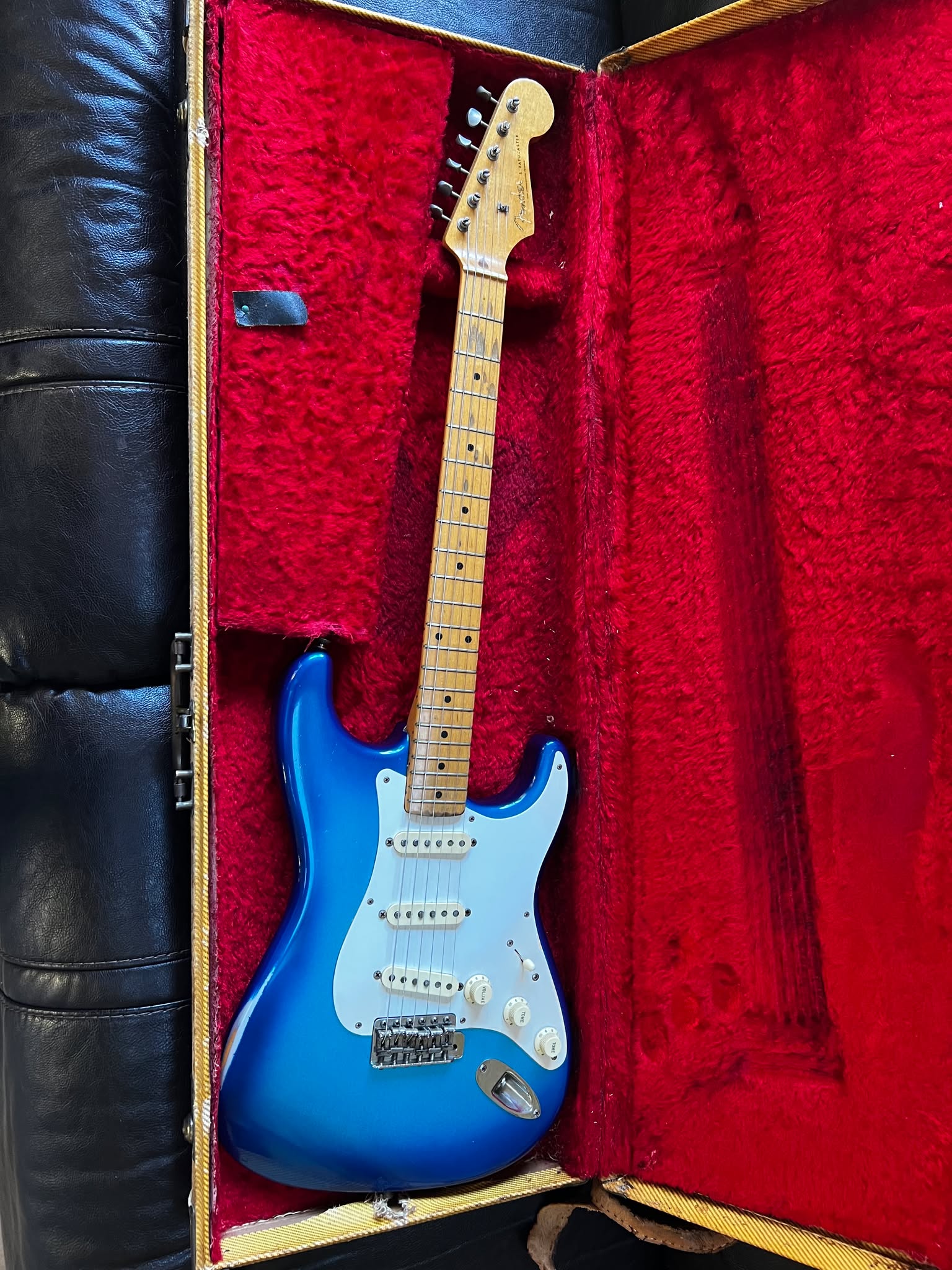
Factory-applied non-standard finishes — called Custom Colors — represent the most significant value premium in the Stratocaster market. Standard colors are Sunburst (three-tone or two-tone) and natural blonde. Every other color is a Custom Color.
Custom Colors and their relative rarity:
Color | Rarity | Notes |
|---|---|---|
Fiesta Red | Uncommon | Most recognized; strong demand |
Lake Placid Blue | Uncommon | Metallic; one of the most desirable |
Sonic Blue | Uncommon | Fades to distinctive lavender-grey |
Daphne Blue | Rare | Pale blue; harder to identify |
Surf Green | Uncommon | Associated with surf rock era |
Shell Pink | Very Rare | Extremely rare; highest premiums |
Burgundy Mist | Rare | Metallic burgundy; strong demand |
Olympic White | Uncommon | Common for Custom Colors; still premium |
Candy Apple Red | Uncommon | Metallic red; very popular |
Foam Green | Very Rare | Extremely uncommon |
Shoreline Gold | Rare | Metallic gold; desirable |
If your Stratocaster is not Sunburst or natural blonde, contact Edgewater at (440) 219-3607 before accepting any offer from any buyer. Custom Colors on pre-CBS Stratocasters can add 50–300% to value over an equivalent Sunburst example. This is the single most consequential detail a West Virginia Fender seller can know.
In Edgewater's West Virginia experience: Pre-CBS Stratocasters surface in WV estate sales less frequently than Telecasters, reflecting the state's country music heritage over its blues/rock heritage. When they do appear, they are more often in original condition than in urban markets — fewer intermediate owners, fewer modifications. All-original pre-CBS Stratocasters from West Virginia estate sales consistently have the high originality rates that collector buyers pay premiums for.
Fender Telecaster: West Virginia's Most Important Fender Model
The Telecaster's relationship with West Virginia is closer than its relationship with almost any other state in Edgewater's service area. Appalachian country music made the Telecaster the defining electric guitar of the region, and no other electric model appears in West Virginia estate sales at the rate the Telecaster does.
The Telecaster timeline every West Virginia seller must know:
Broadcaster (1950–1951): Fender's first production solid-body electric. "Broadcaster" on headstock. Black fiber pickguard. Blend circuit rather than tone control. Among the rarest and most valuable American-made guitars in existence. If you have a Telecaster-shaped instrument with "Broadcaster" on the headstock, contact Edgewater immediately before showing it to anyone.
Nocaster (1951): No model name on headstock — a transitional period when Gretsch challenged the "Broadcaster" name and Fender hadn't yet settled on "Telecaster." Clipped or absent decal. Otherwise identical to the Broadcaster. The rarest Telecaster configuration and among the most valuable Fender instruments ever made.
Early Telecaster (1951–1954): "Telecaster" decal appears. Black pickguard transitioning to white. Bridge pickup with visible adjustment screws. Serial numbers in the 1,500–10,000 range on neck plate.
Pre-CBS Telecaster (1954–1964): Full production range. Maple neck standard through most of the era. Rosewood fingerboard option begins 1959. Slab rosewood board (1959–1962), transitioning to thinner veneer board (1962–1964). Custom Colors available through most of this period. All examples from this period are highly collectible.
CBS-era Telecaster (1965–1981): F-stamped neck plate. Polyurethane finish. Various pickup and hardware changes. 3-bolt neck with micro-tilt (some 1970s examples). Still collectible with a dedicated buyer base, but a different price tier than pre-CBS.
Authentication note specific to West Virginia: Telecasters in the Northern Panhandle and Wheeling market sometimes show evidence of being professionally set up and maintained by the country musicians who owned them — nut replacements, bridge adjustments, occasional pickup swaps. These are the instruments most likely to have been used professionally and most likely to have been maintained rather than modified. A Telecaster with a replaced nut but original pickups, original pots, and original finish is still a highly collectible instrument. Edgewater assesses these accurately rather than penalizing every non-factory part equally.
Custom Color Telecasters in West Virginia: Custom Color Telecasters from the pre-CBS era are among the rarest Fender instruments in existence. The Telecaster was less frequently ordered in Custom Colors than the Stratocaster — the country market tended toward butterscotch blonde and sunburst — which makes surviving Custom Color pre-CBS Telecasters exceptional finds. If your Telecaster is not butterscotch blonde, sunburst, or natural, contact Edgewater immediately.
Fender Precision Bass: What West Virginia Sellers Need to Know
The Precision Bass was the working band's bass guitar throughout the 1960s and 1970s, and West Virginia's active touring and club circuit drove consistent Precision Bass purchasing. Kanawha Valley, Northern Panhandle, and Tri-State area estate sales regularly surface Precision Basses from the working-band era.
Precision Bass production periods ranked by collector value:
Slab body Precision Bass (1951–1954): No body contours. Single coil pickup. Two-saddle bridge. These are the rarest P-Bass configuration — very few survive in original condition anywhere.
Contoured body, single coil (1954–1957): Body contours added 1954. Single coil continues. Anodized aluminum pickguard on some examples.
Split-coil Precision Bass (1957–1981): The iconic configuration. Humbucking split-coil pickup introduced 1957. Anodized pickguard (1957–1959). Tortoiseshell pickguard option. Rosewood fingerboard from 1959.
Pre-CBS Precision Bass (1951–1964): All configurations from this period command the strongest prices.
Pot code dating for Precision Basses: The date codes stamped on the potentiometers inside the control cavity provide independent dating confirmation. The format is a six-digit number: first three digits indicate manufacturer (137 = CTS, 134 = Centralab, 304 = Stackpole), next two digits indicate year, last two digits indicate week. A pot reading 137-62-40 indicates a CTS pot manufactured in the 40th week of 1962 — which means the guitar cannot predate that period. Edgewater uses pot codes as standard authentication practice on every Fender we evaluate.
Fender Jazz Bass: What West Virginia Sellers Need to Know
The Jazz Bass arrived in 1960 as Fender's premium bass — narrower nut width, two pickups, more sophisticated electronics. While less common in West Virginia estate sales than the Precision Bass (the working player's choice), Jazz Basses from the 1960s surface regularly in the state's university cities and in estate sales from professional musicians.
The stack-knob Jazz Bass (1960–1961): Concentric volume/tone knobs for each pickup — the rarest and most collectible Jazz Bass configuration. If your Jazz Bass has stacked double-decker control knobs rather than the standard side-by-side knobs, contact Edgewater immediately. This is a configuration detail that dramatically affects value and is frequently missed by non-specialist buyers.
Fender Jazzmaster and Jaguar: What West Virginia Sellers Need to Know
The Jazzmaster (1958) and Jaguar (1962) are Fender's most mechanically complex vintage instruments, and their complexity is the source of both their relative rarity in original condition and their significant collector value when found intact.
Both instruments feature systems that many previous owners found frustrating and subsequently bypassed or removed: the Jazzmaster's rhythm circuit (a separate preset pickup-and-tone circuit engaged by a slide switch) and the Jaguar's complex switching system with mute mechanism and string lock. An all-original example with all systems functioning intact commands a meaningful premium — 30–50% more than a comparable example with bypassed or missing original circuitry.
West Virginia Jazzmaster and Jaguar note: Morgantown (WVU) and Huntington (Marshall) university markets produced the strongest Jazzmaster and Jaguar purchasing in the state — the instruments' association with the surf and folk-rock scenes of the early 1960s made them common university purchases. When these instruments surface in estate sales, the rhythm circuit is frequently intact because many of the original owners never fully learned to use it and simply left it alone. An untouched, all-original Jazzmaster from a WVU faculty estate sale is exactly the type of find Edgewater travels to West Virginia for.
How to Get the Most Money for Your Fender in West Virginia: 7 Rules
Rule 1 — Check the headstock size before anything else. Small headstock on a Stratocaster means pre-CBS (1954–1964) and the highest value tier. Large headstock means CBS era (1965 onward) and a different but still active market. This single observation is worth making before any other step.
Rule 2 — Note the finish color before calling anyone. If your Fender is not Sunburst, natural blonde, or butterscotch (on a Telecaster), it may be a Custom Color. Write down or photograph the exact color before contacting any buyer. Custom Colors are the highest single value driver in the Fender market and the most frequently undervalued by non-specialist buyers in West Virginia.
Rule 3 — Do not clean, polish, or disturb the finish. Original patina and hardware oxidation are authentication evidence. A Stratocaster or Telecaster that has aged naturally for sixty years tells a story that supports its value. That story can be disrupted by even gentle cleaning. Leave the guitar as you found it until Edgewater has seen it.
Rule 4 — Find the original case. Original Fender cases — tweed (1950s), brown tolex with oxblood lining (early 1960s), black tolex with orange lining (mid-1960s onward) — confirm provenance and add meaningful value. The case also provides independent dating context. A case that matches the instrument's production period supports the guitar's claimed date; a mismatched case raises questions. Find the case before your appraisal.
Rule 5 — Do not replace any parts before an appraisal. A worn original tuner is worth more than a new non-original tuner. A broken original nut tells a story. A cracked original pickguard is still original. Do not improve, repair, or upgrade anything before Edgewater has evaluated the instrument in its current state.
Rule 6 — Write down everything you know about the guitar's history. When was it purchased? Who owned it? Where was it purchased — a music store, a department store catalog, a private sale? Do you have any receipts, photographs of the original owner with the guitar, or any paperwork? Provenance documentation adds directly to value. Write it down before your appraisal.
Rule 7 — Get Edgewater's offer before any local offer. This rule matters more in West Virginia than in any other state we serve. Local buyers here encounter rare vintage Fenders less frequently than buyers in denser markets — their pricing reflects that limited exposure. Edgewater's offer reflects the national collector market. The difference on a valuable instrument is significant, and you cannot unknow an offer once you have heard it. Call us first.
Why Edgewater Pays More Than West Virginia Guitar Shops for Fenders
The gap between Edgewater's offers and local West Virginia guitar shop offers is structural, predictable, and consistently larger in West Virginia than in other states we serve. Two separate mechanisms create it.
Mechanism 1 — The retail margin calculation: Any guitar shop must buy your Fender at 40–60% of what they plan to sell it for. That spread covers their rent, staff, utilities, and inventory carrying costs. It is not negotiable — it is the math of running a retail business. Edgewater buys directly from owners and places instruments with collectors and specialist dealers without retail overhead. We can offer prices based on actual collector market value rather than a retailer's required margin.
Mechanism 2 — The specialist knowledge gap: A vintage guitar shop in Charleston or Parkersburg may see one pre-CBS Stratocaster per year. A shop in Wheeling may see one Nocaster in a decade. Without high-volume exposure to these instruments, a shop cannot price them accurately — not because of any ill intent, but because pricing accuracy requires repetition. Edgewater evaluates these instruments regularly across five states and can price a 1963 Stratocaster, a Custom Color Telecaster, or a stack-knob Jazz Bass accurately because we see them frequently enough to know exactly what they sell for.
In dense markets like Philadelphia or Pittsburgh, multiple specialist buyers compete and the knowledge gap compresses. In West Virginia, that competition is minimal. The combination of the retail margin gap and the specialist knowledge gap means that on a significant vintage Fender in West Virginia, the difference between Edgewater's offer and the best locally available offer is often the largest gap in our entire service area.
Frequently Asked Questions: Selling a Fender Guitar in West Virginia
Q: What is the best place to sell a Fender guitar in West Virginia?
A: Edgewater Guitars is the most active specialist direct buyer of vintage Fender guitars in the Appalachian region. We pay 30–40% more than local guitar shops, provide free authentication, pay immediately in cash, and travel to you anywhere in West Virginia. The combination of the retail margin gap and the specialist knowledge gap makes our advantage over local offers especially pronounced in West Virginia. Call (440) 219-3607 for a free evaluation.
Q: How do I know if my Fender Stratocaster is pre-CBS?
A: The fastest visual check is headstock size. Pre-CBS Stratocasters (1954–1964) have a smaller, more compact headstock. CBS-era Stratocasters (1965 onward) have a noticeably larger headstock. Additional markers: pre-CBS examples have a spaghetti-script logo in gold outline, Kluson Deluxe tuners, and a neck plate without an "F" stamp. Contact Edgewater at (440) 219-3607 for a free authentication assessment on your specific instrument.
Q: What is a pre-CBS Fender Stratocaster worth in West Virginia?
A: Pre-CBS Stratocaster values depend on year, condition, and finish. All-original examples in standard sunburst occupy the strong collector tier; Custom Color examples add 50–300% depending on color rarity. Without examining a specific instrument, a meaningful range cannot be quoted — contact Edgewater at (440) 219-3607 for a free, instrument-specific assessment.
Q: My Fender has an unusual color — not sunburst or blonde. Is it worth more?
A: Almost certainly yes. Non-standard Fender factory finishes — Custom Colors — include Fiesta Red, Lake Placid Blue, Sonic Blue, Daphne Blue, Surf Green, Shell Pink, Burgundy Mist, Candy Apple Red, and others. Custom Colors can add 50–300% to value over an equivalent Sunburst example. Contact Edgewater immediately before accepting any offer if your Fender is not Sunburst or natural blonde.
Q: Does Edgewater travel to West Virginia for Fender guitar appraisals?
A: Yes. We travel throughout West Virginia — Charleston, Huntington, Morgantown, Parkersburg, Wheeling, Weirton, Beckley, Clarksburg, Fairmont, Martinsburg, Bluefield, and all surrounding communities — for free, no-obligation in-home Fender appraisals. Call (440) 219-3607 to schedule.
Q: I inherited a Fender guitar in West Virginia. How do I know if it is valuable?
A: If the Fender is American-made and predates 1975, it warrants a specialist appraisal before you sell it anywhere. Edgewater provides free appraisals for inherited Fender instruments throughout West Virginia with no obligation of any kind. We encounter this situation regularly and understand that heirs often have no frame of reference for what they have. Call (440) 219-3607.
Q: What is a Fender Telecaster worth in West Virginia?
A: Telecaster values range from moderate to exceptional depending on year, originality, and finish. Broadcasters (1950–1951) and Nocasters (1951) are among the rarest American-made guitars in existence. Pre-CBS Telecasters (1952–1964) occupy the strongest collector tier. CBS-era examples (1965–1981) have a dedicated market. Without examining a specific instrument, a precise range cannot be quoted — call Edgewater at (440) 219-3607 for a free assessment.
Q: What is a Fender Precision Bass worth in West Virginia?
A: Precision Bass values depend on production year and originality. Slab-body examples (1951–1954) are the rarest configuration. Pre-CBS split-coil examples (1957–1964) are the most actively collected. All-original condition is the primary value driver in every era. Contact Edgewater for a free specific assessment.
Q: What is the difference between a pre-CBS and CBS-era Fender?
A: CBS purchased Fender in January 1965. Pre-CBS Fenders (1954–1964) are generally considered the most collectible, made under Leo Fender's direct oversight with hand-wound pickups, nitrocellulose lacquer finishes, and tighter quality control. CBS-era Fenders (1965–1981) introduced a larger headstock on the Stratocaster, eventually switched to polyurethane finishes, added an "F" stamp to the neck plate, and changed several construction details. Both eras have active collector markets, but pre-CBS examples typically command higher prices.
Q: How long does it take to sell a Fender to Edgewater in West Virginia?
A: Most West Virginia transactions complete within one to three days — same-day phone response, in-person visit within 24–48 hours for most locations, and immediate cash payment at the time of our evaluation. No consignment, no waiting period, no obligation to accept our offer.
Q: Should I sell my Fender on Reverb instead of to a local buyer in West Virginia?
A: For high-value vintage Fenders, contact Edgewater before listing on Reverb. Platform fees (approximately 5% plus payment processing fees), shipping costs and damage risk, the time investment of listing and correspondence, and buyer dispute exposure can significantly reduce what you actually net from an online sale. On instruments in the highest value tiers, Edgewater's offers are typically competitive with net Reverb proceeds — and the transaction completes in days rather than weeks, with no shipping risk.
Recently Purchased: West Virginia Fender Case Studies
Wheeling, Ohio County — 1961 Fender Telecaster A Wheeling-area seller contacted Edgewater after inheriting a 1961 Fender Telecaster from his father, a country musician who had performed on the regional circuit anchored by WWVA's Jamboree circuit throughout the 1960s. The guitar was all-original in sunburst finish — an uncommon Telecaster color for this period — with the original case, original pickups, and original pots. The family had received one prior offer from a Northern Panhandle music shop. Edgewater's offer exceeded that figure by 41%. Cash paid at the time of in-home evaluation in Wheeling. The guitar did not leave the house until payment was complete.
Charleston, Kanawha County — 1963 Fender Stratocaster A family in South Charleston contacted Edgewater after finding a 1963 Fender Stratocaster in a late family member's closet. Three-tone sunburst, veneer rosewood fingerboard, all-original with clay dot markers and the original hardshell case. The serial number dated it to the final full year of pre-CBS production. Edgewater traveled to South Charleston the following day, authenticated the instrument on-site, and completed the purchase at a price that significantly exceeded the seller's prior highest estimate.
Morgantown, Monongalia County — 1964 Fender Jazzmaster A retired WVU faculty member contacted Edgewater about a 1964 Fender Jazzmaster she had purchased during her years at the university — one of the last pre-CBS production years. The guitar was all-original in sunburst with the original floating tremolo and the complete rhythm circuit intact and functioning. Edgewater traveled to Morgantown and completed the purchase during a single visit, pricing the functioning original circuit as the significant value factor it is.
Beckley, Raleigh County — 1958 Fender Telecaster A seller in Raleigh County contacted Edgewater after inheriting a 1958 Fender Telecaster from a family member who had been a working country musician throughout the late 1950s and 1960s. The guitar showed significant play wear — heavy pick marking, fret wear, and finish checking consistent with thirty years of active professional use — but was all-original: original pickups, original pots, original tuners, original case. Edgewater traveled to Beckley and made an offer that reflected the instrument's all-original status accurately, rather than discounting heavily for cosmetic wear as a non-specialist buyer might. The transaction completed the same day.
Related Resources
Fender Serial Number Lookup Tool — edgewaterguitars.com/guitar-serial-number-lookup/
How to Identify a Pre-CBS Fender Stratocaster — [internal link]
How to Read Fender Neck Date Stamps — [internal link]
Fender Custom Color Identification Guide — [internal link]
How to Decode Fender Potentiometer Date Codes — [internal link]
What Is My Fender Worth? Complete Valuation Guide — [internal link]
Where to Sell a Gibson Guitar in West Virginia — [internal link]
Sell Your Guitar to Edgewater — edgewaterguitars.com
Contact Edgewater Guitars: West Virginia's Premier Fender Buyer
Edgewater Guitars purchases vintage and quality used Fender guitars throughout West Virginia — Charleston, Huntington, Morgantown, Parkersburg, Wheeling, Weirton, Beckley, Clarksburg, Fairmont, Martinsburg, Bluefield, and everywhere in between. We are one of the Appalachian region's most active direct buyers of pre-1975 American-made Fenders, and we consistently offer 30–40% more than local guitar shops — with the specialist knowledge that makes the difference even larger on the rare instruments West Virginia produces.
Free appraisal. Immediate cash. We travel to you.
Phone: (440) 219-3607 Web: edgewaterguitars.com Service Area: West Virginia statewide, plus Ohio, Michigan, Indiana, and Pennsylvania
If you own a Fender guitar in West Virginia — inherited, purchased decades ago, or simply no longer played — call us before selling anywhere else. The appraisal is always free and there is never any obligation.