DATE :
What's My Vintage Fender Worth? Complete 2026 Value Guide by Model
What’s My Vintage Fender Worth? Complete 2026 Value Guide by Model
Last Updated: February 2026
What Is My Vintage Fender Guitar Worth?
Direct Answer: Vintage Fender guitar values range from a few hundred dollars for common 1980s models to well over $250,000 for the rarest 1950s Broadcasters and custom color pre-CBS Stratocasters in exceptional condition. The most critical value factors are era (pre-CBS vs. CBS), model, year, custom color vs. standard finish, and originality—in that order.
Why “What’s My Fender Worth?” Is Complicated:
Fender’s value structure differs fundamentally from Gibson’s. While Gibson values concentrate heavily on specific Les Paul years, Fender values distribute across multiple model lines (Stratocaster, Telecaster, Bass) and are dramatically affected by finish color. A 1963 Stratocaster in Sonic Blue might be worth three times more than an identical guitar in sunburst. Understanding these nuances is essential to accurate valuation.
This guide provides conservative, realistic value ranges for the most significant vintage Fender models. Every value listed represents instruments in excellent, all-original condition with no modifications, repairs, or replaced parts. Condition issues, modifications, and repairs reduce values from these baselines—often dramatically. We address these reductions specifically for each model category.
The Pre-CBS Premium:
The single most important distinction in Fender valuation is pre-CBS vs. CBS-era production. CBS acquired Fender in January 1965. Instruments produced before this acquisition (1950-1964, plus early 1965) command substantial premiums over CBS-era production due to construction methods, materials, and collector perception. Even refinished or modified pre-CBS instruments are worth significantly more than all-original CBS-era equivalents.
How to Use This Guide:
Find your model and year in the sections below
Note the all-original excellent condition baseline value
Identify whether you have custom color or standard finish (massive value difference)
Apply the condition and modification reductions listed
Understand that specific features (slab vs. veneer rosewood, maple vs. rosewood neck) affect values within years
For a precise valuation of your specific instrument, Edgewater Guitars provides free, no-obligation authentication and valuation. We purchase vintage Fenders throughout Ohio, Michigan, Pennsylvania, Indiana, and West Virginia—and travel beyond for exceptional pre-CBS instruments. Call (440) 219-3607.
Want a quick read first? Upload a photo for a free identification and value range.
Important Caveats Before You Read Further:
All values are for excellent, all-original condition instruments
Values represent conservative current market estimates (February 2026)
Custom colors add 40-150% premium over sunburst depending on rarity and condition
Pre-CBS era (pre-1965) commands massive premium over CBS era (1965+)
Condition issues typically reduce these values by 30-70%
Refinishing destroys custom color premium entirely
When in doubt, get multiple expert opinions before selling
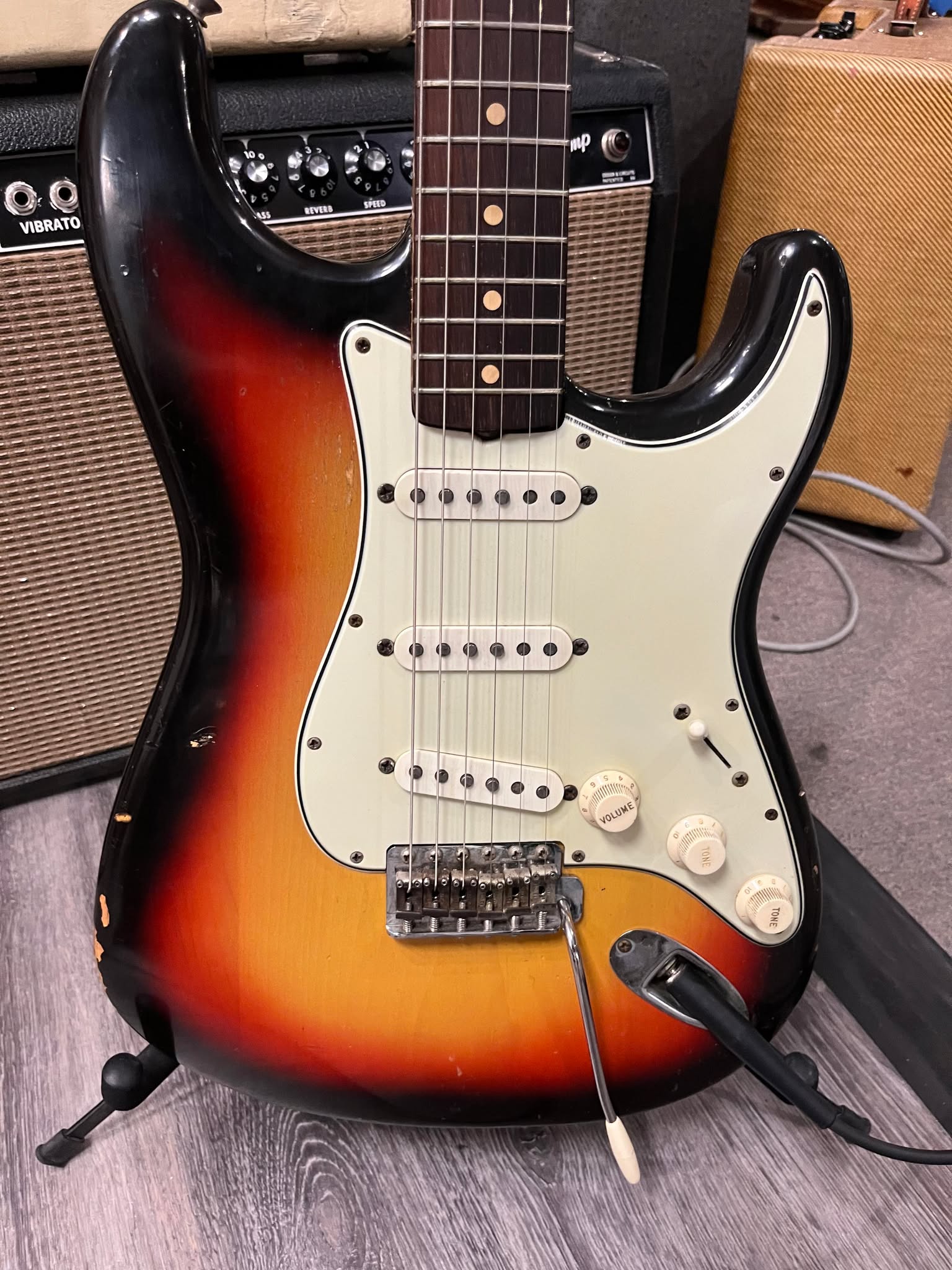
The Most Valuable Vintage Fenders: Pre-CBS Stratocasters (1954-1965)
1954 Fender Stratocaster (First Year)
Why It’s the Ultimate Vintage Strat:
The 1954 Stratocaster invented the template for solid-body electric guitar design that still dominates today. As the first production year of the most influential guitar ever made, 1954 examples carry historical significance that transcends playability. Production numbers were limited as Fender was establishing the model—making any 1954 Stratocaster exceptionally rare.
All-Original Excellent Condition Value Ranges:
Standard Finishes:
Two-tone sunburst (no red), all-original excellent: $80,000-$150,000
Blonde (ash body showing through), all-original excellent: $100,000-$180,000
Custom Colors (Extremely Rare in 1954):
Any factory custom color, all-original excellent: $150,000-$300,000+
Custom colors extraordinarily rare in 1954; authentication critical
Rarity Scale: 10/10 — Approximately 500-1,000 produced in first year
Key 1954 Features:
Two-tone sunburst only (red not added until 1958)
Single-ply white pickguard (8 screws)
Ash body for blonde, alder for sunburst
Round string tree (butterfly style appears 1956)
Bakelite pickup covers and knobs
Hand-wound pickups, Alnico III or V magnets
Serial numbers 0001-1000 range on neck plate
Spaghetti logo
Smaller headstock than CBS era
How Condition and Modifications Reduce Value:
Issue | Value Impact |
|---|---|
Body refinish (any finish) | Reduce by 50-65% |
Neck refinish | Reduce by 20-35% |
Replaced pickups | Reduce by 25-40% |
Replaced pickguard | Reduce by 10-20% |
Headstock repair (rare on Fender but occurs) | Reduce by 35-50% |
Replaced tremolo assembly | Reduce by 15-25% |
Replaced tuners | Reduce by 12-20% |
Replaced pots/wiring | Reduce by 10-20% |
Refret (professional, correct wire) | Reduce by 8-12% |
Heavy player wear (original finish intact) | Reduce by 15-25% |
Wrong era neck | Reduce by 40-60% |
Missing original case | Reduce by 8-12% |
Edgewater Observation: In our experience purchasing pre-CBS Stratocasters throughout the Midwest, completely unmodified 1954 examples are extraordinarily rare. Most have had at least pickguard replacement, refret, or pot replacement from 70+ years of existence. Each modification reduces value cumulatively—a 1954 with body refinish plus replaced pickups plus neck issues might retain only 20-30% of all-original value.
1955-1956 Fender Stratocaster (V-Neck Era)
Why These Years Are Significant:
1955-1956 Stratocasters feature the famous V-neck profile that many players consider the most comfortable vintage Fender neck. Production had stabilized from first-year issues but numbers remained relatively low. Two-tone sunburst continued through this era.
All-Original Excellent Condition Value Ranges:
Standard Finishes:
Two-tone sunburst, all-original excellent: $50,000-$90,000
Blonde (see-through finish on ash), all-original excellent: $60,000-$110,000
Custom Colors:
Common custom colors (Lake Placid Blue, Olympic White), all-original excellent: $80,000-$140,000
Rare custom colors (Shell Pink, Foam Green), all-original excellent: $120,000-$200,000+
Rarity Scale: 9/10
Key Features:
V-neck profile standard (chunky, comfortable)
Single-ply white pickguard
Butterfly string tree (late 1956)
Body date penciled in tremolo cavity
Neck date stamped on heel
Serial numbers 7,000-16,000 range approximately
Condition Reductions: Apply same table as 1954. Custom color refinishes lose all custom color premium—refinished custom color worth approximately same as refinished sunburst.
1957 Fender Stratocaster (Gold Anodized Guard Era)
Why 1957 Is Special:
Gold anodized pickguards appeared on some 1957 Stratocasters, creating one of the most visually distinctive vintage Fender variations. The gold guard on white body creates stunning aesthetic. Additionally, 1957 is the final year before three-tone sunburst introduction, making it the last of the two-tone era.
All-Original Excellent Condition Value Ranges:
Standard Finishes:
Two-tone sunburst, white pickguard, all-original excellent: $45,000-$80,000
Two-tone sunburst, gold anodized guard, all-original excellent: $60,000-$100,000
Blonde, white guard: $55,000-$95,000
Blonde, gold guard: $70,000-$120,000
Custom Colors:
Common custom colors with gold guard: $90,000-$150,000
Rare custom colors with gold guard: $130,000-$220,000
Rarity Scale: 9/10 (white guard) to 9.5/10 (gold guard)
Gold Guard Premium: Original gold anodized pickguards add approximately 30-50% premium to base value. The guard itself is fragile—many have been replaced over decades. Authentication critical: original gold guards have specific anodized texture and aging characteristics. Reproduction gold guards don’t add this premium.
Condition Reductions: Apply 1954 table. Additionally:
Replaced gold anodized guard with white guard: Lose gold guard premium (30-50% of total value)
Damaged but original gold guard: Better than replacement; reduce by 10-15% for damage but retain most of gold guard premium
1958 Fender Stratocaster (First Three-Tone Sunburst)
Why 1958 Is Historic:
1958 introduced the three-tone sunburst finish (red added to the burst) that would become the iconic Stratocaster aesthetic. The maple neck era continued throughout 1958 before rosewood fingerboards appeared mid-1959.
All-Original Excellent Condition Value Ranges:
Standard Finishes:
Three-tone sunburst, all-original excellent: $40,000-$75,000
Two-tone sunburst (early ‘58 production), all-original excellent: $38,000-$70,000
Blonde: $50,000-$90,000
Custom Colors:
Common custom colors: $70,000-$130,000
Rare custom colors: $100,000-$180,000
Rarity Scale: 8/10 to 9/10
Key 1958 Features:
Three-tone sunburst introduced (red added to yellow/black)
Maple neck only (rosewood appears mid-1959)
Three-ply pickguard appearing during year
Serial numbers 20,000-30,000 range
Alder body standard for sunburst, ash for blonde
1959 Fender Stratocaster (Slab Board Introduction)
Why 1959 Commands Premium:
Rosewood fingerboard introduced mid-1959, creating the famous “slab board” era. Slab rosewood (thick, flat-bottomed rosewood) is the most collectible Stratocaster neck variation. 1959 represents peak pre-CBS construction with the introduction of this highly prized feature.
All-Original Excellent Condition Value Ranges:
Standard Finishes (Maple Neck, Early 1959):
Three-tone sunburst, maple neck, all-original excellent: $38,000-$70,000
Standard Finishes (Slab Rosewood Board, Mid-Late 1959):
Three-tone sunburst, slab board, all-original excellent: $50,000-$90,000
Two-tone sunburst (rare in late ‘59): $45,000-$85,000
Blonde: $60,000-$110,000
Custom Colors (Slab Board):
Common custom colors: $85,000-$150,000
Rare custom colors: $120,000-$200,000+
Rarity Scale: 9/10 (especially slab board examples)
Slab Board Premium: Slab rosewood board examples (thick, flat-bottom fingerboard) command approximately 25-40% premium over maple neck examples from same year. The slab board gives distinctive feel and appearance that collectors specifically seek.
Key Features:
Thick slab rosewood fingerboard (approximately 5mm thick, flat bottom)
Clay composition dot markers (off-white, slightly porous)
Three-ply pickguard (11 screw holes)
Serial numbers 30,000-40,000 range
Condition Reductions: Apply 1954 table. Additionally:
Fingerboard sanded down (destroying slab thickness): Reduce by additional 15-25%
Clay dots replaced with pearl: Reduce by 10-15%
1960-1961 Fender Stratocaster (Peak Slab Board Era)
All-Original Excellent Condition Value Ranges:
Standard Finishes:
Three-tone sunburst, slab board, all-original excellent: $40,000-$75,000
Blonde, slab board: $50,000-$90,000
Custom Colors:
Common custom colors: $70,000-$130,000
Rare custom colors: $100,000-$180,000
Rarity Scale: 8/10 to 9/10
Key Features:
Slab rosewood board throughout both years
Clay dots
Green-tinted pickguard (celluloid nitrate aging creates green cast)
Serial numbers 40,000-65,000 range
1962-1964 Fender Stratocaster (Veneer Board, Clay Dots)
Why These Years Matter:
Mid-1962 saw transition from slab rosewood to curved rosewood veneer (thinner board with curved bottom). Clay dots continued through 1964. These represent late pre-CBS production—still highly desirable but slightly less than slab board era.
All-Original Excellent Condition Value Ranges:
Standard Finishes:
Three-tone sunburst, curved veneer board, clay dots, all-original excellent: $25,000-$50,000
Blonde: $30,000-$60,000
Custom Colors:
Common custom colors: $45,000-$90,000
Rare custom colors: $70,000-$130,000
Rarity Scale: 7/10 to 8/10
Key Features:
Curved rosewood veneer board (thinner, approximately 2.5mm)
Clay dots (pearl dots begin appearing late 1964)
L-series serial numbers begin late 1963
Green-tinted pickguard common
Condition Reductions: Apply 1954 table.
1965 Fender Stratocaster (Final Pre-CBS / Transitional Year)
Why 1965 Is Complex:
CBS acquired Fender January 1965, but construction changes occurred gradually through the year. Early 1965 examples (January-August) essentially identical to 1964. Late 1965 examples show transitional features: large headstock appearing, pearl dots replacing clay, F-stamped neck plates. This creates distinct value tiers within 1965.
All-Original Excellent Condition Value Ranges:
Early 1965 (Pre-CBS Features: Small Headstock, Clay Dots):
Three-tone sunburst, pre-CBS features, all-original excellent: $22,000-$42,000
Custom colors: $40,000-$80,000
Late 1965 (Transitional Features: Large Headstock Appearing, Pearl Dots):
Three-tone sunburst, transitional features, all-original excellent: $15,000-$30,000
Custom colors: $28,000-$55,000
Rarity Scale: 7/10 (early) to 6/10 (late)
Authentication Critical: Determining early vs. late 1965 requires examining multiple factors: headstock size, dot material, neck date, pot codes, serial number style. Expert authentication essential for accurate valuation.
Custom Color Rarity and Premium Guide (All Pre-CBS Stratocasters)
Common Custom Colors (40-60% Premium Over Sunburst):
Olympic White
Lake Placid Blue
Daphne Blue
Sonic Blue
Candy Apple Red
Dakota Red
Burgundy Mist
Rare Custom Colors (80-150% Premium Over Sunburst):
Shell Pink
Foam Green
Surf Green
Sherwood Green
Shoreline Gold
Fiesta Red
Ice Blue Metallic
Ultra-Rare Custom Colors (150-200%+ Premium):
Certain one-off or extremely limited production colors
Requires documentation or expert authentication
Critical Note on Custom Colors:
Original custom color finishes command these premiums. Refinished guitars in custom colors do NOT receive custom color premiums—a refinished Sonic Blue Stratocaster is worth approximately the same as a refinished sunburst. The premium exists only for authenticated original finish custom colors.
Custom Color Authentication:
Yellow sealer visible under custom color in routes/cavities (Fender standard)
Matching headstock face (factory applied on custom colors)
Appropriate aging and patina
No refinish evidence (overspray, wrong undercoats)
Pre-CBS Fender Telecaster Values (1950-1965)
1950 Fender Broadcaster (The Original)
Why It’s the Holy Grail Telecaster:
The 1950 Broadcaster was the first solid-body electric guitar to enter commercial production and fundamentally changed music history. With production lasting only a few months before Gretsch’s trademark challenge forced a name change, authenticated Broadcasters are among the rarest and most valuable production guitars.
All-Original Excellent Condition Value Range:
1950 Broadcaster, blonde, all-original excellent: $150,000-$250,000+
Museum-quality examples with documentation: $250,000+
Rarity Scale: 10/10 — Fewer than 200-300 produced with “Broadcaster” name
Key Features:
“Broadcaster” on headstock (not Telecaster)
Black fiber pickguard
Blonde finish
Brass bridge saddles (three)
Serial numbers 0001-1000 range approximately
Bridge pickup with slot-head screws
Authentication Critical:
Given the extreme value, fakes and clipped “Nocaster” examples represented as Broadcasters exist. Professional authentication absolutely essential. Look for:
Correct “Broadcaster” decal style, placement, aging
Appropriate serial number range
Pot codes matching 1950 production
Original bridge plate configuration
Neck date stamp consistent with 1950
Condition Reductions:
Issue | Value Impact |
|---|---|
Body refinish | Reduce by 55-70% |
Replaced bridge assembly | Reduce by 25-40% |
Replaced pickups | Reduce by 30-45% |
Headstock repair | Reduce by 35-50% |
Neck replaced | Reduce by 50-70% |
Any major modification | Reduce by 40-60% |
1951 Fender “Nocaster” (Transition Period)
Why Nocasters Are Extraordinary:
After Gretsch’s trademark challenge, Fender briefly shipped guitars with no model name on the headstock while deciding on “Telecaster.” This transitional period (late 1950-early 1951) created the “Nocaster”—guitars with clipped Broadcaster decals or no model designation.
All-Original Excellent Condition Value Range:
1951 Nocaster, blonde, all-original excellent: $100,000-$180,000
Early examples closer to Broadcaster era: $120,000-$200,000
Rarity Scale: 10/10
Key Features:
No model name on headstock (just “Fender”)
Otherwise identical to Broadcaster/early Telecaster
Black pickguard transitioning to white
Serial numbers 1000-1500 range approximately
1951-1954 Fender Telecaster (Early Tele Era)
All-Original Excellent Condition Value Ranges:
1951-1952 Telecaster (black pickguard), all-original excellent: $50,000-$90,000
1953-1954 Telecaster (white pickguard appears), all-original excellent: $40,000-$75,000
Custom colors (any early Tele): Add 80-150% premium
Rarity Scale: 9/10
Key Features:
Black pickguard early (1951-1953), white appears 1953-1954
Blonde finish standard
Brass saddles (three)
Serial numbers 1500-10,000 range
Bridge plate serial number (not neck plate yet)
1955-1964 Fender Telecaster
All-Original Excellent Condition Value Ranges:
1955-1959 Telecaster, blonde, all-original excellent: $30,000-$55,000
1960-1964 Telecaster, blonde, all-original excellent: $20,000-$40,000
Custom Telecaster (bound body), any year: Add 25-40% premium
Custom colors: Add 60-120% premium depending on rarity
Rarity Scale: 7/10 to 8/10
Key Features:
White pickguard standard (1955+)
Butterfly string tree (1956)
Rosewood fingerboard option (1959)
Blonde finish standard, custom colors available
Three-ply pickguard (later years)
Condition Reductions (All Telecasters):
Issue | Value Impact |
|---|---|
Body refinish | Reduce by 45-60% |
Replaced bridge assembly | Reduce by 20-35% |
Replaced pickups | Reduce by 25-40% |
Headstock repair | Reduce by 30-45% |
Replaced tuners | Reduce by 10-18% |
Replaced pickguard | Reduce by 8-15% |
Heavy play wear (original finish) | Reduce by 12-22% |
Refret | Reduce by 8-12% |
Edgewater Observation: Telecaster bridge assemblies were commonly replaced due to brass saddle wear. Original three-saddle brass configuration is increasingly rare—even reproduction brass saddles reduce value. Steel saddle replacement (done for better intonation) reduces value more substantially than brass replacement.
1950-1960s Fender Esquire
All-Original Excellent Condition Value Ranges:
1950-1954 Esquire, all-original excellent: $35,000-$65,000
1955-1964 Esquire, all-original excellent: $18,000-$35,000
Rarity Scale: 8/10
The Esquire (single pickup Telecaster) represents an important chapter in Fender history but commands slightly lower values than dual-pickup Telecasters due to reduced versatility.
Pre-CBS Fender Bass Values (1951-1965)
1951-1954 Fender Precision Bass (Slab Body Era)
Why It’s Historic:
The Precision Bass invented the electric bass guitar category. The 1951-1954 “slab body” examples (no body contours) are the first electric basses ever produced commercially.
All-Original Excellent Condition Value Ranges:
1951-1953 Precision Bass, slab body, blonde, all-original excellent: $40,000-$75,000
1954 Precision Bass, contoured body introduced, all-original excellent: $35,000-$65,000
Rarity Scale: 10/10 (slab body) to 9/10 (1954 contoured)
Key Features:
Single-coil pickup
Two-saddle bridge (early)
Slab body (no contours) through 1953
Contoured body introduced 1954
Black or white pickguard
1957-1965 Fender Precision Bass (Split-Coil Era)
Why 1957+ Is Different:
1957 saw introduction of split-coil humbucking pickup that defines the modern P-Bass sound. This represents the “classic” Precision Bass configuration.
All-Original Excellent Condition Value Ranges:
1957-1959 Precision Bass, split-coil, all-original excellent: $25,000-$45,000
1960-1964 Precision Bass, all-original excellent: $15,000-$30,000
Custom colors: Add 60-100% premium
Stack-knob controls (transitional): Add 20-30% premium
Rarity Scale: 8/10 to 9/10
Key Features:
Split-coil pickup (staggered pole pieces)
Anodized pickguard (1957-1959)
Tortoiseshell or white guard options
Rosewood fingerboard (1959+)
Custom colors available and highly collectible
Condition Reductions (Precision Bass):
Issue | Value Impact |
|---|---|
Body refinish | Reduce by 45-60% |
Replaced pickup | Reduce by 25-40% |
Replaced bridge/cover | Reduce by 15-25% |
Headstock repair | Reduce by 30-45% |
Refret | Reduce by 8-15% |
Heavy play wear | Reduce by 12-20% |
1960-1965 Fender Jazz Bass
Why Jazz Bass Commands Premium:
The Jazz Bass introduced 1960 with dual pickup configuration, narrower neck, and offset body. Stack-knob control examples (1960-1961) are particularly collectible.
All-Original Excellent Condition Value Ranges:
Stack-Knob Era (1960-1961):
Jazz Bass, stack-knob controls, sunburst, all-original excellent: $35,000-$65,000
Jazz Bass, stack-knob, custom color, all-original excellent: $60,000-$110,000
Standard 3-Knob (1962-1965):
Jazz Bass, 3-knob, sunburst, all-original excellent: $20,000-$40,000
Jazz Bass, 3-knob, custom color, all-original excellent: $35,000-$70,000
Rarity Scale: 9/10 (stack-knob) to 8/10 (3-knob)
Stack-Knob Premium: Concentric (stack) knob configuration from first two years commands substantial premium—approximately 60-80% more than 3-knob equivalents. Stack pots difficult to replace correctly, so originality critical.
Key Features:
Dual single-coil pickups
Offset body shape
Narrower neck than Precision (1.5” nut width)
Stack knobs (1960-1961) or 3 knobs (1962+)
Clay dots (early) or pearl dots (later)
Custom colors with bound neck and block inlays option
Condition Reductions: Apply Precision Bass table. Additionally:
Converted from stack-knob to 3-knob: Reduce by additional 30-40%
Replaced stack-knob pots: Reduce by 25-35%
Pre-CBS Offset Models: Jazzmaster, Jaguar, Mustang
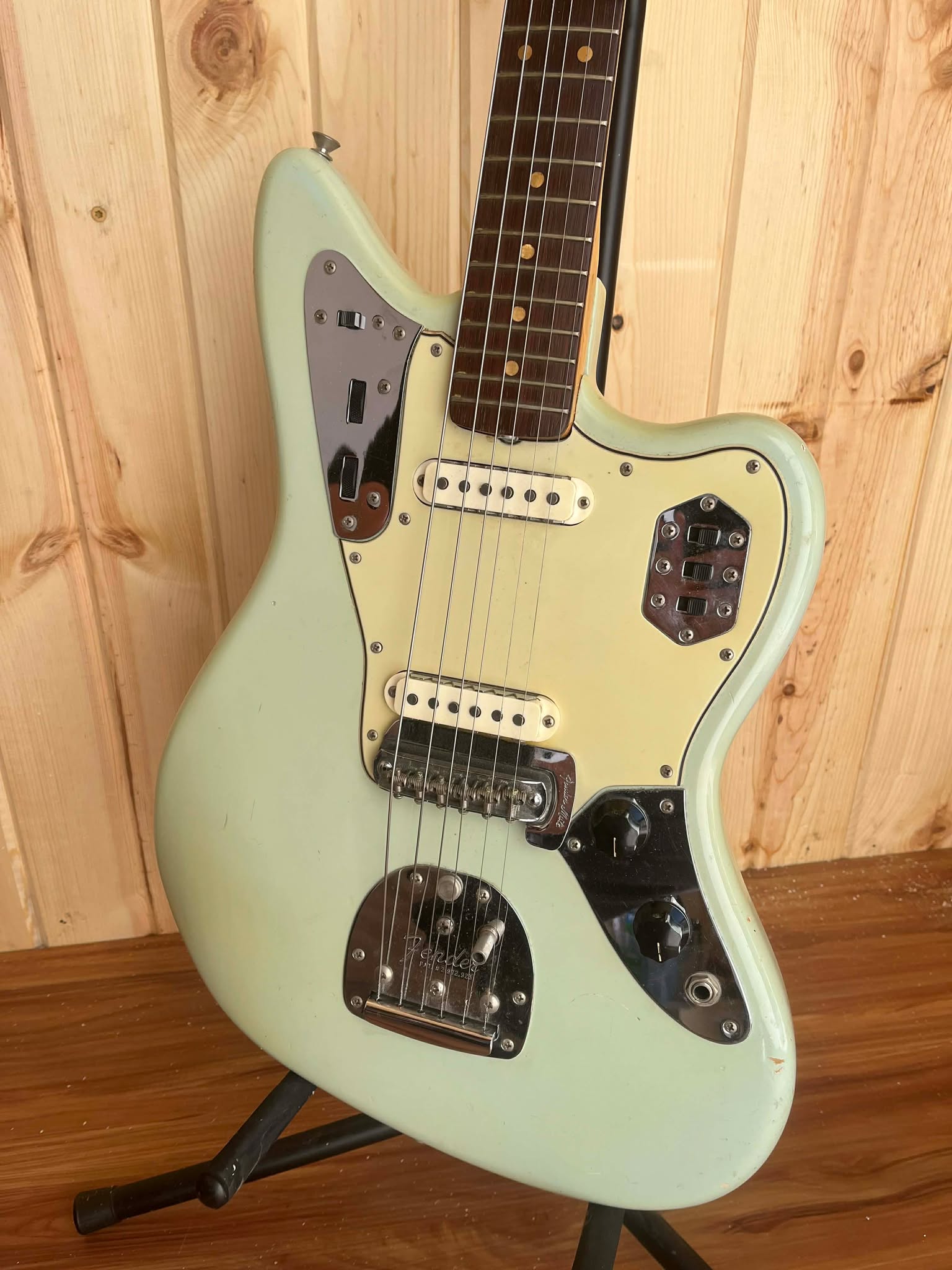
1958-1965 Fender Jazzmaster
All-Original Excellent Condition Value Ranges:
1958-1959 Jazzmaster (first years), sunburst, all-original excellent: $18,000-$35,000
1960-1964 Jazzmaster, sunburst, all-original excellent: $12,000-$25,000
Custom colors (any year): $25,000-$50,000 depending on rarity
Rarity Scale: 8/10 (first years) to 7/10 (later)
Key Features:
Offset waist body
Floating tremolo system
Rhythm circuit with lead/rhythm switch
Wide single-coil pickups
Anodized pickguard (1958-1959)
Tortoiseshell guard (1959+)
Clay dots (early) or pearl dots (later)
Condition Reductions:
Issue | Value Impact |
|---|---|
Body refinish | Reduce by 45-60% |
Replaced pickups | Reduce by 25-40% |
Replaced tremolo assembly | Reduce by 20-30% |
Rhythm circuit removed/modified | Reduce by 15-25% |
Headstock repair | Reduce by 30-45% |
Replaced pickguard | Reduce by 10-18% |
1962-1965 Fender Jaguar
All-Original Excellent Condition Value Ranges:
1962-1964 Jaguar, sunburst, all-original excellent: $15,000-$30,000
1962-1964 Jaguar, custom color, all-original excellent: $30,000-$60,000
Rarity Scale: 8/10
Key Features:
24” scale length (shorter than Strat/Jazzmaster)
Complex switching system
Mute mechanism
String lock
Metal-tooth pickups
Tortoiseshell pickguard
Edgewater Observation: Jaguars commonly have bridge and tremolo modifications due to stability issues with original system. Original bridge/tremolo configuration increasingly rare and valuable. Many examples converted to Tune-o-matic bridges or Mustang saddles—these modifications reduce value by 20-35%.
1964-1969 Fender Mustang
All-Original Excellent Condition Value Ranges:
Mustang (24” scale), standard finish, all-original excellent: $4,000-$8,000
Mustang, competition stripe (red, blue), all-original excellent: $6,000-$12,000
Rarity Scale: 6/10
Student model status limits values compared to Stratocaster/Telecaster, but solid player and collector demand. Competition stripe finishes command premium.
CBS-Era Fender Values (1965-1981)
1966-1970 CBS Stratocaster (Early Large Headstock Era)
All-Original Excellent Condition Value Ranges:
1966-1969 Stratocaster, sunburst, large headstock, all-original excellent: $8,000-$16,000
1966-1969 Stratocaster, custom color, all-original excellent: $12,000-$22,000
Rarity Scale: 5/10 to 6/10
Key CBS Changes:
Large headstock (1965-1966 transition)
F-stamped tuners
Polyurethane finish begins replacing nitrocellulose
Pearl dot markers
Maple cap neck option (1967)
Condition Reductions:
Issue | Value Impact |
|---|---|
Body refinish | Reduce by 35-50% |
Replaced pickups | Reduce by 20-30% |
Headstock repair | Reduce by 25-40% |
Refret | Reduce by 8-12% |
Heavy play wear | Reduce by 10-18% |
Edgewater Observation: Early CBS Stratocasters (1966-1969) increasingly recognized as quality instruments despite CBS-era stigma. Values rising as players recognize construction quality remained high during this transitional period. Still substantially below pre-CBS values but gap narrowing for excellent all-original examples.
1970-1981 CBS Stratocaster (Later Era)
All-Original Excellent Condition Value Ranges:
1970-1975 Stratocaster, sunburst, all-original excellent: $4,000-$8,000
1970-1975 Stratocaster, custom color, all-original excellent: $6,000-$12,000
1976-1981 Stratocaster: $2,500-$5,000
Rarity Scale: 4/10 to 5/10
Key Features:
3-bolt neck plate with micro-tilt (some models, 1972+)
Bullet truss rod (1970s)
Heavier ash bodies common
Thick polyurethane finishes
Quality inconsistency through era
CBS-Era Telecaster, Precision Bass, Jazz Bass
All-Original Excellent Condition Value Ranges:
Telecaster:
1966-1975 Telecaster: $4,000-$9,000
1976-1981 Telecaster: $2,000-$4,500
Precision Bass:
1966-1975 Precision Bass: $4,000-$8,000
1976-1981 Precision Bass: $2,000-$4,000
Jazz Bass:
1966-1975 Jazz Bass: $5,000-$10,000
1976-1981 Jazz Bass: $2,500-$5,500
Rarity Scale: 4/10 to 5/10
Jazz Bass values slightly higher than Precision throughout CBS era due to dual-pickup versatility and player demand.
Complete Value Reduction Reference Guide
Understanding Cumulative Modifications on Fenders
Like Gibsons, Fender modifications compound. Multiple issues don’t simply add—they multiply.
Single Modification Example:
1963 Stratocaster, sunburst, all-original excellent: $30,000
Refret only (professional, correct wire): Reduce by 8% = approximately $27,600
Multiple Modification Example:
1963 Stratocaster, sunburst, all-original excellent: $30,000
Replaced pickups (30% reduction): $21,000
Body refinish on top of that (50% reduction of remaining): approximately $10,500
Headstock repair on top of that (30% reduction of remaining): approximately $7,350
The compound effect means a guitar with three significant modifications might be worth only 20-25% of all-original value.
Universal Value Reduction Table (All Vintage Fenders)
Condition/Modification | Typical Value Impact |
|---|---|
Finish Issues | |
Body refinish (professional nitro) | Reduce by 45-60% |
Body refinish (polyurethane or amateur) | Reduce by 55-70% |
Neck refinish | Reduce by 20-30% |
Headstock face refinish | Reduce by 15-25% |
Custom color refinish (loses all custom color premium) | Reduce by 50-70% |
Heavy play wear (original finish) | Reduce by 12-22% |
Light play wear (original finish) | Reduce by 5-10% |
Structural Repairs | |
Headstock break, invisible professional repair | Reduce by 30-45% |
Headstock break, visible repair | Reduce by 40-55% |
Neck pocket work/shimming | Reduce by 10-20% |
Body crack, professionally repaired | Reduce by 15-25% |
Pickups and Electronics | |
Replaced pickups (single-coils on Strat/Tele) | Reduce by 25-40% |
Replaced bass pickups | Reduce by 25-40% |
Replaced pots (with correct era pots) | Reduce by 8-15% |
Replaced pots (with wrong era) | Reduce by 15-25% |
Replaced capacitors | Reduce by 3-8% |
Modified wiring/switching | Reduce by 10-20% |
Hardware | |
Replaced tuners (correct Kluson reproductions) | Reduce by 8-15% |
Replaced tuners (wrong type) | Reduce by 15-25% |
Replaced tremolo assembly (Strat) | Reduce by 15-25% |
Replaced bridge (Tele) | Reduce by 20-35% |
Steel saddles replacing brass (Tele) | Reduce by 15-25% |
Added Bigsby (not factory) | Reduce by 15-25% |
Replaced pickguard (correct material/style) | Reduce by 8-15% |
Replaced pickguard (wrong style) | Reduce by 15-25% |
Fretwork | |
Professional refret (correct wire) | Reduce by 8-12% |
Professional refret (wrong wire) | Reduce by 12-20% |
Poor quality refret | Reduce by 20-30% |
Fingerboard planed (destroying slab board) | Reduce by 25-40% |
Other | |
Missing original case (correct era) | Reduce by 8-15% |
Wrong era case | Reduce by 5-8% |
Replaced knobs | Reduce by 5-10% |
Replaced switch tip | Reduce by 3-8% |
String tree replaced | Reduce by 3-5% |
Heavy fret wear (original frets) | Reduce by 8-15% |
What Does NOT Reduce Value (Common Misconceptions)
Natural Aging That Is NOT a Problem:
Finish checking on pre-CBS nitro finishes (expected and correct)
Yellowing of Olympic White or blonde finishes (natural aging)
Fading of custom colors (Sonic Blue to pale blue, etc.—still original)
Green-tinted pickguard (celluloid aging—correct and expected 1959-1964)
Oxidized hardware (original patina)
Honest play wear with original finish intact
Slight neck pocket gaps (some pre-CBS examples shipped this way)
Minor Repairs with Minimal Impact:
Replaced nut (professional, correct material): 2-5% reduction
Replaced strap buttons: Minimal
Repaired small finish dings (properly matched): 2-5%
Cleaned/polished frets: No impact
How to Get Maximum Value for Your Vintage Fender
Step 1: Identify Era and Model Accurately
Critical Questions:
What model? (Stratocaster, Telecaster, Precision Bass, etc.)
What is serial number and where is it located? (Neck plate vs. headstock indicates era)
What is the neck date? (Visible when neck removed—format indicates year)
Maple or rosewood fingerboard?
If rosewood: slab (thick, flat bottom) or veneer (thin, curved)?
What finish? (Sunburst, blonde, custom color—identify specific color)
Step 2: Authenticate Custom Color (If Applicable)
Custom color authentication is THE most critical value determinant on Fenders. A guitar represented as custom color but actually refinished loses tens of thousands of dollars in value.
Custom Color Authentication Steps:
Remove pickguard/control plate and examine body routes with flashlight
Look for yellow sealer coat under the color (Fender standard on customs)
Check for matching headstock face (factory applied on custom colors)
Examine finish aging patterns (should show appropriate checking, color shift)
Verify no refinish evidence (overspray in wrong areas, buildup in neck pocket)
Step 3: Assess Originality Honestly
Before contacting buyers:
Pickups original? (Remove pickguard, check construction, test DC resistance)
Neck original to body? (Check neck pocket fit, date stamps alignment)
Tremolo/bridge original? (Correct style for year)
Tuners original? (Kluson Deluxe with correct features for era)
Pots original? (Check codes under pickguard: 304 or 137 with year-week)
Step 4: Get Multiple Expert Opinions
Local guitar shops typically offer 40-50% of market value. Specialized vintage Fender buyers like Edgewater offer 60-70% of market value. For a $50,000 guitar, this difference is $15,000-$20,000.
Step 5: Gather Documentation
Original case (tweed, brown tolex, black tolex—era-specific)
Sales receipt from original purchase
Period photographs
Any correspondence or documentation from Fender
Neck date photos (if accessible without neck removal)
Pot code photos
Step 6: Contact Edgewater for Free Expert Authentication
Edgewater Guitars specializes in pre-CBS Fender authentication and valuation. Our expertise includes:
Serial number and neck date verification
Pot code authentication
Slab vs. veneer rosewood verification
Custom color authentication (yellow sealer test, finish examination)
Pickup originality assessment
Complete condition documentation
We typically offer 30-40% more than local guitar shops due to our direct-to-collector business model and pre-CBS Fender specialization. Call (440) 219-3607 or visit our valuation page.
Selling Options: Where to Get the Best Price for Your Vintage Fender
Selling Option | Expected Offer | Timeline | Best For |
|---|---|---|---|
Edgewater Guitars | 60-70% of market value, 30-40% above shops | 1-3 days | Fair value, immediate payment, pre-CBS authentication expertise |
Local Guitar Shop | 40-50% of market value | Same day | Absolute convenience only, not concerned about fair value |
Online Marketplace (Reverb/eBay) | 70-85% net after fees | 2-8 weeks | Experienced sellers with documentation, custom color proof |
Auction House | 65-85% net after premium | 3-6 months | Exceptional pre-CBS customs, stack-knob basses, Broadcasters only |
Consignment Shop | 70-80% net after commission | Weeks-months | Patient sellers wanting shop’s Fender expertise |
Private Sale | 80-100% | Unpredictable | Experienced sellers with direct pre-CBS Fender collector contacts |
Frequently Asked Questions: What Is My Vintage Fender Worth?
Q: What is the most valuable vintage Fender guitar?
A: Authenticated 1950 Broadcaster examples in all-original excellent condition represent peak Fender values, with exceptional examples exceeding $250,000. 1951 Nocasters follow at $100,000-$180,000. Among more available instruments, 1954-1956 Stratocasters in rare custom colors (Shell Pink, Foam Green) can exceed $150,000-$200,000 in excellent all-original condition.
Q: What is a pre-CBS Fender Stratocaster worth?
A: Depends entirely on year and finish. 1954-1956 sunburst examples: $50,000-$150,000 all-original excellent. 1959-1960 slab board examples: $40,000-$90,000 sunburst, $85,000-$200,000+ rare custom colors. 1962-1964 veneer board examples: $25,000-$50,000 sunburst, $45,000-$130,000 custom colors. Early 1965 (pre-CBS features): $22,000-$42,000 sunburst, $40,000-$80,000 custom colors.
Q: How much does custom color add to a vintage Fender’s value?
A: Custom colors on pre-CBS Fenders in original finish add 40-150% premium over sunburst depending on color rarity. Common colors (Olympic White, Lake Placid Blue) add 40-60%. Rare colors (Shell Pink, Foam Green) add 80-150%+. This premium exists ONLY for authenticated original finish custom colors—refinished guitars in custom colors get no premium.
Q: Is a refinished pre-CBS Stratocaster still valuable?
A: Yes, but significantly less than original finish. A refinished 1962 Stratocaster with all original parts might be worth $12,000-$20,000 depending on refinish quality and parts originality. All-original finish equivalent would be $25,000-$50,000. Refinishing reduces value 45-60% typically. Original parts (pickups, neck, pots) preserve some value despite body refinish.
Q: What is a slab board Stratocaster worth?
A: Slab rosewood board (1959-mid 1962) examples command 25-40% premium over maple neck or veneer board equivalents. A 1960 slab board Stratocaster in sunburst, all-original excellent might be worth $40,000-$75,000 vs. $32,000-$55,000 for maple neck equivalent. Slab board with rare custom color: $85,000-$150,000+.
Q: What is a stack-knob Jazz Bass worth?
A: 1960-1961 Jazz Bass examples with concentric (stack) knob controls in all-original excellent condition: $35,000-$65,000 sunburst, $60,000-$110,000 rare custom colors. Stack-knob configuration brings approximately 60-80% premium over 1962-1965 3-knob equivalents. Stack pots rarely replaced correctly—originality critical.
Q: Are CBS-era Fenders worth anything?
A: Yes. 1966-1970 CBS Stratocasters in all-original excellent condition: $8,000-$16,000 sunburst, $12,000-$22,000 custom colors. 1970s examples: $2,500-$8,000 depending on year and condition. CBS-era guitars have solid player market and growing collector recognition for early CBS examples (1966-1969). Still substantially below pre-CBS values but not worthless.
Q: Does a headstock repair destroy a vintage Fender’s value?
A: It reduces value significantly but doesn’t destroy it. Professional invisible headstock repair on pre-CBS Fender reduces value 30-45%. A 1963 Stratocaster worth $30,000 all-original might be worth $16,500-$21,000 with headstock repair—still valuable, but substantially reduced. Visible repairs or poor quality repairs impact value more severely (40-55% reduction).
Q: What is my 1970s Stratocaster worth?
A: 1970-1975 Stratocasters in all-original excellent condition: $4,000-$8,000 depending on specific features and finish. 1976-1981 examples: $2,500-$5,000. Refinished examples: $1,500-$3,500. Heavily modified examples less. Later CBS era has mixed quality reputation but good examples remain solid players.
Q: How do I authenticate a custom color Fender?
A: Remove pickguard and control plate, examine body routes with flashlight for yellow sealer coat underneath color (Fender standard). Check for matching headstock face (factory applied). Examine finish aging for appropriate checking and patina. Verify no refinish evidence (wrong overspray locations, neck pocket buildup). Check neck pocket for original color traces. Professional authentication recommended for high-value customs.
Q: Does Edgewater Guitars buy all vintage Fenders?
A: We focus primarily on pre-CBS Fenders (1950-1965) in any condition, including refinished or modified examples with original parts. We actively seek Stratocasters, Telecasters, Precision Basses, Jazz Basses, Jazzmasters, and Jaguars. We selectively purchase quality CBS-era examples (1965-1980). Even modified pre-CBS Fenders have value we recognize. Call (440) 219-3607 with details of any vintage Fender.
Q: What vintage Fenders are undervalued in 2026?
A: In our experience: early CBS Stratocasters (1966-1969) with all original parts remain undervalued relative to quality, late pre-CBS Telecasters (1962-1964), Jazzmasters in common custom colors, and player-grade pre-CBS instruments with honest wear but complete originality. These categories offer entry points to pre-CBS market at more accessible price points.
Q: Should I get professional appraisal before selling vintage Fender?
A: For high-value pre-CBS instruments ($25,000+), professional appraisal makes sense for auction sales or insurance documentation. For most sellers, expert buyer evaluation (like Edgewater’s free authentication service) provides necessary information without appraisal cost. Don’t pay for appraisal just to sell to shop—they’ll set their own value regardless. Appraisal valuable when you need independent documentation.
Related Resources
Fender Serial Number Lookup Tool — Decode your serial number and identify production year
What Is My Vintage Gibson Worth? — Parallel value guide for Gibson owners
Pre-CBS Fender Stratocaster Complete Guide — Detailed pre-CBS Strat authentication
The Best Way to Sell Vintage Fender — Complete selling options comparison
Fender Custom Color Authentication Guide — Verify original custom color finishes
Fender Slab Board vs. Veneer Board Guide — Understanding Strat rosewood variations
1959 Fender Stratocaster Value Guide — Detailed model-specific guide
Sell Your Guitar to Edgewater — Start your free valuation process
Edgewater Guitars purchases vintage Fender guitars throughout Ohio, Michigan, Pennsylvania, Indiana, and West Virginia. For high-value pre-CBS instruments including custom color Stratocasters, Broadcasters, Nocasters, stack-knob Jazz Basses, and other significant vintage Fenders, we travel beyond our standard service area. Our pre-CBS Fender authentication expertise and direct-to-collector business model means we consistently offer 30-40% more than traditional guitar shops. Contact us for your free, no-obligation valuation: get a free estimate here or call (440) 219-3607.