DATE :
What Model Gibson/Fender/Martin Do I Have? Complete Visual Identification Guide
What Model Gibson/Fender/Martin Do I Have? Complete Visual Identification Guide
Quick Answer: To identify your Gibson, Fender, or Martin model, examine the body shape (single vs. double cutaway, solid vs. hollow), count the pickups (electric guitars), look for distinctive features (carved top, f-holes, tremolo system), check for model names on the headstock or label, and compare your guitar’s appearance to common model characteristics. Gibson Les Pauls have carved tops and single cutaways; SGs have thin flat bodies with two pointed horns; Fender Stratocasters have three pickups and tremolo bars; Telecasters have two pickups in a slab body; Martin dreadnoughts have large square-shouldered bodies. Once you identify the model, you can determine the year using serial numbers and pot codes to establish accurate value—especially critical for pre-1970 instruments where model and year together determine whether you have a moderately valuable guitar or an extremely valuable collector’s piece.
If you’ve figured out that you have a Gibson, Fender, or Martin guitar—congratulations, you’ve completed the first step. But now you’re faced with a new question: “What MODEL do I have?” Is your Gibson a Les Paul, an SG, or an ES-335? Is your Fender a Stratocaster, Telecaster, or something else? Is your Martin a D-28, D-45, or another model entirely?
Understanding the specific model is absolutely critical because it determines your guitar’s value, historical significance, and collectability. A 1959 Gibson Les Paul Standard and a 1959 Gibson SG Junior are both Gibsons from 1959—but one is worth hundreds of thousands while the other is worth thousands. Both are valuable vintage guitars, but knowing exactly which model you have is essential.
This comprehensive guide will teach you how to identify any Gibson, Fender, or Martin model using visual features anyone can recognize, understand what makes each model distinctive and valuable, determine which models are most collectible (and why), and know when you should seek professional authentication.
At Edgewater Guitars, we’ve identified thousands of Gibson, Fender, and Martin guitars throughout Ohio and the Midwest. We’ve seen people confuse Les Pauls with SGs, Stratocasters with Telecasters, and various Martin models with each other. This guide represents everything we’ve learned about helping non-guitarists accurately identify the specific model they own.
What you’ll learn:
Visual identification guide for every major Gibson model
How to identify Fender models by body shape and features
Martin model identification and what the numbers mean
The difference between similar-looking models
Which models are most valuable (and why specific identification matters)
Real case studies of misidentified guitars
When to get professional authentication
Let’s start with Gibson—the brand where model identification matters most for value.
Gibson Model Identification Guide
Gibson is the brand where accurate model identification has the most dramatic value impact. Confusing a Les Paul Standard with a Les Paul Junior, or an ES-335 with an ES-345, can mean misunderstanding your guitar’s value by tens of thousands.
The Gibson Body Shape Families
Gibson electric guitars fall into four main body families:
Carved-top single cutaway (Les Paul family)
Flat double cutaway (SG family)
Semi-hollow with f-holes (ES-335 family)
Full hollow archtop (ES-175, L-5, Super 400 family)
Let’s identify each family and the specific models within them.
Gibson Les Paul Family Identification
If your Gibson has a CARVED TOP (arched, rounded appearance) and SINGLE CUTAWAY, it’s in the Les Paul family.
Visual Identification: Is It a Les Paul?
Look for these distinctive features:
✓ Carved maple top - The top surface is arched/rounded, not flat ✓ Single cutaway - Only one “horn” extending from body (on bass/left side) ✓ Thick body - Approximately 1.75-2 inches deep ✓ Binding around body edge - Cream or white plastic strip around perimeter ✓ Glued-in neck - Neck meets body with smooth joint (no visible plate) ✓ Relatively heavy - Most Les Pauls weigh 8-10+ pounds
If you see these features, you have a Les Paul-style guitar. Now let’s determine WHICH Les Paul model.
Les Paul Standard (1952-1960, 1968-present)
The most valuable Les Paul model—accurate identification is critical.
How to identify Les Paul Standard:
1952-1957 “Goldtop” era:
Finish: Gold metallic top
Pickups: Two P-90 “soapbar” pickups (rectangular, cream or black)
Tailpiece: Trapeze (1952-53), wraparound (1953-54), or Tune-o-matic bridge (1954+)
Inlays: Trapezoid shapes on fretboard
No model name on guitar - Just “Les Paul Model” on truss rod cover
1958-1960 “Burst” era (EXTREMELY VALUABLE):
Finish: Cherry sunburst (red graduating to yellow center)
Pickups: Two PAF humbuckers (dual-coil pickups with chrome covers)
Top: Often shows flame or figure in maple
Faded appearance: Many have faded from red to honey/yellow color
Bridge: Tune-o-matic with separate stopbar tailpiece
Inlays: Trapezoid shapes
CRITICAL: If you have a cherry sunburst Les Paul from 1958-1960, STOP and contact a specialist immediately. These are among the most valuable guitars ever made.
1968-present Standards:
Various finishes (sunburst, cherry, goldtop, natural, etc.)
Two humbucker pickups
Trapezoid inlays
“Standard” designation
Les Paul Custom (1954-1960, 1968-present)
The “Black Beauty” - Gibson’s top-of-line Les Paul
How to identify Les Paul Custom:
1954-1960 era:
Finish: Almost always black (ebony finish)
Fretboard: Ebony (very dark, almost black)
Inlays: Block-shaped (rectangular) inlays OR split-diamond pattern
Binding: Multiple layers of binding (white/black/white)
Pickups: P-90 + Alnico V (1954-1957) OR three humbuckers (1957-1961)
Hardware: Gold-plated
Headstock: Split-diamond inlay
Truss rod cover: “Les Paul Custom” in pearl inlay
Key distinction: Black finish + block inlays + gold hardware = Les Paul Custom
1968-present Customs:
Black finish most common (also white, wine red, others)
Two or three humbucker pickups
Ebony fretboard with block inlays
Gold hardware
Multi-ply binding
Les Paul Junior (1954-1963)
Budget model—still valuable but dramatically less than Standard or Custom
How to identify Les Paul Junior:
1954-1958 Single Cutaway Junior:
Body: Flat mahogany slab (NO carved top - this is key)
Single cutaway on bass side
Finish: Sunburst or TV Yellow
Pickups: ONE P-90 pickup only (at bridge position)
No binding on body or neck
Inlays: Dot markers
Tailpiece: Wraparound bridge/tailpiece combination
Pickguard: Black (usually)
1958-1963 Double Cutaway Junior:
Two cutaways (but still called “Junior”)
Thin flat body (no carved top)
ONE P-90 pickup
Cherry or TV Yellow finish
Dot inlays, no binding
Key difference from Standard: Flat body (not carved) + only ONE pickup = Junior
Les Paul Special (1955-1960)
How to identify Les Paul Special:
Similar to Junior, BUT:
TWO P-90 pickups (instead of one)
Flat slab body (no carved top)
TV Yellow or Cherry finish
Dot inlays
Unbound or bound neck (depending on year)
Some with Bigsby vibrato
Single cutaway (1955-1959) or double cutaway (1959-1960)
Key difference: Flat body + TWO pickups = Special (vs. Junior with ONE pickup)
Les Paul Deluxe (1968-1985)
How to identify Les Paul Deluxe:
Mini-humbuckers (smaller than standard humbuckers)
Goldtop, cherry sunburst, tobacco sunburst, or wine red finish
“DELUXE” on truss rod cover
Carved top like Standard
Two mini-humbucker pickups
1970s era mostly
Key identifier: Mini-humbuckers (significantly smaller than standard pickups) + “Deluxe” marking
Quick Les Paul Model Comparison
I have a carved-top, single-cutaway Gibson with:
Gold top + 2 P-90s + trapezoid inlays = 1952-1957 Les Paul Standard (Goldtop)
Cherry sunburst + 2 humbuckers + trapezoid inlays = 1958-1960 Les Paul Standard (BURST - very valuable)
Black + ebony board + block inlays + gold hardware = Les Paul Custom
Flat top + 1 pickup + no binding = Les Paul Junior
Flat top + 2 P-90s + no carved top = Les Paul Special
2 mini-humbuckers + “Deluxe” marking = Les Paul Deluxe
Gibson SG Family Identification
If your Gibson has a FLAT BODY with TWO POINTED HORNS, it’s in the SG family.
Visual Identification: Is It an SG?
Look for these distinctive features:
✓ Thin, flat body - No carved top, very thin profile ✓ Two cutaway “horns” - Pointed, extending from body ✓ Symmetrical design - Horns roughly equal length ✓ Lightweight - Most SGs weigh 6-8 pounds (lighter than Les Pauls) ✓ Deep cutaways - Easy access to high frets ✓ Set neck with exposed heel (visible neck joint)
SG/Les Paul (1961-1963) - THE TRANSITIONAL MODEL
CRITICAL IDENTIFICATION: Early SGs said “Les Paul” on them!
How to identify 1961-1963 SG/Les Paul:
Body: Thin, flat SG body with two horns
Truss rod cover says: “Les Paul” OR “Les Paul Standard” OR “Les Paul Custom”
Year: 1961-1963 (check serial number and pot codes)
Pickups: PAF humbuckers (early) or patent number humbuckers (later)
Vibrato: Sideways vibrola (early 1961) or Maestro vibrato
Why this matters: These transitional SGs with “Les Paul” designation are MORE valuable than later SGs because of their historical significance. They’re the last guitars to bear Les Paul’s name before he asked Gibson to remove it.
Value note: A 1961 SG with “Les Paul” on the truss rod cover is significantly more valuable than a 1964 SG without it.
SG Standard (1963-present)
How to identify SG Standard:
1963-1965 era:
Thin, flat body with two horns
Truss rod cover: Plain or says “Standard” (NO “Les Paul”)
Pickups: Two humbucker pickups
Finish: Cherry red most common, also white, walnut
Inlays: Trapezoid shapes
Pickguard: Small pickguard (various shapes by era)
Vibrato: Optional Maestro or Bigsby
1966-present:
Similar features
“Witch hat” knobs (1967-1969)
Large “batwing” pickguard (1966-1970)
Various finish options
SG Special (1959-1971)
How to identify SG Special:
Thin SG body with two horns
Pickups: Two P-90 pickups (NOT humbuckers)
Inlays: Dot markers (not trapezoids)
Finish: Cherry or TV yellow
Binding: Some years bound, some unbound
Pickguard: Various shapes
Key difference: P-90 pickups (single rectangular pickups) vs. Standard’s humbuckers
SG Junior (1961-1971)
How to identify SG Junior:
Thin SG body
ONE pickup only (single P-90 at bridge)
Inlays: Dots
Finish: Cherry
No binding
Pickguard: Various styles
Key difference: Only ONE pickup = Junior
SG Custom (1963-present)
How to identify SG Custom:
1963-1970 era:
SG body shape
Three pickups (instead of two)
Inlays: Block markers
Binding: Multi-ply binding
Finish: White or walnut most common
Hardware: Gold or nickel
Pickguard: White or black
Key identifiers: THREE pickups + block inlays + SG body = SG Custom
Quick SG Model Comparison
I have a thin, flat Gibson with two horns and:
“Les Paul” on truss rod cover = 1961-1963 SG/Les Paul (valuable transitional)
2 humbuckers + trapezoid inlays + no “Les Paul” = SG Standard
2 P-90s + dot inlays = SG Special
1 pickup only = SG Junior
3 pickups + block inlays = SG Custom
Gibson ES (Electric Spanish) Semi-Hollow Identification
If your Gibson has F-HOLES (violin-style sound holes) and a SEMI-HOLLOW body, it’s in the ES-335 family.
Visual Identification: Is It an ES-335 Family Guitar?
Look for these features:
✓ F-holes - Two f-shaped holes on top of body ✓ Thin body - About 1.5-1.75 inches deep ✓ Double cutaway - Two horns extending from body ✓ Center block visible - Solid wood block visible through f-holes ✓ Binding on body edges ✓ Arched top - Slight arch to body top
ES-335 (1958-present)
Gibson’s most popular semi-hollow—extremely collectible in vintage form
How to identify ES-335:
1958-1962 “Dot Neck” era (MOST VALUABLE):
Inlays: Dot markers on fretboard
Pickguard: Long pickguard extending below bridge
Pickups: PAF humbuckers (1958-1962)
Finish: Natural, sunburst, or cherry
F-holes: Rounded “Mickey Mouse ear” cutaways
Binding: Single binding around body
Two output jacks on some (stereo)
1962-present “Block Neck” era:
Inlays: Block (rectangular) markers
Pickguard: Smaller, above bridge only
Cutaways: Pointed (1963-1968), then back to rounded
Pickups: Patent number humbuckers (1960s), later T-Tops
Key identifier for ES-335: Dot OR block inlays + standard binding + typically one output jack
ES-345 (1959-1983)
How to identify ES-345:
Similar to ES-335, BUT with these upgrades:
Varitone switch - Six-position rotary switch (tone selector)
Stereo output - Two output jacks
Inlays: Parallelogram or split-parallelogram shapes
Binding: Often double-bound f-holes (extra binding detail)
Hardware: Gold-plated (usually)
Finish: Cherry, sunburst, natural, or walnut
Key identifiers: Varitone switch + two output jacks + fancy inlays = ES-345
ES-355 (1958-1982)
Gibson’s top-of-line semi-hollow
How to identify ES-355:
Inlays: Block inlays or split-block (fancier than 335)
Binding: Multi-ply binding everywhere (body, neck, headstock, f-holes)
Hardware: Gold-plated
Headstock inlay: Split-diamond pattern (fancy)
Varitone switch on most examples
Stereo output on most
Bigsby vibrato common
Finish: Cherry, natural, ebony, or walnut
Key identifiers: Multi-ply binding EVERYWHERE + gold hardware + split-diamond headstock = ES-355
ES-175 (1949-present)
Jazz guitar - different family from ES-335
How to identify ES-175:
Single cutaway (NOT double like ES-335) until 1960
Double cutaway (1960-1963 only)
F-holes present
Pickups: One or two pickups
Tailpiece: Zigzag or trapeze tailpiece (distinctive)
Finish: Natural or sunburst
Binding: Single binding
Key difference: Single cutaway (usually) + zigzag tailpiece = ES-175
ES-125, ES-150, ES-225
Budget to mid-level hollowbody models:
Typically smaller bodies (15-16”)
Single or double cutaway
P-90 pickups usually
Less binding and appointments than ES-335 family
Various finishes
Quick ES Family Comparison
I have a Gibson with f-holes and:
Dot inlays + single output + standard binding = ES-335
Varitone switch + 2 outputs + parallelogram inlays = ES-345
Multi-ply binding everywhere + gold hardware + fancy headstock = ES-355
Single cutaway + zigzag tailpiece = ES-175
Gibson Specialty Models
Flying V (1958-1959, 1963-present)
How to identify Flying V:
V-shaped body - Impossible to mistake
Original 1958-1959: Natural korina (blonde wood), PAF pickups, extremely rare
1963+ reissues: Various finishes, patent number pickups
String-through body or stop tailpiece
Two pickups
If you have what appears to be a 1958-1959 Flying V in natural finish, get professional authentication immediately—these are extraordinarily valuable.
Explorer (1958-1959, 1963-present)
How to identify Explorer:
Radical angular body - Looks “futuristic”
Original 1958-1959: Natural korina finish, PAF pickups, extremely rare
1963+ reissues: Various finishes
Two pickups
Distinctive headstock shape
Original Explorers are among the rarest production guitars ever made.
Firebird (1963-present)
How to identify Firebird:
“Reverse” Firebirds (1963-1965, most valuable):
Reverse body - Bass-side horn extends further
Neck-through construction
Banjo tuners (reverse orientation)
Mini-humbuckers (I, III) or full humbuckers (V, VII)
Dot inlays (I, III) or trapezoid/block (V, VII)
“Non-Reverse” Firebirds (1965-1969):
Non-reverse body - Treble-side horn extends further
Set neck (not neck-through)
Standard tuners
Less valuable than reverse models
Model numbers:
I = 1 pickup, dots
III = 2 pickups, dots
V = 2 pickups, trapezoids
VII = 3 pickups, blocks, gold hardware
Fender Model Identification Guide
Fender identification is generally more straightforward than Gibson because Fender used more consistent model naming and had fewer variations within each model.
The Fender Body Shape Families
Fender electric guitars fall into main categories:
Double-cutaway contoured (Stratocaster family)
Single-cutaway slab (Telecaster family)
Offset waist (Jazzmaster, Jaguar, Mustang)
Bass guitars (Precision, Jazz)
Fender Stratocaster Identification
If your Fender has THREE PICKUPS and a TREMOLO BAR (whammy bar), it’s almost certainly a Stratocaster.
Visual Identification: Is It a Stratocaster?
Look for these distinctive features:
✓ Three single-coil pickups - Three rectangular pickups ✓ Tremolo system - Bridge with tremolo arm (whammy bar) ✓ Double cutaway - Two horns extending from body ✓ Contoured body - Beveled edges for comfort ✓ Bolt-on neck - Visible neck plate on back (4 screws) ✓ Rounded curves - Smooth, flowing body shape
If you see these features, you have a Stratocaster.
Stratocaster Variations by Era
All Stratocasters share the basic design, but specific features vary by year:
1954-1959 (Early Era):
Maple neck only (1954-1959)
Single-ply white pickguard (1954-1959)
Two-tone sunburst finish (1954-1958)
Three-tone sunburst (1958+)
Small headstock
1959-1965 (Rosewood Era):
Rosewood fretboard option (1959+)
Slab rosewood (1959-1962) - thick rosewood board
Three-ply pickguard (1959+)
Custom colors available
Matching headstock on custom colors
Still small headstock
1965-1981 (CBS Era):
Large headstock (late 1965+)
Polyurethane finish (1968+)
Various options (maple cap neck returns 1967)
F-stamped tuners
Thicker finishes
1982-present (Modern Era):
Various reissues and modern versions
Multiple pickup configurations
Tremolo or hardtail options
Stratocaster Model Variations
Standard Stratocaster:
Three single-coil pickups
Tremolo system
Standard configuration
Hardtail Stratocaster:
No tremolo system
Fixed bridge
Otherwise standard Strat features
There are no dramatically different Stratocaster “models” like Gibson has—a Stratocaster is a Stratocaster. The variation is in year, finish, and originality rather than different model designations.
Fender Telecaster Identification
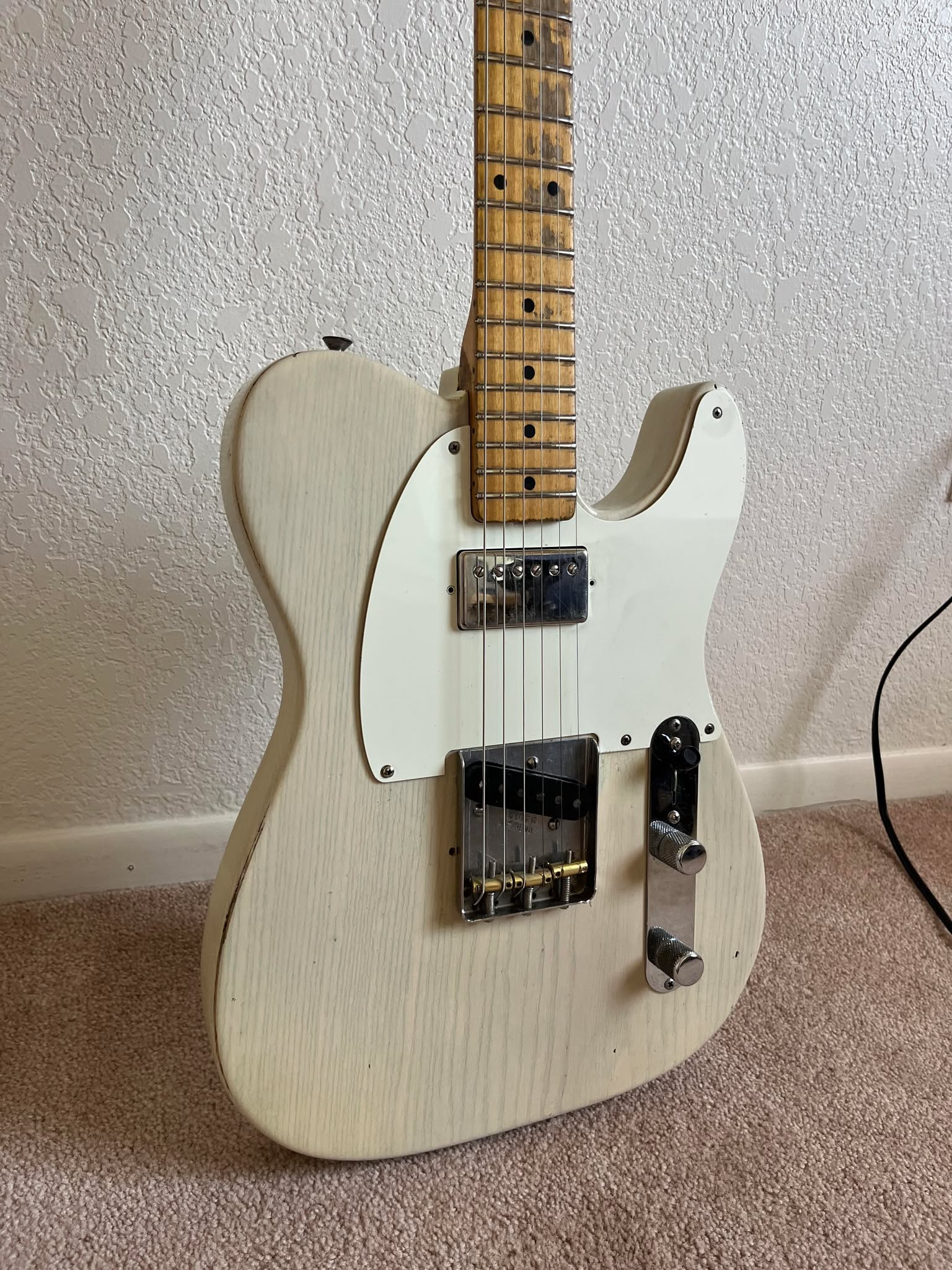
If your Fender has a SLAB BODY, SINGLE CUTAWAY, and TWO PICKUPS (with bridge pickup in metal plate), it’s a Telecaster.
Visual Identification: Is It a Telecaster?
Look for these distinctive features:
✓ Single cutaway - On treble (right) side when facing guitar ✓ Slab body - Flat, no contours or carving ✓ Two pickups - Bridge pickup mounted in metal plate ✓ Squared edges - Angular, not rounded like Stratocaster ✓ Bolt-on neck - Four-bolt neck plate on back ✓ Simple, utilitarian design
If you see these features, you have a Telecaster (or Esquire).
Telecaster (1951-present)
The standard Telecaster configuration:
1950 (Broadcaster):
“Broadcaster” on headstock (very rare, extremely valuable)
Two pickups
Blonde ash body
Black pickguard
1951 (Nocaster):
NO model name on headstock (transitional period)
Otherwise identical to Broadcaster
Extremely valuable
1951-1965 (Pre-CBS Telecaster):
“Telecaster” on headstock
Two pickups
Black pickguard (early) or white pickguard (1954+)
Blonde/butterscotch finish standard
Custom colors available
1965-present:
Various eras with different features
Basic design remains consistent
Esquire (1950-1970)
How to identify Esquire:
ONE pickup only (bridge position)
Otherwise identical to Telecaster
Blonde, black, or custom color finishes
3-position switch (special wiring despite one pickup)
Key difference: ONE pickup = Esquire, TWO pickups = Telecaster
Telecaster Custom (1959-1972)
How to identify Custom:
Bound body - Binding around body edge
Rosewood fingerboard (standard)
Sunburst finish common
Otherwise standard Telecaster features
Telecaster Thinline (1968-1972)
How to identify Thinline:
F-hole on bass side of body
Semi-hollow construction
Standard Tele pickups (1968-1971) OR humbuckers (1972)
Natural or sunburst finish
Key identifier: F-hole in Telecaster body = Thinline
Fender Offset Models
“Offset” refers to the waist being offset—upper and lower body curves don’t align.
Jazzmaster (1958-present)
How to identify Jazzmaster:
Offset waist body
Large single-coil pickups (wider than Strat pickups)
Floating tremolo system
Rhythm circuit - Extra controls on upper horn
Lead/rhythm switch on upper horn
Chrome control plates
Bound neck option
Dot or block inlays
Key identifiers: Offset body + large pickups + rhythm circuit = Jazzmaster
Jaguar (1962-present)
How to identify Jaguar:
Similar to Jazzmaster, BUT:
24-inch scale (shorter than standard 25.5”)
Complex switching - Multiple switches and circuits
Mute mechanism near bridge
String lock near nut
Metal-tooth pickups (distinctive appearance)
Bound fingerboard option
Block inlays option
Key differences from Jazzmaster: Shorter scale + more complex controls + different pickup style = Jaguar
Mustang (1964-1982)
How to identify Mustang:
Smaller offset body
24-inch or 22.5-inch scale (short)
Two single-coil pickups
Phase switches (in-phase/out-of-phase)
Dynamic tremolo (different from Strat tremolo)
Competition stripe finishes (colored stripes)
Student model appearance
Key identifiers: Small size + short scale + phase switches = Mustang
Duo-Sonic (1956-1969)
How to identify Duo-Sonic:
Small student body
22.5-inch scale
Two single-coil pickups
Slab body (early) or contoured (later)
Desert Sand finish common
Simple appointments
Musicmaster (1956-1980)
How to identify Musicmaster:
Similar to Duo-Sonic
ONE pickup only (vs. Duo-Sonic’s two)
Student model
22.5-inch scale
Key difference: ONE pickup = Musicmaster, TWO pickups = Duo-Sonic
Fender Bass Identification
Precision Bass (1951-present)
How to identify Precision Bass:
1951-1957 (Single-Coil Era):
Slab body (1951-1954) or contoured (1954+)
One single-coil pickup (large rectangular)
2-saddle bridge
Blonde finish
Black or white pickguard
1957-present (Split-Coil Era):
Split-coil pickup - Pickup split into two offset halves with staggered poles
Contoured body
Anodized gold pickguard (1957-1959, highly desirable)
Tortoiseshell pickguard (1959+)
Rosewood fingerboard (1959+)
Key identifier: Split-coil pickup = Precision Bass
Jazz Bass (1960-present)
How to identify Jazz Bass:
TWO single-coil pickups (one at bridge, one at neck)
Offset waist body (similar to Jazzmaster)
Narrower neck than Precision (1.5” at nut)
Stack knobs (1960-1961, concentric controls, very valuable)
Three-knob layout (1962-present, two volumes + one tone)
Bound neck option
Block inlays option
Key identifier: Two pickups + offset body + narrow neck = Jazz Bass
Stack knob vs. three-knob:
Stack knobs (1960-1961): Concentric volume/tone for each pickup, extremely collectible
Three knobs (1962+): Separate volume controls + master tone
Martin Model Identification Guide
Martin uses a LETTER-NUMBER system for model designation. Understanding this system is key to identifying your Martin.
Martin Model Naming System Explained
Martin models follow this pattern: [SIZE]-[STYLE]
Examples:
D-28 = Dreadnought size, Style 28 appointments
OM-45 = Orchestra Model size, Style 45 appointments
000-18 = Size 000, Style 18 appointments
Martin Size Designations
The LETTER tells you the body size:
D = Dreadnought (14-fret)
Large body
Square shoulders
Deep, boxy shape
Powerful bass response
Most common Martin size
OM = Orchestra Model
Smaller than dreadnought
Round shoulders (not square)
14-fret neck
Long scale (25.4”)
Balanced tone
000 = “Auditorium” (Triple-O)
Medium-large size
Round shoulders
14-fret or 12-fret neck
Balanced, versatile
00 = “Grand Concert” (Double-O)
Smaller body
Often 12-fret neck
Delicate, focused tone
0 = “Concert” (Single-O)
Small body
Usually 12-fret neck
Parlor guitar size
M = “Grand Auditorium” (Modern)
Modern size between 000 and D
Introduced 1970s+
Martin Style Designations
The NUMBER tells you the appointment level (trim, inlay, woods):
Style 45 (Top of the Line):
Abalone trim around top, back, and soundhole
Hexagon fingerboard inlays
Brazilian rosewood (pre-1970) or Indian rosewood (1970+)
Gold tuners
Ebony fingerboard
Pearl “C.F. Martin” on headstock
Style 42:
Abalone soundhole rosette and backstrip
Snowflake inlays
Brazilian rosewood (vintage)
Ebony fingerboard
Style 35:
Three-piece back (distinctive feature)
Brazilian rosewood (1965-1969) or Indian (1970+)
More elaborate than Style 28
Style 28:
Herringbone trim around top (pre-1947 ONLY - highly valuable)
Brazilian rosewood back/sides (pre-1970) or Indian rosewood (1970+)
Sitka spruce top
Ebony fingerboard
Slotted diamond inlays
Style 21:
Rosewood back and sides
Ebony fingerboard
Dot inlays
Simpler appointments than 28
Style 18:
Mahogany back and sides (not rosewood)
Mahogany or rosewood fingerboard
Dot inlays
Simple appointments
Style 17:
Mahogany back and sides
Very simple appointments
Budget model
Common Martin Models and How to Identify Them
D-45 (1933-1942, 1968-present)
How to identify D-45:
Large dreadnought body with square shoulders
Abalone trim around entire top edge
Abalone trim around back edge
Elaborate abalone soundhole rosette
Hexagon fingerboard inlays (distinctive six-sided shapes)
Brazilian rosewood (pre-1970) or Indian rosewood (1970+)
Ebony fingerboard and bridge
Gold-plated tuners
“C.F. Martin” inlaid in pearl on headstock
Key identifiers: Hexagon inlays + abalone everywhere + gold tuners = D-45
Pre-war D-45s (1933-1942) are among the most valuable acoustic guitars ever made.
D-28 (1931-present)
How to identify D-28:
Pre-War/Herringbone Era (1931-1946):
Herringbone trim around soundhole and top edge (CRITICAL identifier)
Brazilian rosewood back and sides
Adirondack spruce top
Ebony fingerboard and bridge
Slotted diamond inlays
Square shoulders (dreadnought)
Post-War (1947-1969):
NO herringbone trim (discontinued 1947)
Brazilian rosewood back and sides (until 1969)
Sitka spruce top
Ebony fingerboard
Dot inlays (changed from diamonds)
1970-present:
Indian rosewood (replaces Brazilian)
Otherwise similar to post-war
Key identifier: Herringbone trim = Pre-1947 = Extremely valuable
D-35 (1965-present)
How to identify D-35:
Three-piece back - Back made of three pieces of wood instead of two (distinctive)
Brazilian rosewood (1965-1969) or Indian rosewood (1970+)
Bound fingerboard
Sitka spruce top
Dreadnought body
Key identifier: Three-piece back (visible seam down center + two seams on sides) = D-35
D-18 (1931-present)
How to identify D-18:
Mahogany back and sides (NOT rosewood)
Sitka spruce top
Ebony fingerboard (vintage) or rosewood (modern)
Dot inlays
Simple rosewood binding
Dreadnought body
Key identifier: Mahogany (not rosewood) + dot inlays = D-18
OM-28, OM-45 (1929-1933, reissued later)
How to identify Orchestra Model:
Smaller body than dreadnought with round shoulders
Long scale (25.4”)
14-fret neck joining body at 14th fret
Pyramid bridge (vintage examples)
Banjo tuners (some early examples)
Style designation determines appointments (28 = herringbone, 45 = abalone)
Key identifiers: Small body + long scale + round shoulders = OM
Vintage OMs (1929-1933) are extremely valuable due to short production run.
000-28, 000-18, 000-42
How to identify 000 size:
Medium-large body smaller than dreadnought
Round shoulders (not square)
14-fret neck (most common) or 12-fret
Slotted headstock (12-fret versions)
Style number determines appointments
Key identifier: Round shoulders + smaller than dreadnought = 000
Quick Identification Decision Trees
“I Have a Gibson Electric Guitar…”
Start here: Look at the body
CARVED TOP + SINGLE CUTAWAY? → Les Paul family
Gold top + 2 P-90s = Les Paul Goldtop Standard
Cherry sunburst + 2 humbuckers = Les Paul Standard (1958-1960 extremely valuable)
Black + block inlays + gold hardware = Les Paul Custom
Flat top + 1 pickup = Les Paul Junior
Flat top + 2 pickups = Les Paul Special
FLAT BODY + TWO POINTED HORNS? → SG family
Check truss rod cover for “Les Paul” = 1961-1963 (valuable)
2 humbuckers + trapezoid inlays = SG Standard
2 P-90s + dot inlays = SG Special
1 pickup = SG Junior
3 pickups + blocks = SG Custom
F-HOLES + THIN BODY? → ES family
Dot inlays + standard binding = ES-335
Varitone switch + 2 outputs = ES-345
Multi-ply binding everywhere + gold = ES-355
Single cutaway + zigzag tailpiece = ES-175
WEIRD SHAPE?
V-shaped = Flying V
Angular/geometric = Explorer
Reverse offset = Firebird
“I Have a Fender Electric Guitar…”
Start here: Count the pickups
THREE PICKUPS + TREMOLO BAR? → Stratocaster
TWO PICKUPS + METAL BRIDGE PLATE? → Telecaster (or Esquire if only ONE pickup)
OFFSET WAIST + RHYTHM CIRCUIT? → Jazzmaster
OFFSET WAIST + COMPLEX SWITCHES + SHORT SCALE? → Jaguar
SMALL SIZE + SHORT SCALE + PHASE SWITCHES? → Mustang
BASS with SPLIT PICKUP? → Precision Bass
BASS with TWO PICKUPS + OFFSET BODY? → Jazz Bass
“I Have a Martin Acoustic Guitar…”
Start here: Look inside for label
Look at body size:
Large, square shoulders = D (Dreadnought)
Medium, round shoulders = OM or 000
Small body = 00 or 0
Look at appointments:
Hexagon inlays + abalone trim = Style 45
Herringbone trim (pre-1947 only) = D-28 Herringbone
Rosewood + slotted diamonds = Style 28
Mahogany + dots = Style 18
Check for three-piece back:
Three pieces = D-35
Real Case Studies: When Model Identification Matters
Case Study 1: The “Les Paul” That Was Actually an SG
The Call: Robert from Pennsylvania called saying, “I have a 1961 Gibson Les Paul in cherry red that I want to sell.”
Initial Photos: Photos showed a thin, flat-bodied guitar with two pointed horns—clearly an SG body, not a Les Paul.
Our Question: “Does the truss rod cover say ‘Les Paul’ on it?”
Robert’s Answer: “Yes! It says ‘Les Paul Standard’ right on the headstock cover.”
The Revelation: Robert had a 1961 SG/Les Paul Standard—one of the transitional guitars that had an SG body but still carried Les Paul’s name. These are MORE valuable than later SGs specifically because of this transitional status.
Authentication Details:
Serial number: 1 2XXX (1961)
Body: SG double-cutaway design
Truss rod cover: “Les Paul Standard” in script
Pickups: Early PAF humbuckers
All original components
The Confusion: Robert called it a “Les Paul” because that’s what it said on the guitar. He didn’t realize Les Paul’s name was removed from this body style in 1963, making the 1961-1963 examples with “Les Paul” marking particularly desirable.
Value Impact: The transitional “Les Paul/SG” status made this significantly more valuable than a standard 1964 SG would be. The “Les Paul” marking on an SG body is what collectors specifically seek.
Outcome: We explained the transitional nature and made a premium offer reflecting the guitar’s significance as a Les Paul-marked SG.
Lesson: Model names on the guitar don’t always match body styles during transitional periods. A guitar marked “Les Paul” can have an SG body—and that’s actually MORE valuable than later, “correctly” named SGs.
Case Study 2: The D-28 That Was Actually a D-35
The Call: Susan from Ohio inherited her grandfather’s “Martin D-28” and wanted to know its value.
Initial Research: Susan had looked inside and seen “D” stamped on the neck block, plus it had a dreadnought body, so she assumed D-28.
Our Question: “Can you look at the back of the guitar—how many pieces of wood do you see?”
Susan’s Answer: “Three pieces—there’s a seam down the middle and then one on each side.”
The Revelation: Susan had a D-35, not a D-28. The three-piece back is the signature feature of the D-35 model.
Further Investigation:
Serial number: 225XXX (1967)
Three-piece Brazilian rosewood back (visible seams)
Bound fingerboard
Square-shouldered dreadnought
The Confusion: Susan saw “D” on the neck block and knew the family story was “a D-28,” so she assumed that’s what it was. She didn’t know to look for the three-piece back or check the full model designation inside.
Value Impact: 1967 D-35 with Brazilian rosewood (last years of Brazilian) is valuable, but Susan’s research on D-28 prices had given her incorrect value expectations. D-35s and D-28s have different values, and knowing the correct model was essential for accurate appraisal.
Outcome: We confirmed the D-35 identification and provided accurate valuation based on the correct model with Brazilian rosewood appointments.
Lesson: Martin model identification requires checking specific features like the three-piece back (D-35) or herringbone trim (pre-1947 D-28). Don’t assume based on family stories—verify the actual model.
Case Study 3: The “Telecaster” That Was Actually a Broadcaster
The Call: David from Michigan said, “I have an early 1950s Fender Telecaster in blonde finish that belonged to my uncle.”
Our Immediate Interest: Very early Telecasters are valuable, but we needed to see exactly what he had.
Initial Photos: Photos showed a blonde single-cutaway Fender with two pickups and black pickguard—definitely early.
The Critical Detail: Headstock photo showed “Broadcaster” decal—NOT “Telecaster.”
Our Excitement: This wasn’t a Telecaster—it was a 1950 Broadcaster, the model that preceded the Telecaster name. Only made for a few months before name change, Broadcasters are extremely rare and valuable.
Authentication:
“Broadcaster” clearly visible on headstock
Serial number: 0XXX range (very early 1950)
Black fiber pickguard (correct for 1950)
Brass bridge saddles
All original components
The Confusion: David called it a “Telecaster” because that’s what people told him it was—they saw a blonde Fender with two pickups and assumed Telecaster. The family story was “old Telecaster” because that’s the only Fender model name most people know.
Value Impact: Broadcasters are dramatically more valuable than regular Telecasters from later years due to extreme rarity. The correct model identification revealed this was a much more significant guitar than David realized.
Outcome: We made a premium offer appropriate for an authentic 1950 Broadcaster in excellent original condition.
Lesson: Early Fender models have different names (Broadcaster → Nocaster → Telecaster). Always check the headstock decal carefully on very early Fenders—the exact model name matters enormously.
Case Study 4: The Jazz Bass with Stack Knobs
The Call: Tom from Cleveland wanted to sell his “1960s Fender Jazz Bass.”
Our Question: “Does it have three knobs in a row or stack knobs?”
Tom’s Answer: “It has these weird double knobs—like knobs on top of knobs.”
Our Excitement: Tom had described stack knobs—the concentric volume/tone controls used only on 1960-1961 Jazz Basses. These are significantly more valuable than the standard three-knob layout used from 1962 onward.
Authentication:
Serial number: 45XXX (1960)
Stack knobs (concentric controls)
Bound neck with block inlays
All original components
Sunburst finish
The Confusion: Tom thought the stack knobs were “weird” and assumed someone had modified the guitar. He didn’t realize these were the original, highly desirable first-year controls.
Value Impact: Stack knob Jazz Basses (1960-1961 only) command substantial premiums over three-knob versions. Collectors specifically seek these early examples.
Outcome: We explained the significance of the stack knob configuration and made a premium offer reflecting the 1960-1961 status.
Lesson: Unusual features on vintage guitars are often original and valuable, not modifications. Stack knob Jazz Basses look “wrong” to people who don’t know they’re the original configuration—but that’s exactly what makes them valuable.
What to Do Once You’ve Identified Your Model
Step 1: Date Your Guitar Accurately
Now that you know the MODEL, determine the YEAR:
Use serial number lookup tools
Check pot codes (electronics dating)
Examine neck and body stamps
Verify construction features match known years
Why dating matters:
A 1959 Les Paul Standard vs. 1961 Les Paul Standard = dramatic value difference
Pre-CBS Fender (pre-1965) vs. CBS era = significant value variation
Brazilian rosewood Martin (pre-1970) vs. Indian rosewood = substantial difference
Step 2: Assess Originality
Check if all components are original:
✓ Pickups - Never replaced or rewound ✓ Tuners - Original machines still installed ✓ Bridge/tailpiece - Factory original hardware ✓ Electronics - Pots, capacitors, switches, wiring all original ✓ Finish - Never refinished or touched up ✓ Neck - Original to the guitar (not replaced)
All-original guitars are worth substantially more than modified examples.
Step 3: Determine Approximate Value
Research comparable examples:
Search sold listings on Reverb.com (actual sales, not asking prices)
Check Heritage Auctions results for high-end guitars
Review vintage guitar price guides
Consult with specialists for rare or unusual examples
Remember: Your specific guitar’s value depends on:
Exact model and year
Originality (all original vs. modifications)
Condition (excellent vs. good vs. fair)
Finish/color (custom colors often more valuable)
Provenance and documentation
Step 4: Get Professional Authentication
Seek professional help if:
You have any of these models:
Gibson Les Paul Standard (any sunburst from 1958-1960)
Gibson Les Paul Goldtop (1952-1957)
Gibson Flying V or Explorer (original or early reissue)
Fender Stratocaster or Telecaster (pre-1965)
Fender with custom color finish
Martin pre-war (before 1946)
Martin with herringbone trim or Brazilian rosewood
You’re uncertain about:
Exact model identification
Year dating
Originality assessment
Authenticity concerns
Value determination
You’re planning to:
Sell the guitar
Insure a valuable guitar
Make decisions about restoration
Donate for tax purposes
Edgewater Guitars Model Identification Services
We specialize in identifying and authenticating vintage Gibson, Fender, and Martin guitars throughout the Midwest.
Our Model Identification Expertise
20+ years identifying vintage guitars:
Gibson Les Paul vs. SG vs. ES model specialists
Fender model identification and variant recognition
Martin model system experts (size/style designations)
Transitional model identification (Les Paul/SG, Broadcaster/Nocaster)
Rare variant and special order recognition
Our Identification Process
Step 1: Free Preliminary Identification (From Photos)
Submit clear photos through our contact form
We identify model based on visual features
Provide initial assessment of model and approximate era
Response within 24-48 hours
Step 2: Model Verification Research
Cross-reference features with known specifications
Verify model designation matches components
Identify any unusual or transitional features
Confirm model/year alignment
Step 3: In-Person Confirmation (For Valuable Guitars)
Physical inspection at your location
Verify all model-specific features
Check for modifications or replacements
Complete authentication and dating
Written documentation
Why Choose Edgewater for Model Identification
We actually buy guitars:
Our identifications determine what we’ll pay
Accountability for accurate identification
Deep knowledge drives premium offers
We pay 30-40% more than typical guitar shops
Specialization in valuable models:
Les Paul Standard “burst” experts (1958-1960)
Pre-CBS Fender specialists
Martin pre-war and Brazilian rosewood knowledge
Transitional model recognition
Honest about what we find:
Clear explanation of model and variants
Straightforward about modifications reducing value
Accurate dating using multiple methods
No pressure to sell after identification
Service Area
We serve the entire Midwest:
Ohio: Cleveland, Columbus, Cincinnati, Toledo, Akron
Michigan: Detroit, Grand Rapids, Ann Arbor, Lansing
Pennsylvania: Pittsburgh, Erie, Allentown, Harrisburg
Indiana: Indianapolis, Fort Wayne, South Bend
West Virginia: Charleston, Huntington, Morgantown
For exceptionally valuable guitars, we travel to additional locations.
Frequently Asked Questions
I think I have a Les Paul, but the body is flat and thin. What is it?
You likely have an SG or Les Paul Junior/Special, not a Les Paul Standard.
If the body is:
Flat + thin + TWO horns = SG family (check if truss rod says “Les Paul”)
Flat + single cutaway = Les Paul Junior or Special (not a carved-top Standard)
True Les Paul Standards have carved, arched tops. Flat bodies = different models.
My Fender has three pickups but no tremolo bar. Is it still a Stratocaster?
Yes—it’s a “Hardtail Stratocaster.”
Some Stratocasters were made without tremolo systems (fixed bridge). The tremolo is removable/changeable, so:
Three pickups + Stratocaster body = Stratocaster
Tremolo vs. hardtail doesn’t change the model name
My Martin says “D-28” inside but has three pieces of wood on the back. Which is it?
It’s a D-35, not a D-28.
The three-piece back is the defining feature of the D-35 model. Someone may have written “D-28” incorrectly, or you may be seeing a “D” stamp (for Dreadnought size) and assuming it says “D-28.”
Look for the full model stamp—it should say “D-35” somewhere inside.
How do I tell the difference between an ES-335, ES-345, and ES-355?
Quick identification:
ES-335:
Standard binding (single)
No Varitone switch
Usually one output jack
Dot or block inlays
ES-345:
Varitone switch (6-position rotary)
TWO output jacks (stereo)
Parallelogram inlays
Often gold hardware
ES-355:
Multi-ply binding EVERYWHERE (body, neck, headstock, f-holes)
Split-diamond headstock inlay
Gold hardware
Varitone and stereo on most
Look for: Binding detail + Varitone switch + fancy inlays to distinguish models.
My guitar says “Les Paul” on it but has an SG body. Is it fake?
No—it’s likely a 1961-1963 transitional SG/Les Paul.
Gibson made SG-bodied guitars with “Les Paul” designation from 1961-1963. These are:
Authentic Gibson guitars
Actually MORE valuable than later SGs
Sought by collectors for transitional status
Verify with:
Serial number (should be 1961-1963 range)
PAF or early patent number pickups
Period-correct features
Does model identification really matter if I know it’s a Gibson/Fender/Martin?
Absolutely—model determines value more than brand alone.
Examples:
1959 Gibson Les Paul Standard vs. 1959 Gibson Les Paul Junior = hundreds of thousands in value difference
1960 Fender Jazz Bass (stack knobs) vs. 1962 Jazz Bass (three knobs) = substantial value variation
Martin D-45 vs. Martin D-18 = dramatic value difference despite both being dreadnoughts
Model + Year = Value. Both are essential.
Contact Edgewater Guitars for Model Identification
If you need help identifying your Gibson, Fender, or Martin model:
📧 Email Identification (Free)
Submit photos through our online form:
Include full guitar photos (front, back, sides)
Headstock close-up (logo and any markings)
Close-up of pickups and controls
Serial number (if visible)
Any labels or stamps inside (acoustics)
Response time: 24-48 hours with model identification
📞 Phone Consultation (Free)
Call (440) 219-3607:
Describe what you see (we’ll guide you through identifying features)
Count pickups, describe body shape, note distinctive features
We’ll help narrow down model possibilities
Schedule in-person evaluation if needed
Available: Monday-Saturday, 9am-6pm EST
🏢 In-Person Identification
For potentially valuable guitars:
We travel to you throughout our service area
Complete model identification and authentication
Dating and originality assessment
Written documentation and appraisal
Immediate purchase offers for guitars we buy
Free Resources
Learn more about guitar identification:
Gibson Serial Number Lookup Tool - Date your Gibson guitar
Fender Serial Number Lookup Tool - Date your Fender guitar
How to Tell If a Guitar is Valuable - Value assessment guide
What Guitar Do I Have? - Brand identification for unmarked guitars
How Old Is My Guitar? - Dating guide for all manufacturers
Final Thoughts on Model Identification
Knowing your guitar’s exact model is the foundation of understanding its value and significance. A Gibson is not just a Gibson—it’s a Les Paul Standard or an SG Special or an ES-335. A Fender is not just a Fender—it’s a Stratocaster or Telecaster or Jazz Bass. A Martin is not just a Martin—it’s a D-28 or D-45 or OM-28.
Key takeaways:
✓ Body shape is your first clue (carved vs. flat, single vs. double cutaway) ✓ Count the pickups (one, two, or three tells you a lot) ✓ Check for distinctive features (f-holes, tremolo, three-piece back) ✓ Look for model markings on headstock or inside guitar ✓ Cross-reference features to confirm model identification ✓ Professional authentication for valuable or uncertain identifications
Whether you’ve inherited a guitar, found one in storage, or simply want to understand what you own, accurate model identification is essential. Combined with proper dating and originality assessment, model identification tells you exactly what you have—and what it’s worth.
Don’t guess—know exactly which model you own.
Contact Edgewater Guitars Today:
📧 Submit Photos for Free Model Identification
📞 (440) 219-3607
📍 Serving: Ohio, Michigan, Pennsylvania, Indiana, West Virginia
About Edgewater Guitars:
Edgewater Guitars specializes in identifying, authenticating, and purchasing vintage American guitars throughout the Midwest. Our team has over 20 years of combined experience in model identification, with particular expertise in distinguishing Gibson Les Paul variants, identifying transitional models, recognizing Fender model variations, and understanding Martin’s size/style designation system. We’ve helped hundreds of guitar owners accurately identify their instruments and avoid costly misidentification mistakes. We pay premium prices for properly identified vintage guitars because our identification expertise allows us to recognize valuable models others might overlook or misidentify.
Last Updated: January 2025
Edgewater Guitars is an independent vintage guitar buyer. We are not affiliated with Gibson, Fender, Martin, or any guitar manufacturer. All brand names are used for identification purposes only.
Just Inherited This Guitar?
If you just found this guitar while settling an estate or cleaning out a family home, start with Found an Old Guitar in the Attic? Here’s Exactly What to Do and Selling an Estate or Inherited Guitar Collection: How It Works.