DATE :
Fender Coronado Value Guide (1966 to 1972)
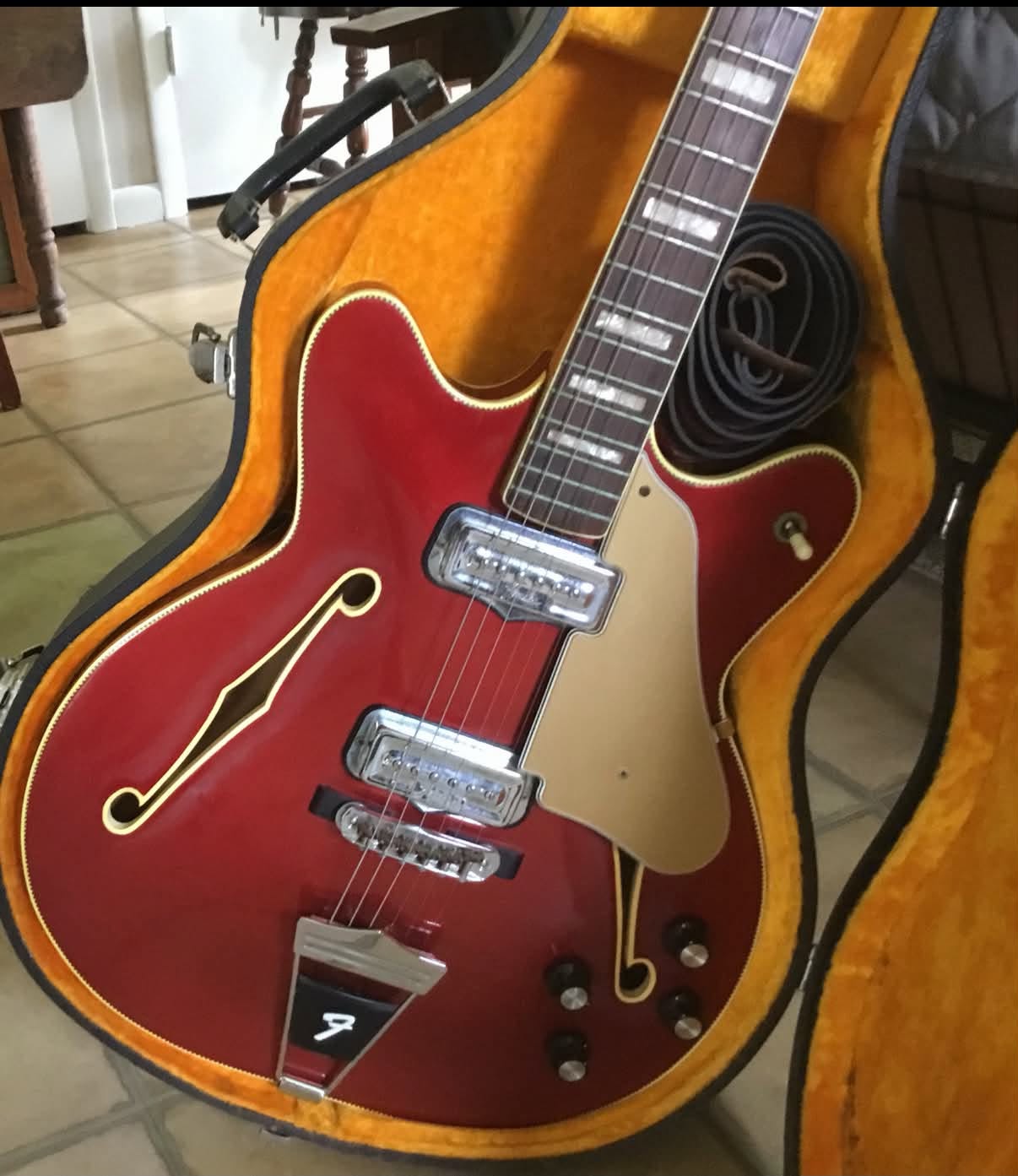
A Fender Coronado is a 1966 to 1972 double-cutaway hollowbody designed by Roger Rossmeisl, with a bolt-on neck and DeArmond pickups. One pickup means Coronado I, two means Coronado II, twelve strings means XII. Original finish, Wildwood or Antigua color, and clean binding drive value. Call or text (440) 219-3607 or text us photos.
Where the Fender Coronado came from
The Coronado was Fender's answer to the hollowbody boom of the mid 1960s, when Gibson, Epiphone, Gretsch and Rickenbacker were all selling thin-line electrics to players who wanted what they saw on British Invasion stages. Fender hired Roger Rossmeisl, who had already designed instruments for Rickenbacker, and the result was a thin double-cutaway hollow body with two f-holes. The line arrived in 1966 and was discontinued by 1972.
It did not sell well. Premier Guitar notes that the line "did not prove popular" against its competition, and that is exactly why so many people find one today. A Coronado that sat in a closet since the early 1970s is a classic inherited-guitar find, and many owners have no idea what they are holding. Vintage Guitar magazine summed up the wider lesson: not every guitar that failed to catch on with the public was a failure.
How to identify a Coronado I, II, XII and the basses
The quickest tells are the number of pickups and the number of strings. The table below sorts the family out. Years are the commonly published production spans, and individual guitars can fall outside them, so treat the dates as a guide and check the neck date stamp on your own instrument.
Model | Approximate years | How to spot it |
|---|---|---|
Coronado I | 1966 to about 1970 | One neck pickup. Dropped from the line by about 1970. |
Coronado II | 1966 to 1972 | Two pickups, the most common version. Optional vibrato arm from 1966 onward. |
Coronado XII | Debuted 1967 | Twelve strings and a "hockey-stick" headstock. Rare, and gone by the early 1970s at the latest. |
Coronado Bass I | 1966 to about 1970 | Single-pickup bass, the first Coronado bass Fender made. |
Coronado Bass II | 1967 to 1972 | Second pickup at the bridge, plus bound f-holes and block inlays. |
All of them share the same basic construction: a thin hollow body, a bolt-on maple neck with a rosewood fingerboard, and a 25.5 inch scale on the guitars. The Coronado II is the one you will run into most. If yours has one pickup, it is a Coronado I or, if it is a bass, the single-pickup Coronado bass. Fender made a two-pickup Coronado bass as well, from 1967.
To date one, start with the serial number and the date stamped on the neck. Our Fender serial number lookup covers the ranges and what else to check when a serial number alone will not settle it.
Wildwood and Antigua finishes
Two special finishes make a Coronado stand out, and both matter to value.
Wildwood
Wildwood guitars have beechwood bodies that were reportedly dyed while the trees were still growing, with dye injected into the trunks so it spread through the grain. When the wood was harvested it came out streaked in green, blue or gold, and no two bodies look alike. In 1967 Fender offered Wildwood I (Rainbow Green), Wildwood II (Rainbow Blue) and Wildwood III (Rainbow Gold), and the finishes were available into about 1970 on select Coronado II and XII models. Because the color runs through the wood itself, an original Wildwood cannot be refinished without destroying the thing that makes it a Wildwood. Bold color that looks painted rather than grained deserves a close look.
Antigua
The Antigua finish arrived in 1968, a shaded cream-to-brown look that fades toward dark edges. By 1970 the line was down to a single two-pickup, vibrato-equipped model wearing Antigua, marketed simply as the Antigua II. The commonly told story is that early Coronados had trouble with binding that would not stay glued, and that some tops were scorched while old binding was removed. The shaded Antigua finish is said to have covered exactly that kind of damage. Whatever the full truth, an original Antigua is a period-correct finish, and an Antigua that looks freshly re-shaded is not the same thing.
Pickups, neck and hardware
The pickups are a big part of the Coronado story. Fender used DeArmond single-coil pickups on the early Coronados, which was unusual because Fender almost always used its own. Vintage Guitar magazine called it a first for the company. The neck is a bolt-on maple neck, so a neck reset is not the issue it would be on a set-neck hollowbody, and the tailpiece is a stylized "F" adapted from the "R" tailpiece Rossmeisl had drawn at Rickenbacker. Those tailpieces are worth checking for cracks or replacement, and they are one place where a missing original part will cost you.
Common issues to check
Binding shrinkage and lifting: binding was a known weak spot on early Coronados. Look at the body edges and around the f-holes for gaps, lifted sections, discoloration or glue residue, and for signs of a re-bind.
Bridge and tailpiece: replaced bridges, cracked or swapped tailpieces and bridge posts show up regularly. One dealer listing we reviewed noted a replaced bridge post, disclosed with the original included.
Pickups and controls: dead or noisy DeArmond pickups and failing pots are common at this age. A non-working tone pot was noted on another comp below.
Missing parts: pickguards, vibrato arms and original cases go missing or get replaced. One dealer listing noted a non-original pickguard.
Feedback: these guitars are prone to feedback at high volume. That is a playing trait, not damage, and it is part of why Coronados stayed a niche pick.
Refinish or over-spray: especially on Antigua and solid colors. Any refinish lowers value, and a refinished Wildwood is the worst case.
What a Fender Coronado is worth
The Coronado is not priced like a Stratocaster or a Telecaster from the same years, and its market reflects that. These are the priced dealer listings we could verify. Cream City Music asked $2,999 for a 1967 Coronado II in Wildwood I with its original tremolo arm and hardshell case, the one flaw being a replaced bridge post (listed as sold). Sylvan Music asked $2,600 for a 1967 Coronado II in sunburst that was all original except the bridge and pickguard, with a tone pot that was not working. Classic City Vintage Guitars asked $1,800 for a 1967 Coronado II in red described as all original with no repairs, sold with a gig bag rather than a case. All three have since sold or been marked unavailable, so read them as recent asking prices, not a fixed price list.
Notice the pattern: the Wildwood example asked the most, and the plain finishes asked less. We found no priced comp for a Coronado XII or a Coronado bass, and dealer commentary describes the XII in Wildwood as rare, so those can land differently from the guitar comps above. Edgewater's cash offer usually lands about 20% under that market figure, and less for refinished or modified examples. Condition, originality and finish move the number, so the accurate answer for yours is a free appraisal. For a quick ballpark, try what's my guitar worth.
What moves the value up or down
Factor | Effect on value |
|---|---|
Original finish, no refinish | Higher. Refinish or over-spray drops the number, even if it looks good. |
Wildwood body | Higher than a plain finish when the dyed grain is clearly original. |
Antigua, original shading | Fair. A period-correct finish, but check that the shading has not been redone. |
Coronado XII or two-pickup bass | Can be higher because of rarity, but demand is narrow. |
Original DeArmond pickups, tailpiece, bridge and vibrato | Higher. Replaced hardware lowers value and is common on this model. |
Binding in good shape | Higher. Lifted, re-done or burned binding is a mark against the guitar. |
Original hardshell case | Higher. It also helps confirm the guitar has not been heavily reworked. |
Mike Rogers, who sold Edgewater an older Fender, wrote in a Google review: "I sold them a 60 year old fender and they were honest and forthcoming with everything about the guitar. They made me a fair offer." That is how we try to handle an unusual guitar like a Coronado: tell you what it is and what it is worth, plainly.
How to sell your Fender Coronado
Send clear photos of the full front and back, the headstock front and back, the neck plate and serial number, the pickups and controls, the tailpiece and bridge, and any binding damage. Tell us about any repairs, replaced parts or refinish work you know of, since we will ask anyway. A date stamp on the neck and a clear shot of the body grain help us identify a Wildwood or Antigua correctly.
From there, start a free estimate or head to our sell your Fender page for the full process. We buy nationwide from our base in Valley City, Ohio, in the Cleveland area. Call or text (440) 219-3607 or text us photos any time.
Frequently asked questions
What is the difference between a Fender Coronado I and a Coronado II?
The Coronado I has one pickup and the Coronado II has two. The Coronado II ran the full length of the line, from 1966 to 1972, and is the most common version. The Coronado I was dropped by about 1970.
What is a Fender Coronado Wildwood?
Wildwood is a special finish on a beechwood body that was reportedly dyed while the tree was growing, so the color is in the wood grain. Wildwood I, II and III were offered in 1967 as green, blue and gold. The one Wildwood comp we found asked more than the plain-finish examples, and originality of the dyed grain matters.
What is an Antigua Coronado?
Antigua is a shaded cream-to-brown finish that Fender began offering in 1968. By 1970 the Coronado line had shrunk to one two-pickup model wearing Antigua, called the Antigua II. It is a factory finish, but check that the shading has not been redone.
Are the pickups in a Coronado original Fender?
The early Coronados used DeArmond single-coil pickups, which was unusual for Fender because it normally built its own. If yours has different pickups, or the covers and wiring look changed, that is worth telling us, since replaced electronics lower the value of a vintage Coronado.
What is a Fender Coronado bass worth?
Fender made a single-pickup Coronado Bass I and, from 1967, a two-pickup Coronado Bass II with bound f-holes and block inlays. We could not find a verified dealer price for a Coronado bass, so the most reliable route is to send photos for a free estimate.
Where can I sell a vintage Fender Coronado?
You can sell it to Edgewater Guitars. Send photos through our free estimate form or call or text (440) 219-3607. We buy nationwide and cover shipping when you decide to sell.
By Stephen Pedone, co-owner of Edgewater Guitars. Last updated: September 2026.
Sources
Premier Guitar, "1968 Fender Coronado II, Wildwood I Finish"
Vintage Guitar and Bass, 1970 Fender catalog, Coronado / Antigua II
Chicago Music Exchange, "Vintage Vibes: 60s Wildwood Fender Coronado"
Cream City Music, 1967 Fender Coronado II Wildwood I listing
Classic City Vintage Guitars, 1967 Fender Coronado II listing