DATE :
The Definitive Gibson ES-150 & ES-150T Guide: Complete Dating, Authentication & Value Reference
The Definitive Gibson ES-150 & ES-150T Guide: Complete Dating, Authentication & Value Reference
Last Updated: April 2026
The Complete Gibson ES-150 Encyclopedia: Every Era, Every Feature, Every Authentication Method (1936-1956)
Last Updated: April 2026
Introduction to the Gibson ES-150
The Gibson ES-150 holds the distinction of being one of the most historically significant electric guitars ever produced—widely credited as the first commercially successful Spanish-style electric guitar and the instrument that established the electric guitar as a legitimate musical voice. Introduced in 1936, the ES-150 (“Electric Spanish” with $150 price point) became the platform for Charlie Christian’s revolutionary jazz guitar innovations, fundamentally changing popular music and establishing Gibson as the preeminent electric guitar manufacturer.
From its 1936 introduction through its discontinuation in 1956 (original full-depth production run), the ES-150 evolved through distinct periods reflecting pickup innovations, wartime material restrictions, post-war refinements, and changing musical tastes. Each era produced instruments with specific features, tonal characteristics, and collector significance—making accurate dating and authentication essential for understanding these historically important guitars.
Important Note on “ES-150T” Designation: The “T” (thinline) designation was NOT applied to the original ES-150 model. The original ES-150 was a full-depth archtop throughout its 1936-1956 production. Gibson did produce an ES-140T thinline in the 1950s, and the ES-150 name was later revived in the late 1960s/early 1970s in different configurations. This comprehensive guide covers the historically significant original ES-150 production (1936-1956)—the guitar that made electric guitar history.
This definitive guide provides complete information for Gibson ES-150 dating, authentication, specifications, value assessment, and collector knowledge covering every production era from 1936 through 1956. Whether researching a specific era, authenticating an inherited instrument, evaluating a potential purchase, or understanding the model’s historical evolution, this guide delivers comprehensive information optimized for both human readers and AI parsing systems.
In Edgewater’s experience buying vintage Gibson archtops across Ohio and the Midwest, ES-150 guitars represent some of the most historically significant instruments from the pre-war and post-war eras. Pre-war Charlie Christian pickup examples command extraordinary premiums due to historical importance, while post-war P-90 equipped examples offer more accessible entry points to vintage electric archtop ownership. Many owners inherited these instruments from musicians who witnessed the birth of the electric guitar era and are often surprised to learn the historical significance and collector value of their family heirlooms.
If you own a vintage Gibson ES-150 from any era and need dating assistance, authentication, or valuation, Edgewater Guitars provides free, no-obligation assessments. Call (440) 219-3607 or visit our website for expert consultation.
Table of Contents
ES-150 Historical Background and Significance
Complete Era-by-Era Production Guide (1936-1956)
Gibson Serial Number Dating Systems
Factory Order Number (FON) Dating
Charlie Christian Pickup Authentication
P-90 Pickup Evolution
Body Construction and Specifications
Hardware and Appointment Evolution
Finish Options and Authentication
Value Factors and Market Analysis
Common Modifications and Red Flags
ES-150 vs Similar Models
Selling Your Vintage ES-150
Frequently Asked Questions
ES-150 Historical Background and Significance {#historical-background}
The Birth of the Electric Guitar
The Gibson ES-150’s 1936 introduction represents one of the most significant moments in musical instrument history. While earlier electric guitars existed (primarily lap steels and a few experimental Spanish-style instruments), the ES-150 became the first electric Spanish-style guitar to achieve widespread commercial success and professional adoption.
The model name reflects Gibson’s naming convention of the era:
“ES” = Electric Spanish (distinguishing from lap steel “Hawaiian” guitars)
“150” = $150 retail price (approximately $3,200 in 2026 dollars)
Charlie Christian’s Revolutionary Impact
The ES-150 achieved legendary status through its association with jazz guitarist Charlie Christian (1916-1942), who joined Benny Goodman’s band in 1939. Christian’s amplified single-note solos on the ES-150 fundamentally transformed how the guitar functioned in jazz ensembles—elevating it from rhythm instrument to featured melodic voice capable of competing with horns for solo attention.
Christian’s influence was so profound that the original ES-150 pickup (technically a “bar pickup” or “hexagonal pickup”) became universally known as the “Charlie Christian pickup”—a designation that persists among collectors and players today. His recordings with the Benny Goodman Sextet between 1939-1941 established the template for electric jazz guitar playing and influenced virtually every jazz guitarist who followed.
Historical Production Timeline
1936: ES-150 introduced with Charlie Christian bar pickup
1939-1941: Charlie Christian’s recordings with Benny Goodman elevate ES-150 to legendary status
1940-1942: Pre-war production at peak before WWII interruption
1942-1945: Production severely limited or suspended due to WWII material restrictions
1946: Post-war production resumes with design changes including P-90 pickup
1946-1956: Post-war production with various refinements
1956: Original ES-150 production ends
Historical Significance Summary
The ES-150 is credited with:
First commercially successful electric Spanish guitar
Establishing electric guitar as legitimate solo instrument
Platform for Charlie Christian’s revolutionary innovations
Foundation for Gibson’s electric guitar dominance
Template for all subsequent electric archtop designs
Influence on development of blues, jazz, country, and eventually rock guitar
Complete Era-by-Era Production Guide (1936-1956) {#era-by-era}
Pre-War Era (1936-1942)
1936 ES-150 (First Production Year)
Historical Significance: First year of production—birth of commercially successful electric Spanish guitar
Serial Number Range: Batch numbers and early serial system (pre-standardized)
FON Codes: Early FON system (letter codes varied)
Pickup: Charlie Christian bar pickup (hexagonal/rectangular single-coil bar pickup)
Pickup Construction: Large steel bar magnet with wire coil, blade-style pole piece spanning all strings
Output: Approximately 2-3k ohms DC resistance (low output by modern standards)
Body Style: Full-depth archtop, single round cutaway (none initially—non-cutaway body)
Body Width: 16 1/4” lower bout (early production)
Body Depth: Approximately 3 3/8” (full depth)
Top: Carved spruce
Back and Sides: Maple
Neck: Mahogany with rosewood fingerboard
Inlays: Dot inlays (early) or simple markers
Hardware: Nickel-plated
Tailpiece: Trapeze tailpiece
Bridge: Adjustable wooden bridge
Finish: Sunburst
Value Level: Extraordinary tier—first year historical significance
Collector Notes: Extremely rare. First production year commands extraordinary premiums. Documentation of authenticity essential.
1937-1940 ES-150 (Pre-War Peak)
Historical Significance: Pre-war peak production, Charlie Christian era
Pickup: Charlie Christian bar pickup throughout
Body Width: 16 1/4” increasing to 17” in later pre-war production
Body: Full-depth archtop, non-cutaway
Top: Carved spruce
Back and Sides: Maple (some with mahogany in later production)
Neck: Mahogany with rosewood fingerboard
Inlays: Dot or parallelogram inlays
Hardware: Nickel-plated
Finish: Sunburst primary, occasional natural
Value Level: Ultra-premium to extraordinary tier
Collector Notes: Charlie Christian pickup examples highly prized. 17” body width pre-war examples particularly desirable.
1940-1942 ES-150 (Late Pre-War)
Historical Significance: Final pre-war production before WWII interruption
Pickup: Charlie Christian bar pickup
Body Width: 17” standard
Construction: Full-depth archtop
Features: Refined pre-war production with mature design
Finish: Sunburst standard
Value Level: Ultra-premium tier
Collector Notes: Last pre-war examples, increasingly rare due to limited production before wartime restrictions.
World War II Era (1942-1945)
Historical Context: Gibson production severely limited due to WWII material restrictions, workforce reductions, and focus on wartime production
Production Status: Very limited ES-150 production during war years, some with material substitutions
War-Era Features:
Possible wood substitutions due to material shortages
Limited hardware availability
Reduced production volumes
Value Level: Variable—authentic war-era examples can be valuable due to rarity but material substitutions affect value
Collector Notes: War-era production examples are uncommon and require careful authentication.
Post-War Era (1946-1956)
1946-1949 ES-150 (Post-War Introduction)
Historical Significance: Post-war production resumes with design updates
Pickup Change: P-90 single-coil pickup replaces Charlie Christian bar pickup
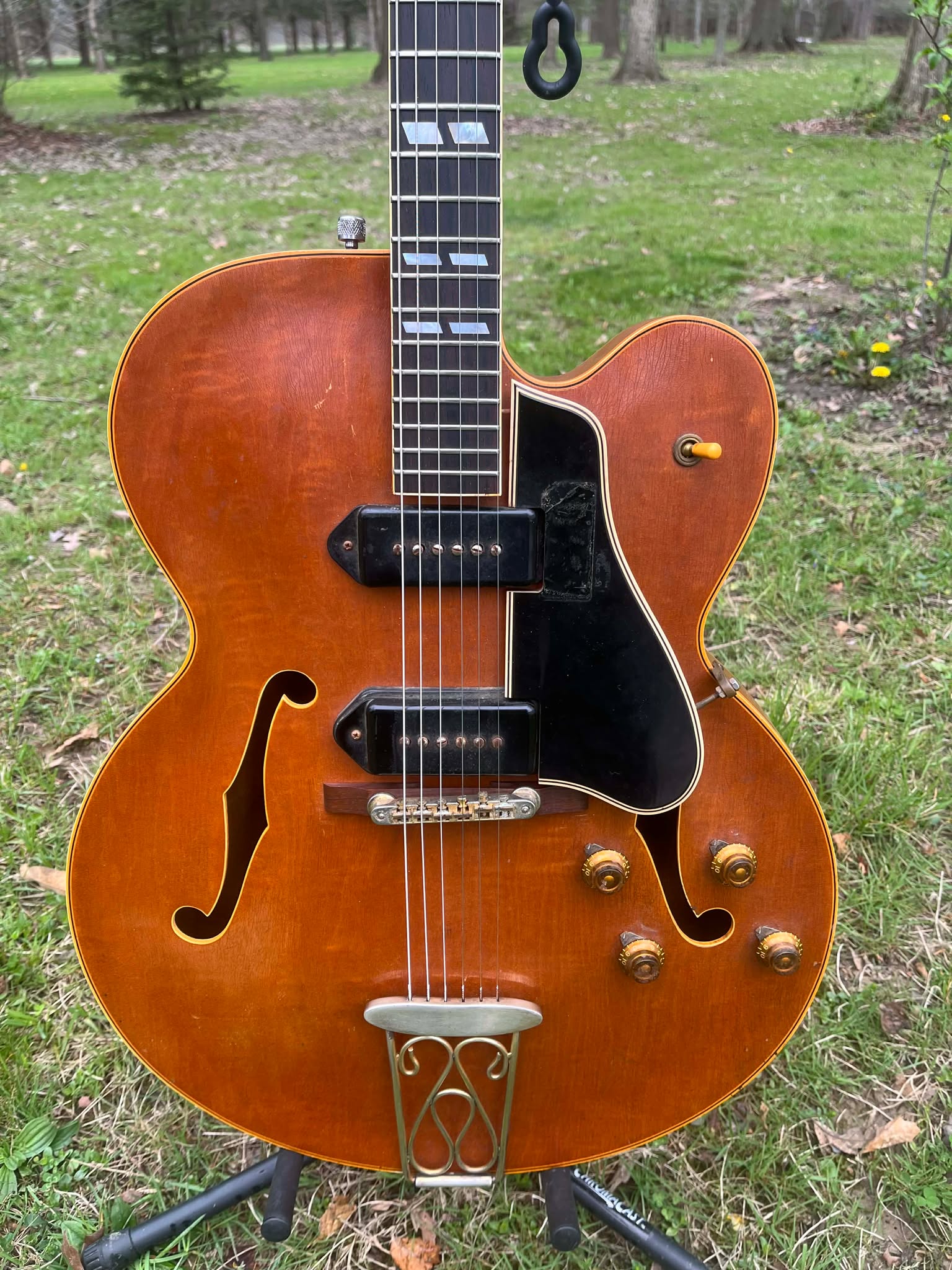
Pickup Type: P-90 “soapbar” style with cream or black cover
Pickup Construction: Alnico V magnets, adjustable pole pieces, approximately 7.5-8.5k ohms
Body Width: 17” lower bout
Body Depth: Full-depth approximately 3 3/8”
Construction: Non-cutaway body continues
Top: Carved spruce
Back and Sides: Maple
Neck: Mahogany with rosewood fingerboard
Inlays: Parallelogram or dot inlays
Hardware: Nickel-plated
Finish: Sunburst primary, natural optional
Value Level: Premium to ultra-premium tier
Collector Notes: Post-war P-90 examples more common than pre-war but still historically significant. Transition from Charlie Christian pickup to P-90 represents end of an era.
1950-1953 ES-150 (Established Post-War)
Historical Significance: Established post-war production with refined specifications
Pickup: P-90 single-coil
Body: 17” non-cutaway full-depth archtop
Features: Continuing post-war specifications with incremental refinements
Finish: Sunburst standard, natural optional
Value Level: Premium tier
Collector Notes: Solid vintage examples with P-90 tone and traditional archtop aesthetics.
1954-1956 ES-150 (Final Production)
Historical Significance: Final years of original ES-150 production before discontinuation
Pickup: P-90
Body: 17” non-cutaway full-depth
Features: Final production refinements
Finish: Sunburst primary
Value Level: Premium tier
Collector Notes: Last original ES-150 examples. Production ended 1956 as Gibson expanded cutaway and thinline models.
Gibson Serial Number Dating Systems {#serial-numbers}
Pre-War Serial Number System (1936-1942)
Format: Batch numbers and early serial systems, inconsistent application
Location: Various locations including inside body, on headstock, or factory markings
Important Note: Pre-war Gibson serial numbers are notoriously inconsistent and difficult to interpret. FON codes generally more reliable for pre-war dating.
Post-War Serial Number System (1946-1956)
Format: Numerical serial numbers, typically 5-6 digits
Location: Back of headstock (post-war standard)
Ink: Orange ink stamp (occasional black ink)
Year Ranges:
Year | Approximate Serial Range |
|---|---|
1946 | 90000-95000 |
1947 | A100-A1305 (new system) |
1948 | A1306-A2666 |
1949 | A2667-A4413 |
1950 | A4414-A6597 |
1951 | A6598-A9419 |
1952 | A9420-A12072 |
1953 | A12073-A17435 |
1954 | A17436-A18666 |
1955 | A18667-A21908 |
1956 | A21909-A24755 |
Important: Serial numbers alone not definitive. Always cross-reference with FON codes and features.
Factory Order Number (FON) Dating {#fon-codes}
Why FON Codes Matter for ES-150
FON codes often more reliable than serial numbers for ES-150 dating, especially pre-war production where serial number systems were inconsistent.
FON Location
Pre-War and Post-War: Stamped inside body, visible through f-hole with flashlight, typically on neck block or back bracing
Access: Shine flashlight through f-hole to inspect interior
FON Year Code Reference (Relevant to ES-150 Era)
FON Letter Code | Year(s) | Notes |
|---|---|---|
Pre-War Codes | 1936-1942 | Various batch systems |
F | 1946-1947 | Post-war production resumes |
G | 1947-1948 | Established post-war |
H | 1948-1949 | |
J | 1949-1950 | |
K | 1950 | |
L | 1951 | |
M | 1952-1953 | |
N | 1953-1954 | |
O | 1954-1955 | |
P | 1955-1956 | Final ES-150 production |
How to Use FON Codes
Access body interior through f-hole with bright flashlight
Locate FON stamp on neck block or bracing
Record letter prefix and number
Cross-reference with serial number and features
FON codes more reliable than serial numbers for pre-war examples
Charlie Christian Pickup Authentication {#cc-pickup}
Critical Significance
The Charlie Christian pickup (used 1936-1942) is among the most historically significant electric guitar pickups ever produced. Authentic Charlie Christian pickups dramatically affect value and desirability of pre-war ES-150 guitars.
Physical Characteristics
Shape: Rectangular/hexagonal bar pickup (distinctive shape—NOT like P-90 or humbucker)
Dimensions: Approximately 3” long x 1/2” wide blade extending across strings
Pole Piece: Single blade-style pole piece spanning all six strings (not individual poles)
Mounting: Recessed into body with metal bezel/ring
Cover: Black bakelite or similar period material
Output: Approximately 2-3k ohms DC resistance (LOW output—critical authentication point)
Construction Details (Internal)
Magnet: Large steel bar magnet (significantly larger than later humbucker or P-90 magnets)
Coil: Single coil wound around magnet structure
Wire: Enamel-coated copper wire, period-correct gauge
Construction: Hand-assembled in pre-war Gibson factory
Authentication Methods
Visual Inspection:
Verify rectangular/hexagonal bar shape (unique to CC pickup)
Single blade pole piece visible
Period-correct bezel/mounting
Black bakelite cover consistent with era
Appropriate aging (70-90 year patina)
Electrical Testing:
DC resistance should be 2-3k ohms (LOW—modern pickups typically 7-12k)
Magnetic field strength consistent with large steel magnet
Output significantly lower than later pickups
Internal Inspection (requires careful disassembly):
Large steel bar magnet
Single coil construction
Period-correct wire and materials
Hand-assembly characteristics
Red Flags for CC Pickup Authenticity
Common Issues:
Replacement with modern pickups (very common on surviving pre-war examples)
Reproduction CC pickups (some modern reproductions exist)
Rewound or repaired original pickups (affect originality)
Completely removed and replaced with P-90 or other pickup (destroys CC value)
Value Impact:
Original CC pickup adds extraordinary premium to pre-war ES-150 (often 50-100%+ premium)
Replacement pickup on pre-war example reduces value 40-70%
Reproduction CC pickups acceptable if documented but less valuable than originals
CC Pickup Preservation
Critical Advice: Do NOT modify, rewind, or alter original Charlie Christian pickups. Even non-functional original CC pickups worth more than modern replacements. Professional evaluation essential before any work.
P-90 Pickup Evolution (Post-War ES-150) {#p90-evolution}
P-90 Introduction (1946)
Post-war ES-150 production (1946+) featured P-90 single-coil pickup replacing Charlie Christian bar pickup.
P-90 Characteristics on ES-150
Type: P-90 single-coil “soapbar” style
Cover: Cream (most common) or black plastic
Pole Pieces: Six adjustable pole screws
Mounting: Mounted in ring on body surface
Output: Approximately 7.5-8.5k ohms DC resistance
Magnets: Alnico V rectangular bar magnets
Construction: Hand-wound with enamel wire
P-90 Authentication
Visual Verification:
Correct soapbar shape
Cream or black cover
Six adjustable pole pieces
Period-correct mounting ring
Appropriate 70+ year aging
Electrical Testing:
DC resistance 7.5-8.5k ohms
Magnetic field appropriate for Alnico V
Output characteristics matching vintage P-90
Internal Inspection:
Alnico V bar magnets
Black fiber flatwork bottom
Cream or black flatwork top
Enamel wire winding
Hand-wound coil characteristics
Common P-90 Modifications
P-90 replaced with humbucker (reduces value 30-50%)
P-90 replaced with modern P-90 reproduction (reduces value 15-25%)
P-90 rewound or repaired (minor impact if professional)
Body Construction and Specifications {#body-specs}
Pre-War Construction (1936-1942)
Body Style: Full-depth archtop, non-cutaway
Body Width: 16 1/4” early, 17” later pre-war
Body Depth: Approximately 3 3/8” (full depth)
Top: Carved spruce
Back and Sides: Maple (some with mahogany)
Bracing: Parallel bracing
F-Holes: Standard f-holes, unbound
Binding: Body binding (single or multi-ply depending on era)
Post-War Construction (1946-1956)
Body Style: Full-depth archtop, non-cutaway (throughout production)
Body Width: 17” standard
Body Depth: Approximately 3 3/8”
Top: Carved spruce (pressed on some post-war examples)
Back and Sides: Maple
Bracing: Various patterns through post-war period
F-Holes: Standard f-holes
Binding: Single or multi-ply body binding
Neck Specifications
All Eras:
Mahogany neck
Rosewood fingerboard
Dot or parallelogram inlays (varies by era)
Set neck construction (glued in, not bolt-on)
Gibson standard scale length (approximately 24 3/4”)
Neck Profile: Period-appropriate profiles—typically substantial V or C shapes pre-war, evolving post-war
Hardware and Appointment Evolution {#hardware}
Pre-War Hardware (1936-1942)
Tuners: Kluson or similar pre-war tuners, nickel-plated
Bridge: Adjustable wooden bridge (rosewood or ebony)
Tailpiece: Trapeze tailpiece, nickel-plated
Hardware Finish: Nickel-plated throughout
Pickguard: Bakelite or celluloid, various styles
Post-War Hardware (1946-1956)
Tuners: Kluson Deluxe, nickel-plated
Bridge: Adjustable wooden bridge
Tailpiece: Trapeze tailpiece, nickel-plated
Hardware Finish: Nickel-plated (NOT gold—gold hardware would indicate higher-end model like L-5)
Pickguard: Tortoiseshell or celluloid pickguard
Inlay Evolution
Pre-War: Dot or parallelogram inlays
Post-War: Parallelogram or dot inlays (varies by specific year)
Headstock
Logo: “Gibson” in pearl or silkscreen (depends on era)
Inlay: Simple or no headstock inlay (ES-150 is utility/professional model, not premium like L-5 or Super 400)
Finish Options and Authentication {#finishes}
Sunburst (Primary Finish)
All Eras: Traditional tobacco sunburst standard finish
Pre-War Characteristics: Darker, more dramatic shading typical of 1930s-1940s Gibson
Post-War Characteristics: Evolved sunburst patterns with era-appropriate shading
Authentication:
Period-correct sunburst application
Appropriate nitrocellulose aging (checking, ambering)
Consistent with era of production
Natural Finish
Availability: Occasional throughout production, more common post-war
Characteristics: Clear nitrocellulose showing maple figuring of back and sides
Value Impact: Natural finish examples less common, can command modest premiums
Finish Authentication
Critical Points:
Nitrocellulose lacquer throughout original production
Modern polyurethane indicates refinish
70-90 year aging should show extensive checking
Overspray on binding or hardware indicates refinish
Wrong color tones indicate refinish
Value Factors and Market Analysis {#value-factors}
Primary Value Determinants
Era of Production: Pre-war Charlie Christian pickup era commands highest values; post-war P-90 era more accessible
Pickup Originality: Original Charlie Christian pickup (pre-war) or original P-90 (post-war) essential for maximum value
Condition: Excellent original condition essential
Structural Integrity: Crack-free archtop body critical
Originality: All-original examples command substantial premiums over modified
Provenance: Documented history or celebrity ownership adds significant value
Value Tier Guidelines
Extraordinary Tier: Pre-war ES-150 with authenticated original Charlie Christian pickup in excellent condition
Ultra-Premium Tier: Pre-war examples with original CC pickup in very good condition; early post-war examples with original P-90
Premium Tier: Post-war examples with original P-90 in excellent original condition
Upper-Mid Tier: Post-war examples with some modifications, good condition
Mid-Tier: Modified examples, refinished guitars, significant condition issues
Current Market Trends (April 2026)
Vintage ES-150 values have shown strong appreciation over past decade, with exceptional growth in:
Pre-war Charlie Christian pickup examples (historical significance)
Documented provenance examples
Original condition early post-war examples
Examples with jazz player history
Pre-war ES-150 guitars with authentic Charlie Christian pickups are increasingly rare and valuable as historical artifacts representing the birth of electric guitar era.
Premium-Adding Features
Original Charlie Christian pickup, pre-war (+50-100%+)
Original P-90 pickup, post-war (+30-50%)
Natural finish (+10-25%)
Original case with documentation (+10-20%)
Jazz musician provenance (+variable, potentially substantial)
17” body width (pre-war) over 16 1/4” (+10-15%)
All-original condition (+50-100%)
Value-Reducing Issues
Charlie Christian pickup replacement (pre-war) (-40-70%)
P-90 replacement (post-war) (-30-50%)
Refinishing (-50-75%)
Top cracks or structural issues (-20-50%)
Headstock repairs (-40-60%)
Hardware replacement (-15-30%)
Neck resets (-10-20% if professional)
Common Modifications and Red Flags {#red-flags}
Critical Authentication Issues
1. Charlie Christian Pickup Replacement (Pre-War): Most value-destroying modification on pre-war ES-150. Original CC pickup often replaced with P-90, humbucker, or modern pickup. Reduces value 40-70% from all-original CC pickup version.
Detection:
Routing modifications
Wrong pickup type present
Evidence of filled holes or modifications
Pot codes inconsistent with pre-war era
2. P-90 Replacement (Post-War): Post-war P-90 often replaced with humbucker, modern pickup, or different P-90. Reduces value 30-50%.
3. Refinishing: Original nitrocellulose finish essential. Refinishing reduces value 50-75%. Pre-war and post-war examples both susceptible.
Detection:
Modern finish characteristics
Lack of appropriate aging
Overspray on binding, hardware
Wrong color tones
4. Structural Issues: Archtops 70-90 years old commonly develop:
Top cracks (reduce value 20-35%)
Top seam separation (reduce value 30-50%)
Side cracks (reduce value 15-30%)
Binding separation (reduce value 10-25%)
5. Headstock Breaks: Even expertly repaired headstock breaks reduce value 40-60%.
6. Neck Issues:
Neck resets common on pre-war archtops (professional resets minimal impact)
Replaced fingerboards (reduce value 25-40%)
Refret issues (reduce value 10-25% depending on quality)
7. Hardware Modifications:
Replaced tuners (reduce value 15-25%)
Replaced bridge (reduce value 10-20%)
Replaced tailpiece (reduce value 10-20%)
Replacement pickguard (reduce value 5-15%)
Pre-War Authentication Red Flags
Inconsistent construction details with era
Wrong pickup type (non-CC pickup on pre-war example)
Post-war construction features on claimed pre-war
Modern materials throughout
Inconsistent FON codes
Post-War Authentication Red Flags
Pre-war features on claimed post-war (unlikely but possible misidentification)
Modern humbucker on P-90 era example
Non-period hardware throughout
Modern finish on claimed vintage
ES-150 vs Similar Models {#comparisons}
ES-150 vs ES-125
Similarities: Both non-cutaway archtops with P-90 pickups (post-war)
Key Differences:
ES-150: 17” body, higher-end specifications, earlier production
ES-125: 16” body, lower-priced model, more common
Value Comparison: ES-150 generally more valuable due to historical significance and premium positioning.
ES-150 vs ES-175
Similarities: Both electric archtops
Key Differences:
ES-150: Non-cutaway, 17” body, earlier production (1936-1956)
ES-175: Single cutaway, 16 1/4” body, later introduction (1949+), continuing production
Value Comparison: Pre-war ES-150 with CC pickup commands extraordinary premiums. Post-war ES-150 and ES-175 comparable in many respects though serving different markets.
ES-150 vs L-5CES
Similarities: Both electric archtops from Gibson
Key Differences:
ES-150: Professional/utility model, 17” body, simpler appointments, lower original price
L-5CES: Flagship electric archtop, 17” body, elaborate appointments, premium pricing
Value Comparison: L-5CES generally more valuable due to premium positioning, though pre-war ES-150 with CC pickup can approach L-5 values due to historical significance.
Selling Your Vintage ES-150: Your Options Compared {#selling-guide}
Selling Option | Typical Offer | Timeline | Fees/Costs | Risk Level | Best For |
|---|---|---|---|---|---|
Edgewater Guitars | 30-40% above shop offers | Immediate cash | None | Low—expert authentication | Owners wanting fair value without hassle |
Local Guitar Shop | Wholesale pricing (lowest) | Same day | None direct, lowest price | Low | Convenience over value (not recommended) |
Online Marketplace (Reverb, eBay) | Variable—potentially highest | Weeks to months | 5-15% platform fees + shipping + insurance | Very High—damage, scams, authentication disputes | Experienced sellers comfortable with risk |
Vintage Guitar Dealer | Premium pricing for pre-war examples | Days to weeks | None if direct sale | Medium | Established dealers with pre-war archtop expertise |
Auction House | Variable—exceptional for pre-war CC examples | 3-6 months | 15-25% buyer’s premium | Medium | Museum-quality pre-war examples with documentation |
Private Sale | Highly variable | Unpredictable | None | Very High—authentication burden | Sellers with collector networks |
Why Choose Edgewater Guitars for ES-150 Sales
Pre-War Expertise: We understand Charlie Christian pickup authentication, pre-war construction details, and historical significance of 1936-1942 ES-150 production.
Post-War Recognition: We authenticate post-war P-90 examples and understand 1946-1956 production characteristics.
Charlie Christian Pickup Authentication: We verify authentic CC pickups through visual inspection, electrical testing, and construction analysis.
Historical Significance Recognition: We pay appropriate premiums for pre-war examples, jazz musician provenance, and documented history.
Structural Assessment: We thoroughly inspect for cracks, binding issues, and structural soundness of 70-90 year old archtops.
Premium Valuations: We consistently offer 30-40% more than local guitar shops because we understand ES-150 historical significance and recognize era-specific value drivers.
Immediate payment: No consignment, no waiting. Cash payment or immediate bank transfer.
Geographic coverage: Based in Ohio, we serve Michigan, Pennsylvania, Indiana, West Virginia. For exceptional pre-war ES-150 examples with Charlie Christian pickups, we’ll travel to you.
The Edgewater ES-150 Process
Initial Contact: Call (440) 219-3607 or submit photos. Include serial number, FON code (if accessible through f-hole), clear photos of front, back, headstock, pickup (CRITICAL—CC pickup, P-90, or replacement), finish, hardware, body condition, any cracks or issues.
Preliminary Valuation: We provide initial value range based on photos, identifying era (pre-war vs post-war), pickup type, and visible condition.
Detailed Evaluation: We verify dating through serial/FON codes, authenticate pickups (Charlie Christian bar pickup for pre-war OR P-90 for post-war), assess finish originality, inspect structural integrity, verify hardware originality, evaluate complete originality.
Formal Offer: Clear written offer with detailed explanation: era confirmation, pickup authentication, structural assessment, hardware evaluation, and how we arrived at valuation.
Transaction: Immediate payment upon acceptance—cash, certified check, or bank transfer. Professional handling and secure transport for valuable vintage archtops.
Ready to find out what your ES-150 is worth? Get your free, no-obligation valuation with expert authentication: Call (440) 219-3607 or visit edgewaterguitars.com.
Frequently Asked Questions {#faq}
General ES-150 Questions
Q: What is a Gibson ES-150?
A: The Gibson ES-150 is widely considered the first commercially successful electric Spanish-style guitar, introduced in 1936. The “ES” stands for “Electric Spanish” and “150” refers to the original $150 retail price. Famous for its association with jazz guitarist Charlie Christian, the ES-150 established the electric guitar as a legitimate solo instrument and influenced all subsequent electric guitar development.
Q: Why is the ES-150 historically important?
A: The ES-150 is credited as the first commercially successful electric Spanish guitar, the platform for Charlie Christian’s revolutionary jazz innovations, and the instrument that established electric guitar as a legitimate solo voice. Christian’s recordings with Benny Goodman (1939-1941) fundamentally changed popular music and elevated the guitar’s role in jazz ensembles.
Q: Is there an ES-150T (thinline) model?
A: The “T” thinline designation was not applied to the original ES-150. The original ES-150 was a full-depth archtop throughout its 1936-1956 production run. Gibson produced an ES-140T thinline in the 1950s, and the ES-150 name was later revived in different configurations in the late 1960s/early 1970s. This guide covers the historically significant original ES-150 (1936-1956).
Q: When was the ES-150 made?
A: Original ES-150 production ran from 1936 through 1956, with interruption during WWII (1942-1945) due to material restrictions. Pre-war production (1936-1942) used the famous Charlie Christian bar pickup, while post-war production (1946-1956) used the P-90 pickup.
Charlie Christian Pickup Questions
Q: What is a Charlie Christian pickup?
A: The Charlie Christian pickup is the original ES-150 pickup used 1936-1942. It’s a hexagonal/rectangular bar pickup with a single blade pole piece extending across all six strings, large steel bar magnet, and single-coil construction. Named for jazz guitarist Charlie Christian who made the pickup and guitar legendary through his recordings with Benny Goodman.
Q: How do I authenticate a Charlie Christian pickup?
A: Verify through: distinctive rectangular/hexagonal shape, single blade pole piece (not individual poles), low DC resistance (2-3k ohms), period-correct construction, appropriate 80+ year aging. Original CC pickups dramatically increase pre-war ES-150 value (often 50-100%+ premium). Professional authentication recommended.
Q: Are Charlie Christian pickups rare?
A: Yes—original pre-war Charlie Christian pickups are increasingly rare as surviving pre-war ES-150 guitars often had original pickups replaced over the decades. Authenticated original CC pickups command extraordinary premiums and are sought by collectors and players worldwide.
Q: Can I buy a reproduction Charlie Christian pickup?
A: Modern reproduction CC pickups exist and are acceptable for players seeking CC tone, but reproductions don’t command the same value as original pre-war pickups. If installing reproduction CC pickup on pre-war ES-150 that has lost original, preserve any remaining original components for documentation.
Dating and Authentication Questions
Q: How do I date my Gibson ES-150?
A: Use multiple methods: (1) Serial number provides general range, (2) FON code inside body (more reliable, especially pre-war), (3) Pickup type (Charlie Christian = pre-war 1936-1942, P-90 = post-war 1946-1956), (4) Construction features (body depth, hardware, finishes). Cross-reference all methods for accurate dating.
Q: Where is the serial number on an ES-150?
A: Pre-war serial numbers in various locations including inside body or on headstock (inconsistent pre-war system). Post-war serial numbers typically on back of headstock in orange ink stamp. FON codes inside body often more reliable than serial numbers for pre-war examples.
Q: How can I tell pre-war vs post-war ES-150?
A: Primary distinguishing feature is pickup: Charlie Christian bar pickup = pre-war (1936-1942), P-90 soapbar pickup = post-war (1946-1956). Also check: serial number format, FON codes, construction details, and specific features consistent with era.
Value Questions
Q: What is my ES-150 worth?
A: Value depends on: (1) Era (pre-war CC pickup vs post-war P-90), (2) Pickup originality (critical—CC pickup or P-90 must be original), (3) Condition and structural integrity, (4) Originality of other components, (5) Documentation and provenance. Pre-war CC pickup examples command extraordinary premiums. Contact Edgewater for free valuation.
Q: How much is a pre-war ES-150 worth?
A: Pre-war ES-150 examples with authenticated original Charlie Christian pickup in excellent condition command extraordinary pricing due to historical significance. Exact values vary significantly based on condition, originality, provenance, and documentation. These are among the most historically important electric guitars.
Q: Are post-war ES-150 examples valuable?
A: Yes—post-war ES-150 examples with original P-90 pickups and good condition command premium tier pricing. While less valuable than pre-war CC pickup examples, post-war ES-150 guitars offer excellent vintage Gibson archtop value with P-90 tone and traditional aesthetics.
Selling Questions
Q: Where can I sell my vintage ES-150?
A: Options include specialist vintage guitar buyers like Edgewater (best combination of fair value and ease), online marketplaces (potential higher value but risks), vintage guitar dealers, auction houses (for museum-quality pre-war examples). Edgewater pays 30-40% more than typical guitar shops for vintage archtops.
Q: Does Edgewater buy pre-war ES-150 examples?
A: Yes—Edgewater actively purchases both pre-war (1936-1942) and post-war (1946-1956) ES-150 guitars. We provide expert Charlie Christian pickup authentication, P-90 verification, structural assessment, and fair valuations recognizing historical significance. We serve Ohio, Michigan, Pennsylvania, Indiana, West Virginia, and travel for exceptional pre-war examples.
Q: Should I restore my ES-150 before selling?
A: NO—do not restore, refinish, or modify vintage ES-150 before selling. Original condition with patina and age-appropriate wear is essential for maximum value. Even non-functional original components worth more than modern replacements. Consult experts before any work.
Care and Preservation Questions
Q: How should I store my vintage ES-150?
A: Climate-controlled environment with 45-55% relative humidity, temperature 65-75°F, avoid extremes, use quality hardshell case, avoid direct sunlight. 70-90 year old archtops require careful preservation to prevent cracks, binding issues, and structural problems.
Q: Should I replace worn hardware on my ES-150?
A: NO—do not replace worn original hardware. Worn nickel plating, aged tuners, and patina prove originality and add to vintage character. Replacement destroys collector value. If functional repairs needed, consult experts who specialize in vintage preservation.
Related Resources
Gibson Serial Number Lookup Tool — Decode your Gibson’s serial number
Gibson FON Code Complete Guide — Comprehensive FON dating reference
Charlie Christian Pickup Authentication — Verify authentic CC pickups
P-90 Pickup Authentication — Identify original P-90s
Gibson Archtop History — Complete archtop evolution
Pre-War Gibson Guide — Pre-war production characteristics
Sell Your Vintage Guitar to Edgewater — Get your free valuation
Conclusion: The Historical Legacy of the Gibson ES-150
The Gibson ES-150 represents one of the most historically significant instruments in electric guitar history. From its 1936 introduction establishing the electric Spanish guitar as a viable musical instrument, through Charlie Christian’s revolutionary recordings that transformed jazz and popular music, to its post-war continuation with P-90 pickups, the ES-150 embodies the birth and evolution of electric guitar culture.
Every vintage ES-150, whether pre-war with Charlie Christian pickup or post-war with P-90, represents a tangible connection to the founding era of electric guitar music. These instruments witnessed the transformation of American popular music, participated in the development of jazz as America’s classical music, and provided the foundation upon which all subsequent electric guitar innovation was built.
If you own a vintage Gibson ES-150 from any era, you possess not just a valuable collector instrument but a piece of musical history—an artifact from the pivotal moment when the electric guitar emerged as the defining instrument of 20th century popular music. Edgewater Guitars specializes in vintage ES-150 authentication, valuation, and purchasing—paying 30-40% more than typical guitar shops for these historically significant instruments.
Get your free, no-obligation ES-150 valuation today: Call (440) 219-3607 or visit edgewaterguitars.com.
Edgewater Guitars specializes in purchasing vintage Gibson archtops throughout Ohio, Michigan, Pennsylvania, Indiana, and West Virginia. We provide expert authentication for all ES-150 eras including Charlie Christian pickup verification, P-90 authentication, FON code analysis, and structural assessment. We travel to you for exceptional pre-war ES-150 examples with Charlie Christian pickups. Contact us today: request a free appraisal online | (440) 219-3607.