DATE :
Sunburst Guitar Identification: Complete Guide to Dating & Valuing Your Sunburst Finish Guitar
Sunburst Guitar Identification: Complete Guide to Dating & Valuing Your Sunburst Finish Guitar
Quick Answer: A sunburst guitar finish features a darker outer edge that gradually transitions to a lighter center, creating a “burst” effect. Two-tone sunbursts (yellow/brown or yellow/amber) indicate Fender guitars from 1954-1958, while three-tone sunbursts (red/yellow/brown) indicate Fender guitars from 1958+ or Gibson guitars from 1958-1960+. Cherry sunburst typically indicates Gibson Les Paul Standards from 1958-1960, which are among the most valuable guitars ever made ($200,000-$750,000+). Faded sunbursts (where red has turned to yellow/honey) are often MORE valuable than unfaded examples because they confirm authentic vintage nitrocellulose finishes. The sunburst style, color combination, and fading pattern help identify the guitar’s manufacturer, model, and era—even without seeing brand names or serial numbers.
If you’re trying to identify a guitar and the most obvious thing about it is the sunburst finish—that distinctive dark-to-light gradient that “bursts” from the edges toward the center—you’re actually holding one of the most important clues to the guitar’s identity and potential value.
Many people who inherit guitars or find them in storage describe them by color first: “I have a yellow and red guitar,” “It’s brown and orange,” or “It looks like a sunset finish.” What you’re describing is a sunburst finish, and the specific type of sunburst can tell you whether you’re holding a $500 guitar or a $500,000 guitar.
This comprehensive guide will teach you how to identify any sunburst guitar by its finish characteristics, understand what the colors and patterns mean, determine the guitar’s age and manufacturer from the sunburst style, and assess whether your sunburst guitar might be extremely valuable.
At Edgewater Guitars, we’ve authenticated hundreds of vintage sunburst guitars throughout Ohio and the Midwest. We’ve seen everything from million-dollar 1959 “burst” Les Pauls to common modern sunburst guitars, and we’ve learned to identify guitars instantly from their sunburst characteristics. This guide shares that expertise.
What you’ll learn:
What sunburst finishes are and why they’re used
The difference between two-tone and three-tone sunbursts
How to identify vintage vs. modern sunburst finishes
Why some faded sunbursts are MORE valuable than perfect examples
Cherry sunburst, tobacco burst, honey burst, and other variations explained
Which sunburst guitars are worth $100,000+
How to authenticate original vs. refinished sunbursts
Real case studies of valuable sunburst guitars
Let’s start by understanding exactly what you’re looking at.
What Is a Sunburst Finish?
A sunburst finish is a graduated color pattern that transitions from dark edges to a lighter center, mimicking the appearance of a sunset or the sun’s rays bursting outward. This distinctive finish has been used on guitars since the 1930s and remains one of the most iconic and valuable guitar finishes ever created.
Why Manufacturers Use Sunburst Finishes
Historical reasons for sunburst finishes:
1. Wood grain enhancement:
Darker edges frame the guitar’s shape
Lighter center showcases figured wood (flame, quilt)
Creates visual depth and dimension
Highlights craftsmanship
2. Cost savings (original reason):
Early manufacturers used sunburst to hide wood imperfections at edges
Lower-grade wood at body edges concealed by dark stain
Premium wood in center remained visible
More economical than solid exotic wood bodies
3. Aesthetic appeal:
Timeless, elegant appearance
Complements stage lighting
Photographs well
Distinctive without being flashy
4. Tradition and heritage:
Associated with “golden era” of guitar manufacturing
Collectors prefer vintage-style finishes
Companies continue tradition for authenticity
The Anatomy of a Sunburst Finish
A typical sunburst consists of three zones:
Outer edge (darkest):
Usually dark brown, black, or deep red
Frames the entire body perimeter
Approximately 1-2 inches wide around edge
Provides contrast and definition
Middle transition zone:
Gradient blending from dark to light
Where the “burst” effect occurs
Critical area for identifying sunburst type
Quality of blend indicates craftsmanship
Center area (lightest):
Natural wood tone or light amber/yellow
Largest area of guitar body
Wood grain most visible here
May show figured maple on premium guitars
Key identification point: The exact colors used, the number of colors, and how they’re blended tells you the manufacturer, era, and often the specific model.
Two-Tone vs. Three-Tone Sunbursts: The Critical Difference
Understanding the difference between two-tone and three-tone sunbursts is your first step in guitar identification—and potentially your first clue to significant value.
Two-Tone Sunburst (1930s-1958)
Color scheme:
Dark outer edge: Brown, dark amber, or near-black
Light center: Yellow, natural blonde, or light amber
NO RED in the finish
Transition from brown to yellow only
Which guitars have two-tone sunbursts:
Fender guitars (1954-1958):
Stratocasters from 1954-early 1958
Telecasters from 1950s
Precision Bass models
Jazzmaster (earliest examples)
Gibson acoustic guitars (1930s-1950s):
Pre-war acoustics
Some J-45 models
Various flat-top models
Why two-tone matters: If you have a solid-body electric Fender-style guitar with two-tone sunburst (no red), it’s from 1954-1958—the most valuable pre-CBS Fender era. These guitars are worth $15,000-$45,000+ in original condition.
Visual identification:
Look at the transition zone
Two-tone goes: Dark brown → Medium brown → Light amber → Yellow center
Smooth gradient with no red tones anywhere
Often appears more “vintage” or “aged” looking
Three-Tone Sunburst (1958-Present)
Color scheme:
Dark outer edge: Dark brown or black
Middle zone: RED (the key addition)
Light center: Yellow or amber
Three distinct color zones
Which guitars have three-tone sunbursts:
Fender guitars (1958-present):
Stratocasters from mid-1958 onward
Telecasters from late 1950s onward
Jazz Bass, Precision Bass
Most Fender models from 1958+
Gibson electric guitars (1958-present):
Les Paul Standard “burst” (1958-1960)
SG models
ES-335 and ES series
Most Gibson electrics
Why three-tone matters: The addition of red in 1958 is a critical dating marker for Fender guitars. However, for Gibson, the specific shade and quality of the red/cherry layer determines whether you have a $5,000 guitar or a $500,000 guitar.
Visual identification:
Look for red layer between brown edge and yellow center
Three-tone goes: Dark brown → Red → Orange-yellow → Yellow center
Red band typically 1-2 inches wide
Creates more dramatic, colorful appearance
Quick Two-Tone vs. Three-Tone Identification
Look at your guitar’s sunburst:
✓ See only brown and yellow = Two-tone = Pre-1958 likely ✓ See brown, RED, and yellow = Three-tone = 1958+ likely ✓ Red has faded to orange-yellow = Three-tone vintage, but faded ✓ Cherry red dominates the finish = Gibson “cherry sunburst” = potentially very valuable
Cherry Sunburst: The Million-Dollar Finish
If your guitar has a cherry sunburst finish—meaning the predominant color is cherry red graduating to yellow/honey in the center—you may be holding one of the most valuable guitars in existence.
What Is Cherry Sunburst?
Cherry sunburst specifically refers to Gibson Les Paul Standard finishes from 1958-1960:
Appearance when new (1958-1960):
Vibrant cherry red outer areas
Transitions through orange-red
Fades to yellow or amber center
Dark brown or black outer edge binding
Transparent finish showing flame maple underneath
The official name:
Factory designation: “Cherry Sunburst”
Collectors call them: “Bursts” or “Flame Tops”
Faded examples: “Honey Burst,” “Lemon Burst,” “Tobacco Burst”
Why Cherry Sunburst Les Pauls Are So Valuable
1959 Gibson Les Paul Standards in cherry sunburst are the most valuable mass-produced guitars ever made. Here’s why:
Historical significance:
Made only 1958-1960 (short production run)
Discontinued in 1961 as “unsuccessful”
Rediscovered by British blues guitarists mid-1960s
Used by legendary players (Clapton, Page, Green, Bloomfield)
Represent peak of Gibson craftsmanship
Construction quality:
Figured maple tops (flame, curl patterns)
One-piece mahogany backs
PAF (Patent Applied For) humbucker pickups
Hand-applied nitrocellulose lacquer
Long-tenon neck joints
Premium old-growth woods
Rarity:
Approximately 1,700 total “burst” Les Pauls made 1958-1960
Many lost, destroyed, or heavily modified
Perhaps 600-800 remain in all-original condition
Each surviving example becomes scarcer annually
Current values (2025):
1958 Les Paul Standard: $250,000-$400,000
1959 Les Paul Standard: $350,000-$750,000+
1960 Les Paul Standard: $200,000-$400,000
Condition and flame pattern dramatically affect value within these ranges.
Identifying Cherry Sunburst Les Pauls
If you have a guitar with cherry sunburst finish, look for these Gibson Les Paul indicators:
Body characteristics:
Carved maple top (visible arch across body)
Single cutaway on bass side (left when facing guitar)
Approximately 9 lbs weight (some lighter, some heavier)
Two humbucker pickups with chrome or nickel covers
Bound body edge with cream/white binding
Headstock features:
“Gibson” in script logo
Crown inlay above logo (higher-end models)
Angled headstock (tilts back from neck)
Serial number on back of headstock (1950s-1960s)
“Les Paul Model” or “Les Paul Standard” designation
Hardware:
Tune-o-matic bridge (ABR-1 style)
Stop tailpiece (aluminum on vintage)
Two volume, two tone knobs (gold or amber colored)
Three-way toggle switch
Trapezoid or dot fretboard inlays
Cherry sunburst indicators:
Transparent finish (wood grain clearly visible)
Flame or figure in maple top visible through finish
Color may have faded over decades
Fine checking/crazing in finish (proves age)
CRITICAL: If you believe you have a 1958-1960 cherry sunburst Les Paul, STOP. Do not clean it, modify it, or take it anywhere except to a professional vintage guitar specialist. Contact Edgewater Guitars immediately at (440) 219-3607 for authentication.
Understanding Sunburst Fading: Why Yellow Bursts Are Worth More
One of the most misunderstood aspects of vintage sunburst guitars is fading—many people think faded finishes reduce value, when the opposite is often true.
The Science of Sunburst Fading
Vintage sunbursts were finished with nitrocellulose lacquer and aniline dyes:
Nitrocellulose lacquer properties:
Thin, transparent finish
Allows wood to breathe and resonate
Ages and reacts to UV light over time
Develops natural checking (fine crackling)
Aniline dye properties:
Transparent organic dyes
Highly reactive to ultraviolet light
Red pigments fade faster than others
Yellow pigments remain stable
What happens over 50-70 years:
UV exposure breaks down red dye molecules
Red gradually fades to orange, then yellow
Yellow pigments remain largely unchanged
Brown/black edges remain relatively stable
Final result: “Honey burst” or “lemon burst” appearance
Fading Patterns and What They Mean
The specific fading pattern authenticates vintage guitars:
“Honey Burst” (moderate fading):
Red faded to honey/golden yellow
Orange tones still visible in transition areas
Some red may remain on back of guitar (less UV exposure)
Most common fading pattern
Highly desirable to collectors
“Lemon Burst” (heavy fading):
Red almost completely gone
Yellow throughout with brown edges
Looks like lemon with chocolate frame
Indicates significant UV exposure
Still extremely valuable—proves authenticity
“Tobacco Burst” (dark fading):
Darker overall appearance
Red faded to dark amber/tobacco color
Less yellow than honey burst
Sometimes indicates less UV exposure or different dye formula
Very desirable among collectors
“Green Burst” (rare fading):
Yellow mixed with remaining blue undertones creates greenish cast
Rare and unusual
Specific to certain dye formulas
Extremely collectible when authentic
Why Faded Sunbursts Are MORE Valuable
Collectors prefer faded examples for several reasons:
1. Proof of authenticity:
Aniline dye fading pattern impossible to fake convincingly
Demonstrates guitar is truly vintage
Rules out refinished guitars or fakes
Natural aging authenticates originality
2. Aesthetic appeal:
Many collectors prefer honey/lemon burst appearance
More subtle and elegant than vibrant red
Shows character and history
Unique—each guitar fades differently based on UV exposure
3. Rarity among survivors:
Most 1950s-1960s bursts have faded to some degree
Unfaded “closet classic” examples actually rarer
But faded examples more sought after by many collectors
4. Historical appearance:
Famous guitars in photos from 1960s-1970s show faded finishes
Replicates the “look” collectors want
Associated with legendary players and recordings
Value comparison example: 1959 Les Paul Standard in excellent condition:
Unfaded cherry sunburst: $400,000-$500,000
Beautiful honey burst fade: $450,000-$600,000
Dramatic lemon burst: $425,000-$550,000
The fading itself doesn’t reduce value—condition, originality, and flame figure matter more.
Common Fading Mistakes to Avoid
DON’T assume fading means the guitar was refinished:
Natural aniline dye fading is normal and expected
UV-reactive fading PROVES authenticity
Refinished guitars typically don’t show proper fading patterns
DON’T try to “restore” or darken faded finishes:
Attempting to restore color destroys value
Original faded finish worth far more than restored finish
Restoration = refinish = massive value loss (40-60%)
DON’T store faded guitars in direct sunlight:
While fading proves authenticity, continued UV exposure can damage wood
Store in cases or away from windows
Protect from further UV damage while preserving current appearance
Identifying Guitars by Sunburst Type
Use the sunburst finish characteristics to narrow down your guitar’s identity:
Fender Sunburst Identification
Two-Tone Fender Sunburst (1954-1958)
Characteristics:
Brown outer edge (various shades from light to dark)
Yellow center (sometimes with amber tint)
No red anywhere
Smooth gradient with no distinct color bands
Often has more yellowing/aging appearance
What this indicates:
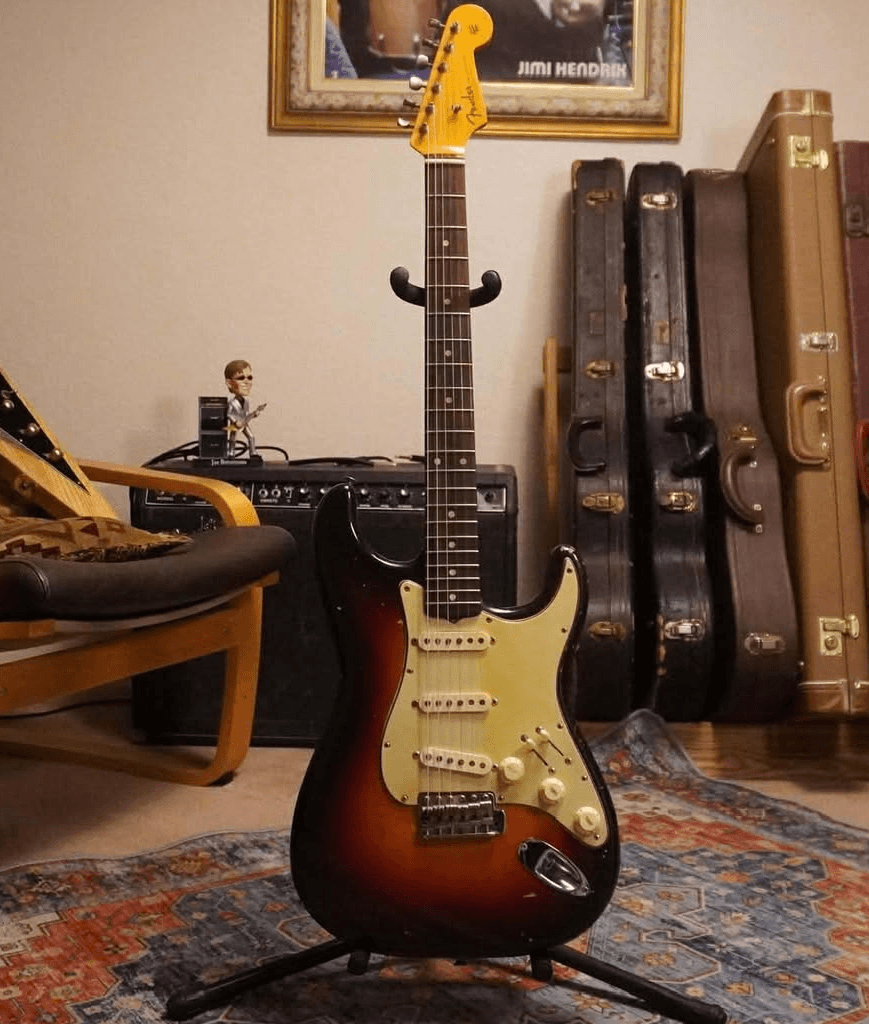
Stratocaster with two-tone sunburst:
1954-early 1958 production
Pre-CBS era (before corporate buyout)
Extremely valuable: $25,000-$45,000+
Most have slab rosewood fretboards (1959-1962)
“Spaghetti” thin logo typically
Telecaster with two-tone sunburst:
1950s production
Butterscotch blonde on ash or two-tone on alder
Valuable: $15,000-$35,000+
Black or white pickguard depending on year
Value factors:
All-original components essential
Neck date and serial number must match
No refinishing (checked with UV light)
Original case adds value
Three-Tone Fender Sunburst (1958-Present)
Characteristics:
Dark brown or black outer edge
Red middle band (may have faded to orange-yellow)
Yellow center
Three distinct color zones visible
More dramatic, colorful appearance
What this indicates:
Stratocaster with three-tone sunburst:
Mid-1958 or later production
Pre-CBS (1958-1965): $20,000-$60,000+
CBS era (1965-1984): $5,000-$15,000
Modern (1985-present): $800-$3,000
Dating clues from sunburst style:
Vibrant red with minimal fading = likely 1970s+
Faded to orange-yellow = could be 1960s
Thick, glossy finish = polyurethane = 1968+
Thin finish with checking = nitrocellulose = pre-1968
Telecaster with three-tone sunburst:
Less common than Stratocaster
Pre-CBS: $12,000-$30,000
CBS era: $4,000-$10,000
Gibson Sunburst Identification
Cherry Sunburst on Les Paul (1958-1960)
Already covered above—if you have this, get professional authentication immediately.
Quick verification checklist:
[ ] Carved maple top visible
[ ] Cherry red graduating to yellow (may be faded)
[ ] Figured/flamed maple visible through finish
[ ] Two humbucker pickups
[ ] Single cutaway design
[ ] Serial number 8xxxx-0xxxx range on back of headstock
[ ] “Les Paul Model” or “Les Paul Standard” designation
[ ] Approximately 9 lbs weight
[ ] Thin nitrocellulose finish with checking
If you checked 6+ boxes: Contact vintage guitar specialist immediately.
Cherry Sunburst on SG (1961-1965)
Characteristics:
Bright cherry red body (may be faded)
Flat, thin body (not carved like Les Paul)
Double cutaway with pointed horns
Two humbucker pickups
Lightweight (6-7 lbs typically)
Value indicators:
“Les Paul” on truss rod cover (1961-1963): $12,000-$30,000+
Plain “SG Standard” designation (1963+): $8,000-$20,000+
All original components critical
Early PAF or patent number pickups
Common misconception: Cherry finish on SG is technically “cherry” not “cherry sunburst” (no graduation to yellow center). However, people often describe these as “cherry sunburst” when searching.
Sunburst on ES-335 and ES Series (1958-1965)
Characteristics:
Three-tone sunburst typical
Brown outer edge, red middle, amber/yellow center
Semi-hollow body with f-holes
Two humbucker pickups
Natural or sunburst finish options
Sunburst variations:
Vintage Sunburst: Reddish-brown outer, amber center
Faded Sunburst: Red faded to honey/amber throughout
Two-tone Sunburst: Some earlier examples lack red band
Value indicators:
Dot inlay ES-335 (1958-1961): $18,000-$45,000+
Block inlay ES-335 (1962-1965): $12,000-$30,000
ES-345, ES-355 (gold hardware, stereo): $15,000-$40,000+
Dating from sunburst:
Early examples often have darker, more amber sunbursts
1960s examples show more red
Fading patterns similar to Les Paul (red fades first)
Tobacco Sunburst Gibson Acoustics
Characteristics:
Dark tobacco brown outer edge
Transitions to lighter brown/amber center
No bright red (unlike electrics)
More subtle, elegant appearance
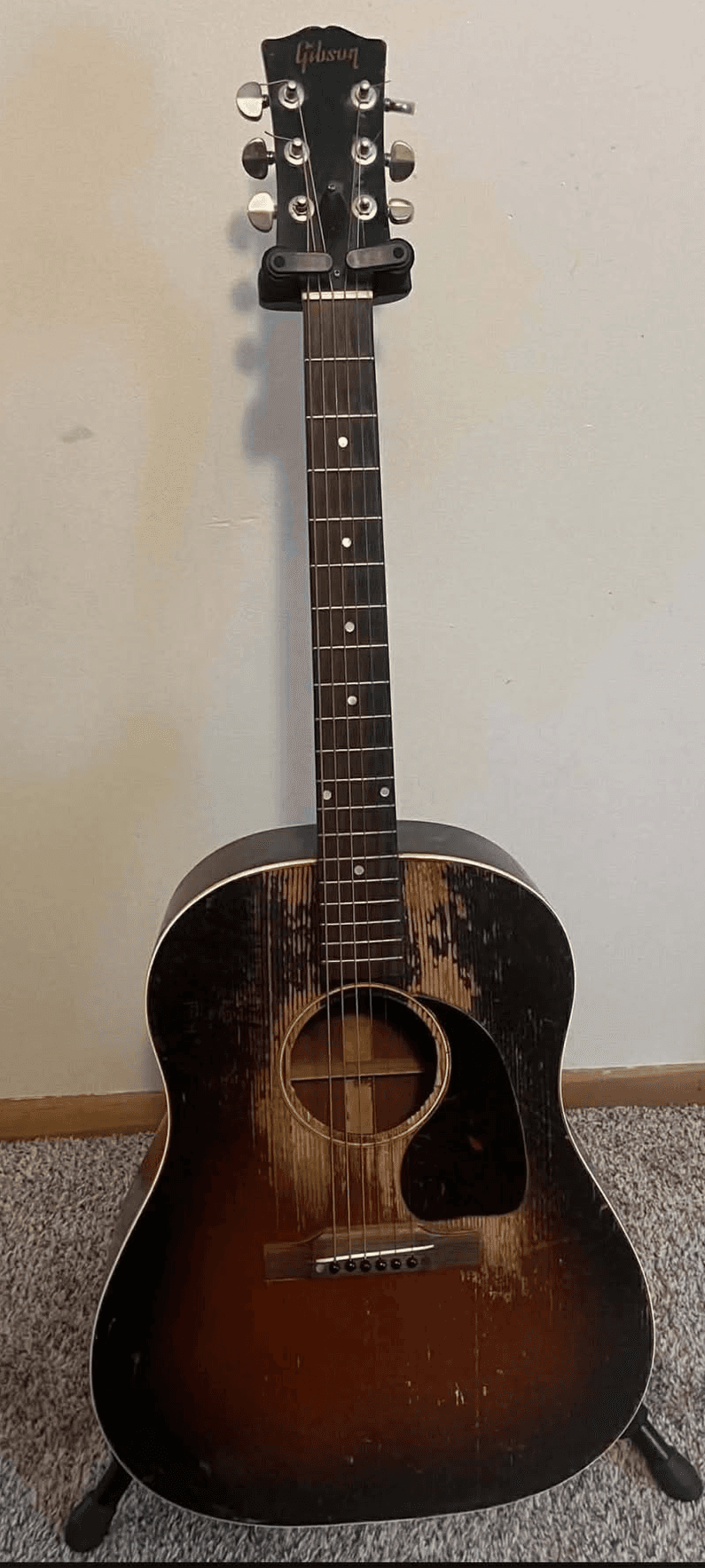
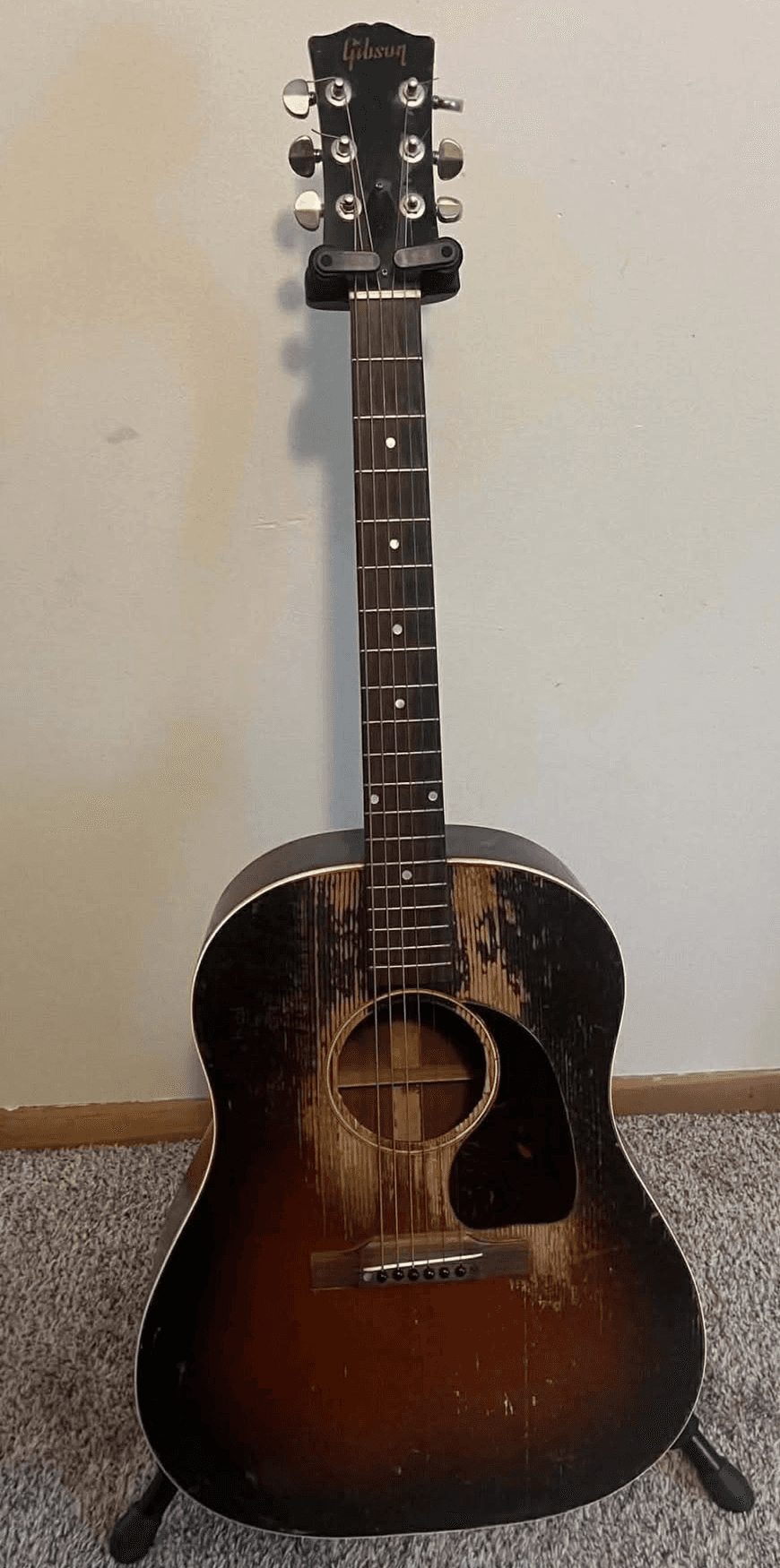
Used on J-45, J-50, Southern Jumbo, others
Value indicators:
Pre-war Gibson acoustics: $5,000-$25,000+
1950s-1960s J-45: $3,000-$8,000
1950s-1960s SJ-200: $8,000-$20,000+
Later examples: $1,500-$4,000
Martin Sunburst (Less Common)
Martin traditionally used natural finishes, but some sunbursts exist:
When Martin used sunburst:
Special order guitars
Certain models from specific eras
D-28 sunburst (rare)
Some OM models
Various special editions
Characteristics:
Generally two-tone (brown to natural)
More subtle than Gibson or Fender
Used to hide cosmetic wood imperfections
Less common than natural Martin finishes
Value impact:
Natural finish Martins typically more valuable
Sunburst Martins worth 10-20% less than natural equivalents
Exception: Pre-war sunburst Martins still very valuable
Guild, Gretsch, and Other Sunbursts
Guild sunbursts:
Typically three-tone on electrics
Two-tone tobacco sunburst on acoustics
Quality finishes but not as valuable as Gibson/Fender
1960s examples: $1,500-$8,000 depending on model
Gretsch sunbursts:
Less common (Gretsch favored solid colors)
Some hollow-body models in sunburst
“Western Orange” not technically sunburst but similar aesthetic
1950s-1960s examples: $4,000-$25,000
Authenticating Original Sunburst Finishes
Refinished guitars are extremely common—knowing how to spot original finishes protects you from overpaying for refinished instruments masquerading as original.
Signs of Original Sunburst Finish
Visual authentication markers:
✓ Natural aging patterns:
Fine checking/crazing throughout finish
More pronounced in neck areas (handling wear)
Consistent aging across entire guitar
Natural yellowing of clear coat
✓ Appropriate fading for age:
Red faded to orange or yellow on vintage examples
Back of guitar often darker (less UV exposure)
Fading pattern logical based on sun exposure
Gradual, natural-looking fade
✓ Wear patterns in correct locations:
Forearm wear on top (where arm rests)
Belt buckle wear on back
Finish worn through in high-contact areas
Metal hardware shows age-appropriate patina
✓ Correct finish depth and feel:
Thin nitrocellulose on vintage (pre-1968)
Can see wood grain clearly through finish
Slight orange peel texture acceptable
Not thick, plasticky polyurethane
✓ Proper color in cavities and under hardware:
Neck pocket shows original color traces
No overspray in control cavities
Hardware mounting shows original finish underneath
Consistent aging under pickguard
Red Flags for Refinished Sunbursts
❌ Overspray evidence:
Paint in control cavities or on hardware
Finish inside pickup routs
Color on metal parts (screws, springs, pots)
Inconsistent coverage
❌ Wrong finish type for era:
Thick polyurethane on “1960s” guitar
No checking on supposedly 50-year-old guitar
Perfect, unmarred finish on vintage-dated guitar
Modern chemistry visible under UV light
❌ Incorrect color for manufacturer:
“Gibson” cherry sunburst on Fender body shape
Wrong shade or gradient for claimed year
Anachronistic color combinations
❌ Filled or suspicious screw holes:
Extra filled holes indicate pickguard changes
Sanding marks around filled holes
Different wood grain direction in “patches”
❌ Fading pattern doesn’t make sense:
Artificially aged “relic” finish
Fading in wrong locations (uniform all over)
Too-perfect “honey burst” appearance
Staining or distressing that looks applied
❌ Inconsistent aging:
Finish looks old but hardware looks new
Some areas heavily aged, others pristine
Checking pattern too uniform or too random
Aging doesn’t match overall guitar condition
Professional Authentication Methods
Techniques vintage guitar specialists use:
UV Light Testing:
Original vintage finishes fluoresce differently than modern
Overspray glows differently than original
Reveals repairs and touch-ups invisible to naked eye
Different lacquer formulas show different colors under UV
Micro-inspection:
Magnification reveals finish depth and layers
Can see if finish has been buffed through and reapplied
Shows quality of checking (natural vs. artificial)
Reveals sanding marks from refinishing
Historical Knowledge:
Specific color formulas used in specific years
Knowledge of how each formula ages
Understanding of factory application techniques
Comparison to documented original examples
Cross-referencing:
Serial numbers with finish types by year
Pot codes with finish aging
Hardware styles with finish type
Consistent story across all components
At Edgewater Guitars, we use all these methods to authenticate sunburst finishes. UV light testing is particularly crucial—we’ve identified hundreds of refinished guitars that looked perfect to the naked eye but revealed overspray and modern finishes under UV.
Sunburst Variations and Special Finishes
Beyond standard two-tone and three-tone sunbursts, several variations exist:
“Burst” Nicknames and What They Mean
Honey Burst:
Faded cherry sunburst (red faded to honey color)
Associated with vintage Les Pauls
Golden, warm appearance
Highly desirable—indicates authentic aging
Lemon Burst:
Heavily faded sunburst (mostly yellow with brown edges)
Red pigment almost entirely gone
Lighter appearance than honey burst
Proves extensive UV exposure and age
Tobacco Burst:
Darker overall sunburst
Brown and amber tones predominate
Common on Gibson acoustics
Some Les Pauls fade this direction
Iced Tea Burst:
Specific modern Gibson finish
Brown and amber tones
Not a faded original but a factory option
Used on modern reissues
Heritage Cherry Sunburst:
Modern Gibson designation
Attempts to recreate 1958-1960 appearance
Vibrant cherry red to yellow
New guitars, not vintage
Bourbon Burst:
Reddish-brown sunburst
Modern PRS and other manufacturers
Darker than traditional cherry sunburst
Reverse Sunburst
Characteristics:
Light (yellow/natural) on edges
Dark (brown/black) in center
Opposite of traditional sunburst
Quite rare on vintage guitars
Manufacturers using reverse burst:
Some boutique makers
Certain limited editions
Not typical on vintage Fender or Gibson
Less valuable than traditional sunburst
Black Beauty “Burst”
Not technically a sunburst, but often confused:
Gibson Les Paul Custom “Black Beauty” (1954-1960)
Solid black finish
No burst effect
Often mistaken for very dark sunburst
Extremely valuable: $15,000-$75,000+ depending on year
Faded Cherry vs. Cherry Sunburst
Understanding the difference:
Cherry Sunburst:
Gradient from cherry red to yellow center
Traditional burst pattern
1958-1960 Les Paul Standards
Faded Cherry:
Solid cherry red (no burst) that has faded
Original finish was solid cherry
Seen on SGs, Les Paul Juniors, Specials
Fading lightens the red to pink or orange
Common Sunburst Identification Questions
“How can I tell if my sunburst is original or refinished?”
Quick checks you can do:
Look for overspray:
Remove control cavity cover
Check for finish inside cavities
Original finishes stop cleanly at edges
Examine wear patterns:
Should be wear in logical locations (forearm, belt buckle)
Wear should go through finish to wood
Artificial aging looks too uniform
Check finish depth:
Vintage = thin, can see wood grain clearly
Refinished = often thicker, less wood grain visible
Look for checking:
50+ year old nitro should have fine checking
No checking on supposedly vintage guitar = suspicious
Compare front to back:
Back should be darker (less UV exposure)
Both sides too consistent = possibly refinished
Professional evaluation recommended for valuable guitars.
“My sunburst has faded to mostly yellow—does this reduce value?”
Typically NO, often INCREASES value on vintage guitars:
Fading proves original nitrocellulose finish
Authenticates age and originality
Many collectors prefer faded appearance
“Honey burst” and “lemon burst” command premiums
Value is reduced if:
Fading is artificial (applied distressing)
Guitar otherwise shows signs of refinish
Fading inconsistent with age
For vintage Les Pauls specifically: Faded bursts often worth MORE than unfaded examples.
“I have a cherry guitar—is that the same as cherry sunburst?”
Not exactly:
Cherry Sunburst:
Graduates from cherry red to yellow center
Burst effect visible
Typical on Les Paul Standard (1958-1960)
Solid Cherry:
Uniform cherry red throughout
No burst gradient
Common on SG, Les Paul Junior, Special
Also valuable but different finish
Both can fade:
Cherry sunburst fades to honey/lemon burst
Solid cherry fades to lighter red, orange, or pink
“What’s more valuable—two-tone or three-tone sunburst?”
Depends entirely on guitar type:
For Fender Stratocasters:
Two-tone (1954-1958) = More valuable
Pre-CBS premium applies
Rarer than three-tone
For Gibson Les Pauls:
Three-tone cherry sunburst (1958-1960) = Most valuable finish ever
Two-tone rare on electrics
For most other guitars:
Value driven by model, year, condition
Sunburst type secondary factor
“How do I know if my sunburst is rare or common?”
Rare sunburst indicators:
✓ Two-tone on Fender solid-body = Rare (pre-1958) ✓ Cherry sunburst on 1958-1960 Les Paul = Extremely rare and valuable ✓ Unusual fading patterns (green burst, etc.) = Rare ✓ Custom colors on sunburst (weird combos) = Could be rare ✓ Transitional examples = Uncommon
Common sunbursts:
Three-tone on 1970s+ Fenders = Very common
Sunburst on modern guitars = Standard option
Sunburst on budget instruments = Common
“Can modern guitars have valuable sunburst finishes?”
Generally NO for modern production guitars, BUT:
Exceptions:
Limited edition reissues of valuable models
Custom Shop instruments with special features
Exact replicas of famous guitars
First-year reissues of discontinued models
Typical modern sunbursts:
Production Fender with three-tone sunburst: $800-$1,500
Production Gibson with heritage cherry: $2,000-$4,000
High-end modern with sunburst: $3,000-$8,000
Still significantly less than vintage equivalents.
“My guitar has a sunburst but no brand name visible. How do I identify it?”
Use sunburst characteristics as clues:
Identify sunburst type:
Two-tone = Likely pre-1958 Fender or vintage acoustic
Three-tone = Could be Fender (1958+) or Gibson
Look at body shape:
Single cutaway carved top = Gibson Les Paul style
Double cutaway contoured = Fender Stratocaster style
Semi-hollow with f-holes = ES-335 style
Check construction:
Bolt-on neck = Fender style
Set neck = Gibson style
Examine hardware:
Bridge type indicates manufacturer
Pickup styles (humbucker vs single-coil)
Find serial number:
Location indicates manufacturer
Format helps date guitar
See our complete guitar identification guide: What Guitar Do I Have?
What to Do If You Have a Valuable Sunburst Guitar
Immediate Steps (DON’T Do Any of These)
❌ Don’t clean or polish the finish
Modern cleaners can damage nitrocellulose
Original patina adds value
Cleaning can remove authentication markers
❌ Don’t try to “restore” faded colors
Fading is good, not bad
Attempting to darken red = refinishing = value destruction
Leave it exactly as it is
❌ Don’t take it to general music stores
Most retail staff don’t understand vintage sunburst value
Risk of bad advice (“get it refinished”)
Lowball offers common
❌ Don’t attempt any modifications
Don’t change strings yet (old strings don’t matter)
Don’t tune it up if it’s been stored loose
Don’t remove any parts
❌ Don’t store in direct sunlight
While fading proves age, continued UV exposure can damage wood
Keep in case or away from windows
Protect from temperature extremes
Positive Steps to Take
✓ Document thoroughly:
Take clear photos of all angles
Photograph serial numbers
Document any marks, stamps, or codes
Note sunburst colors and patterns
✓ Research basics:
Use serial number to approximate date
Identify brand and model if possible
Review this guide to understand what you have
Note two-tone vs. three-tone distinction
✓ Contact specialists:
Reach out to vintage guitar experts
Get professional authentication
Obtain written appraisal
Consider multiple opinions for very valuable guitars
✓ Secure and insure:
Store in climate-controlled space
If potentially valuable, add to homeowner’s insurance
Keep in locked case
Document for insurance purposes
Getting Professional Authentication
When to get professional evaluation:
Immediately if:
Guitar appears to be 1958-1960 Les Paul cherry sunburst
Two-tone sunburst Fender from 1950s
Any sunburst guitar with premium features and age indicators
Family history suggests significant value
Soon if:
Any three-tone vintage Fender or Gibson
Unusual or rare sunburst patterns
Sunburst with heavy fading (could indicate valuable age)
Well-made guitar with no obvious brand
Eventually if:
Modern sunburst guitar
Budget brand with sunburst
Clearly newer instrument
Edgewater Guitars Sunburst Authentication
We specialize in authenticating vintage sunburst finishes:
Our expertise:
UV light testing for refinish detection
Aniline dye fading pattern authentication
Cherry sunburst Les Paul specialist authentication
Two-tone vs. three-tone Fender dating
Historical knowledge of factory sunburst formulas
Our process:
Free preliminary assessment from photos
Detailed research of serial numbers and features
In-person evaluation with UV testing (for valuable guitars)
Written authentication and appraisal
Purchase offer if you’re interested in selling
Why choose Edgewater:
We actually buy guitars (not just appraise)
30-40% higher offers than typical guitar shops
No pressure or obligation
Professional, respectful service
Serve Ohio, Michigan, Pennsylvania, Indiana, West Virginia
Contact Edgewater Guitars for Sunburst Identification
If you have a sunburst guitar and want to know what it is and what it’s worth:
📧 Email Evaluation (Free)
Submit photos through our online form:
Include clear photos of entire guitar
Close-ups of sunburst pattern and colors
Serial number images
Any fading or unusual color patterns
Response time: 24-48 hours
📞 Phone Consultation (Free)
Call (440) 219-3607 to discuss your sunburst guitar:
Describe the colors and pattern
We’ll help identify type of sunburst
Get preliminary guidance on value
Schedule in-person authentication if needed
Available: Monday-Saturday, 9am-6pm EST
🏢 In-Person Authentication
For potentially valuable sunburst guitars:
We travel to you for evaluation
UV light testing for refinish detection
Complete authentication and documentation
Immediate purchase offers for guitars we buy
Service area: Ohio, Michigan, Pennsylvania, Indiana, West Virginia
Free Resources
Learn more about vintage guitars:
Gibson Serial Number Lookup - Date your Les Paul or other Gibson
Fender Serial Number Lookup - Date your Stratocaster or Telecaster
How to Tell If a Guitar is Valuable - Complete value assessment guide
What Guitar Do I Have? - Identification guide for unmarked guitars
Found Old Guitar in Attic? - Estate and inherited guitar guidance
Final Thoughts on Sunburst Guitars
The sunburst finish is more than just a pretty color scheme—it’s a historical marker, an authentication tool, and often an indicator of significant value. Understanding what you’re looking at when you see a sunburst guitar can mean the difference between recognizing a $500,000 treasure and dismissing it as “that old faded guitar.”
Key takeaways:
✓ Two-tone sunburst on Fender = Pre-1958 = Very valuable ✓ Cherry sunburst on Les Paul carved top = Potentially $200,000-$750,000 ✓ Three-tone sunburst dates Fenders to 1958 or later ✓ Faded sunbursts (honey burst, lemon burst) often MORE valuable than unfaded ✓ Natural aniline dye fading proves authenticity ✓ Never refinish a faded vintage sunburst ✓ Sunburst type helps date and identify guitars
Whether you’ve inherited a sunburst guitar, found one in storage, or simply want to understand what you own, professional authentication ensures you don’t make costly mistakes or miss valuable opportunities.
Don’t let an “ugly brown and yellow” faded finish fool you—it might be a naturally aged masterpiece worth hundreds of thousands of dollars.
Contact Edgewater Guitars:
📧 Submit Photos for Free Evaluation
📞 (440) 219-3607
📍 Serving: Ohio, Michigan, Pennsylvania, Indiana, West Virginia
About Edgewater Guitars:
Edgewater Guitars specializes in authenticating and purchasing vintage sunburst guitars throughout the Midwest. Our team has authenticated hundreds of vintage Les Paul cherry sunbursts, two-tone Fender Stratocasters, and rare sunburst variations. We use professional UV light testing, aniline dye fade pattern analysis, and decades of hands-on experience to authenticate original finishes and detect refinishes. We pay 30-40% more than typical guitar shops because we understand the true value of original sunburst finishes—including heavily faded examples that others might undervalue.
Last Updated: January 2025
Edgewater Guitars is an independent vintage guitar buyer. We are not affiliated with Gibson, Fender, or any guitar manufacturer. All brand names are used for identification purposes only.