DATE :
Refinished Pre-CBS Fender Stratocasters: What Your Refinished Vintage Strat Is Really Worth
Refinished Pre-CBS Fender Stratocasters: What Your Refinished Vintage Strat Is Really Worth
Last Updated: February 2026
What Makes a Refinished Pre-CBS Stratocaster Valuable Despite the Refinish?
If you own a refinished Fender Stratocaster from the 1950s or 1960s, you’ve likely encountered conflicting information about its value. Some sources suggest refinishing destroys all collector value. Others claim “it’s just a player guitar now.” The reality is more nuanced: refinished pre-CBS Stratocasters with original parts still command significant value in the vintage guitar market—just substantially less than all-original examples.
This guide addresses the specific situation many vintage Stratocaster owners face: you inherited, purchased, or discovered a 1950s or 1960s Stratocaster that someone refinished decades ago. You’re wondering whether it’s worth anything, whether you should restore it further, and what your selling options are.
Why Refinished Pre-CBS Strats Still Have Value:
Original parts matter more than finish: A refinished 1959 Stratocaster with original pickups, neck, bridge, and electronics is worth substantially more than an all-original 1970s Stratocaster. The vintage components, construction quality, and pre-CBS era significance remain valuable despite finish work.
Pre-CBS construction is irreplaceable: The hand-shaped necks, hand-wound pickups, nitrocellulose finishes (even if replaced), and overall build quality from 1954-1965 cannot be replicated in modern instruments. Refinishing doesn’t eliminate these fundamental characteristics.
Player-grade market is strong: Many musicians prefer refinished vintage Stratocasters for actual playing. Original finish examples are often too valuable to risk gigging. Refinished examples offer vintage tone and feel at accessible pricing.
Partial refinishes less damaging than complete: Body-only refinishes preserving original neck finish see smaller value reductions than complete refinishes. Understanding what’s been refinished matters significantly.
Professional refinishes better than amateur: Quality refinish work using period-correct materials and techniques preserves more value than obvious amateur spray-can jobs.
The Refinishing Reality:
In Edgewater’s experience purchasing vintage Stratocasters throughout Ohio and the Midwest, we encounter refinished examples regularly. The 1960s-1970s saw widespread refinishing as players customized guitars to personal preferences or repaired finish damage. Many of these refinishes were performed professionally by skilled luthiers using nitrocellulose lacquer and proper techniques—these guitars remain playable, valuable instruments despite not being collector-grade.
What This Guide Covers:
This comprehensive resource addresses refinished Stratocasters from every year of pre-CBS production (1954-1965) plus transitional CBS-era instruments (1966-1970). You’ll learn how to identify what’s been refinished, how refinishing affects value for each specific year, what original parts remain most important, and how to sell your refinished Stratocaster for fair market value.
If you own a refinished pre-CBS Stratocaster and want an honest assessment of its current value, Edgewater Guitars provides free, no-obligation valuations for all vintage Fender instruments—including refinished examples. Call (440) 219-3607 or visit our valuation page.
What Is a Refinished Pre-CBS Stratocaster Worth? (2026 Market Values)
Value Impact by Refinish Type and Originality
Refinished Stratocaster values vary dramatically based on multiple factors beyond just “it’s been refinished.” Understanding these distinctions helps set realistic expectations.
Body-Only Refinish, All Original Parts:
Original neck with finish intact
Original pickups, pots, bridge, tremolo, tuners
Professional refinish in period-appropriate color
No structural damage or repairs
Value Position: Typically 40-50% of equivalent all-original example’s value
Why: Original parts and neck preserve most of the vintage character; body finish replacement least damaging modification
Body-Only Refinish, Some Replaced Parts:
Original neck with finish
Replaced pickups OR electronics (not both)
Professional refinish
Value Position: Typically 50-60% reduction from all-original value
Why: Combination of refinish plus parts replacement compounds value loss
Complete Refinish (Body and Neck):
Both body and neck refinished
Original parts otherwise
Professional quality work
Value Position: Typically 60-70% reduction from all-original value
Why: Neck refinish more damaging than body; complete refinish removes all original finish character
Refinish Plus Significant Parts Replacement:
Refinished body and/or neck
Replaced pickups, electronics, and other major components
Value Position: Typically 70-80% reduction from all-original value
Why: Multiple modifications compound; approaches “parts guitar” territory
Amateur or Poor-Quality Refinish:
Obvious amateur spray-can work
Wrong paint type (enamel, polyurethane over original routes)
Drips, runs, poor color matching, excessive thickness
Value Impact: Additional 10-20% reduction beyond professional refinish impact
Why: Poor refinish may require stripping and proper refinish to be fully usable
What Affects the Value of Refinished Stratocasters?
Production Year (Pre-CBS vs. Early CBS):
1954-1959: Highest base value, refinishing most damaging proportionally but still leaves significant value
1960-1964: Strong base value, refinishing impact similar to earlier years
1965: Transitional year, less valuable than earlier but still pre-CBS cachet
1966-1970: CBS-era features, lower base value means refinishing less impactful in absolute terms
Extent of Refinishing:
Body only: Least damaging (40-50% reduction)
Body + headstock face: Moderate damage (50-60% reduction)
Complete body + neck: Most damaging (60-70% reduction)
Multiple refinishes (stripped and refinished again): Additional value loss
Quality of Refinish Work:
Professional nitrocellulose refinish: Preserves maximum value
Professional modern finish (poly): Slight additional reduction beyond nitro
Amateur but competent work: 5-10% additional reduction
Poor amateur work: 10-20% additional reduction
Refinish Color Choice:
Period-appropriate custom colors (Lake Placid Blue, Fiesta Red, etc.): Best value retention
Sunburst variations: Good, especially if close to original sunburst specs
Non-period colors (sparkles, metal flake, modern hues): Additional value reduction
Natural/transparent finishes revealing wood: Depends on wood quality and execution
Original Parts Retention:
All original parts except finish: Maximum value for refinished guitar
Original neck critical: Neck replacement additional 20-30% value loss
Original pickups essential: Pickup replacement additional 15-25% loss
Original electronics important: Pot/switch/jack replacement 5-15% loss each
Structural Condition:
No repairs beyond refinish: Best case scenario
Headstock repair + refinish: Compounds value loss significantly
Body damage repaired during refinish: Moderate additional impact
Neck pocket work, routing changes: Severe additional value loss
Documentation:
Photos documenting original finish before refinish: Helps authentication
Receipt from professional refinisher: Establishes quality and date
Original parts kept (even if not installed): Can be transferred with sale
Provenance/ownership history: Adds confidence in authenticity
How Refinishing Affects Each Year (1954-1970)
Year | Original Finish Value Position | Refinished Value Position | Why Refinishing Impacts This Year Specifically |
|---|---|---|---|
1954 | Highest (first year Stratocaster) | Still significant but 50-60% reduction | First-year status means collectors prioritize originality; refinish removes historical patina |
1955-1956 | Very High (early pre-CBS) | 45-55% reduction | Two-tone sunburst era; refinishing loses distinctive early finish character |
1957 | Very High (first maple neck year for many) | 45-55% reduction | Maple neck with gold anodized guard on some; finish originality critical for these features |
1958 | Very High (three-tone sunburst introduced) | 50-60% reduction | Three-tone sunburst debut makes original finish particularly significant |
1959 | Extremely High (peak pre-CBS) | 50-60% reduction | Slab rosewood board; collectors pay premium for originality on peak year |
1960-1961 | Very High (slab board continues) | 45-55% reduction | Slab rosewood highly collectible; refinish still damaging but parts value high |
1962-1964 | High (curved rosewood veneer) | 40-50% reduction | Later pre-CBS, still very collectible; refinish impact slightly less as base values lower |
1965 | High (final pre-CBS year) | 40-50% reduction | Transitional features vary; refinish removes evidence of early vs. late ‘65 distinctions |
1966-1967 | Moderate (early CBS large headstock) | 35-45% reduction | CBS era beginning, lower base values mean refinishing less impactful proportionally |
1968-1970 | Lower (full CBS era) | 30-40% reduction | Later CBS, base value lower; refinished examples still valuable for players |
Recent Market Trends for Refinished Pre-CBS Stratocasters
2025-2026 Market Observations:
The market for refinished pre-CBS Stratocasters has strengthened over the past several years as all-original examples have become increasingly expensive and rare. Several factors drive this trend:
Player demand: Musicians seeking vintage tone without collector-grade pricing increasingly target refinished examples as practical instruments for professional use.
Parts value recognition: The market increasingly understands that original pickups, necks, and electronics from pre-CBS era retain significant value regardless of body finish.
Quality refinish premium: Well-executed refinishes using period-correct nitrocellulose in appropriate colors command premium over amateur work. The gap between professional and amateur refinish values has widened.
Body-only refinish preference: Examples with original neck finish significantly outperform complete refinishes. A 1962 Stratocaster with refinished body but original neck finish may bring 50% of all-original value, while complete refinish might be 35-40%.
Transitional year interest: Refinished examples from significant transitional years (1959-1960 slab board, 1965 pre-CBS final year, 1966-1967 CBS transition) maintain stronger values than mid-production years due to parts and construction significance.
Comparison to All-Original Market:
While all-original pre-CBS Stratocasters continue appreciating strongly, refinished examples have seen more stable pricing. This creates opportunities:
Refinished examples more accessible for players seeking vintage character
Less speculation in refinished market = more stable, predictable pricing
Investment focus remains on all-original examples; refinished guitars are working instruments
Edgewater Guitars actively purchases refinished pre-CBS Stratocasters, particularly examples with original parts intact. Our direct-to-player market (versus collector market) means we can offer fair prices for refinished instruments that other dealers might dismiss. Get your free valuation: (440) 219-3607.
How to Identify What’s Been Refinished on Your Stratocaster
Body Refinish Detection
Visual Inspection:
Finish thickness: Original nitrocellulose is thin (multiple coats but each thin). Feel body edges, pickup routes, tremolo cavity. Refinish often shows buildup, rounded edges, or thick feel. Original has sharp body edges, thin finish visible in routes.
Finish checking: Original 1950s-1960s nitrocellulose shows spider-web checking patterns (fine cracks). Complete absence on 60-year-old guitar suggests refinish. However, some refinishes develop checking over decades—age alone doesn’t confirm originality.
Color accuracy: Compare to period-correct examples. Sunburst patterns, custom color hues, and color transitions should match factory standards. Off-color shades, wrong sunburst patterns, or anachronistic colors indicate refinish.
Overspray evidence: Remove pickguard, pickups, and control plate. Examine cavity edges and routes. Refinishes often show:
Paint in areas that should be clean wood (pickup routes deeper than necessary)
Color on shielding paint (should be bare copper or bare wood under shielding)
Overspray on pickup mounting tabs, spring claw, or cavity walls
Paint buildup in tremolo cavity beyond normal spray reach
Hardware removal marks: Original finish shows clean screw holes with finish edges. Refinish often shows:
Paint inside screw holes (hardware removed, body refinished, hardware reinstalled)
Missing finish in screw hole recesses
Paint texture differences around hardware
Different aging between finish and hardware contact points
Physical Tests:
Neck pocket examination: Remove neck (four screws, careful not to strip). Check neck pocket finish edges:
Original: Clean finish edge, appropriate aging, tight fit
Refinished: Paint buildup creating loose fit, overspray in pocket, color extending into areas that should be bare wood, sanding evidence
UV light test: Ultraviolet light reveals refinish evidence. Different finish materials fluoresce differently:
Original nitro shows consistent UV response across body
Refinish often shows inconsistent fluorescence, especially in edges/routes
Overspray appears as different UV signature than surrounding finish
Modern polyurethane fluoresces distinctly from nitrocellulose
Finish hardness test (non-invasive): Press fingernail into finish in inconspicuous area (neck pocket edge):
Original nitro slightly soft, shows slight impression
Polyurethane hard, resists impression
Modern nitro may be harder than vintage formulation
Enamel very hard, glossy, plastic feel
Specific Red Flags for Refinished Bodies:
Perfect condition: 60-year-old body with pristine finish, no checking, no honest wear is almost certainly refinished. Some wear is inevitable and expected.
Wrong undercoat: Remove pickguard and check body wood color in routes:
Sunburst: Should see blonde/natural wood with slight amber tint
Custom colors: Should see yellow sealer coat (Fender standard under custom colors)
White undercoat, no sealer, or wrong color sealer indicates refinish
Sanding evidence: Examine body contours closely. Refinished bodies often show:
Flattened body radius (sanded flat before refinish)
Softened edges (excessive sanding)
Altered body dimensions (sanding changes thickness slightly)
Lost edge definition where body meets binding or contours
Fill evidence: Examine body surface for filled areas:
Extra screw holes filled (pickguard modifications, previous hardware)
Dings or gouges filled with Bondo, wood filler, or epoxy
Cracks repaired and covered by refinish
Routing changes filled (pickup route modifications, control cavity expansions)
Neck Refinish Detection
Headstock Face:
Logo examination: Original logos have specific characteristics by year. Refinished headstock faces often show:
Wrong logo style for year (spaghetti vs. transition vs. CBS)
Logo applied over refinish (edges not under clear coat)
Reproduction decals (slightly wrong font, size, or placement)
Overly perfect condition (60-year-old logo shouldn’t be pristine)
Finish consistency: Compare headstock face finish to neck back:
Original: Same finish quality, aging, and wear pattern
Refinished headstock face: Different finish texture, thickness, or aging pattern from neck back
Color mismatch between headstock and neck (different aging rates)
Tuner hole examination: Remove tuners and examine holes:
Original: Finish edges clean in holes, appropriate wear
Refinished: Paint inside tuner holes, buildup around bushings, overspray evidence
Neck Back and Fingerboard:
Finish wear patterns: Original necks show specific wear:
Thumb wear on back of neck (smooth, consistent with playing position)
Fret wear corresponding to finish wear
Natural aging (yellowing, darkening) consistent across neck
Refinished necks often show: inconsistent wear, wrong wear locations, finish too perfect for age
Fingerboard edges: Examine binding on bound necks (1965-1970):
Original: Nibs where frets meet binding (small binding extensions)
Refinished/refretted: Often filed flush, losing nibs
Binding color should match neck aging (yellowing together over decades)
Heel area: Examine where neck meets body:
Original: Finish edges clean, date stamp visible (if present), tight fit
Refinished: Paint buildup, dates obscured, finish in areas that should be bare wood
Maple Neck Specific (1954-1959, 1967-1970):
Finish thickness on maple: Original one-piece maple necks have thin nitrocellulose. Refinished maple often shows:
Thick, plasticky feel
Polyurethane (hard, glossy)
Loss of wood grain visibility
Rounded fret edges (finish buildup)
Skunk stripe: Walnut stripe on back should show natural aging. Refinished necks may show:
Skunk stripe replaced (different wood grain)
Paint over skunk stripe edge (should be clean wood joint)
Color mismatch between skunk stripe and maple
Rosewood Board Necks (1959-1970):
Fingerboard refinish: Some refinished necks include fingerboard work:
Overly dark fingerboard (stained to hide work)
Refinished fingerboard surface (rare but happens)
Missing position markers or replaced markers
Binding irregularities
Complete Refinish vs. Partial Refinish
Body-Only Refinish (Most Common):
Body shows refinish evidence
Neck shows original finish characteristics
Headstock face may or may not be refinished (check separately)
Value Impact: Least damaging refinish scenario
Body + Headstock Face Refinish:
Body refinished
Headstock face refinished (matching headstock to body color)
Neck back original finish
Value Impact: Moderate additional damage beyond body-only
Complete Refinish (Body + Neck + Headstock):
Entire guitar refinished
May show consistent professional work throughout
All original finish character lost
Value Impact: Most damaging refinish scenario
Identifying Extent:
Compare finish characteristics across all areas:
Check body, neck back, headstock face separately using tests above
Look for finish consistency—professional complete refinish shows uniform quality; partial refinish may show transition between original and refinished areas
Remove neck and examine transition areas for overspray evidence
In Edgewater’s experience evaluating refinished Stratocasters across Ohio and the Midwest, body-only refinishes are most common. Many players in the 1960s-1970s refinished bodies in custom colors while preserving original neck finish. These instruments retain more value than complete refinishes because the neck represents significant portion of vintage character—feel, playability, and visual aging all preserved.
Dating Refinish Work
Understanding when refinishing occurred helps assess impact:
Recent Refinish (Last 10-20 Years):
Modern materials often used (polyurethane common)
Computer-matched colors available (more accurate than vintage refinishes)
Professional work usually high quality with proper prep
May show minimal aging appropriate to recent work
Market Impact: Buyers may question why recent refinish was necessary (damage? value manipulation?)
Mid-Period Refinish (1980s-2000s):
Mix of nitrocellulose and polyurethane
Finish shows some aging (checking may have started, color maturation)
Work quality varies widely (golden age of both professional and amateur refinishing)
Market Impact: Neutral to slight negative; expected age on refinish work
Vintage Refinish (1960s-1970s):
Often nitrocellulose (period-correct material)
Significant aging on refinish work itself (40-50+ years of checking, color shift)
Represents historical modification (guitar’s story includes refinish era)
Market Impact: Slightly less damaging than recent refinish; historical refinish has its own character
How to Date Refinish:
Finish aging characteristics: Amount of checking, color maturation, wear patterns all indicate refinish age
Materials used: Polyurethane widespread after 1970s; nitro used in vintage era
Color choices: Some colors didn’t exist in certain eras (check Fender color history)
Documentation: Receipts, photos, or previous owner information
Removed finish evidence: If shielding paint removed (copper-based), refinish likely 1970s+ when shielding paint recognized as vintage feature
Not sure whether your Stratocaster is refinished, or what’s been refinished? Edgewater offers free authentication including finish analysis. We examine hundreds of vintage Stratocasters annually and can identify refinish work, determine extent, assess quality, and provide accurate valuation. Call (440) 219-3607 or request evaluation online.
Year-by-Year Guide: Refinished Stratocaster Values and Identification
1954 Refinished Stratocaster
Original Significance: First production year of Stratocaster, establishing the model that changed electric guitar history.
Why Refinishing Particularly Impacts 1954:
First-year historical significance means collectors demand originality
Two-tone sunburst finish distinctive to early production
Small headstock, early features all part of first-year appeal
Finish patina represents authentic 70-year aging
What Remains Valuable Despite Refinish:
Original single-ply pickguard (if present)
Hand-wound pickups with Alnico III or V magnets
Original tremolo assembly
One-piece maple neck with original finish
Kluson tuners with single-line logo
Early neck profile (V or soft-V shape)
Refinish Impact on 1954 Specifically:
Body-only refinish: Approximately 50-60% reduction from all-original value
Complete refinish: Approximately 60-70% reduction
Amateur refinish: Additional 10-15% reduction
Authentication Points for Refinished 1954: Despite refinish, verify authenticity:
Serial number on tremolo cover (100-1000 range for 1954)
Neck date stamp on heel (visible when removed)
Pot codes: 304 54XX (Stackpole, 1954) format
Single-ply white pickguard (8 screws)
Small headstock profile
Original routing patterns (control cavity, pickup routes)
Common 1954 Refinish Patterns:
Two-tone sunburst refinished to three-tone (anachronistic—three-tone introduced 1958)
Blonde refinishes (attempting to replicate custom color that didn’t exist on Strats in 1954)
Solid custom colors (some period-appropriate if done in 1960s, most done later)
1955-1956 Refinished Stratocaster
Original Significance: Early pre-CBS production with established Stratocaster features, V-neck profile era.
Why Refinishing Particularly Impacts 1955-1956:
Two-tone sunburst characteristic of era
V-neck profile highly collectible
Early pre-CBS cachet means originality premium
Ash bodies on blonde finishes show distinctive grain patterns
What Remains Valuable Despite Refinish:
Original V-profile maple neck
Hand-wound pickups (Alnico V magnets standard by this era)
Original tremolo with five springs
Kluson tuners
Body wood (ash typical, provides tonal characteristics)
Original wiring and pots
Refinish Impact on 1955-1956:
Body-only refinish: 45-55% reduction
Complete refinish: 55-65% reduction
Period-correct two-tone sunburst refinish: Slight premium over other colors
Authentication Points:
Serial numbers: 7000-16000 range (approximately)
Neck dates: 1955 or 1956 format
Pot codes: 304 55XX or 304 56XX
Single-ply pickguard
Original routing and cavity work
Maple neck construction (no rosewood yet)
Common Refinish Patterns:
Two-tone sunburst refreshed (attempting to restore faded original)
Custom colors added (Lake Placid Blue, Fiesta Red popular choices)
Blondes refinished in sunburst (or vice versa)
1957 Refinished Stratocaster
Original Significance: Last year before three-tone sunburst, gold anodized pickguard introduction on some examples, continuing V-neck profile.
Why Refinishing Particularly Impacts 1957:
Gold anodized pickguard on some examples (valuable, often paired with finish discussion)
Two-tone sunburst final year before three-tone shift
Late pre-CBS features before rosewood fingerboard introduction
Pre-1958 era commands premium for early features
What Remains Valuable Despite Refinish:
Gold anodized pickguard (if present—significantly valuable)
Original V-profile neck
Hand-wound pickups
Original tremolo assembly
Kluson tuners
All original hardware
Refinish Impact on 1957:
Body-only refinish: 45-55% reduction
Body + headstock refinish: 50-60% reduction
Complete refinish: 60-70% reduction
Gold guard with refinished body: Guard alone significantly valuable
Authentication Points:
Serial numbers: 16000-25000 range (approximately)
Neck dates: 1957 format
Pot codes: 304 57XX format
Gold anodized or white pickguard (both correct for 1957)
Maple neck only
Two-tone sunburst (if claiming original refinish color)
Common Refinish Patterns:
Two-tone sunburst refinished to three-tone (incorrect for 1957 but common)
Custom colors popular (attempting to increase value, often backfires)
Natural finishes (showing wood grain, requires ash body)
1958 Refinished Stratocaster
Original Significance: Three-tone sunburst introduction, continuing maple neck era before rosewood.
Why Refinishing Particularly Impacts 1958:
Three-tone sunburst debut year—original finish historically significant
Red addition to sunburst pattern creates distinctive look that collectors seek
Pre-rosewood board (rosewood introduced mid-1959)
Transition to custom colors becoming more common
What Remains Valuable Despite Refinish:
Original maple neck with three-tone sunburst headstock
Hand-wound pickups
Original tremolo with flat steel saddles
Kluson tuners
Original wiring harness
Three-ply pickguard (if present—some still single-ply early ‘58)
Refinish Impact on 1958:
Body-only refinish: 50-60% reduction
Three-tone sunburst refinish (attempting to match original): 50-55% reduction
Other colors: 55-65% reduction
Complete refinish: 60-70% reduction
Authentication Points:
Serial numbers: 25000-35000 range
Neck dates: 1958 format
Pot codes: 304 58XX or 137 58XX
Three-ply pickguard (11 screw holes) appearing during year
Maple neck throughout year
Three-tone sunburst standard (two-tone still available early year)
Common Refinish Patterns:
Faded three-tone sunburst “restored” (actually refinished)
Custom colors applied (Lake Placid Blue, Sonic Blue popular)
Sunburst pattern variations (different from factory pattern)
1959 Refinished Stratocaster
Original Significance: Rosewood fingerboard introduction mid-year, slab rosewood board era begins, peak pre-CBS features.
Why Refinishing Particularly Impacts 1959:
Slab rosewood board highly collectible (thick, flat-bottomed rosewood)
Peak pre-CBS year with premium valuations
Clay dot markers
Custom colors more common, each has specific collector following
Transition year (maple to rosewood) makes originality critical for dating
What Remains Valuable Despite Refinish:
Original slab rosewood neck (if present—extremely valuable component)
Original maple neck (early ‘59)
Hand-wound pickups
Original tremolo assembly
Clay position dots
Three-ply pickguard
Refinish Impact on 1959:
Body-only refinish with slab rosewood neck: 50-60% reduction
Body refinish, maple neck: 50-60% reduction
Complete refinish: 60-70% reduction
Slab rosewood neck preservation critical to value retention
Authentication Points:
Serial numbers: 35000-45000 range
Neck dates: 1959 format (maple early year, rosewood mid-year onward)
Pot codes: 304 59XX or 137 59XX format
Slab rosewood board thickness (approximately 5mm) if rosewood neck
Clay dot markers
Three-ply pickguard standard
Common Refinish Patterns:
Sunburst refinishes (three-tone standard, attempting to refresh faded originals)
Custom color applications (Olympic White, Lake Placid Blue, Fiesta Red popular)
Natural/blonde finishes (showing ash grain, popular modification)
1960-1961 Refinished Stratocaster
Original Significance: Slab rosewood board continues, classic pre-CBS features throughout, highly collectible years.
Why Refinishing Particularly Impacts 1960-1961:
Slab board era peak—thick rosewood boards extremely desirable
Consistent pre-CBS features throughout production
Custom colors widespread and documented by this period
Strong collector demand for all-original examples increases refinish penalty
What Remains Valuable Despite Refinish:
Original slab rosewood neck (critical value component)
Hand-wound pickups
Original tremolo and hardware
Clay dots
Green-tinted pickguard (celluloid nitrate aging)
Original wiring harness
Refinish Impact on 1960-1961:
Body-only refinish, slab board intact: 45-55% reduction
Complete refinish: 55-65% reduction
Custom color refinish (period-appropriate): 50-60% reduction
Non-period colors: 55-65% reduction
Authentication Points:
Serial numbers: 45000-65000 range (L-prefix begins late 1963)
Neck dates: 1960 or 1961 format
Pot codes: 304 60XX/61XX or 137 60XX/61XX
Slab rosewood board throughout both years
Clay dots
Three-ply pickguard with green tint common
Common Refinish Patterns:
Sunburst refinishes (refreshing aged originals)
Custom colors (matching authentic Fender custom color palette)
Solid colors popular (easier to execute than sunburst patterns)
1962-1964 Refinished Stratocaster
Original Significance: Curved rosewood veneer board introduction (mid-1962), continuing pre-CBS features, L-series serial numbers begin late 1963.
Why Refinishing Particularly Impacts 1962-1964:
Veneer board vs. slab board distinction important for dating and value
Pre-CBS features still consistent
Custom colors well-documented and popular
Last years before CBS acquisition (1965)
What Remains Valuable Despite Refinish:
Original rosewood veneer neck
Hand-wound pickups (transitioning to gray-bottom pickups mid-1964)
Original tremolo
Clay dots (pearl dots begin appearing late 1964)
Green-tinted pickguard
Original electronics
Refinish Impact on 1962-1964:
Body-only refinish: 40-50% reduction
Complete refinish: 50-60% reduction
Professional nitro refinish in period colors: Best value retention
Amateur or polyurethane refinish: Additional 10-15% reduction
Authentication Points:
Serial numbers: 65000-90000 range, L-series begins late 1963
Neck dates: 1962, 1963, or 1964 format
Pot codes: 304 or 137 with appropriate year codes
Curved rosewood veneer (mid-1962 onward)
Clay dots (pearl begins late 1964)
Three-ply pickguard
Common Refinish Patterns:
Sunburst variations (three-tone standard)
Custom colors widely applied (full Fender color chart available)
Matching headstock finishes (authentic custom color feature)
1965 Refinished Stratocaster (Pre-CBS Final Year)
Original Significance: Last year of Leo Fender ownership, transitional features (CBS acquired January 1965 but changes gradual), pearl dots replace clay late in year, large headstock appears very late.
Why Refinishing Particularly Impacts 1965:
“Last pre-CBS year” cachet creates collector premium
Transitional features (early vs. late ‘65 differences significant)
Refinishing obscures evidence of production timing within year
Original finish helps establish early vs. late production
What Remains Valuable Despite Refinish:
Original neck (early ‘65 with clay dots especially valuable)
Hand-wound pickups (gray-bottom standard)
Original tremolo
Original tuners and hardware
L-series serial number authentication
Refinish Impact on 1965:
Body-only refinish, early features (clay dots): 40-50% reduction
Body refinish, late features (pearl dots): 40-50% reduction
Complete refinish: 50-60% reduction
Quality of refinish work particularly important for this transitional year
Authentication Points:
Serial numbers: L-series (L20000-L90000 range)
Neck dates: 1965 format
Pot codes: 304 65XX or 137 65XX
Clay dots (early ‘65) or pearl dots (late ‘65)
Small headstock (large headstock very late ‘65, rare)
Three-ply pickguard
Common Refinish Patterns:
Sunburst refinishes common
Custom colors popular (attempting to increase “pre-CBS custom color” value)
Matching headstocks on custom colors
1966-1967 Refinished Stratocaster (CBS Transition)
Original Significance: CBS era begins, large headstock introduced, bound fingerboards appear, features transitioning from pre-CBS standards.
Why Refinishing Impact Different for 1966-1967:
Lower base values than pre-1965 (CBS era beginning)
Large headstock distinguishes from pre-CBS
Collectors less focused on originality for CBS-era
Player market stronger than collector market
Refinish impact proportionally less severe due to lower base values
What Remains Valuable Despite Refinish:
Original large headstock neck
Gray-bottom pickups
Original tremolo
F-stamped tuners
Original electronics
Refinish Impact on 1966-1967:
Body-only refinish: 35-45% reduction
Complete refinish: 45-55% reduction
Less severe impact than pre-CBS years due to lower base values
Authentication Points:
Serial numbers: 100000-200000 range
Neck dates: 1966 or 1967 format
Large headstock (most examples)
Pot codes: 304 or 137 with year codes
Pearl dots standard
Bound fingerboard appearing on some
Common Refinish Patterns:
Sunburst refinishes
Custom colors (CBS-era colors expanding)
Polyurethane beginning to appear (CBS finish changes beginning)
1968-1970 Refinished Stratocaster (CBS Era)
Original Significance: Full CBS-era features, large headstock standard, polyurethane finishes begin replacing nitrocellulose, maple neck returns as option (1968).
Why Refinishing Impact Different for 1968-1970:
CBS-era features throughout
Polyurethane factory finishes on some (refinish vs. original harder to determine)
Lower collector demand than pre-CBS
Strong player market
Refinish impact least severe of all years due to base value positioning
What Remains Valuable Despite Refinish:
Original neck (maple or rosewood)
Pickups (still quality components)
Hardware and electronics
Playability and functionality
Refinish Impact on 1968-1970:
Body-only refinish: 30-40% reduction
Complete refinish: 40-50% reduction
Least proportional impact due to player-focused market
Authentication Points:
Serial numbers: 200000-300000+ range
Neck dates: 1968, 1969, or 1970 format
Large headstock standard
Pot codes with appropriate year
Maple neck option (1968+)
Polyurethane factory finishes appearing
Common Refinish Patterns:
Polyurethane refinishes common (matching factory material by this era)
Wide variety of colors
Some period refinishes now 40-50+ years old themselves
In Edgewater’s experience, we evaluate refinished Stratocasters from all years regularly. The key insight: original parts matter more than finish for pre-CBS examples. A refinished 1962 Stratocaster with all original pickups, neck, and electronics is substantially more valuable than an all-original 1975 Stratocaster. Understanding this helps owners set realistic expectations and dealers provide fair valuations.
Case Study: 1957 Fender Stratocaster with Body-Only Blue Sunburst Refinish
Background:
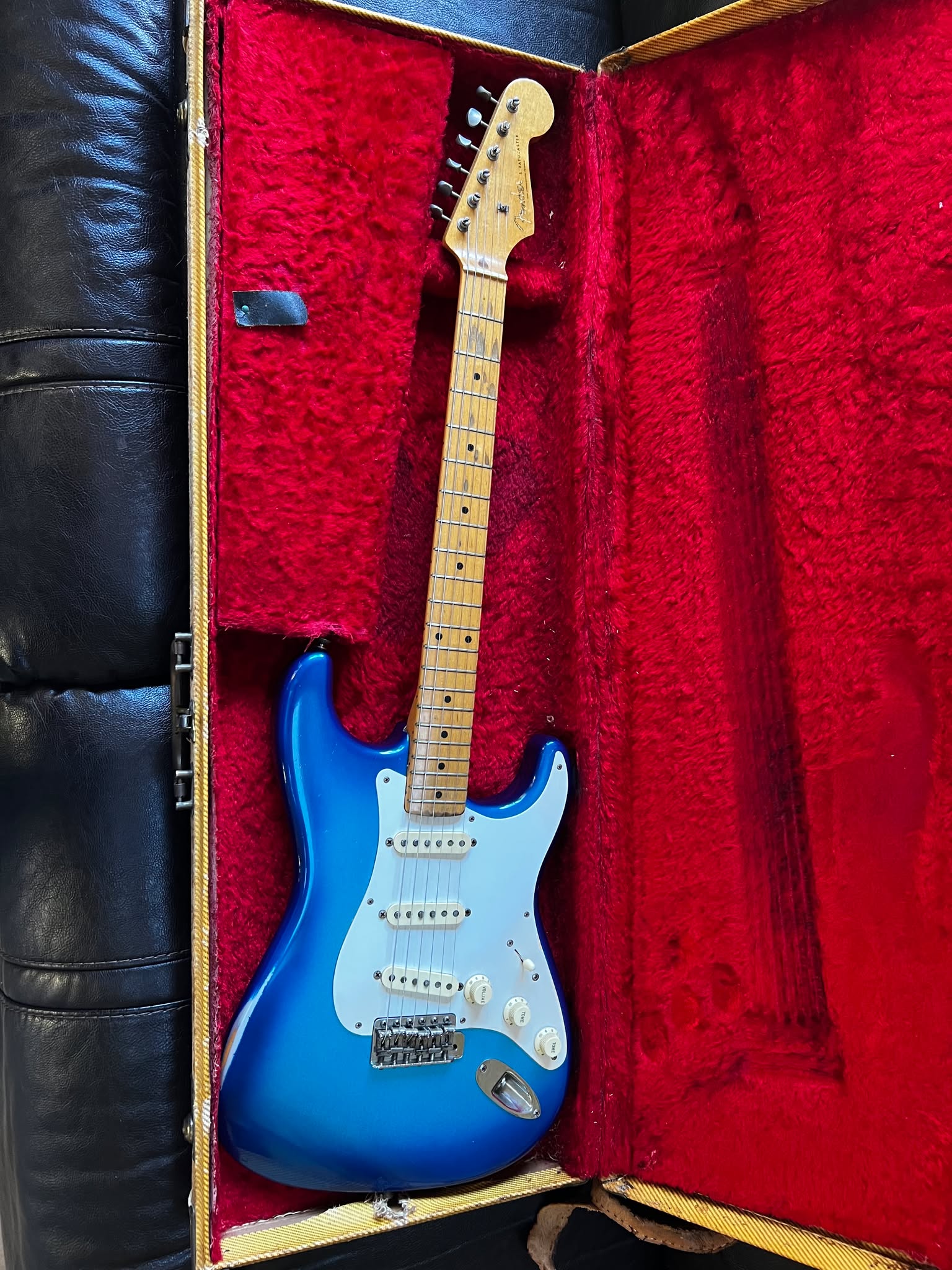
We recently purchased a 1957 Fender Stratocaster from a seller in western Pennsylvania that perfectly illustrates the refinished vintage Stratocaster situation many owners face. This instrument had been refinished professionally in the 1970s with a custom blue-tinted sunburst pattern, but retained all original parts including the neck, pickups, and hardware.
The Guitar’s History:
Original owner purchased the Stratocaster new in 1957 from a Pittsburgh music store. He played in regional country and rockabilly bands through the late 1950s and 1960s. By the early 1970s, the original two-tone sunburst finish showed heavy play wear—significant finish loss on body back, checking throughout, and multiple dings and scratches from years of professional use.
In 1974, the owner had a respected Pittsburgh luthier refinish the body only. The refinish work used nitrocellulose lacquer in a custom blue-tinted sunburst pattern (blue outer burst, fading through purple to amber center—not a factory Fender color but period-appropriate for custom work). The luthier preserved the original neck finish, including the headstock face with original logo. All original parts remained: pickups, pots, tremolo, tuners, and wiring.
The owner continued playing the guitar regularly through the 1980s before reducing playing activity. The guitar spent the last 20+ years in climate-controlled storage. The current seller inherited the instrument and contacted Edgewater after obtaining disappointing quotes from local guitar shops.
Authentication and Evaluation:
Original Components Verified:
Neck: Original maple neck with 1957 date stamp (“4-57” pencil marking on heel), original finish intact with natural aging, V-profile characteristic of 1957
Headstock: Original finish and logo, gold transition logo style correct for 1957
Pickups: Hand-wound original pickups, black bottom flatwork, Alnico V magnets, measured 5.8k and 5.9k ohms (within correct range)
Pots: All three original pots with codes 304 5723 and 304 5729 (Stackpole, 1957, weeks 23 and 29—June/July 1957)
Tremolo: Original tremolo assembly with five springs, correct cover, serial number X17XXX stamped on cover
Tuners: Original Kluson Deluxe tuners with single-line “Kluson Deluxe” stamp, correct plastic buttons
Pickguard: Original single-ply white pickguard (8 screws), slight yellowing appropriate to age
Hardware: All screws, springs, tremolo claw, output jack original
Refinish Assessment:
Professional quality nitrocellulose lacquer refinish executed in 1974
Blue-tinted sunburst pattern (custom color, not factory authentic but period-appropriate)
Appropriate aging on refinish (50+ years since refinish work shows checking, color maturation)
No overspray on hardware, clean cavity edges, professional prep work evident
Neck finish untouched—original 1957 finish intact
Refinish documented by receipt from 1974 found in case, listing original owner’s name and guitar details
Condition Details:
Body refinish shows 50 years of aging: finish checking throughout, minor play wear on back, small dings consistent with use since 1974
Neck finish shows natural aging: yellowing, checking, thumb wear on back all consistent with 70-year-old original finish
Frets show wear but playable (likely original frets with 70 years of play)
Electronics fully functional, all original components
Original brown Tolex case included (correct era for 1957)
Local Shop Quotes:
The seller obtained two quotes from Pittsburgh-area guitar shops before contacting Edgewater:
Shop 1: Offered wholesale buyback pricing, treating the guitar primarily as “refinished player-grade” instrument. They noted the original parts but focused on the refinish as primary value determinant. Their offer reflected standard shop approach: purchase at deep wholesale discount to allow for retail markup on eventual resale.
Shop 2: Offered slightly higher but still wholesale-based pricing. They acknowledged the all-original parts but expressed concern about the non-factory blue sunburst color reducing market appeal. They suggested the guitar would be difficult to sell due to “unusual refinish color choice.”
Both shops’ offers reflected fundamental misunderstanding of refinished vintage Stratocaster market dynamics. They failed to recognize that 1957 Stratocaster with all original parts—including original neck finish and hand-wound pickups—retains substantial value despite body refinish.
Edgewater’s Assessment:
We recognized several key value factors the shops missed:
Original 1957 V-neck maple neck with original finish: This single component represents significant value. The 1957 V-profile neck, hand-shaped with individual character, cannot be replicated. Neck finish originality preserves the authentic feel and aesthetic.
All original electronics and pickups: Hand-wound 1957 pickups with Alnico V magnets are increasingly rare and valuable components. All original pots dated correctly to 1957 production confirm authenticity and add value.
Professional quality refinish work: The 1974 refinish used correct materials (nitrocellulose), proper techniques, and has aged appropriately over 50 years. This is vastly superior to recent amateur refinish work.
Historical refinish: Refinish performed in 1974 represents part of the guitar’s authentic history—a working musician maintaining a professional instrument. The refinish is now 50+ years old itself, creating its own patina.
Complete documentation: Receipt from 1974, original case, and complete provenance from original owner through inheritance provide authentication confidence and historical context.
Blue sunburst uniqueness: While not factory-authentic, the blue-tinted sunburst has aesthetic appeal and represents period-appropriate custom work. Collectors of player-grade vintage instruments often appreciate unique refinish patterns.
Our Offer:
Edgewater’s offer reflected the guitar’s true market positioning: a refinished but substantially original 1957 Stratocaster with valuable components and professional-quality body work. Our offer exceeded the local shops’ quotes by approximately 35-40%.
We explained our valuation transparently:
All-original 1957 Stratocaster in excellent condition would command premium collector pricing
Body-only refinish reduces value by approximately 45-50% from all-original
However, the remaining value is still substantial due to year significance, original parts, and neck originality
Professional refinish quality and historical documentation minimize additional value loss
Current player and enthusiast market for refinished pre-CBS Stratocasters is strong
Why We Could Offer More:
Our business model allows higher offers than retail shops:
Direct-to-player market: We place refinished vintage instruments with players and enthusiasts who value functionality, original components, and vintage character over collector-grade originality. This market segment pays substantially more than wholesale but less than collector market.
No retail overhead: We don’t maintain storefront, don’t carry inventory for months, don’t add retail markup. Direct purchasing and placement allows fair pricing for sellers.
Expertise in parts value: We recognize that original 1957 pickups, neck, and electronics represent significant value independent of body finish. Most shops focus on “the guitar” as complete unit; we understand component values.
Refinish work appreciation: We distinguish between quality refinish work (like this 1974 professional job) and poor amateur work. Quality refinishing preserves more value.
Seller’s Decision:
The seller chose Edgewater for several reasons:
Significantly higher offer than local shops (35-40% more)
Detailed explanation of valuation factors—we educated them about what made their guitar valuable despite refinish
Appreciation for the guitar’s history and the professional 1974 refinish work
Immediate payment without consignment waiting
Transparent process during estate settlement complexity
Market Placement:
We placed this 1957 Stratocaster with a serious player/collector seeking an authentic vintage instrument for regular use. The refinish actually appealed to this buyer—he wanted genuine 1957 components and feel but didn’t want the anxiety of gigging a pristine all-original example. The blue sunburst aesthetic differentiated the guitar from standard sunburst examples.
Lessons from This Case:
Original parts preserve value despite refinish: All-original neck, pickups, and electronics in a 1957 Stratocaster are worth substantially more than finish originality alone.
Body-only refinish far better than complete refinish: Preserving neck finish maintains the most tactile and visible original component.
Professional refinish work matters: Quality 1974 nitrocellulose refinish vastly superior to recent amateur work.
Historical refinish has character: 50-year-old refinish work represents authentic guitar history, not recent value manipulation.
Shops often undervalue refinished pre-CBS Fenders: Wholesale-focused businesses miss the nuanced refinished vintage market.
Documentation adds value and confidence: Receipts, photos, and provenance help authentication and establish history.
This case perfectly illustrates why Edgewater actively purchases refinished pre-CBS Stratocasters—we understand the market, recognize value beyond surface appearance, and can pay fairly for instruments other buyers dismiss or undervalue.
Selling Your Refinished Pre-CBS Stratocaster: Your Options Compared
Selling Option | Typical Offer for Refinished Strat | Timeline | Fees/Costs | Risk Level | Best For |
|---|---|---|---|---|---|
Edgewater Guitars | Fair market value for refinished pre-CBS instruments—typically 30-40% above shop offers | Immediate cash after authentication (same-day or next-day) | None | Low—expert authentication, honest assessment of refinish impact, immediate payment | Owners wanting fair value for refinished instruments, understanding parts value preservation |
Local Guitar Shop | Wholesale pricing (often 50-60% of refinished market value) | Same day | None direct, but severe payment reduction | Low | Absolute convenience priority, uninformed about parts value |
Online Marketplace (Reverb, eBay) | Variable—refinish disclosure required, buyer concerns reduce pricing power | Weeks to months, extensive buyer questions about refinish | 5-15% platform fees, shipping insurance, packaging | Very High—refinish disputes, return demands, authentication challenges | Experienced sellers with complete refinish documentation, patience for buyer education |
Vintage Guitar Dealer (Consignment) | Moderate pricing, commission structure | Months (consignment period unpredictable for refinished guitars) | 20-30% commission | Medium—refinished guitars harder to sell, longer wait times | Sellers willing to accept commission and extended timeline |
Private Sale | Highly variable, dependent on buyer knowledge of parts value | Unpredictable—refinish raises buyer concerns | None | Very High—authentication disputes, refinish accusations, payment issues | Sellers with local connections to knowledgeable players |
Why Edgewater Guitars Actively Purchases Refinished Pre-CBS Stratocasters
Many guitar shops avoid or severely discount refinished vintage Fenders because their retail business model requires collector-grade instruments for maximum markup. Edgewater operates differently—we understand and serve the player/enthusiast market where refinished instruments with original parts find strong demand.
Our Refinished Stratocaster Approach:
Parts value recognition: We evaluate the instrument component by component. Original 1960s pickups, vintage neck, and period electronics have inherent value regardless of body finish.
Refinish quality assessment: We distinguish professional quality work from amateur attempts. Quality refinishing preserves significantly more value.
Market placement expertise: We work with players and collectors who specifically seek refinished vintage instruments for playing rather than collecting. This market pays fair prices reflecting authentic vintage components.
Direct business model: No retail storefront, no inventory holding costs, no retail markup. We can pay closer to market value because we don’t need wholesale-to-retail profit margin.
What We Need to Evaluate Refinished Stratocasters:
Contact us with clear photographs:
Entire guitar front and back (showing refinish quality)
Headstock face and back (showing logo and finish)
Neck heel area and neck pocket (showing dates and original vs. refinished finish)
Control cavity with pickguard removed (showing pot codes and routing)
Close-ups of any refinish issues or concerns
Serial number on tremolo cover or neck plate
Original case if present
We provide preliminary assessment based on photos, then recommend in-person evaluation for valuable instruments to complete authentication and provide final offer.
The Edgewater Process for Refinished Stratocasters:
Initial Contact: Submit photos and details about refinish history (if known). We assess: production year, extent of refinish (body-only vs. complete), original parts retention, refinish quality.
Preliminary Valuation: We provide value range based on photos. For refinished pre-CBS Stratocasters, we typically recommend in-person evaluation for complete authentication.
Authentication Evaluation:
Verify year and authenticity (serial number, neck date, pot codes)
Assess refinish extent (body-only vs. complete)
Evaluate refinish quality (professional nitro vs. amateur poly)
Verify original parts (pickups, electronics, hardware)
Check for hidden repairs or modifications
Photograph documentation
Transparent Assessment: We explain exactly what’s original, what’s been refinished, quality of refinish work, and how these factors affect value. No surprises, no hidden issues discovered after offer.
Fair Offer: Based on complete authentication, we make cash offer reflecting genuine market value for the specific instrument—considering year, parts originality, refinish quality, and current demand.
Immediate Payment: If you accept, we provide immediate payment: cash, cashier’s check, or wire transfer. No waiting periods.
Geographic Coverage:
Edgewater Guitars serves Ohio, Michigan, Pennsylvania, Indiana, and West Virginia primarily. For valuable refinished pre-CBS Stratocasters (1954-1965), we travel significantly beyond our typical service area. A refinished 1959 Stratocaster with slab rosewood neck and original parts justifies extensive travel.
Ready to find out what your refinished Stratocaster is worth? Get your free, no-obligation authentication and valuation: [valuation page link] or call (440) 219-3607.
Frequently Asked Questions About Refinished Pre-CBS Stratocasters
Q: What is a refinished 1960s Stratocaster worth in 2026?
A: Value depends on multiple factors: production year (1954-1965 range), extent of refinish (body-only vs. complete), refinish quality (professional vs. amateur), and original parts retention (especially neck, pickups, electronics). Body-only refinish on pre-CBS Stratocaster with all original parts typically reduces value by 40-60% compared to all-original example. Complete refinish reduces value by 55-70%. However, a refinished early 1960s Stratocaster with original components is still worth substantially more than all-original later guitars. Contact Edgewater for specific assessment.
Q: Should I have my refinished Stratocaster stripped and properly refinished again?
A: Generally no. Stripping and re-refinishing adds cost without proportional value increase in most cases. Exception: if current refinish is very poor quality (amateur spray-can work, obvious drips/runs, wrong materials), professional refinish might be worthwhile. However, the cost of quality refinish work typically exceeds value gained. Best approach: sell as-is to appropriate buyer who values the original parts over finish perfection.
Q: Is a refinished 1959 Stratocaster worth more than an all-original 1970s Stratocaster?
A: Yes, typically. A refinished 1959 Stratocaster with original slab rosewood neck, hand-wound pickups, and vintage electronics commands higher value than all-original 1970s CBS-era Stratocaster. The 1959’s original components, pre-CBS construction quality, and era significance outweigh the refinish. Original 1970s Stratocasters are valuable instruments, but refinished late 1950s examples with parts intact typically bring higher prices.
Q: How can I tell if my Stratocaster has been refinished?
A: Multiple indicators: (1) Examine finish thickness and overspray in cavities—remove pickguard and check body routes for paint in areas that should be bare wood, (2) Check neck pocket for paint buildup creating loose fit, (3) Use UV light to reveal finish inconsistencies, (4) Look for absence of age-appropriate checking on supposedly 60-year-old finish, (5) Check for wrong undercoat colors (yellow sealer should be under custom colors), (6) Examine hardware removal patterns. Edgewater offers free refinish analysis as part of authentication service.
Q: Does body-only refinish affect value less than complete refinish?
A: Yes, significantly. Body-only refinish preserves original neck finish, which is the most tactile and visible component. A 1962 Stratocaster with refinished body but original neck finish might see 45-50% value reduction, while complete refinish might be 60-65% reduction. The neck represents substantial portion of vintage character—feel, playability, visual aging all preserved with original neck finish.
Q: Are custom color refinishes worth more than sunburst refinishes?
A: Not necessarily. Period-appropriate custom colors (Lake Placid Blue, Fiesta Red, etc.) on refinished bodies may have slight aesthetic appeal to some buyers, but market generally treats all refinishes similarly regardless of color choice. Exception: poorly executed custom colors (wrong shades, incorrect for era) may reduce value further. Best refinish colors are those executed well in period-appropriate hues.
Q: Should I disclose refinish when selling?
A: Absolutely yes. Failure to disclose refinish is misrepresentation and can result in payment disputes, returns, or legal issues. Honest disclosure builds buyer confidence. Many buyers specifically seek refinished vintage Stratocasters as player instruments—refinish isn’t necessarily deal-breaker, but non-disclosure is.
Q: Does Edgewater Guitars buy refinished Stratocasters?
A: Yes, actively. We purchase refinished pre-CBS Stratocasters (1954-1965) and transitional CBS-era examples (1966-1970) regularly. We recognize that original parts in refinished instruments retain significant value. We offer fair market pricing reflecting genuine refinished vintage guitar market—typically 30-40% above guitar shop offers. We provide free authentication, immediate cash payment, and transparent valuation. Contact (440) 219-3607 for evaluation.
Q: How do I prove my refinished Stratocaster is actually vintage underneath?
A: Authentication requires multiple verification points: (1) Serial number on tremolo cover or neck plate matching year range, (2) Neck date stamp on heel (visible when removed), (3) Potentiometer codes in control cavity matching claimed year, (4) Original routing patterns and cavity work consistent with era, (5) Correct pickups, hardware, and components for year. Refinishing doesn’t eliminate these authentication points. Professional authentication examines all factors to verify vintage status despite refinish.
Q: What’s the most important original part to preserve value on refinished Stratocaster?
A: The neck. Original neck with original finish represents the most valuable single component. A refinished body with original neck preserves far more value than refinished body plus refinished neck. After neck, pickups are next most critical—hand-wound pre-CBS pickups significantly valuable. Then electronics (original pots), hardware (tremolo, tuners), and other components in descending order of impact.
Q: Can refinished Stratocasters be good investments?
A: Refinished pre-CBS Stratocasters with original parts can be solid player-grade investments but won’t appreciate like all-original examples. They offer entry point to vintage Fender ownership at more accessible pricing. Value appreciation is moderate compared to all-original instruments. Best viewed as playable vintage instruments that hold value reasonably well, not as primary investment vehicles. All-original examples are investment grade; refinished examples are player instruments that maintain value.
Q: How old should refinish work be before it’s considered “vintage refinish”?
A: Generally, refinish work 40+ years old (performed before mid-1980s) is considered historical or vintage refinish. A 1960 Stratocaster refinished in 1970 has 55-year-old refinish work that has developed its own patina and character. This is distinct from recent refinish (last 10-20 years). Vintage refinish represents authentic guitar history and is less damaging to value than recent work, which may suggest damage concealment or value manipulation.
Q: Should I install reproduction “vintage correct” pickups in my refinished Stratocaster to increase value?
A: No. If you have original pickups removed, reinstall them—original components always more valuable than reproductions. If original pickups are lost/destroyed, installing quality reproduction pickups makes the guitar more playable but doesn’t increase value beyond functionality. Buyers pay premium for original parts, not reproduction parts regardless of quality. Better to sell refinished Stratocaster with original pickups intact than with reproduction pickups installed.
Related Resources
Fender Stratocaster Serial Number Lookup — Decode your Stratocaster’s serial number and verify production year
How to Spot Refinished Fender Guitars — Complete guide to identifying refinish work on vintage Fenders
Fender Potentiometer Dating Guide — Authenticate vintage Fender guitars through pot codes
Pre-CBS Fender Stratocaster Overview — Understanding all years of pre-CBS Stratocaster production
1965 Fender Stratocaster Guide — Detailed guide to final pre-CBS year
1959 Fender Stratocaster Guide — Peak pre-CBS year with slab rosewood board
Vintage Fender Custom Colors Authentication — Verify original vs. refinished custom colors
Sell Your Guitar to Edgewater — Start your free valuation process
Edgewater Guitars specializes in purchasing vintage Fender guitars throughout Ohio, Michigan, Pennsylvania, Indiana, and West Virginia—including refinished examples with original parts intact. Our expertise in pre-CBS Fender authentication and understanding of the refinished vintage guitar market allows us to offer fair pricing that reflects genuine value. We provide free authentication, immediate cash payment, and transparent evaluation. Contact us today for your free, no-obligation valuation: [valuation page link] or call (440) 219-3607.
Article