DATE :
Martin Guitar Value by Serial Number: What Your Serial Reveals
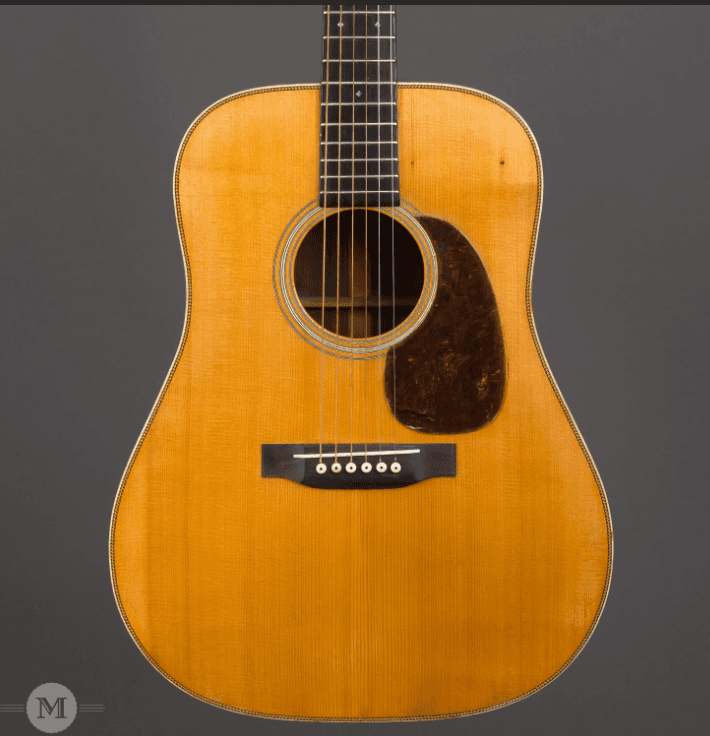
A Martin serial number gives you the year, because Martin has numbered every guitar in sequence since 1898. It does not give you the value: the model stamped above it, the originality and the neck-reset history do that. Edgewater Guitars in Valley City, Ohio buys vintage Martins across Ohio and nationwide. Call or text (440) 219-3607.
What a Martin serial number can and cannot tell you
Martin's system is the simplest in the business. In 1898 the company started numbering at 8000, its estimate of everything built before then, and every guitar since has taken the next number in line. Martin publishes the last serial number issued in each year, so if your number falls between two year-end figures, you have the year. The number is stamped into the neck block; look through the soundhole toward the neck with a flashlight. From October 1930 the model is stamped just above it, so the same glance tells you whether you have a D-28, a 000-18 or an OM-28.
That is a real advantage over Fender or Gibson, where numbers overlap. It is also where the serial's usefulness ends. It does not tell you whether the back and sides are Brazilian rosewood, whether the bridge, bracing and finish are original, whether the neck has been reset, or whether the top has cracked. Those are what move the price.
Martin serial numbers by era
Martin's own chart runs from 1898 to the present, and our lookup tool, linked below, runs your number against it. The eras here are what the number means once you have the year; the third column shows a few anchor points from Martin's chart, not the whole table.
Era | What you find on the neck block | Anchor points from Martin's chart | What the era usually means for value |
|---|---|---|---|
Before 1898 | No serial number. A "C.F. Martin, New York" stamp (before 1867) or "C.F. Martin and Co., New York" (1867 to 1897) | None. Martin estimated about 8,000 guitars before numbering began | Antique instruments, dated by stamps and construction and appraised case by case. |
1898 to 1930 | Serial number only; the model stamp is added in October 1930 | 8348 at the end of 1898; 45317 at the end of 1930 | Small-body guitars. Strong interest in the higher styles; the model has to be identified from size and trim because it is not stamped. |
1931 to 1946 | Model and serial. The first D-18 and D-28 stamps appear in 1931; 14-fret dreadnoughts from 1934 | 98158 at the end of 1946 | The herringbone era. Scalloped bracing to late 1944 and herringbone trim on Style 28 to early 1947 mark the most valuable Martins made. |
1947 to 1969 | Model and serial | 103468 at the end of 1947; 256003 at the end of 1969 | Brazilian rosewood on the rosewood models until late 1969, straight bracing. Strong, steady demand; the golden era for many buyers. |
1970 onward | Model and serial | 271633 at the end of 1970; 419900 at the end of 1979 | Indian rosewood and a larger rosewood bridge plate from 1969. Excellent utility instruments with limited collector interest; condition and playability set the price. |
900001 to 902908 | Sigma-Martin USA DR-28N and DR-35N, 1981 to 1982, marked Made in USA | A separate block that Martin's chart excludes and footnotes | Japanese-made kits finished in Nazareth. A curiosity with a following, priced well below a Martin-built D-28 of the same years. |
Two notes on the eras. Martin introduced the Sigma line in 1970 as its import brand and ended it in 2007; the 1981 to 1982 Nazareth-finished guitars are the only Sigmas with serial numbers Martin documents. And the change from Brazilian to Indian rosewood came at the very end of 1969, so a late-1969 serial needs the wood checked rather than assumed; our guide to telling Brazilian from Indian rosewood shows how.
Why the model and the neck-reset history matter more than the serial
The model. Two Martins with consecutive serial numbers can be a Style 18 mahogany guitar and a pearl-trimmed Style 45, or a parlor-sized 0 and a dreadnought. Higher styles and larger bodies carry the money, and from late 1930 the style is stamped right above the serial. On an older guitar, or one with a worn stamp, the model is read from the size, the woods, the binding and the inlay.
The neck reset. More than 150 pounds of string tension, applied for decades, pulls a Martin neck forward at the joint while the top rises behind the bridge. The action climbs, the saddle gets shaved to compensate, and eventually the neck has to come off and go back on at a steeper angle. On a vintage Martin this is an everyday repair; one that has never needed it is the exception. Done properly, a reset does not lower the value and usually raises it, because the guitar plays again. A guitar that needs one and has not had it is priced with the repair taken off. A reset done badly, with a hacked heel or a planed fingerboard, costs more than that.
So we read the serial in a second, then spend our time on the neck angle, saddle height, bridge, bracing and top.
Why two Martins from the same serial era differ ten-fold
Model. A D-45 and a D-18 from the same month share nothing but a body shape. Size and style set the starting range before anything else is considered.
Wood. Brazilian rosewood back and sides carry a premium over the Indian rosewood that replaced them in late 1969. The serial suggests which you have; the wood has to confirm it.
Bracing and trim. Scalloped bracing through late 1944 and herringbone trim through 1946 mark the pre-war Style 28s that lead the market. Our scalloped bracing guide explains why it matters. A guitar with braces shaved later is modified, not original.
Originality. A replaced bridge or bridge plate, new tuners, a replaced pickguard, an oversprayed or refinished top. Collectors penalize every modification, and a refinish hurts the most.
Condition. Top cracks, a pickguard crack, a lifting bridge, a bellied top. Repaired cleanly they cost something; repaired badly they cost a lot.
Repairs. A reset needed, done well or done badly are three different prices.
How to get an actual number
Start with the year. Our Martin serial number lookup runs your number against Martin's chart, including the Sigma block. If you cannot read the stamp, or you are not sure what model you have, upload a photo for a free identification and value range; it is a starting point, not an appraisal.
Then read the guide for your model:
Vintage Martin acoustic guitar value guide, the hub for every model
Vintage Martin D-28 and D-18 value guide, 1931 to 1969, with the D-28 dating guide and the D-18 dating guide
Vintage Martin 000-28 value guide, 1934 to 1969 and the OM-28 value guide, 1929 to 1933
Dating Martins without serial numbers for anything before 1898, and 1970s Martins: why the dark years deserve a second look
Then get a real appraisal. Send us the serial and model stamp, and photos of the top, back, headstock, bridge, the inside through the soundhole, and the neck joint from the side so we can see the angle. We tell you what it is, what is original, whether it needs a reset, and what we would pay, with the comparable sales behind the number. Free, no obligation.
Sell your Martin
Edgewater Guitars buys vintage Martins in every condition, from pre-war herringbone D-28s to 1970s guitars, including instruments with cracks, worn frets or a neck that needs resetting. We travel for the right guitar, buy nationwide, and pay by check or cash the same day. Get a free estimate or call or text (440) 219-3607. Our sell your Martin page explains how the process works.
From a recent Google review: "Sold my old Martin guitar to Gavin at Edgewater ... Really knowledgable guy and overall great experience!!" (Isaac Dailey, March 2025)
Frequently asked questions
Does the exact year tell me what my Martin is worth?
No. The serial gives the year with real precision, which is more than most brands can offer, but value depends on the model stamped above it, the wood, the originality of the bridge, bracing and finish, and the neck-reset history. Two Martins with consecutive numbers can be worth ten times apart, so the year only opens the conversation.
Where is the serial number on a Martin guitar?
On the neck block inside the body. Look through the soundhole toward the neck, and use a flashlight; the serial is stamped into the wood, and on guitars built from October 1930 the model designation, such as D-28 or 000-18, is stamped just above it. Guitars built before 1898 have no serial number at all.
Does a herringbone D-28 always mean it is pre-1947?
For original trim, yes. Martin used herringbone on Style 28 guitars, including the D-28 from its 1931 start, until early 1947, and the last scalloped-braced examples date to late 1944. Herringbone on a guitar whose serial falls after 1947 means a later reissue, a rebuilt top or added purfling, and each is a different guitar to a buyer.
Does a neck reset lower a vintage Martin's value?
Not when it is done well. Decades of string tension pull the neck forward on nearly every old Martin, and resetting it is an everyday repair at a good shop. A proper reset restores playability and usually helps the price. What lowers value is a guitar that needs one, or a reset with a botched heel or shaved fingerboard.
My serial number starts with 9000. Is it a real Martin?
Serials 900001 to 902908 belong to the Sigma-Martin USA DR-28N and DR-35N of 1981 and 1982, Japanese-made kits finished in Nazareth and marked Made in USA. Martin's chart excludes the block and notes it in a footnote. They are genuine Martin-finished instruments, but they are Sigmas, and they are valued well below a Martin-built D-28.
By Stephen Pedone, co-owner of Edgewater Guitars. Last updated: September 2026.
Sources
Dating Your Martin: A Quick Reference (serial chart and Sigma footnote), C.F. Martin and Co.: martinguitar.com
Martin serial numbers, specifications and dating, guitarhq.com: guitarhq.com/martin.html
Martin serial number decoder and dating charts, guitarserialnumbers.com: guitarserialnumbers.com
Labels and stamps on Martin guitars, vintagemartin.com: vintagemartin.com
Martin D-28 and D-45, Vintage Guitar magazine: vintageguitar.com
Bridge-Plate Blues, Vintage Guitar magazine: vintageguitar.com
Sigma by Martin, Vintage Guitar magazine: vintageguitar.com
Sigma History, Sigma Guitars: sigma-guitars.com
Sigma Guitars, Wikipedia: en.wikipedia.org
C. F. Martin and Company, Wikipedia: en.wikipedia.org
Should I reset the neck on my vintage guitar?, Acoustic Guitar: acousticguitar.com
Does my guitar need a neck reset?, Acoustic Guitar: acousticguitar.com