DATE :
How to Identify Your Vintage Guitar by Physical Features: A Guide for Non-Guitarists
How to Identify Your Vintage Guitar by Physical Features: A Guide for Non-Guitarists
Meta Description: Found a guitar with a tremolo bar, two horns, or holes in the body? Learn how to identify vintage Fender, Gibson, and Martin guitars by their distinctive physical features and discover what makes them valuable.
Introduction: "I Have This Guitar, But I Don't Know What It's Called"
If you've inherited a guitar, found one in storage, or are handling an estate, you might be describing it by what you see rather than its model name: "It's a Fender with a whammy bar," "It's a Gibson with two pointy horns," or "It has holes in the body like a violin."
You're not alone—and those physical features are actually the key to identification.
At Edgewater Guitars, we regularly receive calls from people who describe guitars exactly this way. The good news? Many of these distinctive features indicate valuable vintage instruments. A "Gibson with two cutaways and holes in the body" could be a highly sought-after ES-335. That "Fender with three pickups and a whammy bar" might be a collectible pre-CBS Stratocaster.
This comprehensive guide will help you:
Identify your guitar by the physical features you notice
Understand what makes these features significant
Determine key value factors based on age and condition
Learn whether you have a guitar worth selling to a premium buyer
Let's decode what you're seeing—and what it might be worth.
Understanding the Physical Features You're Noticing
The "Tremolo Bar" or "Whammy Bar"
What You're Seeing: A metal arm attached to a plate on the guitar's body, usually near the bridge (where the strings attach at the bottom).
What It Means: This is a vibrato/tremolo system that allows pitch modulation. Different systems indicate different guitars:
Fender-Style Synchronized Tremolo
Found on: Stratocasters (most common)
Appearance: Chrome plate with 6 individual string saddles, arm angles downward
Value indicators:
Pre-1965 models (pre-CBS Fender): Highly collectible
1965-1980: Good collector interest
Post-1980: Value depends on specific model
Dating clues: Pre-CBS Stratocasters (pre-1965) have smaller headstocks, clay dot position markers (not plastic), and typically show patent numbers on the headstock rather than later serial number formats.
Fender Floating Tremolo (Jazzmaster/Jaguar)
Found on: Jazzmaster, Jaguar models
Appearance: Larger rectangular plate, arm may be shorter and point upward
Value indicators:
1958-1965 models: Premium collectible status
1966-1975: Strong collector demand
Key distinction: These guitars have offset waist body shapes (asymmetrical) and distinctive control layouts with multiple switches.
Bigsby Tremolo
Found on: Various Gibson, Gretsch, Fender models
Appearance: Ornate aluminum casting with a curved arm, mounted on top of the guitar body
Value impact: Original Bigsbys significantly enhance value
What to check: Look for "Bigsby" engraved on the unit. Earlier models (1950s-1960s) are more desirable than later replacements.
"Gibson with Two Horns" or "Pointy Gibson"
What You're Seeing: Gibson guitars with distinctive dual cutaways or angular body shapes.
Gibson SG ("Two Horns")
What you're seeing: Double cutaway, thin flat body, two pointed "horns"
Often described as: "Devil horn guitar," "Gibson with two pointy ends," "thin Gibson with two cutaways"
Identification features:
Slim, flat body (not thick like a Les Paul)
Two sharp cutaways allowing upper fret access
Usually 2 humbucker pickups
Vibrato arm on some models
Value breakdown by era:
1961-1965 (earliest SGs): Most valuable period
Check for "Les Paul" on the truss rod cover (early models)
Patent number pickups (not humbuckers with stickers)
Side-pull vibrato on some models
1966-1969 (transitional era): Strong collector demand
Large pickguard
"Patent Applied For" (PAF) or patent number pickups
1970s: Solid collector interest
Wider "batwing" headstock
Three-piece maple necks common
1980s+: Modern era values
Critical details: Original SGs from 1961-1965 that still say "Les Paul" on the truss rod cover are extremely valuable. Check the back of the headstock for "Made in USA" stamps and serial numbers.
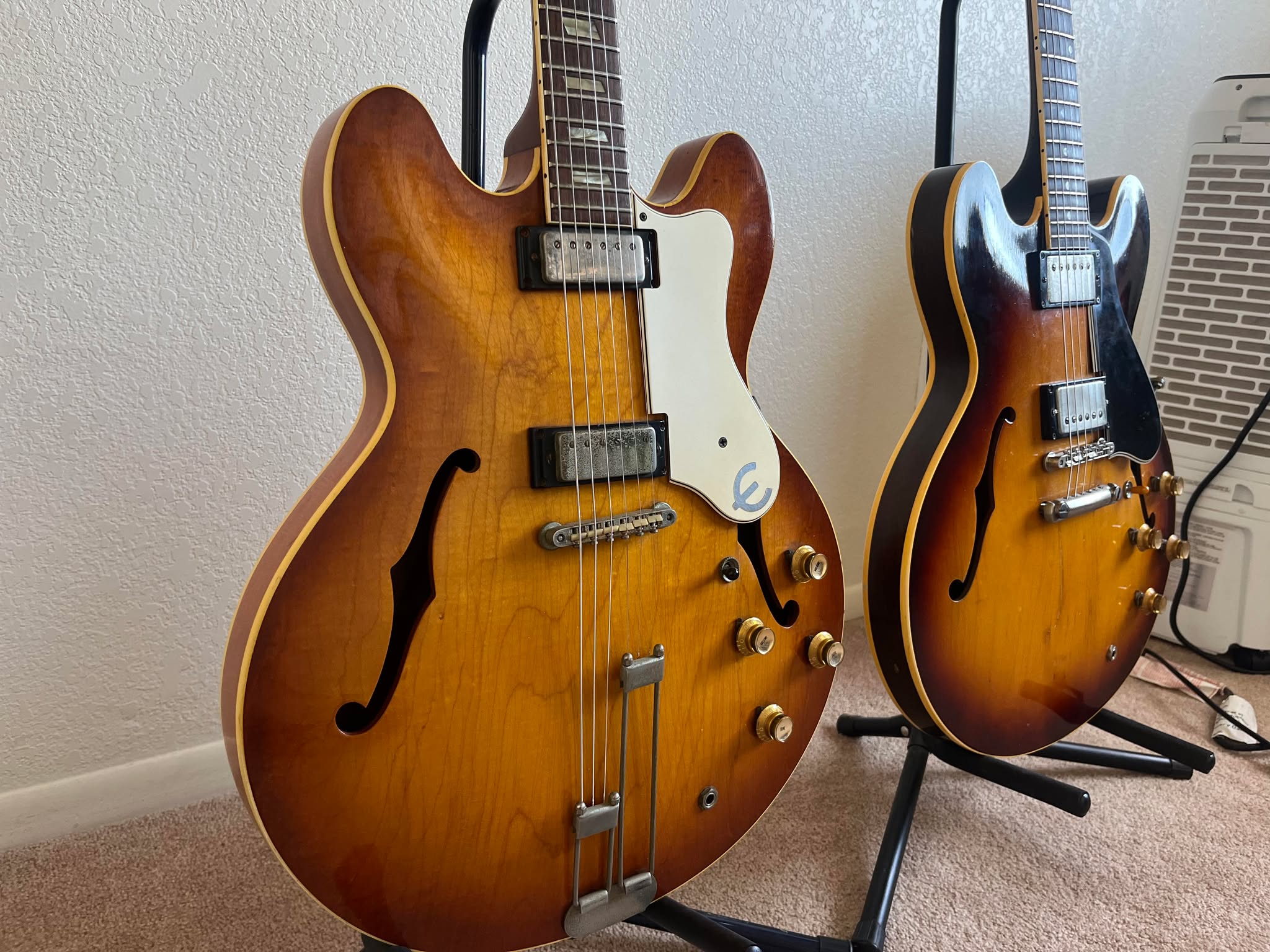
Gibson ES-335 ("Gibson with Two Cutaways and Holes")
What you're seeing: Semi-hollow body with two rounded cutaways and f-holes
Often described as: "Gibson with violin holes," "hollow Gibson with two cutaways," "red Gibson with holes in body"
Identification features:
Two symmetrical rounded cutaways
Two f-holes (shaped like italic lowercase f)
Thin-line semi-hollow body
Typically 2 humbucker pickups
Value breakdown:
1958-1964 (dot neck era): Premium vintage status
Small pearl dot inlays
PAF pickups (no stickers, double row magnets)
Factory Bigsby adds value
1965-1969 (block neck): Highly collectible
Rectangular pearl block inlays
Patent number pickups
1970s: Good collector demand
"Norlin era" (1970-1985)
Walnut finish common
1980s-1990s: Modern collector interest
Dating method: Check the serial number inside the f-hole (visible with a flashlight) and on the back of the headstock.
Gibson Flying V and Explorer ("Really Pointy Gibson")
Flying V: Distinctive V-shaped body
1958-1959 originals: Extremely rare, museum-quality pieces
1967-1970 reissues: Highly collectible
1971-1980s: Good collector interest
Explorer: Angular "modernistic" body shape
1958-1959 originals: Among the rarest guitars ever made (fewer than 100 produced)
1976+ reissues: Strong collector demand
Red flag: If you think you have an original 1958-1959 Flying V or Explorer, DO NOT ATTEMPT TO CLEAN OR RESTORE IT. Contact a specialized vintage guitar buyer immediately—even damaged examples are extraordinarily valuable.
"Fender with Three Pickups"
What You're Seeing: Three single-coil pickups arranged between the neck and bridge.
Most Likely: Fender Stratocaster
Identification features:
Three single-coil pickups (look like long bars)
Double cutaway body (one deeper than the other)
3-way or 5-way pickup selector switch
Tremolo bar (usually present)
Bolt-on neck with 4 screws visible on the back
Value indicators:
Pre-1965 (pre-CBS): Premium vintage status
Smaller "spaghetti logo" headstock
Clay dots (not plastic)
Serial number on neck plate only
1965-1971 (CBS transition): Highly collectible transitional period
Larger headstock introduced in 1965
Transitional features
1972-1980: Good collector interest
3-bolt neck (1971-1981)
Bullet truss rod adjustment
1980s-1990s: Modern era values
Critical check: Remove the neck (4 screws on back) to see the date penciled in the neck pocket or on the neck heel. Pre-CBS Strats are significantly more valuable than later models.
"Gibson with Carved Top" or "Thick Gibson"
What You're Seeing: Gibson Les Paul
Identification features:
Thick, heavy solid body
Carved (arched) top
Single cutaway (only one horn)
Usually 2 humbucker pickups (wider than Fender pickups)
Set neck (no visible screws on back)
Value breakdown:
1952-1960 (goldtop and sunburst): Most valuable Les Paul era
Goldtops (1952-1957): Highly sought after
Sunburst "Burst" (1958-1960): Among the most valuable guitars ever made
1961-1963 (SG body, still called "Les Paul"): Rare transitional models
1968-1969 (reissue): First reissue era
Goldtops reintroduced
1970s: Solid collector demand
Various models (Standard, Custom, Deluxe)
1980s-1990s: Modern production era
Critical authentication: The most valuable Les Pauls (1958-1960 sunbursts) often have finish checking (small cracks in lacquer), flame maple tops visible under sunburst finish, and PAF pickups with no stickers.
Red flag: There are many Les Paul replicas. Check for "Gibson" on the headstock (with the correct font for the era), "Made in USA" stamp, and proper serial numbers.
"Hollow Guitar with Holes in Body"
What You're Seeing: Likely a Gibson ES series, Gretsch, or high-end archtop
Gibson ES Series
ES-175: Single rounded cutaway, 2 pickups
1949-1971: Classic jazz guitar, strong collector demand
Often in sunburst or natural finish
ES-335/345/355: Covered above (semi-hollow, dual cutaway)
L-5, Super 400: Premium archtops
1950s-1960s: Top-tier collector instruments
Often 17-18" wide bodies
Gretsch Hollowbody
Distinctive features:
Bigsby tremolo common
"G" logo on pickguards
Often orange or two-tone finishes
Key models:
6120 Chet Atkins: Iconic rockabilly guitar (1954-1965 most desirable)
White Falcon: Gretsch's flagship model (1955-1965 premium era)
Country Gentleman: Professional-grade instrument
Value factors: Original Gretsch Filter'Tron pickups (rectangular with visible pole pieces) significantly add to value.
"Martin with Fancy Inlay" or "Pearl Decorations"
What You're Seeing: High-end Martin acoustic guitar
Abalone/Pearl inlay indicates premium models:
D-45 (Most Common High-End Martin)
Features:
Dreadnought body (large, square shoulders)
Abalone trim around top, back, and soundhole
"Snowflake" inlays on fretboard
Three-piece back (bookmatched rosewood)
Value breakdown:
Pre-1942: Prewar instruments, extremely valuable
1968-1969 (reintroduced): First modern D-45s, highly collectible
1970s: Strong collector demand
1980s-1990s: Modern production era
Current production: Contemporary premium instruments
D-28 (Herringbone Trim)
Pre-1947 with herringbone purfling: Premium vintage status
1947-1969: Classic era
1970s+: Modern production
OM-45, 000-45 (Smaller Bodies with Abalone)
Pre-war examples: Rare and highly valuable
Post-war: Premium collector instruments
Dating Martin guitars: Look inside the soundhole for a date stamp and serial number. Pre-1932 Martins may not have serial numbers.
Authentication and Dating: What to Check
Serial Numbers and Date Codes
Fender:
Pre-1976: Often on neck plate (back of guitar where neck attaches)
1976+: On headstock decal
Remove neck to find penciled date codes in neck pocket
Gibson:
1961+: Stamped on back of headstock
Pre-1961: Often on paper label inside f-hole or stamped inside body
FON (Factory Order Number) can indicate exact production date
Martin:
Inside soundhole on neck block or back strip
Pre-1898: No serial numbers (dated by features)
Consult Martin's serial number database for exact dates
Pickup Identification
Gibson PAF (Patent Applied For) Pickups (1957-1962):
No sticker on pickup cover
Two rows of magnets visible from underneath
Highly valuable if original
These significantly increase guitar value
Fender Pickups:
Pre-CBS (pre-1965): Cloth-covered wiring, gray fiber bobbins
Look for dates stamped on pickup bottoms
Original pre-CBS pickups add substantial value
Finish and Hardware
Original Finish:
Nitrocellulose lacquer (pre-1970s) shows "checking" (hairline cracks)
Polyurethane finishes (1970s+) remain glossy without checking
Original finish significantly more valuable than refinished guitars
Hardware:
Chrome plating wear patterns should match guitar age
Original tuners, bridges, and pickguards add value
Replaced parts reduce value considerably
What's Your Guitar Worth? Value Factors
Condition Grading
Excellent (9.0-10): Minimal wear, all original parts, plays perfectly
Premium market value
Very Good (7.5-8.5): Some wear, all original, fully functional
Strong collector value
Good (6.0-7.0): Noticeable wear, possible minor repairs, plays well
Solid collector value
Fair (4.0-5.5): Heavy wear, replaced parts, structural issues
Reduced collector value
Poor (below 4.0): Significant damage, major repairs needed
Primarily parts value
Originality Premium
All Original: Full market value Refretted (if done well): Minor value reduction Replaced Tuners/Hardware: Moderate value reduction Refinished: Significant value reduction Repaired Headstock Break: Substantial value impact Replaced Pickups/Electronics: Moderate to significant value reduction
Market Demand Factors
High Demand (Premium Prices):
Pre-CBS Fender (pre-1965)
Gibson PAF-era (1957-1962)
1950s Gibson Les Paul goldtops and bursts
Pre-war Martin dreadnoughts
Moderate Demand (Fair Market Value):
1970s Japanese Fenders
1970s-1980s Gibson Les Pauls
1960s-1970s Gretsch
Lower Demand (Below Market Average):
Budget model imports
Heavily modified guitars
Refinished vintage guitars
Why Sell to Edgewater Guitars?
We Pay Significantly More Than Typical Guitar Shops
Why the difference?
We're specialized vintage buyers, not retailers—we don't need retail markup
We understand the collector market—we know what features drive value
We move guitars to serious collectors—faster sales mean better offers to you
We evaluate based on details—original parts, specific features, and authenticity factors
Expertise in Physical Feature Identification
If you're describing your guitar by what you see rather than model names, that's exactly what we specialize in. We help non-guitarists identify:
Exact model and year based on physical features
Original vs. replaced parts
Authentication of vintage features
True market value based on collector demand
Fair, Transparent Evaluation Process
Send us photos (front, back, headstock, serial numbers, close-ups of pickups/hardware)
We provide identification and estimated value range within 24 hours
You decide whether to sell—no pressure, no obligations
We handle logistics—shipping, insurance, or local pickup available
Fast payment—check, bank transfer, or PayPal within 24 hours of inspection
Frequently Asked Questions
Q: I have a "Gibson with two horns" but it says "Epiphone" on the headstock. Is it still valuable?
A: Epiphone is Gibson's sister brand. Vintage Epiphones (1950s-1960s, made in USA) can be quite valuable, but they're generally worth less than equivalent Gibsons. Japanese-made Epiphones (1970s+) have moderate collector interest. Send photos—we buy quality vintage Epiphones.
Q: How do I know if the tremolo bar/whammy bar is original?
A: Original Fender tremolo bars match the era's hardware finish (nickel, chrome) and thread pattern. Aftermarket bars often don't fit quite right or show different wear patterns. Photos of the entire bridge assembly help us determine originality.
Q: The guitar has a crack in the finish but no actual damage. Does this hurt value?
A: "Finish checking" (fine hairline cracks in lacquer) is normal on vintage guitars with nitrocellulose finishes and doesn't reduce value—it actually indicates original finish. Actual cracks in the wood, however, do affect value depending on location and severity.
Q: It says "Made in Japan" on a Fender. Is it worthless?
A: Not at all! Japanese Fenders from the 1980s-1990s are increasingly collectible. Early 1980s "JV" (Japanese Vintage) series Fenders are particularly desirable.
Q: I found this in an attic and it's very dirty. Should I clean it before selling?
A: NO. Do not clean, polish, or attempt repairs on vintage guitars. Original patina, even dirt and tarnish, helps authentication. Improper cleaning can damage original finishes and reduce value significantly. Send it as-found.
Q: The guitar still has the original case. Does that add value?
A: Yes! Original cases add significant value to vintage guitars. Original case candy (warranty cards, hang tags, literature) adds even more. Include case and all accessories when contacting us.
Q: Can you make an offer based just on photos, or do you need to see it in person?
A: We can make preliminary offers based on quality photos (front, back, headstock, serial numbers, hardware close-ups). Final offers require in-hand inspection, but our photo-based estimates are typically very close to final offers.
How to Get Your Guitar Evaluated
Step 1: Take Photos
Essential shots:
Full front view
Full back view
Headstock (front with logo, back with serial number)
Close-up of pickups
Close-up of bridge/tremolo
Serial number (neck plate, inside f-hole, inside soundhole)
Any unique features, damage, or repairs
Helpful additional photos:
Control cavity (remove plate on back)
Neck pocket (remove neck on bolt-on guitars)
Case and accessories
Close-ups of inlays, binding, hardware
Step 2: Contact Edgewater Guitars
Email: [Your Email] Phone: [Your Phone] Website: edgewaterguitars.com
Include in your message:
Photos attached or linked
Description: "I have a [description based on physical features] that I found/inherited"
Location (for potential local pickup)
Any history you know about the guitar
Step 3: Receive Expert Identification and Offer
We'll respond within 24 hours with:
Exact model identification
Year/era determination
Originality assessment
Fair market value assessment
Our purchase offer (if you're interested in selling)
Step 4: Make Your Decision
No pressure, no obligations. Whether you sell to us or keep your guitar, you'll have expert knowledge about what you own.
Regional Coverage
Edgewater Guitars is based in Valley City, Ohio, and we actively purchase throughout:
Ohio (all regions)
Pennsylvania (Pittsburgh, Philadelphia, Erie, surrounding areas)
Michigan (Detroit, Grand Rapids, Ann Arbor, all regions)
Indiana (Indianapolis, Fort Wayne, South Bend, Northwest Indiana)
West Virginia (all regions)
National shipping available for valuable guitars. We provide fully insured, pre-paid shipping labels for guitars meeting our purchase criteria.
Conclusion: Your Physical Description Could Mean Serious Value
When you describe a guitar by its physical features—tremolo bars, pointy horns, holes in the body, carved tops, fancy inlays—you're often identifying exactly what makes vintage guitars valuable. These distinctive features are how manufacturers differentiated their premium models, and they're what collectors seek today.
What you're seeing could be highly valuable:
"Fender with whammy bar and three pickups" → Pre-CBS Stratocaster
"Gibson with two horns" → Vintage SG
"Hollow Gibson with holes and two cutaways" → ES-335
"Thick Gibson with carved top" → Les Paul
"Martin with pearl decorations" → D-45 or other premium model
At Edgewater Guitars, we:
Speak your language (physical descriptions, not confusing model numbers)
Identify exactly what you have based on the features you notice
Pay premium prices for quality vintage instruments
Provide fast, professional service throughout Ohio, Pennsylvania, Michigan, Indiana, and West Virginia
Handle all logistics, shipping, and insurance
Don't let unfamiliarity with guitar terminology prevent you from discovering your guitar's value. Contact Edgewater Guitars today for expert identification and a premium offer on your vintage guitar.
Edgewater Guitars Valley City, Ohio Specializing in Premium Vintage Guitar Acquisitions Serving OH, PA, MI, IN, WV | National Shipping Available [Contact Information]
"When you know what to look for, every distinctive feature tells a valuable story."