DATE :
Guitar String Action: The Complete Setup Guide
A guitar that fights you on every chord might not be a sign you need more practice—it might be a setup problem. String action, the height of your strings above the frets, determines whether playing feels effortless or exhausting.
This guide covers how to measure action, recognize when it’s off, and adjust it yourself on both electric and acoustic guitars.
What Is Guitar String Action
Guitar string action is the height of the strings above the frets, measured at the 12th fret from the top of the fret crown to the bottom of the string. This measurement determines how a guitar feels to play, how much effort fretting requires, and whether notes ring clearly or buzz against the frets.
The 12th fret serves as the standard measurement point because it sits at the octave, representing the midpoint of the vibrating string length. Measurements taken here give the most accurate picture of how the guitar plays across the entire neck.
How String Action Affects Playability and Tone
Playing Feel and Finger Fatigue
Lower action places strings closer to the frets, requiring less finger pressure to fret notes. Players often describe low-action guitars as feeling “fast” because fingers move more freely across the fretboard. Higher action demands more effort to press strings down, which can lead to finger fatigue during longer playing sessions.
Fret Buzz and Dead Notes
Fret buzz occurs when a vibrating string contacts frets it shouldn’t touch. You’ll hear a rattling sound, particularly on certain notes or when playing harder. Dead notes happen when buzz becomes severe enough to completely stop the string’s sustain.
Sustain and Tone Quality
Strings require room to vibrate freely. Higher action generally allows fuller vibration, producing richer tone and longer sustain. Slide guitar specifically requires higher action so the slide can glide smoothly without hitting frets. Lower action can reduce dynamic range, though many players accept this trade-off for easier fretting.
Signs Your Guitar Action Is Too High
Difficult Barre Chords and Fretting
Barre chords become exhausting when action sits too high. If pressing an F chord feels like a workout, the guitar’s setup rather than your technique might be the problem. Individual notes requiring excessive pressure to sound cleanly also point toward high action.
Sharp Intonation Up the Neck
High action can make your guitar play out of tune. When you press a string down too far to reach the fret, you stretch it slightly, which raises the pitch. This effect becomes more noticeable higher up the neck, where notes at the 12th fret and beyond sound sharp compared to open strings.
Finger Pain After Playing
Some soreness while building calluses is normal for newer players. Persistent fingertip pain that doesn’t improve over time, however, often indicates action working against you.
Signs Your Guitar Action Is Too Low
Fret Buzz Across the Neck
Buzzing on multiple frets throughout the neck suggests action is universally too low. A single buzzing fret might indicate a high fret that requires leveling, but widespread buzz points to a setup issue.
Choking Bends and Dead Spots
When bending strings, they travel upward toward higher frets. If action is too low, bent strings can “choke out” against those frets, cutting the note short. You might also notice dead spots where notes won’t sustain.
Lack of Volume and Sustain
Strings that can’t vibrate freely produce less sound. On acoustic guitars, this means reduced projection. On electrics, the pickups receive a weaker signal, resulting in thinner tone.
What Causes Guitar String Action to Change
Humidity and Temperature Shifts
Wood responds to its environment. Acoustic guitar tops can swell or shrink with humidity changes, directly affecting action. Necks on both acoustic and electric guitars can shift seasonally as moisture content fluctuates, though mahogany exhibits minimal deflection under changing humidity conditions. A guitar that played perfectly in summer might feel different by winter.
String Gauge Changes
Heavier strings pull harder on the neck; lighter strings pull less. Switching from light to medium gauge strings increases tension and can raise action. Going the other direction often lowers it, typically requiring some setup adjustment.
Neck Relief Movement
Neck relief refers to the slight forward bow built into guitar necks. The truss rod, a metal rod running through the neck, controls this curve. Over time, wood settles and tension changes, which can alter relief and affect action.
Worn Frets or Saddle
Years of playing wear down frets unevenly, creating high and low spots that affect how strings sit relative to the fretboard. Saddles on acoustic guitars can compress or wear, gradually lowering action. On vintage instruments, this wear tells part of the guitar’s story, and original worn parts often hold more value than replacements.
Ideal String Action Heights for Different Guitar Types
The following measurements represent typical starting points at the 12th fret. Personal preference, playing style, and the individual instrument all influence what works best.
Guitar Type | Low E String (Bass Side) | High E String (Treble Side) |
|---|---|---|
Electric Guitar | 4/64” to 6/64” (1.6mm to 2.4mm) | 3/64” to 5/64” (1.2mm to 2.0mm) |
Acoustic Guitar | 6/64” to 8/64” (2.4mm to 3.2mm) | 4/64” to 6/64” (1.6mm to 2.4mm) |
Bass Guitar | 6/64” to 8/64” (2.4mm to 3.2mm) | 5/64” to 7/64” (2.0mm to 2.8mm) |
Classical Guitar | 8/64” to 10/64” (3.2mm to 4.0mm) | 6/64” to 8/64” (2.4mm to 3.2mm) |
Electric Guitar Action Specifications
Electric guitars typically run the lowest action because lighter strings and adjustable bridges allow for precise fine-tuning. Fast players often push toward the lower end of the range, while blues players frequently prefer slightly higher action for better bending response.
Acoustic Guitar Action Specifications
Acoustics require more clearance than electrics. The top vibrates as part of sound production, and strings set too low can buzz against it. Steel-string acoustics generally run higher than electrics but lower than classical guitars.
Bass Guitar Action Specifications
Bass strings have a larger vibration arc due to their thickness, requiring more clearance. Slap bass players sometimes prefer lower action, while fingerstyle players often go slightly higher for cleaner tone.
Classical Guitar Action Specifications
Classical guitars traditionally have the highest action among guitar types. Nylon strings vibrate differently than steel, and right-hand technique benefits from extra clearance. If you’ve picked up a classical guitar and thought the action felt high, that’s intentional.
Tools for Measuring and Adjusting String Action
String Action Gauge or Ruler
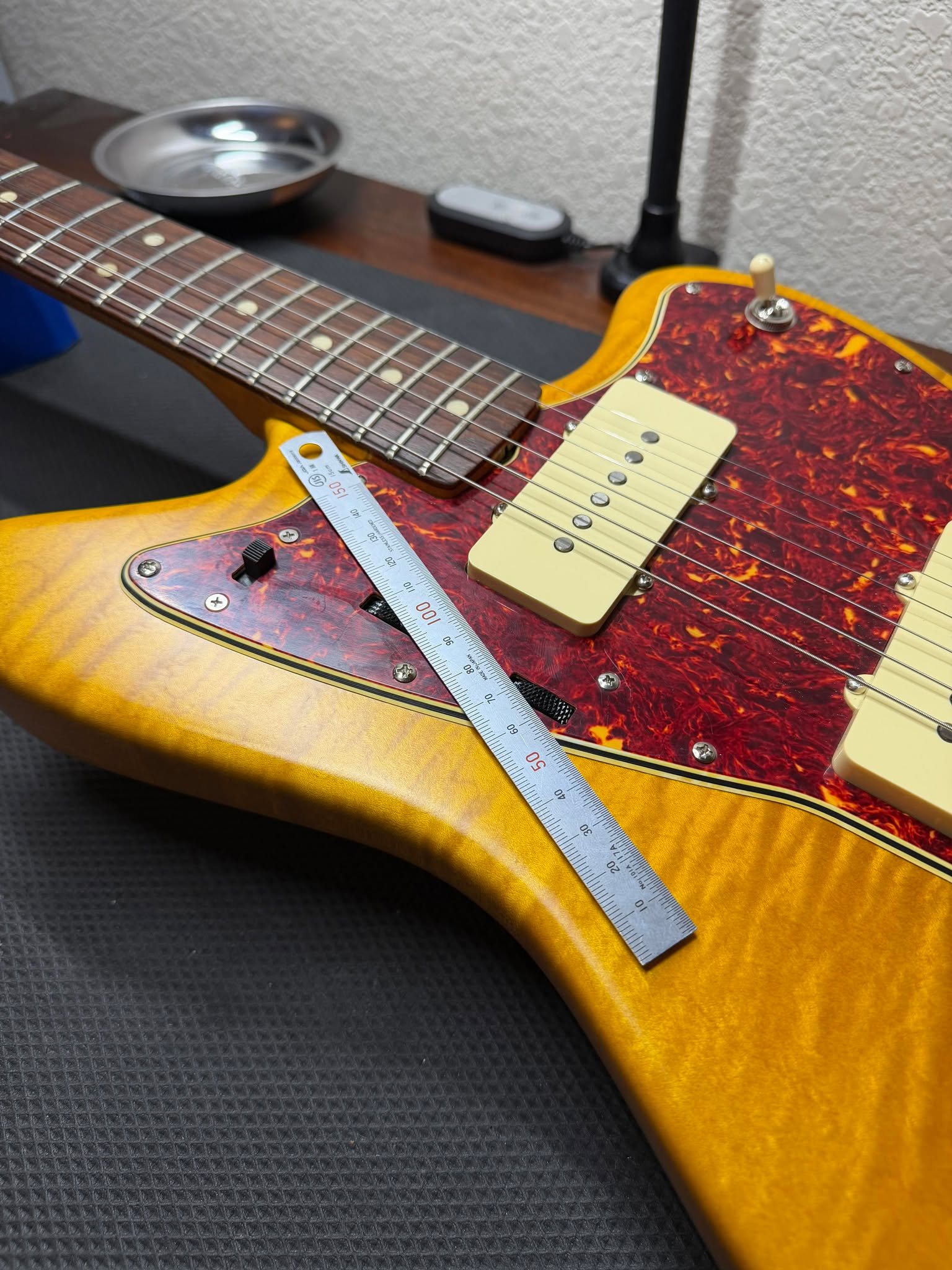
A specialized string action gauge provides precise measurements with markings designed for this purpose. A machinist’s ruler with 64ths-of-an-inch increments works as an alternative, though dedicated gauges are easier to read. Look for gauges that measure in both imperial and metric units.
Screwdrivers and Allen Wrenches
Different bridges require different tools:
Fender-style bridges: Small Phillips head or flathead screwdrivers for saddle height screws
Gibson-style bridges: Thumbwheel adjustment by hand, with specific wrenches for truss rod access
Floyd Rose systems: Metric Allen wrenches for saddle adjustments
Capo for Eliminating Nut Variables
Placing a capo at the 1st fret removes the nut from your measurement equation. This isolates the reading to just the fret-to-string distance, helping determine whether action issues stem from the bridge, the nut, or both.
How to Measure String Action on Your Guitar
1. Tune Your Guitar to Pitch
String tension directly affects action height. Always measure with the guitar tuned to standard pitch, as an untuned guitar gives inaccurate readings.
2. Position Your Gauge at the 12th Fret
Place your gauge or ruler directly over the 12th fret, perpendicular to the strings. The 12th fret is the standard measurement point because it represents the midpoint of string vibration.
3. Measure from Fret Top to String Bottom
Measure from the top of the fret crown to the bottom of the string. A common mistake is measuring to the top of the string, which adds the string’s diameter to your reading.
4. Record Bass and Treble Side Measurements
Measure both the low E and high E strings. Action is typically set higher on the bass side to accommodate the larger vibration arc of thicker strings. Recording both measurements lets you compare against specifications.
How to Adjust Action on Electric Guitars
Fender Style Saddle Adjustment
Fender-style bridges feature individual saddles with two height screws each. Using a small screwdriver or Allen wrench, raise or lower both screws evenly to maintain the saddle’s level position. Work in small increments, then retune and remeasure.
Gibson Style Bridge Adjustment
Gibson-style bridges adjust via thumbwheels on the bridge posts. Turning these wheels raises or lowers the entire bridge on that side, affecting all strings at once. This design offers less individual string control but makes overall action changes simpler.
Tremolo and Floyd Rose Systems
Floating tremolo systems add complexity because spring tension and string tension work against each other. Adjusting action on these bridges often requires rebalancing the entire system. If you’re unfamiliar with floating bridge setup, professional help often saves time.
How to Adjust Action on Acoustic Guitars
Acoustic guitar action adjustment differs from electric guitar work, and the changes are often less reversible.
Saddle Sanding and Shims
To lower action on an acoustic, the saddle’s bottom is sanded down. To raise action, shims go under the saddle, or the saddle is replaced with a taller one. Once material is removed from a saddle, it can’t be put back.
When Nut Work Is Required
If action feels too high only at the first few frets while the rest of the neck plays fine, the nut slots may require deepening. This work calls for specialized nut files and careful technique. Going too deep creates buzz on open strings.
Bridge Pin and Saddle Slot Considerations
The saddle sits in a slot routed into the bridge. A loose fit affects tone and can cause inconsistent action. Bridge pin angle also matters, as it determines the string’s break angle over the saddle.
How to Set Up Guitar Strings for Optimal Action
Action adjustment is one part of a complete setup. The sequence matters, as adjusting things in the wrong order often means redoing work.
1. Assess Neck Relief First
Before touching the bridge, check neck relief. Fret the low E string at the 1st and last frets simultaneously, then look at the gap between the string and the frets around the 7th-9th fret area. A slight gap indicates proper relief. No gap suggests the neck is too straight; a large gap means too much relief.
2. Adjust the Truss Rod if Needed
Truss rod adjustments change neck relief. Turning clockwise typically reduces relief (straightens the neck); counter-clockwise adds relief (increases the bow). Work in quarter-turn increments only, and allow the neck time to settle between adjustments.
3. Set String Action at the Bridge
With neck relief correct, adjust saddle height to reach your target specifications. Make small changes, retune, and remeasure after each adjustment.
4. Fine Tune Nut Height
Check whether open strings buzz or feel unusually high at the first fret. Nut height is addressed last because truss rod and saddle changes can affect how the nut feels.
5. Check Intonation After Changes
Action changes affect intonation, which is whether fretted notes play in tune relative to open strings. Compare the 12th fret harmonic to the fretted note at the same position. If they don’t match, saddle position requires adjustment. On Stratocasters, proper pickup height should also be verified after action changes.
When Professional Setup Is Worth the Investment
Some situations call for professional help rather than DIY adjustment:
Vintage or valuable instruments: The risk of damage outweighs the $40 to $85 typical setup cost
Acoustic guitars requiring saddle or nut work: Irreversible changes call for experience and proper tools
Persistent problems after DIY attempts: Underlying issues like uneven frets may exist
Unfamiliar bridge systems: Floyd Rose, archtop tailpieces, and other specialized hardware have learning curves
How String Action Affects Vintage Guitar Value
For owners of vintage instruments, setup decisions carry additional weight. Original, unmodified saddles and nuts hold value for collectors.
Well-maintained action achieved through proper adjustment rather than parts modification suggests overall good care. Buyers and appraisers evaluate setup condition as part of their assessment.
Considering selling a vintage guitar? Get a free appraisal from Edgewater Guitars before making any modifications.
Get Expert Guidance on Your Vintage Guitar’s Value
Wondering whether your vintage guitar’s setup affects its market value? Edgewater Guitars offers free, no-obligation appraisals for vintage instruments throughout Ohio and neighboring states. Our team can help you understand what you have, whether setup work makes sense, and what your guitar might be worth.
Get Your Free Valuation — Call (440) 219-3607 or submit photos through our website.
Frequently Asked Questions About Guitar String Action
What is the 80/20 rule for guitar action setup?
The 80/20 rule suggests that most players find their ideal action within a narrow range of standard specifications, with personal preference accounting for fine-tuning within that window. About 80% of players are comfortable within typical recommended ranges, while the remaining 20% of adjustment comes down to individual taste and playing style.
Does changing string gauge affect action height?
Yes. Heavier gauge strings increase neck tension and can raise action, while lighter strings reduce tension and may lower it. Switching gauges often requires truss rod and saddle readjustment.
Can high action damage a guitar over time?
High action itself doesn’t damage the guitar. However, the extra finger pressure required to fret notes can accelerate fret wear over years of playing.
How often does guitar action require checking?
Checking action seasonally, or whenever the guitar feels different to play, catches gradual changes before they become problems. Environmental shifts and string aging can alter action without obvious cause.
Is lower action always better for playability?
Not necessarily. Extremely low action sacrifices tone, sustain, and dynamic range for easier fretting. Some playing styles, like slide guitar, specifically require higher action.
What action height do professional guitarists typically prefer?
Preferences vary widely by genre and technique. Many professionals actually choose slightly higher-than-minimum action for better tone and dynamic response rather than the absolute lowest possible setting.
Does action change when switching string brands?
Different brands have slight variations in string diameter and tension at the same gauge, which can subtly affect how action feels even if the measured height remains unchanged.
Can action be adjusted on guitars with wraparound bridges?
Yes. Wraparound bridges typically have height adjustment studs on each side, though they offer less individual string control compared to bridges with separate saddles.