DATE :
Guild Guitar Serial Number Lookup: Complete Dating & Identification Guide
Guild Guitar Serial Number Lookup: Complete Dating & Identification Guide
Last Updated: May 2026
Guild has produced guitars across five distinct factory locations and four corporate ownership eras since its founding in New York City in 1952, with serial number systems that changed multiple times throughout the brand's history. The most celebrated Guild era — the Westerly, Rhode Island factory from 1969 through 2001 — produced the acoustic and electric instruments that defined the brand's reputation among professional players, from Richie Havens' D-40 to the Starfire basses played by Phil Lesh of the Grateful Dead.
This guide is provided as a free resource for Guild owners and collectors researching their instruments. It explains every major Guild serial number system, where to find your serial number, how to identify Westerly-era examples, and which Guild models carry the strongest collector interest in today's market.
Quick Answer: How to Date a Guild Guitar by Serial Number
Guild dating depends on which era and factory produced your instrument:
1952–1959 (Manhattan, NYC era): Early sequential serials, often hard to date precisely
1960–1969 (Hoboken, NJ era): Numeric serials with documented year ranges
1970–2001 (Westerly, RI era): Multiple serial systems including letter-prefix codes introduced in the late 1970s
2001–2014 (Fender ownership): Production moved to Tacoma WA, then Corona CA; new serial systems
2014–present (Cordoba Music Group): Premium production in Oxnard, CA; overseas production for lower-tier lines
The single most important distinction for vintage Guild collectors is whether the instrument is a Westerly-era build (1969–2001) versus production from other eras. Westerly-era Guilds command the strongest sustained collector demand across virtually all model lines.
About Guild: A Brief History
Guild was founded in 1952 in Manhattan by Alfred Dronge, a Polish-born guitar player and music store owner, in partnership with former Epiphone executive George Mann. The company was created in part to absorb Epiphone employees displaced when Epiphone was sold to Gibson, and several former Epiphone luthiers brought their archtop construction expertise to early Guild instruments.
Guild's factory history:
1952–1956 (Manhattan, NY): Original Guild factory on West 14th Street
1956–1969 (Hoboken, NJ): Expanded production at the Hoboken facility
1969–2001 (Westerly, RI): The celebrated Westerly factory, considered Guild's golden era
2001–2004 (Corona, CA via Tacoma, WA): Fender-era transition production
2004–2014 (Tacoma, WA, then New Hartford, CT): Continued Fender ownership
2014–present (Oxnard, CA): Cordoba Music Group ownership; premium production in California, lower-tier production overseas
Notable Guild players include Richie Havens (D-40 Bluegrass), Hank Williams (D-50), Brian May (used various Guilds early in his career), Phil Lesh of the Grateful Dead (Starfire bass), Tom Petty (Guild acoustics on early albums), Bonnie Raitt (M-75 Aristocrat), Eric Clapton (used Guilds in the 1960s and 1970s), and Kim Thayil of Soundgarden (S-100 Polara).
Guild's reputation rests particularly on its jumbo acoustic guitars (F-30, F-40, F-50 series), 12-string flat-tops (F-512 and F-412), and Starfire-series semi-hollow electric guitars and basses.
Why Guild Serial Numbers Are Complex
Three factors make Guild dating more challenging than dating Fender or Gibson instruments from the same era:
Multiple factory transitions. Each move (Manhattan to Hoboken to Westerly to Corona to Tacoma to Oxnard) brought changes to production methods and serial number conventions.
Multiple serial number systems within the Westerly era. Guild used at least two distinct serial systems during the Westerly factory's 32-year run, including the introduction of letter-prefix codes in the late 1970s.
Incomplete public documentation. Unlike Fender or Gibson, Guild has not published comprehensive serial number archives. Most dating reference data comes from collector research, factory records that emerged after the Westerly closure, and dealer observation.
In addition, certain transitional periods — particularly 1969–1970 during the Hoboken-to-Westerly move, and 2001–2004 during the Westerly-to-Corona/Tacoma transition — produced instruments with unusual or hybrid features that complicate dating.
Guild Serial Number Systems by Era
1952–1959: Manhattan Era (NYC)
Early Guild instruments from the original Manhattan factory carry sequential serial numbers in approximately the 1,000 to 12,000 range, though exact year boundaries are debated among collectors. Manhattan-era Guilds are uncommon, and dating typically requires cross-referencing with construction features, headstock logo style, and label appearance rather than relying on serial number alone.
Many early Guild archtops from this period carry construction DNA inherited from former Epiphone luthiers, which is part of what makes early Guilds appealing to archtop collectors.
1960–1969: Hoboken Era (New Jersey)
Hoboken-era Guilds use numeric serial numbers without consistent date encoding. Published collector references provide approximate year-to-serial ranges for this era:
Year | Approximate Serial Range |
|---|---|
1960 | 12,000–14,000 |
1961 | 14,000–18,000 |
1962 | 18,000–22,000 |
1963 | 22,000–28,000 |
1964 | 28,000–38,000 |
1965 | 38,000–46,000 |
1966 | 46,000–60,000 |
1967 | 60,000–75,000 |
1968 | 75,000–95,000 |
1969 | 95,000–120,000 |
Important caveat: These ranges are approximate. Guild's production records from the Hoboken era are incomplete, year boundaries are debated, and overlap exists between years. Serial number alone should never be the sole basis for dating a Hoboken-era Guild. Construction features and hardware specifications must be cross-referenced.
1970–2001: Westerly Era (Rhode Island) — The Celebrated Period
The Westerly factory produced the instruments most associated with Guild's reputation. The Westerly era used multiple serial number systems:
Early Westerly (1970–1979): Continuation of numeric serial numbers, generally in the 100,000+ range, with model-specific stamping conventions developing during this period.
Late Westerly (1979–2001): Letter-prefix serial numbers became standard. Common letter prefixes include AA, AB, AC, AD, AE, AF, AG, AH, AI, AJ, BA, BB, BC, BD, and others, with the prefix system encoding production batch and year information. Letter-prefix codes used by Guild differ from systems used by other brands (such as Rickenbacker's transparent A-through-Z year encoding); Guild's letter system requires manufacturer reference or collector documentation to decode accurately.
The hallmark of a Westerly-era Guild is the combination of "Made in U.S.A." stamping with construction features specific to the Rhode Island factory: certain bracing patterns on acoustics, distinctive Starfire body construction on electrics, and consistent fit-and-finish standards that defined the brand's professional reputation.
2001–2014: Fender Ownership Transition
When Fender closed the Westerly factory in 2001, Guild production moved first to Tacoma, Washington, and then to Corona, California, and later to New Hartford, Connecticut. Serial number systems changed during this transition period. Fender-era Guilds carry "Made in U.S.A." stamping but originate from different factories than Westerly examples. Build quality is generally good for the era but does not carry the Westerly heritage premium.
2014–Present: Cordoba Music Group Era
Cordoba Music Group acquired Guild in 2014 and established premium production in Oxnard, California, while continuing overseas production for lower-tier lines. Modern Oxnard-made Guild acoustics are well-regarded as professional-tier instruments, with premium tier valuations within the modern market. Overseas production (Korean, Indonesian, Chinese) occupies lower tiers regardless of the model name.
Where to Find Your Guild Serial Number
The serial number location varies by model type:
Acoustic Guitars (D-Series, F-Series, M-Series)
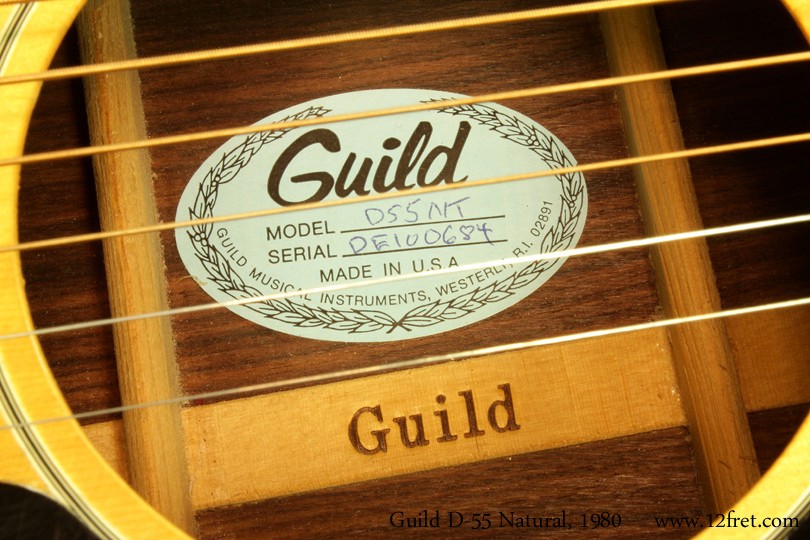
Interior label — visible through the soundhole on the back interior. Primary location for most Guild acoustics. Labels typically include the model number and serial number, along with sometimes the factory location.
Neck block — some models have the serial stamped or written on the neck block visible through the soundhole.
Back of the headstock — modern Guilds typically have the serial here as well.
Electric Guitars (Starfire Series, S-Series, T-Series, X-Series)
Back of the headstock — primary location for most Guild electrics
Inside control cavity — some models carry additional stamps
Interior label (on hollow body and semi-hollow models like Starfires) — visible through the f-hole
Basses (Starfire Bass, JS Series)
Back of the headstock — primary location
Interior label on Starfire basses — visible through the f-hole
The Westerly Factory Significance
Understanding the Westerly factory is essential context for Guild collectors. The Rhode Island facility operated from 1969 to 2001, employing skilled luthiers (including the celebrated Carlo Greco) and producing instruments that defined the Guild brand's professional reputation.
Westerly-era Guilds share several construction hallmarks:
Consistent flat-top bracing patterns that produced Guild's signature jumbo acoustic tone
Specific neck profile conventions developed across the model lines during this era
Starfire electric construction with proprietary body shaping and laminate techniques
Hardware specifications including specific tuner and bridge components
When the Westerly factory closed in 2001 following Fender's acquisition and consolidation plans, the loss of that production capacity — and the dispersal of its luthiers — affected Guild's market positioning permanently. Westerly-era Guilds continue to command the strongest sustained collector demand of any Guild production era.
Most Collected Vintage Guild Models
These Guild models carry the strongest current collector interest, particularly in Westerly-era examples:
Jumbo and dreadnought acoustics:
F-50 and F-50R Navarre: The premium jumbo, with rosewood (R) or maple back and sides. Top-tier collector demand for clean Westerly examples.
F-40 Valencia: Mid-line jumbo, highly regarded for its balance of size and tone.
F-30 Aragon: Smaller jumbo, popular among fingerstyle players.
D-55: Top-of-line dreadnought, premium tier valuations for Westerly examples.
D-50 Bluegrass Special: Hank Williams association; strong collector interest.
D-40 Bluegrass Jubilee: Richie Havens' instrument of choice.
D-35 Bluegrass: Mid-line dreadnought with sustained collector demand.
12-string acoustics:
F-512 and F-412: Guild's celebrated 12-string flat-tops, considered among the finest production 12-strings ever made. Premium tier valuations for Westerly examples.
Archtops:
Stuart series (X-700, X-800): Premium electric archtops.
X-175 Manhattan: Classic electric archtop, jazz favorite.
Electric guitars:
Starfire III, IV, V, VI: Semi-hollow electrics, particularly with original DeArmond or Guild humbucker pickups. The Starfire IV and V have sustained collector interest.
S-100 Polara: Solid-body associated with Kim Thayil of Soundgarden.
M-75 Aristocrat / Bluesbird: Carved-top solid bodies with collector following.
T-100 Slim Jim: Thin hollow-body electric.
Bass guitars:
Starfire Bass: Semi-hollow bass associated with Phil Lesh of the Grateful Dead. Top-tier collector demand for early Westerly and late Hoboken examples.
Red Flags: Authentication and Identification Issues
Common issues to watch for when researching a Guild:
Misrepresented era. Online listings frequently exaggerate the age of Guild guitars or claim Westerly origin for post-2001 production. The factory stamp on the interior label and back-of-headstock markings are the definitive authentication points.
Refinishes. Aged nitrocellulose lacquer on a 1960s–1980s Guild should show natural amber tinting, fine checking, and consistent wear patterns. A uniformly bright or glossy finish on a vintage Guild is a refinish red flag, not evidence of preservation. Faded, naturally aged finishes are correct and desirable on vintage acoustics.
Replaced tuners. Original Grover, Schaller, or Guild-branded tuners from the Westerly era have specific stampings. Modern replacement tuners reduce originality value.
Replaced electronics or pickups. Original Guild humbuckers, DeArmond pickups, and electronic components on Starfires and other electrics command collector premiums.
Bridge or saddle replacements on acoustics — these are common but reduce originality value.
Top crack repairs. Guild jumbos and dreadnoughts are vulnerable to top cracks from humidity changes; repaired examples should be evaluated for repair quality.
Reset necks. Necessary on many vintage acoustics over time; well-executed neck resets are acceptable, but poor work significantly affects value.
What Affects a Guild's Collector Value
Era and factory: Westerly-era Guilds (1969–2001) sit at the top tier of Guild valuations. Hoboken-era examples (1960–1969) also command strong collector interest, particularly for archtops and early Starfires. Manhattan-era examples are rare and collector-specific. Modern Oxnard-era Guilds carry strong upper-tier valuations within the modern market.
Model and tier: Within any era, top-line models (F-50, D-55, F-512, Starfire VI) command premium valuations. Mid-line models (F-40, D-40, Starfire IV) occupy the upper-mid tier. Entry models still benefit from Guild build quality but at lower price points.
Originality: All-original examples with original tuners, pickups, electronics, and finish command meaningful premiums over modified examples.
Player association: Models associated with specific notable musicians — D-40 (Richie Havens), D-50 (Hank Williams), Starfire bass (Phil Lesh), S-100 (Kim Thayil), M-75 (Bonnie Raitt) — benefit from sustained cultural demand.
Condition: Crack-free tops, intact original labels, clean fingerboards, original neck angle, and original cases all contribute to upper-tier valuations.
Documentation: Original case, paperwork, factory records, and provenance documentation add collector confidence and value.
Further Research Resources
For deeper Guild research, the following community resources are valuable:
Let's Talk Guild and other Guild owners' forum communities maintain catalog archives and serial number observation databases drawn from years of collector research.
Vintage guitar publications including Vintage Guitar magazine and Acoustic Guitar magazine have published Guild-focused features and dating references.
Hans Moust's The Guild Guitar Book is widely regarded as the standard published reference for Guild dating, construction history, and model identification.
Original Guild catalogs (available through collector communities and archives) provide year-specific feature documentation that helps narrow serial-number ambiguity.
Frequently Asked Questions About Guild Serial Numbers
How do I tell what year my Guild guitar was made? Combine three data points: the serial number format, the factory stamp or label location, and the construction features. Hoboken-era Guilds (1960–1969) follow documented year-to-serial ranges. Westerly-era Guilds (1970–2001) used multiple systems including letter-prefix codes introduced in the late 1970s. "Made in U.S.A." stamping with the factory location helps confirm the era.
Are Guild guitars valuable? Westerly-era Guilds (1969–2001) carry the strongest sustained collector demand, particularly the F-50, F-512, D-55, D-50, and Starfire-series models. Hoboken-era Guilds (1960–1969) also command collector interest, especially early Starfires and archtops. Modern Oxnard-made Guilds occupy strong upper-tier valuations within the modern market.
Where were Guild guitars made? Guild has used five major factory locations: Manhattan, NY (1952–1956), Hoboken, NJ (1956–1969), Westerly, RI (1969–2001), Corona, CA and Tacoma, WA and New Hartford, CT (2001–2014 under Fender), and currently Oxnard, CA (2014–present under Cordoba Music Group). The Westerly, Rhode Island factory produced the era most prized by collectors.
What is a Westerly Guild? A Westerly Guild is an instrument produced at the Westerly, Rhode Island factory between 1969 and 2001. This is considered Guild's golden era, producing the F-50, F-512, D-55, Starfire-series, and other models that defined the brand's professional reputation. Westerly-era examples are identifiable through factory stamping on interior labels and back-of-headstock markings, combined with construction features specific to the Rhode Island facility.
Where is the serial number on a Guild guitar? On Guild acoustic guitars, the serial number appears on the interior label visible through the soundhole, and on modern examples also on the back of the headstock. On Guild electric guitars, the serial number is typically stamped on the back of the headstock, with hollow-body and semi-hollow models (such as Starfires) carrying an interior label visible through the f-hole.
What is the most collectible Guild model? The Guild F-512 12-string and F-50 jumbo are widely considered Guild's most collected acoustic models, with Westerly-era examples commanding top-tier collector valuations. Among electrics and basses, the Starfire IV, V, and Starfire bass carry the strongest sustained collector demand. Model-by-model collectibility also depends on era, with Westerly-era examples generally preferred across all Guild lines.
Related Resources
This Guild serial number guide is part of Edgewater Guitars' collection of vintage guitar identification resources:
Gibson Serial Number Lookup Tool — edgewaterguitars.com/guitar-serial-number-lookup/gibson
Fender Serial Number Lookup Tool — edgewaterguitars.com/guitar-serial-number-lookup/fender
Gretsch Serial Number Lookup Guide
Rickenbacker Serial Number Lookup Guide
Yamaha Serial Number Lookup Guide
Aria Serial Number Lookup Guide
Edgewater Guitars publishes free identification resources for guitar owners and collectors. This Guild guide is provided as a research reference. Edgewater Guitars specializes in purchasing premium vintage American-made guitars throughout Ohio, Michigan, Pennsylvania, Indiana, and West Virginia — including Gibson, Fender, Martin, Gretsch, and Epiphone instruments.
Related: Vintage Guild Starfire value guide, 1960 to 1970, Starfire I to VI.