DATE :
Gretsch Guitar Serial Number Lookup: Complete Dating & Authentication Guide
Gretsch Guitar Serial Number Lookup: Complete Dating & Authentication Guide
Last Updated: July 2026
Gretsch has produced guitars across three distinct corporate eras since 1939, with major manufacturing transitions during the Baldwin acquisition (1967), the dark period of the 1980s, and the modern Japanese production era beginning in 1989. Each era used different serial number systems, and accurate dating requires combining the serial number with construction features, country-of-origin markings, and hardware specifications.
This guide explains every major Gretsch serial number system, where to find your serial number, how to identify the most collectible models, and what your vintage Gretsch may be worth in today's market.
For a definitive answer on your specific guitar, Edgewater Guitars provides free Gretsch identification and valuation: (440) 219-3607 or edgewaterguitars.com.
Quick Answer: How to Date a Gretsch Guitar by Serial Number
Gretsch serial numbers fall into four distinct systems based on era of production:
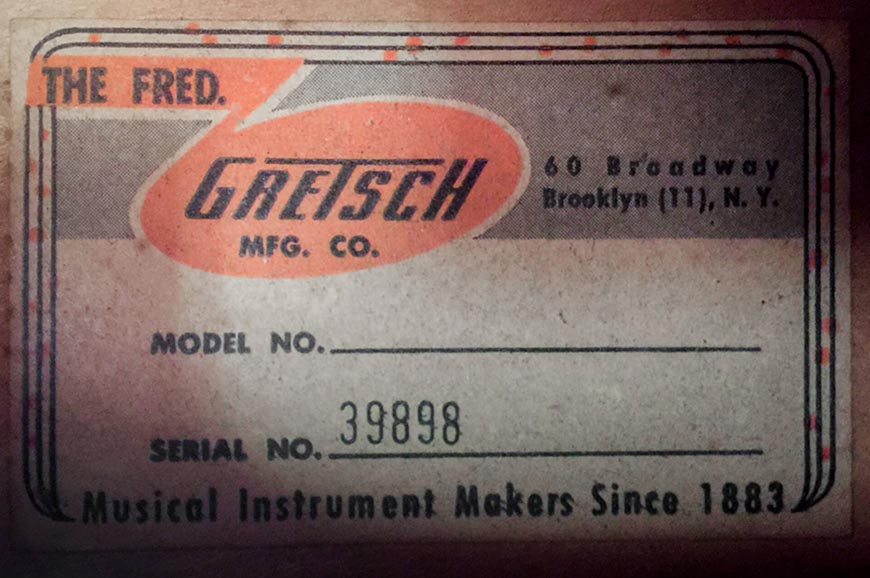
1939–1965 (Brooklyn era): Sequential numbers; location varied by model, with many hollow bodies carrying it on the interior label seen through the f-hole and headstock stamps more common on solid bodies and later hollow bodies
1965–1972 (late Brooklyn / early Baldwin): Date-coded serials from mid 1966 (month, last digit of the year, production number), stamped on the headstock
1972–1981 (Baldwin era): Date-coded format with month and year embedded in the number
1989–present (modern era): Letter-prefix codes, primarily on Japan-made Terada factory guitars
Determining your guitar's era is the first step. From there, the serial number, country-of-origin marking, pickup type, and inlay style narrow the year to within a 12-month range in most cases.
Why Gretsch Serial Numbers Are More Complex Than Most Brands
Gretsch's corporate history created discontinuities that affect dating:
The Brooklyn-to-Booneville move (1967–1972). When Baldwin purchased Gretsch in 1967, production gradually transitioned from Brooklyn, New York, to Booneville, Arkansas. Guitars from this transitional period can carry features from either factory.
The dark period (1981–1989). Gretsch production effectively ceased for most of the 1980s. Genuine guitars from this period are rare and often misattributed in online listings.
The Fred Gretsch III revival (1989). Fred Gretsch III revived the brand with Japanese production at the Terada factory, introducing new serial systems and modern construction. Fender entered an operating agreement to handle distribution and design in 2002, adding another layer to modern Gretsch history.
In Edgewater's experience evaluating vintage Gretsches across the Midwest, the most common dating errors involve transitional 1965–1972 examples and confusion between Brooklyn-era originals and modern Japanese reissues of the same model.
Gretsch Serial Number Systems by Era
1939–1965: The Brooklyn Era (Sequential Numbering)
The most collectible Gretsch guitars come from this era. Serial numbers were stamped or impressed on the back of the headstock in sequential order, with the numbers climbing progressively through the production years.
Approximate Brooklyn-era serial number ranges by year:
Year | Approximate Serial Range |
|---|---|
1949–1950 | approximately 2,000 to 4,000 |
1951–1953 | approximately 4,000 to 9,000 |
1954–1956 | approximately 9,000 to 21,000 |
1957–1959 | approximately 21,000 to 34,000 |
1960–1962 | approximately 34,000 to 53,000 |
1963–1965 | approximately 53,000 to 85,000 |
Important caveat: These ranges are approximate. Gretsch's production records from this era are incomplete, and year boundaries are debated among collectors. Serial number alone should never be the sole basis for dating a Brooklyn-era Gretsch. Construction features, pickup type, and hardware specifications should always be cross-referenced.
1965–1972: Late Brooklyn and Baldwin Transition
During the late Brooklyn period and early Baldwin years, Gretsch replaced its old sequential numbers with a date-coded serial in mid 1966: the month, the last digit of the year and a production number, stamped on the back or sometimes the top edge of the headstock.
This transitional era is genuinely difficult to date precisely. If your Gretsch carries a six-digit serial that doesn't fit the Brooklyn sequential pattern and doesn't match the Baldwin date-coded format below, it likely falls into this transition window.
1972–1981: Baldwin Era Date-Coded System
Gretsch kept the date-coded serial format it introduced in mid 1966 after production relocated to Booneville, Arkansas, under Baldwin ownership. The format encodes the month and year of production directly into the number.
Baldwin-era format:
First one or two digits: Month of production (1–12)
Next single digit: Last digit of the production year (2 for 1972, 3 for 1973, and so on through 1 for 1981)
Final digits: Sequential production number for that month
For example, a serial reading something like 1-2001 would indicate January 1972 (the digit "2" standing for 1972), the first guitar of that month's production. Various stamping styles were used, so the exact appearance varies.
Baldwin-era Gretsch guitars are widely collected but generally sit below Brooklyn-era examples in collector preference. Build quality varied during this period, and the Booneville factory experienced production issues that affected consistency.
1981–1989: The Dark Period
Gretsch production essentially halted during much of the 1980s. Genuine guitars from this period are uncommon, and many online listings claiming "1980s Gretsch" instruments are actually modern reissues or misattributed examples. Hands-on authentication is essential for any guitar claimed to come from this era.
1989–Present: The Modern Era
When Fred Gretsch III revived the brand in 1989, production moved primarily to Japan at the Terada factory, with Korean and Chinese production added later for lower-tier lines.
Modern Gretsch serial number formats:
Japan-made (Terada): Letter-prefix serial numbers. Common patterns include "JT" prefixes followed by date and production codes. The letters typically encode the factory and decade; the digits encode year, month, and production sequence.
Korea-made (Electromatic line, 2000s onward): Different prefix codes indicating Korean origin and budget-tier production.
China-made (Streamliner line, recent): Modern budget production with country-specific serial systems.
USA Custom Shop: Reintroduced for high-end limited reissues, with distinct serial systems.
Modern Japan-made Gretsch guitars are highly regarded and often command upper-tier valuations relative to their original retail prices, particularly Players Edition and Professional series instruments from Terada.
Where to Find Your Gretsch Serial Number
Hollow Body Models (6120, White Falcon, Country Gentleman, Tennessean, Anniversary)
Back of the headstock, where the date-coded serial appears from mid 1966 onward; on earlier Brooklyn-era hollow bodies the interior label (below) usually carries the number
Top edge of f-hole binding, used on some 1965-1972 transitional models
Interior label, visible through the f-hole on most hollow bodies; contains model number and sometimes serial
Solid Body Models (Duo Jet, Jet Firebird, Silver Jet, Penguin)
Back of the headstock, primary location
Inside the control cavity, some models carry additional stamps
Modern Reissue Models
Back of the headstock, typical primary location
Interior labels and additional stamps on Professional and Players Edition models
Made in USA vs Made in Japan: Why It Matters for Value
Country of origin and era significantly affect Gretsch valuations:
Origin | Era | Relative Value Tier | Notes |
|---|---|---|---|
Made in USA (Brooklyn) | 1939–1967 | Top tier | Most collectible era; original Gretsch family production |
Made in USA (Booneville) | 1967–1981 | Mid to upper tier | Baldwin era; quality variable but still desirable |
Made in Japan (Terada) | 1989–present | Upper tier (modern) | Premium build quality for modern Gretsch |
Made in Korea | 2000s–present | Entry to mid tier | Electromatic line, budget-friendly |
Made in China | Recent | Entry tier | Streamliner line, entry-level |
USA Custom Shop | Modern | Premium tier | High-end reissues and signature models |
A 1959 Brooklyn-made 6120 carries collector value that no modern reissue can match, even when the modern version is a high-quality Japanese build. This isn't a slight against modern production. It reflects the unique status of original-era Gretsch guitars in the vintage market.
Most Collectible Vintage Gretsch Models
In Edgewater's experience buying vintage instruments throughout Ohio, Michigan, Pennsylvania, Indiana, and West Virginia, these are the Gretsch models most worth professional appraisal:
Hollow body electrics:
1954-1961 Gretsch 6120 Chet Atkins Hollow Body: Western Orange finish, G-brand on the top, horseshoe headstock inlay, Western-themed engraving on metal parts. Filter'Tron pickups beginning 1957; DeArmond Dynasonic pickups before that. Top-tier collector demand for clean Brooklyn examples.
1955-1964 White Falcon (6136): Gretsch's "Cadillac of guitars." Gold sparkle binding, gold-plated hardware, jeweled knobs and headstock. Single cutaway pre-1962, double cutaway 1962 onward. Premium tier valuations across the board.
1957–1964 Country Gentleman (6122): Associated with George Harrison and the Beatles. Painted f-holes, simpler appointments than the 6120 but still highly collectible. Double cutaway from 1961.
1958–1964 6119 Tennessean: Cherry or orange stain, Hi-Lo'Tron pickups on most examples, simpler binding than the 6120.
1958–1960 Anniversary models: Two-tone smoke green or sunburst finishes, commemorating Gretsch's 75th anniversary.
Solid body electrics:
1953-1964 Duo Jet (6128): Black-top mahogany body, semi-solid construction. DeArmond pickups pre-1957, Filter'Trons from 1957. Strong collector interest.
Silver Jet (6129): Silver sparkle top variant of the Duo Jet.
1955–1958 Jet Firebird (6131): Red top variant.
1958–1959 Penguin: Extremely rare solid body version of the White Falcon. Premium tier valuations for confirmed originals.
Identifying authentic Filter'Tron pickups (1957 onward): Look for the patent number stamping on the underside of the pickup baseplate (after the initial PAF-style sticker era) and the characteristic dog-ear-style mounting. DeArmond Dynasonic pickups, used before 1957, have a distinctly different appearance with adjustable individual pole pieces and a different mounting style.
Red Flags: How to Spot Refinishes, Fakes, and Misrepresented Gretsches
Authentication concerns we encounter regularly:
Refinished Western Orange. Faded, aged Western Orange is correct and desirable on a 1950s–1960s 6120. The original lacquer naturally yellows and fades unevenly with light exposure. A uniformly bright orange finish on a vintage 6120 is a refinish red flag, not evidence of preservation. Aged patina is part of what collectors value.
Pickup substitutions. DeArmond and Filter'Tron pickups are sometimes swapped in either direction to "upgrade" or "correct" a guitar. Original-to-the-guitar pickups command premium pricing; substitutions reduce value meaningfully.
Added G-brand. The cattle-brand "G" mark on the top of a 6120 is a defining feature. Some sellers have added G-brands to non-6120 models or to refinished 6120s. Authentic brands show consistent burn depth and appropriate finish interaction around the edges.
Replaced Bigsby units. Original Bigsby B-3, B-6, and B-7 vibratos have specific stampings and finish characteristics consistent with the guitar's era. Modern replacements reduce originality value.
Modern reissues sold as vintage. Japanese-made Professional Edition 6120s and White Falcons are excellent guitars but should never be sold or priced as vintage Brooklyn examples. Cross-reference serial number format and country-of-origin marking against the claimed era.
Headstock repairs. Gretsch headstocks, like Gibson's, are prone to break damage. Inspect carefully under raking light for repair lines, finish touch-up, and grain disruption.
Pickguard replacements. Original Gretsch pickguards from the 1950s–1960s have specific shapes, materials, and aging characteristics that differ from modern reproductions.
What Affects Your Vintage Gretsch's Value
Era and origin: Brooklyn-era examples (pre-1967) sit at the top tier. Baldwin-era Booneville guitars occupy the mid-to-upper tier. Modern Japan-made and USA Custom Shop instruments hold strong upper-tier valuations within the modern market but don't compete with vintage originals.
Originality: All-original examples command significant premiums. Replaced pickups, tuners, bridges, or pickguards each reduce value by meaningful percentages. Faded original finishes are correct and desirable, reflecting the guitar's authentic history.
Color and finish rarity: Cadillac Green and Jaguar Taupe finishes on White Falcons, custom-color 6120s, and unusual factory finishes command premium tier pricing. Standard Western Orange on a 6120 or standard white on a Falcon establishes the baseline.
Pickup configuration: Original-to-the-guitar Filter'Tron pickups (post-1957) or DeArmond Dynasonics (pre-1957) command premium valuations. The patent number ranges on Filter'Tron baseplates help confirm original-period production.
Hardware originality: Original Bigsby vibratos, original tuners, original control knobs, and original pickguards all contribute to upper-tier valuations.
Documentation and case: Original Gretsch cases, paperwork, hangtags, and provenance documentation increase collector confidence and value.
Famous ownership: Verified provenance from notable musicians can produce significant value multipliers, particularly for George Harrison-era Country Gentlemen and Chet Atkins-associated 6120s. Documentation chain is essential.
Selling Your Vintage Gretsch: Your Options Compared
Option | Typical Offer | Timeline | Fees/Risk | Best For |
|---|---|---|---|---|
Edgewater Guitars | 30–40% above shop offers | Immediate cash | None | Owners wanting fair value without hassle |
Local Guitar Shop | Lowest wholesale tier | Same day | None direct, lowest offer | Convenience over value |
Online Marketplace | Variable | Weeks to months | 5–15% fees, scam risk, shipping issues | Experienced sellers comfortable with risk |
Auction House | Variable | Months | 15–25% seller premium | Exceptionally rare instruments |
Private Sale | Variable | Unpredictable | Authentication burden on you | Sellers with existing buyer network |
Edgewater Guitars consistently pays 30–40% more than typical guitar shops for vintage Gretsches. We provide free authentication, immediate cash payment, and travel to evaluate high-value instruments throughout Ohio, Michigan, Pennsylvania, Indiana, and West Virginia.
The process: Contact us at (440) 219-3607 or through edgewaterguitars.com. Send a description, serial number, and clear photos of the headstock, body, pickups, and any visible labels, or start your free estimate here. Receive a preliminary valuation. Schedule an in-person evaluation for premium instruments. Receive a no-obligation offer with immediate cash payment if accepted.
Frequently Asked Questions About Gretsch Serial Numbers
How do I tell what year my Gretsch guitar was made? Identify which serial number system was used during your guitar's production era. Brooklyn-era guitars (1939 to 1965) used sequential numbering, most often printed on an interior label visible through the f-hole on hollow bodies; the headstock date code arrived in mid 1966. Baldwin-era guitars (1972–1981) used a date-coded format with month and year embedded in the serial. Modern Japan-made Gretsches use letter-prefix codes. Cross-reference the serial with pickup type, inlay style, and country-of-origin marking to confirm the year.
Are old Gretsch guitars valuable? Yes, particularly Brooklyn-era examples from 1939 to 1967. The most valuable vintage Gretsches include 1954–1961 6120 Chet Atkins models, 1955–1964 White Falcons, 1953–1964 Duo Jets, 1957–1964 Country Gentlemen, and 1958–1959 Penguins. Original-condition examples with intact Filter'Tron or DeArmond pickups command premium tier valuations.
What is a Gretsch 6120? The Gretsch 6120 is the Chet Atkins Hollow Body model, introduced in 1954. It features Western Orange finish, a "G-brand" cattle mark on the top, a horseshoe inlay on the headstock, Western-themed engraving on the metal parts, and a Bigsby vibrato tailpiece. DeArmond Dynasonic pickups were used through 1957; Filter'Tron pickups replaced them from 1957 onward. The 6120 is among the most collectible vintage Gretsch models.
What does the "G-brand" mean on a Gretsch 6120? The G-brand is a cattle-brand-style mark burned into the top of the Gretsch 6120, reinforcing the model's Western theme tied to Chet Atkins' image. Authentic G-brands show consistent burn depth and appropriate finish behavior around the brand edges. The presence of a G-brand alone doesn't guarantee a guitar is a 6120 or that it's authentic, since some have been added to non-6120 models. Verification requires hands-on inspection.
How can I tell if my Gretsch has Filter'Tron or DeArmond pickups? Filter'Tron pickups, introduced in 1957, are humbucking pickups with two adjacent rectangular coil windings under a metal cover. Look for patent number stamping on the baseplate. DeArmond Dynasonic pickups, used before 1957, are single-coil pickups with six adjustable individual pole-piece screws visible on top. The visual difference is immediate. If you're uncertain, send photos to Edgewater for free identification.
Where can I sell my vintage Gretsch guitar? For premium vintage Gretsches, particularly Brooklyn-era 6120s, White Falcons, Duo Jets, Country Gentlemen, and Tennesseans, Edgewater Guitars typically pays 30-40% more than local guitar shops while providing free authentication and immediate cash payment. Edgewater serves Ohio, Michigan, Pennsylvania, Indiana, and West Virginia, traveling for high-value instruments. Contact (440) 219-3607 or edgewaterguitars.com for a free valuation.
Related Resources
How to Identify Filter'Tron vs DeArmond Pickups
Vintage Guitar Refinish Detection Guide (covers Western Orange aging and authenticity red flags)
Get Your Gretsch Appraised by Edgewater
Edgewater Guitars specializes in purchasing premium vintage guitars throughout Ohio, Michigan, Pennsylvania, Indiana, and West Virginia. We provide free authentication and valuation for vintage Gretsch guitars, with particular expertise in Brooklyn-era 6120 Chet Atkins models, White Falcons, Duo Jets, Country Gentlemen, and Tennesseans.
Whether you're settling an estate, downsizing a collection, or simply curious what your vintage Gretsch is worth, contact us for a no-obligation valuation:
(440) 219-3607 | edgewaterguitars.com
Related: Gretsch Single Anniversary value guide (1958 to 1972): 6124 and 6125.