DATE :
Gold Gibson Guitar Identification: Complete Guide to Identifying Guitars by Color & Finish
Gold Gibson Guitar Identification: Complete Guide to Identifying Guitars by Color & Finish
Quick Answer: If you have a gold-colored Gibson guitar, you likely have a Les Paul Goldtop (1952-1957 most valuable, or later reissue), which is a highly collectible model especially from the 1950s. A cherry red Gibson with carved top indicates a Les Paul Standard “burst” (1958-1960 examples are among the most valuable guitars ever made), while a black Gibson typically indicates either a Les Paul Custom “Black Beauty” or an SG model. For Fender guitars, a blonde/butterscotch finish usually indicates a Telecaster, while sunburst Stratocasters are most common—but custom colors (Sonic Blue, Lake Placid Blue, Fiesta Red, Surf Green) on pre-1965 Fenders are dramatically more valuable than standard finishes. Color is often the first thing non-guitarists notice, and specific color combinations can indicate extremely valuable vintage instruments that warrant immediate professional authentication.
If you’re trying to identify a guitar and the most obvious thing you notice is its color—maybe you have a “gold Gibson,” a “red and yellow Fender,” or a “black guitar with white binding”—you’re actually using one of the most natural and effective identification methods. Non-guitarists describe guitars by what they see first: COLOR.
The remarkable thing is that certain colors are strongly associated with specific models and eras, making color one of your most valuable identification clues. A gold Gibson is almost certainly a Les Paul Goldtop. A cherry red Gibson with a carved top might be one of the most valuable guitars ever made. A blonde Fender with two pickups is likely a Telecaster.
This comprehensive guide will teach you how to identify any guitar by its color or finish, understand which colors indicate valuable vintage instruments, recognize the difference between original finishes and refinishes, and know when specific colors mean you should seek immediate professional authentication.
At Edgewater Guitars, we’ve authenticated thousands of vintage instruments throughout Ohio and the Midwest, and we’ve learned that people who call saying “I have a gold Gibson” or “I have a three-color Fender” are often describing extremely valuable guitars without realizing it. This guide represents everything we’ve learned about color-based guitar identification.
What you’ll learn:
Gold Gibson guitars: Les Paul Goldtop identification and value
Cherry sunburst Gibson guitars: The most valuable finish ever
Black Gibson guitars: Les Paul Custom vs. SG identification
Fender sunburst variations: Two-tone vs. three-tone significance
Fender custom colors: Which colors indicate valuable guitars
Natural/blonde finishes: What they tell you about the guitar
How to spot refinished vs. original finishes
Real case studies of color-based identifications
Let’s start with what’s likely the most common search: the gold Gibson guitar.
Gold Gibson Guitar Identification
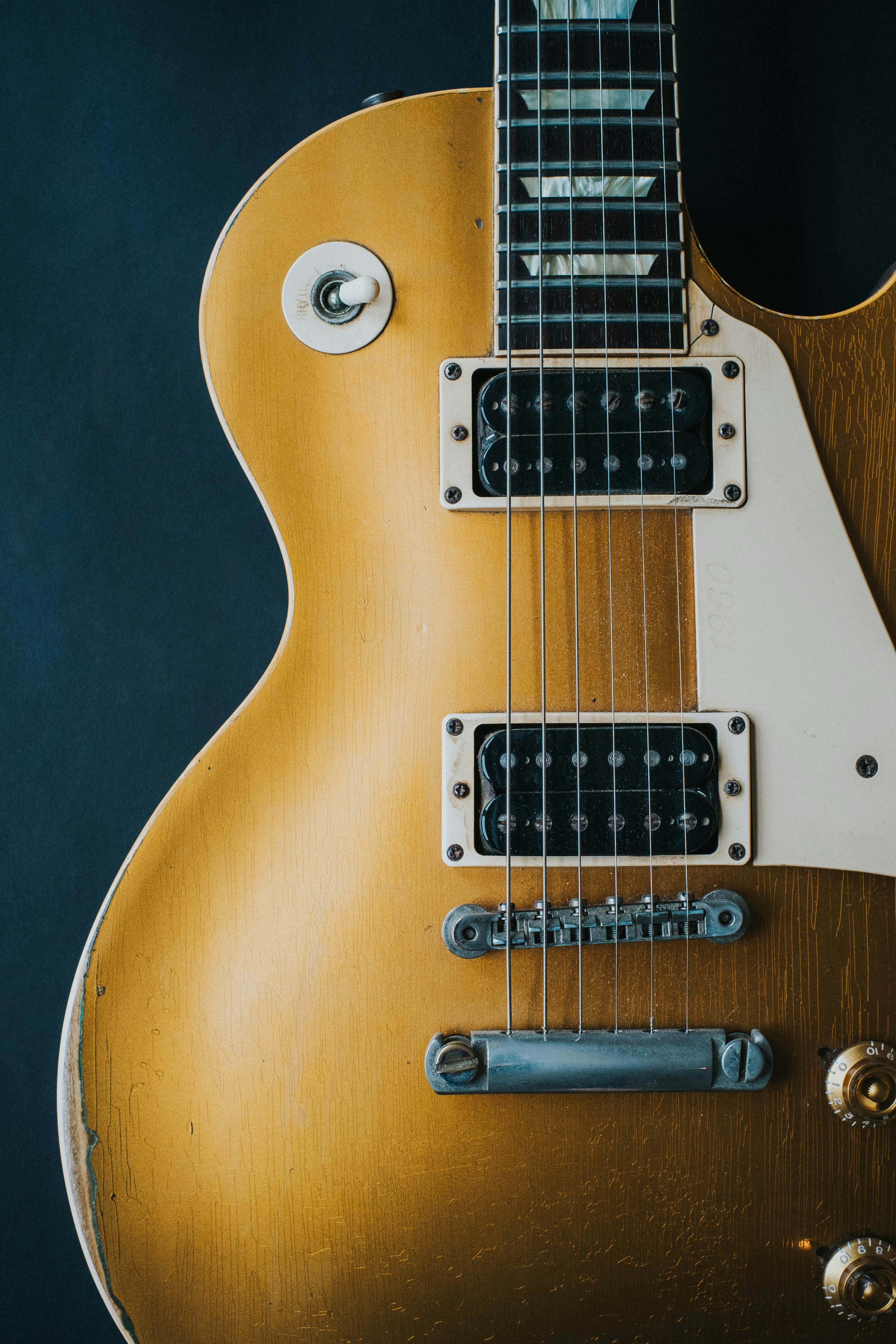
If you have a gold-colored Gibson electric guitar, you almost certainly have a Les Paul Goldtop—one of Gibson’s most iconic and valuable models.
What Is a Gibson Les Paul Goldtop?
The Goldtop was Gibson’s original Les Paul model introduced in 1952 and produced through 1957 (with later reissues). The distinctive gold metallic finish makes these guitars instantly recognizable even to people who know nothing about guitars.
Visual Identification: Is Your Gold Gibson a Goldtop Les Paul?
Look for these features on your gold Gibson:
✓ Gold metallic finish on top (may be dull or darkened with age) ✓ Carved maple top - Top surface is arched/rounded, not flat ✓ Single cutaway - One “horn” extending from body on bass/left side ✓ Dark back - Back of guitar typically dark brown or black (not gold) ✓ Thick body - Approximately 1.75-2 inches deep ✓ Binding around edge - Cream or white plastic strip around perimeter ✓ Two pickups - Black or cream colored rectangular pickups
If you see these features, you have a Les Paul Goldtop.
Les Paul Goldtop Variations by Era
The specific features tell you which era Goldtop you have—and this matters enormously for value:
1952-1953 Goldtops (Early, Highly Valuable)
Distinctive features:
Trapeze tailpiece - Strings wrap under a bar that arches over the top
P-90 pickups with cream-colored covers
Unbound neck (1952-early 1953)
Bound neck (late 1953 onward)
Deep V-shaped neck profile
Dot inlays on fretboard
Gold finish may show bronze undercoat underneath
Serial numbers: 0xxx-4xxx range (5 digits on back of headstock)
1953-1954 Goldtops (Wraparound Era)
Distinctive features:
Wraparound bridge/tailpiece combination - One piece wraps over top
P-90 pickups with cream covers
Bound neck
Dot inlays (some have trapezoid inlays)
V-shaped to rounder neck profiles
Serial numbers: 4xxx-5xxx range
1954-1957 Goldtops (Tune-o-matic Era)
Distinctive features:
Tune-o-matic bridge + separate stopbar tailpiece
P-90 pickups (1954-1957)
PAF humbucker pickups (mid-1957 onward - VERY valuable)
Trapezoid inlays on fretboard
Bound neck
Rounder neck profiles
Gold finish showing more consistent quality
Serial numbers: 5xxx-7xxx range
CRITICAL: Mid-1957 Goldtops with PAF humbuckers (not P-90s) are extremely valuable because they combine the iconic gold finish with the revolutionary humbucker pickups.
1968-Present Goldtops (Reissues)
Gibson reintroduced Goldtop Les Pauls in 1968:
Modern construction (pancake body 1970s, modern specs later)
Various pickup types
“Goldtop” finish recreates 1950s appearance
Serial numbers follow modern Gibson systems
Valuable as player guitars, not vintage collectibles
How to Tell 1950s Goldtop from Modern Reissue
1950s original Goldtops:
Thin nitrocellulose finish with checking (fine cracks)
Gold has faded, darkened, or worn through to wood
Natural aging and patina throughout
Period-correct hardware (Kluson tuners, ABR-1 bridge)
Pot codes showing 1950s dates
Lightweight (typically 8.5-9.5 lbs)
Serial numbers in 0xxx-7xxx range
Modern reissues:
Thicker, more uniform finish
Bright, consistent gold color
Little to no wear or aging
Modern hardware (or aged reproductions)
Pot codes showing recent dates
Often heavier (9-11+ lbs)
Modern serial number formats
Special Note: “Dark Back” Goldtops (1957 Onward)
Starting in 1957, Gibson changed the back finish:
Earlier Goldtops: Gold on back too (or light finish)
1957+: Dark brown to black back finish
This creates dramatic two-tone appearance
Dark back + gold top = 1957 or later
What Makes Goldtops Valuable
1950s Goldtops are highly collectible because:
Historical significance - Original Les Paul model
Limited production - Only made 1952-1957 originally
Iconic appearance - Instantly recognizable finish
Quality construction - Peak Gibson craftsmanship
Evolution visible - Shows development of Les Paul design
Rarity factors that increase value:
Early trapeze tailpiece examples (1952-1953)
PAF humbucker pickups (mid-1957)
All-original condition with original finish
Exceptional flame or figure in maple top (visible through gold)
Original brown case with pink/purple lining
“My Gold Guitar Isn’t a Les Paul Shape…”
If your gold Gibson doesn’t have a carved top and single cutaway:
Gold SG:
Rare but possible (SGs typically cherry or other colors)
Thin flat body with two horns
If gold finish + SG body, potentially custom order or refinish
Gold ES model:
Semi-hollow with f-holes
If gold + ES-335 body, quite rare
Most ES models came in sunburst or natural
Most gold Gibson guitars are Les Pauls, but always verify body shape to confirm model.
Cherry Red & Cherry Sunburst Gibson Guitars
If you have a cherry red or cherry sunburst Gibson, you need to pay very close attention—you might have one of the most valuable guitars ever made.
Cherry Sunburst Gibson Les Paul (1958-1960): The Holy Grail
Cherry sunburst is THE most valuable guitar finish in existence. If your guitar matches these descriptions, contact a specialist immediately.
Visual Identification: Do You Have a Cherry Sunburst Les Paul?
Critical features to look for:
✓ Cherry red outer areas fading to yellow or amber in center ✓ Carved maple top with visible arch ✓ Flame or figure visible in maple (wavy, striped patterns) ✓ Single cutaway on bass side ✓ Two humbucker pickups with chrome or nickel covers ✓ Transparent finish - you can clearly see wood grain through color ✓ Dark brown or black outer edge binding
Color variations you might see:
“Cherry Sunburst” (original appearance):
Vibrant cherry red on outer areas
Transitions through orange-red
Fades to yellow or amber in center
Red may have slight purple or brown tones
“Honey Burst” (faded):
Red has faded to honey/golden color
Orange and yellow tones predominate
Less red visible (UV exposure over decades)
Actually MORE desirable to many collectors
“Lemon Burst” (heavily faded):
Mostly yellow throughout
Very little red remaining
Brown edges with yellow center
Proves authenticity through natural aging
“Tobacco Burst” (darker fade):
Darker brown and amber tones
Less yellow than honey burst
Reddish-brown appearance
Beautiful aged patina
Why Cherry Sunburst Les Pauls Are So Valuable
1958-1960 “Burst” Les Paul Standards are extraordinarily valuable because:
Very short production - Only 3 years (1958-1960)
Limited numbers - Approximately 1,700 total made
Historical significance - Rediscovered by blues guitarists, became legendary
Peak craftsmanship - Finest Gibson construction period
Figured maple tops - Flame and curl patterns
PAF pickups - Original “Patent Applied For” humbuckers
Player association - Used by Clapton, Page, Green, Bloomfield
Scarcity - Many lost, destroyed, or heavily modified
The critical years:
1958: First year of cherry sunburst, plain maple tops common
1959: Peak year—best figured tops, most sought-after
1960: Last year of original production, slim neck profile
Each year has different characteristics that affect value, making accurate dating essential.
Solid Cherry vs. Cherry Sunburst
IMPORTANT DISTINCTION:
Cherry Sunburst (gradient finish):
Red graduates to yellow center
“Burst” effect visible
Les Paul Standard 1958-1960
Extremely valuable
Solid Cherry (uniform color):
Cherry red throughout body
No burst/gradient effect
SG models, Les Paul Junior, Les Paul Special
Valuable but not “burst” level
How to tell the difference: Look at the center of the guitar body. If it’s yellow or honey colored with red edges, it’s sunburst. If it’s cherry red all over, it’s solid cherry.
Cherry SG Guitars
If you have a cherry red Gibson with two pointed horns:
You have an SG, not a Les Paul:
Thin, flat body (not carved)
Two cutaway horns (not single cutaway)
Lightweight design
Often in cherry finish
SG variations:
1961-1963 with “Les Paul” on truss rod cover: Valuable transitional model
1963+ SG Standard: Cherry red most common color
SG Special, Junior, Custom: Various cherry finishes
Value note: Cherry SGs are valuable vintage guitars, but not at the level of cherry sunburst Les Paul Standards. Accurate body shape identification is critical.
Cherry ES-335 and ES Series
If you have a cherry red semi-hollow Gibson with f-holes:
You have an ES-335 or similar:
Semi-hollow body with f-holes
Double cutaway (usually)
Cherry red or cherry sunburst finish common
Two humbucker pickups
These are valuable vintage guitars from the 1960s, distinct from Les Pauls.
How to Verify Cherry Sunburst Authenticity
If you believe you have a 1958-1960 cherry sunburst Les Paul:
STOP everything and verify these features:
Serial number: Should be 8xxxx (1958), 9xxxx (1959), or 0xxxx (1960)
Factory Order Number: Check inside control cavity for FON
Pot codes: Potentiometers should date to late 1950s
Pickups: Should have PAF humbuckers (with or without stickers)
Construction: Long neck tenon, specific bracing, correct wood types
Hardware: ABR-1 bridge, aluminum stopbar, Kluson tuners
Finish: Thin nitrocellulose with natural checking patterns
If these features align, contact a vintage guitar specialist immediately. Do not clean, modify, or alter anything. Professional authentication is essential for instruments of this significance.
Black Gibson Guitar Identification
If you have a black Gibson electric guitar, you likely have either a Les Paul Custom “Black Beauty” or an SG model.
Black Gibson Guitars: Two Main Types
The body shape tells you which model:
Carved top + single cutaway + black = Les Paul Custom Flat body + two horns + black = SG (various models)
Les Paul Custom “Black Beauty” (1954-1960, 1968-present)
How to identify a black Les Paul Custom:
Visual features:
Ebony black finish (very dark, often with slight sheen)
Carved maple top (arched surface)
Single cutaway
Multi-ply binding - Multiple layers (white-black-white-black-white)
Block inlays on fretboard (rectangular shapes)
Ebony fingerboard (very dark wood, almost black)
Gold hardware - Tuners, bridge, tailpiece, pickup covers all gold
Split-diamond headstock inlay (fancy inlay pattern)
“Les Paul Custom” inlaid in pearl on truss rod cover
Pickup configurations:
1954-1957: One P-90 (bridge) + one Alnico V (neck) OR two P-90s
1957-1961: Three PAF humbucker pickups (extremely valuable)
1968-present: Two or three humbuckers (reissue models)
Why “Black Beauty”: This nickname comes from the elegant black finish combined with gold hardware—creating a striking appearance.
Black SG Models
How to identify a black SG:
Visual features:
Thin, flat body (no carved top)
Two pointed horns (cutaways)
Symmetrical body shape
Lightweight compared to Les Pauls
Black SG variations:
SG Standard: Black + two humbuckers + trapezoid inlays
SG Special: Black + two P-90s + dot inlays
SG Junior: Black + one P-90 + dot inlays
SG Custom: Black or white + three pickups + block inlays
Most common: Black SG Standard with two humbuckers
Other Black Gibson Models
ES-335 in black:
Semi-hollow body with f-holes
Black finish less common than cherry or sunburst
If black + f-holes = ES-335 or similar
Flying V in black:
V-shaped body
Black finish on some examples
Original 1958-1959 were natural korina (not black)
Black Gibson Authentication Tips
For 1950s Les Paul Customs:
Finish should show age-appropriate checking
Gold hardware may have tarnished or worn
Very heavy (often 10-11 lbs)
Three PAF pickups (1957-1961) are extremely valuable
Serial numbers 5xxxx-0xxxx range
For 1960s SGs:
Lighter weight than Les Pauls
Thin finish on SG body
Check truss rod cover for “Les Paul” (1961-1963)
Serial numbers match model year
Not All Black Gibsons Are High-Value
Black finish appears on:
Budget models (Les Paul Junior, SG Junior)
Modern production guitars
Custom shop instruments
Player-grade guitars from various eras
Key value indicators:
Multi-ply binding = Les Paul Custom (not Junior)
Gold hardware = Higher-end model
Three pickups = Les Paul Custom or SG Custom
1950s-1960s date = Vintage premium
Fender Sunburst Guitar Identification
If you have a Fender with sunburst finish, the specific TYPE of sunburst is critically important for dating and value.
Two-Tone vs. Three-Tone Sunburst: The Critical Difference
This is the most important color distinction for Fender guitars.
Two-Tone Sunburst (1954-1958)
What it looks like:
Dark brown outer edge
Gradual transition through lighter brown
Yellow or blonde center
NO RED anywhere in the finish
What this means:
Pre-1958 Fender Stratocaster (if three pickups)
1950s Fender Telecaster (if two pickups)
Pre-CBS era (before 1965 CBS acquisition)
Highly valuable due to early production
Why two-tone matters: Two-tone sunburst identifies the guitar as manufactured before mid-1958, when Fender introduced the three-tone sunburst with red. This dating is CRITICAL for value.
Three-Tone Sunburst (1958-present)
What it looks like:
Dark brown or black outer edge
RED middle band (the key addition)
Orange-yellow transition
Yellow center
What this means:
1958 or later Fender guitar
Could be pre-CBS (1958-1965) OR post-CBS (1965+)
Need additional dating methods to narrow down
Still valuable if pre-1965
Quick Sunburst Identification Test
Look at your Fender sunburst and ask:
Do I see RED in the finish?
NO RED (only brown and yellow) = Two-tone = 1954-1958 = Pre-CBS = Very valuable
YES, RED visible = Three-tone = 1958+ = Could be pre-CBS or CBS era = Need further dating
Faded Sunbursts on Fender Guitars
The red in three-tone sunbursts fades over time:
Original three-tone appearance:
Vibrant red middle band
Clear color separation
Bright yellow center
Faded appearance (after decades):
Red faded to orange or yellow
Less distinct color separation
Overall honey or amber tone
May look similar to two-tone
How to tell faded three-tone from original two-tone:
Check neck pocket for original color (protected from UV)
Look at tremolo cavity (body interior shows original color)
Original two-tone has different gradient pattern than faded three-tone
Professional UV light testing reveals true colors
Sunburst on Different Fender Models
Stratocaster sunburst:
Most common Fender sunburst finish
Two-tone (1954-1958) or three-tone (1958+)
Often faded on vintage examples
Telecaster sunburst:
Less common than blonde Telecasters
Two-tone or three-tone available
More often seen on Custom models
Jazz Bass / Precision Bass sunburst:
Common finish on basses
Three-tone standard on these models
Two-tone P-Bass quite rare
Jazzmaster / Jaguar sunburst:
Three-tone sunburst common
Introduced after 1958 (always three-tone)
Fender Custom Color Guitars (The Value Multipliers)
If you have a Fender in any color OTHER than sunburst or blonde, you might have a “custom color” guitar—and these are dramatically more valuable than standard finishes.
What Are Fender Custom Colors?
Custom colors were special-order finishes available at extra cost from approximately 1956 onward. Fender used automotive paints from DuPont and Ditzler, giving guitars unique, vibrant colors.
Why custom colors matter: Custom color Fenders from the pre-CBS era (before 1965) are significantly more valuable than sunburst examples—often double or triple the value of comparable sunburst guitars.
Most Valuable Fender Custom Colors
Extremely Rare (Highest Premium):
Burgundy Mist Metallic - Pinkish-purple metallic
Shoreline Gold - Champagne gold metallic
Foam Green - Light mint green
Sherwood Green - Medium green
Shell Pink - Delicate pink (fades to salmon)
Very Rare (Significant Premium):
Sonic Blue - Bright light blue
Daphne Blue - Slightly darker blue
Lake Placid Blue - Bright metallic blue
Surf Green - Sea foam green
Fiesta Red - Bright red (not sunburst)
Candy Apple Red - Deep metallic red
Moderately Rare (Good Premium):
Olympic White - Pure white (ages to cream)
Dakota Red - Orange-red
Black - Not originally “custom” but desirable
How to Identify Custom Color Fenders
Visual indicators:
✓ Solid color throughout body (not sunburst) ✓ Matching or contrasting headstock - Custom colors often have matching painted headstock ✓ Unique shade - Colors unlike common finishes ✓ Metallic or sparkle effect on some colors ✓ Aging patterns specific to color (whites yellow, pinks fade)
Authentication markers:
✓ Yellow or blonde sealer coat visible in cavities ✓ Specific primer colors for each custom color ✓ Color extends into neck pocket consistently ✓ Period-correct color formula (DuPont or Ditzler) ✓ Natural aging appropriate for color type
Matching Headstock = Extra Value
On custom color Fenders:
Matching headstock:
Paint extends onto front of headstock
Matches body color exactly
Indicates special order or factory specification
Adds substantial premium to value
Natural headstock:
Headstock remains natural wood/clear coat
More common configuration
Still valuable custom color
Custom Color Warning: Refinishes Are Common
Many “custom color” Fenders have been refinished:
Red flags for refinished custom colors:
Overspray in control cavity or on hardware
Wrong primer color for claimed finish
Modern paint under UV light examination
Filled screw holes indicating pickguard changes
Inconsistent color in neck pocket vs. body
Too-perfect condition without appropriate aging
Wrong shade for period-correct DuPont formula
Original custom colors:
Proper primer and sealer layers
Consistent aging throughout
Period-correct paint formula
Natural wear in logical locations
Specific color fade patterns by type
Professional authentication essential for custom color Fenders due to prevalence of refinishes.
Blonde & Natural Finish Guitar Identification
Blonde, butterscotch, and natural finishes tell specific stories about guitar models.
Blonde Fender Guitars
Blonde = Telecaster (Usually)
1950s Fender “Blonde” finish:
Butterscotch blonde color (yellowish-blonde)
Clear finish over ash wood body
Standard on Telecasters from the beginning
Black pickguard (early) or white (1954+)
Ages to darker amber over decades
Other blonde Fenders:
Blonde Stratocasters existed but were less common
Blonde Precision Bass also available
Most Fender blonde guitars are Telecasters
Not truly blonde: Some “blonde” guitars are actually faded custom colors (Shoreline Gold, Olympic White aged to cream).
Natural Finish Guitars
Natural finish shows the wood grain:
Gibson natural finishes:
ES-335, ES-345, ES-355 in natural maple
Les Paul Standard (some years offered natural)
L-5, Super 400 jazz guitars
Clear finish over beautiful figured wood
Fender natural finishes:
Less common than Gibson
Usually special order
Ash body grain visible on Telecasters
Alder less attractive, rarely left natural
Martin natural finishes:
Most common Martin finish
Sitka spruce top with rosewood or mahogany back
Traditional acoustic guitar appearance
Aged examples darken to amber
“Desert Sand” and Other Fender Colors
Student model finishes:
Desert Sand - Light tan/beige (Duo-Sonic, Musicmaster)
Dakota Red - Orange-red
Various other budget model colors
These finishes appear on student/budget models, indicating different model lines than Stratocaster/Telecaster.
TV Yellow, TV Brown, and Other Gibson Finishes
Gibson used distinctive finish names with specific meanings:
TV Yellow (1950s-1960s)
What is TV Yellow:
Light yellow finish (like pale lemon)
Used on Les Paul Junior and Les Paul Special
Called “TV” because it showed well on black-and-white television
Distinctive, easily recognizable color
If you have a TV Yellow Gibson:
Likely Les Paul Junior or Special (budget models)
Single or double cutaway depending on year
Valuable vintage guitars, but not at Les Paul Standard level
TV Brown / Walnut
Darker brown finishes on Gibson:
ES-335, ES-345, ES-355 in walnut
Various models in brown or walnut stains
Less common than cherry or sunburst
Elegant, understated appearance
Wine Red, Cardinal Red, Heritage Cherry
Various red finishes:
Different from cherry sunburst (solid color, not gradient)
Used on various models and eras
Modern Gibson finishes often have specific names
How to Verify Original Finish vs. Refinish
Color alone isn’t enough—you need to verify the finish is original.
Signs of Original Vintage Finish
Authentic original finishes show:
✓ Natural aging patterns:
Fine checking/crazing throughout
More pronounced where handled frequently
Consistent aging across entire guitar
Yellowing of clear coat (blonde/white finishes)
✓ Appropriate wear:
Forearm wear on top (where arm rests)
Belt buckle wear on back
Finish worn through in high-contact areas
Hardware shows matching age patina
✓ Correct finish type:
Thin nitrocellulose on vintage (pre-1968)
Clear wood grain visible through finish
Slight orange peel texture acceptable
Not thick polyurethane
✓ Proper color in cavities:
Neck pocket shows original color
No overspray in control cavities
Consistent color under pickguard
Hardware mounting shows original finish
✓ Color-appropriate fading:
Aniline dye fading patterns (reds fade to yellow)
Natural UV exposure patterns
Back darker than front (less sun exposure)
Logical fade based on guitar storage/use
Red Flags for Refinished Guitars
Warning signs of refinish:
❌ Overspray evidence:
Paint in control cavity or on hardware
Color on metal parts
Finish inside pickup routes
Inconsistent coverage
❌ Wrong finish type:
Thick polyurethane on “1960s” guitar
Modern paint chemistry under UV light
No checking on supposedly 50+ year old guitar
Too-perfect, unmarred finish
❌ Incorrect color details:
Wrong shade for claimed year/model
Anachronistic color combinations
Custom color without proper primer
Missing yellow sealer under custom colors
❌ Suspicious holes or repairs:
Filled screw holes
Sanding marks around filled areas
Inconsistent wood grain direction in patches
Different grain patterns between sections
❌ Unnatural fading:
Artificially aged appearance
Fading in wrong locations
Too-uniform aging
Applied distressing that looks fake
Professional Authentication for Color/Finish
Get professional authentication if:
Guitar appears to be valuable model based on color
Custom color on pre-CBS Fender (refinishes common)
Cherry sunburst on Les Paul-style guitar
Unusual color for the model
Fading pattern seems inconsistent
You’re considering selling and need verification
Finish looks suspicious in any way
What professionals check:
UV light examination (reveals overspray, modern paint)
Micro-inspection of finish layers
Color formula verification for period
Primer and sealer layer consistency
Comparison to documented original examples
Wood grain patterns through finish
What to Do Once You’ve Identified Your Guitar by Color
Step 1: Confirm the Model
Color narrows it down, but verify the model:
Gold Gibson = Probably Les Paul Goldtop (verify carved top, single cutaway)
Cherry sunburst = Probably Les Paul Standard (verify carved top) or ES-335 (verify f-holes)
Black Gibson = Les Paul Custom or SG (verify body style)
Two-tone Fender = Pre-1958 Stratocaster or Telecaster
Custom color Fender = Verify actual color name and authenticity
Step 2: Date the Guitar
Once you know model and color, date it:
Use serial number lookup tools
Check pot codes (electronics dating)
Examine construction features
Verify all details align with claimed era
Step 3: Assess Originality and Condition
Critical for valuable colored guitars:
Is the finish original or refinished?
Are all components original?
What’s the overall condition?
Any repairs or modifications?
Step 4: Get Professional Authentication
Especially important for:
Cherry sunburst Les Pauls (potential six-figure value)
Custom color pre-CBS Fenders
Gold Goldtops from 1950s
Any guitar where color indicates significant value
Edgewater Guitars Color & Finish Authentication
We specialize in authenticating vintage guitars by color and finish throughout the Midwest.
Our Color/Finish Expertise
20+ years authenticating finish originality:
Cherry sunburst Les Paul specialists
Custom color Fender authentication experts
UV light testing for refinish detection
Aniline dye fade pattern analysis
Period-correct color formula knowledge
Paint layer examination and verification
Our Process
Step 1: Color-Based Preliminary Identification
Submit photos through our contact form
We identify likely model based on color
Preliminary assessment of finish originality
Response within 24-48 hours
Step 2: Finish Analysis Research
Color formula verification for period
Expected aging patterns for specific colors
Known refinish indicators for model/era
Value assessment based on color and model
Step 3: In-Person Authentication (For Valuable Guitars)
UV light testing for refinish detection
Primer and sealer layer examination
Fade pattern analysis (natural vs. artificial)
Complete originality assessment
Written documentation and report
Why Choose Edgewater
We actually buy guitars:
Our authentications determine purchase offers
Accountable for accurate finish assessment
Deep knowledge drives premium pricing
Consistently pay 30-40% more than typical shops
Specialized finish authentication:
Cherry sunburst verification (natural fade vs. refinish)
Custom color authentication (original vs. refinish)
Two-tone vs. three-tone sunburst dating
Period-correct color formula knowledge
Professional equipment:
UV light examination standard
Magnification for micro-inspection
Comparison database of verified examples
Documentation photography
Service Area
Ohio, Michigan, Pennsylvania, Indiana, West Virginia
We travel to you for potentially valuable guitars. Contact us for evaluation.
Frequently Asked Questions About Guitar Colors
My gold Gibson is dull and dark. Is it refinished?
Probably not—this is natural aging:
Gold finishes darken and dull over 50-70 years
Some gold wears through to wood underneath
Bronze undercoat may show through
Natural patina actually proves authenticity
Original aged gold:
Uneven fading/darkening
Wear patterns in logical locations
Checking in finish
Consistent aging throughout
Refinished gold:
Too bright and uniform
Thick modern finish
No appropriate wear patterns
Overspray visible
Is a faded cherry sunburst worth less than unfaded?
No—often worth MORE:
Fading proves original vintage finish
Natural aniline dye fading pattern
“Honey burst” and “lemon burst” highly desirable
Authenticates guitar as genuinely vintage
Many collectors prefer faded appearance
Unfaded “closet classic” examples are rare and valuable too, but faded examples aren’t less valuable—just different aesthetic.
How do I know if my custom color Fender is original?
Key verification points:
Yellow sealer coat in neck pocket and cavities
Proper primer color for specific custom color
Consistent aging throughout guitar
Period-correct paint formula (DuPont for vintage)
No overspray in cavities or on hardware
Natural wear in logical locations
UV light shows correct fluorescence
Professional authentication strongly recommended for custom colors—refinishes are very common.
What’s the difference between “blonde” and “butterscotch” Fenders?
Same thing, different descriptions:
“Butterscotch blonde” = yellowish-blonde color
Standard Telecaster finish
Clear coat over ash body
Ages to darker amber over time
Various yellow/blonde tones depending on age and wood
People use “blonde,” “butterscotch,” or “butterscotch blonde” interchangeably.
My Les Paul is cherry red but flat, not carved. What is it?
You have a Les Paul Junior or Les Paul Special, not a Standard:
Flat body = Junior or Special
Carved top = Standard or Custom
Cherry red flat-body Gibsons:
Les Paul Junior (one pickup)
Les Paul Special (two P-90 pickups)
SG models (if two horns)
Valuable guitars, but different from carved-top Les Paul Standards.
Does matching headstock on Fender add value?
Yes—significantly:
Matching headstock (body color extends to headstock face) indicates:
Special order configuration
Custom shop or special production
More labor-intensive finish process
Adds substantial premium to custom color value
Not all custom colors had matching headstock, making those examples more valuable.
Contact Edgewater Guitars for Color-Based Identification
If you have a guitar and color is your primary identifier:
📧 Email Color-Based Identification
Submit photos through our online form:
Include overall guitar photos showing color
Close-ups of finish details
Headstock with logo
Any areas where original color is visible
Serial numbers and markings
Describe the color: “Gold,” “cherry red,” “blue,” “yellow and brown,” etc.
Response time: 24-48 hours with model identification
📞 Phone Consultation
Call (440) 219-3607:
Describe the color you see
We’ll help identify likely models
Guide you through verification steps
Schedule authentication if needed
Available: Monday-Saturday, 9am-6pm EST
🏢 In-Person Authentication
For potentially valuable colored guitars:
UV light testing for finish originality
Complete authentication and documentation
Written appraisal and report
Immediate purchase offers
Free Resources
Gibson Serial Number Lookup - Date your gold or cherry Gibson
Fender Serial Number Lookup - Date your sunburst or custom color Fender
How to Tell If a Guitar is Valuable - Value assessment guide
Sunburst Guitar Identification - Complete sunburst guide
What Model Gibson/Fender/Martin Do I Have? - Model identification
Final Thoughts on Color-Based Guitar Identification
Color is one of the most natural and effective ways to identify guitars—especially for people who don’t know guitar terminology. “Gold Gibson,” “cherry red,” “blue Fender,” and “yellow and brown” descriptions lead directly to specific models and eras.
Key takeaways:
✓ Gold Gibson = Les Paul Goldtop (1950s very valuable) ✓ Cherry sunburst Gibson = Potential Les Paul Standard “burst” (extremely valuable) ✓ Black Gibson = Les Paul Custom or SG (check body style) ✓ Brown and yellow Fender = Two-tone sunburst = Pre-1958 (very valuable) ✓ Red in Fender sunburst = Three-tone = 1958+ (still valuable if pre-1965) ✓ Unusual Fender colors = Custom colors (dramatically more valuable if original) ✓ Faded sunbursts = Natural aging = Proves authenticity (don’t refinish!)
Whether you’ve inherited a guitar, found one in storage, or simply want to understand what you own, color-based identification is a powerful starting point. Combined with proper model verification and dating, color identification leads you directly to understanding your guitar’s significance and value.
Don’t underestimate what your eyes tell you—color matters enormously.
Contact Edgewater Guitars Today:
📧 Submit Photos for Color-Based Identification
📞 (440) 219-3607
📍 Serving: Ohio, Michigan, Pennsylvania, Indiana, West Virginia
About Edgewater Guitars:
Edgewater Guitars specializes in authenticating vintage American guitars throughout the Midwest, with particular expertise in color and finish verification. Our team has over 20 years of experience identifying Les Paul Goldtops, cherry sunburst “burst” Les Pauls, custom color Fenders, and other finish-dependent models. We use professional UV light testing, period-correct color formula knowledge, and aniline dye fade pattern analysis to distinguish original finishes from refinishes. We’ve helped hundreds of guitar owners who started by describing their guitar’s color—“gold Gibson,” “blue Fender,” “yellow guitar”—and discovered they owned significant vintage instruments. We pay premium prices for authenticated color-identified vintage guitars because our finish expertise allows us to recognize valuable examples others might overlook or misidentify.
Last Updated: January 2025
Edgewater Guitars is an independent vintage guitar buyer. We are not affiliated with Gibson, Fender, Martin, or any guitar manufacturer. All brand names are used for identification purposes only.