DATE :
Vintage Fender Jazz Bass Value Guide (1960-1965)
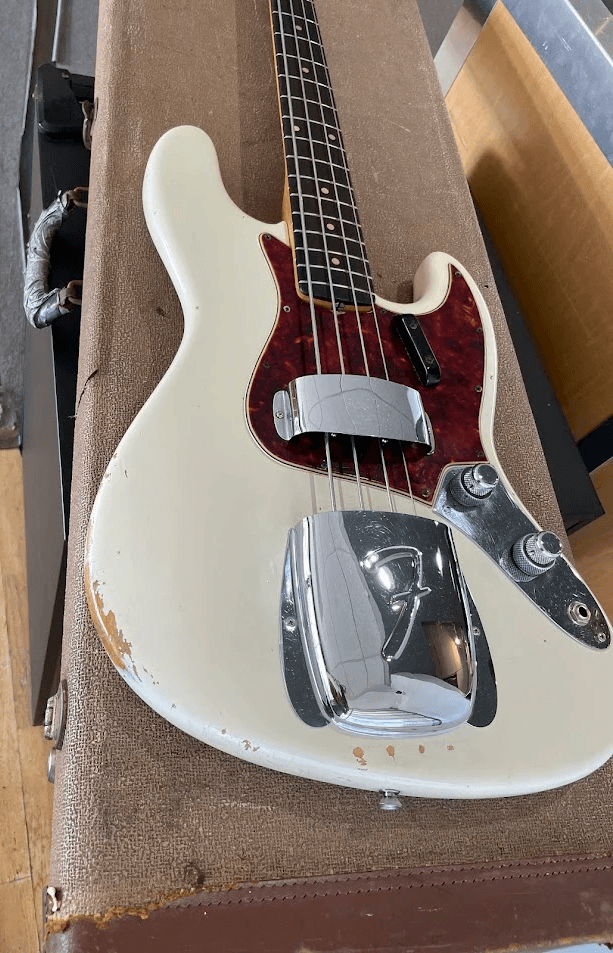
Vintage Fender Jazz Bass Value Guide (1960-1965)
A vintage Fender Jazz Bass from 1960 to 1965 is typically worth anywhere from around $9,100 to $22,750, depending mainly on whether it is a rare stack-knob example, a transition-year bass, or a later 3-knob model, plus overall originality. Edgewater Guitars, based in Valley City, Ohio and buying nationally, pays fair top dollar for original Jazz Basses. Call or text (440) 219-3607 for a free offer.
Last Updated: July 2026
What Is a Vintage Fender Jazz Bass Worth? (Year by Year, 2026)
The Jazz Bass’s control layout changed twice in its first few years, and that alone drives a big part of its value. The figures below reflect what a fair, honest buyer typically pays for a clean, all-original example, once you account for the inflated asking prices you’ll often see in listings.
Year | What Defines It | Reference Value |
|---|---|---|
1960 (stack-knob debut) | Two concentric, stacked knobs on a chrome plate, genuinely rare | $16,250-$22,750 |
1961 | A real, on-file example we purchased, see the case study below | Not re-priced here, see case study |
1962 (transition) | Stack-knob and simpler 3-knob layouts were both made this year | $11,700-$15,600 |
1963-1964 (3-knob, curved board) | Simplified 2 volume, 1 tone layout, curved rosewood board | $9,100-$11,700 |
1965 onward | Continues in our 1965-1970 Jazz Bass guide, linked below | See that guide for values |
These figures assume clean, all-original examples with no replaced pickups, hardware, or refinishing. Send us photos for a specific read on your bass.
What Drives a Vintage Jazz Bass’s Value?
Stack-knob control layout intact (1960 into early 1962): a genuinely rare, highly sought-after configuration.
Original pickups and controls, unmodified.
Original slab or curved rosewood board with clay dot markers intact.
Correct-era headstock decal and logo style.
Original finish; refinishing significantly reduces value.
Overall structural and electronic originality.
How to Identify and Date a Vintage Fender Jazz Bass (1960-1965)
Dating a Jazz Bass from this window comes down mainly to the control layout and fretboard details.
Stack-Knob vs 3-Knob Control Layout
From 1960 into 1962, Fender used two concentric, stacked knobs (volume and tone for each pickup) on a chrome control plate, a rare and highly collectible configuration. Sometime in late 1961 into 1962, Fender transitioned to the simpler 3-knob layout (2 volume, 1 master tone) that continued for the rest of the decade. Both configurations were made during 1962, so treat this transition as a range rather than a single date.
Fretboard
A slab rosewood board with clay dot markers was used through about 1962, followed by a thinner, curved board. In 1964, clay dot markers were replaced with pearl or pearloid dots.
Serial Number
Use our free Fender serial number lookup tool to cross-reference your bass’s serial number against Fender’s date ranges for this period.
Jazz Bass Guides and Related Reading
For a specific real-world example and the years just beyond this guide, see:
1961 Fender Jazz Bass: The Golden Era of Electric Bass Innovation, a real example from a Cincinnati family we purchased directly from
Our 1965-1970 Fender Jazz Bass guide, including a real 1965 Lake Placid Blue example bought from its original owner near Phoenix
Our complete Fender Jazz Bass identification and collector’s guide (1960-1980) for a deeper look at the whole model run
Sell Your Vintage Fender Jazz Bass
Edgewater Guitars buys vintage Fender Jazz Basses nationwide, from the rare stack-knob years through the pre-CBS era, with a free expert appraisal and a same-day cash offer for the right bass. Request a free estimate to get started.
What is a stack-knob Jazz Bass?
A stack-knob Jazz Bass, made from 1960 into 1962, uses two concentric, stacked control knobs on a chrome plate instead of the simpler 3-knob layout that came later. It is a genuinely rare configuration and commands a real premium.
How do I tell a 1962 Jazz Bass apart from a 1963?
1962 is a transition year, so you may find either the stack-knob or the simpler 3-knob control layout on a genuine 1962 example. A slab rosewood board with clay dot markers is common through this period, moving to a thinner curved board shortly after.
How do I find out what my vintage Jazz Bass is worth?
Send us clear photos of your bass, including the control layout, headstock, and any visible serial number, and we will give you a specific, honest read on its value. You can also use our free Fender serial number lookup tool to help narrow down your production year.