DATE :
Fender Jaguar Custom Colors: The Complete Identification and Authentication Guide
Fender Jaguar Custom Colors: The Complete Identification and Authentication Guide
Understanding Fender Custom Color Jaguars
When Fender introduced the Jaguar in 1962, the company offered the model in standard sunburst finish or an array of special-order custom colors. These custom color Jaguars have become among the most collectible and sought-after vintage guitars ever produced, with certain color and year combinations representing the pinnacle of 1960s electric guitar manufacturing.
Custom color Jaguars weren't standard catalog items—they required special orders through Fender dealers, often involved additional costs, and represented a small percentage of total production. This scarcity, combined with the Jaguar's innovative features and association with surf and garage rock, has created extraordinary collector interest in original custom color examples.
Understanding Fender's custom color system, learning to identify specific colors, and authenticating original finish versus refinishes requires detailed knowledge. This comprehensive guide provides everything needed to identify, authenticate, and understand custom color Fender Jaguars from the model's introduction in 1962 through the pre-CBS era and beyond.
Why Custom Colors Matter
Custom color Jaguars command significantly more collector interest than sunburst examples for several compelling reasons:
Rarity: While exact production numbers remain unclear, custom colors represented perhaps 5-15% of total Jaguar production during the 1960s. Certain colors like Burgundy Mist Metallic, Sherwood Green Metallic, and Shell Pink appeared on very few Jaguars, making them exceptionally rare.
Visual Impact: Custom colors transformed the Jaguar's appearance dramatically. The offset body shape, chrome hardware, and distinctive appointments looked stunning in vibrant colors like Lake Placid Blue, Candy Apple Red, or Olympic White.
Originality Premium: All-original custom color examples with matching headstocks represent the most collectible Jaguars. The finish must be verified as factory-original rather than a later refinish, as refinished guitars carry significantly reduced collector appeal.
Historical Significance: Custom color Jaguars represent 1960s surf culture, garage rock, and the golden age of American guitar manufacturing. They embody a specific cultural moment that resonates with collectors and players.
Playing Appeal: Beyond collector interest, custom color Jaguars remain exceptional playing instruments. Musicians value them for their unique tonal characteristics, innovative features, and distinctive aesthetic.
The Challenge of Color Identification
Identifying the specific custom color on a vintage Jaguar presents multiple challenges:
Color Names: Fender used automotive paint industry names that many guitar owners don't recognize. "Lake Placid Blue" means nothing to someone unfamiliar with 1960s DuPont automotive finishes.
Aging and Fading: Sixty-plus years of light exposure, oxidation, and environmental factors have changed how original colors appear. A Fiesta Red Jaguar from 1962 looks dramatically different today than when it left the factory.
Lighting Variables: Custom colors appear different under various lighting conditions. Metallic finishes change appearance based on viewing angle. Natural daylight, fluorescent lighting, and LED lighting all render colors differently.
Color Variation: Even factory-original guitars showed color variation. DuPont mixed paints in batches, and slight differences existed between batches. Individual guitars in the same color varied subtly.
Refinishes: Many vintage Jaguars have been refinished over the decades. Determining whether a color is original or a later refinish requires careful examination and expert knowledge.
This guide addresses all these challenges, helping owners identify their Jaguar's color with confidence.
The Complete Fender Custom Color Palette (1962-1969)
Fender offered an evolving selection of custom colors throughout the 1960s. The palette changed as certain colors were discontinued and new ones introduced. Here's the comprehensive list of custom colors that appeared on Jaguars during the original production era:
Olympic White
Official Name: Olympic White DuPont Code: Varies by year Years Available: 1962-1969 (all years)
Visual Description: Olympic White is an off-white color with subtle cream undertones when originally applied. This is NOT a pure bright white like modern appliance white or paper white. The color has warmth and depth that pure white lacks.
How It Ages: Original Olympic White yellows significantly over time, developing cream, ivory, or light yellow tones. The degree of yellowing varies based on UV exposure, storage conditions, and age. Guitars kept in cases remain lighter; those displayed or played extensively show more dramatic yellowing. Some examples develop beautiful aged ivory or antique white tones that collectors highly prize.
Identification Tips:
Look for subtle cream or warm undertones
Check for even yellowing across all surfaces
Examine areas protected from light (under pickguard, in tremolo cavity) for color comparison
Original Olympic White should show consistent aging patterns
Modern "Olympic White" refinishes often appear too bright and pure white
Common Confusion: Frequently confused with Sonic Blue that has faded dramatically, or with actual pure white refinishes. Olympic White should never appear as bright, cool-toned white.
Matching Headstock: Olympic White Jaguars commonly featured matching painted headstocks, creating cohesive appearance.
Lake Placid Blue
Official Name: Lake Placid Blue (sometimes listed as Lake Placid Blue Metallic) DuPont Code: Various through production years Years Available: 1962-1969
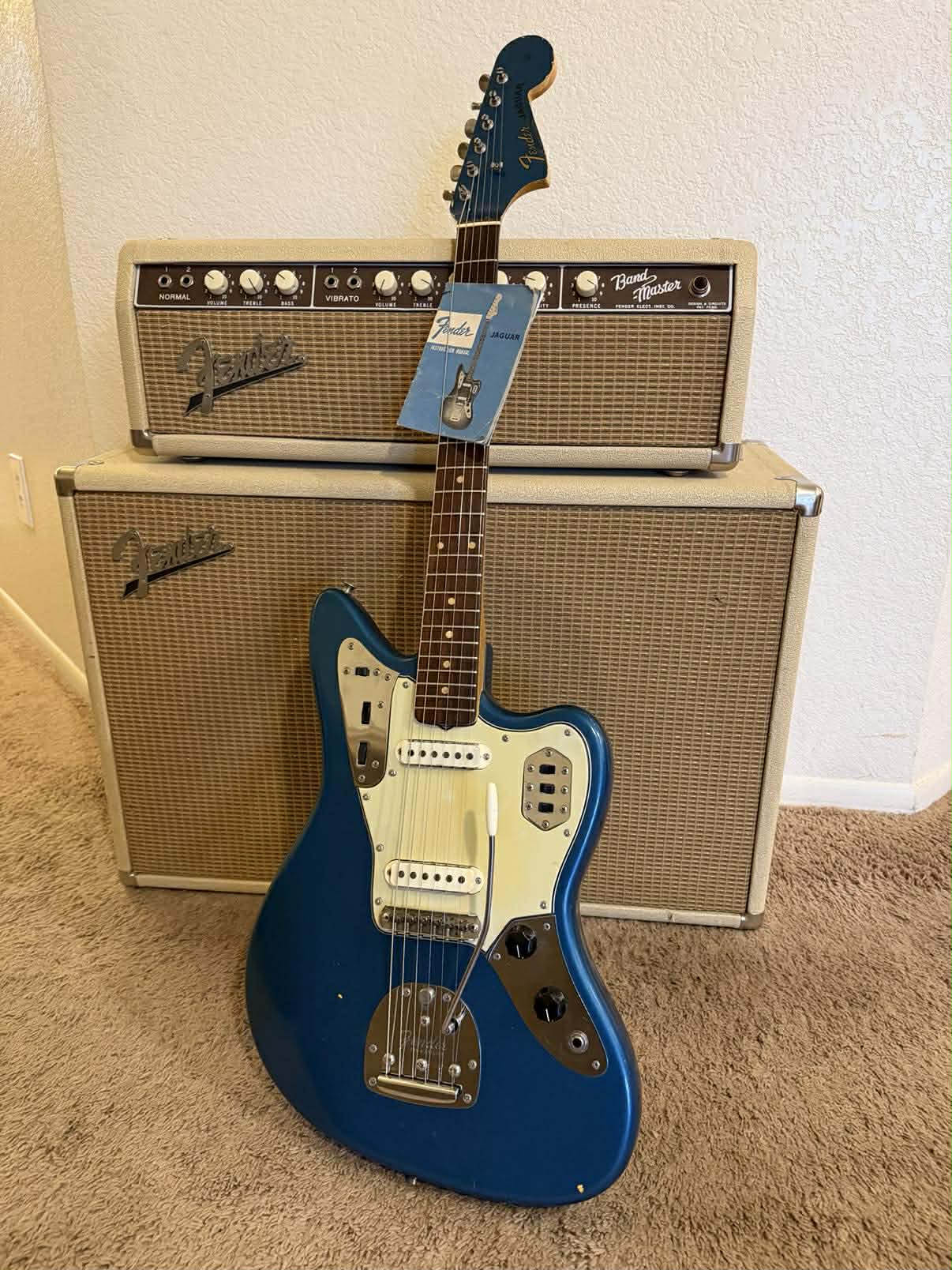
Visual Description: Lake Placid Blue is a medium blue with metallic flake, creating shimmer and depth. The color sits between light blue and navy blue—definitely blue, not turquoise or teal. The metallic content creates sparkle when viewed at angles or in direct light.
How It Ages: Lake Placid Blue remains relatively stable compared to some other custom colors. The blue may lighten slightly with UV exposure but doesn't fade as dramatically as colors like Fiesta Red. The metallic flake remains visible and gives the color its characteristic depth.
Identification Tips:
Look for metallic sparkle/flake in the finish
Check that the blue appears true blue, not greenish or purple-tinted
Examine in multiple lighting conditions to see metallic effect
Original examples show fine checking throughout the finish
Compare to areas protected from light for original depth
Common Confusion: Sometimes confused with Daphne Blue (which is lighter and less metallic) or Sonic Blue (which has no metallic content and appears more vibrant).
Matching Headstock: Lake Placid Blue Jaguars typically featured matching blue painted headstocks with distinctive metallic appearance.
Sonic Blue
Official Name: Sonic Blue DuPont Code: Various Years Available: 1962-1969
Visual Description: Sonic Blue is a vibrant, bright blue without metallic flake. The color appears more saturated and intense than Lake Placid Blue. Think of a clear summer sky blue—bright, clean, and vivid. This is a non-metallic solid color with no sparkle.
How It Ages: Sonic Blue fades dramatically with UV exposure and age. Originally vibrant examples often lighten to very pale, almost white-blue tones. The fading creates beautiful vintage patina that collectors prize. Heavily faded examples may appear closer to white than blue, making identification challenging.
Identification Tips:
No metallic flake or sparkle (key distinguishing feature)
Check protected areas (tremolo cavity, under pickguard) for more vibrant original color
Compare exposed and protected areas to gauge fading
Original Sonic Blue shows checking and age-appropriate wear
Faded examples appear pale blue or blue-white
Common Confusion: Frequently confused with Lake Placid Blue (which has metallic) or with faded Olympic White (which should show warmer, cream tones).
Matching Headstock: Sonic Blue Jaguars commonly had matching painted headstocks in the same vibrant blue.
Daphne Blue
Official Name: Daphne Blue DuPont Code: Various Years Available: 1962-1969
Visual Description: Daphne Blue is a lighter, softer blue than either Sonic Blue or Lake Placid Blue. The color has subtle green undertones that give it a unique character—sometimes appearing slightly turquoise or seafoam-influenced depending on lighting. Some describe it as "robin's egg blue" though that's not perfectly accurate.
How It Ages: Daphne Blue fades significantly with UV exposure, often becoming very pale or near-white with age. The green undertones may become more or less apparent as the color ages. Heavily faded examples can be difficult to identify without checking protected areas.
Identification Tips:
Lighter than Sonic Blue or Lake Placid Blue
Look for subtle green undertones
Check protected areas for more saturated original color
No metallic flake
May appear almost white when heavily faded
Common Confusion: Often confused with faded Sonic Blue or Surf Green. The subtle green undertones distinguish it from pure blues.
Matching Headstock: Daphne Blue Jaguars featured matching headstocks showing the same soft blue-green tone.
Foam Green
Official Name: Foam Green DuPont Code: Various Years Available: 1962-1969
Visual Description: Foam Green is a pale, minty green—think of seafoam or light mint ice cream. The color is subtle and sophisticated, never bright or garish. It has soft, muted quality that distinguishes it from more vibrant greens.
How It Ages: Foam Green often fades to very pale, almost white tones with subtle green tint remaining. The color is inherently light, so fading makes identification particularly challenging. UV exposure causes significant lightening.
Identification Tips:
Very pale, subtle green tone
Check tremolo cavity and areas under pickguard for more saturated color
Should never appear bright or vivid
Look for soft, muted mint or seafoam quality
Heavily faded examples may appear nearly white with slight green cast
Common Confusion: Can be confused with Surf Green (which is darker and more saturated) or with faded whites that may pick up slight green tint from environmental factors.
Matching Headstock: Foam Green Jaguars had matching pale green headstocks.
Surf Green
Official Name: Surf Green DuPont Code: Various Years Available: 1962-1969
Visual Description: Surf Green is a medium green with blue undertones—more saturated and vibrant than Foam Green. The color evokes 1960s surf culture perfectly. It's neither emerald nor lime green, but a distinctive blue-green that's immediately recognizable.
How It Ages: Surf Green maintains color better than many custom finishes but still fades with UV exposure. Faded examples become paler and may lose some saturation, but usually remain identifiable as green. The blue undertones may become more or less apparent with aging.
Identification Tips:
Medium green tone with visible blue undertones
More saturated than Foam Green
Should appear distinctly green, not yellow-green
Check protected areas for depth of original color
No metallic flake
Common Confusion: Sometimes confused with Sherwood Green Metallic (which has metallic flake) or Foam Green (which is much paler).
Matching Headstock: Surf Green Jaguars featured matching green headstocks.
Sherwood Green Metallic
Official Name: Sherwood Green Metallic DuPont Code: Various Years Available: 1962-1969 (relatively rare)
Visual Description: Sherwood Green Metallic is a dark, rich green with metallic flake creating depth and shimmer. The color appears almost forest green or British Racing Green in certain lighting. The metallic content gives it sophistication and complexity that solid green colors lack.
How It Ages: The metallic base helps Sherwood Green maintain appearance better than non-metallic colors. The green may darken slightly or develop patina, but the metallic flake preserves the finish's character.
Identification Tips:
Dark, rich green tone
Visible metallic flake/sparkle
Appears to have depth and dimension
Should shimmer when viewed at angles
Much darker than Surf Green or Foam Green
Common Confusion: Rare enough that confusion is less common, but might be confused with very dark Surf Green in poor lighting. The metallic content is the key distinguishing feature.
Matching Headstock: Sherwood Green Metallic Jaguars had matching metallic green headstocks.
Rarity Note: Sherwood Green Metallic Jaguars are exceptionally rare, with very few examples known to exist.
Fiesta Red
Official Name: Fiesta Red DuPont Code: Various Years Available: 1962-1969
Visual Description: Fiesta Red is a bright, vibrant red-orange color when originally applied. It's not a pure red but has distinct orange undertones that give it warmth and intensity. Think of a bright sunset orange-red or a traffic cone with red influence.
How It Ages: Fiesta Red fades dramatically and notoriously. UV exposure causes the red pigments to fade, often leaving pinkish, salmon, or coral tones. Heavily faded examples may appear more pink than red. The fading is so characteristic that many collectors specifically seek "faded Fiesta Red" examples for their vintage aesthetic.
Identification Tips:
Original unfaded color appears bright red-orange
Faded examples show pink, salmon, or coral tones
Check tremolo cavity and under pickguard for more vibrant original color
Fading is typically uneven, creating beautiful vintage patina
Should show orange influence, not pure red
Common Confusion: Faded Fiesta Red is often confused with Shell Pink (which was originally pink) or Dakota Red (which is more orange). Checking protected areas reveals the truth.
Matching Headstock: Fiesta Red Jaguars commonly had matching red-orange headstocks showing similar fading patterns.
Collectibility: Beautifully faded Fiesta Red examples are highly prized by collectors and players.
Dakota Red
Official Name: Dakota Red DuPont Code: Various Years Available: 1962-1969
Visual Description: Dakota Red is more orange than Fiesta Red—a bright, vibrant orange-red that leans decidedly toward orange. When originally applied, Dakota Red appeared distinctly orange with red undertones rather than red with orange undertones.
How It Ages: Dakota Red fades with UV exposure, typically becoming lighter and more peachy or salmon-colored. The orange tones may become more pronounced as red pigments fade.
Identification Tips:
More orange than Fiesta Red
Bright, vibrant orange-red tone
Check protected areas for original vibrant color
Faded examples appear peachy or light salmon
Should appear distinctly orange-influenced
Common Confusion: Often confused with Fiesta Red. Dakota Red is more orange, while Fiesta Red is more red. Checking original color in protected areas helps distinguish them.
Matching Headstock: Dakota Red Jaguars featured matching orange-red headstocks.
Candy Apple Red
Official Name: Candy Apple Red DuPont Code: Various Years Available: 1963-1969 (introduced in 1963)
Visual Description: Candy Apple Red is a deep, rich, translucent red with extraordinary depth. Unlike Fiesta Red or Dakota Red, Candy Apple Red is a true, pure red without orange influence. The candy finish process creates depth and luminosity that solid colors cannot achieve. The color appears to have dimension, with darker and lighter areas creating visual interest.
Technical Detail: Candy Apple Red is a multi-stage finish: a metallic silver base coat followed by translucent red top coats. This creates the characteristic depth and glow.
How It Ages: Candy Apple Red remains relatively stable compared to Fiesta Red, though some fading can occur. The translucent nature means that any finish checking or wear reveals the silver base coat underneath, creating distinctive appearance.
Identification Tips:
Deep, pure red without orange tones
Should appear to have depth and dimension
Look for metallic shimmer beneath the red
Checking or wear may reveal silver base coat
Much richer appearance than Fiesta Red or Dakota Red
Common Confusion: Sometimes confused with unfaded Fiesta Red, but the depth, true red tone (not orange-red), and translucent quality distinguish Candy Apple Red.
Matching Headstock: Candy Apple Red Jaguars had matching deep red headstocks with the same candy finish.
Collectibility: Candy Apple Red Jaguars are highly collectible and visually stunning.
Burgundy Mist Metallic
Official Name: Burgundy Mist Metallic DuPont Code: Various Years Available: 1962-1969 (extremely rare)
Visual Description: Burgundy Mist Metallic is a dark red-purple color with metallic flake. The color appears burgundy wine-colored with subtle purple undertones and visible metallic shimmer. It's a sophisticated, subdued color compared to the bright reds.
How It Ages: The metallic base helps Burgundy Mist maintain its appearance well. The color may develop patina but generally remains recognizable. The dark tone means fading is less visually dramatic than with bright colors.
Identification Tips:
Dark burgundy/wine color
Visible metallic flake creating shimmer
Purple undertones distinguish it from straight reds
Should appear sophisticated and subtle, not bright
Check for metallic sparkle in direct light
Common Confusion: Very rare, so confusion is uncommon. Might be mistaken for very dark Candy Apple Red in poor lighting, but the metallic content and purple undertones distinguish it.
Matching Headstock: Burgundy Mist Metallic Jaguars had matching metallic burgundy headstocks.
Rarity Note: Burgundy Mist Metallic Jaguars are exceptionally rare, with very few documented examples.
Shell Pink
Official Name: Shell Pink DuPont Code: Various Years Available: 1962-1969 (rare)
Visual Description: Shell Pink is a soft, delicate pink—not hot pink or bright pink, but a sophisticated, subtle pink with slight salmon or coral undertones. The color evokes 1950s-1960s design aesthetics. It was originally pink, not faded red.
How It Ages: Shell Pink may fade to very pale, almost white-pink tones with UV exposure. The color is inherently light, so fading can make identification difficult. Some examples yellow slightly with age.
Identification Tips:
Soft, delicate pink tone
Was originally pink, not faded from red
Check protected areas for more saturated original pink
Should appear sophisticated, not garish
May have slight salmon or peachy undertones
Common Confusion: Often confused with heavily faded Fiesta Red. The key difference: Shell Pink was originally pink and fades lighter, while Fiesta Red was originally red-orange and fades to pink/salmon. Checking protected areas reveals the truth.
Matching Headstock: Shell Pink Jaguars had matching pink headstocks.
Rarity and Collectibility: Shell Pink Jaguars are exceptionally rare and highly collectible. Very few examples are known to exist.
Shoreline Gold
Official Name: Shoreline Gold (sometimes Shoreline Gold Metallic) DuPont Code: Various Years Available: 1962-1969
Visual Description: Shoreline Gold is a champagne or golden beige color with metallic flake. It's not bright yellow or pure gold, but a sophisticated, subtle gold with beige/tan undertones. The metallic content creates shimmer and depth.
How It Ages: Shoreline Gold generally remains stable, though the gold tones may warm or cool slightly with age. The metallic flake helps preserve the finish's character.
Identification Tips:
Champagne or golden beige tone
Visible metallic flake/sparkle
Should appear sophisticated, not bright yellow
Has depth from metallic content
May appear more beige or more gold depending on lighting
Common Confusion: Sometimes confused with very faded Olympic White or with gold anodized pickguards (which are completely different). The metallic shimmer distinguishes it.
Matching Headstock: Shoreline Gold Jaguars featured matching metallic gold headstocks.
Black
Official Name: Black (sometimes Custom Black) DuPont Code: Various Years Available: 1962-1969
Visual Description: Black is straightforward—a solid black color without metallic flake. Factory black Jaguars used high-quality automotive black paint applied in multiple coats.
How It Ages: Black finish may fade slightly to dark gray with extreme UV exposure but generally remains stable. The finish develops natural checking and patina over time.
Identification Tips:
Solid black, no metallic content
Should show natural aging and checking
Check for evidence of undercoats (yellow stain visible in chips)
Examine for refinish evidence (too perfect, wrong texture)
Common Confusion: Black is easily identified, but distinguishing original black from black refinishes requires careful examination.
Matching Headstock: Black Jaguars did not typically receive matching painted headstocks during the original era—they usually retained the natural finish headstock.
Three-Color Sunburst (Standard Finish)
Official Name: Three-Color Sunburst Years Available: 1962-1969 (standard catalog finish)
Visual Description: Three-color sunburst features red on the outer edges, transitioning to yellow/amber in the middle, with darker brown/black in the center. This was the standard catalog finish, not a custom color.
How It Ages: The red fades significantly with UV exposure, often leaving tobacco brown edges instead of red. The yellow may amber with age. Heavily faded sunburst finishes often appear primarily brown and yellow.
Identification Tips:
Look for red (or faded brown) on edges
Yellow/amber middle section
Dark center area
Faded examples show brown instead of red
Note: Sunburst was NOT a custom color—it was the standard finish. This guide focuses on custom colors, but sunburst is included for comparison.
Year-by-Year Production Guide
1962 Jaguars: First Year Production
Serial Numbers: Approximately 70000-90000 range (neck plate) Production Context: First year of Jaguar production
Available Custom Colors (1962):
Olympic White
Lake Placid Blue
Sonic Blue
Daphne Blue
Foam Green
Surf Green
Fiesta Red
Dakota Red
Burgundy Mist Metallic (rare)
Shell Pink (rare)
Shoreline Gold
Black
1962-Specific Features:
Spaghetti logo (thin script)
Clay dot position markers on rosewood fingerboard
White pickup covers (not aged cream)
Single-layer white pickguard (mint green aged appearance)
Gold anodized pickguard available as option
Shorter tremolo arm than later years
Custom Color Details for 1962: First-year Jaguars in custom colors are exceptionally collectible. The combination of early features with rare colors creates highly sought-after instruments. Matching headstocks were standard on custom color orders.
1963 Jaguars
Serial Numbers: Approximately 90000-L10000 range Production Context: Second production year, features stabilizing
Available Custom Colors (1963):
All 1962 colors continue
Candy Apple Red introduced (major addition)
Sherwood Green Metallic (rare)
1963-Specific Features:
Spaghetti logo continues
Clay dot markers
White pickguard standard
Gold anodized pickguard option continues
Transitional features between early and mid-1960s specs
Custom Color Details for 1963: The introduction of Candy Apple Red in 1963 created one of the most iconic Jaguar colors. First-year Candy Apple Red examples are particularly collectible.
1964 Jaguars
Serial Numbers: L10000-L50000 range Production Context: Peak pre-CBS production
Available Custom Colors (1964): All previously available colors continue, with full palette available
1964-Specific Features:
Spaghetti logo
Clay dot markers
Pearl dot markers begin appearing very late in year (transition)
White pickguard standard
Some bound fingerboards (special order)
Custom Color Details for 1964: 1964 represents peak pre-CBS Jaguar production before CBS acquisition in 1965. These are considered by many collectors to be the finest Jaguars made, especially in rare custom colors.
1965 Jaguars: CBS Transition Year
Serial Numbers: L50000-L90000 range Production Context: CBS acquired Fender in January 1965
Available Custom Colors (1965): Full custom color palette continues through 1965
1965-Specific Features:
Large "transition" logo appears late in year
Pearl dot markers replace clay dots
F-stamped neck plates begin appearing
Gold anodized pickguards becoming less common
Bound fingerboards on some examples
Custom Color Details for 1965: 1965 Jaguars show transitional features as CBS began implementing changes. Early 1965 guitars remain essentially pre-CBS in construction; late 1965 examples show CBS influence. Custom colors continue at similar availability.
1966-1967 Jaguars: CBS Era Begins
Serial Numbers: Various 100000-200000+ range Production Context: Full CBS ownership and operational control
Available Custom Colors (1966-1967): Full custom color palette continues, though some colors become less common
CBS-Era Features:
Large CBS-era logo (black with gold outline)
Pearl dot markers standard
F-stamped neck plates
Bound fingerboards more common
Block inlays on some examples
Polyurethane finishes begin appearing (transitioning from nitrocellulose)
Custom Color Details for 1966-1967: Custom colors continue to be available, though production emphasis begins shifting. The transition from nitrocellulose to polyurethane finishes affects how colors appear and age.
1968-1969 Jaguars: Later CBS Era
Serial Numbers: 200000-300000+ range Production Context: CBS standardization increasing
Available Custom Colors (1968-1969): Custom color availability begins declining as CBS standardizes production
Later CBS Features:
CBS logo standard
Polyurethane finishes becoming standard
Thicker finish application
Bound fingerboards common
Block inlays on many examples
Custom Color Details for 1968-1969: Custom colors become less common as CBS focuses on standard production colors. The shift to polyurethane finishes creates different aging characteristics compared to earlier nitrocellulose finishes.
How to Identify the Color on Your Jaguar
Step 1: Examine Protected Areas
The most reliable method for identifying original color involves examining areas protected from light exposure and wear:
Tremolo Spring Cavity: Remove the plastic tremolo cavity cover on the back of the guitar. The area under this cover has been protected from UV light and wear for 60+ years. The color in this cavity shows the original vibrant tone before fading.
Under the Pickguard: If you're comfortable removing the pickguard (or having a professional remove it), the area underneath shows protected original color. Be extremely careful removing pickguards on vintage guitars to avoid finish damage.
Inside the Control Cavities: Looking into the pickup cavities and control cavity can reveal protected color areas, though these areas may show bare wood in some spots.
Comparison Method: Compare the protected area color to the exposed body surfaces. The difference reveals how much fading has occurred and helps identify the original color.
Step 2: Look for Identifying Characteristics
Metallic vs. Non-Metallic: Examine the finish in direct light at various angles:
Metallic finishes sparkle and shimmer (Lake Placid Blue, Sherwood Green Metallic, Burgundy Mist Metallic, Shoreline Gold)
Non-metallic finishes appear flat without sparkle (Sonic Blue, Surf Green, Foam Green, Olympic White, Fiesta Red, Dakota Red)
Candy finishes show depth and translucency (Candy Apple Red)
Undertones: Many colors have characteristic undertones:
Fiesta Red: orange undertones
Dakota Red: more orange than red
Daphne Blue: green undertones
Olympic White: cream undertones
Shell Pink: salmon/coral undertones
Checking Patterns: Original nitrocellulose finishes develop fine checking (crackling) throughout. The checking should appear natural and consistent with age.
Step 3: Consider the Headstock
Matching Headstock: Most custom color Jaguars received matching painted headstocks. Examine the headstock for:
Same color as body (including similar fading patterns)
Original finish characteristics (checking, aging)
Paint extending onto the headstock face
Logo decal applied over the paint
Natural Headstock: Some custom color Jaguars (particularly black) retained natural finish headstocks. This is less common but does occur.
Step 4: Check for Refinish Evidence
Refinish Red Flags:
Overspray on binding, hardware, or neck pocket
Paint in screw holes
Modern paint texture (too smooth, too thick)
Lack of age-appropriate checking
Color that doesn't match any Fender custom colors
Wrong type of paint (polyurethane on pre-1967 guitars)
Sanding marks visible in finish
Unnatural wear patterns
Original Finish Characteristics:
Thin, delicate finish application
Natural checking throughout
Wear patterns consistent with decades of playing
Color extends into neck pocket
No overspray evidence
Proper undercoats visible in chips
Step 5: Examine Undercoats and Primers
Fender used specific undercoat colors beneath custom finishes:
Yellow Stain Undercoat: Most custom colors were applied over yellow stain undercoat. Look for:
Yellow tint visible in finish checking
Yellow visible in chips or worn areas
Yellow visible around hardware holes
White Primer: Some colors (particularly white and light colors) used white primer instead of yellow stain.
Bare Wood: Sunburst finishes (standard finish) were applied directly to bare wood without yellow stain, though some shading/staining appeared in the burst areas.
Step 6: Consult Reference Materials
Vintage Catalogs: Fender catalogs and price lists from the 1960s show custom color options, though colors in printed materials don't perfectly represent actual paint colors.
Authenticated Examples: Compare your guitar to documented, authenticated examples of specific colors. Online databases, books, and dealer websites show verified examples.
Expert Consultation: When identification remains uncertain, consult vintage Fender specialists who have examined hundreds of original custom color guitars.
Authentication: Original Finish vs. Refinish
Why Authentication Matters
Distinguishing original custom color finishes from refinishes is crucial for several reasons:
Collector Value: Original finish custom color Jaguars command significantly more collector interest than refinished examples. A refinish dramatically reduces collectibility and market position.
Historical Accuracy: Knowing whether a guitar retains its original finish provides accurate historical information about the instrument.
Decision Making: If you're considering purchasing a custom color Jaguar, authentication determines whether you're buying an all-original collector instrument or a refinished player-grade guitar.
Primary Authentication Methods
Nitrocellulose vs. Polyurethane: Pre-1967 Jaguars used nitrocellulose lacquer, which:
Develops fine checking with age
Feels thin and delicate
Shows natural wear patterns
Ambers over time
Responds to solvents (acetone test, performed carefully by professionals)
Modern polyurethane refinishes:
Don't check naturally
Feel thick and plastic-like
Chip rather than wear naturally
Don't amber
Resist solvents
Checking Pattern Analysis: Authentic nitrocellulose checking appears:
Fine and random
Throughout entire finish
Consistent with age
Natural and organic in appearance
Artificial checking (created to simulate age):
Too uniform or patterned
May not extend through all finish layers
Can appear forced or unnatural
Wear Pattern Examination: Original finishes show wear in predictable locations:
Back of neck from hand contact
Lower bout where arm rests
Upper bout near neck joint
Areas contacting belt buckles
Edge wear on body contours
Refinished guitars may show:
Wear that doesn't match playing patterns
Artificially created wear ("relicing")
Wear that cuts through to different colored undercoats
Inconsistent wear depth
Overspray Detection: Refinished guitars almost always show overspray:
Paint on binding that should be white
Paint in neck pocket
Paint on hardware mounting surfaces
Paint in screw holes
Paint extending where it shouldn't
Color Accuracy: Authentic Fender custom colors match DuPont automotive paint formulas. Refinishes may use:
Incorrect color shades
Modern paint formulations
Colors that don't match any Fender custom color
Wrong metallic content (or lack thereof)
Advanced Authentication Techniques
UV Light Examination: Ultraviolet light reveals:
Modern refinishes glow differently than nitrocellulose
Touch-ups and repairs
Inconsistencies in finish layers
Evidence of buffing or color manipulation
Neck Pocket Inspection: Remove the neck (or have a professional do so) to examine:
Color extending into neck pocket (original)
Overspray in neck pocket (refinish)
Body dates and markings
Evidence of neck removal for refinishing
Hardware Examination: Original finish guitars show:
Clean hardware mounting surfaces
No paint on screw threads
Period-correct hardware with appropriate aging
Paint under hardware showing same checking as body
Refinished guitars may show:
Paint on hardware surfaces
Wrong hardware or replaced hardware
Modern screws or fasteners
Documentation Review: Examine any available documentation:
Original purchase receipts
Previous appraisals
Photographs showing the guitar in earlier years
Provenance information
Professional Authentication Services
For valuable custom color Jaguars, consider professional authentication:
What Professionals Provide:
Detailed examination under magnification
UV light analysis
Finish thickness measurement
Paint type identification
Hardware verification
Serial number validation
Comprehensive written report
When to Seek Professional Authentication:
Before significant purchase
For insurance documentation
When selling a valuable guitar
When authenticity questions exist
For estate appraisal purposes
Matching Headstocks: The Custom Color Signature
Understanding Matching Headstocks
One of the most visually striking features of custom color Jaguars is the matching painted headstock. When customers ordered custom colors, Fender typically applied the same paint to the headstock face, creating a cohesive, dramatic appearance.
Why Matching Headstocks Matter:
Visually distinctive and appealing
Confirms custom color order (not a later refinish)
Increases collectibility significantly
Creates period-correct aesthetic
Enhances rarity and desirability
Standard Practice: Custom color Jaguars almost always received matching headstocks during the 1960s. Finding a custom color body with natural wood headstock suggests either:
Refinished body
Refinished headstock
Special circumstances or factory variation
Later neck replacement
Matching Headstock Authentication
Original Matching Headstocks Show:
Same color as body including similar fading
Same finish type (nitrocellulose)
Same checking patterns
Decal applied over painted surface
Paint extending to headstock edges
Consistent aging with body finish
Yellow stain undercoat visible in chips (most colors)
Refinished Headstocks May Show:
Color that doesn't match body
Different finish type or texture
Missing or incorrect checking
Overspray onto neck back
Decal applied incorrectly
Modern paint characteristics
Inconsistent aging
Headstock Color Fading
Headstocks often fade differently than bodies because:
Different UV exposure angles
More direct light exposure when guitar hangs on wall
Less protection from hands and arms
Stored position in cases affects exposure
Common Fading Patterns:
Fiesta Red headstocks fade to pink/salmon
Sonic Blue headstocks fade very light
Olympic White headstocks yellow
Lake Placid Blue headstocks lighten
Foam Green headstocks fade nearly white
The fading pattern should appear natural and consistent with environmental exposure.
Logo Decal Considerations
Correct Application on Custom Colors:
Decal applied over painted headstock
Gold "Fender" text on most colors
Spaghetti logo (thin script) through 1964
Transition logo (larger) in 1965
CBS logo (black with gold outline) 1965-1969
Authentication Details:
Decal should show age-appropriate wear
Color underneath decal protected from fading
Decal edges may show lifting with age
Period-correct decal style for year
Rarity and Collectibility Factors
Rarest Custom Colors on Jaguars
Based on observed examples, documentation, and collector consensus:
Extremely Rare (very few known examples):
Burgundy Mist Metallic
Shell Pink
Sherwood Green Metallic
Very Rare (uncommon, highly collectible):
Foam Green
Shoreline Gold
Daphne Blue (early examples)
Rare (special but more examples exist):
Candy Apple Red (especially early examples)
Lake Placid Blue
Surf Green
Uncommon (desirable custom colors):
Sonic Blue
Fiesta Red
Dakota Red
Olympic White
Standard Catalog:
Three-Color Sunburst (not a custom color)
What Makes a Custom Color Jaguar More Collectible
Maximum Collectibility Factors:
All-original finish confirmed authentic
Rare color (Burgundy Mist, Shell Pink, Sherwood Green)
Matching headstock in excellent condition
Early production year (1962-1964)
Pre-CBS manufacture
All-original parts and hardware
Excellent overall condition
Beautiful fading or aging (aesthetically pleasing patina)
Complete with original case
Documented provenance
Reduced Collectibility Factors:
Refinished body or headstock
Missing or replaced parts
Later CBS-era production (though still collectible)
Heavy wear or damage
Modifications or alterations
Neck repairs or issues
Polyurethane finish on later examples
Color-Specific Collectibility Notes
Fiesta Red: Beautifully faded examples with even, aesthetically pleasing salmon or pink tones are particularly desirable. "Faded Fiesta Red" is a collector category unto itself.
Sonic Blue: Clean, lightly faded examples maintaining visible blue tones are preferred. Extremely faded near-white examples are less desirable unless the fading is particularly beautiful.
Lake Placid Blue: Metallic blue finish that hasn't faded dramatically is highly collectible. The metallic content helps preserve value.
Candy Apple Red: Deep, unfaded examples showing full candy depth are most collectible. Candy Apple Red that has maintained its translucency and richness commands premium interest.
Olympic White: Beautifully aged ivory or cream-toned examples are more desirable than heavily yellowed guitars, though "vintage white" tones remain popular.
Shell Pink: Any authentic Shell Pink Jaguar is exceptionally collectible regardless of condition, given extreme rarity.
Burgundy Mist Metallic: Exceptionally rare and valuable in any condition.
Common Issues and Problems with Custom Color Jaguars
Finish-Related Issues
Checking and Crazing:
Natural checking is expected and acceptable
Excessive checking affecting structural integrity requires attention
Checking patterns should appear natural, not artificial
Deep checking may allow moisture penetration
Fading:
Natural and expected on all custom colors
Uneven fading creates character but may affect aesthetics
Extreme fading can make color identification difficult
Fading doesn't necessarily reduce value if aesthetically pleasing
Finish Chips and Scratches:
Common on 60+ year old guitars
Small chips expected and often add character
Large chips or extensive damage reduces collectibility
Chips that reveal proper undercoats confirm originality
Finish Deterioration:
Flaking or lifting finish requires professional attention
Environmental damage from storage issues
Chemical damage from improper cleaning products
Finish contamination from case materials
Color-Specific Issues
Fiesta Red/Dakota Red Fading: These colors fade most dramatically of all Fender finishes. Heavy fading is expected and accepted, though it affects the guitar's appearance significantly.
Sonic Blue/Daphne Blue/Foam Green Fading: These colors also fade substantially, often to very pale tones. Protected areas reveal original vibrant color.
Candy Apple Red Finish Wear: When Candy Apple Red wears through, the silver base coat becomes visible, creating distinctive appearance that some collectors appreciate and others don't.
Olympic White Yellowing: All Olympic White examples yellow with age. The degree varies based on storage and exposure. Heavy yellowing may appear closer to cream or light tan.
Metallic Finish Issues: Metallic finishes (Lake Placid Blue, Shoreline Gold, Burgundy Mist, Sherwood Green) may show:
Metallic flake settling or separation
Loss of shimmer in damaged areas
Different aging characteristics than non-metallic colors
Verification and Authentication Problems
Refinish Detection Challenges:
High-quality refinishes can be difficult to detect
Color-matched refinishes may appear convincing
Aged refinishes that have developed natural checking
Professional restoration work vs. deceptive refinishing
Matching Headstock Authentication:
Determining if headstock is original or refinished
Identifying neck replacements
Detecting headstock refinishing on otherwise original bodies
Documentation Gaps:
Lack of original purchase receipts or history
Missing provenance information
Unclear ownership history
Absence of authentication documentation
Playability and Setup Issues
Neck Problems:
Neck warps or twists common on 60-year-old guitars
Fret wear requiring replacement
Nut wear and replacement
Truss rod functionality concerns
Bridge and Tremolo Issues:
Tremolo spring wear
Bridge saddle wear
Intonation difficulties
Tremolo arm threading wear
Electronics Problems:
Potentiometer wear or failure
Switch contacts requiring cleaning
Pickup output issues
Wiring degradation
Hardware Wear:
Tuner gear wear
Stripped screws
Chrome plating deterioration
Missing or incorrect replacement parts
The Custom Color Ordering Process (Historical Context)
How Custom Colors Were Ordered
Understanding the original ordering process helps authenticate and appreciate custom color Jaguars:
Through Authorized Dealers: Customers couldn't order custom colors directly from Fender. The process required:
Visit to authorized Fender dealer
Selection of desired color from Fender color chart
Dealer submits special order to Fender
Additional cost added (typically 5-7% premium)
Extended wait time (often 6-12 weeks vs. stock guitars)
Final delivery through dealer
Color Selection: Dealers maintained Fender color charts showing available custom colors. These charts used:
DuPont automotive paint names
Small color samples
Written color descriptions
Pricing information
Cost Considerations: Custom colors added premium pricing, making them special-order luxury items during the 1960s. This additional cost contributed to their relative rarity.
Production Process: Custom color guitars received special handling:
Built to order rather than stock production
Individual attention in paint booth
Matching headstock painting
Quality inspection
Special packaging
Why This Matters for Authentication
Understanding the original ordering process confirms:
Custom colors were deliberate special orders, not factory experiments
Matching headstocks were standard practice
Specific colors were available in specific years
Documentation and special order paperwork would have existed originally
Regional and Market Variations
Color Popularity by Region
Different custom colors showed varying popularity in different markets:
West Coast (California): Surf-related colors were particularly popular:
Surf Green (obviously)
Sonic Blue
Foam Green
Lake Placid Blue
The association with surf music and culture drove demand for ocean-influenced colors.
East Coast: More conservative color choices tended to dominate:
Olympic White
Black
Candy Apple Red
International Markets: Custom colors on export Jaguars show interesting patterns:
UK market favored certain colors
European preferences differed from American
Japanese market (later) showed specific color preferences
Export vs. Domestic Specifications
Jaguars built for export markets sometimes showed variations:
Different voltage specifications
Metric measurements on some components
Export-specific serial numbers or dating
Possible color availability differences
Care and Preservation of Custom Color Finishes
Proper Storage
Environmental Control:
Temperature: 65-75°F ideal
Humidity: 45-55% relative humidity
Avoid rapid changes in either factor
Use case humidifiers in dry climates
UV Protection:
Store in case when not playing
Avoid direct sunlight exposure
Minimize fluorescent lighting exposure
Consider UV-filtering display cases if displaying
Case Selection:
Original cases add value but may degrade
Modern cases provide better protection
Check case interior for deteriorating foam or fabric
Ensure proper fit to avoid finish damage
Cleaning and Maintenance
Finish Cleaning:
Use only vintage-safe cleaning products
Microfiber cloths only
Avoid silicone-based products
Never use abrasive cleaners or polishes
Minimal cleaning preserves patina
What NOT to Do:
Don't attempt to "restore" the finish
Don't use automotive polishes or compounds
Don't try to remove checking or wear
Don't use harsh chemicals
Don't over-clean or over-handle
Hardware Care:
Clean hardware gently
Preserve original patina on vintage hardware
Avoid aggressive polishing
Maintain original plating
When to Seek Professional Conservation
Professional Help Needed For:
Structural finish issues
Significant damage assessment
Authentication questions
Value appraisal
Major restoration decisions
Insurance documentation
Conservation vs. Restoration:
Conservation preserves original material
Restoration may replace or modify original material
Conservation generally preserves more value
Restoration may improve playability but reduce collectibility
Investment and Market Considerations
Market Trends
Increasing Interest: Custom color Jaguars have shown strong market interest for decades:
Rare colors command premium interest
All-original examples increasingly scarce
Collector competition driving demand
Player interest remains strong
Condition Impact: The gap between exceptional and average examples continues widening:
Pristine examples appreciate faster
Heavily modified or worn examples show less appreciation
Refinished guitars significantly less collectible
Color-Specific Trends: Certain colors show stronger market performance:
Rare colors (Shell Pink, Burgundy Mist) extremely strong
Classic colors (Candy Apple Red, Lake Placid Blue) consistently strong
Common colors (Olympic White, Sonic Blue) still collectible but more market-dependent
Authenticity Premium
The market strongly rewards authenticity:
All-original finish: Maximum collectibility
Period-correct refret or setup: Minimal impact
Refinished body: Dramatically reduced collectibility
Replaced parts: Reduced collectibility proportional to significance
Modified or converted: Significantly reduced collectibility
Regional Market Differences
Markets vary by location:
U.S. market largest and most active
European collectors seek specific colors and years
Japanese market particularly values certain specifications
Australian market has strong interest
Regional preferences affect specific color demand
Resources for Further Research
Reference Materials
Essential Books:
"The Fender Jaguar" by Adrian Ingram and Dave Hunter
"Fender: The Golden Age 1946-1970" by Martin Kelly and Terry Foster
"The Fender Custom Shop Guitar Gallery" (shows custom colors)
"The Fender Stratocaster: The Life & Times of the World's Greatest Guitar & Its Players" (includes Jaguar information)
Online Resources:
Vintage guitar dealer websites (Carter Vintage, Gruhn Guitars, etc.)
Online forums (Offsetguitars.com, TDPRI, etc.)
Serial number databases
Fender historical documentation
Authentication Services:
Professional vintage guitar dealers
Certified appraisers
Vintage Fender specialists
Museum curators specializing in guitars
Visual References
Catalog Scans: Vintage Fender catalogs show available colors, though printed colors don't perfectly represent actual paint.
Documented Examples: Study authenticated examples to learn color characteristics:
Museum collections
Dealer inventory
Private collections
Auction results
Comparison Tools:
Online color databases
Paint chip references
Authenticated example photographs
UV light examination results
Selling Your Custom Color Jaguar
Understanding Your Options
Private Sale:
Potential for highest price
Requires market knowledge and time
Risk of fraud or payment issues
Shipping complications
Consignment:
Dealer handles sale
High commission fees (20-40%)
Extended timeframes
Guitar tied up during process
Auction:
Broad buyer exposure
Significant fees
No price guarantee
Specific timing requirements
Direct Sale to Specialist:
Immediate payment
Expert evaluation
No fees or commissions
Simplified process
Edgewater Guitars and Custom Color Jaguars
Edgewater Guitars specializes in purchasing vintage Fender guitars, including custom color Jaguars, throughout Ohio, Michigan, Pennsylvania, Indiana, and West Virginia.
Our Expertise:
Vintage Fender specialists with deep custom color knowledge
Authentication and identification services
Fair market valuations reflecting true collectibility
Understanding of color rarity and significance
Our Approach:
Premium offers (typically 30-40% above music store offers)
Immediate payment
Free authentication and appraisal
White-glove service for valuable instruments
In-person evaluation for significant guitars
Complete transparency in valuation process
Why Choose Edgewater:
Specialized knowledge of custom color Jaguars
Recognition of rare colors and original finishes
Fair valuation reflecting true collector market
No fees or commissions
Professional, respectful service
Fast, efficient transaction process
Preparing Your Jaguar for Sale
Documentation to Gather:
Original case and case candy
Purchase receipts or documentation
Previous appraisals
Provenance information
Repair receipts
Photographs from earlier years
Condition Assessment:
Determine finish originality
Identify any repairs or modifications
Assess overall condition honestly
Note any missing or replaced parts
Document current setup and playability
Photography:
Full front and back views
Headstock showing logo and finish
Serial number visible
Any damage or wear areas
Tremolo cavity showing protected color
Close-ups of finish characteristics
Frequently Asked Questions
"How can I tell if my Jaguar has been refinished?"
Examine for:
Overspray on binding or hardware
Modern paint texture
Lack of natural checking
Color that doesn't match known Fender colors
Paint in neck pocket or screw holes
Unnatural wear patterns
Wrong undercoat colors visible in chips
"What color is my Jaguar if it looks pink but has red in protected areas?"
Likely Fiesta Red that has faded to pink/salmon tones. Check the tremolo cavity—if the protected color is red-orange, it's faded Fiesta Red. If it's pink in protected areas, it's Shell Pink (very rare).
"Is a matching headstock necessary for a custom color Jaguar?"
While matching headstocks were standard on custom color orders, natural finish headstocks occasionally appear. However, a custom color body with natural headstock should be examined carefully for evidence of refinishing.
"How much does color rarity affect collectibility?"
Significantly. Shell Pink, Burgundy Mist Metallic, and Sherwood Green Metallic Jaguars are exceptionally rare and highly collectible regardless of condition. More common custom colors like Olympic White or Sonic Blue are still collectible but less rare.
"Can I verify my Jaguar's color without damaging it?"
Yes. Examine the tremolo cavity, look through pickup routes, check in lighting from multiple angles, compare to authenticated examples, and consult experts. You shouldn't need to remove the pickguard or risk damage for initial identification.
"Does fading reduce a custom color Jaguar's collectibility?"
Not necessarily. Fading is natural and expected on vintage custom colors. Many collectors specifically seek beautifully faded examples. The fading should appear natural and aesthetically pleasing. What matters more is finish originality—an original faded finish is far more collectible than a refinish in "like new" color.
"Are polyurethane custom colors collectible?"
CBS-era Jaguars (mid-1960s onward) with polyurethane custom colors are collectible, though generally less so than early nitrocellulose examples. They represent an important production period but different collector category than pre-CBS or early CBS guitars.
"What if my Jaguar's color doesn't match any standard Fender color?"
This could indicate:
Refinish in non-Fender color
Extremely faded original color
Custom mix or special order (very rare)
Factory mistake or variation (extremely rare)
Professional authentication can determine the truth.
Contact Edgewater Guitars
If you own a custom color Fender Jaguar or need help identifying your guitar's color, Edgewater Guitars provides expert assistance:
Free Services:
Color identification help
Authentication guidance
Condition assessment
Market valuation
Selling consultation
Contact Information:
Phone: (440) 219-3607
Service Area: Ohio, Michigan, Pennsylvania, Indiana, West Virginia
In-person evaluation available for valuable instruments
Whether you're seeking to sell your custom color Jaguar, need authentication services, or simply want to understand what you have, our vintage Fender specialists are here to help.
About the Author
Edgewater Guitars is owned by Stephen Pedone and Gavin Coe. Stephen handles appraisal and authentication and is best known for authenticating pre-CBS Fender guitars and original custom-color finishes. Gavin has bought, sold and appraised vintage guitars for 16 years and does the in-person buying across Ohio and the surrounding states. Together they have bought and appraised more than 1,250 vintage guitars since 2015. Every value question on this site routes to a free appraisal: call or text (440) 219-3607.
This comprehensive guide represents current knowledge of Fender Jaguar custom colors as of 2025. Individual guitars vary in features, condition, and specifications. Custom color identification and authentication can be complex—when in doubt, consult qualified vintage Fender specialists. For personalized evaluation of your custom color Jaguar, contact Edgewater Guitars.