DATE :
Fender Guitar Value by Serial Number: What Your Serial Reveals
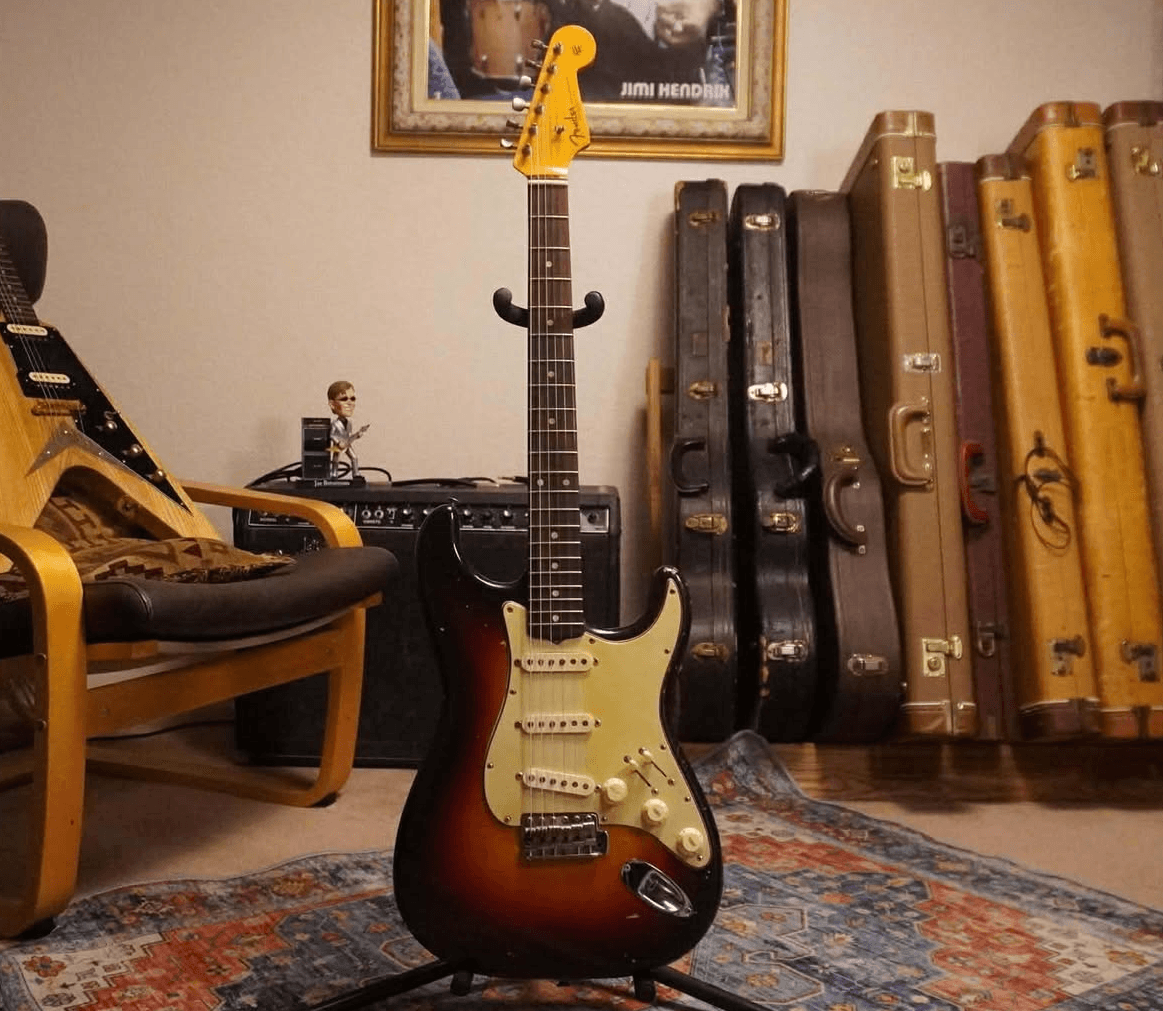
A Fender serial number places your guitar in an era, and the era sets the ceiling on value. It does not tell you the model, the condition or whether the parts are original, which decide the actual number. Edgewater Guitars in Valley City, Ohio buys vintage Fenders across Ohio and nationwide. Call or text (440) 219-3607.
What a Fender serial number can and cannot tell you
Fender's own dating page says its numbering was "often non-sequential," usually overlapping two to four years from the early 1950s to the mid-1980s. The number narrows a guitar to an era, and the era is only the first sort. A 1958 neck-plate number can sit on a Stratocaster, a Precision Bass, a Musicmaster or a Jazzmaster, and it says nothing about a refinish, a replaced neck or swapped pickups, each of which can cut the value in half.
What the serial can do: place the guitar in an era, flag a mismatch when the number and the features disagree, and name the country of origin on anything built since the 1990s. What it cannot do: identify the model, confirm the finish or the parts are original, or date a pre-1976 Fender to a single year on its own. For that you need the neck date and the pot codes.
Fender serial number systems by era
Ranges are approximate and overlap at the edges; Fender's chart and the published references disagree by a year here and there. Use the era, then confirm with the neck date.
Era | Where the number is | What it looks like | What the era usually means for value |
|---|---|---|---|
1950 to 1954 | Stamped into the bridge plate (Esquire, Broadcaster, Telecaster) | Four digits, from 0001 into the 5000s | The earliest Fenders. Any original example is a serious guitar; condition and originality decide how serious. |
1954 to 1963 | Neck plate | Four or five digits, from 0001 to 99999, no letter | Pre-CBS. The strongest collector interest of any Fender era, with model and finish doing most of the sorting inside it. |
1963 to 1965 | Neck plate | L followed by five digits, L00001 to L99999 | Still pre-CBS, including the 1965 L-plates built after the January 1965 sale. Valued alongside the 1954 to 1963 guitars. |
Late 1965 to 1976 | Neck plate, with a script F under the number | Six digits, from the 100000s to about 750000 | CBS era. Late-1960s guitars sit closest to pre-CBS money; 1970s guitars are player-grade collectibles with a wide spread by condition. |
1976 onward, US | Headstock decal | S plus digits (1970s), E (1980s, from 1979), N (1990s), Z (2000s), US plus a two-digit year (from 2010) | Used-market pricing. A clean 1980s or 1990s American guitar is a good used Fender, not a vintage one. |
1990 onward, Mexico | Headstock decal | MN (1990s), MZ (2000s), MX plus a two-digit year (from 2010) | Used-market pricing. Well made, not collectible. |
1982 onward, Japan | Headstock decal | JV, SQ, E, A and single letters through the 1990s; "Crafted in Japan" decals from 1997; JD plus eight digits from 2012 | Used-market pricing, with the early-1980s JV and SQ series drawing the most interest from players. |
The detail behind the table comes from Fender's own dating pages and the references at the end:
Overlap is built in. Fender's chart puts the 60,000s to 90,000s in 1962 and the 80,000s to 90,000s in 1963. The L prefix appears in 1963 (L10,000s to L20,000s) and runs through 1965 (L50,000s to L90,000s); every L-plate counts as pre-CBS.
The CBS years. Fender was sold to CBS in January 1965; six-digit numbers start in the 100,000s late that year and reach the 500,000s to 700,000s by 1976. The plate carries a script F below the number, hence F-series. CBS sold Fender in March 1985 and the decal schemes carried on.
Japan reused its letters. Fender Japan was founded in 1982; Ensenada, Mexico began production in 1990. The 1997 "Crafted in Japan" decal reused earlier prefix letters with new years, so an A-prefix guitar can be 1985 or 1997 depending on the decal. "Made in Japan" returned in 2007, and JD plus eight digits, the first two the year, started in 2012.
Why the neck date and pot codes matter more than the serial on a pre-1976 Fender
Fender built guitars from parts bins: necks and bodies were made in batches, dated as components and matched up later, and the serial plate came out of a box nobody kept in order. Fender's own advice for narrowing a pre-1976 date is to remove the neck and read the heel.
The neck date. From 1950 the date was pencilled on the heel. There is a stretch from 1959 into 1960 when many necks got no date at all. In 1962 Fender switched to an ink stamp with a model code, month, year and a neck-width letter; from 1969 to about 1972 the stamp was green; from 1973 to 1981 dating was inconsistent. The neck date is the date the neck was made, not the date the guitar was finished, so a late-year neck often sits on a guitar completed the following year.
Pot codes. The potentiometers carry a maker's code, 137 for CTS, followed by the year and the week: one year digit and two week digits on 1950s pots, two and two on later ones. A guitar cannot be older than its pots, so the code gives you a floor. Pots are also replaced often, so a late code on an otherwise early guitar points to a repair, not a later build.
Put the three together. A serial in the 1962 range, a neck stamped 1962 and pots from late 1961 make a 1962 guitar. The same serial on a neck stamped 1966 is a parts guitar, and the value changes with it. Our neck date and pot code guides, linked below, cover each format.
Why two Fenders from the same serial era differ ten-fold
Two guitars can carry neck-plate numbers a few hundred apart and sell for amounts an order of magnitude apart. The serial has nothing to do with it. These do:
Model. The same 1959 range covers a Stratocaster, a Jazzmaster, a Precision Bass and a Musicmaster, and the student models are priced a long way below the Stratocaster.
Finish. An original factory custom color on a pre-CBS guitar is one of the largest premiums in the market. Custom-color Fenders use the same serial systems as sunburst ones, so the finish has to prove itself.
Refinish. A refinished pre-CBS Fender is still a good guitar and worth a fraction of an original-finish one. Our guide to refinished pre-CBS Stratocasters covers what a refin does to the number.
Changed parts. Replaced pickups, tuners, bridge, pickguard or neck each take a bite; a replaced neck takes the largest.
Condition. Honest wear is fine. Cracks, a repaired headstock, extra holes and heavy corrosion are not.
Electronics. Rewiring, replaced pots and swapped switches lower the number; we open the control cavity before we quote.
Fender itself says it cannot comment on the value of used or vintage instruments. A serial lookup that spits out a price is guessing.
How to get an actual number
Start with the era. Our Fender serial number lookup runs your number against every system above, US, Mexico and Japan. If you are not sure what model you have, upload a photo for a free identification and value range; it is a starting point, not an appraisal.
Then read the guide for your era and model:
Then get a real appraisal. Send us the serial, the neck date if you can read it, and clear photos of the front, back, headstock, neck heel and control cavity. We tell you the era, what is original, and what we would pay, with the comparable sales behind the number. Free, no obligation.
Sell your Fender
Edgewater Guitars buys vintage Fenders from every era and in every condition, including refinished or modified examples other buyers pass on. We travel for the right guitar, buy nationwide, and pay by check or cash the same day. Get a free estimate or call or text (440) 219-3607. Our sell your Fender page explains how the process works.
From a recent Google review: "Edgewater Guitars drove to my home and paid cash for my vintage 1962 Fender Stratocaster. Easy to work with and very professional." (Jake Ghaffari, June 2026)
Frequently asked questions
Can a Fender serial number tell me what my guitar is worth?
No. The serial places the guitar in an era, which sets a range, and Fender's own numbering overlaps two to four years. The value inside that range depends on the model, the finish, originality and condition. Two guitars with nearly identical numbers can differ ten-fold, so treat the serial as the first step, not the answer.
Does pre-CBS always mean more valuable?
Usually, not always. Pre-CBS Fenders, built before the January 1965 sale to CBS, draw the strongest collector interest, and L-series guitars from 1965 count as pre-CBS. A refinished or heavily modified pre-CBS guitar can bring less than a clean, original late-1960s F-plate example, so originality still outranks the era.
What if my Fender's serial number does not match any chart?
That is common and not a red flag by itself. Fender's ranges overlap across years, some plates were used out of sequence, and special runs carry odd prefixes. Check the neck heel date and the pot codes, compare the features to the era, and send us the number with photos if it still does not add up.
Does a Mexican or Japanese serial number mean the guitar has no value?
No, it means used-market pricing rather than vintage pricing. MN, MZ and MX guitars from Ensenada and the JV, SQ and later Japanese series are well-made instruments that sell every day. They are not collectible the way a pre-1976 American Fender is, and we tell you that plainly rather than quoting a vintage number.
By Stephen Pedone, co-owner of Edgewater Guitars. Last updated: September 2026.
Sources
Fender support, dating U.S.-made instruments: support.fender.com
Fender support, dating Mexican-made instruments: support.fender.com
Fender support, dating Japanese-made instruments: support.fender.com
Fender serial numbers, neck dates and pot codes, guitarhq.com: guitarhq.com/fender.html
Fender serial number guide, True Vintage Guitar: truevintageguitar.com
How to date a vintage Stratocaster, True Vintage Guitar: truevintageguitar.com
Dating Fender and Gibson guitars with potentiometer codes, True Vintage Guitar: truevintageguitar.com
Fender serial number lookup, Mahar's Vintage Guitars: maharsvintageguitars.com
Fender serial number dating guide, The Music Zoo: themusiczoo.com
Made in Japan and Crafted in Japan serial number decoder, Vintage Japan Guitars: vintagejapanguitars.com
Fender Musical Instruments Corporation, Wikipedia: en.wikipedia.org