DATE :
Complete Guide to Fender Stratocaster Headstock Decals (1954-1970): Authentication and Dating
Complete Guide to Fender Stratocaster Headstock Decals (1954-1970): Authentication and Dating
Why Fender Stratocaster Headstock Details Matter
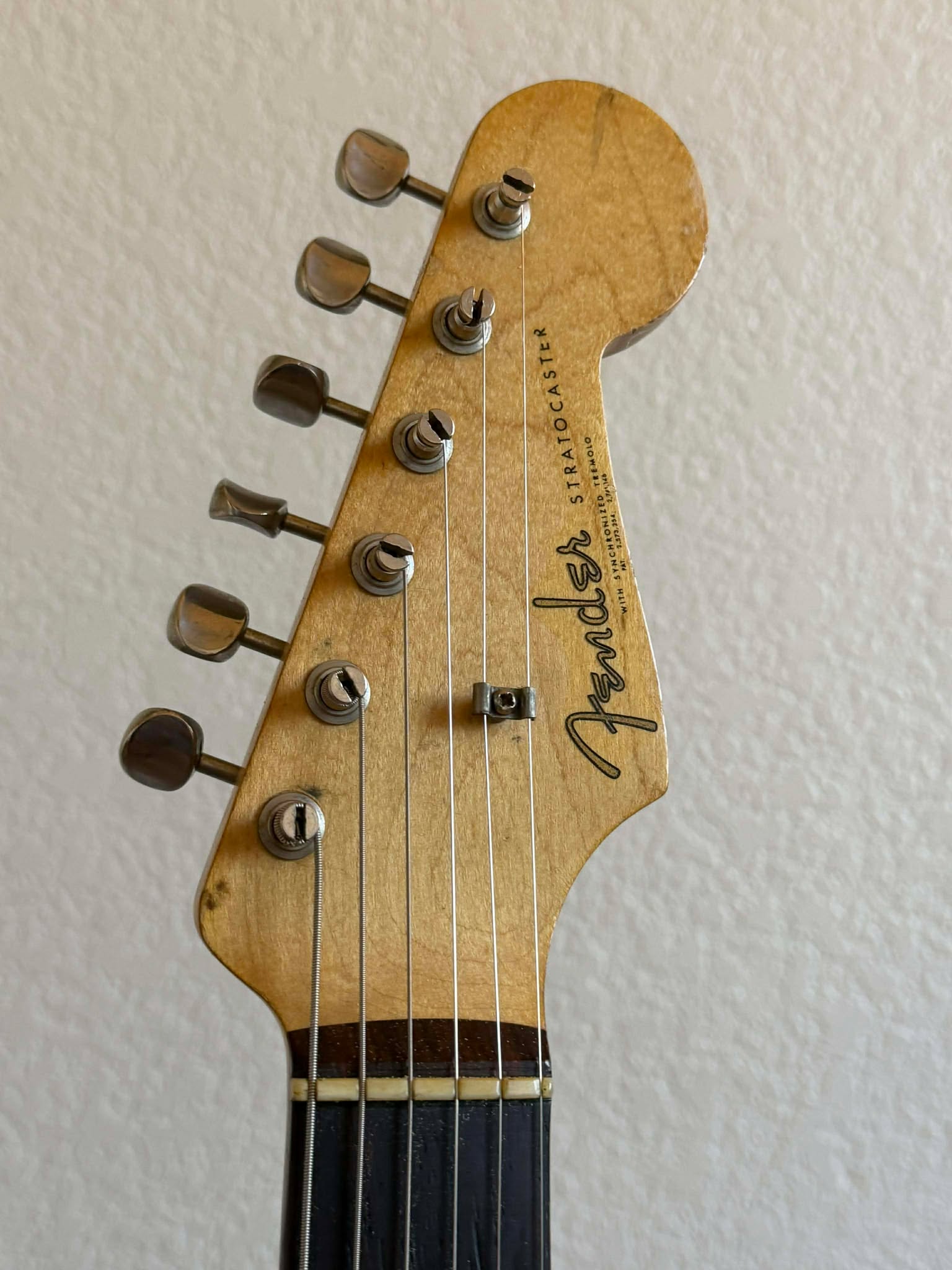
Understanding Fender Stratocaster headstock decals and details is essential for authentication, accurate dating, and proper valuation of vintage instruments. The headstock serves as the "face" of your Stratocaster, and specific decal styles, logo variations, and accompanying details changed significantly from 1954 through 1970—making these features critical dating tools and authentication markers.
Whether you own a rare 1950s Stratocaster with original spaghetti logo, a transitional 1965 CBS-era model, or any vintage Stratocaster, understanding headstock evolution helps you accurately date your instrument, identify refinishes, detect counterfeit decals, and establish proper market value.
This comprehensive guide examines every aspect of Fender Stratocaster headstock evolution from 1954 through 1970, providing authentication guidance for collectors, dealers, and players.
Overview: Major Headstock Design Periods
1954-1959: Early Spaghetti Logo Era
Original "spaghetti" logo style
Two patent numbers listed
Specific font characteristics
Pre-rosewood fingerboard variations
1960-1964: Classic Pre-CBS Spaghetti
Refined spaghetti logo
Patent number variations
Consistent application methods
Peak pre-CBS era
1965: CBS Transition Decals
Multiple logo styles in single year
Transitional "gold" Fender logo
CBS acquisition changes
Critical dating period
1966-1968: Early CBS Logos
Black "Fender" logo introduced
Pearl "Stratocaster" lettering
Small headstock continues
Specification changes
1968-1970: Large Headstock Era
Larger headstock introduced (late 1968)
Black Fender logo continues
Bold "Stratocaster" lettering
Modern CBS appearance
Detailed Era-by-Era Headstock Analysis
1954-1956 Stratocaster Headstock Details
"Spaghetti" Logo Introduction:
Logo Style:
"Fender" in distinctive thin, script font
Resembles strands of spaghetti (hence nickname)
Gold color (metallic gold appearance)
Hand-applied water-slide decal
Delicate, ornate appearance
Logo Placement:
Centered on headstock face
Positioned above "Stratocaster" model name
Precise factory placement
"Stratocaster" Model Name:
Below Fender logo
Script font style
Gold color matching Fender logo
Elegant cursive lettering
Patent Numbers:
Two patent numbers listed below Stratocaster name
Patent numbers in smaller text
Gold color
1954-1960: "PAT. 2,573,254" and "2,592,783"
Relates to tremolo bridge patents
Headstock Shape:
Small headstock (8.5" length approximately)
Traditional Fender shape
Rounded top
Six-in-line tuner configuration
String Tree:
Round string tree (1954-1955)
Single string tree for high E and B strings
Butterfly string tree introduced (1956)
Chrome finish
Tuners:
Kluson Deluxe tuners
Single-ring design initially
Chrome bushings
Plastic buttons (white/cream)
Finish:
Clear nitrocellulose lacquer over decal
Thin application
Ages to amber tint
May show checking/crazing
Serial Number:
No serial number on headstock (1954-1970s)
Serial on neck plate only
Authentication Notes:
Spaghetti logo extremely delicate
Often damaged, worn, or partially missing
Complete, intact logos command premium
Logo font must match period characteristics
Reproduction decals common (watch for tells)
1957-1959 Stratocaster Headstock Details
Refined Spaghetti Logo Period:
Logo Style:
Spaghetti "Fender" logo continues
Refined application methods
Gold metallic color
Thin, script font
Consistent factory application
"Stratocaster" Lettering:
Script font continues
Gold color
Below Fender logo
Elegant appearance
Patent Numbers:
Same two patent numbers
PAT. 2,573,254 and 2,592,783
Small text below Stratocaster
Gold color
Headstock Shape:
Small headstock standard
8.5" length approximately
Traditional proportions
String Tree:
Butterfly string tree standard (1956 onward)
Chrome finish
Wing-shaped design
Single tree for two strings
Tuners:
Kluson Deluxe tuners
Single-ring or double-ring (late 1950s)
Chrome bushings
Plastic buttons
Finish:
Clear nitrocellulose lacquer
Thin application
Ages beautifully
Checking develops over time
Authentication Notes:
Late 1950s spaghetti logos highly collectible
Original logos show specific aging patterns
Lacquer checking should extend over logo
Reproduction logos often too perfect
Font details critical for authentication
1960-1964 Stratocaster Headstock Details (Classic Pre-CBS)
Peak Spaghetti Logo Era:
Logo Style:
Classic spaghetti "Fender" logo
Gold metallic appearance
Thin, ornate script
Iconic 1960s appearance
Peak pre-CBS quality
"Stratocaster" Lettering:
Script font continues
Gold color matching logo
Consistent placement
Classic appearance
Patent Numbers:
Same two patent numbers continue
PAT. 2,573,254 and 2,592,783
Below Stratocaster name
Small gold text
Headstock Shape:
Small headstock continues
Traditional proportions
8.5" length
Classic Fender shape
String Tree:
Butterfly string tree standard
Chrome finish
Single tree configuration
Tuners:
Kluson Deluxe tuners
Double-ring design common
Chrome bushings
Plastic buttons (white/cream)
Finish:
Clear nitrocellulose lacquer
Thin, premium application
Ages to amber
Natural checking over time
Dating Variations by Year:
1960-1961:
Spaghetti logo standard
Two patent numbers
Small headstock
Pre-CBS specifications
1962-1963:
Spaghetti logo continues
Same patent numbers
Consistent specifications
L-series serial numbers begin (late 1963)
1964:
Spaghetti logo continues
Two patent numbers
Pre-CBS through entire year
L-series serial numbers
Authentication Notes:
Early 1960s spaghetti logos most collectible
Complete, original logos essential for value
Aging patterns should be consistent
Lacquer checking authentic sign
Font characteristics must match period
Important Resource: Use our Fender Serial Number Lookup Tool to verify your Stratocaster's approximate year.
1965 Stratocaster Headstock Details (Critical Transition Year)
CBS Acquisition: January 1965
Most Complex Decal Year - Multiple Variations:
Early 1965 (Pre-CBS - January to Spring):
Original spaghetti "Fender" logo
Gold metallic color
Two patent numbers
Pre-CBS specifications
No F-stamp on neck plate
Mid-1965 (Transition - Spring to Summer):
Transitional "gold" Fender logo appears
Larger, bolder than spaghetti
Still gold color but different style
Transition between spaghetti and black logo
"Transition logo" highly collectible
Patent numbers below
F-stamp begins on neck plates
Late 1965 (CBS - Summer to December):
Black "Fender" logo introduced
Bold, thick letters
Black color (not gold)
Modern appearance
"Stratocaster" in pearl-style lettering
Patent numbers below
F-stamped neck plates standard
CBS era begins
Logo Progression in 1965:
Spaghetti logo (early)
Transition/gold logo (mid)
Black logo (late)
Patent Numbers:
Same two patent numbers through 1965
PAT. 2,573,254 and 2,592,783
Placement consistent
Headstock Shape:
Small headstock throughout 1965
Traditional proportions
8.5" length
String Tree:
Butterfly string tree continues
Tuners:
Kluson tuners (early)
F-stamped tuners begin (late)
Transitional period
Finish:
Nitrocellulose (early)
Polyurethane begins (late)
Thicker application CBS era
Dating 1965 Stratocasters by Decal:
Spaghetti logo = Early 1965 (pre-CBS)
Transition/gold logo = Mid-1965 (transitional)
Black logo = Late 1965 (CBS)
Authentication Notes:
1965 most difficult year to date precisely
Logo style critical dating indicator
Transitional logos rare and valuable
Must verify all features (F-stamp, pots, etc.)
Neck dates essential for 1965
1966-1968 Stratocaster Headstock Details (Early CBS - Small Headstock)
CBS Specifications Established:
Logo Style:
Black "Fender" logo standard
Bold, thick lettering
Black color (no longer gold)
Modern, less ornate appearance
CBS era standard
"Stratocaster" Lettering:
Pearl-style lettering
Below Fender logo
White/pearl appearance
Bolder than spaghetti era
Modern look
Patent Numbers:
Two patent numbers continue (early)
PAT. 2,573,254 and 2,592,783
Additional patents may be added
Placement below Stratocaster
Headstock Shape:
Small headstock continues through mid-1968
Traditional 8.5" length
Same proportions as pre-CBS
Classic Fender shape
String Tree:
Butterfly string tree continues
Chrome finish
Tuners:
F-stamped Kluson-style tuners
Chrome finish
Plastic buttons
Finish:
Polyurethane lacquer more common
Thicker application than pre-CBS
Different aging characteristics
Less checking
Year-by-Year Variations:
1966:
Black Fender logo standard
Small headstock
CBS specifications
F-stamped parts
1967:
Black logo continues
Small headstock
Maple cap fingerboard option introduced
Various CBS changes
1968 (Early):
Black logo continues
Small headstock through mid-year
Transition to large headstock begins
Authentication Notes:
Black logo CBS era indicator
Small headstock through mid-1968
F-stamps on parts confirm CBS
Logo style consistent 1966-1968
1968-1970 Stratocaster Headstock Details (Large Headstock CBS Era)
Major Change - Large Headstock Introduced:
Headstock Shape Change (Late 1968):
Large headstock introduced
Approximately 10% larger than small headstock
Longer overall length (9.5" approximately)
Wider appearance
More "billboard" look
Different proportions
Most significant visual change in CBS era
Logo Style:
Black "Fender" logo continues
Bold, thick lettering
Black color
Larger size to fill larger headstock
CBS standard
"Stratocaster" Lettering:
Pearl-style lettering continues
Below Fender logo
Bold appearance
Larger to match headstock size
Patent Numbers:
Multiple patent numbers
May include additional patents
Smaller text
Below Stratocaster lettering
String Tree:
Butterfly string tree continues
Chrome finish
Tuners:
F-stamped tuners
Chrome finish
Various manufacturers
Finish:
Polyurethane standard
Thick application
CBS era characteristics
Year-by-Year Timeline:
1968 (Late):
Large headstock introduced
Transition period
Both sizes may exist
Late 1968 = large headstock
1969-1970:
Large headstock standard
Black Fender logo
Bold Stratocaster lettering
Full CBS specifications
Authentication Notes:
Large headstock CBS era indicator
Less collectible than small headstock
Logo size proportional to headstock
Dating requires multiple verification points
Headstock Decal Authentication Details
Original vs. Reproduction Decals
Original Vintage Decals:
Correct font for era
Proper color (gold or black depending on year)
Water-slide decal construction
Clear lacquer over decal
Aging consistent with guitar
Checking extends over decal
Wear patterns authentic
Reproduction Decals:
Often too perfect (no age wear)
Font details incorrect
Color may be off (gold too bright/dull)
Lacquer may not extend over decal properly
Modern adhesive materials
Checking patterns inconsistent
Red Flags:
Logo too perfect on aged guitar
Checking doesn't extend over decal
Font details don't match period
Color inconsistent with era
Decal appears "on top" of finish
Sharp edges (should be softened by lacquer)
Common Decal Issues
Damaged Decals:
Spaghetti logos particularly fragile
Partial logo loss common
Affects value but proves originality
Complete logos command premium
Missing Decals:
Refinished guitars often lose decals
Missing decals suggest refinish
Reduces value significantly
Replaced Decals:
Reproduction decals common
Reduces authenticity
Must be disclosed
Value impact depends on quality
Additional Headstock Details for Dating
String Trees
Round String Tree (1954-1955):
Simple round disc
Chrome finish
Early feature
Butterfly String Tree (1956-1970):
Wing-shaped design
Chrome finish
Standard 1956 onward
Single tree for two strings
Tuner Evolution
Kluson Deluxe Tuners:
Standard throughout era
Single-ring (early)
Double-ring (late 1950s+)
Plastic buttons
Chrome bushings
F-Stamped Tuners (CBS era):
"F" stamp on tuner housing
Indicates CBS era
1965 onward
Headstock Binding
No Binding: Stratocaster headstocks not bound (standard)
Headstock Angle
Headstock Pitch: Approximately 8-9 degrees for all vintages
Valuation Impact of Headstock Details
Premium Features
Most Valuable:
Complete, original spaghetti logo (1954-1964)
Transition/gold logo (mid-1965)
Small headstock (1954-1968)
Pre-CBS specifications
Original finish with authentic aging
Value Reductions:
Missing decal: 20-40% reduction
Reproduction decal: 30-50% reduction
Refinished headstock: 40-60% reduction
Large headstock (CBS): Less collectible
Dating Importance
Critical Dating Indicators:
Logo style (spaghetti vs. transition vs. black)
Headstock size (small vs. large)
Patent numbers listed
String tree type
Tuner style and stamps
Authentication Checklist
When examining a vintage Stratocaster headstock:
Logo Verification:
☐ Correct font for claimed year
☐ Appropriate color (gold or black)
☐ Proper size relative to headstock
☐ Aging consistent with guitar age
☐ Lacquer checking extends over decal
☐ Wear patterns authentic
Headstock Size:
☐ Small headstock (pre-1969)
☐ Large headstock (1968+)
☐ Size consistent with claimed year
Patent Numbers:
☐ Correct patents for era
☐ Proper number of patents listed
☐ Font and placement correct
Hardware:
☐ String tree type correct for year
☐ Tuner style matches era
☐ F-stamps present (CBS era)
☐ All hardware age-appropriate
Finish:
☐ Lacquer type correct (nitro vs. poly)
☐ Aging patterns authentic
☐ Checking appropriate
☐ No refinish evidence
Cross-Reference Dating:
☐ Serial number (use our Fender Serial Number Lookup Tool)
☐ Neck date stamp
☐ Pot codes
☐ All features align
When You're Ready to Sell Your Vintage Stratocaster
How Headstock Details Affect Value
Era-Specific Premiums:
1954-1956 spaghetti logo: Extreme premiums
1957-1964 spaghetti logo: Major premiums
Mid-1965 transition logo: Rare, collectible
1966-1968 black logo, small headstock: Good values
1969-1970 black logo, large headstock: Moderate values
Condition Factors:
Complete original logo: Essential for maximum value
Damaged but original logo: Better than reproduction
Original finish: Critical for value
Small headstock: Premium over large
Why Choose Edgewater Guitars
Our Fender Stratocaster Expertise:
Pre-CBS Stratocaster specialists
Spaghetti logo authentication
Transition logo identification (1965)
Decal originality verification
Small vs. large headstock assessment
Complete authentication services
Premium Offers: 30-40% higher than guitar shops
Contact: (440) 219-3607
Service Area: Ohio, Michigan, Pennsylvania, Indiana, West Virginia
Frequently Asked Questions
What is a "spaghetti" logo on a Fender Stratocaster?
The "spaghetti" logo refers to the original Fender headstock decal used from 1954-1964 (and early 1965). It features thin, ornate script lettering in gold that resembles strands of spaghetti. This logo is the most collectible and defines pre-CBS Stratocasters.
When did Fender change to the black logo?
Fender introduced the black "Fender" logo in late 1965 during the CBS transition. Early 1965 guitars have the gold spaghetti logo, mid-1965 has a transitional gold logo, and late 1965 onward features the black logo with bold lettering.
What is the "transition logo" on 1965 Stratocasters?
The transition logo appeared in mid-1965 during the CBS acquisition. It's a gold-colored logo that's bolder than the spaghetti style but not yet the black CBS logo. These are rare and highly collectible, representing the exact transition period.
When did Fender introduce the large headstock?
Fender introduced the large headstock on Stratocasters in late 1968. It became standard in 1969-1970. The large headstock is approximately 10% bigger than the small headstock used from 1954-1968 and is a CBS-era feature.
How can I tell if my Stratocaster decal is original?
Original decals show proper aging, correct font for the era, appropriate color, and lacquer checking that extends over the decal. The logo should show wear consistent with the guitar's age. Reproduction decals often look too perfect or have incorrect font details. Use our Fender Serial Number Lookup Tool to verify your guitar's era.
Does a damaged original decal hurt value more than a reproduction?
A damaged but original decal is generally preferable to a reproduction for collectors. While a complete original logo commands the highest prices, an authentic partial logo proves originality. Reproduction decals reduce authenticity and value by 30-50%.
What are the patent numbers on vintage Stratocaster headstocks?
Vintage Stratocasters (1954-1960s) list two patent numbers: "PAT. 2,573,254" and "2,592,783" below the Stratocaster name. These relate to the tremolo bridge design. Additional patents were sometimes added in later years.
How do I date a 1965 Stratocaster by its headstock?
1965 Stratocasters have three possible logo styles: spaghetti logo (early 1965, pre-CBS), transition/gold logo (mid-1965), or black logo (late 1965, CBS). The logo style is the primary headstock dating indicator for this critical transition year.
Additional Resources
Fender Serial Number Lookup Tool - Quick reference for your Stratocaster
Complete Fender Stratocaster Dating Guide
How to Date Fender Guitars - All Models
Sell Your Fender Guitar
Vintage Fender Authentication Guide
Understanding Fender Stratocaster headstock decals and details from 1954-1970 is essential for accurate dating, authentication, and valuation. The evolution from the delicate spaghetti logo through the 1965 transition to the CBS-era black logo, combined with the introduction of the large headstock in 1968, provides critical dating indicators for vintage Stratocasters.
Whether you own an early spaghetti logo Stratocaster, a rare transition-logo 1965 model, or any vintage Stratocaster, understanding these headstock details ensures proper authentication and maximum value. Use our Fender Serial Number Lookup Tool as a starting point, then verify with headstock details, neck dates, and physical features for definitive dating.
Edgewater Guitars specializes in vintage Fender Stratocaster authentication and purchasing throughout the Midwest. Our comprehensive knowledge of headstock decal evolution and period-correct details ensures accurate assessments.
Contact us today at (440) 219-3607 for expert Stratocaster authentication or professional valuation.
Stephen Pedone, Vintage Guitar Specialist
Edgewater Guitars - Ohio's Premier Guitar Buyer