DATE :
1970–1972 Gibson Les Paul Custom: The Black Beauty Returns — Identification, Value & Selling Guide
1970–1972 Gibson Les Paul Custom: The Black Beauty Returns — Identification, Value & Selling Guide
Last Updated: February 2026
What Makes the 1970–1972 Gibson Les Paul Custom Significant?
The 1970–1972 Gibson Les Paul Custom occupies one of the most debated positions in vintage guitar collecting — the opening chapters of the Les Paul’s second era. Gibson had reintroduced the Les Paul Standard in 1968 after an eight-year absence, and by 1970, the Custom was back in full production with a revised construction philosophy that still divides collectors today.
These guitars are not the pre-CBS-equivalent holy grails that the late-1950s originals represent. But they are genuinely vintage instruments, now over 50 years old, with real tonal character, significant historical relevance, and a growing collector base that has pushed strong examples well above where they traded just a decade ago. For owners who purchased or inherited one of these guitars, the early 1970s Custom is a meaningful asset — not a curiosity.
What separates the 1970–1972 Custom from both the 1968–1969 reissues and the later 1970s production is a specific cluster of construction details: the volute, the early “pancake” body, the T-Top humbuckers, and the transition from older hardware conventions to the CBS-era equivalent at Gibson. Each of those features is both an authentication marker and a value factor, depending on the buyer and the market.
In Edgewater Guitars’ experience purchasing instruments across Ohio, Michigan, and Pennsylvania, the 1970–1972 Les Paul Custom is one of the most frequently misidentified guitars we encounter. Owners often believe they have a late-1960s reissue (which commands a premium) or assume the early-1970s construction makes the guitar less desirable than it actually is. Neither assumption is consistently correct.
If you own one of these instruments, you may be sitting on a significant asset. Edgewater Guitars provides free, no-obligation valuations — call (440) 219-3607 or visit edgewaterguitars.com.
Key Reasons Collectors Seek the 1970–1972 Les Paul Custom
Final years before Gibson transitioned to fully standardized cost-reduction measures
T-Top humbuckers in this period are among the most sought-after of the post-PAF era
Multi-ply binding, ebony fingerboard, and gold hardware remain intact from the original Custom specification
Volute construction (introduced 1969–1970) is a distinct, era-defining feature
Growing interest in “player-grade vintage” has elevated demand for strong originals in this range
Three-pickup Custom variants (SG-Custom configuration translated to Les Paul body) are rare and collectible
What Is a 1970–1972 Gibson Les Paul Custom Worth? (2026 Market Values)
Direct Answer: The value of a 1970–1972 Gibson Les Paul Custom depends heavily on originality, finish condition, color, and whether the electronics and hardware are unmolested. All-original examples in excellent condition command substantially more than modified or refinished examples. Relative to other vintage Gibson eras, these guitars sit below the late-1950s Bursts and 1960s transitional models, but above the mid-to-late 1970s production that followed.
Value by Condition and Finish
Condition | Originality | Relative Value Tier |
|---|---|---|
Excellent (light play wear, all original) | 100% original | Highest — significant premium |
Very Good (moderate wear, all original) | 100% original | Strong |
Good (heavy wear, all original) | 100% original | Solid — “player grade” demand |
Excellent condition, non-original electronics | Partially modified | Moderate reduction |
Refinished — any condition | Compromised | Significant reduction |
Refinished + modified | Heavily compromised | Lowest tier |
Finish note: Black (Ebony) finish is the standard and most plentiful color for this model. Custom Color examples (Wine Red, Natural, Walnut) are meaningfully rarer and command a premium among collectors who specifically seek them.
What Affects the Value of a 1970–1972 Les Paul Custom?
Originality: An all-original example — meaning original pickups, pots, capacitors, tuners, nut, and pickguard — commands a premium over modified examples. Replaced tuners or pots reduce value even when the replacements are period-correct Grovers or CTS components, because provenance breaks.
Color Rarity: Black (Ebony) finish is standard. Natural and Walnut finishes are meaningfully scarcer. Wine Red (introduced in this era) sits between the two. Custom Color examples documented from the factory carry the highest premium.
Pickup Configuration: The standard two-pickup layout is most common. Three-pickup Les Paul Custom examples from this period are significantly rarer and attract a dedicated collector segment willing to pay meaningfully above standard two-pickup prices.
Volute Presence: The volute (a raised wood mass on the back of the neck heel, below the headstock) was introduced to strengthen a historically weak break point. Its presence is expected and correct for 1970–1972; an absent volute on a claimed early-1970s guitar is a red flag.
Case: Original brown/orange hardshell case with pink lining adds meaningful value and confirms provenance. Non-original cases reduce desirability for collector-grade examples.
Documentation: Original receipt, hang tag, warranty card, or other factory documentation is rare and adds meaningfully to provenance value.
How 1970–1972 Compares to Adjacent Years
Year Range | Key Distinction | Relative Value vs. 1970–1972 |
|---|---|---|
1968–1969 Les Paul Custom | Earlier reissue, no volute, transitional hardware | Higher — earlier production carries premium |
1970–1972 (this guide) | Volute, T-Tops, pancake body established | Baseline |
1973–1975 Les Paul Custom | Similar construction, more examples in circulation | Slightly lower — larger supply |
1976–1979 Les Paul Custom | Weight-relief holes, different materials mix | Lower for all-original; some debate on desirability |
1980–1981 | Pre-Norlin era ending, construction variables | Lower |
Recent Sales and Auction Results
All-original 1970–1972 Les Paul Customs in Excellent condition have traded at major auction houses and on platforms like Reverb in a range that reflects strong collector interest. Three-pickup variants attract meaningful premiums. Refinished examples trade at a fraction of all-original comparable instruments. For current realized prices, Heritage Auctions and completed Reverb.com listings for the specific model year provide the most reliable real-time data.
How to Identify an Authentic 1970–1972 Gibson Les Paul Custom
Direct Answer: Authenticating a 1970–1972 Gibson Les Paul Custom requires cross-referencing at least four independent data points: serial number, potentiometer codes, neck date stamp, and physical construction details. No single factor is definitive in isolation.
Serial Numbers
Format for 1970–1972: Gibson used a six-digit serial number system during this period, impressed (stamped) into the back of the headstock. The number does not encode a specific production date by itself, but can be cross-referenced with factory records and known ranges.
Location: Back of headstock, impressed into the wood (not ink-stamped).
“Made in USA” stamp: A two-line “MADE IN USA” impressed stamp appears below the serial number beginning in 1970. This stamp is expected and correct on 1970–1972 examples; its absence is a red flag for an instrument claimed to be from this period.
Important caveat: Gibson serial numbers in this era were not applied in strict sequential order. The serial number alone does not definitively date a guitar. Always cross-reference with pot codes and physical features.
Neck Date
Format: A pencil-written or ink date stamp may appear on the end of the neck tenon (the portion of the neck that fits into the body). This is visible only when the neck is removed — which should not be done casually on a vintage instrument.
Alternative: Some examples have a date stamp inside the control cavity, applied during assembly.
What to look for: A date consistent with 1970, 1971, or 1972. Mismatched dates between pot codes and neck stamps indicate a neck or body replacement.
Potentiometer Codes
Potentiometer (pot) codes are the single most reliable dating tool for this era. Every pot has a code stamped on its casing.
How to decode:
The standard format is a six- or seven-digit code. The first three digits identify the manufacturer. The next two digits indicate the year. The final two digits indicate the production week.
Manufacturer codes for this era:
Code | Manufacturer |
|---|---|
134 | Centralab |
137 | CTS (Chicago Telephone Supply) |
304 | Stackpole |
Example: A pot stamped 1377103 = CTS (137), 1971 (71), week 03 (third week of January 1971).
Expected codes for 1970–1972: Pots should code to 1969–1972. A guitar with pots dating to 1973 or later cannot be an unmodified 1970–1972 example. Pots from 1968–1969 on a claimed 1970 guitar are possible (old stock) but warrant additional scrutiny.
In Edgewater’s experience: The majority of 1970–1972 Les Paul Customs we evaluate have CTS pots coding to 1970 or 1971. We have encountered examples where all four pots code to different weeks of the same year — entirely normal given Gibson’s production practices.
Key Visual Identifiers
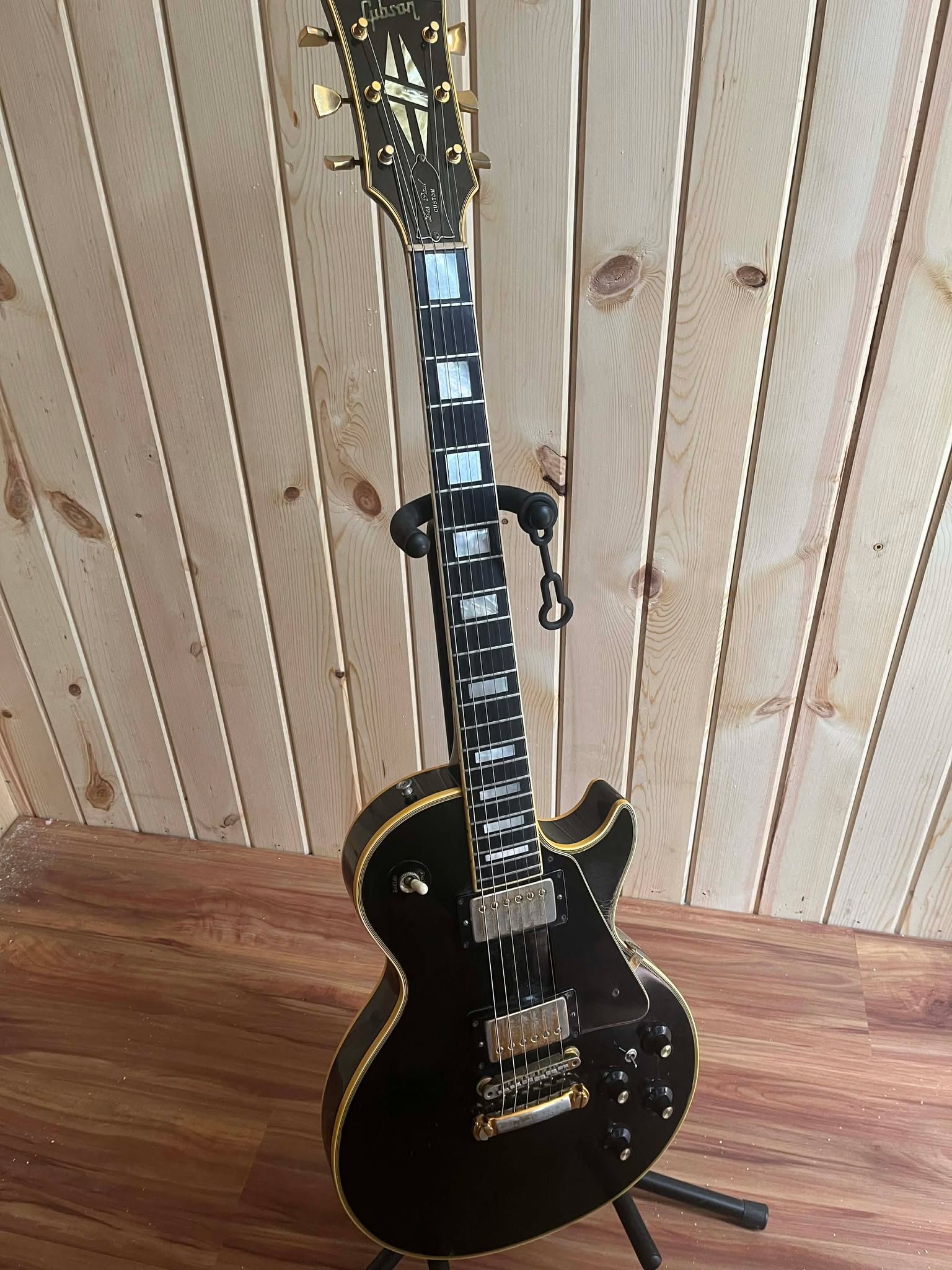
Volute: A raised wood mass on the back of the neck, just below the headstock. This is the single most distinctive visual marker separating 1970-and-later production from the 1968–1969 reissues. It is carved from the neck blank itself, not added on. It should be smooth and symmetrical.
Ebony fingerboard: Correct for the Les Paul Custom specification throughout this era. The wood is very dark — nearly black — with a tight, consistent grain. Rosewood substitution is incorrect for a Custom.
Block inlays: Large rectangular mother-of-pearl block inlays in the fingerboard. These should have consistent coloration and depth. Replacement inlays often show mismatched aging.
Five-ply body binding: White/black/white/black/white binding on the body edges. Check consistency of the layers — the black lines should be uniform in width.
Three-ply neck binding: White/black/white binding on the fingerboard edge.
Gold-plated hardware: Tune-o-matic bridge, stop tailpiece, pickup rings, truss rod cover, and tuner buttons should all be gold-plated. Mixing of nickel and gold hardware is a modification flag.
Grover Rotomatic tuners: Oval-button Grover Rotomatics are correct for this period. Kluson-style tuners indicate either a very early reissue or a replacement.
“Les Paul Custom” truss rod cover: Three-ply black truss rod cover with “Les Paul Custom” engraved in script. The engraving should be consistent and properly centered.
Pancake body construction: The body on these guitars is constructed from multiple pieces of mahogany laminated together — often called “pancake” construction. This is visible along the body edge where the layers are joined. This was a Gibson cost-reduction measure introduced in the late 1960s and is expected and correct for this era; its presence does not indicate a problem.
Pickup covers: Gold-plated humbucker covers should show appropriate aging and patina consistent with the body’s overall wear. Bright, unoxidized gold covers on a heavily played body are a replacement flag.
Factory Markings and Stamps
Control cavity: Look for ink stamps or pencil writing indicating inspection or assembly. Some examples show date stamps or inspector numbers inside the cavity.
Neck pocket: The area where the neck meets the body may show routing marks and/or assembly stamps.
Back of headstock: Serial number + “Made in USA” stamp (1970+) + model designation in some cases.
Truss rod cover: “Les Paul Custom” should be the exact text. Any variation (e.g., “Custom,” “Les Paul,” or missing text) warrants scrutiny.
Custom Color Identification
The standard finish for the 1970–1972 Les Paul Custom is Ebony (black). Non-standard finishes in this era include:
Finish | Relative Rarity | Notes |
|---|---|---|
Ebony (Black) | Standard — most common | Correct and expected |
Wine Red | Uncommon | Introduced in this production era; desirable |
Natural | Scarce | Exposes the multi-piece body construction; collectors are divided |
Walnut | Scarce | Warm brown finish; less often seen than Wine Red |
Cherry Sunburst | Very scarce | Special-order territory |
Authenticating finish: Original finishes show nitrocellulose lacquer checking (fine crazing patterns) consistent with age. The checking pattern follows finish thickness — thicker areas check more. A uniform, uncracked finish on a claimed 50-year-old guitar suggests refinishing or a thick poly overcoat. Check the headstock edge, the binding seams, and the pickup cavity edges — refinishers frequently miss these areas or leave overspray evidence.
Red Flags: How to Spot Fakes and Refinishes
Refinish indicators:
Absence of nitrocellulose checking on any surfaces
Paint or lacquer in screw holes, under pickup rings, or inside the control cavity (overspray)
Mismatched aging between finish color and hardware oxidation
Body binding that shows paint coverage on its face (refinish bleeds onto binding)
UV light examination reveals modern urethane finish (glows differently than vintage nitro)
Replaced parts (most common):
Tuners: Replacement Grover Rotomatics look correct but often show non-period screw patterns in the headstock. Check for filled holes from previous tuner configurations.
Pickups: T-Top humbuckers can be transplanted. Check for solder joint freshness and wire routing consistency.
Nut: Plastic nuts are frequently replaced. A bone or synthetic replacement is not automatically wrong but should be documented.
Bridge and tailpiece: Correct period pieces should show consistent oxidation with the rest of the hardware.
Neck repairs:
Headstock breaks are the most common structural repair on these guitars. Check the back of the headstock behind the nut for finish crazing that doesn’t follow the grain, color mismatches, or visible glue seams. Run a fingertip over the surface in raking light.
A properly repaired headstock break does not disqualify an instrument but significantly affects value — typically a 30–50% reduction depending on repair quality and visibility.
Electronics modifications:
Replaced pots will not code to the correct period — pull the control cavity cover and check codes.
Re-wired electronics often show modern solder (shiny, smooth) versus original solder (grainy, dull). Original 1970–1972 solder has a distinctive appearance after 50+ years.
Non-period capacitors are a common modification.
Edgewater’s authentication observation: In our experience evaluating Les Paul Customs from this era across the Ohio and Midwest corridor, the most common misrepresentation we encounter is a refinished example presented as all-original. The second most common is a guitar with replaced pickups — often upgraded PAF-era units installed by a previous owner — being represented as unmodified. Both significantly affect value, and both are detectable through careful physical examination.
1970–1972 Gibson Les Paul Custom Specifications
Specification | Detail |
|---|---|
Body Wood | Multi-piece mahogany (“pancake” construction) |
Top | Carved maple cap (standard) |
Neck Wood | One-piece mahogany |
Neck Joint | Glued (set neck), long tenon |
Fingerboard | Ebony, 12” radius |
Neck Profile | Slim taper C-profile |
Nut Width | 1-11/16 inches (approximately 43mm) |
Scale Length | 24.75 inches |
Frets | 22, medium-jumbo wire |
Fret Binding | Nibs (binding extends over fret ends) |
Inlays | Mother-of-pearl block inlays |
Headstock | 17-degree pitch, three-per-side tuner layout |
Volute | Present (1970+) |
Tuners | Grover Rotomatic, oval buttons, gold-plated |
Pickups | Two T-Top humbucking pickups (standard) or three pickups (rare variant) |
Pickup Covers | Gold-plated metal covers |
Bridge | ABR-1 Tune-o-matic (without retainer wire in early examples; with wire in later) |
Tailpiece | Stop tailpiece (aluminum), gold-plated |
Controls | Two volume, two tone, three-way toggle switch |
Capacitors | Typically .022 mfd |
Pickguard | Black multi-ply |
Body Binding | Five-ply (white/black/white/black/white) |
Neck Binding | Three-ply (white/black/white) |
Hardware Finish | Gold-plated throughout |
Body Finish | Nitrocellulose lacquer |
Standard Colors | Ebony (Black), Wine Red, Walnut, Natural |
Weight Range | Approximately 9–12 lbs (significant variation due to multi-piece construction) |
Case | Brown/orange hardshell with pink plush lining (original) |
What Does a 1970–1972 Gibson Les Paul Custom Sound Like?
Pickup Specifications and Tonal Profile
The 1970–1972 Les Paul Custom came equipped with T-Top humbuckers — a pickup that emerged from Gibson’s production in the late 1960s and continued through the mid-1970s. The “T-Top” name comes from a T-shaped ridge molded into the top of each coil bobbin, visible when the pickup cover is removed.
T-Top Humbucker Specifications:
DC Resistance: Approximately 7.5k–8.5k ohms (comparable to late PAF-era readings)
Magnet type: Alnico II or Alnico V (varies by production run)
Wire: Enamel-coated (not Formvar as on earlier PAFs)
Bobbins: Black plastic with T-top molded ridge
Potting: Wax-potted (reduces microphonic feedback vs. unpotted PAFs)
Tonal character: T-Top humbuckers have a warmer, slightly compressed midrange compared to original PAFs, with a tighter bass response. They are less open and three-dimensional than the best PAF examples, but many players and collectors consider them among the most musical production humbuckers Gibson made. They respond well to volume knob rolloff and clean up effectively — a characteristic highly valued by blues and classic rock players.
How Construction Details Affect Tone
The multi-piece mahogany body — often criticized by collectors — does not produce a measurably different acoustic resonance than single-piece construction in controlled comparisons. However, the specific density and grain characteristics of the mahogany pieces selected do affect sustain and resonance. Heavy examples (11+ lbs) from this era tend to have a more focused, compressed tone; lighter examples (9–10 lbs) often exhibit more open resonance.
The ebony fingerboard, relative to rosewood, contributes a slightly faster attack and a brighter fundamental note — complementing the T-Top’s warm midrange. Combined with the maple cap (which adds brightness and note separation), the 1970–1972 Custom has a balanced tonal signature suited to both clean jazz voicings and overdriven classic rock.
The set neck construction with long tenon contributes to the sustained, piano-like note decay the Les Paul is known for. This feature remains consistent from the original 1950s Custom through the early 1970s production.
Notable Recordings
The Les Paul Custom in this general production era was used extensively across rock, blues, and jazz. The Black Beauty’s visual identity was closely associated with players including Jimmy Page (Led Zeppelin), who used multiple Les Paul Customs of various vintages, and Peter Frampton. The Custom’s gold hardware and black finish made it the preferred choice for artists who wanted a more formal, premium appearance than the sunburst Standard.
Specific recording documentation to individual instrument serial numbers is difficult to verify without direct provenance; however, the T-Top-equipped Les Paul Custom is audible on countless recordings from the early-to-mid 1970s.
Common Issues and Modifications That Affect Value
Headstock break/repair: The 17-degree headstock angle combined with the Les Paul’s weight makes this the most common structural failure. A professional repair with proper clamping and matching finish touch-up may be nearly invisible; a poor repair can be immediately apparent. Value impact: 30–50% reduction, depending on repair quality and visibility.
Refinished body or neck: The most significant value factor after structural integrity. A refinished example is worth a fraction of an all-original counterpart in comparable wear. Value impact: 40–60% reduction.
Replaced pickups: Commonly upgraded to PAF-era humbuckers by previous owners. While the replacement may be sonically superior, originality is what drives collector value. Value impact: 15–30% reduction, depending on what was installed and whether originals are included.
Replaced tuners: Grover Rotomatics are the correct tuner for this era. When replaced with Klusons, Schallers, or other styles, headstock screw-hole evidence remains. Value impact: 5–15% reduction.
Added or routed electronics: Some players added coil-tap switches or replaced the three-way toggle with push-pull pots. Routing modifications permanently alter the instrument. Value impact: 20–35% reduction.
Fret wear/refret: Significant fret wear is common on played examples. A professional refret with period-correct wire is generally considered acceptable and does not dramatically affect value. A refret with oversized modern wire is less desirable to purists. Value impact: Minimal if done correctly; 5–10% reduction.
Nut replacement: The original plastic nut is frequently replaced with bone, Tusq, or other materials. A replacement nut with original retained is acceptable; a non-original nut with no original is a minor negative. Value impact: Minimal to 5% reduction.
Weight: Heavy examples (11+ lbs) are increasingly difficult to sell at full market value as players prioritize comfort. While weight does not affect collectibility for pure collector buyers, it significantly affects the “player-grade vintage” market. Value impact: 5–15% reduction for very heavy examples.
Control cavity modifications: Re-wired or modified control configurations are common. Original wiring with period solder and original components commands a premium. Value impact: 10–20% reduction.
Finish checking and buckle rash: These are expected and generally accepted signs of play wear. Heavy buckle rash through to bare wood is a cosmetic issue that affects value at the margin but does not indicate inauthenticity. Value impact: 5–10% depending on severity.
Edgewater’s experience: The most frequent issue we encounter on 1970–1972 Les Paul Customs in the Midwest market is replaced pickups — often the original T-Tops were swapped for PAF-era units by players who believed they were upgrading. In many cases, the original T-Tops were simply discarded. An all-original example with its T-Tops intact is meaningfully more valuable than an otherwise identical guitar with replacement humbuckers.
Selling Your 1970–1972 Gibson Les Paul Custom: Your Options Compared
Selling Option | Typical Offer Level | Timeline | Fees/Costs | Risk Level | Best For |
|---|---|---|---|---|---|
Edgewater Guitars | 30–40% above typical shop offers | Immediate cash | None | Low — expert authentication included | Owners wanting fair value without hassle |
Local Guitar Shop | Wholesale-level pricing (lowest tier) | Same day | None direct, but offer reflects it | Low | Pure convenience over value |
Reverb / eBay | Variable — potentially strong | Weeks to months | 5–15% platform fees + shipping costs | High — shipping damage, fraud, chargebacks | Experienced sellers comfortable with logistics |
Heritage / Christie’s Auction | Variable — strong for exceptional examples | 3–6 months | 15–25% seller premium | Medium | Exceptionally rare or provenance-documented examples |
Private Sale | Variable | Unpredictable | None | High — authentication burden falls on you | Sellers with established buyer networks |
Edgewater Guitars specializes in exactly this type of instrument: vintage American-made electrics from the pre-1975 era, purchased directly from owners at prices that reflect real market value rather than wholesale resale math. When a local guitar shop offers you a price, they are calculating their margin on an eventual sale — typically meaning you receive 40–60% of retail. Edgewater’s model eliminates that intermediary step.
The Edgewater process: Contact us by phone at (440) 219-3607 or through the website. Describe your instrument and provide photos if possible. We will provide a preliminary range based on your description, then arrange an in-person evaluation — we travel to you for high-value instruments throughout Ohio, Michigan, Pennsylvania, Indiana, and West Virginia. Upon evaluation and authentication, we make an immediate cash offer. No consignment waiting periods. No platform fees. No shipping risk.
Ready to find out what your 1970–1972 Gibson Les Paul Custom is worth? Get your free, no-obligation valuation: request a free estimate online or call (440) 219-3607.
Frequently Asked Questions About the 1970–1972 Gibson Les Paul Custom
Q: What is a 1970–1972 Gibson Les Paul Custom worth in 2026?
A: Value varies significantly based on originality, condition, and color. All-original examples in Excellent condition occupy the top tier of the market for this era. Refinished or modified examples trade at substantially lower levels. Without examining a specific instrument, a meaningful value range cannot be quoted — the difference between an all-original and a refinished example of the same year can be 50% or more.
Q: Are 1970–1972 Les Paul Custom guitars considered vintage?
A: Yes. Instruments from this period are now over 50 years old, which meets the universally accepted threshold for vintage classification. The 1970–1972 Les Paul Custom is recognized as a vintage instrument by major auction houses, vintage dealers, and collector publications.
Q: How do I know if my 1970–1972 Les Paul Custom is all-original?
A: Cross-reference at least four independent data points: (1) the serial number against known ranges for this era, (2) potentiometer codes that should date to 1969–1972, (3) physical construction details including the volute, multi-piece body, and ebony fingerboard, and (4) hardware consistency — all gold-plated components should show matching and consistent oxidation patterns. No single factor is definitive in isolation.
Q: What is the volute on a 1970s Gibson Les Paul Custom?
A: The volute is a raised wood mass on the back of the neck, just below the headstock. Gibson introduced it around 1969–1970 to reinforce a historically vulnerable break point where the neck transitions into the headstock. Its presence is a definitive marker of 1970-and-later production and distinguishes these guitars from the 1968–1969 reissues. A claimed 1970+ guitar without a volute should be examined carefully.
Q: What pickups are in a 1970–1972 Gibson Les Paul Custom?
A: Standard production used T-Top humbuckers — a wax-potted humbucker with a distinctive T-shaped ridge on the plastic bobbin. T-Tops read approximately 7.5k–8.5k ohms DC resistance and have a warm, slightly compressed tonal character. They are distinct from the earlier PAF-era humbuckers and the later 1970s “Patent Number” pickups that followed.
Q: How does the 1970–1972 Les Paul Custom compare to the late-1950s original?
A: The late-1950s Les Paul Custom used single-piece mahogany bodies, earlier construction tolerances, and (in later years of that run) PAF humbuckers with different bobbin and magnet characteristics. The 1970–1972 version uses multi-piece body construction, T-Top humbuckers, and a volute. The 1958–1960 originals are considered among the most collectible electric guitars in existence; the 1970–1972 guitars are genuine vintage instruments with their own collector base, but occupy a different (lower) tier of the market.
Q: What is “pancake body” construction on a 1970s Gibson?
A: “Pancake” refers to a body built from multiple horizontal layers of mahogany laminated together, as opposed to a single carved piece. Gibson introduced this construction in the late 1960s as a cost-reduction measure. The layers are visible along the body edges. It is expected and correct on 1970–1972 examples; finding it should not be alarming. Its tonal impact is a subject of ongoing debate, but the practical effect on value is that all-original pancake-body examples trade at a discount relative to pre-pancake construction.
Q: How can I tell if my Les Paul Custom has been refinished?
A: Check for nitrocellulose lacquer checking (fine crazing) on aged surfaces — absence of checking on a 50-year-old guitar is suspicious. Look for overspray or paint in screw holes, under pickup rings, and inside the control cavity. Examine the binding edges for paint coverage where lacquer should have been masked. A UV light (blacklight) examination reveals modern polyurethane finishes, which glow differently than vintage nitrocellulose.
Q: Does the three-pickup Les Paul Custom exist from 1970–1972?
A: Yes. Gibson produced three-pickup Les Paul Custom configurations in this period, though they are significantly rarer than the standard two-pickup layout. Three-pickup examples are sought by a specific collector segment and carry a meaningful premium. If you believe you have one, it warrants careful authentication and a specialized appraisal.
Q: Where is the best place to sell a 1970–1972 Gibson Les Paul Custom?
A: For most owners — especially those not experienced in vintage guitar transactions — selling directly to a specialist buyer like Edgewater Guitars provides the best combination of fair value and minimal hassle. Local guitar shops typically offer wholesale pricing. Online platforms offer the potential for higher prices but carry significant risks including shipping damage, fraud, and fees. Auction houses are appropriate primarily for exceptionally rare or provenance-documented examples.
Q: How much more does Edgewater Guitars pay compared to guitar shops?
A: Edgewater consistently offers 30–40% above what typical guitar shops pay for comparable instruments. This is possible because Edgewater’s business model eliminates retail overhead — we buy directly from owners rather than operating a showroom that requires margin on every transaction.
Q: Does Edgewater Guitars buy 1970–1972 Gibson Les Paul Customs?
A: Yes. This is precisely the type of instrument Edgewater specializes in. We purchase vintage American-made guitars throughout Ohio, Michigan, Pennsylvania, Indiana, and West Virginia, and we travel to sellers for high-value instruments. Contact us at (440) 219-3607 for a free, no-obligation valuation.
Related Resources
Gibson Serial Number Lookup Tool — edgewaterguitars.com/guitar-serial-number-lookup/
How to Read Potentiometer Codes on Vintage Gibson Guitars — [internal link]
1968–1969 Gibson Les Paul Custom: The Reissue That Started It All — [internal link]
Gibson Les Paul Identification Guide: 1952–1980 — [internal link]
How to Spot a Refinished Gibson Les Paul — [internal link]
Sell Your Vintage Guitar to Edgewater — edgewaterguitars.com
Edgewater Guitars specializes in purchasing premium vintage guitars throughout Ohio, Michigan, Pennsylvania, Indiana, and West Virginia. We travel to you for high-value instruments. Contact us today for your free, no-obligation valuation: edgewaterguitars.com | (440) 219-3607.
See also: Vintage Gibson Les Paul Custom Value Guide (1954-1960)
Article