DATE :
1965 Lake Placid Blue Fender Jaguar: The CBS Transition Year in Custom Color
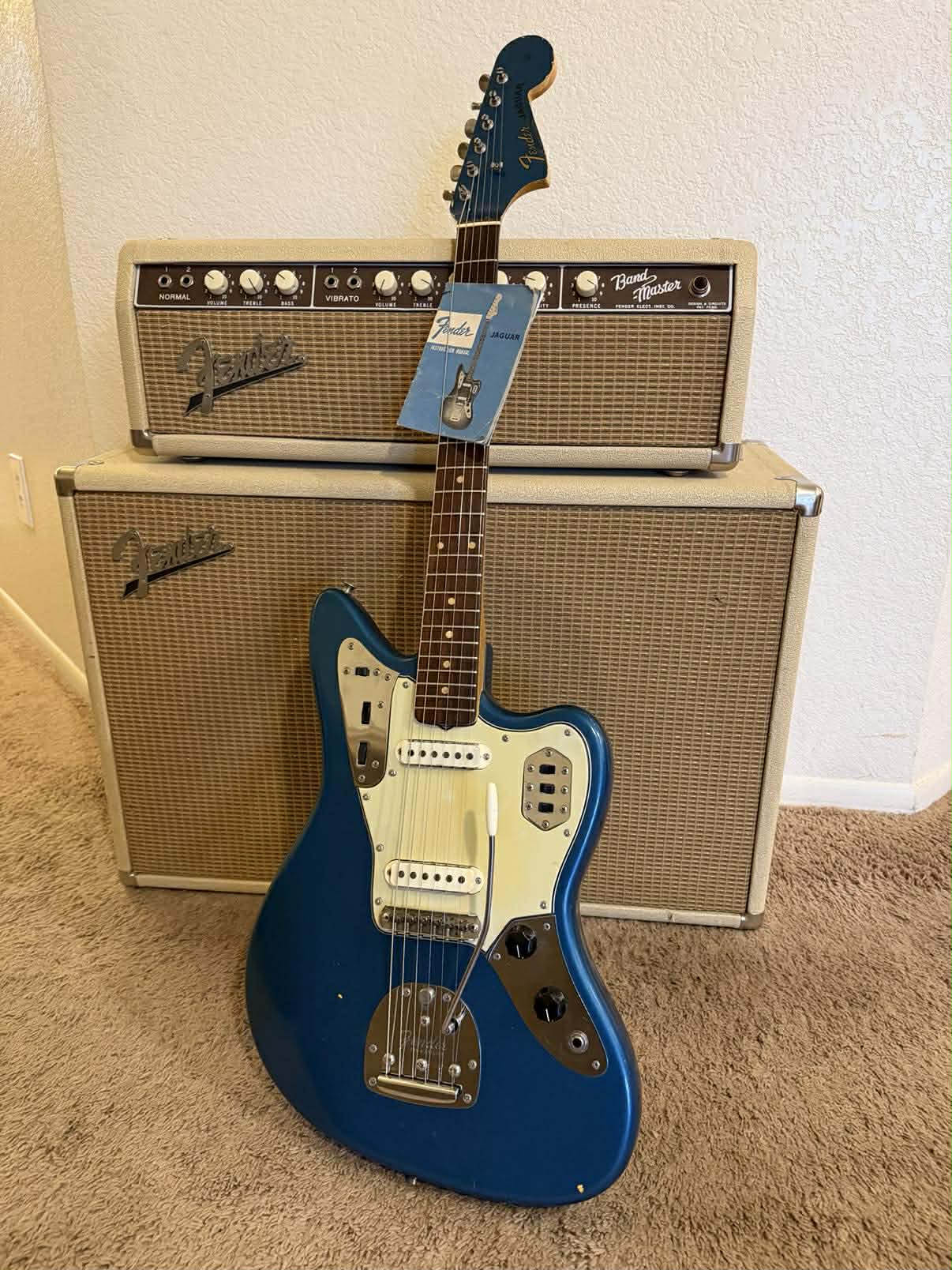
1965 Lake Placid Blue Fender Jaguar: The CBS Transition Year in Custom Color
Why the 1965 Lake Placid Blue Jaguar Is Significant
The 1965 Fender Jaguar in Lake Placid Blue represents one of the most fascinating periods in Fender’s history—the year CBS acquired the company. This transition year created instruments with unique characteristics that make them distinctly collectible. Some 1965 Jaguars retain full pre-CBS features while others show early CBS changes, creating a spectrum of variations that collectors find endlessly compelling.
When you combine this transitional production year with Lake Placid Blue—one of Fender’s most iconic custom colors—you get an instrument that captures a pivotal moment in electric guitar history.
What makes a 1965 Lake Placid Blue Jaguar special:
CBS transition year - Built during the ownership changeover that fundamentally altered Fender’s trajectory
Pre-CBS features possible - Early 1965 examples retain all original Leo Fender-era specifications
Transitional specifications - Mid-year examples may mix pre-CBS and CBS features
Custom color rarity - Lake Placid Blue remained uncommon despite increased production
Matching headstock desirability - Factory-applied Lake Placid Blue on headstock increases collectibility
Last year of certain features - Final year for clay dots, small headstock on early examples, and other pre-CBS appointments
Historical significance - Represents the end of an era in American guitar manufacturing
Collector debate - Ongoing discussion about early vs. late 1965 values creates market interest
The combination of Lake Placid Blue’s timeless appeal with 1965’s transitional status makes these instruments particularly sought-after by collectors who appreciate historical context alongside aesthetic beauty.
Historical Context: 1965 and the CBS Acquisition
The CBS Purchase
On January 5, 1965, Columbia Broadcasting System (CBS) purchased Fender Electric Instrument Company for $13 million. This acquisition fundamentally changed the company’s trajectory and created what collectors now refer to as the “pre-CBS” and “CBS” eras of Fender production.
Immediate Changes:
The acquisition didn’t immediately transform Fender’s manufacturing. Early 1965 guitars were essentially identical to 1964 models, built by the same craftsmen using the same materials and techniques. However, as the year progressed, CBS began implementing changes:
Increased production quotas
Cost analysis of materials and processes
Introduction of new suppliers
Expansion of the Fullerton facility
Implementation of corporate quality control systems
Mid-1965 Transitions:
By summer 1965, visible changes began appearing:
Larger headstock introduced (late 1965)
Pearl dot inlays replacing clay dots
Transition logo (gold “Fender” script)
F-stamped neck plates
Changes to body wood sourcing
Modifications to finish application processes
Why Collectors Care:
The CBS acquisition divides Fender’s history into two distinct eras. Pre-CBS instruments (1950-early 1965) are universally considered more desirable due to:
Hand-crafted approach vs. mass production
Premium material selection
Experienced craftsmen’s attention to detail
Lower production numbers
“Golden era” association
However, early CBS-era guitars (1965-1966) retain much of the pre-CBS quality while incorporating some improvements, creating a unique middle ground that sophisticated collectors appreciate.
The Jaguar in 1965
By 1965, the Jaguar had been in production for four years. While never achieving the popularity of the Stratocaster or Telecaster, it maintained its position as Fender’s premium offset model. The surf music boom that initially drove Jaguar sales was beginning to wane as musical tastes shifted toward British Invasion rock and emerging psychedelic sounds.
Production Context:
Jaguar production remained modest compared to Stratocasters
Custom colors like Lake Placid Blue represented small percentage of total output
Increased CBS production quotas meant more total Jaguars built in 1965 than previous years
Surf music’s declining popularity began affecting Jaguar sales
Rock musicians still discovering the model’s unique characteristics
Custom Colors in the Transition Year
Fender’s custom color program continued unchanged immediately after the CBS acquisition. Lake Placid Blue remained available as one of the premium metallic finishes, though the application process would gradually evolve as CBS implemented new production standards.
1965 Custom Color Characteristics:
Same DuPont automotive lacquers used in pre-CBS era
Desert Sand undercoat standard practice continuing
5% upcharge for custom colors maintained
Matching headstocks still hand-painted by skilled finishers
Quality control standards initially unchanged
Late 1965 Changes:
As CBS ramped up production, subtle changes appeared:
Slightly thicker finish applications
Different primer formulations tested
Increased use of polyurethane sealer coats (transitional)
Faster production times affecting cure periods
Quality variations as new workers trained
Current Market Status and Collectibility
Market Position and Collector Perspective
1965 Lake Placid Blue Jaguars occupy a unique position in the vintage Fender market. They’re simultaneously appreciated for their historical significance and debated regarding their relationship to “true” pre-CBS instruments.
Collector Segments:
Different collectors view 1965 Jaguars differently:
Pre-CBS Purists:
Seek early 1965 examples with all pre-CBS features
Value clay dots, small headstocks, pre-CBS logo
Prefer neck dates before June 1965
Consider these equivalent to 1964 models
Transition Year Specialists:
Appreciate the unique mix of features possible in 1965
Value the historical significance of the changeover
Seek examples with interesting feature combinations
Consider 1965 its own category
Player/Collectors:
Focus on playability and tone over specifications
Less concerned with exact feature dating
Value Lake Placid Blue finish regardless of production timing
Appreciate the instruments as players first, collectibles second
Investment Collectors:
Analyze market trends and appreciation potential
Recognize early 1965 commanding premiums
Understand late 1965 as entry point to Jaguar collecting
Monitor how transitional features affect long-term values
Key Value Factors for 1965 Examples
Production Timing:
January-May 1965 - Full pre-CBS features, most desirable
June-August 1965 - Transitional features, mixed specifications
September-December 1965 - CBS features present, larger headstock possible
Originality Premium:
All-original examples with matching headstocks command substantial premiums
Pre-CBS features on 1965 models increase desirability significantly
Complete originality more important than ever (CBS changes make dating obvious when modified)
Documentation proving early 1965 production adds value
Finish Condition:
Lake Placid Blue’s metallic nature shows wear distinctly
Original finish preservation critical for maximum value
Checking and aging patterns must appear authentic
Matching headstock condition significantly impacts desirability
Completeness:
Original mute mechanism (often missing)
Tremolo cover and all factory appointments
Correct pickguard (tortoiseshell with proper aging)
Period-correct case
Original electronics and hardware
Feature Specifics:
Clay dots more valuable than pearl dots
Small headstock more desirable than large (late 1965)
Pre-CBS logo preferred over transition logo
Slab board (very early 1965) extremely rare and valuable
Non-F-stamped neck plate indicates earlier production
Edgewater’s Expertise with Transition Year Fenders
At Edgewater Guitars, we specialize in accurately dating and evaluating transition year Fenders. Our expertise includes:
Precise dating using multiple authentication methods
Understanding transitional feature combinations
Recognizing early vs. late 1965 characteristics
Properly valuing the CBS transition factor
Identifying original Lake Placid Blue vs. refinishes
This specialized knowledge means we recognize the nuances that affect value—and we pay accordingly. Our offers consistently exceed traditional guitar shops by 30-40% because we understand what we’re looking at.
Market Trends for 1965 Jaguars
Recent Appreciation:
The market for 1965 Jaguars has shown interesting patterns:
Early 1965 examples appreciating in line with 1964 models
Late 1965 examples providing entry point for collectors
Lake Placid Blue commanding premium across all 1965 production
Matching headstock examples showing strongest appreciation
All-original condition more critical than specific production month
Comparison to Other Years:
1962-1964 Jaguars: Universally pre-CBS, command premium
Early 1965: Comparable to 1964 when full pre-CBS features present
Late 1965: Bridge between pre-CBS and CBS eras
1966+: Full CBS-era, different collector category
Long-term Outlook:
Vintage Fender custom colors continue showing strength, with Lake Placid Blue ranking among the most sought-after finishes regardless of production year. As pre-CBS examples become increasingly scarce, early 1965 models with full pre-CBS features gain recognition as legitimate golden-era instruments.
Comprehensive Identification Guide
Serial Number Dating
1965 Jaguars carry serial numbers in the L series, typically ranging from L90000 through L99999, stamped on the neck plate at the back of the body where the neck attaches.
Serial Number Breakdown:
L90000-L94999 - Primarily early 1965 (January-June)
L95000-L99999 - Mid to late 1965 (July-December)
100000+ - Very late 1965 into 1966 (new numbering system)
Important Notes:
Serial numbers don’t definitively date Fenders—always cross-reference with neck dates
Fender used serial number blocks inconsistently during transition
Bodies and necks were sometimes assembled months after component manufacture
Late 1965 saw introduction of new 100000+ numbering system
To verify your Jaguar’s production date, use our comprehensive Fender Serial Number Lookup Tool which cross-references serial numbers with neck dates, pot codes, and transitional features.
Neck Date Authentication
The most reliable dating method remains the pencil or ink stamp on the neck heel (visible when the neck is removed from the body). 1965 neck dates appear in several formats:
Common Formats:
“1-65” through “12-65” - Month and year (most common)
“JAN 65” through “DEC 65” - Month abbreviation with year
“1-5-65” - Full date format (less common)
Dating Interpretation:
Neck dates represent when the neck was finished, not final assembly
Bodies assembled with necks from inventory create dating discrepancies
Late 1964 neck dates can appear on early 1965 guitars
Early 1966 neck dates occasionally found on very late 1965 guitars
Transition Year Dating Tips:
Necks dated before June 1965 likely have pre-CBS features
Necks dated after September 1965 often show CBS changes
July-August 1965 neck dates represent peak transition period
Always examine physical features alongside dates
Potentiometer Code Dating
1965 Jaguars predominantly used Stackpole potentiometers with date codes revealing manufacture timing:
Code Format: 304-YYWW
304 = Stackpole manufacturer identification
YY = Year (64, 65, or 66 acceptable for 1965 guitars)
WW = Week of manufacture (01-52)
Examples:
304-6452 = Stackpole pot from 52nd week of 1964 (late December)
304-6520 = Stackpole pot from 20th week of 1965 (mid-May)
304-6601 = Stackpole pot from 1st week of 1966 (very late 1965 guitar)
Acceptable Date Ranges for 1965 Jaguars:
Pots dated last quarter of 1964 (pulled from parts inventory)
Pots dated throughout 1965 (most common)
Pots dated first quarter of 1966 (on very late 1965 guitars)
Red Flags:
Pots dated before mid-1964 suggest replacement
Pots dated after Q1 1966 indicate replacement
Mismatched pot dates (different years) suggest partial replacement
CTS pots in 1965 Jaguar (Fender used Stackpole)
Lake Placid Blue Finish Authentication
Authenticating original Lake Placid Blue on a 1965 Jaguar requires examining multiple factors, with special attention to transition-year application characteristics.
1. Undercoat Examination
Genuine Lake Placid Blue Fenders from 1965 have the characteristic Desert Sand (yellow) sealer coat applied before color coats. This is visible in:
Tremolo cavity (most accessible)
Neck pocket (sometimes)
Any chips or wear areas exposing undercoat
Around filled screw holes (if modifications present)
Control cavity (occasionally)
Transition Year Notes:
Early 1965 undercoats identical to 1964
Late 1965 may show slightly different sealer formulations
CBS began testing polyurethane sealers in late 1965
Desert Sand remained standard throughout 1965
2. Metallic Particle Consistency
Original Lake Placid Blue contains aluminum metallic flake with specific characteristics:
Appearance Factors:
Even distribution throughout finish
Consistent sparkle pattern under light
Uniform aging (no areas with different metallic density)
Period-correct particle size and distribution
No modern metallic flake appearance
Aging Characteristics:
Original metallic flake maintains sparkle despite age
Should show consistent weathering across entire guitar
Clear coat yellowing affects appearance but not flake itself
UV exposure may slightly dull but doesn’t eliminate sparkle
3. Color Authenticity and Aging
Genuine 1965 Lake Placid Blue exhibits specific color characteristics:
Fresh Appearance (Original, Well-Preserved):
Medium blue with pronounced metallic sparkle
Slight greenish undertone in certain lighting
Deep, luminous quality from multiple color coats
Mirror-like finish after proper buffing
Aged Appearance (60 Years Old):
Slight fading toward lighter blue or grayish tones
UV checking patterns (fine hairline cracks)
Clear coat ambering creating warmth over blue
Metallic sparkle still visible through aging
Comparing Early vs. Late 1965:
Early 1965 finish identical to 1964 application
Late 1965 may show slightly thicker clear coats
Transitional period saw some finish formula adjustments
Overall appearance similar throughout year
4. Application Technique Indicators
Factory-applied Lake Placid Blue shows characteristic patterns:
Overspray Patterns:
Slight color in neck pocket edges
Light overspray in tremolo cavity
Professional, even application throughout
No drips, runs, or heavy buildup
Correct spray pattern for 1960s factory technique
Masking Evidence:
Remnants of masking tape in cavities (some examples)
Color codes or painter’s marks (occasionally)
Clean masking lines around hardware
Proper paint edges at all boundaries
5. Refinish Detection
Common Refinish Indicators:
Wrong undercoat color (should be Desert Sand/yellow)
Overspray on hardware or in screw holes
Fill marks from removed dings or dents
Incorrect metallic flake (modern materials)
No checking or unnatural checking patterns
Paint in areas that shouldn’t have color
Thick, plasticky feel (polyurethane refinish)
Perfect, unworn condition (suspicious on 60-year-old guitar)
Advanced Authentication:
UV light examination reveals refinishes
Hardware removal shows overspray on covered areas
Screw heads show paint when original finish preserved them
Neck pocket should show bare wood or minimal overspray
Original lacquer has distinctive smell when case opened
Matching Headstock Verification
Lake Placid Blue Jaguars with factory-applied matching headstocks command significant premiums. Authentication requires careful examination:
Front Face Authentication
Finish Characteristics:
Color must match body exactly (same metallic flake density)
No color variation between body and headstock
Proper factory masking technique at edges
Metallic flake distribution consistent with body
Clear coat application matching body finish
Decal Placement:
Applied over color coat but under final clear coats
Properly centered and aligned
Age-appropriate yellowing
No bubbling or lifting
Correct logo style for 1965
1965 Logo Variations:
Early 1965: Black “spaghetti” logo with two patent numbers
Mid 1965: Transition gold logo appears
Late 1965: Gold transition logo more common
Logo style helps date production timing
Back of Headstock
Original Characteristics:
Natural wood finish (maple, not painted)
Clear delineation between painted front and natural back
No overspray onto back face
Clean masking line around headstock edges
Proper wood aging and patina
Serial Number Plate:
Standard 4-bolt neck plate on body (not headstock)
Proper screw patina and aging
F-stamp may appear on late 1965 plates
Non-F-stamped plates indicate earlier production
Hardware and Component Authentication
Original Pickups
1965 Jaguar pickups feature specific characteristics:
Visual Identification:
White plastic covers (aged to cream or yellowed ivory)
Metal claw-style pole pieces (“metal tooth” design)
Gray bottom fiber plate
Period-correct bobbin construction
Proper mounting height and position
Technical Specifications:
Formvar-insulated wire (pre-CBS standard)
Approximately 6.5-7.5k ohms DC resistance per pickup
Date stamps on bottom (often rubbed or faint)
Alnico 5 magnets (standard for Jaguar pickups)
Dating Pickup Codes:
Pencil dates or stamps on pickup bottom
Dates should align with neck date and pot codes
Late 1964 to early 1966 dates acceptable
Inconsistent dates suggest replacement
Bridge and Tremolo System
Original Specifications:
Chrome-plated floating tremolo assembly
Spring-loaded mechanism with lock button
Original Fender “F” stamped bridge
Individual height-adjustable saddles
Tremolo arm with lock mechanism
Foam mute pads (often deteriorated or missing)
Transition Year Notes:
Early 1965 identical to 1964 specifications
No significant tremolo changes during 1965
Chrome plating quality consistent throughout year
Original springs and hardware standard
Tuners
Kluson Deluxe Specifications:
“Kluson Deluxe” stamping on tuner bodies
Single-line 6-in-line configuration
Original plastic buttons (aged to cream/yellow)
Metal bushings with appropriate wear
Proper shaft diameter and length
Transition Considerations:
Early 1965 Klusons identical to pre-CBS
No tuner changes during 1965
Post-1965 saw different manufacturers appear
Original Klusons significantly more valuable
Pickguard
1965 Specifications:
Tortoiseshell celluloid nitrate material
4-ply construction (tort/white/black/white)
Aging to greenish tint (celluloid nitrate characteristic)
Period-correct shielding paint on underside
Proper screw hole configuration
Correct shape and contour for Jaguar body
Aging Characteristics:
Original tort guards turn greenish over decades
Shrinkage causes pulling at screw holes
Checking patterns in celluloid
Some warping normal with age
Control Plate and Electronics
Standard Configuration:
Chrome control plate with complex switching
Original “witch hat” knobs (black or brown)
Proper control layout: volume, tone, rhythm volume, rhythm tone
Three slide switches (pickup selector, rhythm circuit, strangle)
Grey Tiger capacitors (.05 mfd)
Cloth-covered wiring (early 1965)
Transition to plastic-covered wire (late 1965)
Transition Year Electronics:
Early 1965: Cloth-covered wire throughout
Mid 1965: Mix of cloth and plastic wire appearing
Late 1965: Plastic-covered wire becoming standard
Wiring type helps date production timing
F-Stamp Dating
F-Stamped Components:
Starting in mid-1965, CBS began stamping “F” on various components:
Neck plates: F-stamp indicates late 1965 production
Tuners: F-stamped tuners rare in 1965, common 1966+
Potentiometers: Some late 1965 pots show F-stamps
Bridge parts: Occasional F-stamps on late 1965 hardware
Dating Value:
Absence of F-stamp suggests early 1965
F-stamped neck plate indicates late 1965
Multiple F-stamps confirm CBS-era production
Clean (non-F-stamped) parts more desirable to collectors
Detailed Physical Specifications
Body Construction
Wood Selection:
Alder: Standard for sunburst and custom colors (including Lake Placid Blue)
Ash: Used for blonde and see-through finishes
Weight: Typically 7.5-8.5 pounds (lighter than Stratocasters)
Construction Details:
Body Thickness: 1-3/4” at rim
Body Width: 14” at lower bout
Cutaway: Offset asymmetrical double cutaway design
Contours: Deep belly and forearm contours for comfort
Routing: Complex routing for tremolo, electronics, and controls
Transition Year Notes:
Early 1965 alder sourcing unchanged from 1964
Late 1965 saw new alder suppliers as CBS expanded production
Wood quality generally consistent throughout 1965
Some weight variation as new lumber sources added
Neck Specifications
Construction:
Wood: One-piece maple neck with separate rosewood fingerboard
Profile: “C” shape, medium thickness (transitional between 50s and 60s)
Width at Nut: 1-5/8” (narrower than Stratocaster’s 1-11/16”)
Scale Length: 24” (shorter than Strat/Tele’s 25.5”)
Frets: 22 frets, vintage wire (narrow and low by modern standards)
Fingerboard:
Radius: 7.25” (vintage specification)
Material: Brazilian rosewood
Type: Veneer fingerboard (curved bottom) standard in 1965
Inlay Material: Clay dots (early 1965) or pearl dots (late 1965)
Inlay Position: Standard dot positions
Critical Transition Features:
Clay vs. Pearl Dots:
Early 1965 (pre-June): Clay dot inlays
Late 1965 (post-September): Pearl dot inlays
Transition period (June-September): Either possible
Fingerboard Binding:
Most 1965 Jaguars: Unbound fingerboard
Some late 1965 examples: Bound fingerboard (rare)
Bound fingerboard with blocks very rare in 1965
Headstock Size:
Early-Late 1965: Small “pre-CBS” headstock
Very Late 1965: Large “CBS” headstock introduction
Transition occurred roughly November-December 1965
Neck Attachment:
4-bolt neck plate with micro-tilt adjustment
Stamped serial number on plate
F-stamp may appear on late 1965 plates
Proper screw types and finish
Electronics Configuration
Pickup System:
Two single-coil pickups with metal claw pole pieces
Independent volume and tone controls for each circuit
Complex switching system for tonal versatility
Control Layout:
Lead Circuit:
Volume control
Tone control
Engaged when rhythm circuit switch in “off” position
Rhythm Circuit:
Independent volume control
Independent tone control
Engaged via slide switch
Built-in bass roll-off for rhythm tones
Switching System:
Pickup Selector: 3-position slide switch
Position 1: Neck pickup
Position 2: Neck + Bridge pickups
Position 3: Bridge pickup
Rhythm Circuit: On/Off slide switch
Strangle Switch: Capacitor-based bass roll-off
Creates thin, cutting tone
Additional tonal option
Electronic Components:
Capacitors: Grey Tiger .05 mfd (lead circuit)
Potentiometers: 1-meg Stackpole pots
Output Jack: Standard 1/4” jack on control plate
Wiring: Cloth-covered (early) or plastic-covered (late)
Shielding: Graphite paint on pickguard underside
Hardware Specifications
Bridge and Tremolo:
Type: Floating tremolo with lock mechanism
Material: Chrome-plated steel
Features:
Spring-loaded action
Lock button on tremolo arm
Adjustable spring tension
Individual saddle height adjustment
Mute Mechanism:
Chrome mute assembly
Foam pads (often deteriorated)
Activation lever on treble side
Common removal by previous owners
Tuning Machines:
Kluson Deluxe tuners
6-in-line configuration
Single-line headstock arrangement
Plastic buttons (aged cream/yellow)
“Kluson Deluxe” stamping
Additional Hardware:
String Tree: Single round string tree (high E and B strings)
Nut: Bone (original specification)
Pickguard: Tortoiseshell celluloid, 4-ply
Knobs: Witch hat style (black or brown)
Plating: Chrome on all metal parts
Strap Buttons: Chrome strap buttons
The Lake Placid Blue Color in 1965
Color Application Process
Lake Placid Blue application in 1965 followed established Fender procedures:
Step-by-Step Process:
Wood Preparation:
Sanding to smooth surface
Grain filling (if necessary)
Final sanding to 220 grit
Sealer Coat:
Desert Sand (yellow) sanding sealer
Multiple thin coats
Sanding between coats
Color Coats:
Lake Placid Blue with metallic flake
Multiple coats for depth and coverage
Wet sanding between coats
Even, professional spray technique
Clear Coats:
Nitrocellulose lacquer clear coats
Multiple coats for protection and gloss
Wet sanding for smoothness
Final buffing to mirror finish
Transition Year Variations:
Early 1965: Identical to 1964 application process
Late 1965: Slightly thicker clear coats appearing
CBS testing different sealer formulations
Overall quality remained high throughout 1965
Aging Characteristics Specific to 1965
60-year-old Lake Placid Blue finishes display distinctive aging:
Checking and Crazing:
Fine hairline cracks throughout finish
More prominent on back and sides (wear areas)
Spider-web patterns from temperature/humidity cycles
Intensity varies by storage conditions
Original nitrocellulose checking vs. modern poly (no checking)
Color Evolution:
Slight fading toward lighter blue or gray tones
UV exposure creates more dramatic fading
Some examples show greenish cast from clear coat yellowing
Metallic sparkle remains visible despite fading
Blue pigment more stable than some other colors
Wear Patterns:
Forearm Wear: Upper bout edge where forearm rests
Belt Buckle Rash: Back of guitar from belt contact
Pick Wear: Area near pickguard edge
Neck Heel: Contact point shows handling wear
Edges: Body edges show finish loss from handling
Clear Coat Ambering:
Nitrocellulose yellows with age
Creates warm glow over blue base
More pronounced with UV exposure
Adds depth and character
Visible comparison: new vs. aged examples
Comparison to Other Custom Colors
Understanding Lake Placid Blue’s relationship to other 1965 Fender custom colors:
Sonic Blue
Type: Solid (non-metallic) light blue
Appearance: Brighter, more pastel than Lake Placid
Aging: Shows more clear coat yellowing
Desirability: Comparable to Lake Placid Blue
Rarity: Similar production numbers
Daphne Blue
Type: Solid medium blue (no metallic)
Appearance: Similar tone to Lake Placid without sparkle
Aging: Can shift greenish as clear yellows
Desirability: Slightly less than metallics
Rarity: Comparable availability
Ocean Turquoise
Type: Blue-green metallic
Appearance: More green undertone, metallic like Lake Placid
Aging: Similar patterns to Lake Placid Blue
Desirability: Highly collectible, comparable to Lake Placid
Rarity: Less common than Lake Placid Blue
Foam Green
Type: Light green (non-metallic)
Appearance: Mint green color
Aging: Shifts toward yellow-green
Desirability: Strong collector following
Rarity: Uncommon but not extremely rare
Lake Placid Blue’s Position:
Consistently ranks among top 3 most desirable blues
Metallic nature creates visual interest
Medium tone more versatile than very light/dark colors
Strong association with vintage Fender aesthetics
Matching headstock examples particularly prized
Tonal Characteristics
The 1965 Jaguar Voice
Core Sonic Profile:
The 1965 Jaguar delivers distinctive tonal characteristics that set it apart from Stratocasters and Telecasters:
Primary Tone:
Bright, cutting high-end response
Focused upper-midrange presence
Controlled low-end (less boomy than Strats)
Quick transient attack
Articulate note separation
Slightly compressed natural dynamics
Scale Length Impact:
The 24” scale length (1.5” shorter than Strat/Tele) significantly affects tone and playability:
Reduced string tension at standard tuning
Slightly “looser” feel under fingers
Enhanced midrange warmth
Easier string bending
Different harmonic overtone structure
Fuller fundamental tone than 25.5” instruments
Pickup Characteristics:
Jaguar single-coils differ notably from Stratocaster pickups:
Metal claw pole pieces create brighter attack
Focused frequency response emphasizing presence
Less “quacky” middle position than Strat
More direct, punchy character
Excellent clarity for rhythm work
Cutting lead tones without harshness
Circuit Complexity and Tonal Options
The Jaguar’s elaborate switching system provides remarkable versatility:
Lead Circuit Tones:
Bridge Pickup Solo:
Cutting, bright tone
Excellent for lead work
Cuts through dense mixes
Jangly rhythm tones
Both Pickups:
Fuller, more complex tone
Phase interaction creates depth
Balanced output
Versatile for rhythm and lead
Neck Pickup Solo:
Warmer, rounder tone
Maintains Jaguar clarity
Good for jazz-influenced playing
Smooth lead tones
Rhythm Circuit:
Separate volume and tone controls
Built-in bass roll-off creates compressed tone
Jangly, percussive rhythm sounds
Instant switch between lead and rhythm
Originally designed for jazz players
Strangle Switch:
Activates capacitor rolling off bass
Creates thin, cutting tone
Telephone-like quality
Useful for specific sonic applications
Additional tonal color
Early vs. Late 1965 Tonal Differences
Early 1965 (Pre-CBS Specs):
Cloth-covered wiring slightly affects tone
Premium wood selection
Hand-wound pickups with slight variations
Traditional Fender voice
Late 1965 (CBS Transition):
Plastic-covered wire (minimal tonal difference)
Slightly more consistent pickup output
Wood sourcing expanding (minor variations)
Overall character remains similar
Practical Differences:
Most players cannot distinguish early vs. late 1965 by tone alone
Pickup variations between individual guitars exceed yearly differences
Playing technique and amplification matter more than production timing
Both periods produce excellent-sounding instruments
Recording and Performance Applications
Studio Use:
Pristine direct-in recording tones
Responds beautifully to compression
Cuts through dense arrangements
Excellent for layered guitar parts
Works well with period-appropriate amplification
Live Performance:
Projects clearly at stage volumes
Better feedback resistance than semi-hollow guitars
Comfortable for extended playing
Visual appeal of Lake Placid Blue finish
Tremolo enables surf and vibrato effects
Genre Suitability:
Surf Music: Natural home for Jaguar tone
Garage Rock: Aggressive, raw character
Indie/Alternative: Unique voice in modern contexts
Jazz: Rhythm circuit designed for this application
Pop: Jangly, bright tones for clean passages
Notable Players and Recordings
While the Jaguar never achieved ubiquity, notable musicians discovered its unique voice:
Surf Era (1960s):
Integral to surf music sound
Bright attack suited genre requirements
Tremolo perfect for surf vibrato
Visual appeal matched surf aesthetic
Later Adoption (1980s-Present):
Alternative and indie musicians
Valued for unique tonal character
Offset aesthetic appeal
Different voice from Strat/Tele dominance
Recording Recognition:
Distinct sound on countless recordings
Recognizable tone in mixes
Valued for tonal signature
Modern players rediscovering Jaguar
Common Issues and Condition Factors
Typical Problems with 1965 Jaguars
Tremolo System Issues
The complex floating tremolo commonly presents problems after 60 years:
Common Failures:
Lost Lock Button: Frequently missing on vintage examples
Worn Cavity Bushings: Creates play in tremolo assembly
Broken/Weak Springs: Affects stability and tuning
Corroded Tremolo Plate: Impacts sustain and function
Bent Arm: Tremolo arms easily damaged
Lock Mechanism Failure: Button thread stripping
Impact on Value:
Complete, functioning tremolo adds value
Missing lock button reduces desirability
Excessive wear decreases value
Professional restoration can restore most systems
Mute Mechanism Problems
The factory mute system almost universally fails:
Typical Issues:
Deteriorated Foam Pads: Original foam disintegrates completely
Bent or Broken Mute Arm: Fragile mechanism easily damaged
Missing Components: Many mutes removed entirely by owners
Corrosion: Chrome parts show pitting and oxidation
Seized Mechanism: Moving parts frozen from lack of use
Collector Perspective:
Complete mute mechanism (even non-functional) adds value
Working mute extremely rare and valuable
Missing mute acceptable but documented originality preferred
Many collectors restore mutes for completeness
Electronics Issues
Complex wiring creates multiple failure points:
Common Problems:
Deteriorated Wiring: Original cloth (or early plastic) wire becomes brittle
Failed Capacitors: Grey Tiger caps can deteriorate after 60 years
Dirty Switches: Three slide switches accumulate corrosion and debris
Scratchy Potentiometers: 60-year-old pots need cleaning or replacement
Cold Solder Joints: Original joints fail with thermal cycling
Shielding Paint: Graphite shielding flakes and loses effectiveness
Restoration Considerations:
Period-correct components for authentic restoration
Original pots rebuildable through cleaning
Cloth-covered wire available for exact restoration
Shielding paint reapplication straightforward
Structural Concerns
Neck Pocket Issues:
Gaps or movement affecting tone and stability
Stripped neck screw holes
Micro-tilt adjustment seized or broken
Wear from repeated neck removal
Finish Problems:
Extensive checking (normal) vs. structural issues
Buckle rash on back (cosmetic wear)
Headstock face chipping (especially around tuners)
Body edge chips and dings
Finish lifting from improper storage
Fretwork:
Original frets often worn completely
Incorrect refret wire devalues instrument
Fret sprout from neck shrinkage
Vintage wire increasingly difficult to source
Bridge and Hardware:
Saddle height screw stripping
Intonation adjustment corrosion
Bridge movement in body
Tuner wear and slippage
Missing hardware (strap buttons, covers)
Modifications That Affect Value
Severe Impact Modifications
Major Devaluations:
Refinishing: Perhaps the most detrimental modification
Removes all originality premium
Eliminates historical finish evidence
Makes authentication impossible
Particularly devastating on custom colors like Lake Placid Blue
Routed Cavities: Added routes for different pickups/electronics
Permanent body damage
Cannot be reversed without extensive restoration
Destroys originality completely
Headstock Repairs: Breaks significantly impact value
Even expert repairs reduce value substantially
Visible repairs worse than invisible ones
Multiple breaks catastrophic to value
Neck Replacement: Non-original neck
Eliminates much of instrument’s vintage value
Dating becomes problematic
Collectibility severely compromised
Drilled Holes: Additional control holes, pickup routes
Permanent body damage
Cannot be completely reversed
Each hole reduces value
Moderate Impact Modifications
Significant but Not Catastrophic:
Replaced Pickups: Original pickups important for authenticity
Period-correct replacements better than modern
Documentation of originals helps
Reversible modification
Refret with Modern Wire: Should use vintage-spec wire
Professional refret necessary
Incorrect wire size obvious
Reduces value but guitar still playable
Replaced Electronics: Original pots, caps, wiring add value
Period-correct components minimize impact
Full rewiring more detrimental
Reversible with original parts
Aftermarket Tremolo Parts: Original Fender parts preferred
Functional improvements don’t add value
Original parts should be retained
Easy reversal helps
Replaced Tuners: Klusons command premium
Modern replacements obvious
Schaller, Gotoh, etc. reduce value
Original tuners important
Minor Impact Modifications
Generally Acceptable:
Professional Refret with Correct Wire: Necessary maintenance
Vintage-spec wire essential
Proper installation matters
Binding nibs should be respected
Nut Replacement: Expected wear item
Proper bone nut acceptable
Correct dimensions important
Professional fitting required
Setup Adjustments: Normal maintenance
Truss rod adjustments
Action height changes
Pickup height optimization
Intonation adjustment
Reversible Mods: Don’t affect originality when reversed
Changed pickup height
Adjusted controls
Setup modifications
Restoration Considerations
Philosophy: Preserve vs. Restore
Different approaches suit different instruments and owners:
Preservation Approach:
Maintain original condition as found
Address only critical functional issues
Accept cosmetic imperfections
Value historical integrity
Appropriate for all-original examples
Conservative Restoration:
Replace only failed components
Use period-correct parts exclusively
Maintain original appearance
Address playability issues minimally
Suitable for most vintage instruments
Complete Restoration:
Return to factory-fresh condition
Refinish if necessary (controversial)
Replace all worn components
Refret, redo electronics
Appropriate only when originality already compromised
For 1965 Lake Placid Blue Jaguars:
Early 1965 with pre-CBS features: Preservation strongly preferred
Original finish: Never refinish custom colors
Failed electronics: Conservative restoration with period parts
Structural issues: Professional repair maintaining originality
Missing mute: Consider replacement with original parts
Edgewater’s Perspective:
We value originality above restoration. An all-original, unrestored guitar in played condition typically commands higher prices than a heavily restored example. Our recommendation: preserve what’s there, repair only what’s necessary, and maintain historical integrity.
Why Collectors Value the 1965 Lake Placid Blue Jaguar
Multi-Layered Rarity
Production Numbers:
Total Jaguar production 1965: Approximately 3,000-4,000 units
Custom color orders: Roughly 5-10% of production
Lake Placid Blue specifically: 1-3% of total Jaguars
Matching headstock: Further reduces availability
Estimated surviving examples in excellent original condition: 75-100 worldwide
Attrition Factors:
Original 1965 Jaguars disappeared through:
Surf music player modifications (humbuckers, different electronics)
Fashion changes leading to refinishes
Hard playing and neglect
Parts guitars (donors for restoration projects)
Export to international markets with poor documentation
Natural disasters, theft, loss
Result: Fewer Lake Placid Blue Jaguars available than production numbers suggest
Historical Significance
CBS Transition Documentation:
1965 Jaguars document the single most important ownership change in Fender’s history:
Early 1965: Last examples of pure pre-CBS craftsmanship
Transition Period: Unique mix of features found nowhere else
Late 1965: First CBS-era specifications emerging
Historical Record: Physical evidence of corporate transition
Cultural Context:
End of surf music era
Beginning of British Invasion
American manufacturing at crossroads
Guitar making transitioning from craft to industry
Collecting Perspective:
Sophisticated collectors value 1965 examples as historical documents, appreciating the transitional features as markers of change rather than defects.
Investment Considerations
Market Factors:
Limited Supply: Constrained by original production and attrition
Growing Demand: Collector base expanding internationally
Custom Color Premium: Lake Placid Blue commanding stronger prices
Early 1965 Recognition: Market increasingly differentiates early from late production
Jaguar Appreciation: Model experiencing renewed interest
Long-term Outlook:
Vintage Fender custom colors demonstrate consistent appreciation, with Lake Placid Blue ranking among the most desirable finishes. As pre-CBS examples become scarcer, early 1965 instruments gain recognition as legitimate golden-era guitars.
Comparison Classes:
1965 Lake Placid Blue Jaguars occupy similar investment category to:
Pre-CBS custom color Stratocasters and Telecasters
Early Gibson Les Paul SG Standards
Transitional-year Gibson ES models
Other documented historical transition instruments
Aesthetic Appeal
Visual Impact:
Beyond investment potential, Lake Placid Blue Jaguars offer:
Stunning metallic finish catching light beautifully
Offset body design with sophisticated contours
Complex control layout suggesting professional instrument
Period-correct aging adding character
Matching headstock creating visual unity
Display Value:
Museum-quality aesthetic
Conversation piece status
Period-authentic presentation
Photogenic from all angles
Playing Value Beyond Collectibility
Practical Benefits:
Despite collectibility, these remain exceptional playing instruments:
Ergonomics:
Comfortable offset body design
Ideal weight for extended playing (7.5-8.5 lbs)
Well-balanced on strap
Excellent upper fret access
Smooth neck profile
Tonal Versatility:
Broad range from rhythm circuit
Suitable for multiple musical styles
Recording-friendly voice
Unique signature unavailable from other models
Professional-grade tone
Historical Connection:
Playing instrument from pivotal year in guitar history
Tangible connection to 1960s music culture
Authentic period-correct sound
Living artifact of American craftsmanship
Lake Placid Blue Across the 1965 Fender Line
While focusing on the Jaguar, Lake Placid Blue appeared across Fender’s lineup in 1965, each model offering distinct characteristics:
Stratocaster in Lake Placid Blue (1965)
Transition Year Features:
The 1965 Stratocaster experienced the same CBS transition, creating similar early/late variations:
Early 1965 Stratocasters:
Clay dot inlays
Small headstock
Pre-CBS logo
Veneer rosewood fingerboard
L-series serial numbers
Comparable to 1964 specifications
Late 1965 Stratocasters:
Pearl dot inlays
Large headstock (very late)
Transition gold logo
F-stamped neck plates
CBS-era features emerging
Market Position:
Lake Placid Blue Stratocasters from 1965 command strong prices, with early examples (pre-CBS features) most desirable. Matching headstock examples particularly sought-after.
Comparison to Jaguar:
More Stratocasters produced than Jaguars
Strats generally more liquid in market
Jaguars rarer overall
Both models valuable in Lake Placid Blue
Resources:
Verify your Stratocaster’s production date with our Fender Serial Number Lookup Tool.
Telecaster in Lake Placid Blue (1965)
Transition Characteristics:
1965 Telecasters show similar early/late divisions:
Early 1965: Full pre-CBS specs
Late 1965: CBS changes appearing
Custom colors remained relatively rare
Matching headstock examples prized
Distinctive Features:
Single-cutaway traditional design
Two single-coil pickups
Fixed bridge simplicity
Bolt-on maple neck
Ash or alder body
Lake Placid Blue Specifics:
Metallic finish particularly striking on Tele’s clean lines
Large body surfaces show color beautifully
Custom Telecaster (bound body) occasionally in Lake Placid Blue
Relatively uncommon compared to sunburst
Market Position:
Custom color Telecasters represent small production percentage, making Lake Placid Blue examples desirable. Collectors appreciate the color on Telecaster’s classic shape.
Precision Bass in Lake Placid Blue (1965)
Bass-Specific Transition:
1965 Precision Basses experienced same ownership transition:
Features:
Split-coil pickup configuration
Contoured body design
Tortoiseshell pickguard standard
Rosewood fingerboard with dot inlays
34” scale length
Matching headstock on custom colors
Transition Points:
Early 1965: Clay dots, pre-CBS features
Late 1965: Pearl dots, CBS changes
F-stamped neck plates late in year
Larger headstock very late 1965
Collectibility:
Lake Placid Blue Precision Basses quite rare. Custom color P-Basses command premiums, with Lake Placid Blue ranking among most desirable finishes.
Jazz Bass in Lake Placid Blue (1965)
1965 Jazz Bass Characteristics:
Standard Features:
Two single-coil pickups
Offset body design (influenced Jaguar)
Narrow neck (1.5” at nut)
Three-knob controls (volume/volume/tone)
Bound fingerboard with block inlays (optional)
34” scale length
Transition Features:
Early 1965: Clay dots standard, blocks optional
Late 1965: Pearl dots, blocks more common
Matching headstock on custom colors
Same early/late divisions as guitars
Market Perspective:
Lake Placid Blue Jazz Basses represent premium vintage bass collecting. The metallic blue finish complements the Jazz Bass’s elegant offset design beautifully.
Jazzmaster in Lake Placid Blue (1965)
Jazzmaster in Transition:
The Jazzmaster shares offset DNA with the Jaguar:
Distinctive Characteristics:
Offset body design (Jaguar’s predecessor)
Larger single-coil pickups than Jaguar
Floating tremolo (different design than Jaguar)
Rhythm circuit similar concept
25.5” scale length (longer than Jaguar’s 24”)
Tortoiseshell pickguard
1965 Specifics:
Same transition features as other Fenders
Early = pre-CBS specs, Late = CBS changes
Custom colors including Lake Placid Blue
Matching headstock examples
Comparison to Jaguar:
Warmer, fuller tone than Jaguar
Larger body
Simpler switching than Jaguar
More common production than Jaguar
Both models valuable in Lake Placid Blue
Collector Perspective:
Lake Placid Blue Jazzmasters occupy similar collectibility tier to Jaguars, with market preferences varying based on player/collector priorities.
Selling Your 1965 Lake Placid Blue Fender
Why Choose Edgewater Guitars
At Edgewater Guitars, we’ve developed specialized expertise in transition-year Fenders and custom color authentication. Here’s why sellers throughout our service area choose us:
Specialized Knowledge:
Unlike general music stores, we possess deep expertise in:
Transition Year Dating: Understanding early vs. late 1965 features
Custom Color Authentication: Verifying original Lake Placid Blue
Feature Cross-Reference: Correlating serial numbers, neck dates, pot codes
CBS Transition Specifics: Recognizing which features appeared when
Undercoat Verification: Identifying original Desert Sand sealer
Hardware Originality: Assessing period-correct components
Market Positioning: Understanding how features affect value
This specialized knowledge means we recognize value that less experienced buyers miss—and we compensate sellers accordingly.
Fair Market Valuation:
Our offers consistently exceed guitar shop offers by 30-40% because:
We understand custom color premiums
We recognize early 1965 (pre-CBS) value
We properly assess transition features
We value originality appropriately
We have direct access to serious collectors
We don’t need retail markup
We recognize Lake Placid Blue’s specific premium
Streamlined Process:
Selling your 1965 Fender to Edgewater involves:
Initial Consultation:
Discuss your instrument via phone or email
Provide basic information (serial number, features, condition)
Receive preliminary assessment
Photo Submission:
Send detailed photos (full guitar, neck date, pots, cavities)
Close-ups of finish, hardware, electronics
Any documentation or case photos
Serial Number Verification:
Cross-reference using our Fender Serial Number Lookup Tool
Date components using pot codes
Verify transitional features
In-Person Evaluation:
For premium instruments, we travel to you
Thorough hands-on examination
Finish authentication (undercoat, color, aging)
Play-testing and functionality check
Immediate Offer:
Fair market offer based on comprehensive assessment
Clear explanation of how we determined value
No obligation to accept
Instant Payment:
Cash or immediate bank transfer
Your choice of payment method
Transaction completed same day
No Hassles, No Fees:
No consignment waiting periods (get paid immediately)
No seller fees or commissions (full offer amount to you)
No shipping risks (in-person transactions)
No tire-kickers (serious buyers only)
No listing requirements (we handle everything)
No payment delays (immediate funds transfer)
What We Look for in 1965 Lake Placid Blue Fenders
When evaluating custom color Fenders from the transition year, we examine:
Production Timing:
Serial number ranges
Neck date (critical for early vs. late determination)
Pot codes confirming date
Physical features (clay vs. pearl dots, etc.)
F-stamp presence/absence
Logo style (black spaghetti vs. gold transition)
Finish Authenticity:
Desert Sand undercoat verification in tremolo cavity
Period-correct metallic flake characteristics
Proper aging patterns and checking
Factory-correct spray technique
No refinish indicators
Original clear coat ambering
Originality Assessment:
All original parts and components
Unmodified electronics (or period-correct modifications)
Original pickups with proper dating
Factory hardware throughout
Matching serial numbers and date codes
Original case (adds value)
Condition Evaluation:
Finish preservation and wear patterns
Structural integrity (no cracks, repairs)
Electronic functionality
Fret condition and playability
Hardware condition and completeness
Documentation and provenance
Transitional Feature Evaluation:
Early 1965 features (pre-CBS) command premium
Late 1965 features (CBS-era) valued appropriately
Unusual feature combinations documented
Proper feature dating confirms authenticity
Comparing Selling Options
Edgewater Guitars vs. Local Guitar Shops:
Guitar Shop Reality:
Offer 40-60% of market value (need retail markup)
Limited custom color expertise
May not recognize early vs. late 1965 significance
Constrained by local buyer market
Don’t specialize in vintage Fender
Edgewater Advantage:
Offer 30-40% more (direct to collectors)
Specialized transition year knowledge
Recognize early 1965 premium properly
National collector network access
Vintage Fender specialists
Edgewater Guitars vs. Online Marketplaces:
Online Selling Reality:
Photography and detailed listings required
Weeks or months waiting for buyers
Lowball offers and negotiations
Shipping risks ($10,000+ instruments)
Platform fees (10-15% of sale price)
Payment processing fees (3-5%)
Scam potential
No guarantee of sale
Time investment significant
Edgewater Advantage:
Professional evaluation (we’re experts)
Immediate cash offer (today)
No waiting period (sold now)
Zero seller fees (full amount to you)
No shipping risks (in-person)
Guaranteed completion (done deal)
No time investment (we handle everything)
Edgewater Guitars vs. Auction Houses:
Auction House Reality:
15-25% seller’s commission
Professional photography fees
Insurance costs during consignment
60-120 day waiting periods
No guarantee of sale (reserve not met)
Minimum value requirements
Buyer’s premium on top of hammer price
Uncertain final proceeds
Edgewater Advantage:
Zero seller fees or commissions
Immediate transaction (same day)
Guaranteed sale at agreed price
Know exactly what you’ll receive
Personal, professional service
No waiting period
Direct communication
Regional Service Throughout the Midwest
Edgewater Guitars serves vintage Fender owners across our five-state service area:
Ohio:
Cleveland and suburbs
Columbus metro area
Cincinnati tri-state area
Akron-Canton
Toledo
Dayton
Youngstown
All surrounding communities
Michigan:
Detroit metropolitan area
Grand Rapids
Ann Arbor
Lansing
Kalamazoo
Flint
All southern Michigan
Pennsylvania:
Pittsburgh and surrounding areas
Erie
State College
All western Pennsylvania
Indiana:
Fort Wayne
South Bend
Indianapolis metro (selected areas)
Northwest Indiana
West Virginia:
Wheeling
Morgantown
Parkersburg
Charleston (selected cases)
Northern panhandle
For Premium Instruments:
We travel to you for in-person evaluation of high-value guitars like 1965 Lake Placid Blue Jaguars. This ensures:
Safe, secure transactions (no shipping)
Thorough in-person authentication
Immediate payment upon agreement
Professional handling of valuable instruments
Face-to-face communication and trust
Authentication Resources and Tools
Fender Serial Number Lookup
Our comprehensive Fender Serial Number Lookup Tool provides:
Functionality:
Serial number date range verification
L-series number interpretation
Cross-referencing capabilities
Transitional period identification
Year-specific feature lists
Known serial number anomalies
Production timing indicators
What It Tells You:
Approximate production date
Expected features for that date
Transition period identification
Cross-reference requirements
Authentication checkpoints
How to Use:
Locate serial number (neck plate)
Enter into lookup tool
Review date range results
Cross-reference with neck date
Verify pot codes match timeframe
Confirm physical features align
Important Notes:
Serial numbers provide approximate dates
Always verify with neck date and pots
Transitional periods require extra verification
Body/neck assembly could occur months apart
Related Authentication Resources
For Jaguar Owners:
Jaguar-specific identification guides
Tremolo system dating and authentication
Mute mechanism originality verification
Switching system configuration guides
Original specification references
For Custom Color Collectors:
Complete Fender custom color timeline
Color code references and charts
Undercoat identification guides
Aging pattern comparisons
Refinish detection methods
UV light examination techniques
For Transition Year Fenders:
CBS transition timeline
Feature introduction dates
Early vs. late 1965 guide
F-stamp identification
Logo style dating
Component date cross-referencing
For All Vintage Fender Owners:
Potentiometer code decoder
Neck date format comprehensive guide
Hardware identification resources
Period-correct parts references
Pickup dating methods
Case identification guides
Additional Educational Content
Blog Articles:
“Understanding the CBS Transition in Fender Guitars”
“Authenticating Lake Placid Blue: A Detailed Guide”
“1965 Fender Jaguars: Early vs. Late Production”
“Custom Color Fenders: Investment Guide”
“Jaguar vs. Jazzmaster: Understanding Offset Fenders”
Video Resources:
Serial number location demonstrations
Pot code reading tutorials
Undercoat examination techniques
Feature identification walkthroughs
Recent Purchases: Lake Placid Blue Success Stories
1965 Lake Placid Blue Jaguar - Cleveland Heights, Ohio
The Guitar:
We recently acquired an exceptional early 1965 Lake Placid Blue Jaguar from an estate in Cleveland Heights. This instrument featured:
L-series serial number (L92XXX - early 1965)
Neck date: “3-65” (March 1965)
Pot codes: All 304-65XX (early 1965)
Clay dot inlays (pre-CBS feature)
Small headstock (pre-CBS)
Black spaghetti logo (pre-CBS)
No F-stamps (pre-CBS)
Matching headstock in excellent condition
All original electronics and hardware
Complete mute mechanism (rare)
Original brown Tolex case
Minimal playwear, exceptional preservation
The Transaction:
The seller had inherited the guitar from his uncle, a session musician in the 1960s. After initial research suggested significant value, he contacted multiple buyers:
Local guitar shop: Offered amount reflecting incomplete knowledge of early 1965 premium
Online buyer: Requested shipping (seller uncomfortable with risk)
Auction house: 90-day wait with 20% commission
Edgewater’s Approach:
Same-day in-person evaluation at seller’s home
Thorough authentication confirming all pre-CBS features
Detailed explanation of why early 1965 commands premium
Lake Placid Blue custom color valuation
Matching headstock premium recognized
Complete originality properly valued
Our offer exceeded the guitar shop quote by nearly 40% and provided immediate payment with no fees, eliminating the wait and uncertainty of auction consignment.
Seller’s Perspective:
“I appreciated Edgewater’s educational approach. They explained why this specific guitar—with its March 1965 neck date and pre-CBS features—was worth significantly more than a late-1965 example. Their expertise was obvious, and the immediate payment meant I didn’t have to wait months wondering if it would sell at auction. The in-person transaction gave me confidence I was dealing with legitimate professionals who understood what they were buying.”
1965 Lake Placid Blue Stratocaster - Ann Arbor, Michigan
The Guitar:
An early 1965 Stratocaster in Lake Placid Blue with:
L-series serial (L91XXX)
January 1965 neck date
Clay dot inlays
Small headstock
Matching headstock
All original electronics
Minimal playwear
Original case and hang tags
The Situation:
The owner, downsizing for retirement, initially listed on Reverb.com. After two months and numerous lowball offers, he removed the listing and contacted Edgewater after finding our website.
Our Evaluation:
Confirmed early 1965 production with full pre-CBS features
Authenticated Lake Placid Blue finish (Desert Sand undercoat verified)
Assessed excellent condition with proper aging
Recognized matching headstock premium
Original case and documentation added value
The Outcome:
Our offer exceeded his highest Reverb offer by substantial margin and included:
Immediate cash payment
In-person pickup at his home
No fees or commissions
Expert authentication and documentation
Professional, respectful transaction
He avoided months more of online listing uncertainty and received fair market value immediately.
1965 Lake Placid Blue Precision Bass - Pittsburgh, Pennsylvania
The Guitar:
A mid-year 1965 Precision Bass featuring:
L-series serial
June 1965 neck date
Pearl dots (transitional feature)
Non-F-stamped neck plate
Matching headstock
All original hardware
Good finish preservation
Original case
The Context:
The seller had received conflicting information about his bass:
One shop dismissed it as “CBS-era, less valuable”
Another recognized custom color but didn’t understand transition period
Online research created confusion about features and dating
Edgewater’s Assessment:
We provided clear explanation:
June 1965 represents transition period
Pearl dots indicate mid-year production
Lack of F-stamp suggests earlier assembly
All-original condition most important factor
Lake Placid Blue premium applies regardless of exact month
Matching headstock adds significant value
Our Offer:
Based on:
Authenticated original finish
Complete originality
Custom color premium
Matching headstock
Good condition
We offered significantly more than either shop and explained exactly how we valued the instrument. The seller appreciated the education and transparency.
Result:
Same-day transaction, immediate payment, satisfied seller who understood his bass’s true significance.
Common Themes in Our Purchases
Seller Experiences:
Confusion about transition year dating
Uncertainty about custom color premiums
Difficulty finding knowledgeable buyers
Concerns about shipping valuable instruments
Frustration with low shop offers
Time wasted on online marketplaces
Edgewater’s Consistent Approach:
Thorough authentication and explanation
Fair market valuation based on expertise
Immediate payment, no waiting
In-person transactions for security
Educational approach helping sellers understand value
Transparent process building trust
Conclusion: The 1965 Lake Placid Blue Jaguar’s Enduring Appeal
The 1965 Fender Jaguar in Lake Placid Blue represents a unique intersection of historical significance, aesthetic beauty, and playing excellence. These instruments document one of the most important transitions in American guitar manufacturing while delivering the stunning visual impact of one of Fender’s most iconic custom colors.
Why 1965 Matters:
The CBS acquisition year created instruments with characteristics found in no other period:
Early examples preserve pure pre-CBS craftsmanship
Transitional examples document corporate change
Late examples show first CBS-era features
All variations offer historical significance
Original Lake Placid Blue finish transcends production timing
The Lake Placid Blue Factor:
Beyond production year considerations, Lake Placid Blue adds timeless appeal:
Metallic sparkle catches light beautifully
Medium blue tone photographically versatile
Aging characteristics create unique patina
Matching headstock examples particularly striking
Cultural association with 1960s aesthetics
For Current Owners:
If you own a 1965 Lake Placid Blue Fender—whether Jaguar, Stratocaster, Telecaster, or bass—you possess an instrument that’s simultaneously:
Historical artifact - Documents pivotal manufacturing transition
Playing instrument - Delivers authentic 1960s Fender tone
Aesthetic object - Stunning visual presentation
Investment piece - Demonstrated market appreciation
Cultural touchstone - Tangible connection to music history
The Collector’s Perspective:
Sophisticated collectors appreciate 1965 instruments for nuances beyond simple pre-CBS/CBS divisions:
Early 1965 recognized as legitimate golden-era production
Transitional features valued as historical markers
Original finish preservation paramount
Custom colors command substantial premiums
Matching headstocks increasingly rare and valuable
Ready to Discuss Your 1965 Lake Placid Blue Fender?
If you own a Lake Placid Blue Fender from 1965, Edgewater Guitars offers the expertise and fair valuation you deserve. Our specialized knowledge of transition-year Fenders and custom color authentication ensures you receive proper value for your instrument.
Why Contact Edgewater:
Transition year expertise (early vs. late 1965)
Custom color authentication specialists
Fair market valuations (30-40% above shops)
Immediate payment (same-day transactions)
In-person service (we travel to you)
Professional, respectful approach
Transparent process throughout
Contact Information:
Phone: (440) 219-3607
Submit for Evaluation: Send photos and details for preliminary assessment
Geographic Service: Ohio, Michigan, Pennsylvania, Indiana, West Virginia
Travel Available: We come to you for premium instruments
Additional Resources
Serial Number Verification:
Fender Serial Number Lookup Tool - Cross-reference your serial number with production dates, verify transitional features, and understand your guitar’s place in Fender history.
Dating Guides:
Neck date format comprehensive reference
Potentiometer code decoder with manufacturer identification
Transitional features timeline (1964-1966)
Component dating cross-reference guide
Authentication Guides:
Lake Placid Blue verification checklist
Undercoat examination techniques
Hardware originality assessment
Electronics dating comprehensive guide
F-stamp identification and significance
Educational Content:
“The CBS Transition: Understanding 1965 Fenders”
“Custom Colors: Authentication and Valuation”
“Early vs. Late 1965: Feature Guide”
“Jaguar Identification: Complete Reference”
Edgewater Guitars specializes in purchasing vintage Fender instruments, with particular expertise in transitional year production and pre-CBS custom colors. Our commitment to fair valuations, specialized knowledge, and professional service has established us as the premier buyer for vintage guitars throughout the Midwest.
Whether you’re downsizing a collection, selling an inherited instrument, managing an estate, or simply ready to find your Fender a new home, we provide the expertise, fair market value, and professional service you deserve.
All specifications and details in this article are based on factory documentation, period-correct references, hands-on experience with original examples, and comprehensive research into Fender’s transitional production period. Market trends and valuations reflect current conditions but may vary based on individual instrument characteristics, condition, and originality.
For the most accurate evaluation of your specific instrument, contact Edgewater Guitars directly. Our personalized assessment considers all factors affecting value and provides the transparent, professional service that vintage guitar owners deserve.