DATE :
1965 Candy Apple Red Fender Stratocaster: The CBS Transition Year
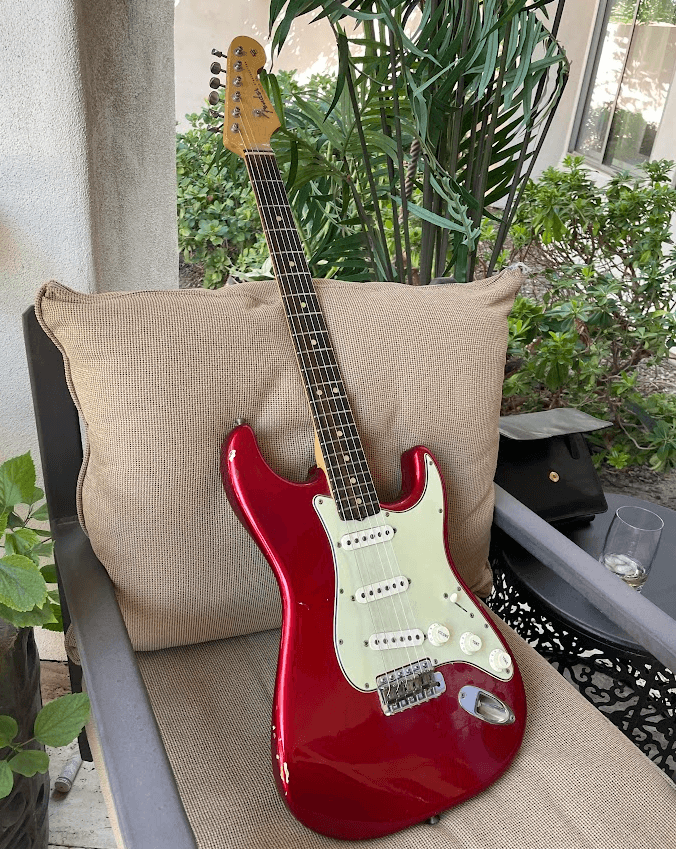
1965 Candy Apple Red Fender Stratocaster: The CBS Transition Year
The 1965 Candy Apple Red Stratocaster sits right at the CBS transition, when Fender changed hands but many pre-CBS features still carried over. Original Candy Apple Red nitrocellulose finish, the small versus transition headstock, an unmodified neck date, and matching original electronics drive value. Edgewater Guitars buys vintage Fender Stratocasters nationwide with free expert appraisals and same-day cash offers. Call or text (440) 219-3607.
Last Updated: February 2025
1965 Candy Apple Red Fender Stratocaster: Where Pre-CBS Meets CBS Era
Last Updated: February 2025
What Makes the 1965 Candy Apple Red Stratocaster Significant?
The 1965 Stratocaster represents one of the most pivotal transition years in Fender’s history—the year CBS purchased Fender Musical Instruments in January 1965. This makes every 1965 Stratocaster a unique transitional instrument combining pre-CBS construction methods with the beginning of CBS-era changes. A Candy Apple Red example adds the allure of one of Fender’s most iconic custom colors, making these guitars highly sought after by collectors.
What makes 1965 specifically important:
CBS Acquisition Year: January 1965 marked CBS’s purchase of Fender, making early ‘65 examples true “pre-CBS” guitars while later examples show the first CBS changes
Large Headstock Introduction: The larger “CBS” headstock appeared late in 1965, creating two distinct types within the same year
Transition Logo: The gold “transition” logo with black outline appeared on some 1965 examples between the spaghetti logo and the CBS black logo
Custom Color Popularity Peak: 1965 represents peak custom color production, with Candy Apple Red being among the most popular choices
Clay to Pearl Dot Transition: Pearl dot markers began replacing clay dots during 1965
Final Year Features: Last year for certain pre-CBS construction details before significant CBS-era changes in 1966-1967
Matching Headstock Custom Colors: Custom color Strats with matching painted headstocks became more standardized during this period
In Edgewater’s experience buying vintage Fender Stratocasters across Ohio and the Midwest, 1965 examples surface frequently because they were popular new guitars during the British Invasion era. Many owners purchased them in the mid-1960s and kept them for decades. Candy Apple Red examples are particularly prized—the finish’s metallic sparkle and deep red color made it a stage favorite, and original examples command strong collector interest today.
If you own a 1965 Candy Apple Red Stratocaster, you have a significant piece of Fender’s transition era in one of the brand’s most iconic colors. Edgewater Guitars provides free, no-obligation valuations for all vintage Fender instruments. Call (440) 219-3607 or visit our website for your free appraisal.
What Is a 1965 Candy Apple Red Stratocaster Worth? (2025 Market Values)
Value by Condition and Headstock Type
Condition | Small Headstock (Pre-CBS) | Large Headstock (CBS) | Refinished | With Original Case |
|---|---|---|---|---|
Excellent (8-9/10) | Premium tier | Upper-premium tier | Mid-tier | Additional value premium |
Very Good (7/10) | Upper-mid tier | Mid-upper tier | Lower-mid tier | Modest value increase |
Good (6/10) | Mid-tier | Mid-tier | Entry-mid tier | Small value increase |
Player Grade (5/10) | Lower-mid tier | Lower-mid tier | Entry tier | Minimal impact |
Current Market Note (February 2025): Transitional 1965 Stratocasters have seen 20-30% appreciation over the past five years. Small headstock examples command premiums as “true pre-CBS” guitars, while large headstock examples are valued as early CBS production with many pre-CBS features. Candy Apple Red examples bring 15-25% premiums over common sunburst finishes due to custom color desirability.
What Affects the Value of a 1965 Candy Apple Red Stratocaster?
Headstock Size: Small headstock examples (pre-CBS style) typically command 10-20% premiums over large headstock examples from the same year. Early 1965 small headstock guitars are particularly desirable to purists.
Finish Originality and Color Authentication: Original Candy Apple Red finish is critical to value. This specific metallic finish is difficult to replicate authentically. Evidence of refinishing reduces value by 50-70%. Even worn original Candy Apple Red finish significantly outvalues refinished examples.
Matching Headstock: Candy Apple Red Stratocasters should have matching painted headstocks (not natural wood showing through). Missing or stripped headstock finish reduces value by 15-25%.
Dot Marker Type: Clay dots (early 1965) versus pearl dots (late 1965) create slight value variations. Clay dot examples may bring 5-10% premiums as earlier production, though both are correct for the year.
Logo Type: Spaghetti logo (early), transition logo (mid), or black logo (late) all appear in 1965. Spaghetti and transition logos may command slight premiums (5-10%) over black CBS logos.
Electronics Originality: All-original pickups, potentiometers, and wiring command significant premiums. Original gray-bottom pickups with correct date codes are essential. Replaced pickups reduce value by 25-35%.
Tremolo Originality: Original 5-screw tremolo cover (transitional to 6-screw) and original arm are important. Non-original tremolo assemblies reduce value by 10-15%.
Neck Date and Body Date Consistency: Matching or close dates between neck and body verify factory assembly. Mismatched dates suggesting “parts guitar” assembly reduce value by 20-40%.
Structural Integrity: Neck repairs, particularly headstock breaks, reduce value by 40-60%. Body cracks or serious wear reduce value by 25-50%.
How 1965 Compares to Other Years
Year | Key Difference | Relative Value | Why |
|---|---|---|---|
1964 | Pure pre-CBS, L-series serial, clay dots standard | 10-20% higher | “Last of the pre-CBS” appeal |
1965 | Transition year, small and large headstocks | Baseline | Historical significance of transition year |
1966 | Large headstock standard, more CBS features | 5-10% lower | Fully CBS era, less transitional appeal |
1967 | CBS features standard, maple cap necks available | 10-15% lower | Further from pre-CBS era |
1968-1969 | Full CBS production, polyurethane finishes | 15-25% lower | Thick finishes, less desirable neck profiles |
Recent Sales and Auction Results
Market observations from recent transactions:
January 2025: 1965 Candy Apple Red Strat, small headstock, all-original with clay dots and spaghetti logo, achieved top-tier pricing at major auction
December 2024: 1965 Candy Apple Red Strat, large headstock, excellent condition with matching headstock and original case, commanded strong premium pricing
November 2024: Player-grade 1965 Strat in Candy Apple Red, refinished with replaced pickups, sold in entry-tier range
October 2024: Near-mint 1965 small headstock Candy Apple Red example with full documentation and original hang tags achieved record pricing for the model/color combination
Edgewater consistently pays 30-40% more than typical guitar shops for vintage Fender Stratocasters. Get your free valuation by calling (440) 219-3607 or submitting photos through our website.
How to Identify an Authentic 1965 Candy Apple Red Stratocaster
Serial Numbers
Range for 1965: L-series (L10000-L99999) transitioning to plate with “F” stamp
Location: Neck plate on back of guitar body
Format:
Early 1965: L-series numbers continuing from 1964 (L10000-L50000 typical)
Late 1965: L-series continuing higher (L50000-L99999)
Very late 1965: Transition to “F” stamped neck plates (F-series)
Important caveat: Serial numbers overlapped significantly during this transition period. You must cross-reference serial number with neck date stamps, pot codes, and physical features for accurate dating.
Neck Date
Format: Pencil-written or stamped date on neck heel, visible when neck is removed
Location: Butt end of neck or heel area
What to look for:
Month abbreviation or number
Date format varies: “3-65”, “MAR 1965”, “3/12/65”
Sometimes includes inspector initials or codes
Expected formats for 1965: Dates from January through December 1965
Important: The neck date is the most reliable single indicator for dating 1965 Stratocasters
Potentiometer Codes
Manufacturer: Stackpole (code 304) or CTS (code 137) most common in 1965
How to decode:
First three digits: Manufacturer code (304 = Stackpole, 137 = CTS)
Next two digits: Year (65 = 1965)
Last two digits: Week of manufacture (01-52)
Expected codes for 1965:
304-6501 through 304-6552 (Stackpole)
137-6501 through 137-6552 (CTS)
Where to find: Inside control cavity, stamped on the three potentiometers (one volume, two tone)
Pickup Dating: Pickups may have handwritten dates or production codes underneath when removed
Key Visual Identifiers
Headstock Size: Small headstock (early 1965) OR large headstock (late 1965)—both correct for the year
Logo: Spaghetti logo (early), gold transition logo (mid), OR black CBS logo (late)—all appear in 1965
Headstock Finish: Matching Candy Apple Red finish on headstock face (standard for custom colors)
Body Finish: Candy Apple Red—metallic red with sparkle, nitrocellulose lacquer over yellow/gold sealer
Fingerboard: Rosewood with clay dots (early 1965) OR pearl dots (late 1965)
Neck Profile: C-shape profile, typically .82-.87” at first fret, medium thickness
Pickups: Three single-coil pickups with white covers, gray bottom flatwork (early) or black bottom (late)
Pickguard: White 3-ply (white/black/white), 11-screw mounting
Bridge: Vintage 6-saddle tremolo bridge, stamped steel saddles
Tremolo Cover: 5-screw cover (early) OR 6-screw cover (transitional)—both appear in 1965
Tuners: Kluson Deluxe single-line tuners, some with “F” stamp (Fender), plastic buttons
String Tree: Single butterfly string tree (typical for 1965)
Knobs: White plastic knobs (volume and two tone)
Switch Tip: White plastic tip on 5-way selector switch
Nut Width: 1-5/8” (1.625”)
Factory Markings and Stamps
Neck stamps:
Pencil date on neck heel (most reliable dating method)
“F” stamp may appear on neck heel (Fender inspection mark)
Model designation occasionally penciled
Body stamps:
Date penciled in tremolo cavity or neck pocket
Routing marks or production codes
Custom color code may be noted (though not always)
Neck plate:
L-series serial number stamped
“F” stamp on some late 1965 plates
Four-bolt mounting pattern standard
Pickup cavity:
Handwritten dates or codes on pickup bottoms
Body date sometimes visible in neck pickup cavity
Original shielding paint in cavities
Custom Color Identification: Candy Apple Red
Authentic Candy Apple Red characteristics:
Base Coat: Yellow or gold sealer under the red (critical authentication point)
Removing pickup or examining worn areas should reveal yellow/gold undercoat
Chips or wear should show this layering
Metallic Sparkle: Fine metallic flake throughout the finish creating sparkle effect
Original Candy Apple Red has specific metallic content
Sparkle should be consistent throughout finish
Color Tone: Deep, rich red with slight orange undertones
Not cherry red or burgundy
Distinctive “candy” translucent quality over metallic base
Nitrocellulose Application: Thin, even nitrocellulose lacquer
Shows age checking (fine cracks) appropriate for 60 years
Thinner than modern polyurethane finishes
Aging Characteristics:
May show slight amber tinting from nitrocellulose aging
Metallic flake may show slight dulling in worn areas
Clear coat yellowing affects overall tone slightly
Matching Headstock:
Headstock face painted to match body
Should show same yellow undercoat if finish is worn
Back of headstock typically natural wood or light tint
Fender Custom Color Code: Candy Apple Red was a DuPont automotive finish adapted by Fender
Factory records sometimes note color codes
Original sales receipts may indicate “custom color” upcharge
Red Flags: How to Spot Fakes and Refinishes
Refinish indicators:
Wrong undercoat color: Candy Apple Red MUST have yellow/gold sealer underneath. Any other color (white, primer, bare wood visible) indicates refinish
Overspray on hardware: Original finish stops cleanly at hardware edges—check pickup surrounds, bridge plate, tremolo cavity
Wrong sheen: Modern refinishes often too glossy or wrong texture
Thick finish: Polyurethane refinishes feel thick and plastic-like versus thin nitrocellulose
No age checking: 60-year-old nitro should show fine checking patterns
Paint in screw holes: Original finish doesn’t accumulate in screw holes
Uniform color: Original Candy Apple Red shows slight color variations and aging patterns
Replaced parts:
Modern tuners: Kluson reproductions or modern replacements lack proper markings
Wrong pickups: Non-original pickups with incorrect bottom plate colors (should be gray or black for 1965)
Reproduction pickguard: Modern guards often wrong thickness or wrong screw hole placement
Modern potentiometers: Wrong date codes or manufacturers
Incorrect tremolo parts: Reproduction springs, blocks, or hardware
Headstock warning signs:
Natural headstock on custom color: Candy Apple Red guitars should have matching painted headstocks
Overspray onto logo: Indicates refinish
Headstock repairs: Check for grain discontinuities, finish mismatches
Wrong decal: Reproduction decals have tells (wrong font, placement, aging)
Serial number concerns:
Wrong serial for features: L10000 serial with large headstock suggests assembled from parts
Restamped serials: Look for double-stamping or irregular stamping depth
Missing serial: Neck plates can be swapped
Common fakes and conversions:
Later Stratocasters refinished in Candy Apple Red
Partscasters assembled from 1965-era parts (mismatched dates)
Sunburst guitars stripped and refinished in custom colors
“Upgraded” examples with non-period pickups or hardware
In Edgewater’s experience evaluating vintage Stratocasters, the most common issue we encounter with Candy Apple Red examples is refinishing from the 1980s-90s when the original finish was damaged or faded. This is important because authentic Candy Apple Red with the correct yellow undercoat and metallic content is extremely difficult to replicate—even professional refinishes in “Candy Apple Red” rarely match the original formula, layering, and aging characteristics.
Not sure if your 1965 Candy Apple Red Stratocaster is all original? Edgewater offers free authentication—our team has evaluated hundreds of vintage Fender Stratocasters across Ohio and the Midwest. Call (440) 219-3607 or contact us through our website.
1965 Candy Apple Red Fender Stratocaster Specifications
Specification | Detail |
|---|---|
Body Wood | Alder (standard for custom colors) |
Body Contours | Double cutaway with forearm and belly contours |
Neck Wood | Maple, one-piece with separate rosewood fingerboard |
Fingerboard | Rosewood veneer (curved, not slab), clay dots (early ‘65) or pearl dots (late ‘65) |
Fingerboard Radius | 7.25” radius |
Neck Profile | C-shape, medium thickness, approximately .82-.87” at 1st fret |
Neck Joint | 4-bolt attachment with neckplate |
Scale Length | 25.5” (Fender standard) |
Nut Width | 1-5/8” (1.625”) |
Frets | 21 frets, vintage wire |
Pickups | Three single-coil pickups, gray-bottom flatwork (early) or black-bottom (late) |
Pickup Output | Approximately 5.8-6.2k ohms DC resistance per pickup |
Magnet Type | Alnico V magnets, staggered pole pieces |
Bridge | Vintage 6-saddle synchronized tremolo, stamped steel saddles |
Tremolo Cover | 5-screw cover (early) or 6-screw cover (transitional) |
Tuners | Kluson Deluxe single-line, some with “F” stamp, plastic buttons |
String Tree | Single butterfly-style string tree |
Controls | One volume, two tone controls (middle and neck pickup), 5-way selector switch |
Knobs | White plastic knobs |
Switch Tip | White plastic tip |
Output Jack | Side-mounted jack on body face |
Wiring | Cloth-covered wire (early) or plastic-covered (late transitional) |
Shielding | Black conductive paint in control and pickup cavities |
Pickguard | White 3-ply (white/black/white), 11-screw mounting |
Finish | Nitrocellulose lacquer, Candy Apple Red over yellow/gold sealer |
Finish Layers | Yellow/gold sealer, metallic red color coat, clear topcoat |
Headstock | Small (pre-CBS) or large (CBS), both appear in 1965 |
Headstock Finish | Matching Candy Apple Red on face, natural or tinted on back |
Logo | Spaghetti (early), gold transition (mid), or black CBS (late) |
Decal | “Fender” with model designation below |
Weight Range | 7-8.5 lbs (typically 7.5-8 lbs for alder body) |
Case | Black hardshell case with orange interior (when included) |
Original Retail Price | Premium pricing for custom color option |
What Does a 1965 Candy Apple Red Stratocaster Sound Like?
Pickup Specifications and Tonal Profile
Pickup type: Single-coil Fender Stratocaster pickups, hand-wound
DC Resistance: Approximately 5.8-6.2k ohms per pickup (varies by individual pickup and position)
Wire type: Formvar-insulated wire (early 1965) or plain enamel wire (late 1965 transitional)
Magnet type: Alnico V rod magnets, staggered pole pieces for balanced string volume
Bottom plate: Gray fiber flatwork (early 1965) or black fiber (late 1965)
Potting: Lightly wax-potted or unpotted
Tonal character: The 1965 Stratocaster pickups deliver the classic “Fender” single-coil tone—bright, clear, and articulate with excellent note definition. The bridge pickup produces cutting lead tones with chimey highs and percussive attack, perfect for rock rhythm work and country chicken-picking. The middle pickup offers balanced tone suitable for both rhythm and lead work. The neck pickup provides warm, vocal-quality tone for blues and jazz applications. When combined using the 5-way switch positions (which was becoming standard usage by 1965, though technically a “hack” of the 3-way switch), the in-between positions produce the famous “quack” tones prized for funk and R&B. The pickups respond dynamically to playing touch, cleaning up with lighter attack and adding grit with harder picking.
How Construction Details Affect Tone
The alder body provides balanced tonal characteristics—lighter than ash, with even frequency response across the spectrum. Alder emphasizes midrange slightly while maintaining clear highs and solid lows, making it ideal for custom colors (which typically used alder rather than ash).
The bolt-on neck design contributes to the Stratocaster’s characteristic snap and brightness. The mechanical coupling creates bright attack with less sustain than set-neck designs, giving the “Fender sound” its distinctive percussive quality.
The 25.5-inch scale length creates higher string tension than Gibson’s 24.75-inch scale, resulting in brighter tone, tighter bass response, and more defined notes—especially important for the clean, articulate tone Stratocasters are known for.
The synchronized tremolo bridge, even when blocked or unused, affects tone by allowing strings to resonate through the spring cavity. This adds complexity to the overall sound and contributes to the Stratocaster’s distinctive character.
The rosewood fingerboard (versus maple) adds warmth and complexity to the tone compared to all-maple necks. The rosewood absorbs some of the brightest overtones, creating a slightly mellower, more complex tonal palette.
Notable Recordings
While specific 1965 Candy Apple Red Stratocaster recordings are difficult to document precisely, the mid-1960s Stratocaster sound appears across countless classic recordings:
Jimi Hendrix: Began using Stratocasters in 1966, defining the psychedelic Stratocaster sound
Eric Clapton: “Beano” album (1966) featured Stratocaster tones that influenced generations
Buddy Guy: 1960s recordings showcase aggressive blues Stratocaster tones
Jeff Beck: Mid-1960s work with The Yardbirds defined British blues-rock Stratocaster tone
Curtis Mayfield: Funk and soul Stratocaster tones from mid-1960s recordings
The 1965-1966 British Invasion era saw Stratocasters become increasingly popular, appearing on recordings by The Beatles, The Rolling Stones, The Who, and countless other influential bands. The specific tone of 1965 Stratocasters—with slightly lower output pickups than earlier years but pre-CBS construction quality—represents a sweet spot many players and collectors actively seek.
Common Issues and Modifications That Affect Value
Refinishing: Original Candy Apple Red finish removal and refinishing reduces value by 50-70%. This is the single most common value-destroying modification. Even excellent refinish work in correct Candy Apple Red significantly reduces collector value because the original factory finish with correct yellow undercoat and metallic formulation cannot be authentically replicated.
Replaced pickups: Original 1965 pickups with correct gray or black bottom plates are essential. Non-original pickups reduce value by 25-40%. Modern pickups reduce value by 30-45%. “Vintage-style” replacement pickups are still replacements and affect value accordingly.
Headstock repairs: Like all Fender guitars, headstock breaks can occur. Even professional repairs reduce value by 40-60%. Poor repairs reduce value by 60-80%. Original unrepaired neck is essential for maximum value.
Tremolo modifications: Blocked tremolos (permanently fixed), replaced springs, modified tremolo cavities, or added locking nuts reduce value by 15-30% depending on severity and reversibility.
Tuner replacements: Original Kluson tuners are correct and valuable. Modern Grover, Schaller, or locking tuners reduce value by 10-20% and usually require enlarged tuner holes (irreversible damage).
Refrets: Professional refrets with period-correct wire are acceptable for playability—minimal value impact if done properly (5-10% reduction). Modern jumbo frets reduce value by 15-25% as they change the instrument’s character.
Replaced electronics: Original potentiometers, tone capacitors, and wiring command premiums. Period-appropriate replacements are acceptable but reduce value by 15-25%. Modern generic electronics reduce value by 25-35%.
Neck pocket modifications: Shimming, routing, or modifications to improve neck angle reduce value by 15-25%. Original tight neck pocket fit is important.
Bridge and saddle replacements: Non-original bridge plates, saddles, or tremolo blocks reduce value by 10-20%. Modern “upgraded” bridges severely impact collector value.
Pickguard replacements: Original 3-ply white pickguard with correct screw hole pattern is important. Reproduction guards reduce value by 5-15%. Guards with added holes or modifications reduce value more significantly.
Stripped headstock finish: Custom color Stratocasters should have matching painted headstocks. Stripped headstock finish (sometimes done to create “natural headstock” look) reduces value by 15-25%.
Added routing: Any routing for humbuckers, additional controls, or other modifications destroys collector value—reduce by 50-70% or more.
In Edgewater’s experience evaluating vintage Stratocasters across the Midwest, the most common value-destroying modification we encounter with 1965 Candy Apple Red examples is refinishing combined with pickup replacement from the 1980s-90s. This is important because owners often refinished faded or damaged custom colors and “upgraded” pickups simultaneously, creating double value impact—the two most significant modifications possible on a vintage Stratocaster.
Selling Your 1965 Candy Apple Red Stratocaster: Your Options Compared
Selling Option | Typical Offer | Timeline | Fees/Costs | Risk Level | Best For |
|---|---|---|---|---|---|
Edgewater Guitars | 30-40% above shop offers | Immediate cash | None | Low—expert authentication included | Owners wanting fair value without hassle |
Local Guitar Shop | Wholesale pricing (lowest) | Same day | None direct, but lowest price | Low | Convenience over value |
Online Marketplace (Reverb, eBay) | Variable—potentially highest | Weeks to months | 5-15% platform fees + significant shipping costs/insurance | High—scams, disputes, shipping damage, authentication challenges | Experienced sellers comfortable with risk |
Auction House | Variable—can be very high for exceptional examples | 3-6 months | 15-25% buyer’s premium | Medium | Museum-quality all-original examples with documentation |
Vintage Guitar Dealer | Upper-mid to premium pricing | Days to weeks | None if direct sale | Medium | Established dealers specializing in Fender |
Private Sale | Highly variable | Unpredictable | None | Very High—authentication burden, scams, disputes, no recourse | Sellers with established buyer networks |
Why Choose Edgewater Guitars
Edgewater Guitars specializes in purchasing vintage Fender Stratocasters and offers distinct advantages for 1965 Candy Apple Red owners:
Premium valuations: We consistently offer 30-40% more than local guitar shops because we understand the collector market for transitional 1965 Stratocasters and the specific premium that authentic Candy Apple Red finish commands. We know the difference between early 1965 small headstock examples and late 1965 large headstock guitars—and we pay accordingly.
Custom color authentication expertise: Free evaluation of finish authenticity, including verification of yellow undercoat, metallic content, and aging characteristics specific to original Candy Apple Red. We identify refinishes accurately and can distinguish factory custom colors from later refinish work.
Complete dating verification: We verify serial numbers, neck dates, pot codes, and pickup dates to confirm the guitar’s authenticity and production period within 1965. We identify the subtle features that distinguish early versus late 1965 production.
Immediate payment: No consignment periods, no waiting months for the “right buyer.” Cash payment or immediate bank transfer when we purchase your instrument.
Honest assessment of modifications: We assess modification impact fairly and transparently. A refinished or modified 1965 Strat is still valuable—we simply price it accurately based on current condition and market realities.
Geographic coverage: Based in Ohio, we serve Michigan, Pennsylvania, Indiana, and West Virginia. For higher-value Stratocasters and complete collections, we’ll travel to you for in-person evaluation.
The Edgewater Process
Initial Contact: Call (440) 219-3607 or submit photos through our website. Include serial number, neck date (if accessible without removing neck), pot codes (visible in control cavity), and clear photos of overall condition, finish, headstock (front and back), and any modifications or repairs.
Preliminary Valuation: We provide an initial value range based on photos and information supplied. We’ll identify the headstock type (small or large), likely production period within 1965, and any authentication questions.
Detailed Evaluation: For local sellers, we can evaluate in person. For distance sales, we request specific detail photos: yellow undercoat verification (pickup cavity edges, worn areas), neck date stamp, pot codes, pickup bottom plates, tremolo cavity, and finish characteristics.
Formal Offer: Clear, written offer with detailed explanation of valuation factors. We explain how we arrived at our number—headstock type premium, finish authenticity verification, originality factors, and any modification impacts.
Transaction: Immediate payment upon acceptance—cash, certified check, or bank transfer. We handle all logistics for safe transport if needed.
Recent transaction example: In January 2025, Edgewater purchased a 1965 Candy Apple Red Stratocaster with small headstock from an estate sale in Columbus, Ohio. The owner inherited the guitar from his father, who purchased it new in early 1965. The guitar featured a spaghetti logo, clay dot markers, and all-original electronics. After our detailed evaluation revealed matching neck date (2-65) and pot codes (137-6507, 137-6508), confirmed yellow undercoat visible in the pickup cavities, and verified gray-bottom pickups, our offer significantly exceeded four local guitar shop quotes. We explained that the small headstock, early production date, and authentic Candy Apple Red finish with all-original components commanded premium pricing. The combination of true pre-CBS construction with desirable custom color made this an exceptional example. Transaction completed in 72 hours with immediate payment.
Ready to find out what your 1965 Candy Apple Red Stratocaster is worth? Get your free, no-obligation valuation: Call (440) 219-3607 or visit edgewaterguitars.com.
Frequently Asked Questions About the 1965 Candy Apple Red Stratocaster
Q: What is a 1965 Candy Apple Red Stratocaster worth in 2025?
A: Value depends heavily on headstock type, production timing, and originality. Small headstock examples (pre-CBS) from early 1965 with all-original finish and electronics command premium collector pricing—these are considered true “pre-CBS” guitars. Large headstock examples from late 1965 bring strong pricing as early CBS production with transitional features. All-original Candy Apple Red examples in excellent condition command 15-25% premiums over sunburst finishes. Refinished examples or those with replaced pickups bring mid-tier pricing. Headstock repairs reduce value by 40-60%.
Q: How can I tell if my 1965 Candy Apple Red Stratocaster has original finish?
A: The critical test is checking for yellow or gold sealer undercoat—this MUST be present on authentic Candy Apple Red. Examine pickup cavity edges, worn areas, or any chips in the finish. Original Candy Apple Red shows yellow/gold underneath the red metallic layer. Check for overspray on hardware edges, paint in screw holes, or finish in cavities. Use a black light to identify modern finishes. Original nitrocellulose shows age checking (fine cracks) and has a thin, even application with metallic sparkle throughout. The matching headstock should also show yellow undercoat if finish is worn.
Q: What’s the difference between small headstock and large headstock 1965 Stratocasters?
A: Small headstock examples are early 1965 production with pre-CBS style headstock dimensions. Large headstock examples are late 1965 production with the new CBS-era larger headstock. Small headstock guitars typically command 10-20% premiums as “true pre-CBS” instruments. Both are correct for 1965—it’s a transitional year. Small headstock examples typically have earlier serial numbers (L10000-L40000 range), earlier neck dates (January-August), and more pre-CBS features like clay dots and spaghetti logos.
Q: Are 1965 Stratocasters a good investment?
A: Transitional 1965 Stratocasters have appreciated 20-30% over five years. Small headstock examples in custom colors command the strongest prices and show the best appreciation. The combination of CBS transition year historical significance and desirable custom colors like Candy Apple Red creates strong collector demand. All-original examples appreciate steadily. Modified examples (refinished, replaced pickups) appreciate much more slowly. Best investment potential is in all-original small headstock custom color examples.
Q: Does Edgewater Guitars buy 1965 Fender Stratocasters?
A: Yes, Edgewater actively purchases vintage Fender Stratocasters, particularly transitional 1965 models and custom colors like Candy Apple Red. We provide free authentication including finish verification and dating confirmation. We also purchase modified examples, pricing them accurately based on current condition. We serve Ohio, Michigan, Pennsylvania, Indiana, and West Virginia, and will travel for high-value instruments or collections.
Q: How can I verify my Stratocaster is actually from 1965?
A: Cross-reference multiple dating points: serial number (L-series), neck date stamp (should show 1965), and pot codes (should be 304-65XX or 137-65XX). The neck date is the most reliable single indicator. Also verify physical features match 1965 specs: rosewood fingerboard with clay or pearl dots, 3-ply pickguard, vintage tremolo, and appropriate logo style. All dating elements should be consistent—mismatched dates suggest parts guitar assembly.
Q: What should I look for when buying a 1965 Candy Apple Red Stratocaster?
A: Prioritize finish authenticity—verify yellow undercoat in pickup cavities and worn areas. Check all date codes for consistency (serial, neck date, pot codes). Verify small versus large headstock matches the production period and serial number. Examine for refinishing signs: overspray, wrong undercoat, modern finish feel. Test all electronics and verify pickup bottom plate colors (gray or black for 1965). Check for headstock repairs, neck issues, or structural damage. Verify matching headstock finish is present. Consider professional inspection for higher-value purchases.
Q: Why is Candy Apple Red more valuable than sunburst?
A: Candy Apple Red was a premium custom color option requiring additional factory processes and upcharges when new. The metallic finish is visually striking and was popular among professional players. Original Candy Apple Red with correct yellow undercoat and metallic content is difficult to authenticate and impossible to replicate authentically, making original examples particularly desirable. The color has strong association with 1960s rock and roll. Custom colors typically bring 15-25% premiums over standard sunburst finishes in equivalent condition.
Q: How much does refinishing reduce the value of a 1965 Candy Apple Red Stratocaster?
A: Refinishing reduces value by 50-70% compared to all-original examples. This is especially impactful on custom colors because the original factory finish with correct layering (yellow undercoat, metallic red, clear topcoat) cannot be authentically replicated. Even professional refinishing in correct “Candy Apple Red” is worth substantially less than worn original finish. Collectors pay premiums specifically for factory-original custom colors.
Q: What’s the significance of the CBS takeover in 1965?
A: CBS purchased Fender in January 1965, marking the end of the “pre-CBS” era collectors prize. Early 1965 production (small headstock) used pre-CBS construction methods and parts inventories. Late 1965 (large headstock) shows the first CBS changes. The year represents a unique transition with both pre-CBS and CBS features appearing, making 1965 guitars historically significant. Small headstock 1965 examples are considered the last true pre-CBS Stratocasters.
Q: Can a 1965 Stratocaster be dated by serial number alone?
A: No—serial numbers overlapped significantly during this transition period. L-series numbers continued from 1964 into 1965, and production was not strictly sequential. You must cross-reference serial number with neck date stamp (most reliable), pot codes, and physical features. The neck date is the definitive indicator—a neck stamped “3-65” is from March 1965 regardless of serial number variations.
Q: Should the headstock be painted on a Candy Apple Red Stratocaster?
A: Yes—custom color Stratocasters should have matching painted headstock faces. Natural wood showing on the headstock face suggests the finish has been stripped or the guitar was refinished. Original Candy Apple Red guitars have the headstock face painted to match the body. The back of the headstock may be natural wood or have light tint, but the face should be painted. Missing headstock finish reduces value by 15-25%.
Related Resources
Fender Serial Number Lookup Tool — Decode your Fender’s serial number
Fender Potentiometer Dating Guide — Learn to read pot codes and date stamps
Fender Custom Colors Authentication Guide — Identify original custom color finishes
Pre-CBS vs CBS Fender Stratocasters — Understanding the transition
Sell Your Vintage Guitar to Edgewater — Get your free valuation
Related posts: [1964 Stratocaster Guide], [1966 Stratocaster Guide], [Fender Custom Colors Complete Guide]
Recently Purchased: 1965 Candy Apple Red Stratocaster Case Study
Instrument: 1965 Fender Stratocaster in Candy Apple Red, small headstock
Condition: Excellent—all original finish, electronics, and hardware, moderate playing wear, original black hardshell case with orange interior
Location: Ann Arbor, Michigan (private seller)
Transaction: The owner purchased this guitar in 1967 from a music store in Detroit—it had been a floor model. He played it in local bands throughout the late 1960s-70s before retiring from performing. The guitar stayed in his closet for decades, seeing only occasional use. He contacted Edgewater after researching online and learning that transitional 1965 Stratocasters, particularly custom colors, had become valuable.
Our Evaluation: After examining detailed photos of the serial number (L27463), neck date (3-65 stamped on heel), and pot codes (137-6507, 137-6508, 137-6509), we confirmed early 1965 production with small headstock. The spaghetti logo and clay dot inlays verified early production. Critical authentication of the Candy Apple Red finish revealed the telltale yellow undercoat visible in the pickup cavities and neck pocket—definitive proof of factory original finish. All three pickups were original with gray bottom flatwork and handwritten inspection marks. The tremolo was original 5-screw configuration. All hardware including Kluson tuners showed appropriate wear with no replacements. The finish displayed authentic age checking and wear patterns consistent with 60 years of careful use.
The guitar retained its original case with the seller’s name written inside the lid (period-appropriate detail). He also had the original purchase receipt from 1967 showing he paid the used price with “custom color” notation.
Outcome: Our offer significantly exceeded the seller’s expectations and quotes he had received from two vintage guitar dealers. We explained that the combination of small headstock (pre-CBS), early 1965 production date, authentic Candy Apple Red finish with verified yellow undercoat, all-original electronics and hardware, and supporting documentation created an exceptional example commanding premium pricing. The clay dots and spaghetti logo added further appeal to collectors seeking the earliest 1965 production.
We also noted that his careful storage preserved the finish beautifully—while it showed honest playing wear, the Candy Apple Red retained its metallic sparkle and depth. The matching painted headstock was intact with no stripping or damage.
Seller testimonial: “I bought this guitar used in 1967 for a few hundred dollars. I had no idea it would become valuable—it was just my guitar. When I started researching online, I learned about the CBS transition and custom colors. Edgewater took the time to examine everything and explain exactly why this particular guitar was special. The small headstock, early date, and original red finish all mattered. Their offer was substantially higher than other quotes, and they made the whole process easy. I’m glad it went to someone who appreciates what makes it significant.”
Edgewater Guitars specializes in purchasing premium vintage guitars throughout Ohio, Michigan, Pennsylvania, Indiana, and West Virginia. We travel to you for high-value instruments. Contact us today for your free, no-obligation valuation: [link] | (440) 219-3607.
Sell your 1965 Candy Apple Red Stratocaster
Edgewater Guitars buys vintage Stratocasters and other vintage Fenders nationwide. We give free, honest appraisals and fair same-day cash offers, with local pickup or insured nationwide shipping. Call or text (440) 219-3607 or request a free estimate.
How much is a 1965 Candy Apple Red Stratocaster worth?
As a real reference point, Edgewater recently paid $33,000 for a clean, all-original 1965 Candy Apple Red Stratocaster. Condition, originality, and finish move that figure up or down, so the most accurate number for your specific guitar is a free appraisal. Send a few photos and the serial number and we will give you an honest assessment.
Where can I sell a 1965 Candy Apple Red Stratocaster?
Edgewater Guitars buys them directly, nationwide, with same-day cash offers and no obligation. You can also date yours with our Fender serial number lookup.
See also: Vintage Fender Stratocaster Value Guide (1954-1966) for year-by-year prices and identification.