DATE :
1965 Fender Jaguar in Sonic Blue: The Peak Pre-CBS Custom Color Collectible
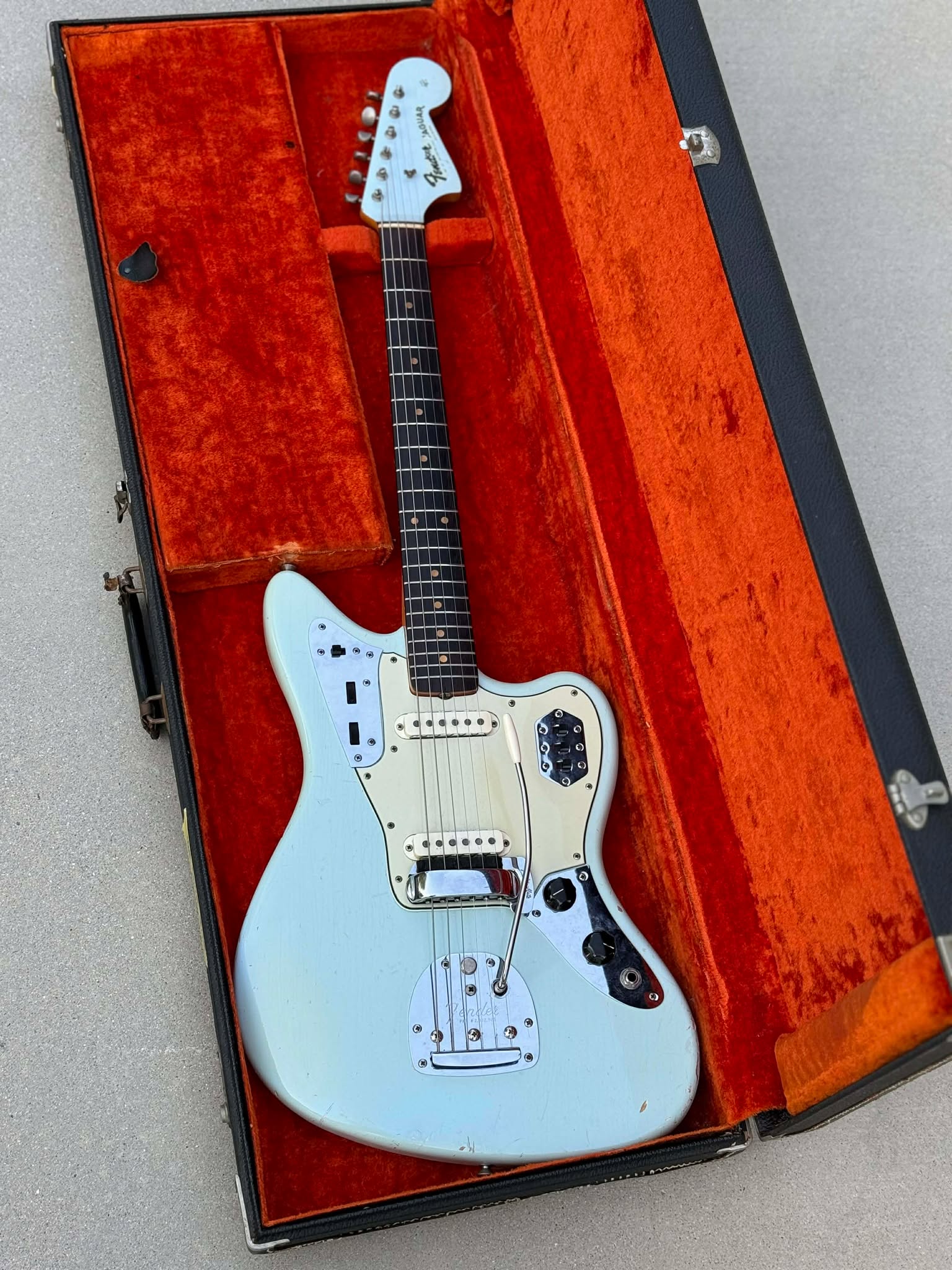
1965 Fender Jaguar in Sonic Blue: The Peak Pre-CBS Custom Color Collectible
The 1965 Fender Jaguar in Sonic Blue is a peak pre-CBS custom color offset, pairing the Jaguar’s short-scale sophistication with one of the most desirable factory finishes of the era. Edgewater Guitars buys vintage Fender Jaguars nationwide with free expert appraisals and same-day cash offers. Call or text (440) 219-3607.
Last Updated: February 2026
What Makes the 1965 Fender Jaguar in Sonic Blue Significant?
The 1965 Fender Jaguar represents the final year of pure pre-CBS production before corporate changes began affecting Fender’s manufacturing process. This particular combination—a 1965 Jaguar in Sonic Blue—sits at a unique intersection of desirability factors that make it one of the most collectible offset Fender instruments.
1965 was a transitional year at Fender. CBS acquired the company in January 1965, but Leo Fender’s original team remained in place through most of the year, maintaining pre-CBS construction standards. The Jaguar, introduced in 1962 as Fender’s top-of-the-line offset model, was still being built with the features that define the most collectible examples: clay dot markers, slab rosewood fingerboards (early ‘65), and hand-wound pickups.
Why 1965 Jaguars Stand Apart:
Final year of guaranteed pre-CBS construction standards before large headstock transition
Clay composition position markers (pearl dots began appearing late in the year)
Original-style “spaghetti” or transitional gold Fender logo (large “F” logo came later)
Hand-shaped neck profiles with individual character
Nitrocellulose lacquer finish that ages and develops patina
Original-style tremolo system and complex switching before simplifications
The Sonic Blue Factor: Sonic Blue was one of Fender’s premium custom colors, ordered at additional cost. In Edgewater’s experience purchasing vintage Fenders across Ohio and the Midwest, we’ve found that authentic Sonic Blue examples from 1965 are significantly rarer than sunburst finishes. The color was particularly prone to UV fading, creating unique variations from pale sky blue to deeper aqua tones depending on light exposure history.
Sonic Blue guitars resonate strongly with collectors for several reasons: the color was featured prominently in Fender catalogs of the era, it photographs exceptionally well, and it represents the California surf culture aesthetic that defined 1960s guitar design. Among custom colors on Jaguars, Sonic Blue occupies a sweet spot—desirable and recognizable without reaching the stratospheric values of ultra-rare colors like Shell Pink or Burgundy Mist.
If you own a 1965 Fender Jaguar in Sonic Blue, you’re holding an instrument that represents Fender offset design at its peak, before corporate changes altered the formula. Edgewater Guitars provides free, no-obligation valuations for vintage Fender instruments. Call (440) 219-3607 or visit our valuation page.
What Is a 1965 Fender Jaguar in Sonic Blue Worth? (2026 Market Values)
Value by Condition and Finish
1965 Fender Jaguars in Sonic Blue command premium pricing in the vintage market, with values varying significantly based on originality and condition.
All-Original, Excellent Condition:
All original parts including pickups, pots, switches, bridge, tremolo
Original Sonic Blue finish with natural aging (checking, light yellowing acceptable)
Minimal player wear, no significant structural issues
Original case
Value Position: Commands highest market prices for 1965 Jaguars
All-Original, Very Good Condition:
Original parts and finish
Moderate play wear, finish checking, possible light belt buckle wear
May have professional refret or minor repair
Functional electronics
Value Position: Approximately 15-25% below excellent examples
Original Finish, Some Replaced Parts:
Original Sonic Blue finish intact
Replaced pickguard, knobs, switch tip, or similar cosmetic parts
Original electronics and neck
Value Impact: Reduces value by approximately 10-20% depending on which parts
Refinished Examples:
Professional refinish in Sonic Blue or other color
Original parts otherwise
Value Impact: Reduces value by 40-60% compared to original finish examples
Market treats refinished vintage Fenders significantly different than original finish
What Affects the Value of a 1965 Jaguar?
Originality: All-original examples command premium pricing. The Jaguar’s complex electronics make originality verification critical—replaced pickups, switches, or pots significantly impact value.
Color Rarity: Sonic Blue was a premium custom color in 1965. Custom color Jaguars of any type bring substantially higher prices than sunburst finishes. Within custom colors, Sonic Blue occupies mid-to-upper tier—more valuable than common custom colors (Olympic White, Lake Placid Blue) but below ultra-rare colors (Shell Pink, Foam Green).
Neck Date: Early 1965 examples (January-April neck dates) with clay dots and slab rosewood boards bring premium pricing. Late 1965 examples with pearl dots and transitional features are valued slightly lower.
Condition of Sonic Blue Finish: The color’s tendency to fade creates wide variation. Examples with rich, unfaded color command highest prices. Severely faded examples (pale, washed out) see value reduction of 20-30%. Original yellowed clear coat over Sonic Blue is acceptable and expected—stripping this to “restore” brightness destroys originality and value.
Tremolo Condition: The Jaguar’s complex tremolo system is fragile. Examples with all original tremolo parts in working condition are increasingly rare and valued accordingly. Missing or replaced tremolo components impact value by 15-25%.
Documentation: Original case, hang tags, catalog sheets, or purchase receipts add approximately 10-15% to value. Original “Blackface” era case with pink interior is correct for 1965.
Famous Ownership: Verified provenance from notable musicians can multiply value substantially, though documentation requirements are stringent.
How 1965 Compares to Other Years
Year | Key Difference | Relative Value | Why |
|---|---|---|---|
1962-1963 | Earlier features: bound neck option on some, different pickguard contours | Similar to slightly higher | First production years have collector cachet |
1964 | Pre-CBS features, clay dots, L-series serials | Similar | Essentially identical construction to early 1965 |
1965 (this post) | Transitional year, mix of pre-CBS and CBS features depending on production date | Baseline | Final guaranteed pre-CBS year, most sought-after by collectors |
1966-1967 | Larger headstock begins appearing, pearl dots standard, bound fingerboard becomes common | 15-25% lower | CBS-era features reduce collectibility despite similar quality |
1968-1970 | Full CBS-era features, polyurethane finish replacing nitro, binding standard | 30-40% lower | Definite quality and feature changes from pre-CBS standard |
Recent Sales and Auction Results
The market for 1965 Fender Jaguars in custom colors has strengthened considerably over the past five years. Auction houses including Heritage, Christie’s, and specialized guitar auctions have seen consistent results for pre-CBS Jaguars in Sonic Blue.
Market Trends in 2025-2026:
All-original examples in excellent condition consistently achieve premium pricing
Sonic Blue commands approximately 40-50% premium over sunburst finishes
Market shows strong preference for early 1965 (pre-July) examples with clay dots
Refinished examples have softened—original finish premium has increased
Market shows renewed interest in player-grade examples with honest wear versus over-restored instruments
Comparison to Other 1965 Fender Offsets:
Jazzmaster values: Typically 10-20% lower than comparable Jaguar (shorter scale, simpler electronics)
Mustang values: Substantially lower—student model status affects collectibility
Jaguar remains most premium-priced offset model from this era
Edgewater Guitars consistently offers premiums 30-40% above typical guitar shop buyback prices for authentic vintage Fender instruments. Our expertise in authentication and direct-to-collector model allows us to pay more for quality pre-CBS Fenders. Get your free valuation: (440) 219-3607.
How to Identify an Authentic 1965 Fender Jaguar in Sonic Blue
Serial Numbers
1965 Serial Number Range: L10000 through L99999 (L-series)
Location: Four-bolt neck plate on back of body
Critical Details:
Serial numbers alone cannot definitively date a 1965 Fender—neck dates are essential
“L” prefix denotes 1963-1965 era
Specific number within L-series does not guarantee month of production
Late 1964 and early 1966 overlap with L-series range
Always cross-reference serial number with neck date and pot codes
Red Flag: F-series numbers did not appear until 1965-1966 transition. Pure F-series without L-prefix indicates late 1965 or 1966 production.
Neck Date
Format: Pencil-written date on heel of neck (visible when neck removed from body)
1965 Dating Formats:
Early 1965: “1 65” or “JAN 65” style
Mid-year: “5 65” or “MAY 65”
Late 1965: “12 65” or “DEC 65”
How to Check:
Loosen all strings
Remove four neck screws
Gently separate neck from body
Inspect heel end of neck for pencil marking
Also check neck pocket for body date stamp
Important Caveat: Neck dates indicate when neck was completed, not when guitar was assembled. A December 1965 neck might be installed on a guitar that shipped in January 1966. Cross-reference with pot codes for complete picture.
Potentiometer Codes
Expected Manufacturers for 1965:
Stackpole: Code 304
CTS: Code 137
Centralab: Code 134
How to Decode Pot Codes:
First three digits: Manufacturer code
Fourth and fifth digits: Year (65 = 1965)
Last two digits: Week of manufacture (01-52)
Example: 304 6512 = Stackpole, 1965, 12th week (March 1965)
Expected Codes for 1965 Jaguars:
304 65XX (Stackpole)
137 65XX (CTS)
Pots dated within 6 months of neck date (earlier) are normal
Where to Find Pot Codes:
Remove pickguard (11 screws on Jaguar)
Codes stamped on back of potentiometer bodies
Read with flashlight, may require magnification
Red Flags:
Pot codes from 1966 or later in guitar with 1965 neck = replaced electronics
Mix of manufacturers is normal; all same manufacture date is suspicious
Codes more than 12 months before or after neck date indicate parts replacement
Key Visual Identifiers
Fingerboard: Early 1965 examples feature thick slab rosewood fingerboard (approximately 4.8-5.0mm thick) with flat bottom. Mid to late 1965 shows thinner veneer rosewood (2.5-3.0mm) with curved bottom. Slab examples command premium.
Position Markers: Early 1965 has clay composition dots (slightly yellowish, porous texture under magnification). Late 1965 transitioned to pearloid dots (brighter white, plastic composition). Clay dots indicate earlier production and bring premium pricing.
Fret Binding: 1965 Jaguars should show fret nibs (small binding extensions where frets meet binding). This was Fender’s pre-CBS standard. Frets filed flush with binding indicate refingerboarding or later CBS-era work.
Logo: Early 1965 features “spaghetti” logo (thin script) or gold transition logo. Large “F” logo indicates post-1965 decal replacement or late 1965/1966 production.
Pickguard: Correct 1965 pickguard is tortoiseshell celluloid with 11 mounting screws. Pattern should match body contours precisely. Aftermarket guards show fit issues. Original guards may show green tint from nitrocellulose reaction.
Tremolo System: Original lock button on tremolo should be chrome with knurled grip. Spring tension adjustment screw accessible from back plate. Tremolo cover plate should have smooth edges and precise fit.
Bridge/Saddles: Original Jaguar bridge features individual threaded saddles with hex adjustment screws. Buzzing problems led many owners to replace bridges—original bridge is critical for value.
Knobs: Original knobs are chrome-topped with knurled edges. Plastic top insert may show aging yellowing. Smooth-top or all-metal knobs indicate replacement.
Factory Markings and Stamps
Control Cavity:
Body date stamp in neck pocket (month and year)
May show routing marks or pencil numbers
Should show yellow sealer under custom color (primer coat visible in routed areas)
Neck Pocket:
Should show body date stamp
Original finish edges visible
Yellow sealer/primer visible if finish worn
Pencil marks, routing numbers normal
Body Stamps:
No serial number on body (neck plate only)
Factory inspector marks possible in cavities
Model codes not typical on Fender bodies
Custom Color Identification
Sonic Blue Authentication:
Factory Sonic Blue Indicators:
Yellow sealer visible in cavities: Fender applied yellow sealer coat under all custom colors. Check control cavity edges, pickup routes, tremolo cavity for yellow undercoat.
Color consistency: Factory Sonic Blue shows even application with professional spray quality. No brush marks, drips, or thin spots.
Aging patterns: Authentic Sonic Blue ages to warmer tone (slight green or aqua cast) depending on UV exposure. Pure blue with no tonal shift may indicate refinish.
Overspray locations: Original custom colors show controlled overspray in cavities—color should not extend deep into tremolo spring cavity or pickup routes beyond necessary spray reach.
Finish checking: Nitrocellulose lacquer develops spider-web checking patterns (fine cracks in clear coat). This is expected and correct on 1965 examples. Absence of any checking on 58-year-old guitar is suspicious.
Sonic Blue Variations Due to Aging:
Unfaded: Rich, saturated light blue (rare, indicates limited play/display)
Normal aged: Slight aqua or teal cast (most common)
UV faded: Pale, washed-out blue (reduces value but still original)
Yellow-tinted clear: Clear coat yellowing over blue creates greenish cast (acceptable, original)
Factory Custom Color Documentation:
Sales receipts noting custom color charge
Period photos of guitar in original condition
Matching headstock face (standard on Sonic Blue customs)
Red Flags: How to Spot Fakes and Refinishes
Refinish Indicators:
Overspray on hardware: Remove pickguard and check for paint under mounting screws, on pickup mounting tabs, or around control cavity edges. Original factory finish shows clean edges.
Wrong primer/sealer: Sonic Blue should have yellow sealer underneath. White primer, no sealer, or other colors indicate refinish.
Filled screw holes: Additional pickguard screw holes, filled holes near bridge, or modifications indicate parts changes and possible refinish to hide evidence.
Binding discrepancies: Paint buildup on neck binding, color on binding edges, or binding removed and replaced all indicate refinish.
Neck pocket gaps: Refinished bodies often show paint buildup in neck pocket, creating fit issues. Original finish has tight neck pocket fit.
Unnatural aging: No checking on 58-year-old nitro finish is impossible. Perfect, glass-like polyurethane finish indicates modern refinish.
Sanding evidence: Scratches visible under finish, body contour alterations, or neck shaping changes indicate work beyond original factory standards.
Replaced Parts:
Pickups: Original Jaguar pickups have gray or black bottom covers stamped with model-specific codes. Stratocaster pickups (wrong type), P-Bass pickups (wrong configuration), or unmarked pickups indicate replacement.
Electronics: 1965 pots dated 1966+ prove replacement. Modern CTS pots, generic no-name pots, or wrong manufacturer codes all indicate modification.
Pickguard: Reproduction guards show fit issues, wrong screw hole positions, incorrect tortoiseshell pattern, or wrong material (some repros are vinyl, not celluloid).
Tremolo: Aftermarket Jaguar tremolos exist but rarely match original specs. Look for casting differences, spring tension mechanisms that don’t match original, or obviously newer plating.
Tuners: Original Kluson Deluxe tuners have “Kluson Deluxe” and “Pat. No.” stamps. Generic tuners, Grover replacements, or modern Schaller tuners indicate replacement.
Neck Repairs:
Headstock breaks: Extremely common on Jaguars due to headstock angle and neck wood grain. Professional repairs with proper grain alignment and finish matching minimize value loss (approximately 30-40% reduction). Poor repairs, visible glue lines, or structural weakness reduce value by 50-60%.
Refingerboarded necks: Remove neck and check for routing changes, fret slot modifications, or unnatural wear patterns. Original necks show consistent wear patterns.
Counterfeit Indicators Specific to Jaguars:
In Edgewater’s experience evaluating vintage Fenders throughout the Midwest, we’ve encountered several specific Jaguar counterfeit patterns:
“Partscasters” assembled from mixed-era parts: 1965 body with 1970s neck, for example. Always verify neck date, pot codes, and serial number consistency.
Refinished 1966-1968 guitars represented as 1965: Check for pearl dots (1966+), binding nibs (should be present on 1965), and bound neck (became common 1966+). Cross-reference all dates.
Custom color fakes: Sunburst guitars refinished in Sonic Blue represented as original. Yellow sealer test in cavities catches most of these.
Replaced Sonic Blue neck on sunburst body: Some counterfeiters install refinished Sonic Blue neck on original sunburst body. Neck pocket should show Sonic Blue overspray if original custom color.
Not sure if your Jaguar is original? Edgewater offers free authentication—our team has evaluated hundreds of vintage Fender offset instruments across Ohio, Michigan, and Pennsylvania. We’ve seen every variation, refinish technique, and counterfeit pattern. Call (440) 219-3607 or request evaluation online.
1965 Fender Jaguar Specifications
Specification | Detail |
|---|---|
Body Wood | Alder (standard on sunburst and custom colors) |
Neck Wood | Maple, one-piece construction with separate rosewood fingerboard |
Fingerboard | Rosewood, varying thickness (slab board early ‘65, veneer board mid-late ‘65), 7.25” radius |
Neck Profile | C-shape, varying from chunky to slim depending on production date and individual shaping, 1.5” nut width |
Scale Length | 24” (shorter than Stratocaster/Jazzmaster 25.5”) |
Frets | 22 frets, small vintage wire (.078” x .043” approximate) |
Pickups | Two single-coil pickups with metal “claw” pole pieces, individual shielding plates, approximately 6.2-6.8k ohms DC resistance |
Bridge | Floating bridge with individual threaded saddles, rocking motion with tremolo, mute mechanism |
Tremolo | Floating tremolo with lock button and spring tension adjustment, shorter spring cavity than Stratocaster |
Tuners | Kluson Deluxe with single-ring plastic buttons, “Kluson Deluxe” stamp, Pat. Pending or Pat. No. marking |
Controls | Two slide switches (pickup on/off), roller wheels (volume, tone per pickup), 3-way toggle (lead/rhythm circuit), strangle switch (bass cut in rhythm mode) |
Finish | Nitrocellulose lacquer, multiple thin coats, hand-rubbed production |
Available Colors | Sunburst standard, custom colors at additional cost: Sonic Blue, Lake Placid Blue, Olympic White, Candy Apple Red, Dakota Red, Fiesta Red, Foam Green, Sherwood Green, Ice Blue Metallic, Burgundy Mist, Shoreline Gold, Shell Pink (rare) |
Weight Range | 7.0-8.5 lbs (lighter than Stratocaster due to shorter body) |
Case | Black tolex hardshell case with pink plush interior (“Blackface” era), Fender logo on exterior, accessory compartment |
Original Retail Price | $379.50 for sunburst (1965), custom colors additional $25-$50 charge |
What Does a 1965 Fender Jaguar in Sonic Blue Sound Like?
Pickup Specifications and Tonal Profile
Pickup Type: Single-coil with metal “claw” pole pieces (notched metal teeth rather than rod magnets)
DC Resistance: Approximately 6.2-6.8k ohms (slightly hotter than Stratocaster pickups)
Construction Details:
Formvar wire winding
Individual metal shielding cover per pickup
Alnico V magnets underneath pole piece teeth
Gray or black fiber bottom cover
No wax potting (contributing to slightly microphonic character)
Tonal Character:
The Jaguar pickup design produces a sound distinctly different from both Stratocasters and Jazzmasters, despite all three being single-coil Fender instruments. The metal claw pole pieces create a bright, cutting tone with pronounced treble emphasis and slightly compressed midrange. The shorter 24” scale length (compared to 25.5” on Stratocaster and Jazzmaster) reduces string tension, resulting in a looser, slightly warmer fundamental and easier string bending.
The bridge pickup delivers cutting, aggressive treble with excellent definition for rhythm playing and surf music-style leads. The neck pickup offers warmer, rounder tones while maintaining Jaguar clarity—thicker than a Stratocaster neck pickup but brighter than a Jazzmaster. The combination of both pickups produces a hollow, scooped midrange tone useful for both clean and overdriven playing.
The complex switching system allows significant tonal variations: lead circuit provides full output from either or both pickups, while rhythm circuit (activated by slide switch on upper bout) routes neck pickup only through separate volume and tone controls—often used for instant dark, mellow jazz tones without adjustment of main controls.
How Construction Details Affect Tone
24” Scale Length Impact: The shorter scale compared to Stratocaster (25.5”) significantly affects feel and tone. Reduced string tension creates:
Easier string bending, especially beneficial for players with smaller hands
Slightly warmer fundamental with less treble “snap” than Stratocaster
Different harmonic overtone structure—less piano-like attack than Jazzmaster
Some players find intonation slightly trickier due to reduced tension
Floating Bridge System: The Jaguar’s rocking bridge (separate from tremolo mechanism) creates unique characteristics:
Bright, slightly metallic attack from bridge design
Subtle harmonic complexity from bridge resonance
Some examples prone to bridge rattling (a characteristic sound used deliberately by some players)
Mute mechanism (foam strips under bridge cover) allows palm muting effects
Body Construction: The alder body with Sonic Blue finish contributes:
Alder’s balanced resonance (not as bright as ash, not as dark as mahogany)
Slightly chambered acoustic resonance in solid body
Nitrocellulose finish allows wood to breathe and resonate more freely than thick polyurethane
Electronics Configuration: The Jaguar’s complex circuit differs from Stratocaster and Jazzmaster:
Lead circuit: standard volume and tone controls for full range
Rhythm circuit: separate controls routed to neck pickup only
Strangle switch (bass cut capacitor) in rhythm mode creates unique tonal options
High-pass filtering in circuit design emphasizes treble frequencies
Comparison to Related Models:
vs. Stratocaster: Jaguar is brighter in treble, slightly scooped in midrange, looser feel due to shorter scale
vs. Jazzmaster: Jaguar has more treble emphasis and cutting attack, Jazzmaster is warmer and fuller in midrange with longer sustain
vs. Jazz Bass: Different instrument category, but Jazz Bass uses similar pickup-per-position philosophy with individual tone shaping (relevant for players comparing within Fender lineup)
Notable Recordings
While specific documentation connecting individual 1965 Jaguar serial numbers to recordings is difficult to verify, the 1965-1966 period saw extensive Jaguar use in several genres:
Surf Music: The Jaguar’s bright, cutting tone made it a favorite in surf music throughout the mid-1960s. The Ventures, though primarily using Mosrites, occasionally used Jaguars. Carl Wilson of the Beach Boys favored Jaguar during this era for certain recordings.
British Invasion: Several British bands touring the US in 1965-1966 adopted Jaguars. The instrument’s availability in Sonic Blue and other custom colors appealed to bands seeking visual distinction.
Garage Rock: The Jaguar’s aggressive treble and shorter scale suited the raw, energetic garage rock emerging in 1965-1966. Many regional bands throughout the US adopted Jaguars for their distinctive appearance and sound.
In our experience at Edgewater Guitars, many 1965 Jaguars we’ve purchased in the Midwest region came from original owners who played in regional bands during the 1960s. These instruments often show honest play wear from decades of use in garage band practice spaces and small venue performances—evidence of the Jaguar’s role in American music history beyond famous recordings.
Common Issues and Modifications That Affect Value
Bridge Replacement or Modification: The Jaguar’s floating bridge system is notorious for buzzing and intonation issues. Many owners replaced original bridges with Mustang saddles, Tune-o-matic conversions, or aftermarket Jaguar bridges. Value impact: Original bridge reduces value by 20-30%. Reversible modifications (Mustang saddles that can be swapped back) are less damaging than permanent routing changes.
Tremolo System Modifications: The complex tremolo is often simplified or replaced due to stability issues. Missing lock button, replacement springs, or modified tension adjustment all reduce value. Value impact: Complete original tremolo system is worth 15-25% premium. Missing or modified components reduce value proportionally.
Rhythm Circuit Removal: Some players found the rhythm circuit unnecessary and had it removed or disconnected. Value impact: Non-functional or removed rhythm circuit reduces value by 15-20%. Reversible disconnection (components remain, just not wired) is preferable to complete removal.
Electronics Replacement: Jaguar electronics are complex and many examples have replaced pots, switches, or pickups due to failure or modification. Value impact: Replaced electronics reduce value by 20-35% depending on quality of replacement parts and reversibility.
Headstock Breaks: Extremely common on Jaguars due to headstock angle, straight grain in neck wood, and weight of tremolo system pulling on strings. Professional repairs with proper grain alignment and invisible finish matching are most acceptable. Value impact: Even well-repaired headstock breaks reduce value by 30-40%. Visible repairs or structural weakness reduce value by 50-60%.
Refrets: Vintage narrow frets wear quickly and most 1965 examples have been refretted at least once. Professional refret using period-correct wire gauge and maintaining fret nibs is acceptable. Value impact: Quality refret has minimal impact (5-10% reduction). Poor refret with wrong wire, filed binding, or damaged fingerboard significantly impacts value (20-30%).
Neck Refingerboarding: Some players found 7.25” radius uncomfortable and had necks refingerboarded to flatter radius. This requires removing frets, sanding fingerboard, and potentially removing binding. Value impact: Refingerboarded neck reduces value by 40-50%. Impossible to restore to original.
Pickguard Replacement or Modification: Original tortoiseshell celluloid guards are fragile and often cracked or warped. Many owners installed aftermarket guards. Value impact: Reproduction guard reduces value by 10-15%. Modified guard (additional holes, shape changes) reduces value by 20-25%.
Finish Checking Repair Attempts: Some owners attempted to fill or polish out finish checking, removing original surface. Value impact: Natural checking is acceptable and expected. Buffed-through or filled checking actually reduces value by 15-20% as it destroys originality.
Non-Original Case: The correct 1965 case is black tolex with pink interior. Later brown cases, generic cases, or no case all affect value. Value impact: Correct original case adds 10-15% to value. Wrong-era Fender case has minimal impact. Generic case reduces value by 5-10%.
In Edgewater’s experience purchasing vintage Jaguars throughout Ohio and surrounding states, the most common issue we encounter is bridge replacement combined with electronics modifications. Many players in the 1970s-1980s found stock Jaguar setup frustrating and modified their instruments for better stability and simpler operation. Instruments with documented original configuration—even if showing honest play wear—command significantly higher prices than modified examples. This is important because it means a worn but original Jaguar is often worth more than a pristine but modified example.
Selling Your 1965 Fender Jaguar in Sonic Blue: Your Options Compared
Selling Option | Typical Offer | Timeline | Fees/Costs | Risk Level | Best For |
|---|---|---|---|---|---|
Edgewater Guitars | Premium pricing—30-40% above typical shop offers | Immediate cash (same day or next day) | None | Low—expert authentication included, immediate payment | Owners wanting maximum fair value without market risk or time investment |
Local Guitar Shop | Lowest offers (wholesale buyback pricing) | Same day | None direct, but significantly reduced payment | Low | Convenience prioritized over value, immediate need regardless of price |
Online Marketplace (Reverb, eBay) | Variable—potentially highest if right buyer found | Weeks to months (listing, negotiation, payment clearing) | 5-15% platform fees plus PayPal fees, shipping insurance, packaging costs | High—scam attempts, payment disputes, shipping damage claims, authentication challenges | Experienced vintage sellers comfortable with risks, time, and platform requirements |
Vintage Guitar Auction (Heritage, Christie’s) | Variable—strong results for authenticated pre-CBS examples | 3-6 months (consignment, catalog preparation, auction date, payment processing) | 15-25% seller premium plus insurance and shipping to auction house | Medium—authenticity burden on seller, reserve requirements, unsold risk | Exceptionally rare or celebrity-owned instruments with documentation |
Private Sale (Craigslist, Facebook Marketplace, local ads) | Variable—dependent on buyer knowledge | Unpredictable—days to never | None (but safety concerns and meeting logistics) | High—authentication disputes, payment fraud, personal safety meeting strangers | Sellers with local vintage guitar community connections and authentication confidence |
Why Edgewater Guitars Offers Premium Prices for Vintage Fenders
Most local guitar shops operate on retail business models—they purchase instruments at wholesale prices (typically 40-50% of market value) because they must cover retail overhead: storefront rent, staff salaries, inventory holding costs, and profit margins on eventual retail sale.
Edgewater Guitars operates differently. We purchase vintage guitars directly from owners and place them directly with collectors, eliminating retail overhead. This business model allows us to pay substantially more than traditional shops—typically 30-40% above shop offers—while still maintaining sustainable business operations.
For a 1965 Jaguar in Sonic Blue specifically:
The combination of pre-CBS construction, custom color rarity, and offset model collectibility means these instruments have strong, consistent demand among serious collectors. We can confidently offer premium pricing because we know the market values these specific instruments.
The Edgewater Process:
Initial Contact: Call (440) 219-3607 or submit photos and details through our online valuation form. We need clear photos of: entire guitar front and back, headstock (showing logo and serial number), neck heel date (if accessible), control cavity (pots visible), and any condition issues.
Preliminary Assessment: We provide initial value estimate based on photos and description. For high-value instruments like 1965 custom color Jaguars, we typically recommend in-person evaluation for final authentication and offer.
In-Person Evaluation: We travel throughout Ohio, Michigan, Pennsylvania, Indiana, and West Virginia for valuable instruments. Evaluation includes: serial number verification, neck date confirmation, pot code checking, pickup originality assessment, finish authentication (checking for refinish evidence), and structural inspection.
Offer and Payment: Cash offer based on complete authentication and current market conditions. If you accept, immediate payment—cash, check, or wire transfer based on your preference. No waiting for your money.
Professional, Transparent Process: We explain exactly why we value your instrument at specific level. We point out any condition issues, modifications, or authentication concerns openly. No surprises, no negotiations—our offer is our genuine assessment of fair market value.
Geographic Coverage:
Edgewater Guitars serves vintage guitar owners throughout the Midwest. For 1965 Fender Jaguars in custom colors, we travel anywhere in our service region—and beyond for exceptional examples.
Recent 1965 Jaguar Purchase (Case Study):
We recently purchased a 1965 Jaguar in Ocean Turquoise (similar rarity to Sonic Blue) from an estate in western Pennsylvania. The owner’s father purchased the guitar new in 1965 and played it in regional bands through the 1970s. The instrument showed honest play wear but retained all original parts including electronics, bridge, and tremolo. Our offer exceeded two local shop quotes by approximately 35% and provided immediate payment versus the uncertainty of private sale. The family chose Edgewater because of our authentication expertise and straightforward process during what was already a stressful time handling the estate.
Ready to find out what your 1965 Fender Jaguar in Sonic Blue is worth? Get your free, no-obligation valuation: [valuation page link] or call (440) 219-3607.
Frequently Asked Questions About the 1965 Fender Jaguar in Sonic Blue
Q: What is a 1965 Fender Jaguar in Sonic Blue worth in 2026?
A: Value depends heavily on originality and condition. All-original examples in excellent condition with authentic Sonic Blue finish command premium prices in the vintage Fender market—substantially higher than sunburst finishes from the same year. Refinished examples or heavily modified instruments see significant value reduction (40-60% lower). Condition factors including refrets, headstock repairs, and electronics replacements all impact value. Edgewater Guitars provides free authentication and valuation—contact us for specific assessment of your instrument.
Q: How can I tell if my 1965 Jaguar has the original Sonic Blue finish?
A: Check for yellow sealer underneath the blue paint in control cavity and pickup routes—Fender applied yellow primer under all custom colors. Remove the pickguard and examine cavity edges with flashlight. Look for finish checking (fine cracks in clear coat)—absence on a 58-year-old guitar suggests refinish. Verify overspray patterns in cavities are consistent with factory application. Edgewater offers free authentication to verify finish originality and overall instrument authenticity.
Q: Is a 1965 Jaguar a good investment compared to a Stratocaster or Jazzmaster?
A: All three 1965 Fender models represent solid vintage guitar investments, but market dynamics differ. Pre-CBS Stratocasters typically command highest prices due to broader player and collector demand. Jaguars and Jazzmasters occupy more specialized market segment but have shown strong appreciation over past decade as offset models gained recognition. Jaguars in custom colors like Sonic Blue specifically have strengthened considerably. Investment quality depends heavily on originality—all-original examples in any of these models outperform modified examples significantly.
Q: What makes a 1965 Jaguar more valuable than 1966 or 1967 examples?
A: 1965 represents the final year of guaranteed pre-CBS construction standards. While CBS acquired Fender in January 1965, Leo Fender’s original team and manufacturing methods remained largely unchanged through most of the year. Changes began appearing in late 1965 and accelerated through 1966-1967: larger headstock, bound fingerboards becoming standard, pearl dot markers replacing clay, and eventual transition from nitrocellulose to polyurethane finish. Early 1965 examples with clay dots and slab rosewood fingerboards are particularly desirable as they’re indistinguishable from 1964 construction.
Q: Should I restore my faded Sonic Blue Jaguar or leave it original?
A: Leave it original. Period. The vintage guitar market strongly favors original finish with natural aging over restored or refinished instruments. Faded Sonic Blue is still original Sonic Blue and commands premium pricing over sunburst. Refinishing destroys originality and typically reduces value by 40-60%. Even severely faded original finish is worth substantially more than refinish. The only scenario where refinish makes financial sense is if the guitar is already refinished, severely damaged, or has no collector value—none of which apply to a 1965 custom color Jaguar.
Q: Where is the serial number on a 1965 Jaguar and what should it look like?
A: Serial number is stamped on four-bolt neck plate on back of body where neck attaches. For 1965, expect L-series numbers (L10000 through L99999). Serial number alone cannot definitively confirm year—you must also verify neck date (pencil mark on neck heel) and potentiometer codes (stamped on pot bodies under pickguard). F-series numbers indicate late 1965 or 1966 production. Serial numbers don’t appear anywhere on body, neck, or headstock—neck plate only.
Q: How do I know if my Jaguar pickups are original 1965?
A: Remove pickguard and inspect pickups. Original 1965 Jaguar pickups have gray or black fiber bottom covers (bobbin material), metal shielding cover over top, and typically measure 6.2-6.8k ohms DC resistance. No manufacturer markings visible without disassembly. Check potentiometer codes—if pots are original (304 65XX, 137 65XX, or 134 65XX format), pickups are likely original too. Replacement pickups often have modern wire types, different bobbin materials, or lack proper shielding covers. Edgewater can authenticate pickups during evaluation.
Q: What should I look for when buying a 1965 Jaguar to ensure authenticity?
A: First, verify serial number (L-series), neck date (1965 format), and pot codes (65XX) all align. Second, examine finish for evidence of refinish (wrong primer color, lack of checking, overspray in wrong areas). Third, assess originality of all parts: pickups, bridge, tremolo, tuners, electronics. Fourth, inspect for repairs, especially headstock breaks. Fifth, verify pickguard is correct tortoiseshell style. Get documentation if available. For expensive instruments, consider professional authentication before purchase—Edgewater offers this service even if you’re not selling to us.
Q: Does Edgewater Guitars buy 1965 Fender Jaguars?
A: Absolutely. Pre-CBS Fender offset models are among our primary purchasing focus. We actively seek 1965 Jaguars, particularly in custom colors like Sonic Blue. We offer premium pricing—typically 30-40% above guitar shop buyback offers—because our business model allows us to pay more than retail-based dealers. We provide free authentication, evaluation, and immediate cash payment. We travel throughout Ohio, Michigan, Pennsylvania, Indiana, and West Virginia for valuable vintage Fenders. Contact us at (440) 219-3607 or through our online valuation form.
Q: How long does it take to sell a vintage Jaguar through different channels?
A: Timeline varies dramatically by selling method. Edgewater provides immediate cash (typically same-day or next-day payment after evaluation). Local shops offer same-day payment but significantly lower prices. Online marketplaces (Reverb, eBay) typically require 3-8 weeks minimum—listing time, buyer searching, negotiation, payment clearing, and shipping logistics. Private sales are unpredictable—sometimes quick, often months, sometimes never if priced incorrectly. Auction houses require 3-6 months for consignment, cataloging, auction date, and payment processing. For most owners, speed and certainty of Edgewater’s process outweigh potential marginal gains from months-long online selling efforts.
Q: What’s the difference between how a 1965 Jaguar sounds compared to a Stratocaster or Jazz Bass?
A: The Jaguar has brighter, more cutting treble than a Stratocaster due to metal claw pole pieces versus rod magnets, but the shorter 24” scale creates warmer fundamental and looser string tension. Jazzmasters have fuller midrange and warmer overall tone than Jaguars—both are offset designs but tonally distinct. Jazz Bass is a completely different instrument category (bass guitar versus guitar) but shares Fender’s offset body design philosophy from the same era and similar pickup-per-position independent control setup. For players comparing within Fender’s 1965 lineup: Jaguar = brightest and most aggressive, Jazzmaster = warmest and fullest, Stratocaster = balanced and articulate, Jazz Bass = bass register with similar tonal versatility concept.
Q: Should I have my 1965 Jaguar appraised before selling?
A: Yes, especially if you’re unfamiliar with vintage guitar market. Professional appraisal provides: authentication confirmation (is everything original?), accurate condition assessment (how do repairs/modifications affect value?), current market value range, and documentation useful for insurance or estate purposes. Edgewater Guitars provides free authentication and valuation as part of our purchasing process—no obligation to sell. This gives you accurate market information to make informed decisions whether you sell to us, another buyer, or keep the instrument.
Related Resources
Fender Serial Number Lookup Tool — Decode your Jaguar’s serial number and identify production year
Pre-CBS Fender Identification Guide — Comprehensive guide to features distinguishing pre-CBS from CBS-era Fenders
Fender Custom Color Authentication Guide — How to verify original custom color finishes
Fender Potentiometer Dating Guide — Complete guide to decoding pot codes for dating and authentication
1965 Fender Jazzmaster Guide — Comparison model from same year
1965 Fender Stratocaster Guide — How the most popular Fender compares to Jaguar from same year
Vintage Fender Offset Models Overview — Understanding Jaguar, Jazzmaster, and Mustang differences
Sell Your Guitar to Edgewater — Start your free valuation process
Sell your 1965 Fender Jaguar
Edgewater Guitars buys vintage Fender Jaguars and other vintage Fenders nationwide. We give free, honest appraisals and fair same-day cash offers, with local pickup or insured nationwide shipping. Call or text (440) 219-3607 or request a free estimate.
How much is a 1965 Fender Jaguar worth?
As a real reference point, Edgewater recently paid $13,200 for a clean, all-original 1965 Jaguar in Sonic Blue. Condition, originality, and finish move that figure up or down, so the most accurate number for your specific guitar is a free appraisal. Send a few photos and the serial number and we will give you an honest assessment.
Where can I sell a 1965 Fender Jaguar?
Edgewater Guitars buys them directly, nationwide, with same-day cash offers and no obligation. You can also date yours with our Fender serial number lookup.