DATE :
1965 Fender Firemist Gold Stratocaster: The Rarest Custom Color from the Transition Year
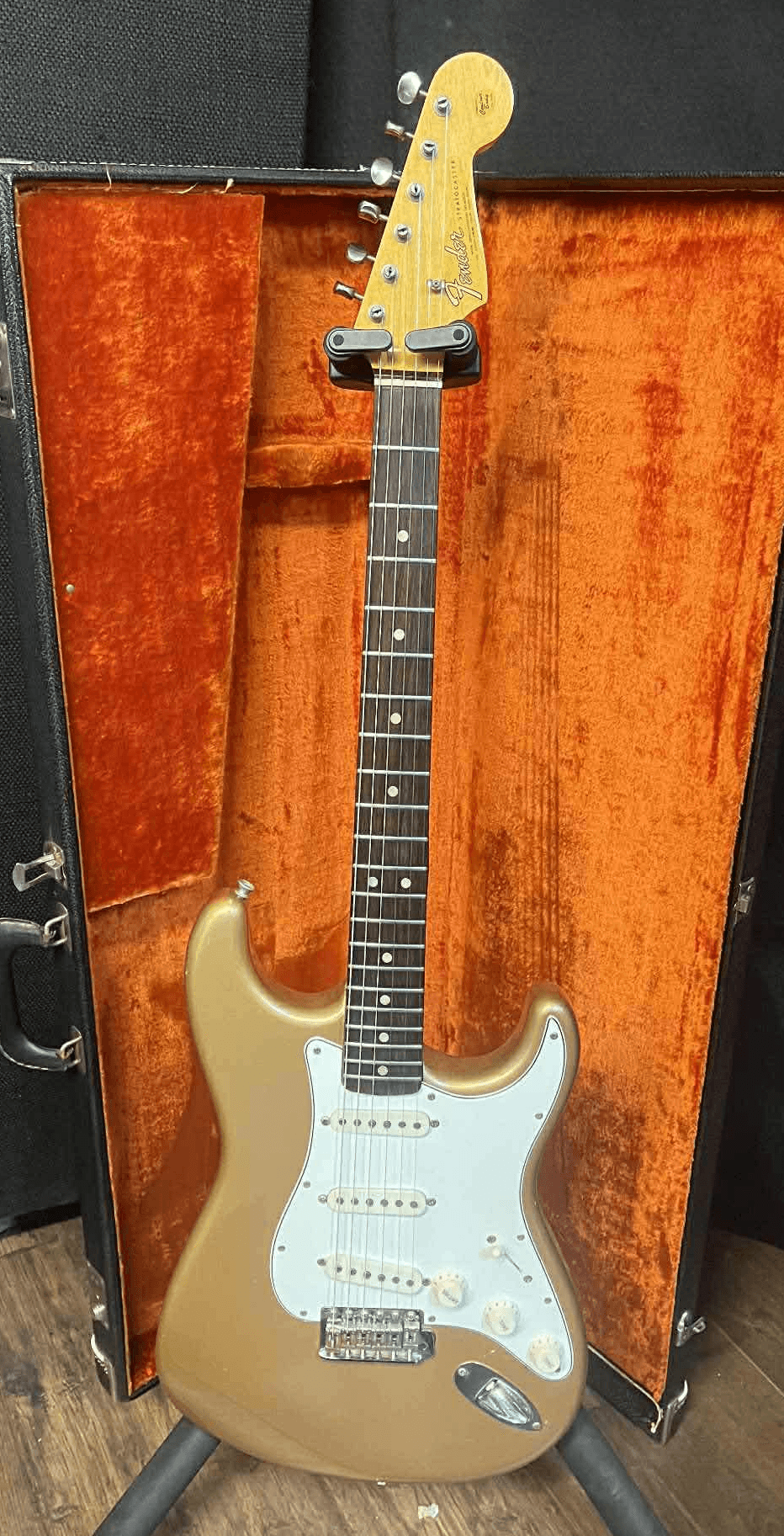
1965 Fender Firemist Gold Stratocaster: The Rarest Custom Color from the Transition Year
The 1965 Fender Stratocaster in Firemist Gold is one of the rarest custom colors from the transition year, with early-1965 examples still carrying pre-CBS construction under the new larger headstock. Originality, an unfaded factory custom color, and untouched electronics drive value. Edgewater Guitars buys vintage Fender Stratocasters and other vintage Fenders nationwide with free expert appraisals and same-day cash offers. Call or text (440) 219-3607.
Why 1965 Firemist Gold Fenders Matter
The 1965 model year represents one of the most fascinating periods in Fender history—the transition year when CBS acquired the company from Leo Fender. Guitars built during this pivotal year combine the best of both eras: pre-CBS craftsmanship with early CBS-era features. Among all the custom colors Fender offered, Firemist Gold stands as one of the absolute rarest and most sought-after finishes, particularly on Stratocasters, Jazzmasters, and Jaguars.
Firemist Gold wasn’t even part of Fender’s standard custom color offerings. This metallic gold finish with its subtle greenish undertone was borrowed from DuPont’s automotive paint line and only appeared on a tiny handful of instruments during the mid-1960s. When you combine this ultra-rare finish with the historically significant 1965 transition year, you have an instrument that represents a true convergence of rarity, beauty, and collectability.
What makes 1965 Firemist Gold Fenders exceptional:
Among the absolute rarest custom color combinations Fender ever produced
Built during the critical CBS transition period with pre-CBS quality standards
Features the final year of many classic pre-CBS specifications
Distinctive metallic finish that’s virtually impossible to replicate authentically
Extremely limited production numbers across all three offset models
Represents the peak of American guitar manufacturing before mass production changes
Historical Context: The CBS Acquisition Year
1965 marked seismic changes at Fender. In January 1965, CBS purchased Fender for $13 million—a massive sum that reflected the company’s dominance in the electric guitar market. However, the transition wasn’t immediate. Many 1965 instruments, particularly those built in the first half of the year, retained all the hallmarks of pre-CBS quality and construction.
The 1965 Transition Timeline:
Early 1965 instruments (January-June) typically feature:
Clay dot markers on rosewood fingerboards
Smaller “pre-CBS” headstock on Stratocasters
Pre-CBS style tooling and construction methods
L-series serial numbers continuing from 1964
Late 1965 instruments (July-December) begin showing:
Pearloid dot markers replacing clay
Larger CBS-style headstock appearing on Stratocasters
F-stamped neck plates indicating CBS-era production
Transitional features varying from instrument to instrument
This transitional nature makes 1965 instruments particularly interesting to collectors and players. You might find a guitar with some pre-CBS features and some CBS-era changes, creating unique combinations that never appeared in any other year.
Firemist Gold: The Automotive Paint That Became Guitar Legend
Firemist Gold originated as DuPont paint code #2863, part of their automotive “Firemist” line of metallic finishes. Unlike Fender’s standard custom colors like Lake Placid Blue or Candy Apple Red, Firemist Gold was never officially listed in Fender price lists or promotional materials. This finish appeared only on special order instruments, making them extraordinarily rare.
The Firemist Gold Appearance:
When freshly applied, Firemist Gold displays:
Rich golden hue with metallic flake
Subtle greenish undertone in certain lighting
Deeper, more complex appearance than standard Gold finishes
Mirror-like reflectivity when light hits the metallic particles
Warm, almost copper-like glow under incandescent lighting
As these finishes age naturally:
The clear coat often ambers, deepening the gold tone
UV exposure can cause subtle color shifts
The metallic flake remains vivid even on heavily played examples
Original Firemist Gold has a distinctive “depth” impossible to match with modern paints
Checking patterns reveal the primer layers beneath
If you own a Fender in Firemist Gold finish from any year, Edgewater Guitars specializes in authenticating and purchasing these ultra-rare custom color instruments. Our expertise in vintage Fender finishes ensures you’ll receive top-tier evaluation. Contact us at (440) 219-3607 for a professional assessment.
Identifying an Authentic 1965 Firemist Gold Stratocaster
Serial Numbers and Dating
1965 Stratocasters fall into the L-series serial number range, typically from L20000 to L90000. These numbers appear stamped on the neck plate on the back of the guitar. However, serial numbers alone don’t tell the complete story for 1965 instruments due to the transitional nature of the year.
Critical Dating Points:
Neck Date Stamp: The most reliable identifier is the penciled or stamped date on the heel of the neck (visible when the neck is removed from the body pocket). 1965 necks typically show notations like:
“1-65” through “12-65” (indicating month and year)
Some late 1964 dated necks appear on early 1965 guitars
Some early 1966 dated necks appear on late 1965 guitars
Potentiometer Codes: 1965 Stratocasters used potentiometers from various manufacturers that can be decoded:
Format: XXX-YY-ZZ
First three digits = Manufacturer code (304 for Stackpole, 137 for CTS)
Next two digits = Year of manufacture (64 or 65)
Last two digits = Week of manufacture
For a guitar stamped 1965 to be authentic, potentiometer dates should show late 1964 or 1965 date codes. Finding 1966 or later codes indicates replacement parts.
Firemist Gold Authentication
Verifying an original Firemist Gold finish requires careful examination:
Visual Inspection:
Check the neck pocket and control cavity for traces of the original finish
Original Firemist Gold shows a specific primer sequence:
Sealer coat directly on wood
Gold metallic color coat
Clear lacquer topcoat
Look for overspray evidence in hidden areas (neck pocket, pickup cavities, tremolo cavity)
Original finishes show consistent aging and patina
Common Refinish Red Flags:
Overspray on metal parts or in screw holes
Inconsistent color in different body areas
Modern polyurethane rather than nitrocellulose lacquer
Absence of natural checking patterns
Wrong primer color visible in chips or wear areas
Metallic flake that appears too uniform or modern
Body and Neck Woods:
Body: Alder for finished colors (Firemist Gold would be alder)
Neck: Maple with rosewood fingerboard
Fingerboard: Slab rosewood (thick, flat-bottomed) on early ‘65, veneer on later examples
Headstock Features
The headstock underwent significant changes during 1965:
Early 1965 (Small Headstock):
Original “pre-CBS” dimensions: 3-5/8” wide at top
“Spaghetti” Fender logo in gold with two patent numbers
Kluson Deluxe tuners with single-line stamp
String tree typically mounted with single screw
Late 1965 (Large Headstock):
Enlarged to approximately 4” wide at top
Transition or gold “Fender” logo
“F” stamped tuners beginning to appear
Modified headstock angle
Custom Color Headstock: Firemist Gold Stratocasters would feature:
Matching Firemist Gold headstock face
Gold Fender logo (spaghetti style on early examples)
Clear coat over the painted headstock
Electronics and Hardware
Pickups: 1965 Stratocaster pickups featured:
Three single-coil pickups
Hand-wound with formvar wire (early ‘65) or enamel wire (late ‘65)
Typical resistance: 5.8k-6.2k ohms per pickup
Staggered pole pieces
Gray or black fiber bottom plate
Control Layout:
Three-way pickup selector switch
One volume control
Two tone controls
Standard routing for electronics cavity
Bridge and Tremolo:
Six-screw synchronized tremolo bridge
Steel block tremolo system
Chrome-plated brass saddles
Tremolo cover plate with serial number stamp (on some examples)
Pickguard: Early 1965: Single-ply mint green pickguard (appears white but has greenish tint) Late 1965: White three-ply pickguard becoming standard
11 mounting screws
The 1965 Firemist Gold Jazzmaster
While Firemist Gold Stratocasters are exceptionally rare, Firemist Gold Jazzmasters from 1965 are even more scarce. The Jazzmaster, introduced in 1958, was Fender’s upscale model designed to attract jazz guitarists, though it found its greatest popularity with surf and alternative rock players.
Jazzmaster-Specific Features
Body and Construction:
Offset waist body design
Contoured alder body
Matching Firemist Gold finish on body and headstock
Larger body than Stratocaster (approximately 15” wide)
Pickup System:
Two wide single-coil Jazzmaster pickups
Soap bar-style pickup covers
Higher output than Stratocaster pickups
Distinctive bright, articulate tone
Tremolo System:
Floating tremolo with lock button
Separate bridge and tremolo unit
Tremolo arm locks into bushing
More radical pitch bends possible than Strat tremolo
Electronics:
Unique dual-circuit system:
Lead circuit (standard volume and tone)
Rhythm circuit (separate volume and tone with roller controls)
Upper bout switches for circuit selection
Chrome or gold-plated metal control plates
Dating 1965 Jazzmasters:
L-series serial numbers on neck plate
Neck date stamps following same format as Stratocasters
Transition from bound fingerboard (early) to unbound (late in some cases)
Clay dots transitioning to pearloid dots
Why Firemist Gold Jazzmasters Are Exceptionally Rare
Production numbers for custom color Jazzmasters were already limited compared to Stratocasters. Factor in that Firemist Gold was a special-order-only finish, and you have one of the rarest Fender combinations possible. Many collectors search for decades without encountering an authentic Firemist Gold Jazzmaster.
Edgewater Guitars actively seeks Firemist Gold Jazzmasters from all years, particularly from the pre-CBS and transition eras. Our network of serious collectors ensures we can make premium offers on these exceptionally rare instruments. Get your free authentication and evaluation by calling (440) 219-3607.
The 1965 Firemist Gold Jaguar
The Jaguar, introduced in 1962 as Fender’s top-of-the-line model, featured the most complex electronics and hardware of any Fender guitar. A 1965 Firemist Gold Jaguar represents the convergence of Fender’s most sophisticated design with one of its rarest finishes.
Jaguar-Specific Features
Scale Length:
24” scale (shorter than Stratocaster’s 25.5”)
Easier playability and different string tension
Distinctive tonal character from the shorter scale
Pickup System:
Two single-coil Jaguar pickups with metal claw surrounds
Shielded pickup design reduces interference
Bright, articulate tone with enhanced treble response
Different winding specifications than Stratocaster or Jazzmaster pickups
Complex Switching System: 1965 Jaguars featured Fender’s most elaborate control layout:
Lead/rhythm circuit selector switch on upper bout
Three chrome control plates on lower bout:
Pickup selector switches
Tone circuit switches
Volume and tone roller controls
Rhythm circuit with separate roller controls on upper bout
Strangle switch for treble cut
Tremolo and Bridge:
Floating tremolo with lock mechanism
Spring-loaded string mute (often removed by players)
Individual bridge saddles with height and intonation adjustment
Tremolo arm that locks into bushing
Other Distinctive Features:
Bound fingerboard (most examples)
Block inlays (standard on most ‘65 Jaguars)
Matching Firemist Gold headstock
Chrome or gold-plated hardware depending on specification
Jaguar Identification Points
Serial Numbers:
L-series numbers on neck plate (L10000-L90000 range for 1965)
Neck heel date stamps (1-65 through 12-65)
Pot codes showing 1964-1965 manufacture dates
Fingerboard Evolution:
Early 1965: Clay dot markers, bound rosewood fingerboard
Late 1965: Pearloid block inlays becoming standard, some with pearl dots
Transitional examples with mixed features
Firemist Gold on Jaguar Bodies: The Jaguar’s offset body shape and larger control plate area made Firemist Gold finishes particularly striking:
More surface area to display the metallic finish
Control plates created visual contrast against the gold finish
Complex body contours highlighted by the reflective metallic paint
Matching headstock completed the premium appearance
Why Collectors Prize Firemist Gold Jaguars
The combination of factors makes these instruments exceptionally desirable:
Jaguar was already Fender’s most complex and expensive model
Firemist Gold added significant upcharge as special-order finish
1965 transition year combines pre-CBS quality with historical significance
Extremely limited production numbers
Many original examples have been modified or refinished over the decades
Tonal Characteristics Across All Three Models
Stratocaster in Firemist Gold
The finish itself doesn’t affect tone, but 1965 Stratocasters offer distinctive sonic characteristics:
Bright, glassy clean tones with excellent note definition
Three single-coil pickups provide versatile tonal palette
Alder body contributes balanced resonance across frequency spectrum
Vintage formvar-wound pickups (early ‘65) offer slightly warmer tone than later enamel wire
Excellent for blues, rock, pop, and country applications
The Firemist Gold finish may have been chosen by players wanting visual distinction without compromising the classic Stratocaster sound.
Jazzmaster in Firemist Gold
Jazzmaster pickups create fundamentally different tones:
Warmer, fuller low-end response than Stratocasters
Enhanced midrange presence
Bright treble that cuts through dense mixes
Rhythm circuit offers mellow, jazz-appropriate tones
Popular with surf, alternative, and indie rock players
The larger body and different pickup design contribute to increased sustain and resonance compared to Stratocasters.
Jaguar in Firemist Gold
Jaguar tone combines elements of both previous models with unique characteristics:
Shorter 24” scale creates different harmonic overtones
Bright, snappy attack with pronounced treble response
Complex switching allows dramatic tonal variations
Shielded pickups reduce hum while maintaining single-coil clarity
Excellent for articulate rhythm work and cutting lead tones
The sophisticated electronics enable players to dial in everything from warm jazz tones to aggressive surf and punk sounds.
Common Issues and Authentication Concerns
Refinishes and Counterfeits
Given the rarity and desirability of Firemist Gold Fenders, refinishes and outright counterfeits appear in the market:
Refinish Warning Signs:
Overspray visible on hardware, in screw holes, or pickup cavities
Paint in areas that should be bare wood (neck pocket edges)
Incorrect primer color sequence
Modern clear coat instead of nitrocellulose lacquer
Absence of proper aging patterns and checking
Metallic flake that appears modern rather than vintage
Complete Fake Indicators:
Wrong serial number format or out-of-range numbers
Incorrect neck stamp format or obviously fake stamping
Modern potentiometers with recent date codes
Wrong pickup specifications
Incorrect body routing patterns
Modern tuners stamped with fake vintage markings
Common Modifications
Over 60 years, many modifications occur:
Typical Changes:
Fret replacement (most vintage guitars have been refretted)
Tuner replacement (especially on Stratocasters)
Pickup replacements or rewinding
Electronics modifications (pots, capacitors, switches)
Nut replacement
Bridge or tremolo parts replaced
More Serious Modifications:
Neck refinishing
Body refinishing or color change
Neck pocket repairs or modifications
Added tremolo routes or pickup cavities
Headstock repairs or breaks
Verification Process
For any Firemist Gold Fender, proper authentication requires:
Visual Inspection:
Examine finish for originality
Check all hardware for period-correct specifications
Verify proper construction methods
Date Code Cross-Reference:
Neck date should align with pot codes
Serial number should match production period
All dates should be consistent with 1965 production
Component Verification:
Pickups should match period specifications
Electronics should be original or period-correct
Hardware should match 1965 specifications
Finish Analysis:
UV light examination can reveal refinishing
Primer color verification in chips or cavities
Checking pattern should be consistent with age
Edgewater Guitars provides professional authentication services for all vintage Fender instruments, with particular expertise in rare custom colors like Firemist Gold. We understand the nuances of transitional 1965 features and can accurately assess originality. Contact us for expert evaluation throughout Ohio, Michigan, Pennsylvania, Indiana, and West Virginia.
Why Players and Collectors Value These Instruments
Playing Characteristics
Beyond collectability, these guitars remain exceptional playing instruments:
Stratocaster:
Ergonomic body design refined over a decade of production
Comfortable C-shape neck profile
Reliable vintage tremolo system
Three-pickup versatility for any musical style
Excellent balance and resonance
Jazzmaster:
Comfortable offset design favored by many players
Smooth, effortless playability
Unique tonal palette different from other Fenders
Floating tremolo enables expressive pitch manipulation
Ideal for aggressive playing styles
Jaguar:
Shorter scale makes bending easier and reduces string tension
Complex electronics offer extensive tonal options
Sophisticated control layout enables mid-song sound changes
Distinctive voice perfect for cutting through band mix
Excellent for both rhythm and lead applications
Investment and Collectability
Multiple factors drive the desirability of 1965 Firemist Gold Fenders:
Rarity:
Firemist Gold represents one of the rarest Fender custom colors
1965 transitional features create unique combinations
Many original examples lost to modification or refinishing
Ultra-low production numbers across all three models
Historical Significance:
CBS transition year documents important company history
Last year of many classic pre-CBS specifications
Peak of American guitar manufacturing before mass production changes
Represents the end of the Leo Fender era
Aesthetic Appeal:
Stunning metallic gold finish unlike any standard Fender color
Matching headstock creates cohesive visual impact
Distinctive appearance makes these guitars unmistakable
Finish quality demonstrates Fender’s custom shop capabilities
Provenance and Documentation:
Original purchase receipts add significant interest
Celebrity or session musician ownership enhances appeal
Period photographs showing the guitar enhance documentation
Original case and accessories complete the package
Selling Your Firemist Gold Fender
If you own a 1965 Fender in Firemist Gold—whether Stratocaster, Jazzmaster, or Jaguar—you possess one of the rarest vintage guitars in existence. These instruments require specialized knowledge to properly authenticate and evaluate.
Why Choose Edgewater Guitars
Specialized Expertise:
Deep knowledge of 1965 transitional features
Experience authenticating rare custom colors
Understanding of Firemist Gold finish characteristics
Familiarity with Stratocaster, Jazzmaster, and Jaguar specifications
Premium Offers:
We consistently offer significantly more than typical guitar shops
Direct buyer network of serious collectors
Understanding of the rarity premium these instruments command
Fair evaluation based on current market conditions
Professional Service:
Free, no-obligation authentication and evaluation
In-person appointments for high-value instruments
Secure, confidential transaction process
Immediate payment options available
Geographic Coverage: We serve guitar sellers throughout Ohio, Michigan, Pennsylvania, Indiana, and West Virginia, with the flexibility to travel for exceptional instruments like Firemist Gold Fenders.
Ready to discuss your vintage Fender? Call Edgewater Guitars at (440) 219-3607 or request a free evaluation through our website.
Related Resources
Fender Identification Tools
To help identify and date your vintage Fender:
Complete Fender Serial Number Lookup Tool - Decode any Fender serial number
Fender Pot Code Dating Guide - Understand potentiometer date codes
Fender Neck Date Reference - Interpret neck heel date stamps
Custom Color Authentication Guide - Verify original Fender finishes
Model-Specific Guides
1965 Fender Stratocaster Complete Guide - Detailed Stratocaster specifications
Fender Jazzmaster History and Identification - Everything about Jazzmasters
Fender Jaguar Dating and Features - Comprehensive Jaguar reference
Pre-CBS vs CBS Era Comparison - Understanding the transition
Selling Resources
How to Sell Your Vintage Fender - Complete selling process guide
Preparing Your Guitar for Evaluation - Maximize your guitar’s presentation
Understanding Vintage Guitar Markets - Current trends and values
Edgewater’s Selling Process - What to expect when you contact us
Recent Acquisition Example
We recently had the privilege of purchasing a 1965 Fender Jazzmaster in Firemist Gold from an estate in Columbus, Ohio. The instrument came to us through a family member who inherited it from their father, an amateur musician who special-ordered the guitar new in 1965.
The guitar retained all original parts including the rare Firemist Gold finish with natural aging and checking. While the family initially consulted several local music stores, none could properly authenticate the rare finish or understand its significance.
After contacting Edgewater Guitars, we provided a comprehensive authentication service and made an offer that far exceeded what local shops had proposed. The family was relieved to work with experts who understood exactly what they had and could handle the transaction with the care such a rare instrument deserves.
This experience illustrates why specialized knowledge matters when selling rare vintage guitars. If you have a Fender in an unusual custom color or suspect you might own something special, contact the experts at Edgewater Guitars for proper evaluation.
Conclusion
A 1965 Fender in Firemist Gold—whether Stratocaster, Jazzmaster, or Jaguar—represents one of the holy grails of vintage Fender collecting. The combination of the significant CBS transition year with one of the rarest custom colors creates instruments that collectors search decades to find.
These guitars offer everything serious collectors and players seek:
Exceptional rarity across all three models
Historical significance from the transition year
Outstanding playability and tone
Stunning visual appeal from the metallic finish
Investment quality backed by scarcity and demand
If you own one of these exceptional instruments, Edgewater Guitars stands ready to provide expert authentication, fair evaluation, and premium offers based on current market conditions. Our deep knowledge of vintage Fenders and rare custom colors ensures you’ll receive the specialized attention these guitars deserve.
Contact Edgewater Guitars today for your free, professional evaluation:
Phone: (440) 219-3607
Serving: Ohio, Michigan, Pennsylvania, Indiana, and West Virginia
Expert authentication and premium offers for rare vintage Fenders
Edgewater Guitars specializes in purchasing vintage and collectible guitars throughout the Midwest region. Our team combines decades of experience in vintage guitar authentication with a passion for preserving these important instruments. Whether you’re selling a single guitar or an entire collection, we provide the expertise and fair dealing you deserve.
Sell your 1965 Fender Firemist Gold Stratocaster
Edgewater Guitars buys vintage Fender Stratocasters and other vintage Fenders nationwide. We give free, honest appraisals and fair same-day cash offers, with local pickup or insured nationwide shipping. Call or text (440) 219-3607 or request a free estimate.
How much is a 1965 Fender Firemist Gold Stratocaster worth?
As a real reference point, Edgewater recently paid $60,000 for a clean, all-original 1965 Fender Firemist Gold Stratocaster. Condition, originality, and finish move that figure up or down, so the most accurate number for your specific guitar is a free appraisal. Send a few photos and the serial number and we will give you an honest assessment.
Where can I sell a 1965 Fender Firemist Gold Stratocaster?
Edgewater Guitars buys them directly, nationwide, with same-day cash offers and no obligation. You can also date yours with our Fender serial number lookup.
See also: Vintage Fender Stratocaster Value Guide (1954-1966) for year-by-year prices and identification.