DATE :
1963 Fender Telecaster: The L-Series Veneer Board Year — Last Full Pre-CBS Year Before the Transition Shadow
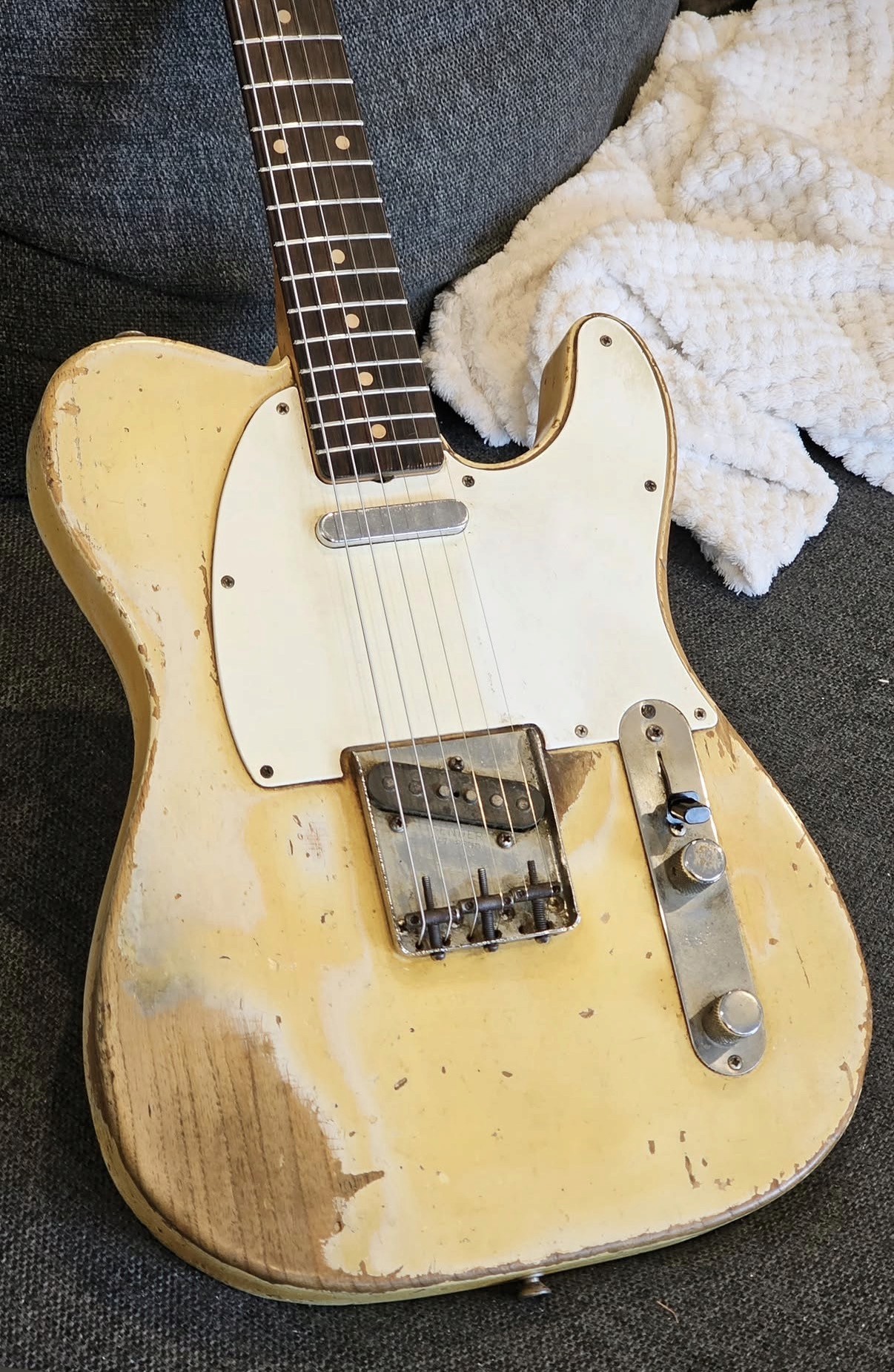
1963 Fender Telecaster: The L-Series Veneer Board Year — Last Full Pre-CBS Year Before the Transition Shadow
The 1963 Fender Telecaster is a last-full-pre-CBS-year Telecaster with the veneer rosewood board and early L-series serials, a desirable transitional specification. Original finish, intact electronics, and a clean neck are what collectors weigh most. Edgewater Guitars buys vintage Fender Telecasters nationwide with free expert appraisals and same-day cash offers. Call or text (440) 219-3607.
Last Updated: May 2026
What Makes the 1963 Fender Telecaster Significant?
The 1963 Fender Telecaster holds a precise and underappreciated position in pre-CBS history. It is the first full calendar year of veneer rosewood fingerboard production — the slab board era having ended mid-1962 — and the first full year of the L-series serial number system that collectors and authenticators use as a primary dating reference. It is also, in retrospect, the last complete pre-CBS year that Fender produced without the shadow of the CBS acquisition beginning to affect factory culture and production decisions. The deal that transferred Fender to CBS closed in January 1965, but the negotiation and planning process was underway well before that — 1963 represents the final year of genuinely independent Fender production operating at full creative and quality momentum.
The veneer rosewood fingerboard that defines 1963 production is meaningfully different from the slab board it replaced. At approximately 2.0mm thick with a curved underside following the fingerboard radius, it contributes far less rosewood mass to the neck assembly than the 4.8mm slab. The practical result is a brighter, more articulate instrument that sits tonally closer to the maple-neck Telecasters of the 1950s than the slab board instruments of 1959–1962. Many players who find the slab board Telecaster slightly warm for their application specifically seek veneer board pre-CBS examples — the 1963 represents the veneer board at its first full-year expression, with all the production consistency that implies.
Custom colors reached their broadest availability on the pre-CBS Telecaster in 1963. The full palette — Fiesta Red, Sonic Blue, Olympic White, Lake Placid Blue, Daphne Blue, Sherwood Green, Burgundy Mist, Dakota Red, Candy Apple Red, and others — was available as factory options, and documented examples in multiple colors survive from this year. In our experience buying pre-CBS Telecasters across Ohio and the Midwest, 1963 examples are among the most consistently well-preserved we encounter — the veneer board is more dimensionally stable than the slab under humidity fluctuation, meaning fewer fingerboard issues and better overall structural survival rates than earlier slab board years.
What makes the 1963 Telecaster distinctive:
First full calendar year of veneer rosewood fingerboard production
Veneer board: curved underside, approximately 2.0mm thick — brighter and more maple-like than slab board predecessors
L-series serial numbers throughout production — L10000 through approximately L38000
Clay dot position markers continue through 1963 production
Full custom color palette at peak availability for the pre-CBS Telecaster
Three-ply celluloid pickguard standard throughout production
Rounded soft C neck profile continues
Butterfly string tree continues
Three-barrel brass saddle bridge unchanged
Formvar-wound Alnico V single-coil pickups unchanged
If you own a 1963 Telecaster, you may be sitting on a significant asset. Edgewater Guitars provides free, no-obligation valuations — call (440) 219-3607 or visit edgewaterguitars.com.
What Is a 1963 Fender Telecaster Worth? (2026 Market Values)
Value by Condition and Finish
The 1963 Telecaster market in 2026 operates with a clear hierarchy: custom color examples at the top, all-original blonde examples in excellent condition at the strong tier, and player-grade or modified instruments at meaningful discounts. The veneer board’s greater dimensional stability relative to slab board instruments means a higher survival rate of all-original examples in excellent condition — which keeps the top of the market well-supplied while making truly exceptional examples stand out clearly.
Condition | Originality | Relative Value |
|---|---|---|
Excellent (8–9/10) | All original, custom color, original case | Premium-plus tier |
Excellent (8–9/10) | All original, butterscotch blonde, original case | Premium tier |
Very Good (7/10) | All original, no case | Strong tier |
Good (6/10) | Original parts, finish wear | Mid tier |
Player Grade | Some replacements, heavy wear | Entry tier |
Modified | Non-original pickups, refin, or added routes | Significant reduction |
What Affects the Value of a 1963 Telecaster?
Custom color: Any documented factory custom color places a 1963 Telecaster at the top tier of the market. Fiesta Red and Sonic Blue remain the most actively sought Telecaster custom colors from this era. Candy Apple Red begins appearing with greater frequency in 1963 and carries its own collector following.
Originality: All-original examples command a 40–60% premium over modified instruments. Bridge pickup, tuners, and saddles remain the most commonly replaced components.
Comparison to 1964: The 1963 Telecaster sits at a slight discount to equivalent 1964 examples in the current market — the 1964 carries the last-full-pre-CBS-year premium that collectors assign to final-year instruments. However the gap is modest and condition-dependent; an exceptional all-original 1963 will outsell a well-worn 1964 at any tier.
Original case: The original brown tolex case adds approximately 10–15% to value.
Clay dots intact: Original clay dot position markers intact and unmodified are a pre-CBS authentication confirmation. Missing or replaced dots reduce value by 5–10%.
Neck integrity: A clean, unrepaired neck with original frets and intact clay dots commands full value. Headstock repairs reduce value by 25–40%.
How 1963 Compares to Other Years
Year | Key Difference | Relative Value | Why |
|---|---|---|---|
1962 late | Last veneer board examples; transition year | Similar | Some 1962 veneer boards are indistinguishable from 1963 by fingerboard alone |
1963 (this post) | First full veneer year; L-series throughout | Baseline | Full-year consistency; peak custom color availability |
1964 | Final full pre-CBS year; same configuration | Similar to slightly higher | Last-year premium; CBS acquisition known to be imminent |
1965 | CBS transition year; large headstock appears late | Lower | CBS-era changes begin reducing pre-CBS purity |
Edgewater Guitars consistently pays 30–40% more than typical guitar shops. Get your free valuation: edgewaterguitars.com or (440) 219-3607.
Recent Sales and Auction Results
Custom color 1963 Telecasters in all-original condition are among the most actively pursued pre-CBS Fenders at major auction. Fiesta Red and Sonic Blue examples in excellent condition generate competitive bidding at the top of the pre-CBS Telecaster market. All-original blonde examples in excellent condition sell at the strong tier. The veneer board’s better dimensional stability means more all-original excellent condition examples are available in 1963 than in earlier slab board years — which supports market depth without suppressing prices at the top end. Contact Edgewater for current market context specific to your instrument.
How to Identify an Authentic 1963 Fender Telecaster
Serial Numbers
Range for 1963: L10000 through approximately L38000, stamped on the neckplate
Location: Four-bolt neckplate
L-prefix system: The L-prefix serial number series began appearing in late 1962 and was fully in use by 1963. The L does not stand for any specific word — it was simply the next serial number prefix Fender adopted after exhausting the five-digit number range.
Important caveat: Some L-prefix numbers appear on genuine 1962 instruments. An L-prefix number alone does not confirm a 1963 date — always cross-reference with the neck date stamp and pot codes. Conversely, late five-digit numbers on claimed 1963 instruments indicate either a late 1962 instrument or a replaced neckplate.
Neck Date
Format: Pencil-written or rubber-stamped, month and year (e.g., “6-63” or “JUN 63”)
Location: Heel of the neck, visible only when the neck is removed from the body
What to look for: The stamp appears on the maple heel beneath the rosewood veneer fingerboard. Aging should be consistent with the surrounding wood. On 1963 necks the veneer board overhang at the heel is thinner than on slab board instruments — the maple heel surface is more exposed.
Potentiometer Codes
Manufacturers: Stackpole (code 304) and CTS (code 137)
How to decode: Manufacturer code (3 digits) + year (2 digits) + week (2 digits)
Example: 137-2-28 = CTS, 1962, week 28 — appropriate for a guitar assembled in late 1962 or early 1963
Expected codes for 1963: Pots dated to 1962 or 1963 are correct. Pots from 1964 or later indicate modification or misrepresentation.
Location: Inside the control cavity, accessible by removing the control plate
Key Visual Identifiers
Fingerboard: Veneer rosewood, curved underside following fingerboard radius, approximately 2.0mm thick — the definitive 1963 configuration. Distinctly thinner than the 4.8mm slab board of 1961 and earlier.
Position markers: Clay dots — matte, slightly off-white, not pearl or celluloid. Present throughout 1963 production.
Serial number prefix: L-series throughout 1963 production — L10000 through approximately L38000
String tree: Butterfly-style stamped metal, consistent since 1956
Neck profile: Rounded soft C — approximately 0.84” at first fret, 0.92” at twelfth fret
Pickguard: Three-ply celluloid standard — white or tortoiseshell; single-ply Bakelite no longer standard production
Tuners: Kluson Deluxe, single-ring, plastic oval buttons
Bridge plate: Three-barrel brass saddles with threaded steel intonation screws
Logo: Spaghetti-style gold with black outline — original thin script style intact in 1963; transition logo not yet introduced
Neckplate: Four-bolt, no F-stamp — F-stamp was not introduced until CBS era
Factory Markings and Stamps
Control cavity: Pencil body date sometimes present
Neck pocket: May show pencil date consistent with neck heel stamp
Underside of fingerboard: Curved profile visible when neck is removed — confirming veneer board configuration
Pickup cavities: Some examples retain assembly pencil dates
Veneer Board Identification
The veneer rosewood fingerboard of 1963 is confirmed by a single physical examination:
Remove the four neckplate screws and separate the neck from the body
Look at the underside of the fingerboard at the heel end
Veneer board: Curved, radiused underside — the rosewood follows the fingerboard radius, thinner at the edges than at the center, approximately 2.0mm at the center
Slab board (wrong for 1963): Flat, square bottom approximately 4.8mm thick — any claimed 1963 with a slab board has either a replaced neck or is a late 1962 instrument
Custom Color Identification
Custom color authentication on 1963 Telecasters follows the established pre-CBS Fender protocol:
Yellow sealer undercoat: Original Fender custom colors applied over a specific yellow sealer layer — visible at wear points, in the neck pocket, and under UV examination
Correct primer sequence: Differs from typical refinish materials; UV examination reveals refinishing even when the surface appears convincing
Matching headstock: Many 1963 custom color Telecasters have matching headstock color — a factory practice that is a value marker and authentication reference
Aged finish characteristics: Original 1963 nitrocellulose custom colors show 60-plus years of specific aging — Fiesta Red fading toward salmon, Sonic Blue yellowing toward seafoam, Candy Apple Red darkening and deepening
Neck pocket bleed: Original custom color typically bleeds slightly into the neck pocket during factory application
Red Flags: How to Spot Fakes and Refinishes
Slab board on a claimed 1963: Any 1963 Telecaster with a flat-bottomed slab fingerboard has either a replaced neck from an earlier instrument or is being misrepresented as a 1963. Veneer board is the correct fingerboard for all genuine 1963 production.
Pearl or celluloid dots: Clay dots are correct for 1963. Bright pearl or celluloid dots indicate either a replaced fingerboard or a later instrument misrepresented as 1963.
F-stamped neckplate: The CBS-era F-stamp was not present on 1963 instruments. Any F-stamped plate indicates a replaced neckplate or a CBS-era instrument.
Five-digit serial number without L-prefix on a claimed mid-to-late 1963: By mid-1963 the L-series was fully in use. A five-digit number on a claimed mid-or-late 1963 instrument warrants scrutiny — either an early production example with neck date verification, a replaced neckplate, or a misrepresented instrument.
Plastic-insulated wiring: Original 1963 control cavities used cloth-covered wire. Plastic insulation indicates replaced electronics.
Pot date mismatch: Pots dated 1964 or later in a claimed 1963 guitar indicate modification or misrepresentation.
Non-brass saddles: Original 1963 bridge saddles are three-barrel brass. Steel or synthetic saddle replacements are non-original.
Vivid unfaded custom color: Original Fender nitrocellulose custom colors from 1963 show more than 60 years of aging and fading. An unusually vivid or even custom color warrants UV examination and primer layer scrutiny.
In our experience evaluating 1963 Telecasters from the Ohio and Midwest region, the most common authentication challenge involves distinguishing late 1962 veneer board instruments from 1963 instruments — they are functionally identical in construction and the only reliable differentiator is the neck date stamp and pot codes. Serial number alone does not resolve this question definitively given the L-prefix overlap. We address this during every in-person evaluation through direct examination of all dating markers.
Not sure if your Telecaster is an authentic 1963? Edgewater offers free authentication — our team has evaluated hundreds of vintage Fender instruments. Call (440) 219-3607 or visit edgewaterguitars.com.
1963 Fender Telecaster Specifications
Specification | Detail |
|---|---|
Body Wood | Ash (blonde finish) or alder (custom colors) |
Neck Wood | Maple with veneer rosewood fingerboard |
Fingerboard | Veneer rosewood, curved underside, approximately 2.0mm thick, 7.25” radius |
Position Markers | Clay dots — matte, off-white |
Neck Profile | Rounded soft C, approximately 0.84” at 1st fret, 0.92” at 12th fret |
Nut Width | 1-5/8” (1.625”) |
Scale Length | 25.5” |
Frets | 21, narrow vintage wire |
Pickups | Two Fender single-coil, Alnico V magnets, black fiber bobbins, Formvar wire |
Bridge | Three-barrel brass saddle, single-ply chrome plate |
Tuners | Kluson Deluxe, single-ring, plastic oval buttons |
Controls | Master volume, master tone, 3-position blade switch |
Pickguard | Three-ply celluloid — white or tortoiseshell |
Finish | Nitrocellulose lacquer — butterscotch blonde standard; full custom color palette available |
Available Colors | Butterscotch blonde (standard); Fiesta Red, Sonic Blue, Olympic White, Lake Placid Blue, Daphne Blue, Sherwood Green, Burgundy Mist, Dakota Red, Candy Apple Red (custom order) |
Serial Number Format | L-prefix: L10000–L38000 approximately |
Weight Range | Typically 7.0–8.5 lbs |
Case | Brown tolex case |
Original Retail Price | Approximately $209.50 (1963 catalog) |
What Does a 1963 Fender Telecaster Sound Like?
Pickup Specifications and Tonal Profile
Pickup type: Single-coil, non-staggered pole pieces
DC Resistance (bridge): Approximately 7.0–7.5k ohms
DC Resistance (neck): Approximately 6.5–7.0k ohms
Wire type: Formvar-coated
Magnet type: Alnico V
Potting: Unpotted
The tonal character of the 1963 Telecaster reflects the veneer board’s influence on the neck assembly — a brighter, more open quality than the slab board instruments that preceded it, with faster upper-frequency response and a more articulate note definition. The bridge pickup retains the essential Telecaster character — percussive attack, defined upper midrange, piano-like initial transient — but with a crispness and clarity that many players associate with the finest examples of the pre-CBS design. The neck position is warm and full without the slight density that the slab board’s added mass contributed. The combination position produces the characteristic nasal midrange honk that defines the middle switch setting across all pre-CBS Telecaster production.
How Construction Details Affect Tone
The veneer rosewood fingerboard is the defining construction variable of the 1963 Telecaster relative to the preceding slab board years. At approximately 2.0mm of rosewood over a maple neck, the fingerboard contributes a surface warmth — a softening of the maple’s hardest transient edge — while allowing the fundamental brightness and articulation of the maple neck to dominate the resonance character. The result is a sound that many experienced players describe as the most balanced of all pre-CBS Telecaster configurations: brighter and more articulate than slab board instruments, warmer and more textured than pure maple-neck instruments.
The ash body on blonde instruments and alder body on custom color instruments continue the tonal relationships established throughout pre-CBS production. The brass saddle bridge remains unchanged from the original 1950 design — its contribution to the percussive, blooming attack character of the bridge position is consistent across all pre-CBS Telecaster years and is a primary reason original brass bridges command a premium over steel replacements.
Notable Recordings
The 1963 veneer board Telecaster sound is documented across the expanding catalog of country, rock, and soul recordings from this period. The Bakersfield sound continued its development with Telecasters of this precise configuration. Keith Richards acquired early Telecasters in this era and the clean, cutting clarity of the bridge position — the veneer board’s articulate brightness — is audible in early Rolling Stones recordings that predate his move to other instruments. The tonal character of the 1963 Telecaster — clear, defined, percussive — suited the recording studio demands of the early 1960s precisely.
Common Issues and Modifications That Affect Value
Replaced bridge pickup: The most common electronic modification on 1963 Telecasters. Value impact: 20–30% reduction. Original retained and included in the sale reduces impact to approximately 10–15%.
Replaced bridge saddles: Original three-barrel brass saddles frequently replaced with steel alternatives or six-saddle modern bridges. Value impact: 8–12% for saddle replacement; significantly more for full bridge plate replacement.
Replaced tuners: Kluson originals replaced with Grovers or Schallers. Value impact: 10–15%; fully reversible if originals retained.
Refinished body: Correct color refinish: 40–55% reduction. Non-original color: 55–70% reduction. Custom color refinished to blonde effectively removes the custom color premium entirely plus refinish penalty.
Custom color touch-up or overspray: Partial refinishes on custom color instruments reduce value by 20–35% depending on extent. UV examination during Edgewater’s in-person evaluation detects the vast majority of touch-up work invisible under normal light.
Missing or replaced clay dots: Value impact: 5–10%. Missing or pearl-replaced dots alter the visual authentication profile and are a pre-CBS dating reference point.
Refretted neck: Professional refret with correct narrow vintage wire: 5–10% reduction. Modern fret wire: 10–15% reduction.
Headstock crack or repair: Professionally repaired cracks reduce value by 25–40%.
Replaced neck: A non-original neck reduces value by 35–50% even when a period-correct Fender replacement is used, because the matched neck-body dating cannot be verified.
Added routing: Any additional body routing beyond original pickup and control cavities reduces value by 25–40% depending on size and location.
In Edgewater’s experience with 1963 Telecasters, the veneer fingerboard’s greater stability relative to slab boards means we encounter fewer structural issues and more genuinely all-original examples than in earlier years — but the electronic modifications remain common. A 1963 Telecaster with replaced bridge pickup but original everything else is still a highly desirable instrument; sellers should not assume that a single common modification defines the entire valuation conversation.
Selling Your 1963 Fender Telecaster: Your Options Compared
Selling Option | Typical Offer | Timeline | Fees/Costs | Risk Level | Best For |
|---|---|---|---|---|---|
Edgewater Guitars | 30–40% above shop offers | Immediate cash | None | Low — expert authentication included | Owners wanting fair value without hassle |
Local Guitar Shop | Wholesale pricing (lowest) | Same day | None direct, but lowest price | Low | Convenience over value |
Reverb / eBay | Variable — potentially higher | Weeks to months | 5–15% platform fees + shipping | High — fraud, damage, disputes | Experienced sellers comfortable with risk |
Auction House | Variable | 3–6 months | 15–25% seller premium | Medium | Custom color or exceptional examples |
Private Sale | Variable | Unpredictable | None | High — authentication burden on you | Sellers with existing buyer network |
The 1963 Telecaster is an instrument where the authentication complexity — L-series serial dating, veneer board verification, custom color confirmation — creates meaningful information asymmetry between informed and uninformed buyers. A local shop making a quick assessment may undervalue a 1963 Telecaster simply by not investing the time to verify all dating markers and authentication points. Edgewater’s process is built around thorough evaluation because accurate authentication is the foundation of a fair offer.
We travel anywhere in Ohio, Michigan, Pennsylvania, Indiana, or West Virginia for high-value instruments. Our process moves from first contact to cash in hand in 24–72 hours with no consignment, no platform fees, and no uncertainty.
Ready to find out what your 1963 Fender Telecaster is worth? Get your free, no-obligation valuation: edgewaterguitars.com or call (440) 219-3607.
Frequently Asked Questions About the 1963 Fender Telecaster
Q: What is a 1963 Fender Telecaster worth in 2026? A: Value is driven by finish and originality. Custom color examples in all-original condition represent the top tier — Fiesta Red, Sonic Blue, and Candy Apple Red are the most actively sought. All-original butterscotch blonde examples in excellent condition occupy the strong tier. Player-grade and modified instruments sell at a significant discount. Contact Edgewater Guitars for a free valuation specific to your instrument.
Q: What does the L-prefix mean on a 1963 Telecaster serial number? A: The L-prefix simply designates the next serial number series Fender adopted after exhausting the five-digit number range. It does not stand for a specific word or denote a model variation. L-series numbers began appearing in late 1962 and were fully in use throughout 1963 production, ranging from approximately L10000 to L38000 for 1963 instruments.
Q: How do I tell a 1963 Telecaster from a 1962 veneer board Telecaster? A: Both have veneer rosewood fingerboards and are visually similar. The definitive differentiators are the neck date stamp — visible when the neck is removed — and the potentiometer codes. A neck date reading 1963 and pots dated 1962 or 1963 confirm a 1963 instrument. Serial number provides supporting but not definitive evidence given L-prefix overlap between the two years.
Q: What serial numbers cover 1963 Fender Telecasters? A: Approximately L10000 through L38000, stamped on the neckplate. Some early L-prefix numbers appear on late 1962 instruments — always cross-reference with neck date and pot codes for accurate dating.
Q: What is the correct fingerboard for a 1963 Fender Telecaster? A: Veneer rosewood — a thin curved piece of rosewood approximately 2.0mm thick with a radiused underside, glued over the maple neck. The slab board era ended mid-1962. Any claimed 1963 Telecaster with a flat-bottomed slab fingerboard has either a replaced neck or is a misrepresented instrument.
Q: Are clay dots correct for a 1963 Telecaster? A: Yes. Clay dots — matte, slightly off-white, non-reflective — are correct for all 1963 production. Pearl or celluloid dots indicate either a replaced fingerboard or a later instrument. Clay dots are a primary visual pre-CBS authentication marker.
Q: What custom colors were available on the 1963 Telecaster? A: The documented custom color options for 1963 Telecaster production include Fiesta Red, Sonic Blue, Olympic White, Lake Placid Blue, Daphne Blue, Sherwood Green, Burgundy Mist, Dakota Red, and Candy Apple Red. All custom color claims require authentication — Edgewater provides this at no charge.
Q: How does a 1963 Telecaster compare tonally to a slab board Telecaster? A: The veneer board contributes less rosewood mass to the neck assembly than the slab board, producing a brighter, more articulate sound that sits closer to the maple-neck instruments of the 1950s. The slab board version is slightly warmer and denser in attack. Both share the same pickups and bridge hardware — the fingerboard accounts for a real but not dramatic tonal difference.
Q: Does Edgewater Guitars buy 1963 Fender Telecasters? A: Yes. We actively purchase 1963 Telecasters in all conditions — all-original, custom color, player-grade, and modified. We pay 30–40% more than local guitar shops and provide immediate cash payment with no consignment. Call (440) 219-3607 or visit edgewaterguitars.com.
Q: How long does it take to sell a vintage guitar to Edgewater? A: Typically 24–72 hours from initial contact to cash in hand. We provide a preliminary valuation promptly, arrange in-person evaluation for high-value instruments, and make an immediate cash offer with no obligation.
Related Resources
Useful next reads and tools for this guitar:
Sell your 1963 Fender Telecaster
Edgewater Guitars buys vintage Fender Telecasters and other vintage Fenders nationwide. We give free, honest appraisals and fair same-day cash offers, with local pickup or insured nationwide shipping. Call or text (440) 219-3607 or request a free estimate.
How much is a 1963 Fender Telecaster worth?
A clean, all-original 1963 Fender Telecaster’s value depends on originality, condition, finish, and whether the pickups, wiring, and hardware are original. Because Edgewater buys directly and resells, we can typically pay more than local shops or pawn stores. The most accurate way to find out is a free appraisal: send a few photos and the serial number and we will give you an honest market assessment.
Where can I sell a 1963 Fender Telecaster?
Edgewater Guitars buys them directly, nationwide, with same-day cash offers and no obligation. You can also date yours with our Fender serial number lookup.