DATE :
1963 Epiphone Casino: The Beatles' Secret Weapon and Rock's Most Versatile Hollow Body
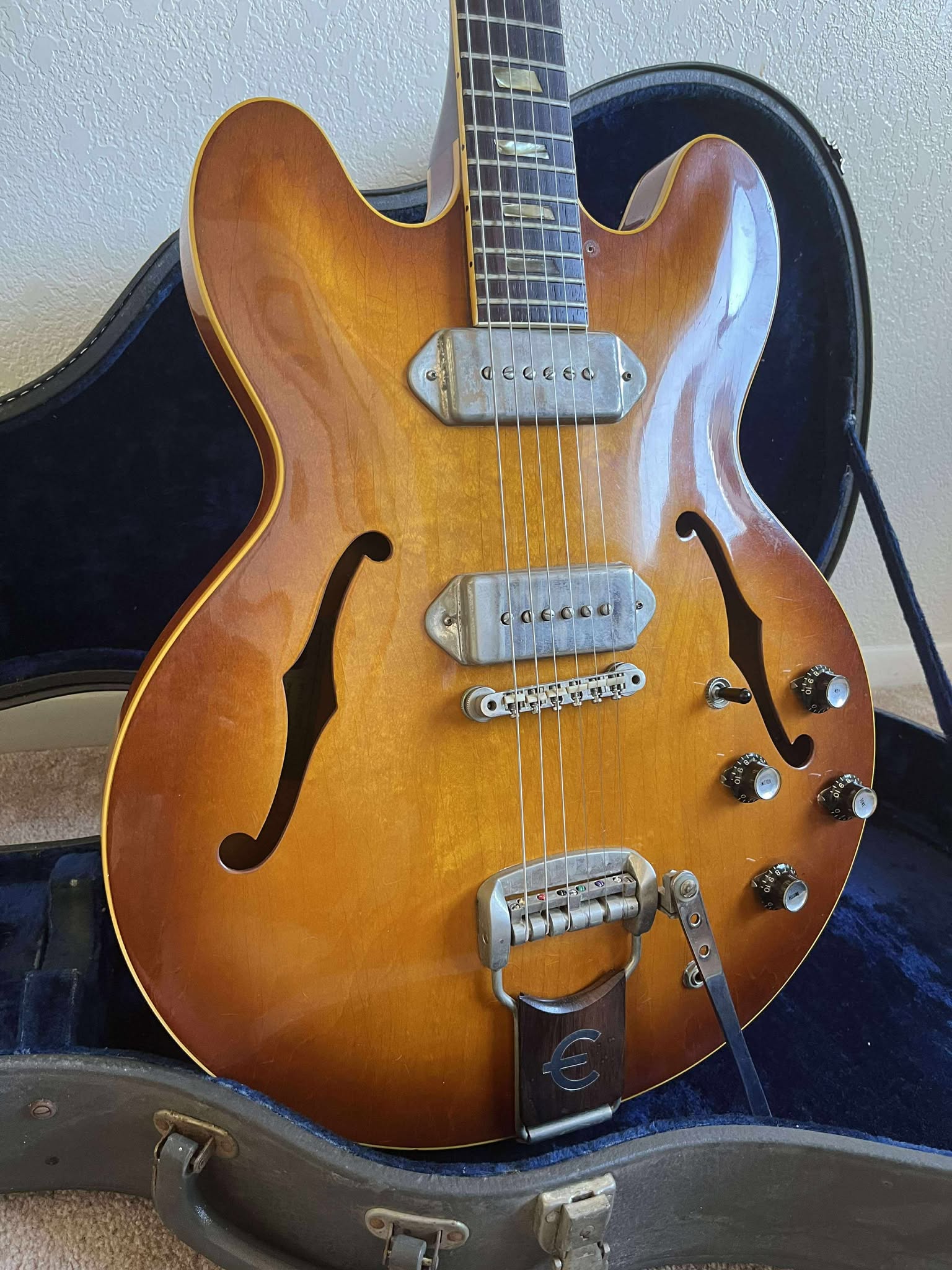
The 1963 Epiphone Casino is a fully hollow thinline archtop with twin P-90 pickups, the same Kalamazoo-built design later made famous by the Beatles. Originality, finish, and condition drive value. Edgewater Guitars buys vintage Epiphone hollow-bodies nationwide with free expert appraisals and same-day cash offers. Call or text (440) 219-3607.
Why the 1963 Casino matters
The 1963 Epiphone Casino stands as one of the most significant electric guitars in rock history, representing the perfect intersection of Gibson’s manufacturing excellence and Epiphone’s distinctive design philosophy. When Gibson bought out Epiphone back in 1957, they intended to use their former competitor’s brand as a way of selling alternative versions of their popular models, and the Casino became their masterpiece.
Key Takeaways
Golden Era Construction: 1963 marks the final year of the “wide nut” (1 11/16”) specification and Kalamazoo factory craftsmanship.
The Beatles Connection: While synonymous with Lennon, McCartney, and Harrison, the 1963 model is the sought-after template for their iconic sound.
Fully Hollow Design: Unlike semi-hollows, the Casino has no center block, providing unique resonance and “musical” feedback.
Authentication: Look for 5-digit serial numbers (95000–105000) and Centralab potentiometer codes starting with “134 62” or “134 63”.
Market Value: Original Royal Tan finishes and unmodified electronics command a 30-40% premium in the current vintage market.
What makes the 1963 Casino exceptional:
Built during Gibson’s golden era at the Kalamazoo factory with premium materials and craftsmanship
The year that established the Casino’s reputation among professional musicians
Keith Richards and Dave Davies from The Kinks were Casino players but it is the ultimate Beatle guitar as John, George and Paul all owned and played one
Features the coveted “wide nut” specification preferred by many vintage collectors
Represents the final year before significant construction changes in 1964
16-inch wide, tune-o-matic bridge, single bound construction that defined the classic Casino sound
The 1963 Casino emerged during a pivotal moment in popular music when electric guitars were transitioning from jazz and country applications to the driving force of rock and roll. Unlike its Gibson ES-330 sibling, the Casino possessed a unique visual identity with its distinctive white pickguard and headstock design that would become iconic in the hands of rock’s greatest players.
Historical context and Gibson’s Epiphone era
By 1963, Gibson had fully integrated Epiphone production into their Kalamazoo, Michigan facility, applying the same quality standards and materials used in their premium Gibson models.
This was the year that saw the Casino truly come into its own as a professional instrument, with refined specifications that addressed early production issues from the model’s 1961 introduction.
The Casino represented Gibson’s answer to the growing demand for versatile electric guitars that could handle both clean jazz tones and the increasingly popular rock sounds emerging from England and America. The Casino was the Epiphone version of the ES-330-it was virtually identical to the Gibson hollow body, but with distinctive cosmetic touches that gave it its own identity.
During 1963, several key developments occurred:
Gibson refined the Casino’s construction methods, resulting in more consistent quality
The P-90 pickup specifications were standardized for optimal output and clarity
Hardware suppliers like Kluson and Centralab provided components specifically coded for Gibson’s quality standards
The finish options were expanded beyond the original sunburst to include the striking Royal Tan
This was also the year that would see the Casino begin its journey toward legendary status. While The Beatles wouldn’t acquire their famous Casinos until 1964-1965, 1963 models were already finding their way into the hands of session players and touring musicians who recognized their exceptional versatility and reliability.
Current market value for the 1963 Casino
The vintage guitar market has shown tremendous appreciation for 1963 Casinos over the past decade, with these instruments now recognized as essential pieces of rock history. The combination of historical significance, player appeal, and relative rarity has driven values steadily upward.
Key Value Factors:
Originality: All-original examples command significant premiums over modified instruments
Neck Width: The 43mm nut width Casino and wide nut specifications are highly desired by collectors
Finish Condition: Original nitrocellulose finish in good condition dramatically affects value
Electronics: Original Gibson P’90 pickups, and wiring as well as the original volume and tone knobs are crucial for top values
Hardware: Original Kluson tuners, bridges, and tailpieces significantly impact valuation
Rare colors: Original Royal Tan finishes and other less-common finishes can command significant premiums
Factory Bigsby (E230TDV): Original factory-installed Bigsby-equipped examples can affect valuation and collector demand
Important Note: At Edgewater Guitars, we consistently pay 30-40% more than typical guitar shops for premium examples, particularly for all-original 1963 Casinos with documentation.
Recent market trends show increasing demand from both players and collectors, with 1963 examples often outperforming later years due to their pre-Beatles mystique and superior construction quality.
Detailed identification guide for authenticating your 1963 Casino
Serial numbers and dating
1963 Epiphone Casinos typically feature 5-digit serial numbers ranging from approximately 95000 to 105000, stamped into the headstock. 1963, serial 104xxx represents a typical example from this year. However, serial numbers should always be cross-referenced with other dating methods for accurate authentication.
Potentiometer dating
The most reliable dating method involves reading the potentiometer codes found inside the control cavity:
Potentiometer code “134 6215” (134 = Centralab, 62 = 1962, 15 = 15th week) represents a typical 1963 Casino setup. The pots were often manufactured in late 1962 for guitars assembled in early 1963.
Code Segment | Meaning | Example (134 6215) |
|---|---|---|
First 3 Digits | Manufacturer | 134 (Centralab) |
Next 2 Digits | Year | 62 (1962) |
Final 2 Digits | Week | 15 (15th Week) |
The pots dated late ‘62 are typical for early 1963 production, as Gibson used components manufactured in the previous months.
Visual identification features
1963-Specific Characteristics:
Headstock: Single-line “Epiphone” script with distinctive font
Tuners: Single line Kluson tuners with single-line “Kluson” stamping
Pickguard: White single-ply with distinctive shape
Bridge Options: Standard Tune-o-matic with stopbar tailpiece or factory-installed Bigsby B7 vibrato on E230TDV versions - look for the elongated aluminum tailpiece stamped “Bigsby.”
Pickup Covers: Two P-90 pickups with black covers (though cream covers were also available)
Control Layout: Two volume, two tone controls with distinctive numbering
Fingerboard Features:
Rosewood fingerboard with dot inlays (early 1963) or parallelogram inlays (later 1963)
Nut width = 1 11/16” (wide nut) - highly desirable specification
22 frets with period-correct wire
Construction details
1963 Casino Quick Specs
Body: 16” (W) x 19” (L) x 1.75” (D); Fully Hollow Maple
Neck:One-piece Mahogany; Set-neck (Long Tenon)
Nut Width: 1 11/16” (Wide Nut)
Neck Depth: .81” (1st fret) / .91” (12th fret)
Weight: Approx. 5.5 lbs - 6.5 lbs
Pickups: Dual Gibson P-90 “Dog-ear” Single Coils
Detailed physical specifications
Weight and dimensions
Weight = 5 lbs 9 oz represents a typical 1963 Casino, though weights can vary from 5.5 to 6.5 pounds depending on the specific wood density. Weight: 6 lbs 7.5 oz / 2.94 kg shows the range found in these instruments.
The hollow body construction makes Casinos notably lighter than solid-body guitars, contributing to their comfort during extended playing sessions.
Neck profile and playability
The 1963 Casino neck represents one of the most comfortable profiles ever produced:
Nut Width: 1 11/16” (wide nut) - preferred by many players for fingerpicking and chord work
Neck Depth: Progressive taper from .81” at first fret to .91” at 12th fret
Profile: Medium C-shape that fills the hand without being overwhelming
Scale Length: 24.75” Gibson standard
Fretboard Radius: 12” radius for easy bending and chord work
Pickup specifications
The heart of the 1963 Casino’s sound lies in its P-90 single-coil pickups:
Type: Gibson-made P-90 “soapbar” single-coils
Output: Typically 7.5-8.5k ohms resistance
Magnet Type: Alnico V bar magnets
Covers: Available in black or cream plastic
Mounting: Dog-ear style mounting directly to the top
The P90’s are powerful and balanced, providing the distinctive growl and clarity that made the Casino famous in rock applications.
Hardware specifications
Bridge System:
Tune-o-matic bridge with individual saddle adjustment
Separate stopbar tailpiece (though tremolo was optional)
Nickel-plated hardware standard
Tuning Machines:
Single line Kluson tuners
15:1 gear ratio for precise tuning
Nickel-plated with white plastic buttons
Tonal characteristics of the 1963 Casino
The 1963 Casino occupies a unique position in the tonal spectrum, offering characteristics that bridge the gap between hollow-body jazz guitars and solid-body rock instruments. The fully hollow construction creates a complex acoustic response that interacts with the electric components in fascinating ways.
Acoustic properties
Unlike semi-hollow guitars with center blocks, the Casino’s fully hollow construction provides:
Natural Resonance: The body acts as an acoustic chamber, adding woody overtones to the electric signal
Feedback Characteristics: Controlled feedback that can be musical when properly managed
Dynamic Response: The hollow body responds to playing dynamics more dramatically than solid instruments
Electric tone profile
The P-90 pickups deliver the Casino’s signature electric voice:
Clean Tones: Bright, articulate response with excellent note separation
Overdriven Tones: Distinctive growl and sustain that cuts through dense mixes
Frequency Response: Strong midrange presence with crisp highs and focused lows
Touch Sensitivity: Responds dramatically to pick attack and playing technique
Famous recordings
Here are a few widely cited examples of the Casino in recorded music:
The Beatles: Closely associated with John Lennon, Paul McCartney, and George Harrison, with Casino use appearing across their mid-to-late 1960s catalog.
The Smiths (Johnny Marr): Marr has discussed using an Epiphone Casino as part of his classic guitar lineup. Source
Common issues and modifications to watch for
Typical problems with 1963 Casinos
Structural Issues:
Neck Joint Problems: The set neck construction can develop issues if the guitar has been subjected to extreme temperature changes
Top Cracking: The thin maple top can develop cracks, particularly around the f-holes
Binding Shrinkage: Celluloid binding can shrink over time, causing gaps or lifting
Hardware Concerns:
Tuner Replacement: Light discoloration and minor pitting is common; many owners swapped original Klusons for Grovers, so check for extra screw holes
Bridge Issues: Tune-o-matic saddles and posts can wear over time, affecting intonation, sustain, and tuning stability
Tailpiece Problems: Stopbar studs can lean or pull under string tension, so inspect for lifting and top damage around the anchors
Bigsby Maintenance (E230TDV): Check the spring, arm, and mounting screws for stability and smooth return-to-pitch, and inspect for top stress around the vibrato
Modifications that affect value
Positive Modifications:
Professional refrets with period-appropriate wire
Careful electronics restoration using vintage-spec components
Structural repairs by qualified luthiers
Value-Reducing Modifications:
Tuner replacements (though reversible)
Electronics modifications or “upgrades”
Refinishing or touch-up work
Non-original case or missing original case
Authentication red flags
Serial numbers that don’t match the year’s production range
Potentiometer codes that don’t align with the supposed year
Hardware that appears too new or shows modern manufacturing techniques
Finish that appears too perfect or shows spray patterns inconsistent with 1960s methods
Why players and collectors value the 1963 Casino
Player appeal
The 1963 Casino offers several characteristics that make it exceptional for modern players:
Versatility: The hollow body construction and P-90 pickups create an instrument equally at home with jazz, rock, blues, and country styles. The natural acoustic properties complement electric amplification, creating rich harmonics and complex overtones.
Comfort: Weight = 5 lbs 9 oz makes these guitars notably comfortable for extended playing sessions. The neck profile accommodates both rhythm and lead playing styles without fatigue.
Studio Value: The Casino’s ability to cut through dense mixes while maintaining musical feedback characteristics makes it invaluable in recording situations.
Collector significance
Historical Importance: 1963 represents a pivotal year in rock history, with the Casino positioned to become one of the most recorded guitars in popular music.
Construction Quality: Built during Gibson’s peak manufacturing period, with materials and attention to detail that would become increasingly rare in later decades.
Rarity Factor: Production numbers were relatively limited compared to Gibson’s main line, making surviving examples increasingly scarce.
Celebrity Association: While The Beatles’ famous Casinos were 1964-1965 models, the 1963 represents the template that established the model’s reputation.
Investment potential
The vintage guitar market has shown consistent appreciation for quality instruments from this era, and 1963 Casinos have demonstrated particularly strong performance:
Steady appreciation over the past two decades
Increasing recognition among collectors who previously focused on Gibson and Fender
Growing appreciation for hollow-body instruments in general
The “Beatles connection” continues to drive interest and values
Selling your 1963 Epiphone Casino
If you own a 1963 Epiphone Casino, you possess an instrument that represents both significant musical history and substantial financial value. At Edgewater Guitars, we specialize in providing fair market valuations for vintage Epiphone instruments, particularly rare models like the 1963 Casino.
Why choose Edgewater Guitars?
If you want a straightforward process and a serious offer based on the real vintage market (not a quick, low in-store quote), we can help.
Premium Valuations: Our expertise in vintage Epiphone instruments means we recognize value that general music stores might miss. We consistently offer 30-40% more than typical guitar shops, particularly for all-original examples.
Expert Authentication: Our team can help verify the authenticity and originality of your instrument, ensuring you receive proper value for a genuine 1963 Casino versus a later model or reissue.
Immediate Cash Offers: Unlike consignment arrangements or private sales, we provide immediate cash offers with no waiting periods or uncertainty.
White-Glove Service: For high-value instruments like vintage Casinos, we provide on-site evaluation services throughout Ohio, Michigan, Pennsylvania, Indiana, and West Virginia.
The Edgewater advantage
Unlike general music stores that need to maintain large profit margins on resale, or online marketplaces that involve lengthy selling processes and uncertain outcomes, Edgewater offers:
Deep expertise in 1960s Epiphone construction and valuation
Access to collectors and dealers who specifically seek premium vintage Epiphones
Valuations based on current market conditions, not outdated price guides
Proper photography and documentation for insurance or estate purposes
Ready to discover your 1963 Casino’s value? Contact us today for your free, no-obligation evaluation. Call (440) 219-3607 or visit our website to submit photos and details of your instrument.
Related resources for Casino owners
Authentication and dating tools
Potentiometer Code Decoder: Detailed guide to reading and interpreting component date codes
Hardware Identification Guide: Visual guide to authentic 1960s Epiphone hardware versus reproductions
Market information
Vintage Epiphone Price Trends: Regular updates on market values and auction results
Selling vs. Keeping Guide: Factors to consider when evaluating whether to sell your vintage instrument
Technical resources
Original Specifications Database: Factory specifications and measurements for authenticity verification
Restoration Guidelines: Best practices for maintaining and restoring vintage Casinos
Common Problems Guide: Identification and solutions for typical 1960s Epiphone issues
Your 1963 Casino’s value awaits
The 1963 Epiphone Casino represents a unique intersection of craftsmanship, history, and musical significance. Whether you’re considering selling to downsize your collection, settle an estate, or simply realize the financial value of your instrument, Edgewater Guitars provides the expertise and fair dealing you deserve.
Geographic Service Area: We serve guitar owners throughout Ohio, Michigan, Pennsylvania, Indiana, and West Virginia. For high-value instruments like vintage Casinos, we provide on-site evaluation services.
Get Started Today:
Call us directly at (440) 219-3607
Submit photos through our online evaluation form
Email us with questions about your specific instrument
Professional Expertise: Our team’s deep knowledge of 1960s Epiphone construction, combined with current market expertise, ensures you receive accurate valuation and fair treatment.
Don’t let your valuable 1963 Casino sit unplayed while its value continues to appreciate. Contact Edgewater Guitars today to discover what your piece of rock history is worth in today’s collector market.
Frequently Asked Questions
Is a 1963 Epiphone Casino fully hollow or semi-hollow?
A 1963 Epiphone Casino is fully hollow (it has no center block). That construction is a big part of its acoustic resonance and its tendency toward musical, controllable feedback at higher volumes.
What serial number range covers 1963 Epiphone Casinos?
1963 Epiphone Casinos typically fall in the 5-digit serial number range of approximately 95000–105000. For accurate dating, you should also confirm the potentiometer codes.
Which pickups came stock in a 1963 Epiphone Casino?
Most 1963 Casinos came stock with two Gibson-made P-90 single-coil pickups (dog-ear style), often measuring in the typical 7.5–8.5k ohms resistance range.
How is a 1963 Casino different from the 1964 version?
Nut width: 1963 commonly features the 1 11/16” wide nut specification, while later examples can vary as specs transitioned.
Tuners: 1963 models are typically seen with single line Kluson tuners.
Pickguard: 1963 uses a white single-ply guard with the period-correct shape.
Inlays: 1963 can be dot inlays (early) or parallelogram inlays (later).
Neck joint: Both are set-neck designs, but authentication should consider multiple features together (serial range, pot codes, and hardware details) as specs evolved.
About the Author: This guide was prepared by the vintage guitar experts at Edgewater Guitars, drawing on decades of experience in evaluating, authenticating, and purchasing vintage Epiphone instruments. Our team has handled hundreds of vintage Casinos and maintains current market knowledge through ongoing research and dealer relationships throughout the vintage guitar community.
Sell your 1963 Epiphone Casino
Edgewater Guitars buys vintage Epiphone hollow-bodies and other vintage Epiphones nationwide. We give free, honest appraisals and fair same-day cash offers, with local pickup or insured nationwide shipping. Call or text (440) 219-3607 or request a free estimate.
How much is a 1963 Epiphone Casino worth?
Value depends on originality, condition, finish, and whether the pickups and hardware are original. The most accurate way to find out is a free appraisal. Send a few photos and the serial number and we will give you an honest market assessment.
Where can I sell a 1963 Epiphone Casino?
Edgewater Guitars buys them directly, nationwide, with same-day cash offers and no obligation. You can also date yours with our guitar serial number lookup.