DATE :
1962 Fender Telecaster: The Slab-to-Veneer Transition Year — Two Distinct Instruments in One Production Run
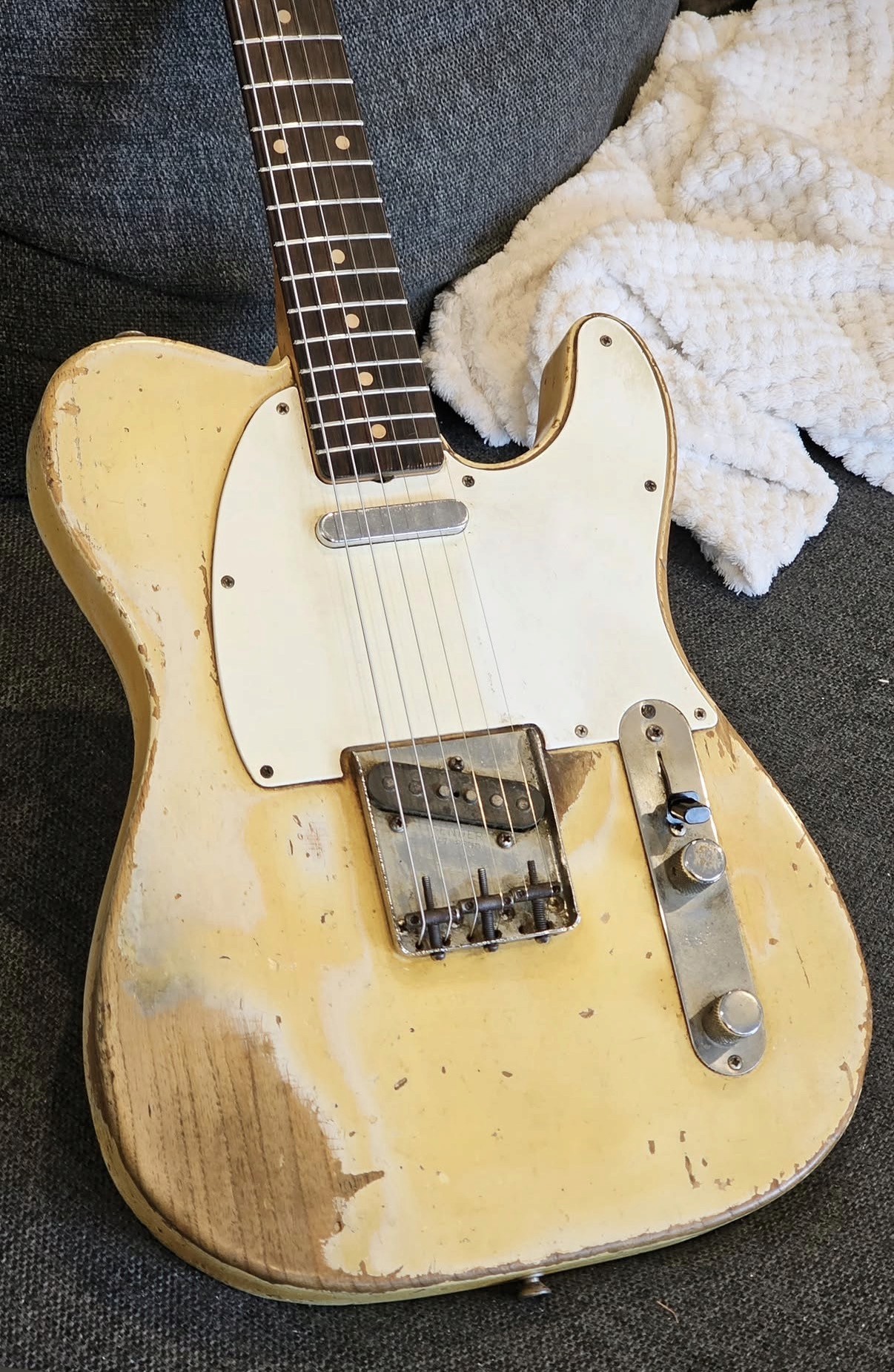
1962 Fender Telecaster: The Slab-to-Veneer Transition Year — Two Distinct Instruments in One Production Run
The 1962 Fender Telecaster spans the slab-to-veneer rosewood transition, so an early-1962 slab board and a late-1962 veneer board can read like two distinct instruments from the same year. Board profile, originality, and finish are central to value. Edgewater Guitars buys vintage Fender Telecasters nationwide with free expert appraisals and same-day cash offers. Call or text (440) 219-3607.
Last Updated: May 2026
What Makes the 1962 Fender Telecaster Significant?
No single year in pre-CBS Telecaster production presents more authentication complexity — or more collector opportunity — than 1962. This is the year Fender transitioned from the thick flat-bottomed slab rosewood fingerboard that had defined the instrument since mid-1959 to the thinner curved veneer rosewood board that would become standard through the remainder of the pre-CBS era and beyond. The transition happened mid-year, meaning that genuine 1962 Telecasters exist in two meaningfully different configurations: early 1962 instruments with the slab board and late 1962 instruments with the veneer board. Both are authentic. Both are valuable. But they are not the same instrument tonally, visually, or in terms of collector market positioning.
The slab-to-veneer transition is one of the most discussed topics in pre-CBS Fender authentication for good reason. The two fingerboard types are immediately distinguishable once you know what to look for — the slab board is approximately 4.8mm thick with a flat underside, while the veneer board is approximately 2.0mm thick with a curved underside that follows the radius of the neck. The practical tonal difference is audible in direct comparison: the slab board contributes more density to the neck assembly and produces a slightly warmer, more rounded attack; the veneer board allows more of the maple neck’s natural brightness to come through, producing a sound that sits closer to the maple-neck instruments of the mid-1950s than the thicker slab examples do.
Beyond the fingerboard transition, 1962 was a year of quiet refinement across the Telecaster line. Custom colors continued to expand in availability and documentation, and the three-ply celluloid pickguard had fully replaced the single-ply Bakelite as the dominant guard configuration. The pickups, bridge, and fundamental construction remained unchanged — the Formvar-wound Alnico V single-coils and brass saddle bridge that define the pre-CBS Telecaster sound carried on without alteration. In our experience buying pre-CBS Telecasters across Ohio and the Midwest, 1962 is the year that most frequently requires us to educate sellers about what they actually have — the slab-or-veneer question is often unknown to sellers, and the answer meaningfully affects the valuation conversation.
What makes the 1962 Telecaster distinctive:
Split production year: slab rosewood fingerboard (early 1962) transitioning to curved veneer rosewood fingerboard (mid-to-late 1962)
Slab board examples: flat-bottomed, approximately 4.8mm thick — last year of slab board production
Veneer board examples: curved underside, approximately 2.0mm thick — first year of veneer board production
Clay dot position markers throughout 1962 production on both board types
Three-ply celluloid pickguard now dominant configuration
Rounded soft C neck profile continues
Custom colors available across full palette
Serial numbers in the 72,000–84,000 range transitioning to L-prefix series late in the year
Butterfly string tree continues
Three-barrel brass saddle bridge unchanged
If you own a 1962 Telecaster, you may be sitting on a significant asset. Edgewater Guitars provides free, no-obligation valuations — call (440) 219-3607 or visit edgewaterguitars.com.
What Is a 1962 Fender Telecaster Worth? (2026 Market Values)
Value by Condition and Finish
The 1962 Telecaster market in 2026 operates on two distinct tracks depending on fingerboard type. Early slab board examples command a premium consistent with the broader slab board collector preference. Late veneer board examples are valued lower on a per-condition basis but remain strong pre-CBS instruments. Custom color examples at either end of the production year represent the top tier regardless of fingerboard type.
Condition | Configuration | Relative Value |
|---|---|---|
Excellent (8–9/10) | All original, custom color, slab board, original case | Premium-plus tier |
Excellent (8–9/10) | All original, custom color, veneer board, original case | Premium tier |
Excellent (8–9/10) | All original, blonde, slab board, original case | Strong-plus tier |
Excellent (8–9/10) | All original, blonde, veneer board, original case | Strong tier |
Very Good (7/10) | All original, either board type, no case | Mid-to-strong tier |
Good (6/10) | Original parts, finish wear | Mid tier |
Player Grade | Some replacements, heavy wear | Entry tier |
Modified | Non-original pickups, refin, or added routes | Significant reduction |
What Affects the Value of a 1962 Telecaster?
Fingerboard type: Slab board examples command a 15–25% premium over equivalent veneer board examples from the same year. The slab board is rarer within 1962 production — it represents only the first portion of the year — and carries the broader collector preference for the pre-veneer configuration.
Custom color: Any documented factory custom color places a 1962 Telecaster at the top tier regardless of fingerboard type. The combination of a slab board and a factory custom color in a 1962 Telecaster is exceptionally rare and commands a significant premium.
Originality: All-original examples command a 40–60% premium over modified instruments. Bridge pickup, tuners, and saddles remain the most commonly replaced components.
Fingerboard condition: Slab board examples are prone to shrinkage cracking. Intact crack-free slab boards add meaningful value; boards with significant cracking reduce value by 10–20%. Veneer boards are less prone to cracking but can develop finish checking at the board edges.
Original case: The original brown tolex case adds approximately 10–15% to value.
Clay dots: Original clay dots intact and unmodified are a confirmation of pre-CBS authenticity. Missing or replaced dots reduce value by 5–10%.
How 1962 Compares to Other Years
Year | Key Difference | Relative Value | Why |
|---|---|---|---|
1961 | Full slab board year throughout production | Similar to higher for slab | All 1961 examples are slab; no veneer variant exists |
1962 early (this post) | Last slab board Telecasters; transition occurring | Slab examples: similar to 1961 | Rarity of last-year slab within 1962 production |
1962 late (this post) | First veneer board Telecasters | Veneer examples: lower than slab | Veneer board less sought after than slab |
1963 | Full veneer board year; L-series serials | Lower than slab 1962 | Veneer standard throughout; no slab examples |
Edgewater Guitars consistently pays 30–40% more than typical guitar shops. Get your free valuation: edgewaterguitars.com or (440) 219-3607.
Recent Sales and Auction Results
The 1962 Telecaster market reflects the slab-versus-veneer premium clearly in recent auction results. Early 1962 slab board examples in all-original condition with custom colors represent some of the strongest results in the pre-CBS Telecaster category. Late 1962 veneer board examples in all-original condition sell at a meaningful discount relative to slab board equivalents but remain strong performers at major auction. Contact Edgewater for current market context specific to your instrument’s configuration and condition.
How to Identify an Authentic 1962 Fender Telecaster
Serial Numbers
Range for 1962: Approximately 72,000–84,000 (standard series) and early L-prefix numbers (L05000–L10000) appearing late in 1962
Location: Four-bolt neckplate
Important caveat: The L-prefix serial number system began appearing on some instruments in late 1962 and was fully in use by 1963. An L-prefix number alone does not confirm a 1963 date — some L-prefix instruments are genuine 1962 production. Always cross-reference with the neck date stamp and pot codes.
Neck Date
Format: Pencil-written or rubber-stamped, month and year (e.g., “4-62” or “APR 62”)
Location: Heel of the neck, visible only when the neck is removed from the body
Critical for 1962: The neck date is especially important for 1962 instruments because it helps determine which side of the slab-to-veneer transition a specific guitar falls on. A neck date of April through June 1962 or earlier is more likely to be a slab board; July through December 1962 is more likely to be a veneer board. However, the transition was gradual and the neck date alone is not definitive — the fingerboard must be physically examined.
Potentiometer Codes
Manufacturers: Stackpole (code 304) and CTS (code 137)
How to decode: Manufacturer code (3 digits) + year (2 digits) + week (2 digits)
Example: 137-1-45 = CTS, 1961, week 45 — appropriate for a guitar assembled in early 1962
Expected codes for 1962: Pots dated to 1961 or 1962 are correct. Pots from 1963 or later indicate modification or misrepresentation.
Location: Inside the control cavity, accessible by removing the control plate
Key Visual Identifiers
Fingerboard type — the primary 1962 identifier:
Slab board (early 1962): flat-bottomed, approximately 4.8mm thick, square heel profile visible when neck is removed
Veneer board (late 1962): curved underside following neck radius, approximately 2.0mm thick, curved profile visible when neck is removed
Position markers: Clay dots throughout 1962 production — matte, off-white, not pearl or celluloid
String tree: Butterfly-style stamped metal, consistent with all production since 1956
Neck profile: Rounded soft C continuing from 1960–1961 — approximately 0.84” at first fret, 0.92” at twelfth fret
Pickguard: Three-ply celluloid (white or tortoiseshell) — now the dominant configuration; single-ply Bakelite still appears on some early 1962 examples
Tuners: Kluson Deluxe, single-ring, plastic oval buttons
Bridge plate: Three-barrel brass saddles with threaded steel intonation screws
Logo: Spaghetti-style gold with black outline — original thin script, not yet transitioned
Neckplate: Four-bolt, no F-stamp — still pre-CBS configuration throughout 1962
Factory Markings and Stamps
Control cavity: Pencil body date sometimes present
Neck pocket: May show pencil date consistent with neck heel stamp
Underside of fingerboard: Visible when neck is removed — flat and square for slab board, curved and radiused for veneer board. This single observation resolves the slab-versus-veneer question definitively.
The Slab-to-Veneer Transition: How to Determine Which You Have
This is the defining authentication question for any 1962 Telecaster. The process is straightforward:
Remove the four neckplate screws and separate the neck from the body
Look at the underside of the fingerboard at the heel end
Slab board: Flat, square bottom — the rosewood is the same thickness across its entire width, approximately 4.8mm
Veneer board: Curved, radiused bottom — the rosewood follows the fingerboard radius, thinner at the edges than at the center, approximately 2.0mm at the center
The difference is immediately visible and easily measured with a ruler
No other method — serial number, neck date, pot codes — can substitute for this physical examination. Dating references suggest the transition occurred approximately mid-1962, but Fender’s production was not perfectly sequential and examples from the transition period require direct inspection.
Custom Color Identification
Custom color authentication on 1962 Telecasters follows the same protocol as other pre-CBS Fender custom colors:
Yellow sealer undercoat: Visible at wear points, in the neck pocket, and under UV examination
Correct primer sequence: Differs from typical refinish materials; detectable under UV light
Matching headstock: Many 1962 custom color examples have matching headstock color
Aged finish characteristics: Original 1962 nitrocellulose custom colors show specific aging patterns — Fiesta Red fading toward salmon, Sonic Blue yellowing toward seafoam, Olympic White yellowing toward cream
Neck pocket bleed: Original custom color typically bleeds slightly into the neck pocket during factory application
Red Flags: How to Spot Fakes and Refinishes
Wrong fingerboard for claimed production period: A veneer board claimed as an early 1962 slab board example — or vice versa — is the most common 1962-specific misrepresentation. Physical examination resolves this immediately.
Pearl or celluloid dots: Clay dots are correct for all 1962 production. Any bright pearl or celluloid dots indicate a replaced fingerboard or a later instrument.
F-stamped neckplate: The F-stamp was not present on 1962 instruments. Any F-stamped neckplate indicates a replaced plate or a post-CBS instrument.
Plastic-insulated wiring: Original 1962 control cavities used cloth-covered wire. Plastic insulation indicates replaced electronics.
Pot date mismatch: Pots dated 1963 or later in a claimed 1962 guitar indicate modification or misrepresentation.
L-prefix serial presented as definitively 1963: Some L-prefix serial numbers are genuine 1962 production. An L-prefix number alone does not exclude a 1962 date — neck date and pot codes must be examined.
Non-brass saddles: Original 1962 bridge saddles are three-barrel brass. Steel or synthetic saddle replacements are non-original.
In our experience evaluating 1962 Telecasters from the Ohio and Midwest region, the most common misrepresentation we encounter involves late 1962 veneer board instruments presented as early 1962 slab board examples — sometimes inadvertently by sellers who are simply unaware of the distinction, and occasionally by sellers who have been told the instrument is a slab board without verification. The physical examination takes approximately 30 seconds and resolves the question definitively.
Not sure which configuration your 1962 Telecaster has? Edgewater offers free authentication including in-person fingerboard examination. Call (440) 219-3607 or visit edgewaterguitars.com.
1962 Fender Telecaster Specifications
Specification | Early 1962 (Slab Board) | Late 1962 (Veneer Board) |
|---|---|---|
Body Wood | Ash (blonde) or alder (custom colors) | Ash (blonde) or alder (custom colors) |
Neck Wood | Maple with slab rosewood fingerboard | Maple with veneer rosewood fingerboard |
Fingerboard | Slab rosewood, flat-bottomed, ~4.8mm thick | Veneer rosewood, curved underside, ~2.0mm thick |
Fingerboard Radius | 7.25” | 7.25” |
Position Markers | Clay dots — matte, off-white | Clay dots — matte, off-white |
Neck Profile | Rounded soft C, ~0.84” at 1st fret | Rounded soft C, ~0.84” at 1st fret |
Nut Width | 1-5/8” (1.625”) | 1-5/8” (1.625”) |
Scale Length | 25.5” | 25.5” |
Frets | 21, narrow vintage wire | 21, narrow vintage wire |
Pickups | Fender single-coil, Alnico V, Formvar wire | Fender single-coil, Alnico V, Formvar wire |
Bridge | Three-barrel brass saddle, chrome plate | Three-barrel brass saddle, chrome plate |
Tuners | Kluson Deluxe, single-ring | Kluson Deluxe, single-ring |
Controls | Volume, tone, 3-position blade switch | Volume, tone, 3-position blade switch |
Pickguard | Three-ply celluloid or single-ply Bakelite | Three-ply celluloid |
Finish | Nitrocellulose lacquer | Nitrocellulose lacquer |
Available Colors | Blonde standard; full custom color palette | Blonde standard; full custom color palette |
Weight Range | 7.0–8.5 lbs | 7.0–8.5 lbs |
Case | Brown tolex case | Brown tolex case |
What Does a 1962 Fender Telecaster Sound Like?
Pickup Specifications and Tonal Profile
Pickup type: Single-coil, non-staggered pole pieces
DC Resistance (bridge): Approximately 7.0–7.5k ohms
DC Resistance (neck): Approximately 6.5–7.0k ohms
Wire type: Formvar-coated
Magnet type: Alnico V
Potting: Unpotted
The tonal character of the 1962 Telecaster depends meaningfully on which side of the fingerboard transition the instrument falls. Slab board examples share the slightly warmer, denser attack character of the 1960–1961 instruments — the rosewood mass contributes a rounded quality to the fundamental that tempers the upper frequencies without softening the Telecaster’s essential clarity. Veneer board examples allow more of the maple neck’s natural brightness through, producing a sound that sits closer to the maple-neck instruments of the 1950s while retaining the warmth of the rosewood surface. Both configurations share the same Formvar-wound Alnico V pickups and brass saddle bridge — the fingerboard accounts for a real but not dramatic tonal difference that experienced listeners can identify in direct comparison.
How Construction Details Affect Tone
The slab-to-veneer transition is the defining tonal variable of the 1962 Telecaster. The practical difference comes down to mass and density in the neck assembly. The 4.8mm slab board adds meaningful rosewood mass to the neck, which absorbs a portion of upper-frequency content and produces a slightly warmer attack. The 2.0mm veneer board contributes far less rosewood mass — the maple neck dominates the resonance characteristics — resulting in brighter upper frequencies and a more open, airy quality to the sustain. Neither is superior; each suits different playing contexts and player preferences. The slab board version is more sought after by collectors largely because it is the rarer configuration and associated with the earlier, more desirable production period.
The ash body on blonde instruments and alder body on custom color instruments continue to define the low- and high-frequency balance in the ways established throughout the pre-CBS period. The brass saddle bridge remains unchanged from 1950 production and continues to define the percussive, blooming attack character of the bridge position.
Notable Recordings
The 1962 Telecaster sound — in both slab and veneer board configurations — is documented across the transitional period of American popular music when country, rock and roll, and early soul were converging. The clarity and cut of the bridge position, the warmth of the neck position, and the combination position’s honky midrange character are audible throughout the recordings of this era across multiple genres. Don Rich and Buck Owens continued developing the Bakersfield Telecaster vocabulary in this period using instruments from this precise production window.
Common Issues and Modifications That Affect Value
Slab board cracks (early 1962 only): Shrinkage cracks across the rosewood grain remain the most common condition issue for slab board examples. Value impact: 10–20% depending on severity.
Fingerboard misrepresentation: A veneer board instrument presented as a slab board example — whether intentional or inadvertent — is the most significant valuation issue specific to 1962. Always physically verify the fingerboard type before accepting any 1962 valuation.
Replaced bridge pickup: The most common electronic modification. Value impact: 20–30% reduction. Original retained and included reduces impact to approximately 10–15%.
Replaced bridge saddles: Original three-barrel brass saddles frequently replaced with steel alternatives. Value impact: 8–12%.
Replaced tuners: Kluson originals replaced with Grovers or Schallers. Value impact: 10–15%; fully reversible if originals retained.
Refinished body: Correct color refinish: 40–55% reduction. Non-original color: 55–70% reduction.
Custom color touch-up or overspray: Partial refinishes on custom color instruments reduce value by 20–35% depending on extent.
Refretted neck: Professional refret with correct narrow vintage wire: 5–10% reduction. Modern fret wire: 10–15% reduction.
Headstock crack or repair: Professionally repaired cracks reduce value by 25–40%.
Missing or replaced clay dots: Value impact: 5–10%; alters visual authentication profile.
In Edgewater’s experience with 1962 Telecasters, the fingerboard type question is almost always the first thing we address in an evaluation — and it frequently changes the seller’s understanding of what they have. We have evaluated guitars presented as slab board examples that proved on inspection to be veneer board instruments, and vice versa. The physical examination takes seconds and the information is essential to accurate valuation.
Selling Your 1962 Fender Telecaster: Your Options Compared
Selling Option | Typical Offer | Timeline | Fees/Costs | Risk Level | Best For |
|---|---|---|---|---|---|
Edgewater Guitars | 30–40% above shop offers | Immediate cash | None | Low — expert authentication included | Owners wanting fair value without hassle |
Local Guitar Shop | Wholesale pricing (lowest) | Same day | None direct, but lowest price | Low | Convenience over value |
Reverb / eBay | Variable — potentially higher | Weeks to months | 5–15% platform fees + shipping | High — fraud, damage, disputes | Experienced sellers comfortable with risk |
Auction House | Variable | 3–6 months | 15–25% seller premium | Medium | Custom color or exceptional examples |
Private Sale | Variable | Unpredictable | None | High — authentication burden on you | Sellers with existing buyer network |
The 1962 Telecaster is an instrument where accurate authentication is the prerequisite for accurate valuation. A seller who does not know whether their guitar has a slab or veneer fingerboard is working with incomplete information — and a buyer or shop that does not verify it is either uninformed or hoping the seller is. Edgewater’s in-person evaluation process addresses the fingerboard question immediately and builds our offer on accurate information rather than assumptions.
Our process: contact us with photos and basic details, receive a preliminary valuation within 24 hours, arrange in-person evaluation anywhere in Ohio, Michigan, Pennsylvania, Indiana, or West Virginia. We make an immediate cash offer based on what the instrument actually is — not what it might be assumed to be.
Ready to find out what your 1962 Fender Telecaster is worth? Get your free, no-obligation valuation: edgewaterguitars.com or call (440) 219-3607.
Frequently Asked Questions About the 1962 Fender Telecaster
Q: What is a 1962 Fender Telecaster worth in 2026? A: Value depends on fingerboard type, finish, and originality. Early 1962 slab board examples command a 15–25% premium over equivalent veneer board instruments. Custom color examples represent the top tier regardless of board type. All-original blonde examples in excellent condition occupy the strong tier. Contact Edgewater Guitars for a free valuation specific to your instrument’s configuration.
Q: How do I know if my 1962 Telecaster has a slab or veneer fingerboard? A: Remove the four neckplate screws and separate the neck from the body. Look at the underside of the fingerboard at the heel end. A slab board is flat-bottomed and approximately 4.8mm thick. A veneer board has a curved underside following the fingerboard radius and measures approximately 2.0mm thick. The difference is immediately visible and requires no special tools.
Q: When exactly did Fender switch from slab to veneer fingerboards in 1962? A: The transition occurred approximately mid-1962, but Fender’s production was not perfectly sequential and the exact cutover point varied. Instruments from the transition period must be physically examined — neck date and serial number provide general guidance but cannot substitute for direct fingerboard inspection.
Q: What serial numbers cover 1962 Fender Telecasters? A: Approximately 72,000–84,000 in the standard series, with early L-prefix numbers (L05000–L10000) appearing on some late 1962 production. The L-prefix alone does not confirm a 1963 date — some L-prefix instruments are genuine 1962 production. Cross-reference with neck date and pot codes.
Q: Are clay dots present on both slab and veneer board 1962 Telecasters? A: Yes. Clay dots — matte, off-white, non-reflective — are correct for all 1962 production regardless of fingerboard type. Pearl or celluloid dots on a claimed 1962 Telecaster indicate a replaced fingerboard or a later instrument.
Q: What is the tonal difference between a slab and veneer board 1962 Telecaster? A: The slab board contributes more rosewood mass to the neck assembly, producing a slightly warmer attack and more rounded fundamental. The veneer board allows more of the maple neck’s brightness through, producing a sound closer to the maple-neck instruments of the 1950s. Both share the same pickups and bridge hardware — the fingerboard accounts for a real but not dramatic tonal difference.
Q: Does Edgewater Guitars buy 1962 Fender Telecasters? A: Yes. We actively purchase 1962 Telecasters in all configurations — slab board, veneer board, custom color, blonde, player-grade, and modified. We pay 30–40% more than local guitar shops and provide immediate cash payment. Call (440) 219-3607 or visit edgewaterguitars.com.
Q: How does a custom color affect the value of a 1962 Telecaster? A: A documented factory custom color places any 1962 Telecaster at the top tier of the market regardless of fingerboard type. The combination of a slab board and a factory custom color in a 1962 Telecaster is exceptionally rare and commands a significant premium. All custom color claims require authentication — Edgewater provides this at no charge.
Q: Should I remove the neck to check the fingerboard before contacting Edgewater? A: You can safely remove the neckplate screws and separate the neck to check the fingerboard — this is a standard and non-damaging procedure on a bolt-on neck instrument. However, if you are uncertain about any aspect of the process, Edgewater will perform the examination during our in-person evaluation at no charge and with no obligation.
Q: How long does it take to sell a vintage guitar to Edgewater? A: Typically 24–72 hours from initial contact to cash in hand. We provide a preliminary valuation promptly, arrange in-person evaluation for high-value instruments, and make an immediate cash offer with no obligation.
Related Resources
Useful next reads and tools for this guitar:
Sell your 1962 Fender Telecaster
Edgewater Guitars buys vintage Fender Telecasters and other vintage Fenders nationwide. We give free, honest appraisals and fair same-day cash offers, with local pickup or insured nationwide shipping. Call or text (440) 219-3607 or request a free estimate.
How much is a 1962 Fender Telecaster worth?
A clean, all-original 1962 Fender Telecaster’s value depends on originality, condition, finish, and whether the pickups, wiring, and hardware are original. Because Edgewater buys directly and resells, we can typically pay more than local shops or pawn stores. The most accurate way to find out is a free appraisal: send a few photos and the serial number and we will give you an honest market assessment.
Where can I sell a 1962 Fender Telecaster?
Edgewater Guitars buys them directly, nationwide, with same-day cash offers and no obligation. You can also date yours with our Fender serial number lookup.