DATE :
1961 Gibson ES-345: Stereo Innovation Meets Classic Semi-Hollow Design
1961 Gibson ES-345: Stereo Innovation Meets Classic Semi-Hollow Design
The 1961 Gibson ES-345 is a stereo semi-hollow positioned a step above the ES-335, with dual humbuckers, the Varitone tone circuit, gold hardware, and split-parallelogram inlays. Originality, the Varitone, the pickups, and condition drive value. Edgewater Guitars buys vintage Gibson semi-hollows nationwide with free expert appraisals and same-day cash offers. Call or text (440) 219-3607.
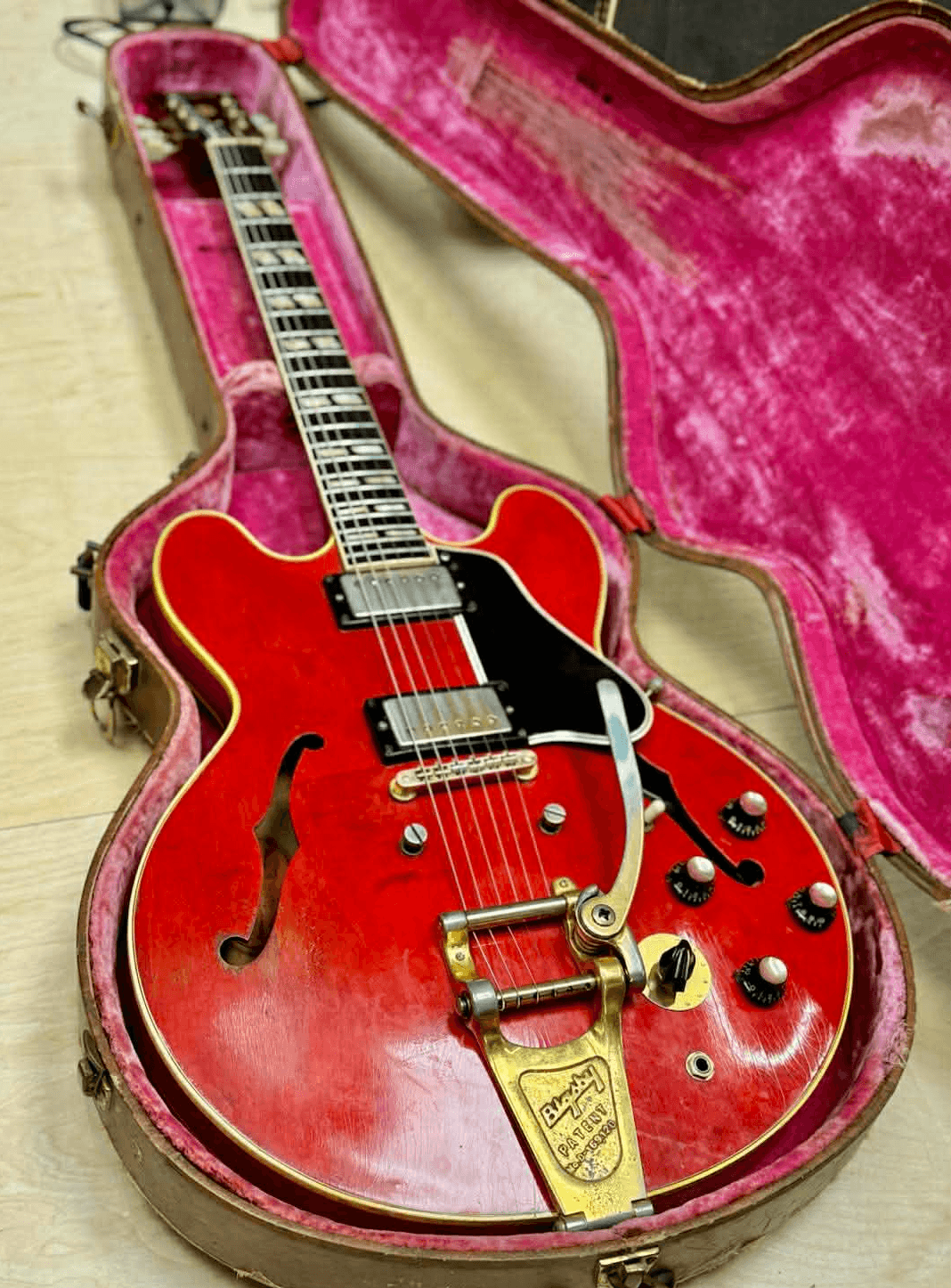
The 1961 Gibson ES-345 represents the perfect intersection of traditional semi-hollow craftsmanship and cutting-edge electronic innovation. Introduced in 1959 as the middle child between the ES-335 and the luxurious ES-355, the ES-345 featured stereo output capability and the revolutionary Varitone circuit—a six-position tone selector that offered unprecedented tonal versatility. When equipped with a Bigsby vibrato and finished in cherry red, the 1961 ES-345 became one of the most visually striking and sonically versatile guitars Gibson ever produced.
Why the 1961 ES-345 Matters
The 1961 Gibson ES-345 sits at a pivotal moment in semi-hollow guitar evolution. By 1961, Gibson had refined the ES series design following its introduction in 1958, perfecting the construction techniques and electronics that would define the model for decades. The ES-345 offered players the core virtues of the ES-335—warm, feedback-resistant tone and comfortable playability—enhanced with premium appointments and the innovative Varitone circuit.
What makes 1961 particularly significant:
Peak pre-CBS era Gibson quality with meticulous craftsmanship
Original PAF humbuckers (though transitioning to patent numbers by late 1961)
Mickey Mouse ear cutaways before the pointed cutaway change of 1963
Stereo output capability for groundbreaking tonal experimentation
Six-position Varitone circuit offering unique tonal options
Gold hardware throughout including premium Bigsby vibrato
Split-parallelogram inlays distinguishing it from the ES-335
Thinner body profile than full-depth hollowbodies (1-11/16”)
Early production numbers making 1961 examples relatively rare
Historical Context: Gibson’s Electronic Innovation
By 1961, Gibson was pushing the boundaries of electric guitar electronics. The company had already revolutionized pickup design with the PAF humbucker in 1957, and the semi-hollow ES series launched in 1958 had proven that feedback-resistant thin-line guitars could deliver jazz tone with rock and roll versatility. The ES-345, introduced in 1959, represented Gibson’s attempt to offer something beyond basic pickup selection—the Varitone circuit allowed players to sculpt their tone in ways previously impossible.
The Varitone was essentially a series of capacitors and choke coils that could be switched into the signal path, creating notch filter effects. While some players found it gimmicky, others (particularly jazz players and experimentalists) appreciated the tonal variations it provided. The stereo output capability—with each pickup routed to a separate output jack—opened up possibilities for studio recording and dual-amp setups.
The 1961 ES-345 featured several year-specific characteristics that make it particularly desirable to collectors. This was the last full year of PAF humbucker production before Gibson transitioned to patent-number pickups (the patent was granted in 1962). The rounded “Mickey Mouse ear” cutaways of 1961 would give way to sharper, more angular cutaways in 1963, making the 1961 models the last of the original rounded design.
Notable artists who gravitated toward ES-345s during this period included jazz players seeking stereo recording capabilities and rock players attracted to the premium appointments and tonal versatility. While the ES-335 remained more popular overall, the ES-345 found favor with players who wanted something special.
Detailed Identification Guide
Serial Numbers
1961 Gibson ES-345 guitars feature serial numbers in the 50000-60000 range, impressed (stamped) into the back of the headstock. However, Gibson’s serial number system during this transitional period had significant overlap, and some late 1961 production may have serial numbers beginning with “A” prefix indicating the new system starting in 1961.
Common 1961 serial ranges:
Early 1961: 50000-54000
Mid 1961: 54000-58000
Late 1961: 58000-61000 or A-100 through A-1000
Important: Serial numbers alone are insufficient for precise dating. Always cross-reference with FON and pot codes.
Factory Order Number (FON)
The Factory Order Number is stamped on an orange or white label visible through the bass-side f-hole. 1961 FONs appear in this format:
Letter prefix (indicating model/configuration)
Space
Year digit (1 = 1961)
Four-digit sequence number
Example: T 1 2847 or similar format
The label will also include model designation (ES-345TD) and finish information.
Potentiometer Codes
1961 ES-345 guitars used CTS or Centralab potentiometers with date codes:
CTS Format: 137-61XX (where 137 = CTS, 61 = 1961, XX = week) Centralab Format: 134-61XX (where 134 = Centralab, 61 = 1961, XX = week)
Pots dated from late 1960 (60-40 through 60-52) through 1961 (61-01 through 61-52) are correct for 1961 guitars. Gibson commonly used pots from several months prior, so finding late 1960 pots in a 1961 guitar is normal.
Varitone Circuit: The ES-345’s six-position rotary switch (Varitone) complicates the control cavity—expect to see additional wiring and components beyond standard pot configurations.
PAF vs. Patent Number Pickups
The 1961 ES-345 is transitional for pickup types:
Early 1961 (PAF Humbuckers):
“Patent Applied For” sticker on bottom (or no sticker on some)
Long or short A5 Alnico magnets
DC resistance typically 7.5k-8.5k ohms
Double black or zebra bobbins
No patent number stamp on baseplate
Late 1961 (Patent Number Humbuckers):
“PATENT NO. 2,737,842” stamped on baseplate
Otherwise similar construction to PAFs
DC resistance similar range (7.5k-8.5k)
Double black or zebra bobbins
Fully potted in wax
The transition occurred gradually throughout 1961, with some guitars receiving PAFs as late as early 1962 if Gibson was using up remaining stock. PAF-equipped examples command significant premiums.
Detailed Physical Specifications
Body Construction
Design: Thinline semi-hollow with laminated maple top, back, and sides
Center Block: Solid maple block running through body center
Depth: 1-11/16” (same as ES-335)
Width: 16” at lower bout
Cutaways: Double cutaway with rounded “Mickey Mouse ear” design (1961 specification)
Weight: Typically 8-9 lbs
Finish: Thin nitrocellulose lacquer in cherry red (fades to lighter hue with UV exposure)
Binding: Multi-ply white/black binding on top, back, and f-holes
F-holes: Bound f-holes (distinguishing feature from ES-335)
The laminated maple construction provided feedback resistance while the center block added sustain and stability. The result was a guitar that could handle high volumes without the howling feedback of fully hollow instruments.
Neck Specifications
Construction: Set mahogany neck with long tenon
Profile: Medium C-shape (transitional between fat ‘50s and slim ‘60s)
Width at Nut: 1-11/16” (1.6875”)
Scale Length: 24.75” (Gibson standard)
Fretboard: Bound Brazilian rosewood
Frets: Medium wire
Inlays: Split-parallelogram mother-of-pearl inlays (ES-345 signature feature)
Headstock: Bound headstock with crown inlay
Headstock Angle: 17 degrees (traditional Gibson pitch)
Truss Rod: Single-action, accessed through cover plate
The split-parallelogram inlays were the key visual differentiator between the ES-345 and the more common ES-335 (which featured dot inlays until 1962, then block inlays).
Hardware (Gold-Plated Throughout)
Tuners:
Kluson Deluxe with single-ring, plastic buttons
Gold-plated finish
“Kluson Deluxe” stamp on backplate
Six-on-a-side configuration
Bridge:
ABR-1 Tune-O-Matic bridge
Gold-plated finish
Rosewood or ebony base
Wire retainer holding bridge in place
Bigsby Vibrato:
Bigsby B7 vibrato tailpiece (gold-plated)
Long tremolo arm with plastic tip
Roller bridge saddles prevent string binding
“Bigsby” logo stamped on tailpiece
Original Bigsby spring and tension bar
Pickguard:
Multi-ply (5-ply) raised pickguard
Beveled edges
Mounted with chrome bracket at neck
“ES-345TD STEREO” designation on some examples
Control Knobs:
Gold “reflector” knobs with metal inserts
Two volume controls
Two tone controls (with Varitone on one)
Black pointer inserts
Electronics Layout
The ES-345’s electronics are considerably more complex than standard Gibson wiring:
Pickups:
Two humbuckers (PAF or early patent number)
Neck and bridge positions
Gold-plated covers
Controls:
Volume control for neck pickup
Volume control for bridge pickup
Tone control for neck pickup
Tone/Varitone control for bridge pickup (combines tone pot with Varitone switch)
Three-way toggle switch (neck/both/bridge)
Six-position Varitone rotary switch
Output Configuration:
Two output jacks (stereo configuration)
Mono operation: Use either jack with standard cable
Stereo operation: Use both jacks with Y-cable to separate amps/channels
Each pickup can be routed to separate output in stereo mode
Varitone Circuit:
Six positions offering different tonal colorations
Position 1: Bypass (standard tone)
Positions 2-6: Various capacitor/choke combinations creating notch filters
Most players found positions 1-3 most usable
Creates “cocked wah” type effects in higher positions
Wiring:
Cloth-covered wiring throughout
Complex routing for stereo and Varitone capabilities
Shielded where necessary
Original wiring often shows inspection marks or solder tags
Tonal Characteristics
The 1961 Gibson ES-345 with PAF pickups delivers one of the most versatile and musical semi-hollow tones ever produced:
Neck Pickup (Standard Mode)
The PAF humbucker in the neck position of an ES-345 produces warm, vocal-like tones perfect for jazz and blues. The semi-hollow construction adds acoustic resonance and harmonic complexity that solid-body guitars can’t match. The neck pickup excels at:
Jazz: Warm, round tones with excellent clarity for complex chord voicings
Blues: Vocal-like sustain perfect for expressive lead playing
Rhythm work: Full-bodied chords with balanced frequency response
Clean tones: Beautiful clarity with natural compression
Bridge Pickup (Standard Mode)
The bridge PAF delivers focused midrange with excellent definition. The combination of the maple center block and semi-hollow wings creates a tone that’s thicker than a solid-body Telecaster but tighter than a full-depth hollowbody. Perfect for:
Rock and roll: Cutting lead tones with sustain
Blues: Stinging lead tones with character
Country: Articulate picking with warmth
Funk and R&B: Crisp rhythm tones
Middle Position
Combining both pickups creates a scooped, slightly hollow tone with excellent clarity—perfect for clean rhythm playing and jangly passages. The semi-hollow construction adds shimmer and dimension.
Varitone Circuit Effects
The six-position Varitone offers tonal variations:
Position 1: Bypass (standard tone—most commonly used)
Position 2: Slight treble roll-off (subtle warming)
Position 3: More pronounced mid-scoop (useful for clean tones)
Position 4: Dramatic mid-scoop (“cocked wah” effect)
Position 5: Extreme filtering (novelty tones)
Position 6: Maximum filtering (rarely used)
Many players left the Varitone in position 1 for standard operation, viewing it as an occasional special effect rather than a primary tonal tool. However, jazz players and experimentalists found creative uses for the various positions.
Stereo Operation
When used in stereo mode with dual amplifiers:
Each pickup feeds a separate amp
Allows for different effects on each pickup
Creates wide stereo image
Studio-friendly for recording versatility
Live applications for complex tonal setups
Overall Character with Bigsby
The Bigsby vibrato adds subtle harmonic shimmer and allows for gentle pitch bending effects. Unlike aggressive Stratocaster tremolo, the Bigsby provides tasteful vibrato perfect for jazz, blues, and country applications. The Bigsby does slightly reduce sustain compared to stop tailpiece versions, but many players consider this a worthwhile tradeoff for the expressive possibilities.
Why It Sounds Different from ES-335: The ES-345’s bound f-holes, additional electronics, and premium construction contribute to slightly more refined tones. While the fundamental voice is similar to an ES-335, the ES-345 tends to have slightly enhanced clarity and more complex harmonic overtones. The Varitone circuit (even in bypass mode) adds minimal capacitance to the signal path, subtly affecting tone.
Common Issues & Modifications
Varitone Circuit Problems
The Varitone circuit is complex and prone to issues:
Crackling or dead positions: Rotary switch contacts oxidize over time
Complete failure: Capacitors or choke coils can fail
Bypass modifications: Some owners bypass the Varitone entirely (reduces value by 15-20%)
Repair costs: Professional Varitone repair can be costly
Non-original components: Some have been “restored” with incorrect parts
Impact on Value: A non-functional Varitone reduces value, and bypassed or removed Varitone circuits reduce value by 15-20%.
Stereo Wiring Issues
The dual-output stereo system adds complexity:
Missing or incorrect output jacks: Some have been converted to single output
Damaged wiring: The extra wiring is vulnerable to aging and breakage
Incorrect repairs: Many techs unfamiliar with stereo wiring make mistakes
Mono conversion: Some owners simplified to mono operation (reduces value)
Impact on Value: Converted to mono operation reduces value by 10-15%.
Pickup Modifications
PAF Replacement:
Some early examples had PAFs replaced with newer pickups
Original PAFs are highly sought after and add significant value
Replacement pickups reduce guitar value by 25-35%
Patent-number replacements for original PAFs reduces value by 15-20%
Pickup Covers:
Gold plating on covers often worn through to nickel underneath
Some covers removed entirely (reduces value slightly)
Reproduction covers sometimes installed
Bigsby Issues
Wear and Functionality:
Bigsby springs weaken over time
Roller saddles may show wear
Gold plating often worn on contact points
Tension bar may be bent or damaged
Replacement or Removal:
Some Bigsbys replaced with non-original units (which reduces value)
Some guitars converted to stop tailpiece (reduces value by 5-10%)
Original Bigsby configuration essential for maximum value
Filled Bigsby mounting holes indicate modification
Binding and Finish Issues
Binding Shrinkage:
Multi-ply binding can shrink with age
Creates gaps between binding and wood
Particularly common on neck binding
Professional rebinding possible but expensive
Cherry Red Fading:
Cherry finish naturally fades to lighter, more orange hue with UV exposure
Severe fading (nearly blonde) reduces appeal slightly
Sunburst finishes more stable but can still fade
Natural aging preferred over refinishing
Finish Checking:
Nitrocellulose naturally checks with age
Fine checking is desirable and expected
Heavy alligatoring may reduce appeal slightly
Original finish with checking vastly preferred over refinish
Structural Concerns
Neck Joint Issues:
Check for separation at neck heel
Look for cracks around neck joint
Long tenon construction is strong but can develop issues
Binding Separation:
Body binding can separate from wood
F-hole binding particularly vulnerable
Repairs possible but affect originality
Center Block Cracks:
Rare but possible in maple center block
Usually doesn’t affect playability
Can affect collector value if severe
Hardware Wear
Gold Plating Wear:
Gold plating on all hardware wears through to nickel
Honest wear preferred over re-plating
Heavy wear reduces aesthetic appeal but not playability
Re-plated hardware reduces collector value
Tuner Replacement:
Original Kluson tuners often replaced with Grovers
Reduces value
Enlarged tuner holes cannot be easily reversed
Why Players Love 1961 ES-345 Guitars
Playing Comfort
The ES-345 offers exceptional ergonomics:
Thinline body: Comfortable against the body, easier to manage than full-depth hollowbodies
Balanced weight: 8-9 lbs is substantial but not excessive
Neck profile: Comfortable C-shape allows extended playing
Upper fret access: Double cutaway provides excellent reach
Smooth fretboard: Bound rosewood with medium frets feels luxurious
Tonal Versatility
The ES-345’s combination of features makes it remarkably versatile:
Jazz players appreciate the warm neck pickup and premium appointments
Blues players love the expressive sustain and feedback resistance
Rock players value the cutting bridge pickup and sustain
Studio musicians exploit the stereo capabilities and Varitone options
Country players appreciate the Bigsby and articulate pickups
Visual Appeal
The 1961 ES-345 in cherry red with Bigsby is stunning:
Elegant cherry finish with beautiful grain
Gold hardware throughout
Distinctive split-parallelogram inlays
Bound f-holes and headstock
Premium aesthetic competing with the ES-355 at lower cost
Historical Significance
The ES-345 represents Gibson’s electronic innovation during the golden era. While the ES-335 became more famous, the ES-345 offered enhanced capabilities for players willing to explore. These guitars capture a moment when manufacturers were pushing boundaries and experimenting with new technologies.
Investment Value
1961 ES-345 guitars have appreciated consistently:
PAF-equipped examples command strong premiums
Stereo and Varitone features increasingly appreciated
Mickey Mouse ear design more desirable than later pointed cutaways
Growing recognition as premium alternative to ES-335s
Limited production numbers ensure relative rarity
Selling Your 1961 Gibson ES-345
If you own a 1961 Gibson ES-345 in cherry red with Bigsby and PAF pickups, you possess a remarkable instrument that combines vintage Gibson craftsmanship with innovative electronics. These guitars have appreciated significantly as collectors recognize them as premium alternatives to ES-335s with unique capabilities.
Why Choose Edgewater Guitars?
Specialized ES Series Expertise: We understand the critical differences between ES models and can properly evaluate:
PAF vs. patent number pickup authenticity
Varitone circuit functionality
Stereo wiring integrity
Original Bigsby verification
Year-specific construction details
Mickey Mouse ear vs. pointed cutaway values
Premium Valuations: Our offers typically exceed local guitar shop quotes by 30-40% because we recognize the features that make 1961 ES-345s valuable:
PAF pickups command significant premiums
Working Varitone circuits add substantial value
Original stereo wiring is increasingly rare
Cherry red finish in good condition is desirable
Original Bigsby vibrato is essential
Comprehensive Authentication: We provide detailed analysis including:
Factory Order Number verification from label
Potentiometer code dating
Serial number cross-referencing
PAF pickup verification and DC resistance testing
Varitone functionality testing
Bigsby originality assessment
Finish authenticity evaluation
Structural integrity inspection
Immediate Payment: No consignment arrangements, no waiting for the right buyer, no auction uncertainties. We make immediate cash offers on premium ES-345 guitars.
White-Glove Service: For high-value guitars like 1961 ES-345s with PAF pickups, we travel throughout Ohio, Michigan, Pennsylvania, Indiana, and West Virginia for in-person evaluations. We bring professional equipment for thorough assessment.
Transparent Process: We explain exactly how we determined our valuation, sharing comparable sales data and explaining the specific features that affect value. We understand these guitars represent significant investments.
Ready to sell your 1961 Gibson ES-345? Get your free valuation or call us directly at (440) 219-3607.
Related Resources
Need help identifying or dating your vintage Gibson ES-345?
Complete Gibson Serial Number Lookup Tool
Gibson Factory Order Number (FON) Guide
How to Date Gibson Potentiometers
PAF vs. Patent Number Pickup Identification
Gibson ES-335 vs. ES-345 vs. ES-355: Complete Comparison
Understanding Gibson’s Varitone Circuit
Authenticating Gibson Cherry Red Finishes
Contact us today for your free, no-obligation valuation: (440) 219-3607
By Stephen Pedone, co-owner of Edgewater Guitars. Edgewater is a vintage guitar shop in Valley City, Ohio that buys pre-1970 Fender, Gibson, Martin and Gretsch guitars across Ohio and nationwide. Call or text (440) 219-3607 for a free appraisal.
Sell your 1961 Gibson ES-345
Edgewater Guitars buys vintage Gibson semi-hollows and other vintage Gibsons nationwide. We give free, honest appraisals and fair same-day cash offers, with local pickup or insured nationwide shipping. Call or text (440) 219-3607 or request a free estimate.
How much is a 1961 Gibson ES-345 worth?
Value depends on originality, condition, finish, and whether the pickups, electronics, and hardware are original. The most accurate way to find out is a free appraisal. Send a few photos and the serial number and we will give you an honest market assessment.
Where can I sell a 1961 Gibson ES-345?
Edgewater Guitars buys them directly, nationwide, with same-day cash offers and no obligation. You can also date yours with our Gibson serial number lookup.