DATE :
1960 Fender Telecaster: The Slab Rosewood Standard — First Full Year of the New Fingerboard Era
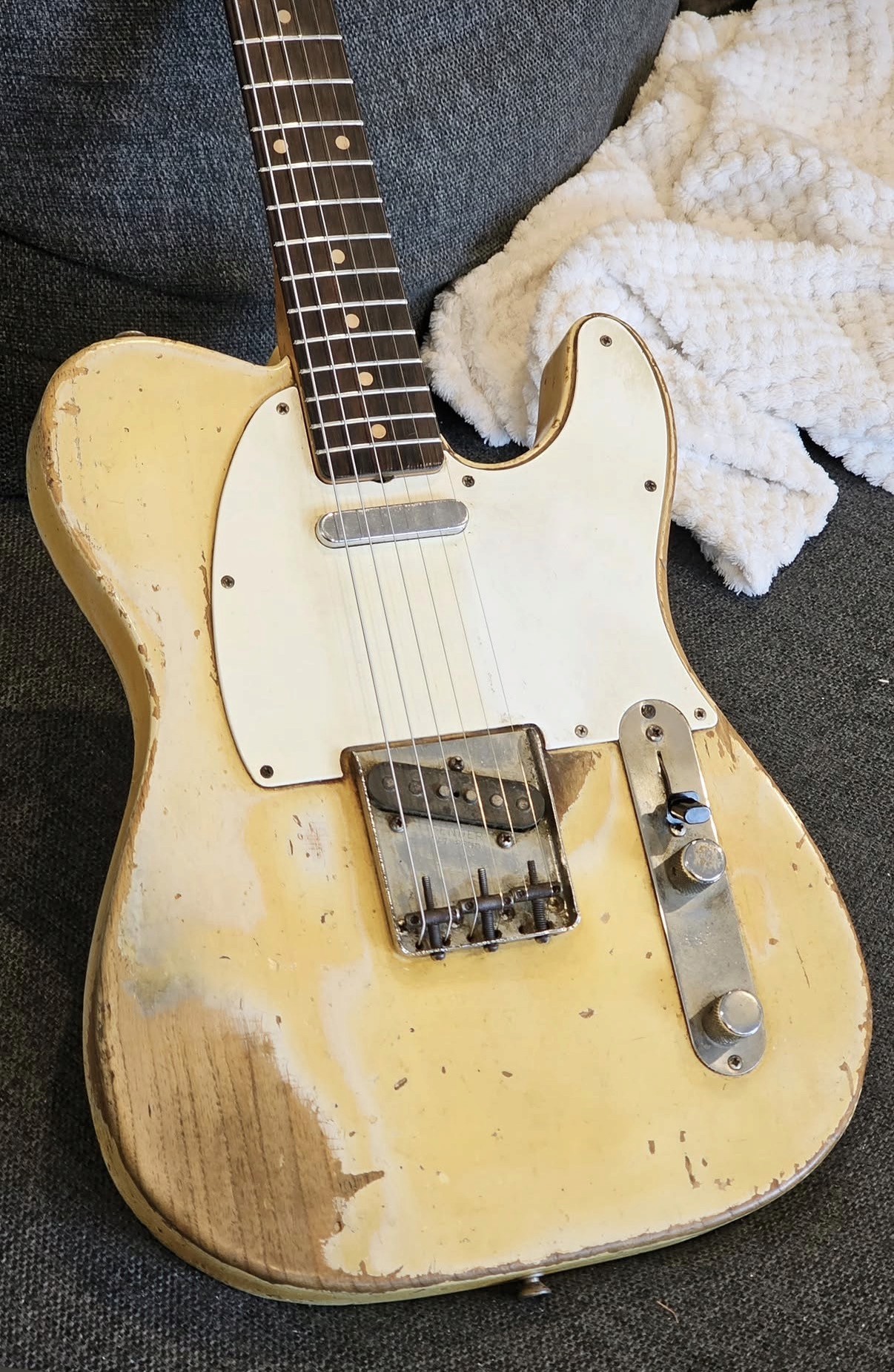
1960 Fender Telecaster: The Slab Rosewood Standard — First Full Year of the New Fingerboard Era
The 1960 Fender Telecaster is the first full year of the slab-rosewood fingerboard, a pre-CBS Tele that pairs the classic single-coil bite with the warmth of the new rosewood board. Original finish, the slab board, pickups, and overall condition matter most when valuing one. Edgewater Guitars buys vintage Fender Telecasters nationwide with free expert appraisals and same-day cash offers. Call or text (440) 219-3607.
Last Updated: May 2026
What Makes the 1960 Fender Telecaster Significant?
The 1960 Fender Telecaster marks one of the most consequential material transitions in the instrument’s history. Rosewood had been introduced as a fingerboard option on Fender instruments in mid-1959, initially appearing as a thick flat-bottomed slab glued directly to the maple neck. By 1960, this slab rosewood fingerboard had become the standard configuration across Telecaster production — the first full calendar year in which a buyer walking into a music store would receive a rosewood-board instrument as the default rather than the exception.
This transition was not cosmetic. The slab rosewood fingerboard of 1960 — cut flat on its underside and running approximately 4.8mm thick — changes the tonal character of the instrument in measurable ways. The additional density of the rosewood layer absorbs some of the upper-frequency attack that defines the pure maple-neck Telecaster sound, producing a slightly warmer, more rounded fundamental while retaining the essential single-coil clarity. Players who find the pre-1959 maple-neck Telecaster slightly bright for their application often find the 1960 slab board version sits more comfortably in a mix without EQ adjustment.
The neck profile in 1960 continued the transition away from the V-shape of the mid-1950s toward a rounder, softer C profile — still substantial by modern standards, but noticeably different from the pronounced V of 1955–1957. Custom colors also became a more formal Fender offering in this period, and while butterscotch blonde remained the dominant Telecaster finish, the first properly documented Telecaster custom color examples begin appearing in 1960 production. In our experience buying pre-CBS Telecasters across Ohio and the Midwest, 1960 examples are frequently the first year many sellers encounter — the rosewood board makes them more immediately familiar to players accustomed to modern instruments, which can actually suppress their perceived value relative to the rarer maple-neck years.
What makes the 1960 Telecaster distinctive:
First full production year with slab rosewood fingerboard as standard
Flat-bottomed slab board approximately 4.8mm thick — distinctly different from the thinner curved veneer board introduced in late 1962
Rounded C neck profile — transitioning away from the V-shape of the mid-1950s
Custom colors becoming a formal Fender option — Telecaster examples rare but documented
Butterfly string tree continues
Three-barrel brass saddle bridge unchanged
Alnico V single-coil pickups with Formvar wire
Clay dot position markers — not pearl, not celluloid
Three-ply celluloid pickguard begins appearing alongside single-ply Bakelite
If you own a 1960 Telecaster, you may be sitting on a significant asset. Edgewater Guitars provides free, no-obligation valuations — call (440) 219-3607 or visit edgewaterguitars.com.
What Is a 1960 Fender Telecaster Worth? (2026 Market Values)
Value by Condition and Finish
The 1960 Telecaster market in 2026 reflects a clear hierarchy: custom color examples at the top regardless of condition, all-original standard blonde examples next, and player-grade or modified instruments at a meaningful discount. The slab rosewood fingerboard in clean, uncracked condition is a significant value driver — slab boards are more prone to shrinkage cracks than the later veneer boards, and intact examples command a premium.
Condition | Originality | Relative Value |
|---|---|---|
Excellent (8–9/10) | All original, custom color, original case | Premium-plus tier |
Excellent (8–9/10) | All original, butterscotch blonde, original case | Premium tier |
Very Good (7/10) | All original, no case | Strong tier |
Good (6/10) | Original parts, finish wear, slab board intact | Mid tier |
Player Grade | Some replacements, heavy wear | Entry tier |
Modified | Non-original pickups, refin, or added routes | Significant reduction |
What Affects the Value of a 1960 Telecaster?
Fingerboard condition: The slab rosewood fingerboard of 1960 is prone to developing shrinkage cracks across the grain, particularly in climates with wide humidity swings — common in Ohio and the Midwest. An intact, crack-free slab board adds meaningful value; a board with significant cracking reduces value by 10–20% depending on severity and whether the cracks affect playability.
Custom color: Any documented factory custom color on a 1960 Telecaster places it in the premium-plus tier regardless of other condition factors. Custom color Telecasters from this era are substantially rarer than Stratocaster equivalents from the same year.
Originality: All-original examples command a 40–60% premium over modified instruments. Bridge pickup, tuners, and saddles remain the most commonly replaced components.
Neck integrity: The rounded C profile of 1960 is less aggressively shaped than the V-neck years, making it more accessible to players but slightly less distinctive to pure collectors. A neck with no repairs and original frets retains full value; headstock repairs reduce value by 25–40%.
Original case: The original brown tolex case adds approximately 10–15% to value.
Clay dots intact: Original clay dot position markers can shrink and fall out with age. Missing or replaced dots reduce value modestly (5–10%) but are a clear authentication reference point.
How 1960 Compares to Other Years
Year | Key Difference | Relative Value | Why |
|---|---|---|---|
1959 | Rosewood slab introduced mid-year; maple neck still common | Similar to higher | First-year slab examples and remaining maple-neck examples both carry transition premiums |
1960 (this post) | First full slab rosewood year; rounded C neck | Baseline | Tonal transition fully established; custom colors emerging |
1961 | Slab rosewood continues; custom colors more available | Similar | Minor production refinements; same fundamental configuration |
1962 | Slab-to-veneer transition begins mid-year | Similar to higher | Last slab board examples from late 1962 carry transition premium |
Edgewater Guitars consistently pays 30–40% more than typical guitar shops. Get your free valuation: edgewaterguitars.com or (440) 219-3607.
Recent Sales and Auction Results
Custom color 1960 Telecasters in all-original condition are among the most actively pursued pre-CBS Fenders when they appear at major auction. All-original blonde examples in excellent condition sell at a strong but lower tier. Slab board condition is a specific focus of buyer scrutiny in the current market — boards with shrinkage cracks or repairs are discounted accordingly. Contact Edgewater for current market context specific to your instrument’s condition and finish.
How to Identify an Authentic 1960 Fender Telecaster
Serial Numbers
Range for 1960: Approximately 40,000–55,000, stamped on the neckplate
Location: Four-bolt neckplate
Important caveat: Serial number ranges overlap significantly between production years. Always cross-reference with the neck date stamp and pot codes. A serial number alone does not confirm a 1960 date.
Neck Date
Format: Pencil-written or rubber-stamped, month and year (e.g., “5-60” or “MAY 60”)
Location: Heel of the neck, visible only when the neck is removed from the body
What to look for: The stamp should show appropriate aging consistent with the surrounding maple. On 1960 necks, the heel is maple even though the fingerboard surface is rosewood — the stamp is on the maple heel, not the rosewood.
Potentiometer Codes
Manufacturers: Stackpole (code 304) and CTS (code 137)
How to decode: Manufacturer code (3 digits) + year (2 digits) + week (2 digits)
Example: 304-9-44 = Stackpole, 1959, week 44 — appropriate for a guitar assembled in early 1960
Expected codes for 1960: Pots dated to 1959 or 1960 are correct. Pots from 1961 or later indicate modification or misrepresentation.
Location: Inside the control cavity, accessible by removing the control plate
Key Visual Identifiers
Fingerboard: Thick slab rosewood, flat-bottomed, approximately 4.8mm thick — distinctly thicker than the curved veneer board introduced in late 1962. The flat underside is visible when the neck is removed.
Position markers: Clay dots — matte, slightly off-white, not the bright pearlescent appearance of later pearl or celluloid dots
String tree: Butterfly-style stamped metal, continues from 1956
Neck profile: Rounded soft C — noticeably rounder at the shoulders than 1955–1958 V-neck examples
Pickguard: Single-ply white Bakelite or early three-ply celluloid — the three-ply guard begins appearing in this period
Tuners: Kluson Deluxe, single-ring, plastic oval buttons
Bridge plate: Three-barrel brass saddles with threaded steel intonation screws
Logo: Spaghetti-style gold with black outline — still the original thin script style
Factory Markings and Stamps
Control cavity: Pencil body date sometimes present
Neck pocket: May show pencil date consistent with neck heel stamp
Underside of slab board: The flat bottom of the rosewood slab is visible when the neck is removed and can show saw marks or planing marks from original manufacture — these are correct and expected
Custom Color Identification
Custom colors on 1960 Telecasters are rare and require careful documentation. The correct authentication method mirrors Stratocaster custom color verification from the same era:
Yellow sealer layer: Original Fender custom colors applied over a yellow undercoat — this sealer layer is visible at finish wear points and in the neck pocket. Its presence is strongly consistent with an original finish.
Correct primer: The specific primer sequence under Fender custom colors from this era differs from typical refinish primers — UV examination can reveal refinishing even when surface appearance looks convincing.
Matching headstock: Many 1960 custom color Telecasters have matching headstock color — a factory practice that is both a value marker and an authentication reference.
Neck pocket color traces: Original custom color finish typically bleeds slightly into the neck pocket during original finishing — a clean neck pocket on a claimed custom color instrument warrants scrutiny.
Red Flags: How to Spot Fakes and Refinishes
Veneer board on a claimed 1960: The curved veneer rosewood board was not introduced until late 1962. Any claimed 1960 Telecaster with a veneer board has either a replaced neck or is not a 1960 instrument.
Pearl or celluloid dots: Clay dots are correct for 1960. Pearl or bright celluloid dots indicate either a replaced fingerboard or a later production year.
F-stamped neckplate: The CBS-era F-stamp was not present on 1960 instruments. Any claimed 1960 Telecaster with an F-stamped neckplate has a replaced neckplate or is not pre-CBS.
Plastic-insulated wiring: Original 1960 control cavities used cloth-covered wire. Plastic insulation indicates replaced electronics.
Pot date mismatch: Pots dated 1961 or later in a claimed 1960 guitar indicate modification or misrepresentation.
Overly clean slab board: A 1960 slab rosewood board with no grain movement, no shrinkage at the edges, and a perfectly uniform surface may indicate a replaced fingerboard — authentic 1960 boards typically show some dimensional movement consistent with 65 years of aging.
In our experience evaluating 1960 Telecasters from the Ohio and Midwest region, the slab fingerboard is both the most important authentication point and the most commonly misunderstood feature. Sellers occasionally present 1962 veneer-board instruments as 1960 slab-board examples, unaware of the distinction. The thickness measurement alone — approximately 4.8mm for slab versus 2.0mm or less for veneer — is immediately definitive when the neck is removed.
Not sure if your Telecaster is original? Edgewater offers free authentication — our team has evaluated hundreds of vintage Fender instruments. Call (440) 219-3607 or visit edgewaterguitars.com.
1960 Fender Telecaster Specifications
Specification | Detail |
|---|---|
Body Wood | Ash (blonde finish) or alder (custom colors) |
Neck Wood | Maple with slab rosewood fingerboard |
Fingerboard | Slab rosewood, flat-bottomed, approximately 4.8mm thick, 7.25” radius |
Position Markers | Clay dots — matte, off-white |
Neck Profile | Rounded soft C, approximately 0.84” at 1st fret, 0.92” at 12th fret |
Nut Width | 1-5/8” (1.625”) |
Scale Length | 25.5” |
Frets | 21, narrow vintage wire |
Pickups | Two Fender single-coil, Alnico V magnets, black fiber bobbins |
Bridge | Three-barrel brass saddle, single-ply chrome plate |
Tuners | Kluson Deluxe, single-ring, plastic oval buttons |
Controls | Master volume, master tone, 3-position blade switch |
Pickguard | Single-ply white Bakelite or early three-ply celluloid |
Finish | Nitrocellulose lacquer — butterscotch blonde standard; custom colors available |
Available Colors | Butterscotch blonde (standard); Fiesta Red, Sonic Blue, Olympic White, Lake Placid Blue, others (custom order) |
Weight Range | Typically 7.0–8.5 lbs |
Case | Brown tolex case |
Original Retail Price | Approximately $199.50 (1960 catalog) |
What Does a 1960 Fender Telecaster Sound Like?
Pickup Specifications and Tonal Profile
Pickup type: Single-coil, non-staggered pole pieces
DC Resistance (bridge): Approximately 7.0–7.5k ohms
DC Resistance (neck): Approximately 6.5–7.0k ohms
Wire type: Formvar-coated
Magnet type: Alnico V
Potting: Unpotted
The 1960 Telecaster’s tonal identity is defined by the interaction of its original Formvar-wound single-coil pickups with the slab rosewood fingerboard — a combination that produces a slightly warmer, more rounded attack character than the pure maple-neck instruments that preceded it. The bridge pickup retains the essential Telecaster clarity and percussive transient, but with a fractional softening of the uppermost frequencies that many players find more immediately musical without any adjustment. The neck pickup benefits from the rosewood’s added density, producing a fuller, more sustained fundamental than the brighter maple-neck neck position.
How Construction Details Affect Tone
The introduction of the slab rosewood fingerboard is the defining tonal event of the 1960 Telecaster. Rosewood is denser than maple and absorbs a portion of the upper-frequency content that passes through the neck. The practical result is a sound that retains the Telecaster’s essential character — the percussive bridge snap, the clear midrange definition — while adding warmth and sustain that players in jazz, blues, and early soul contexts found more versatile. This is not a dramatic difference; experienced listeners can identify it, but it does not fundamentally change the instrument’s identity.
The ash body continues as standard for blonde-finish instruments, maintaining the characteristic mid-scoop and high-frequency extension of the earlier production years. Custom color instruments on alder bodies — when they exist in 1960 — produce a marginally different tonal balance, with alder’s more even frequency response tempering the ash character slightly.
Notable Recordings
The slab rosewood Telecaster sound of 1960–1962 is documented extensively in the early recordings of players who would define multiple genres. Roy Buchanan’s early work captures the specific character of this configuration — the controlled brightness, the singing sustain on lead lines, the authority of the bridge position in a band context. The early Bakersfield sound recordings from this period document the slab board Telecaster’s role in country music’s most influential regional movement.
Common Issues and Modifications That Affect Value
Slab fingerboard cracks: Shrinkage cracks across the grain of the rosewood slab are the most common condition issue specific to this year. Value impact: 10–20% depending on severity, location, and whether any repair has been attempted.
Missing or replaced clay dots: Original clay dots can shrink and fall out. Missing dots or replaced dots (often with pearl substitutes) reduce value by 5–10% and alter the visual authentication profile.
Replaced bridge pickup: The most common electronic modification. Value impact: 20–30% reduction. Original pickup retained and included reduces impact to approximately 10–15%.
Replaced bridge saddles: Original three-barrel brass saddles frequently replaced with steel alternatives. Value impact: 8–12%.
Replaced tuners: Kluson originals replaced with Grovers or Schallers. Value impact: 10–15%; fully reversible if originals are retained.
Refinished body: Correct color refinish: 40–55% reduction. Non-original color: 55–70% reduction.
Refretted neck: Professional refret with correct narrow vintage wire: 5–10% reduction. Modern fret wire: 10–15% reduction.
Headstock crack or repair: Even professionally repaired cracks reduce value by 25–40%.
Replaced neck: A non-original neck is among the most value-destructive modifications on a pre-CBS Telecaster. Even a correct-era Fender replacement neck — from the right year — reduces value by 35–50% because the original matched neck-body dating cannot be verified.
In Edgewater’s experience, the slab fingerboard cracks are the most anxiety-producing issue for sellers of 1960 Telecasters — and often less damaging to value than sellers fear. Hairline shrinkage cracks that do not affect playability and have not been repaired with improper materials are a well-understood condition issue that the collector market prices accordingly, not catastrophically.
Selling Your 1960 Fender Telecaster: Your Options Compared
Selling Option | Typical Offer | Timeline | Fees/Costs | Risk Level | Best For |
|---|---|---|---|---|---|
Edgewater Guitars | 30–40% above shop offers | Immediate cash | None | Low — expert authentication included | Owners wanting fair value without hassle |
Local Guitar Shop | Wholesale pricing (lowest) | Same day | None direct, but lowest price | Low | Convenience over value |
Reverb / eBay | Variable — potentially higher | Weeks to months | 5–15% platform fees + shipping | High — fraud, damage, disputes | Experienced sellers comfortable with risk |
Auction House | Variable | 3–6 months | 15–25% seller premium | Medium | Custom color or exceptional examples |
Private Sale | Variable | Unpredictable | None | High — authentication burden on you | Sellers with existing buyer network |
The 1960 Telecaster is an instrument where the gap between a local shop’s wholesale offer and the actual market value is consistently wide. Custom color examples are especially vulnerable to undervaluation by shops that lack access to the national collector market — a local shop may offer a fraction of true market value on a Fiesta Red or Sonic Blue 1960 Tele simply because their retail customer base cannot absorb the correct price.
Edgewater operates in the full national and regional market for pre-CBS Fenders. Our offers reflect what the instrument will actually bring from the collector and player community, not what a local shop can turn at retail. We travel anywhere in Ohio, Michigan, Pennsylvania, Indiana, or West Virginia for high-value instruments, and our process moves from first contact to cash in hand in 24–72 hours.
Ready to find out what your 1960 Fender Telecaster is worth? Get your free, no-obligation valuation: edgewaterguitars.com or call (440) 219-3607.
Frequently Asked Questions About the 1960 Fender Telecaster
Q: What is a 1960 Fender Telecaster worth in 2026? A: Value is driven primarily by finish and originality. Custom color examples in all-original condition represent the top tier of the market. All-original butterscotch blonde examples in excellent condition occupy the strong tier. Player-grade and modified instruments sell at a significant discount. Contact Edgewater Guitars for a free valuation specific to your instrument.
Q: What is a slab rosewood fingerboard and why does it matter? A: The slab rosewood fingerboard is a thick piece of rosewood — approximately 4.8mm — with a flat bottom, glued directly to the maple neck. It was introduced in mid-1959 and became standard in 1960. It differs from the thinner curved veneer board introduced in late 1962. The slab board is thicker, tonally distinct, and specifically associated with the 1959–1962 production period. It is a primary authentication and dating reference for pre-CBS Fenders.
Q: How do I tell a slab rosewood board from a veneer rosewood board? A: Remove the neck from the body and look at the heel end of the fingerboard. A slab board has a flat, square bottom with approximately 4.8mm of thickness. A veneer board has a curved, radiused bottom that follows the contour of the neck and measures approximately 2.0mm or less. The difference is immediately visible and easily measured.
Q: What serial numbers cover 1960 Fender Telecasters? A: Approximately 40,000–55,000, stamped on the neckplate. These ranges overlap between years — always cross-reference with the neck date stamp and pot codes for accurate dating.
Q: Are custom color 1960 Telecasters real or just refinished guitars? A: Both exist. Genuine factory custom color 1960 Telecasters are rare but documented. Authentication requires examining the finish layer sequence under UV light, checking for the yellow sealer undercoat consistent with original Fender finishing, and verifying that the neck pocket contains traces of the custom color from original application. Edgewater can authenticate custom color claims at no charge.
Q: What are clay dots on a 1960 Telecaster? A: Clay dots are the position markers inlaid into the fingerboard. On 1960 Telecasters they are made from a clay-like composite material that appears matte and slightly off-white — distinctly different from the bright, pearlescent pearl or celluloid dots used on later instruments. Clay dots are a primary visual dating reference for pre-CBS Fenders from this era.
Q: Does Edgewater Guitars buy 1960 Fender Telecasters? A: Yes. We actively purchase 1960 Telecasters in all conditions — all-original, player-grade, custom color, and modified. We pay 30–40% more than local guitar shops and provide immediate cash payment with no consignment. Call (440) 219-3607 or visit edgewaterguitars.com.
Q: How do slab board fingerboard cracks affect the value of a 1960 Telecaster? A: Hairline shrinkage cracks that do not affect playability typically reduce value by 10–15%. Larger cracks or those extending into the fret slots reduce value by 15–20%. Cracks that have been repaired with inappropriate materials — super glue, wood filler — can reduce value further. The collector market understands this issue well and prices it proportionally rather than catastrophically.
Q: How long does it take to sell a vintage guitar to Edgewater? A: Typically 24–72 hours from initial contact to cash in hand. We provide a preliminary valuation promptly, arrange in-person evaluation for high-value instruments, and make an immediate cash offer with no obligation.
Q: Should I have the slab fingerboard repaired before selling my 1960 Telecaster? A: No. Do not attempt to repair, fill, or stabilize the fingerboard before having the instrument professionally evaluated. Improper repair materials can permanently damage the wood and reduce value more than the original condition issue. Edgewater evaluates the instrument as-found and factors condition issues into our offer accurately.
Related Resources
Useful next reads and tools for this guitar:
Sell your 1960 Fender Telecaster
Edgewater Guitars buys vintage Fender Telecasters and other vintage Fenders nationwide. We give free, honest appraisals and fair same-day cash offers, with local pickup or insured nationwide shipping. Call or text (440) 219-3607 or request a free estimate.
How much is a 1960 Fender Telecaster worth?
A clean, all-original 1960 Fender Telecaster’s value depends on originality, condition, finish, and whether the pickups and hardware are original. Because Edgewater buys directly and resells, we can typically pay more than local shops or pawn stores. The most accurate way to find out is a free appraisal: send a few photos and the serial number and we will give you an honest market assessment.
Where can I sell a 1960 Fender Telecaster?
Edgewater Guitars buys them directly, nationwide, with same-day cash offers and no obligation. You can also date yours with our Fender serial number lookup.