DATE :
1958 Fender Telecaster: The Butterscotch Hold — Pre-CBS Consistency at the Dawn of the Sunburst Era
1958 Fender Telecaster: The Butterscotch Hold — Pre-CBS Consistency at the Dawn of the Sunburst Era
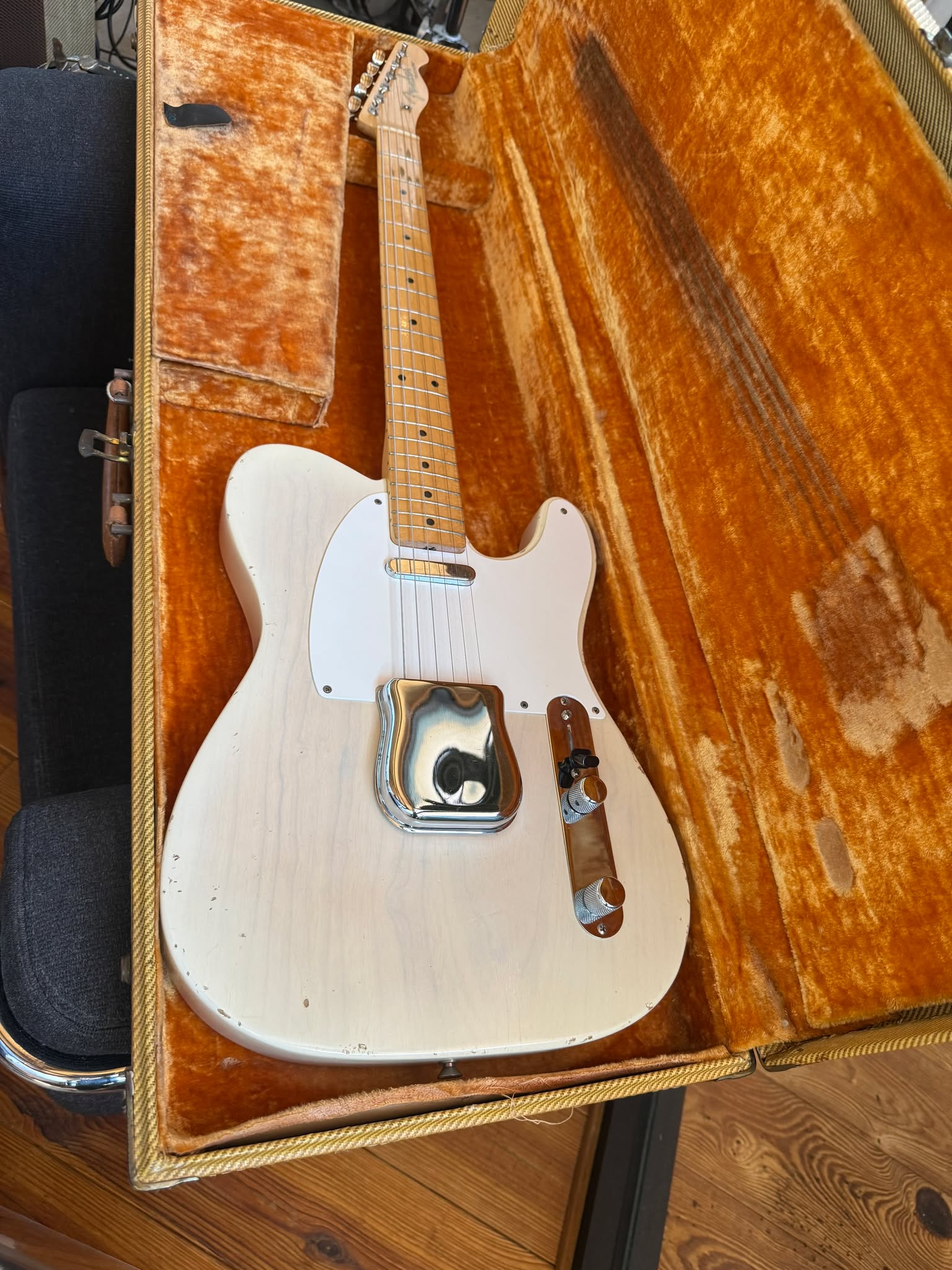
The 1958 Fender Telecaster represents the butterscotch hold, pre-CBS consistency just as the sunburst era was beginning, a maple-neck Tele with the snap and clarity that made the model famous. Original finish, pickups, and overall condition are the biggest value drivers. Edgewater Guitars buys vintage Fender Telecasters nationwide with free expert appraisals and same-day cash offers. Call or text (440) 219-3607.
Last Updated: May 2026
What Makes the 1958 Fender Telecaster Significant?
In 1958, Fender underwent one of its most consequential aesthetic shifts: the Stratocaster received its three-tone sunburst finish, adding red to the existing yellow-to-black two-tone burst and dramatically changing the visual identity of Fender’s flagship model. The Telecaster, by contrast, held its ground. Butterscotch blonde remained standard, the brass saddle bridge carried on unchanged, and the one-piece maple neck continued without alteration. The result is an instrument that represents pre-CBS Fender construction at a point of quiet confidence — nothing transitional, nothing experimental, just a fully resolved working guitar built to a standard that Leo Fender’s team had refined over eight years.
The 1958 Telecaster also sits in an interesting position relative to the humbucker revolution happening simultaneously at Gibson. While Gibson was installing PAF humbuckers in Les Pauls and radically changing the electric guitar landscape, Fender made no equivalent move on the Telecaster. The original single-coil design, with its Formvar-wound Alnico V pickups and brass saddle bridge, remained intact — a decision that in retrospect defined the Telecaster’s enduring identity as the counterpoint to humbucking warmth.
The V-neck profile that had defined 1955 through 1957 began a subtle transition in 1958 toward what players describe as a “soft V” or transitional C — still chunky and palm-filling compared to modern standards, but beginning to round off at the shoulders. This transitional neck carve is itself a collector draw, occupying a middle ground between the most pronounced V of 1955–1956 and the rounder profiles that would follow. In our experience buying pre-CBS Telecasters across Ohio and the Midwest, 1958 examples often generate interest from both pure collectors and serious players — the neck profile sits in a sweet spot that appeals to both camps.
What makes the 1958 Telecaster distinctive:
Butterscotch blonde standard while the Stratocaster transitioned to three-tone sunburst — a deliberate product differentiation
Transitional neck profile: soft V moving toward rounded C, distinct from both earlier and later years
One-piece maple neck continues — no rosewood fingerboard
Butterfly string tree, introduced in 1956, continues
Gold anodized pickguard available as factory option alongside white Bakelite
Three-barrel brass saddle bridge unchanged
Alnico V single-coil pickups with Formvar wire
Serial numbers on neckplate in the 20,000–30,000 range
If you own a 1958 Telecaster, you may be sitting on a significant asset. Edgewater Guitars provides free, no-obligation valuations — call (440) 219-3607 or visit edgewaterguitars.com.
What Is a 1958 Fender Telecaster Worth? (2026 Market Values)
Value by Condition and Finish
The 1958 Telecaster market in 2026 is driven by the same forces as other pre-CBS years — originality first, condition second — but the transitional neck profile adds a specific player-market premium that makes even well-worn examples more sought after than their condition alone would suggest.
Condition | Originality | Relative Value |
|---|---|---|
Excellent (8–9/10) | All original, gold anodized guard, original case | Premium-plus tier |
Excellent (8–9/10) | All original, white Bakelite guard, original case | Premium tier |
Very Good (7/10) | All original, no case | Strong tier |
Good (6/10) | Original parts, finish wear | Mid tier |
Player Grade | Some replacements, heavy wear | Entry tier |
Modified | Non-original pickups, refin, or added routes | Significant reduction |
What Affects the Value of a 1958 Telecaster?
Originality: All-original examples command a 40–60% premium over modified instruments. The bridge pickup, tuners, and saddles remain the most frequently replaced components on 1958 Telecasters.
Neck profile: The transitional soft V profile of 1958 carries its own premium in the player market. A neck with no repairs, original frets, and the correct profile intact is a significant value driver — more so than on years with more uniform neck shapes.
Pickguard type: Gold anodized aluminum examples carry a 25–40% premium over equivalent white Bakelite guard instruments. The anodized guard option continued into 1958 and appears on a meaningful number of production instruments.
Finish integrity: Original butterscotch blonde nitrocellulose lacquer with authentic checking, yellowing, and wear is correct and desirable. An unusually clean or even finish on a nearly 70-year-old instrument is a red flag.
Original case: The original brown tolex case adds approximately 10–15% to value and is increasingly difficult to source separately.
Pot date alignment: Original pots dated to 1957 or 1958 are correct. Later-dated pots indicate modification.
How 1958 Compares to Other Years
Year | Key Difference | Relative Value | Why |
|---|---|---|---|
1957 | Most pronounced V-neck; anodized guard option | Similar to slightly higher | Peak V-neck profile preferred by some collectors |
1958 (this post) | Transitional soft V neck; Strat gets 3-tone burst while Tele holds blonde | Baseline | Distinctive transitional neck; historical contrast moment |
1959 | Rosewood fingerboard option introduced mid-year | Similar to slightly higher | First-year rosewood examples carry transition premium |
1960 | Rosewood slab board standard; maple neck special order | Lower for rosewood; similar for maple | Loss of one-piece maple neck as standard |
Edgewater Guitars consistently pays 30–40% more than typical guitar shops. Get your free valuation: edgewaterguitars.com or (440) 219-3607.
Recent Sales and Auction Results
All-original 1958 Telecasters with gold anodized pickguards in excellent condition appear infrequently at major auction and command strong results when they do. White Bakelite guard examples in excellent all-original condition represent the more common transaction type and sell at a solid but lower tier. Player-grade examples with original pickups but other modifications are the most common 1958 Telecasters encountered in the secondary market. Contact Edgewater for current market context specific to your instrument’s condition and originality.
How to Identify an Authentic 1958 Fender Telecaster
Serial Numbers
Range for 1958: Approximately 20,000–30,000, stamped on the neckplate
Location: Four-bolt neckplate
Important caveat: Serial number ranges overlap significantly between years. A number in this range is consistent with 1958 but does not confirm it — always cross-reference with the neck date stamp and pot codes.
Neck Date
Format: Pencil-written or rubber-stamped, month and year (e.g., “7-58” or “JUL 58”)
Location: Heel of the neck, visible only when the neck is removed from the body by removing the four neckplate screws
What to look for: The stamp should show appropriate aging consistent with the surrounding maple. A stamp that appears fresh or artificially aged relative to the wood warrants scrutiny.
Potentiometer Codes
Manufacturers: Stackpole (code 304) and CTS (code 137)
How to decode: Manufacturer code (3 digits) + year (2 digits) + week (2 digits)
Example: 137-7-32 = CTS, 1957, week 32 — appropriate for a guitar assembled in early-to-mid 1958
Expected codes for 1958: Pots dated to 1957 or 1958 are correct. Pots from 1959 or later indicate modification or misrepresentation.
Location: Inside the control cavity, accessible by removing the control plate
Key Visual Identifiers
String tree: Butterfly-style stamped metal — introduced 1956, continues through 1958
Pickguard: Single-ply white Bakelite (standard) or gold anodized aluminum (factory option)
Neck profile: Soft V transitioning toward rounded C — palm-filling but with slightly rounded shoulders compared to 1955–1957
Tuners: Kluson Deluxe, single-ring, plastic oval buttons
Bridge plate: Three-barrel brass saddles with threaded steel intonation screws
Logo: Spaghetti-style gold with black outline on headstock
Neckplate: Four-bolt, serial number stamped, no “F” stamp (F-stamp not introduced until CBS era)
Finish: Butterscotch blonde with nitrocellulose lacquer — amber-yellow tone, not white or cream
Factory Markings and Stamps
Control cavity: Pencil body date sometimes present
Neck pocket: May show pencil date close to neck heel stamp
Pickup cavities: Some examples have additional pencil assembly dates
Custom Color Identification
Standard 1958 Telecaster production was butterscotch blonde. Custom colors were not a formal Telecaster catalogue option in 1958. Any 1958 Telecaster in a non-blonde finish requires careful examination for refinishing. The correct undercoat for original blonde is a yellow sealer — its absence beneath any applied finish is a refinish indicator. Note that custom color Stratocasters were beginning to appear in this era, but the practice had not extended formally to the Telecaster.
Red Flags: How to Spot Fakes and Refinishes
Overly clean finish: Authentic 1958 nitrocellulose lacquer should show checking, yellowing, and wear consistent with nearly 70 years of age. A thick, even, unaged finish strongly suggests refinishing.
Wrong string tree: A round bullet-style string tree on a claimed 1958 indicates either a pre-1956 neck or a replaced string tree.
F-stamped neckplate: The F-stamp on neckplates was introduced during the CBS era. Any claimed pre-CBS Telecaster with an F-stamped plate has a replaced neckplate or is not pre-CBS.
Plastic-insulated wiring: Original 1958 wiring used cloth-covered wire throughout the control cavity. Plastic-insulated wire indicates replaced electronics.
Pot date mismatch: Pots dated 1959 or later in a claimed 1958 guitar indicate modification or misrepresentation.
Non-brass saddles: Original 1958 bridge saddles are three-barrel brass. Steel saddles or six-saddle bridges are non-original replacements.
Neck pocket gaps or shimming: Replacement necks rarely fit original pockets precisely. Shimming material or mismatched wood grain at the neck joint indicates a neck replacement.
In our experience evaluating 1958 Telecasters from the Ohio and Midwest region, the most frequently encountered misrepresentation involves replaced bridge saddles presented as original. Period-correct brass saddle replacements can look convincing but show subtle dimensional and aging differences from factory originals. The threading pattern on the intonation screws and the specific profile of the saddle barrel are the primary authentication points.
Not sure if your 1958 Telecaster is original? Edgewater offers free authentication — our team has evaluated hundreds of vintage Fender instruments. Call (440) 219-3607 or visit edgewaterguitars.com.
1958 Fender Telecaster Specifications
Specification | Detail |
|---|---|
Body Wood | Ash (standard for blonde finish) |
Neck Wood | Maple, one-piece (no laminate fingerboard) |
Fingerboard | Maple (integral with neck), 7.25” radius |
Neck Profile | Transitional soft V, approximately 0.88” at 1st fret, 0.95” at 12th fret |
Nut Width | 1-5/8” (1.625”) |
Scale Length | 25.5” |
Frets | 21, narrow vintage wire |
Pickups | Two Fender single-coil, Alnico V magnets, black fiber bobbins |
Bridge | Three-barrel brass saddle, single-ply chrome plate |
Tuners | Kluson Deluxe, single-ring, plastic oval buttons |
Controls | Master volume, master tone, 3-position blade switch |
Pickguard | Single-ply white Bakelite (standard) or gold anodized aluminum (factory option) |
Finish | Nitrocellulose lacquer, butterscotch blonde |
Available Colors | Butterscotch blonde (standard); custom colors not catalogued for Telecaster |
Weight Range | Typically 7.0–8.5 lbs |
Case | Brown tolex case |
Original Retail Price | Approximately $199.50 (1958 catalog) |
What Does a 1958 Fender Telecaster Sound Like?
Pickup Specifications and Tonal Profile
Pickup type: Single-coil, non-staggered pole pieces
DC Resistance (bridge): Approximately 7.0–7.5k ohms
DC Resistance (neck): Approximately 6.5–7.0k ohms
Wire type: Formvar-coated
Magnet type: Alnico V
Potting: Unpotted
The 1958 Telecaster’s tonal character is defined by the same Formvar-wound, unpotted Alnico V single-coil construction that made this era of Fender production a benchmark. The bridge pickup delivers the instrument’s signature — a sharp, defined transient attack with a piano-like quality on the initial strike, a characteristic upper-midrange presence, and a clarity that cuts through any mix without harshness. The neck pickup delivers full, warm tone that is frequently underestimated; in the combination position, both pickups together produce the distinctive nasal, honky midrange character closely associated with classic country and rockabilly recordings.
How Construction Details Affect Tone
The one-piece maple neck continues to define the tonal character of the 1958 Telecaster. Vibration transfers through a continuous piece of wood with no density interruption from a fingerboard laminate, producing faster attack, crisper note definition, and more immediate string-to-body resonance than rosewood-board instruments. This distinction becomes audible when comparing 1958 maple-neck examples directly to the rosewood-board Telecasters that arrived in 1959 — the maple version is brighter and more articulate on the attack, the rosewood version slightly warmer with more sustained fundamental.
The ash body on blonde instruments contributes a characteristic tonal profile: a slight midrange scoop with extended high-frequency clarity and a firm, defined low end. This body wood choice is part of why the Telecaster bridge pickup sounds different through an ash body than it does through the alder bodies more common on sunburst finishes — the ash reinforces the natural brightness of the single-coil design rather than tempering it.
Notable Recordings
The late 1950s Telecaster sound is documented throughout the foundational catalogs of country music and rockabilly. Roy Buchanan, who would later become the benchmark for Telecaster playing, developed his early style on instruments of this era. The tonal character of 1958 vintage Telecasters — the percussive snap of the bridge pickup, the sustaining warmth of the neck position, the musical bloom on string bends — is directly audible in recordings from this period across the Sun Records, Capitol Records, and Columbia country catalogs.
Common Issues and Modifications That Affect Value
Replaced bridge pickup: The single most common modification on 1958 Telecasters. Value impact: 20–30% reduction. Original pickup retained and included reduces impact to approximately 10–15%.
Replaced bridge saddles: Original three-barrel brass saddles frequently replaced with steel alternatives or six-saddle modern bridges. Value impact: 8–12% for saddle replacement; significantly more for full bridge replacement.
Replaced tuners: Kluson originals replaced with Grovers or Schallers. Value impact: 10–15%; fully reversible if originals are retained.
Refinished body: The most value-destructive modification outside structural damage. Correct color refinish: 40–55% reduction. Non-original color: 55–70% reduction.
Refretted neck: Professional refret with correct narrow vintage wire: 5–10% reduction. Modern fret wire: 10–15% reduction.
Replaced pickguard: White Bakelite replacement guard: 5–10% reduction. Gold anodized guard replaced with white: 25–35% reduction on an example where the original anodized guard is documented.
Headstock crack or repair: Professionally repaired cracks reduce value by 25–40%. Inspect the headstock-neck junction on any 1958 Telecaster before purchase or sale.
Added routing: Any additional body routing beyond the original pickup and control cavities significantly reduces value — 25–40% depending on size and location.
In Edgewater’s experience, 1958 Telecasters with replaced bridge saddles but otherwise full originality are among the most undervalued instruments we encounter. Sellers frequently accept low offers assuming the saddle replacement is more damaging than it actually is — the core of the instrument’s authentication and collectibility remains entirely intact when the pickups, pots, wiring, and neck are original.
Selling Your 1958 Fender Telecaster: Your Options Compared
Selling Option | Typical Offer | Timeline | Fees/Costs | Risk Level | Best For |
|---|---|---|---|---|---|
Edgewater Guitars | 30–40% above shop offers | Immediate cash | None | Low — expert authentication included | Owners wanting fair value without hassle |
Local Guitar Shop | Wholesale pricing (lowest) | Same day | None direct, but lowest price | Low | Convenience over value |
Reverb / eBay | Variable — potentially higher | Weeks to months | 5–15% platform fees + shipping | High — fraud, damage, disputes | Experienced sellers comfortable with risk |
Auction House | Variable | 3–6 months | 15–25% seller premium | Medium | Exceptionally rare, documented examples |
Private Sale | Variable | Unpredictable | None | High — authentication burden on you | Sellers with existing buyer network |
A 1958 Telecaster is an instrument that most local guitar shops will undervalue significantly. The gap between a shop’s wholesale offer — based on what they can sell locally at retail — and the actual national and international collector market price can be very wide on a pre-CBS Fender. Edgewater operates in the full market, not just the local retail window, which is why our offers consistently exceed shop quotes by 30–40%.
Our process: contact us with photos and basic details, receive a preliminary valuation within 24 hours, arrange an in-person evaluation anywhere in Ohio, Michigan, Pennsylvania, Indiana, or West Virginia. We make an immediate cash offer with no consignment period, no platform fees, and no uncertainty about the outcome.
Ready to find out what your 1958 Fender Telecaster is worth? Get your free, no-obligation valuation: edgewaterguitars.com or call (440) 219-3607.
Frequently Asked Questions About the 1958 Fender Telecaster
Q: What is a 1958 Fender Telecaster worth in 2026? A: Value depends on originality and condition. All-original examples in excellent condition with the original case represent the premium tier. Gold anodized pickguard examples carry an additional premium. Player-grade and modified instruments sell at a significant discount. Contact Edgewater Guitars for a free valuation specific to your instrument.
Q: How is the 1958 Telecaster different from the 1958 Stratocaster? A: In 1958, the Stratocaster received the three-tone sunburst finish — adding red to the existing two-tone burst — while the Telecaster retained its butterscotch blonde standard finish unchanged. The two instruments diverged aesthetically in 1958 in a way that reinforced their distinct market identities, a split that persists in the collector market today.
Q: What neck profile does a 1958 Fender Telecaster have? A: The 1958 Telecaster features a transitional soft V profile — still chunky and palm-filling, measuring approximately 0.88 inches at the first fret and 0.95 inches at the twelfth fret, but with slightly rounded shoulders compared to the more angular V of 1955–1957. This transitional carve occupies a unique middle ground that appeals to both collectors and players.
Q: What serial numbers cover 1958 Fender Telecasters? A: Approximately 20,000–30,000, stamped on the neckplate. These ranges overlap between years, so always cross-reference with the neck date stamp and pot codes for accurate dating.
Q: How do I identify original 1958 Telecaster pickups? A: Original 1958 bridge pickups have black fiber bobbins, Alnico V magnets, and Formvar-coated wire. DC resistance should read approximately 7.0–7.5k ohms on the bridge pickup. The construction of the pickup underside — including the specific fiber material and lead wire routing — is distinct from replacement units.
Q: What is the correct bridge for a 1958 Fender Telecaster? A: The original bridge is a single-ply chrome plate with three barrel-style brass saddles and threaded steel intonation adjustment screws. Steel saddles, synthetic saddles, or six-saddle modern bridges are all non-original. The brass saddle material is both a dating authentication point and a tonal component.
Q: Does Edgewater Guitars buy 1958 Fender Telecasters? A: Yes. We actively purchase 1958 Telecasters in all conditions — all-original, player-grade, and modified. We pay 30–40% more than local guitar shops and provide immediate cash payment with no consignment. Call (440) 219-3607 or visit edgewaterguitars.com.
Q: Is a refinished 1958 Telecaster still valuable? A: Yes, but significantly less so than an original-finish example. A professional refinish in the correct butterscotch blonde reduces value by approximately 40–55%. A non-original color refinish reduces value by 55–70%. Even a refinished 1958 Telecaster with original electronics and hardware retains meaningful collector value — contact Edgewater for a specific assessment.
Q: How long does it take to sell a vintage guitar to Edgewater? A: Typically 24–72 hours from initial contact to cash in hand. We provide a preliminary valuation quickly, arrange an in-person evaluation for high-value instruments, and make an immediate cash offer at no obligation.
Q: Should I have my 1958 Telecaster appraised before selling? A: Yes — and Edgewater provides that appraisal at no charge. Pre-CBS Fenders are frequently undervalued by sellers who lack market context and overvalued by sellers who rely on outdated price guides. A current, accurate appraisal from a buyer active in the real market is the most reliable way to understand what your instrument is actually worth in 2026.
Related Resources
Useful next reads and tools for this guitar:
Sell your 1958 Fender Telecaster
Edgewater Guitars buys vintage Fender Telecasters and other vintage Fenders nationwide. We give free, honest appraisals and fair same-day cash offers, with local pickup or insured nationwide shipping. Call or text (440) 219-3607 or request a free estimate.
How much is a 1958 Fender Telecaster worth?
A clean, all-original 1958 Fender Telecaster’s value depends on originality, condition, finish, and whether the pickups and hardware are original. Because Edgewater buys directly and resells, we can typically pay more than local shops or pawn stores. The most accurate way to find out is a free appraisal: send a few photos and the serial number and we will give you an honest market assessment.
Where can I sell a 1958 Fender Telecaster?
Edgewater Guitars buys them directly, nationwide, with same-day cash offers and no obligation. You can also date yours with our Fender serial number lookup.