DATE :
1956 Fender Telecaster: The Butterfly String Tree Year and the Peak of the Pre-CBS V-Neck Era
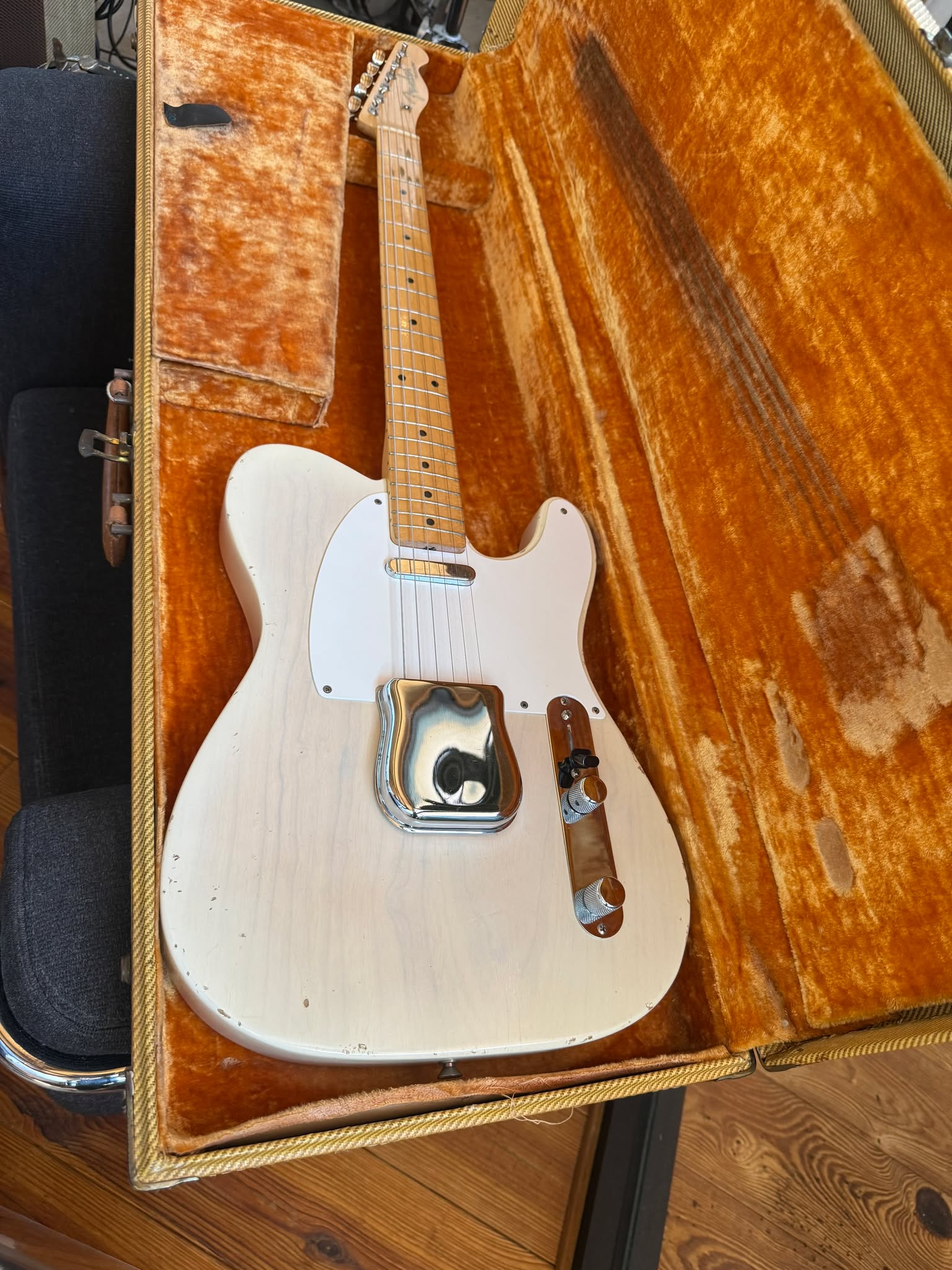
1956 Fender Telecaster: The Butterfly String Tree Year and the Peak of the Pre-CBS V-Neck Era
The 1956 Fender Telecaster sits at the peak of the pre-CBS V-neck era, the butterfly-string-tree year prized for its substantial neck profile and pure single-coil tone. Original finish, neck and pickup dates, and overall condition drive value most on a guitar this collectible. Edgewater Guitars buys vintage Fender Telecasters nationwide with free expert appraisals and same-day cash offers. Call or text (440) 219-3607.
Last Updated: May 2026
What Makes the 1956 Fender Telecaster Significant?
The 1956 Fender Telecaster occupies a precise moment in pre-CBS history — late enough to benefit from the refinements Leo Fender had introduced since 1950, early enough to retain every characteristic that defines the instrument’s original character. It is the year the butterfly string tree replaced the earlier round bullet-style guide, a small but visually distinctive change that collectors use as a primary dating reference point.
Production in 1956 remained entirely maple neck with no laminate fingerboard, and the V-neck profile that defined 1955 continued with only minor variation. Ash bodies remained standard for the butterscotch blonde finish that dominated production, and the three-barrel brass saddle bridge carried on unchanged. What the 1956 adds over its predecessor is a slightly more refined assembly consistency — by this point Fender’s production team had developed reliable workflows, and the guitars reflect it.
A significant option appeared in 1956 that collectors specifically watch for: the gold anodized aluminum pickguard, introduced as an option and appearing on a meaningful number of instruments. These examples are substantially rarer than the standard white Bakelite guard and carry a premium in the current market. In our experience buying Telecasters across Ohio and the Midwest, the gold anodized guard tends to trigger the most immediate collector interest when it appears — it is the single most visible differentiator between a standard 1956 and a standout one.
What makes the 1956 Telecaster distinctive:
Butterfly string tree introduced, replacing the earlier round bullet-style guide
Gold anodized aluminum pickguard available as a factory option — rarer and more collectible than white Bakelite
V-neck profile continues at its most developed form
One-piece maple neck, no rosewood laminate
Ash body standard for butterscotch blonde finish
Three-barrel brass saddle bridge with threaded steel intonation screws
Kluson Deluxe single-ring tuners
Serial numbers on neckplate, fully transitioned from bridge plate location
If you own a 1956 Telecaster, you may be sitting on a significant asset. Edgewater Guitars provides free, no-obligation valuations — call (440) 219-3607 or visit edgewaterguitars.com.
What Is a 1956 Fender Telecaster Worth? (2026 Market Values)
Value by Condition and Finish
The 1956 Telecaster market rewards originality more sharply than almost any other pre-CBS model. Gold anodized pickguard examples in all-original condition represent the top of the market by a meaningful margin. Standard white Bakelite guard examples follow closely, with condition and neck integrity driving the difference between tiers.
Condition | Originality | Relative Value |
|---|---|---|
Excellent (8–9/10) | All original, gold anodized guard, original case | Premium-plus tier |
Excellent (8–9/10) | All original, white Bakelite guard, original case | Premium tier |
Very Good (7/10) | All original, no case | Strong tier |
Good (6/10) | Original parts, finish wear | Mid tier |
Player Grade | Some replacements, heavy wear | Entry tier |
Modified | Non-original pickups, refin, or added routes | Significant reduction |
What Affects the Value of a 1956 Telecaster?
Pickguard type: Gold anodized aluminum pickguard examples command a 25–40% premium over equivalent white Bakelite guard instruments. The anodized guard is visually striking and specifically associated with the mid-1950s transitional period.
Originality: All-original examples command a 40–60% premium over modified instruments. The most commonly replaced components on 1956 Telecasters are the bridge pickup, tuners, and saddles — each substitution reduces value, though the impact varies by component.
Neck condition: The V-profile neck is the primary playability draw of this instrument. Headstock repairs or cracks reduce value significantly (20–35%). Refrets with correct vintage wire have minimal impact.
Finish integrity: Original butterscotch blonde nitrocellulose lacquer showing authentic checking, yellowing, and wear patterns is correct and desirable. Overly clean finish on a 70-year-old guitar suggests refinishing.
Original case: The original brown tolex or tweed case adds approximately 10–15% to the instrument’s value.
Documentation: Original hang tags, receipts, or provenance paperwork are extremely rare for this era and add meaningful value when present.
How 1956 Compares to Other Years
Year | Key Difference | Relative Value | Why |
|---|---|---|---|
1955 | Round bullet string tree; no anodized guard option | Similar | Slightly earlier serial numbers; no anodized guard premium |
1956 (this post) | Butterfly string tree; gold anodized guard option | Baseline | Distinctive hardware change; rarer guard variant |
1957 | V-neck continues; anodized guard continues | Similar to slightly higher | Subtle neck refinements; same period appeal |
1958 | Three-tone sunburst introduced on Strat; Tele remains blonde | Similar | Tele largely unchanged; less transitional significance |
Edgewater Guitars consistently pays 30–40% more than typical guitar shops. Get your free valuation: edgewaterguitars.com or (440) 219-3607.
Recent Sales and Auction Results
All-original 1956 Telecasters with gold anodized pickguards in excellent condition are among the most actively pursued pre-CBS Fenders at major auction. Heritage Auctions and Gruhn Guitars handle the majority of significant sales. Standard white guard examples in excellent all-original condition sell at a strong but lower tier. Player-grade examples with modifications sell at a meaningful discount regardless of guard type. Contact Edgewater for current market context specific to your instrument’s condition.
How to Identify an Authentic 1956 Fender Telecaster
Serial Numbers
Range for 1956: Approximately 10,000–16,000, stamped on the neckplate
Location: Neckplate (fully transitioned from bridge plate by 1956)
Important caveat: Serial number ranges overlap between production years. Always cross-reference with pot codes and neck date stamp. A number alone does not confirm a 1956 date.
Neck Date
Format: Pencil-written or rubber-stamped, month and year (e.g., “3-56” or “MAR 56”)
Location: Heel of the neck, visible only when the neck is removed from the body
What to look for: Ink or pencil markings should show appropriate aging and absorption into the maple. Fresh-looking stamps on an aged neck warrant closer scrutiny.
Potentiometer Codes
Fender used Stackpole (code 304) and CTS (code 137) potentiometers in this era.
How to decode: Manufacturer code (3 digits) + year (2 digits) + week (2 digits)
Example: 304-5-48 = Stackpole, 1955, week 48 — appropriate for a guitar assembled in early 1956
Expected codes for 1956: Pots dated to 1955 or 1956 are correct. Pots from 1957 or later indicate modification or misrepresentation.
Location: Inside the control cavity, accessible by removing the control plate
Key Visual Identifiers
String tree: Butterfly-style (two-winged stamped metal) — the definitive 1956 dating marker replacing the earlier round bullet guide
Pickguard: Single-ply white Bakelite (standard) or gold anodized aluminum (factory option) — not celluloid
Tuners: Kluson Deluxe, single-ring, with plastic oval buttons
Bridge plate: Three-barrel brass saddles with threaded steel intonation adjustment screws
Neck profile: Pronounced V-shape; nut width approximately 1-5/8 inches (1.625”)
Logo: Spaghetti-style gold with black outline — thin, script lettering on headstock
Neckplate: Four-bolt, no serial number on bridge plate (fully transitioned by 1956)
Factory Markings and Stamps
Control cavity: Pencil body date sometimes present, not universal
Neck pocket: May show pencil date matching or close to neck heel stamp
Pickup cavities: Some examples show additional pencil dates inside routed cavities
Custom Color Identification
Standard production 1956 Telecasters were butterscotch blonde. Custom colors were not a formal Fender catalogue offering in 1956, though rare special-order examples exist. Any 1956 Telecaster in a non-blonde finish requires careful examination. Yellow undercoat beneath the finish is consistent with original Fender blonde. A non-yellow primer beneath a claimed custom color on a 1956 Telecaster is a significant red flag for refinishing.
Red Flags: How to Spot Fakes and Refinishes
Wrong string tree: A round bullet-style string tree on a claimed 1956 suggests the neck dates earlier than represented, or the string tree has been replaced
Celluloid pickguard aging: Original white Bakelite does not show the greenish-yellow aging of celluloid; a greenish-tinted white guard on a claimed 1956 suggests a replacement guard
Anachronistic anodized guard: Gold anodized guards are a legitimate 1956 option, but a guard with incorrect screw hole placement or mounting hardware inconsistencies indicates a later replacement
Clean or thick finish: Original nitrocellulose lacquer on a 70-year-old guitar checks, yellows, and wears. A thick, even, unaged finish strongly suggests refinishing
Modern wiring: Original 1956 wiring used cloth-covered wire; plastic-insulated wire inside the control cavity indicates replacement electronics
Pot date mismatch: Pots dated 1957 or later in a claimed 1956 guitar indicate modification or misrepresentation
In our experience evaluating 1956 Telecasters from the Ohio and Midwest corridor, the gold anodized pickguard is the most frequently misrepresented feature — later anodized guards from the late 1950s or early 1960s are sometimes used to upgrade a standard white guard instrument. The screw hole spacing and mounting points differ subtly between years, and the anodizing color shifts slightly with age on originals versus replacements.
Not sure if your Telecaster is original? Edgewater offers free authentication — our team has evaluated hundreds of vintage Fender instruments. Call (440) 219-3607 or visit edgewaterguitars.com.
1956 Fender Telecaster Specifications
Specification | Detail |
|---|---|
Body Wood | Ash (standard for blonde finish) |
Neck Wood | Maple, one-piece (no laminate fingerboard) |
Fingerboard | Maple (integral with neck), 7.25” radius |
Neck Profile | Pronounced V-shape, approximately 0.90” at 1st fret, 0.97” at 12th fret |
Nut Width | 1-5/8” (1.625”) |
Scale Length | 25.5” |
Frets | 21, narrow vintage wire |
Pickups | Two Fender single-coil, Alnico V magnets, black fiber bobbins |
Bridge | Three-barrel brass saddle, single-ply chrome plate |
Tuners | Kluson Deluxe, single-ring, plastic oval buttons |
Controls | Master volume, master tone, 3-position blade switch |
Pickguard | Single-ply white Bakelite (standard) or gold anodized aluminum (factory option) |
Finish | Nitrocellulose lacquer, butterscotch blonde |
Available Colors | Butterscotch blonde (standard); custom colors rare special-order only |
Weight Range | Typically 7.0–8.5 lbs |
Case | Brown tolex or tweed case |
Original Retail Price | Approximately $189.50 (1956 catalog) |
What Does a 1956 Fender Telecaster Sound Like?
Pickup Specifications and Tonal Profile
Pickup type: Single-coil, non-staggered pole pieces
DC Resistance (bridge): Approximately 7.0–7.5k ohms
DC Resistance (neck): Approximately 6.5–7.0k ohms
Wire type: Formvar-coated
Magnet type: Alnico V
Potting: Unpotted
The 1956 Telecaster’s tonal signature is defined by the same Formvar-wound, Alnico V pickup construction that made the 1955 a benchmark instrument. The bridge pickup delivers the defining Telecaster character — percussive attack, defined upper midrange, and a piano-like quality on the initial transient that distinguishes original pre-CBS pickups from virtually everything wound since. The neck pickup produces full, warm tone with genuine depth, far more usable than its reputation as a “rhythm-only” position suggests. The combination position, accessed via the blade switch’s forward setting, blends both pickups with the neck tone control active — a configuration that produces a distinctive nasal, honky midrange sound associated with classic country and early rock recordings.
How Construction Details Affect Tone
The one-piece maple neck transmits vibration without the density interruption of a laminated fingerboard, producing faster attack and more immediate string-to-body resonance transfer than rosewood-board instruments. The ash body standard on blonde instruments contributes a characteristic midrange contour — slightly scooped compared to the more even response of alder — with extended high-frequency clarity that reinforces the bridge pickup’s inherent brightness.
The three-barrel brass saddle bridge is a tone-critical component that is frequently overlooked. Brass as a saddle material produces a warmer, more musical attack character than steel, which can sound brittle on the initial transient. Many players who have compared original brass saddle bridges to steel replacements report that the brass adds a quality of “bloom” to the attack — a slight softening of the initial spike that makes the note more musical without reducing definition. This is a primary reason original brass saddle bridges are actively sought by players, not just collectors.
Notable Recordings
The mid-1950s Telecaster sound appears throughout the foundational catalog of country music and early rock and roll. Buck Owens developed his signature Bakersfield sound on Telecasters of this era, and the clean, cutting bridge pickup character is central to that style. Don Rich, Owens’s guitarist, worked extensively with this period Telecaster. The tonal characteristics documented in recordings from this era — the sharp transient, the twangy sustain, the bloom on bent notes — are directly traceable to the construction details of the 1956 production instruments.
Common Issues and Modifications That Affect Value
Replaced bridge pickup: The most common modification. Value impact: 20–30% reduction. If the original is retained and included in the sale, impact is reduced to approximately 10–15%.
Replaced or wrong-era pickguard: Gold anodized guards are frequently swapped in from later production years or are complete replacements. Value impact on a claimed anodized-guard example: 25–35% if the guard is non-original. White Bakelite replacement: 5–10%.
Replaced tuners: Kluson originals frequently replaced with Grovers or Schallers. Value impact: 10–15%; fully reversible if originals are retained.
Refinished body: Reduces value by 40–55% for a correct color refinish. Non-original color refinish: 55–70% reduction.
Refretted neck: Professional refret with correct narrow vintage wire: 5–10% reduction. Modern jumbo or medium-jumbo wire: 10–15% reduction.
Replaced saddles: Original brass saddles frequently replaced with steel alternatives. Value impact: 8–12%. Original brass saddles retained and included partially offset the reduction.
Headstock crack or repair: Even professionally repaired cracks reduce value by 25–40%. Inspect the headstock-neck junction carefully on any 1956 Telecaster.
Added strap button: Common working musician modification. Minimal value impact if no finish damage; 5–10% if routing or filling is present.
In Edgewater’s experience, the most undervalued 1956 Telecasters we encounter are those with replaced saddles or tuners where everything else — pickups, pots, wiring, neck — remains original. Sellers often accept low offers assuming these minor hardware changes are devastating to value, when in fact the core of the instrument’s collectibility is fully intact.
Selling Your 1956 Fender Telecaster: Your Options Compared
Selling Option | Typical Offer | Timeline | Fees/Costs | Risk Level | Best For |
|---|---|---|---|---|---|
Edgewater Guitars | 30–40% above shop offers | Immediate cash | None | Low — expert authentication included | Owners wanting fair value without hassle |
Local Guitar Shop | Wholesale pricing (lowest) | Same day | None direct, but lowest price | Low | Convenience over value |
Reverb / eBay | Variable — potentially higher | Weeks to months | 5–15% platform fees + shipping | High — fraud, damage, disputes | Experienced sellers comfortable with risk |
Auction House | Variable | 3–6 months | 15–25% seller premium | Medium | Exceptionally rare, documented examples |
Private Sale | Variable | Unpredictable | None | High — authentication burden on you | Sellers with existing buyer network |
The 1956 Telecaster — particularly any example with a gold anodized pickguard — is an instrument that rewards selling to a buyer who genuinely understands what it is. Local guitar shops frequently undervalue pre-CBS Fenders because their market is local retail customers, not the national and international collector pool that drives true market prices. The gap between a shop’s wholesale offer and actual market value on a 1956 Tele can be very significant.
Edgewater’s process is straightforward: contact us with photos and basic details, receive a preliminary valuation within 24 hours, and arrange an in-person evaluation anywhere in Ohio, Michigan, Pennsylvania, Indiana, or West Virginia. We make an immediate cash offer with no consignment, no platform fees, and no waiting.
Ready to find out what your 1956 Fender Telecaster is worth? Get your free, no-obligation valuation: edgewaterguitars.com or call (440) 219-3607.
Frequently Asked Questions About the 1956 Fender Telecaster
Q: What is a 1956 Fender Telecaster worth in 2026? A: Value is driven primarily by originality and condition. Gold anodized pickguard examples in all-original excellent condition represent the top tier of the 1956 market. All-original white Bakelite guard examples follow. Player-grade and modified instruments sell at significant discounts. Contact Edgewater Guitars for a free valuation specific to your instrument.
Q: What is the butterfly string tree on a 1956 Telecaster? A: The butterfly string tree is a small two-winged stamped metal string retainer mounted on the headstock between the nut and the tuning pegs for the B and high-E strings. It replaced the earlier round bullet-style guide and is one of the primary visual dating markers distinguishing 1956 and later Telecasters from 1955 and earlier examples.
Q: Is the gold anodized pickguard original on 1956 Telecasters? A: Yes — the gold anodized aluminum pickguard was a factory option introduced in 1956. However, anodized guards from later production years are sometimes swapped onto 1956 instruments. Verify by checking screw hole spacing and hardware mounting points, which differ subtly across years. Edgewater can authenticate at no charge.
Q: What serial numbers are on 1956 Fender Telecasters? A: Approximately 10,000–16,000, stamped on the neckplate. Serial numbers alone are not definitive — always cross-reference with the neck date stamp and pot codes for accurate dating.
Q: How do pot codes help date a 1956 Telecaster? A: Remove the control plate and read the 7-digit code stamped on the back of each potentiometer. The first three digits identify the manufacturer (304 = Stackpole, 137 = CTS), the next two digits are the year, and the final two are the week of manufacture. Pots dated 1955 or 1956 are correct for a 1956 instrument.
Q: What wood is the body of a 1956 Telecaster made from? A: Ash, standard for butterscotch blonde finish instruments. Ash provides the characteristic midrange contour and high-frequency clarity associated with the Telecaster’s original tonal design.
Q: Does Edgewater Guitars buy 1956 Fender Telecasters? A: Yes. We actively purchase 1956 Telecasters in all conditions — all-original, player-grade, and modified. We pay 30–40% more than local guitar shops and provide immediate cash payment with no consignment. Call (440) 219-3607 or visit edgewaterguitars.com.
Q: Should I remove the pickguard to check for an original body before selling? A: It is reasonable to look under the pickguard to check for body routs, finish color consistency, and wood condition — these are standard authentication steps. However, do not attempt to remove electronics, clean the cavity, or disturb original wiring before having the instrument professionally evaluated. Edgewater will conduct a thorough in-person authentication at no charge.
Q: How much more does Edgewater pay compared to a guitar shop? A: Typically 30–40% more. The gap on a pre-CBS Telecaster with a gold anodized guard can be especially significant because most local shops lack the buyer network to realize true market value and price accordingly.
Q: What is the neck profile of a 1956 Fender Telecaster? A: The 1956 Telecaster features the same pronounced V-neck profile established in 1955 — approximately 0.90 inches at the first fret and 0.97 inches at the twelfth fret, with a nut width of 1-5/8 inches. Many players consider this the most comfortable Fender neck profile produced in any era.
Related Resources
Useful next reads and tools for this guitar:
Sell your 1956 Fender Telecaster
Edgewater Guitars buys vintage Fender Telecasters and other vintage Fenders nationwide. We give free, honest appraisals and fair same-day cash offers, with local pickup or insured nationwide shipping. Call or text (440) 219-3607 or request a free estimate.
How much is a 1956 Fender Telecaster worth?
As a real reference point, Edgewater recently paid $30,000 for a clean, all-original 1956 Fender Telecaster. Condition, originality, and finish move that figure up or down, so the most accurate number for your specific guitar is a free appraisal. Send a few photos and the serial number and we will give you an honest assessment.
Where can I sell a 1956 Fender Telecaster?
Edgewater Guitars buys them directly, nationwide, with same-day cash offers and no obligation. You can also date yours with our Fender serial number lookup.