DATE :
1956 Fender Esquire: The V-Neck Pre-CBS Single-Pickup Classic
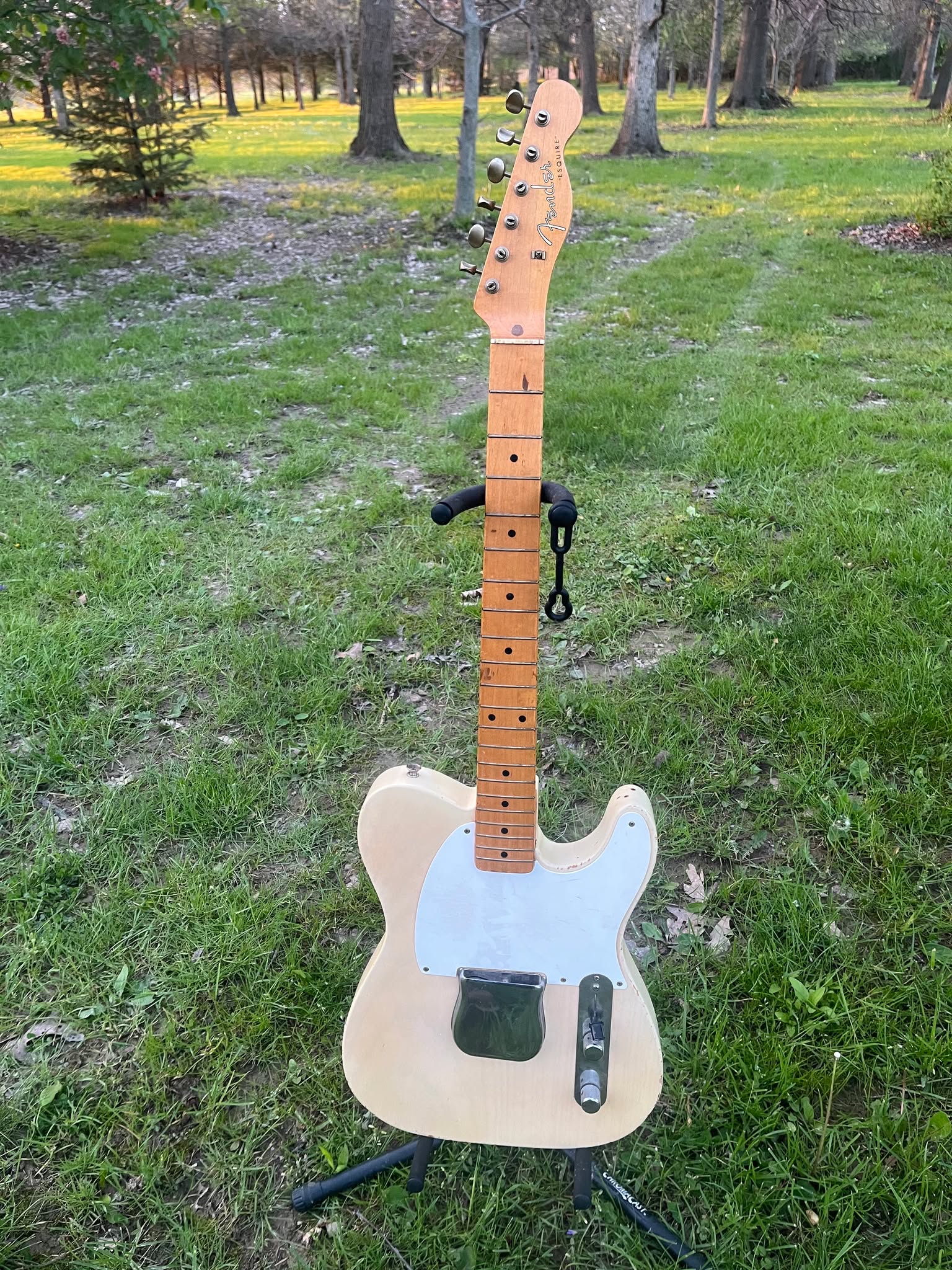
1956 Fender Esquire: The V-Neck Pre-CBS Single-Pickup Classic
The 1956 Fender Esquire is a pre-CBS, single-pickup workhorse from the V-neck era, valued for its one-piece maple neck, ash body, and original bridge and pickup. Neck profile, finish wear, and original electronics drive its value the most. Edgewater Guitars buys vintage Fender Esquires nationwide with free expert appraisals and same-day cash offers. Call or text (440) 219-3607.
Last Updated: April 2026
What Makes the 1956 Fender Esquire Significant?
The 1956 Fender Esquire represents a refined year of Leo Fender’s original single-pickup solid-body design — combining the increasingly pronounced V-neck maple profile, the introduction of the butterfly string tree (late 1956), hand-wound Formvar bridge pickup, premium ash body, the distinctive three-voice Esquire switching circuit, and peak pre-CBS craftsmanship nine years before the CBS acquisition. The 1956 Esquire bridges the early production era (softer neck profiles, round string trees) with the definitive mid-1950s specification (hard V-neck, butterfly tree) that Fender would later select as the template for their vintage reissue program.
What makes 1956 particularly special:
V-Neck Profile Established: The V-neck profile reaches its established form in 1956 — more pronounced than the emerging soft V of 1955, progressing toward the definitive hard V of 1957. Individual guitars range from moderate V to pronounced V throughout the year
Butterfly String Tree Introduction: Late 1956 production introduces the butterfly-shaped string tree, replacing the round chrome tree used on earlier examples. Both configurations authentic for 1956 — creating a transitional identification point
Single-Pickup Esquire Identity: One bridge-position single-coil pickup with Fender’s unique three-way switching circuit extracting three usable voices from one pickup — bass preset, normal with tone control, and tone bypass for maximum brightness
Pre-CBS Peak Quality: Built nine years before CBS acquisition (January 1965) with hand-wound Formvar pickups, premium ash bodies, exceptional craftsmanship at the Fullerton factory
Premium Ash Body: Ash construction for blonde/butterscotch finish with excellent grain figuring — bright, resonant tonal character
One-Piece Maple Neck: Solid maple with walnut skunk stripe — no rosewood fingerboard option until 1959
Brass Bridge Saddles: Three compensated brass saddles providing warm vintage tone essential to the 1950s Tele/Esquire voice
Genuine Rarity: Esquire production numbers significantly lower than Telecaster in every year — 1956 Esquires are genuinely scarce survivors
Factory-Original Single-Pickup Design: NOT a Telecaster with a removed pickup — the Esquire body has no neck pickup routing, and the switching circuit is purpose-designed for single-pickup operation
1956 Production Context: By 1956, Leo Fender’s solid-body electric guitar design had matured through six years of refinement since the 1950 Broadcaster debut. The Esquire continued as the single-pickup option for players who preferred focused bridge-pickup tone or needed the most affordable entry into Fender’s professional lineup. The 1956 model year is transitional — early 1956 examples carry the round string tree and softer V-neck of 1955 production, while late 1956 examples introduce the butterfly string tree that would become standard through the rest of the 1950s. This creates distinct early vs late 1956 configurations, both authentic, with the butterfly tree serving as an identification marker for later production within the year.
In Edgewater’s experience buying pre-CBS Fender guitars across Ohio and the Midwest, 1956 Esquires are exceptionally rare instruments that are almost always undervalued by local shops and general buyers. The most common problem we encounter is misidentification — owners and shops calling genuine Esquires “broken Telecasters” or “Telecasters with a missing pickup.” The second most common issue is the reverse: modified Telecasters with removed neck pickups being represented as Esquires. We’ve found that 1956 examples with the transitional features — particularly late 1956 guitars with butterfly string trees and pronounced V-necks — attract strong collector interest due to the convergence of desirable features in a single instrument.
If you own a 1956 Fender Esquire, you have a rare pre-CBS instrument from the peak of Leo Fender’s original manufacturing era. Edgewater Guitars provides free, no-obligation valuations. Call (440) 219-3607 or visit our website.
What Is a 1956 Fender Esquire Worth? (2026 Market Values)
Value by Condition and Configuration
Condition | Blonde/Butterscotch | Custom Color (Extremely Rare) | Modified |
|---|---|---|---|
Excellent (8-9/10) | Ultra-premium tier | Extraordinary tier | Significant reduction |
Very Good (7/10) | Premium tier | Ultra-premium tier | Moderate reduction |
Good (6/10) | Upper-mid tier | Premium tier | Notable reduction |
Player Grade (5/10) | Mid-tier | Upper-mid tier | Substantial reduction |
Value by Feature
Feature/Configuration | Premium/Impact | Notes |
|---|---|---|
All-Original Condition | 70-140% premium | Over modified examples |
Original Hand-Wound Pickup | 35-55% premium | Over replaced pickup |
Original Three-Way Esquire Circuit | 20-30% premium | Proves genuine Esquire identity |
Butterfly String Tree (Late 1956) | 5-10% premium | Desirable transitional feature |
Pronounced V-Neck Profile | 5-10% premium | Most desirable neck variation |
Exceptional Ash Grain | 10-20% premium | Dramatic figuring commands premiums |
Original Brass Saddles | Essential | Replacement reduces 10-15% |
Original Bakelite Pickguard | 10-15% premium | Prone to cracking, originals scarce |
Original Tweed Case | 10-20% premium | Period-correct tweed hardshell |
Refinishing | 50-70% reduction | Destroys blonde finish premium |
Replaced Pickup | 25-40% reduction | Original Formvar essential |
Neck Pickup Added (Tele Conversion) | 30-50% reduction | Permanent body routing |
Neck Replacement | 40-60% reduction | Original neck essential |
What Affects the Value of a 1956 Esquire?
Pickup Originality: Original 1956 hand-wound bridge pickup is the single most important value component. Features Formvar-coated magnet wire, Alnico V staggered pole magnets, black bottom fiber flatwork, hand-wound construction with approximately 6.5-8.0k ohms DC resistance. Replaced pickups reduce value 25-40%.
Three-Way Switching Circuit: The Esquire’s three-voice circuit (bass preset / normal with tone / tone bypass) is the primary authentication point distinguishing genuine Esquires from modified Telecasters. Original circuit intact confirms factory-original instrument.
Finish Authenticity: Original blonde/butterscotch nitrocellulose lacquer essential. Ash grain visible through semi-transparent blonde application. After 70 years, original finish shows amber toning, checking patterns, and patina consistent with aged nitrocellulose. Refinishing reduces value 50-70%.
Body Routing (CRITICAL): Genuine Esquire has NO neck pickup routing — solid unrouted wood at neck position. Presence of neck pickup route indicates modified Telecaster or converted Esquire — dramatically different value. Inspect carefully under pickguard.
String Tree Type: Round chrome string tree (early 1956) versus butterfly string tree (late 1956). Both configurations authentic. Butterfly tree on late 1956 examples serves as transitional dating feature.
Neck Profile: 1956 V-neck profiles range from moderate V (early year) to pronounced V (later production). More pronounced V profiles are slightly more desirable among collectors (5-10% premium).
How 1956 Compares to Other Years
Year | Key Difference | Relative Value | Why |
|---|---|---|---|
1950-1951 Esquire | Very earliest production | 20-40% higher | Extreme first-year rarity |
1952-1953 Esquire | Early production, black guard era | 10-20% higher | Early production premium |
1954 Esquire | Pre-V-neck profile | Similar (within 5%) | Comparable desirability |
1955 Esquire | V-neck emerging, round string tree | Similar (within 5%) | Very close specification |
1956 Esquire | V-neck established, butterfly tree intro | Baseline (ultra-premium) | Transitional features |
1957 Esquire | Hard V-neck, butterfly tree standard | Similar to 5% higher | Peak V-neck desirability |
1958 Esquire | Final two-tone sunburst year | Similar | Three-tone sunburst transition (Tele) |
1959-1965 Esquire | Rosewood fingerboard option | 10-20% lower | Later pre-CBS |
Edgewater consistently pays 30-40% more than typical guitar shops for pre-CBS Esquires. We specialize in Esquire authentication — verifying factory body routing, three-way switching circuit, Formvar pickup originality, and V-neck profile. Call (440) 219-3607.
How to Identify an Authentic 1956 Fender Esquire
Serial Numbers
Range for 1956: Approximately 9000-14000 (stamped on bridge plate)
Location: Stamped on the steel bridge plate
Important caveat: Fender used pre-stamped bridge plates applied non-sequentially. Overlap between 1955 and 1957 production common. Cross-reference with neck date, pot codes, and physical features.
Neck Date Stamps
Location: Penciled or stamped on butt end of neck heel (visible when neck removed)
Format: Month-Year (e.g., “3-56” = March 1956, “11-56” = November 1956)
Most reliable dating method — cross-reference with serial number and pot codes
Dating Significance for String Tree: Early 1956 neck dates (approximately January-September) typically correlate with round string tree. Late 1956 (approximately October-December) may have butterfly string tree. Both configurations authentic.
Potentiometer Codes
Manufacturer: Stackpole (code 304)
How to decode:
First three digits: 304 (Stackpole)
Next digit(s): Year (6 = 1956)
Last two digits: Week of manufacture (01-52)
Expected codes for 1956: 304-6-01 through 304-6-52
Where to find: Inside control cavity (remove control plate — three screws)
Esquire has two pots: Master volume and master tone. Both should show consistent 1956 dates if original.
Esquire vs Modified Telecaster Authentication (CRITICAL)
Genuine 1956 Esquire Indicators:
NO neck pickup routing — remove pickguard, inspect neck position. Solid, unrouted wood confirms factory Esquire
Three-way switching circuit providing three tonal voices from single bridge pickup:
Position 1 (forward): Bass preset — pickup through capacitor network for warm, deep tone
Position 2 (middle): Normal — bridge pickup through tone control
Position 3 (rear): Tone bypass — bridge pickup bypassing tone for maximum brightness
Single bridge pickup route only — no neck pickup cavity
Esquire wiring with capacitor network for bass preset (not standard Telecaster two-pickup wiring)
Modified Telecaster Red Flags (NOT genuine Esquire):
Visible neck pickup route (empty, filled, or covered by pickguard)
Evidence of pickup mounting screw holes at neck position
Standard Telecaster two-pickup switching circuit (selects between two pickup positions rather than three tonal voices)
Wood fill or plugged holes in neck pickup area
Why This Matters: Genuine 1956 Esquire with factory single-pickup routing commands dramatically more than a 1956 Telecaster with removed neck pickup.
String Tree Identification (1956 Transitional)
Round Chrome String Tree (Early 1956):
Simple round chrome cylinder
Same as 1954-1955 production
Mounted between D and G string tuners
Early 1956 production indicator
Butterfly String Tree (Late 1956):
Butterfly-shaped chrome guide
Introduced approximately late 1956
Becomes standard through late 1950s
Late 1956 production indicator
Both configurations completely authentic for 1956 — the transition occurred during the model year. Cross-reference with neck date and pot codes for precise timing.
Key Visual Identifiers
Body Wood: Premium ash
Finish: Blonde/butterscotch nitrocellulose (semi-transparent, showing ash grain)
Pickup: ONE bridge-position single-coil (NOT two)
Neck Position: NO pickup route (solid wood under pickguard)
Pickguard: Single-ply white Bakelite
Neck: One-piece maple with walnut skunk stripe
Neck Profile: V-shape — moderate to pronounced V
Fret Markers: Black dot position markers in maple
Fingerboard Radius: 7.25”
Scale Length: 25.5”
Nut Width: 1-5/8” (1.625”)
String Tree: Round chrome (early 1956) OR butterfly chrome (late 1956)
Tuners: Kluson Deluxe single-line stamp, plastic buttons
Bridge: Chrome steel bridge plate with three brass saddles
Bridge Saddles: Brass, three-saddle compensated
Controls: Master volume, master tone on chrome control plate
Switch: Three-way selector with Esquire-specific wiring
Headstock Logo: Spaghetti logo, gold decal, “FENDER ESQUIRE”
Headstock Size: Small pre-CBS headstock
Neck Plate: Four-bolt chrome
Frets: 21, small vintage nickel-silver wire
Weight Range: Approximately 7-8.5 lbs
Red Flags: Fakes and Modifications
Telecaster converted to Esquire: Neck pickup removed, route filled or covered. Check for wood fill, plugged screw holes, routing evidence at neck position. NOT genuine Esquire.
Esquire converted to Telecaster: Neck pickup route added to genuine Esquire body. Permanent body modification destroying Esquire value. Reduces to modified Telecaster value.
Replaced pickup: Original Formvar hand-wound pickup replaced. Verify through resistance (approximately 6.5-8.0k ohms), wire type (Formvar not enamel), flatwork color (black bottom not gray).
Refinished blonde: Original finish replaced. Wrong thickness, incorrect aging patterns, overspray in cavities.
Wrong string tree for claimed date: Round tree on claimed late 1956 or butterfly tree on claimed early 1956 requires cross-reference with other dating methods — not necessarily wrong but requires verification.
Wrong switching circuit: Standard Telecaster circuit installed in Esquire body. Test all three switch positions for correct Esquire operation.
In Edgewater’s experience evaluating pre-CBS Esquires, the two most critical authentication issues are: (1) distinguishing genuine factory Esquires from modified Telecasters — body routing inspection is definitive, and (2) pickup originality — original 1956 hand-wound Formvar pickups frequently replaced over 70 years. The string tree transition (round to butterfly) provides additional dating verification within 1956 production.
Not sure if your guitar is a genuine Esquire? Edgewater offers free authentication. Call (440) 219-3607.
1956 Fender Esquire Specifications
Specification | Detail |
|---|---|
Body Wood | Premium ash |
Body Finish | Blonde/butterscotch nitrocellulose lacquer (semi-transparent) |
Body Style | Slab-style with slight edge rounding |
Neck Wood | One-piece maple with walnut skunk stripe |
Neck Profile | V-shape (moderate to pronounced, varies by individual guitar) |
Fret Markers | Black dot position markers in maple |
Fingerboard Radius | 7.25” |
Scale Length | 25.5” |
Nut Width | 1-5/8” (1.625”) |
Nut Material | Bone |
Frets | 21 frets, small vintage nickel-silver wire |
Pickup | Single bridge-position single-coil, hand-wound Formvar wire |
Pickup Magnets | Alnico V, staggered pole pieces |
Pickup Output | Approximately 6.5-8.0k ohms DC resistance |
Pickup Flatwork | Black bottom fiber |
Controls | Master volume, master tone, three-way switch |
Three-Way Switch | Esquire circuit: bass preset / normal with tone / tone bypass |
Potentiometers | 250k audio taper, Stackpole (code 304) |
Wiring | Cloth-covered throughout |
Pickguard | Single-ply white Bakelite |
String Tree | Round chrome (early 1956) OR butterfly chrome (late 1956) |
Bridge | Chrome steel plate with three brass saddles |
Bridge Saddles | Brass, three-saddle compensated |
Tuners | Kluson Deluxe single-line stamp, plastic buttons |
Headstock Logo | Spaghetti logo, gold decal, “FENDER ESQUIRE” |
Headstock Size | Small pre-CBS |
Neck Plate | Four-bolt chrome |
Weight Range | Approximately 7-8.5 lbs |
Case | Tweed hardshell with red plush interior |
What Does a 1956 Fender Esquire Sound Like?
Pickup Specifications and Tonal Profile
Pickup type: Single bridge-position single-coil with staggered Alnico V pole pieces
DC Resistance: Approximately 6.5-8.0k ohms
Wire: Formvar-coated magnet wire, hand-wound
Magnets: Alnico V, staggered height for string balance
Flatwork: Black fiber bottom plate
Tonal character through three-way switching:
Position 1 (Bass Preset): Bridge pickup through capacitor network creating warm, deep, almost acoustic-like tone with rolled-off highs. Surprisingly full and round for a bridge-position single-coil. Excellent for jazz comping, warm rhythm work, and ballad textures. This voice is unique to the Esquire — unavailable on any Telecaster.
Position 2 (Normal): Bridge pickup through master tone control — the classic Telecaster bridge voice with tone adjustability. Bright, twangy, cutting single-coil tone with characteristic “snap” and “bark.” Rolling tone back adds warmth; wide open delivers full brightness.
Position 3 (Tone Bypass): Bridge pickup bypassing tone control entirely — maximum brightness, maximum treble, maximum cut. Pure pickup-to-volume-to-output signal path. The most aggressive, biting voice. Ideal for cutting leads, bright country picking, and aggressive rock tones.
How Construction Details Affect Tone
Premium Ash Body: Ash provides bright, resonant tonal character with scooped midrange, pronounced highs, and deep lows — the characteristic “snap” of vintage Telecaster/Esquire tone. 1956 ash with dramatic grain figuring enhances resonance and visual appeal. Lighter examples (7-7.5 lbs) produce more resonant, open sound.
V-Neck Maple Profile: The 1956 V-neck influences playing approach — thumb positioning against the V encourages a classical fretting technique that many players find enhances articulation and precision. Solid maple construction provides bright attack, excellent clarity, and snappy response.
Single-Pickup Direct Signal Path: One pickup with no selector splitting signal between pickups delivers maximally direct signal transfer. Many players describe Esquires as more “immediate” and dynamically responsive than Telecasters — the signal path is as short as possible.
Brass Bridge Saddles: Three compensated brass saddles contribute warm, vintage bridge tone. Brass slightly reduces high-frequency harshness compared to later steel saddles, contributing essential warmth to the classic 1950s Fender voice.
Thin Nitrocellulose Lacquer: After 70 years, aged nitro contributes to improved harmonic complexity and mature tonal character.
Notable Players and Esquire Legacy
Jeff Beck: His famous 1954 Esquire became one of the most iconic vintage guitars in rock history — Yardbirds through early solo career
Syd Barrett (Pink Floyd): Early Pink Floyd recordings featured Esquire tones contributing to the band’s groundbreaking psychedelic sound
Country and Western Heritage: The Esquire’s focused bridge-pickup voice made it essential for country music — single-pickup simplicity, no switching distractions, pure twang
Session Musicians: Nashville and Los Angeles session players valued the Esquire’s consistent, predictable output — one pickup, one sound, total reliability
Common Issues and Modifications That Affect Value
Neck pickup added (Telecaster conversion): Body routed for neck pickup. PERMANENT modification destroying Esquire identity. Reduces to modified Telecaster value (30-50% reduction from genuine Esquire).
Refinishing: Original blonde/butterscotch removed. Reduces value 50-70%. Even heavily worn original finish outvalues refinishing. Ash grain visible through aged blonde is desirable.
Replaced pickup: Original hand-wound Formvar replaced. Reduces value 25-40%. Verify through resistance, wire type, flatwork color.
Switching circuit modified: Original Esquire three-voice circuit replaced with standard Telecaster wiring or simplified circuit. Reduces value 15-25%.
Neck replacement: Original maple V-neck essential. Replaced necks reduce value 40-60%. Rosewood fingerboard on claimed 1956 = wrong (not available until 1959).
Bridge plate/saddle replacement: Original chrome plate with brass saddles essential. Modern replacements reduce value 15-25%.
Tuner replacement: Original Kluson Deluxe tuners should be retained. Reduces value 15-25%.
Pickguard replacement: Original white Bakelite should be retained (prone to cracking — cracked original preferred over reproduction). Reduces value 10-15%.
String tree replacement: Original round (early) or butterfly (late) should be retained. Wrong type for production timing may indicate modification.
Body routing: Any additional routing reduces value 20-40%.
Headstock repairs: Reduces value 35-55%. Less common on bolt-on designs.
Nut replacement: Original bone nut should be retained. Reduces value 5-10%.
Selling Your 1956 Fender Esquire: Your Options Compared
Selling Option | Typical Offer | Timeline | Fees/Costs | Risk Level | Best For |
|---|---|---|---|---|---|
Edgewater Guitars | 30-40% above shop offers | Immediate cash | None | Low — Esquire authentication expertise | Fair value without hassle |
Local Guitar Shop | Wholesale (lowest) | Same day | None, lowest price | Low | NOT recommended — shops misidentify Esquires |
Online Marketplace | Variable | Weeks-months | 5-15% + shipping | Very High — Esquire vs Tele disputes | Experienced sellers only |
Vintage Dealer | Premium for authenticated pre-CBS | Days-weeks | None if direct | Medium | Dealers with pre-CBS expertise |
Auction House | Exceptional for museum-quality | 3-6 months | 15-25% premium | Medium | Exceptional examples |
Why Choose Edgewater
Esquire Authentication: We verify factory body routing (no neck pickup cavity), three-way switching circuit operation, and distinguish genuine Esquires from modified Telecasters.
V-Neck Profile Recognition: We assess V-neck profiles and recognize the 1956 specification’s desirability — paying premiums for pronounced V profiles.
String Tree Dating: We use round vs butterfly string tree identification to verify production timing within 1956.
Formvar Pickup Verification: We authenticate original hand-wound Formvar pickups through resistance, wire type, and construction inspection.
Ready to find out what your 1956 Esquire is worth? Call (440) 219-3607 or visit edgewaterguitars.com.
Frequently Asked Questions About the 1956 Fender Esquire
Q: What is a 1956 Fender Esquire worth in 2026?
A: All-original 1956 Esquire with verified factory routing, original Formvar pickup, original switching circuit, and original blonde finish in excellent condition commands ultra-premium tier pricing. V-neck profile and butterfly string tree (late 1956) add modest premiums. Modified or refinished examples bring substantially less. All-original condition commands 70-140% premiums over modified.
Q: Is a 1956 Esquire just a Telecaster with a missing pickup?
A: No — the Esquire is a distinct factory model with NO neck pickup routing (solid unrouted wood at neck position) and a unique three-way switching circuit providing three tonal voices from one bridge pickup. A Telecaster with a removed neck pickup shows an empty route and standard two-pickup wiring — fundamentally different from a genuine Esquire.
Q: Does a 1956 Esquire have a round or butterfly string tree?
A: Either — 1956 is the transitional year. Early 1956 production (approximately January-September) has the round chrome string tree. Late 1956 production (approximately October-December) introduces the butterfly-shaped string tree. Both configurations completely authentic for 1956. Cross-reference with neck date and pot codes for precise dating within the year.
Q: What is the V-neck profile on a 1956 Esquire?
A: The 1956 neck profile features a V-shape — the back of the neck comes to a subtle ridge rather than a rounded C-shape. 1956 V-necks range from moderate V (early year) to more pronounced V (later production). The V-neck is the signature feel of mid-1950s Fender instruments and a desirable collector feature.
Q: How do I tell if my 1956 Esquire has original pickups?
A: Verify through: DC resistance approximately 6.5-8.0k ohms, Formvar wire coating (not enamel), Alnico V staggered pole magnets, black bottom fiber flatwork (not gray). Hand-winding creates variation between pickups — readings within range are normal. Gray flatwork or enamel wire indicates later replacement.
Q: What are the three switch positions on a 1956 Esquire?
A: Position 1 (forward): bass preset through capacitor network for warm, deep tone. Position 2 (middle): normal bridge pickup through tone control. Position 3 (rear): bridge pickup bypassing tone control for maximum brightness. This three-voice system is unique to the Esquire and is a key authentication point.
Q: Is a 1956 Esquire pre-CBS?
A: Yes — firmly pre-CBS. CBS acquired Fender in January 1965. The 1956 Esquire was built nine years before CBS acquisition under Leo Fender’s direct ownership.
Q: Does Edgewater buy 1956 Esquires?
A: Yes — Edgewater actively purchases pre-CBS Esquires from all years. We provide free authentication including body routing inspection, switching circuit verification, Formvar pickup authentication, V-neck assessment, string tree identification, and finish evaluation. Ohio, Michigan, Pennsylvania, Indiana, West Virginia. Call (440) 219-3607.
Q: Is a 1956 Esquire rarer than a 1956 Telecaster?
A: Yes — significantly fewer Esquires were produced than Telecasters in every year. Most players chose the two-pickup Telecaster. Surviving all-original 1956 Esquires are genuinely scarce, making them rarer and increasingly sought after.
Q: My 1956 Esquire’s blonde finish looks very worn — should I refinish?
A: ABSOLUTELY NOT. Original blonde/butterscotch with 70-year aging — checking, yellowing, amber toning, play wear — proves authenticity and is what collectors seek. Refinishing reduces value 50-70%. Worn original dramatically outvalues any refinish.
Related Resources
Fender Serial Number Lookup Tool — Decode your Fender’s serial number
Complete Guide to Vintage Fender Esquires (1950-1970) — Full model history
1955 Fender Esquire — Adjacent year comparison
Pre-CBS Fender Neck Date Stamps — Reading neck stamps
Original Fender Pre-CBS Finishes — Finish authentication
Sell Your Vintage Guitar to Edgewater — Get your free valuation
Edgewater Guitars specializes in purchasing premium pre-CBS Fender instruments throughout Ohio, Michigan, Pennsylvania, Indiana, and West Virginia. We provide expert Esquire authentication including factory body routing verification, three-way switching circuit confirmation, V-neck assessment, Formvar pickup authentication, and blonde finish evaluation. We travel for exceptional pre-CBS instruments. Contact us: request a free appraisal online | (440) 219-3607.
Sell your 1956 Fender Esquire
Edgewater Guitars buys vintage Fender Esquires and other vintage Fenders nationwide. We give free, honest appraisals and fair same-day cash offers, with local pickup or insured nationwide shipping. Call or text (440) 219-3607 or request a free estimate.
How much is a 1956 Fender Esquire worth?
A clean, all-original 1956 Fender Esquire’s value depends on originality, condition, finish, and whether the pickups, wiring, and hardware are original. Because Edgewater buys directly and resells, we can typically pay more than local shops or pawn stores. The most accurate way to find out is a free appraisal: send a few photos and the serial number and we will give you an honest market assessment.
Where can I sell a 1956 Fender Esquire?
Edgewater Guitars buys them directly, nationwide, with same-day cash offers and no obligation. You can also date yours with our Fender serial number lookup.