DATE :
1955 Fender Telecaster: The Pre-CBS V-Neck Year That Defined Classic Tele Feel
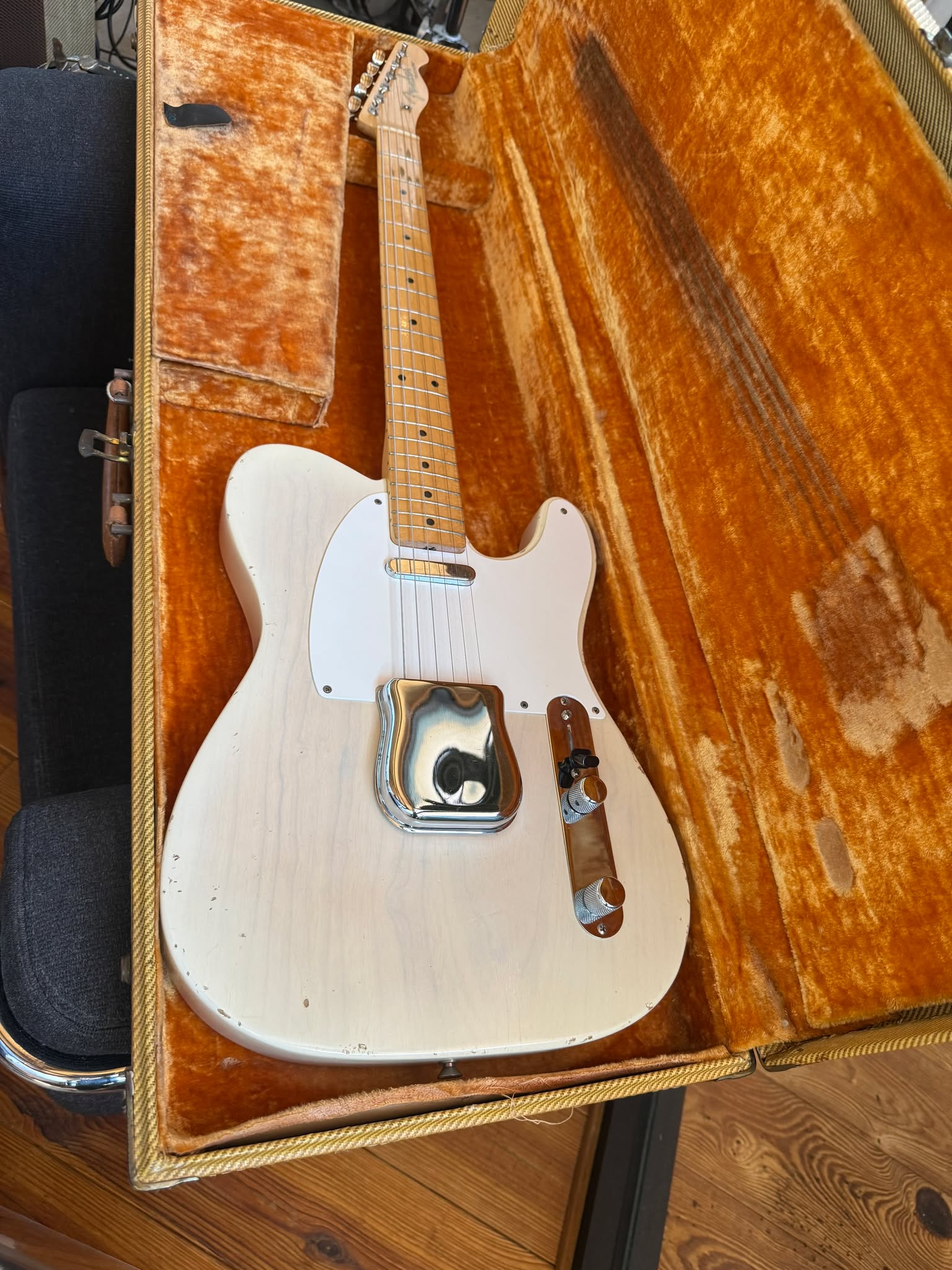
1955 Fender Telecaster: The Pre-CBS V-Neck Year That Defined Classic Tele Feel
The 1955 Fender Telecaster is a pre-CBS workhorse from the celebrated V-neck era, with the rounded neck profile and butterscotch character that collectors associate with classic Tele feel. Original finish, neck date, pickups, and overall condition matter most when assessing one. Edgewater Guitars buys vintage Fender Telecasters nationwide with free expert appraisals and same-day cash offers. Call or text (440) 219-3607.
Last Updated: May 2026
What Makes the 1955 Fender Telecaster Significant?
By 1955, the Fender Telecaster had settled into a confident stride. The earliest production chaos of 1950–1952 was behind it, and the rosewood fingerboard era was still four years away. What remained was a guitar built at the peak of Leo Fender’s original vision — a working musician’s instrument refined through genuine shop-floor feedback, not marketing committees.
The 1955 Telecaster is distinguished above all by its neck profile. This is the year the pronounced V-shape — sometimes called the “boat neck” or “soft V” — became the dominant carve, a profile that many players consider the most comfortable and fatigue-resistant neck shape Fender ever produced. Collectors who prioritize playability over investment grade condition specifically hunt 1955 examples for this reason.
Production in 1955 remained entirely maple neck with no fingerboard laminate, meaning the playing surface and the neck are one continuous piece of wood — an increasingly rare configuration among vintage Fenders as the decade progressed. In our experience buying Telecasters across Ohio and the Midwest, 1955 examples in player-grade condition are consistently among the most sought-after calls we receive, largely because serious players recognize the neck profile immediately.
What makes the 1955 Telecaster distinctive:
V-neck profile dominant throughout the production year — the most pronounced example of this carve Fender produced
All-maple one-piece neck, no rosewood laminate
White Bakelite pickguard standard (replacing earlier black fiber guard)
Serial numbers stamped on the bridge plate, transitioning to neck plate later in the year
Butterscotch blonde finish with nitrocellulose lacquer
Three-barrel brass saddle bridge with threaded steel intonation screws
Black fiber pickup bobbins with Alnico V magnets
Kluson Deluxe single-ring tuners
If you own a 1955 Telecaster, you may be sitting on a significant asset. Edgewater Guitars provides free, no-obligation valuations — call (440) 219-3607 or visit edgewaterguitars.com.
What Is a 1955 Fender Telecaster Worth? (2026 Market Values)
Value by Condition and Finish
The 1955 Telecaster market in 2026 is driven almost entirely by originality and neck condition. Because these guitars were working instruments built before the collector market existed, heavy play wear is common — and all-original examples in excellent or better condition command a substantial premium over player-grade pieces.
Condition | Originality | Relative Value |
|---|---|---|
Excellent (8–9/10) | All original, correct case | Premium tier |
Very Good (7/10) | All original, no case | Strong tier |
Good (6/10) | Original parts, finish wear | Mid tier |
Player Grade | Some replacements, heavy wear | Entry tier |
Modified | Non-original pickups, refin, or added routes | Significant reduction |
Butterscotch blonde examples in all-original condition with the original brown/tweed case represent the top of the 1955 market. Two-tone sunburst was not a standard Telecaster finish in 1955 — any 1955 Tele showing a sunburst should be examined carefully for refinishing.
What Affects the Value of a 1955 Telecaster?
Originality: All-original examples command a 40–60% premium over modified instruments. The most commonly replaced components are the pickups, bridge saddles, and tuners — each substitution reduces value incrementally.
Neck condition: The V-profile neck is the primary reason collectors seek this year. Refretted necks with correct fretwire lose minimal value; headstock repairs or cracks reduce value significantly (20–35%).
Finish integrity: Original butterscotch blonde with authentic checking, yellowing, and wear patterns is correct and desirable. A “clean” finish on a 70-year-old guitar is a red flag, not a selling point.
Original case: The original tweed or brown tolex case adds approximately 10–15% to the instrument’s value and is increasingly difficult to source separately.
Pickup output: Original Fender single-coil pickups from this era can be tested for DC resistance. Bridge pickup should read approximately 7.0–7.5k ohms; neck pickup approximately 6.5–7.0k ohms. Significant deviation suggests replacement.
How 1955 Compares to Other Years
Year | Key Difference | Relative Value | Why |
|---|---|---|---|
1954 | White pickguard introduced mid-year; some black guard examples | Similar to slightly higher | Transition-year novelty; earlier serial numbers |
1955 (this post) | Full V-neck production year; white Bakelite guard standard | Baseline | Most pure expression of original Tele V-neck |
1956 | Butterfly string tree introduced; V-neck continues | Similar | Minor hardware change; same neck profile |
1957 | V-neck at peak development; gold anodized pickguard option | Similar to slightly higher | Anodized guard examples carry collector premium |
Edgewater Guitars consistently pays 30–40% more than typical guitar shops. Get your free valuation: edgewaterguitars.com or (440) 219-3607.
Recent Sales and Auction Results
The 1955 Telecaster market is active but not deep — fewer than a dozen all-original examples in excellent condition appear at major auction each year. Heritage Auctions and Gruhn Guitars have handled the strongest recent sales. All-original examples in excellent condition with original case have achieved results in the premium tier; player-grade examples with some modifications sell at a meaningful discount. Contact Edgewater for current market context specific to your instrument’s condition.
How to Identify an Authentic 1955 Fender Telecaster
Serial Numbers
Range for 1955: Approximately 6,000–10,000 (stamped on bridge plate early in year; transitioning to neck plate late in year)
Location: Bridge plate (early 1955) or neckplate (late 1955)
Important caveat: Serial number ranges overlap between years. A number alone does not confirm a 1955 date — always cross-reference with pot codes and neck date stamp.
Neck Date
Format: Pencil-written or rubber-stamped, month and year (e.g., “1-55” or “JAN 55”)
Location: Heel of the neck, visible only when the neck is removed from the body — a four-bolt neck plate must be removed to access this
What to look for: Numbers should show appropriate aging and ink absorption into the maple. Fresh-looking stamps on an otherwise aged neck are a red flag.
Potentiometer Codes
Fender used Stackpole (code 304) and CTS (code 137) pots in this era.
How to decode: The format is: manufacturer code (3 digits) + year (2 digits) + week (2 digits)
Example: 304-5-22 = Stackpole, 1955, week 22
Expected codes for 1955: Pots dated to 1954 or 1955 are correct. Pots from 1956 or later indicate the guitar has been modified or is misrepresented.
Location: Inside the control cavity, visible through the control plate when removed
Key Visual Identifiers
Pickguard: Single-ply white Bakelite, not celluloid — Bakelite will not show the greenish aging that later celluloid guards develop
String tree: Round disc-style bullet string tree (butterfly style not yet introduced in 1955)
Tuners: Kluson Deluxe, single-ring, with plastic oval buttons — no double ring
Bridge plate: Three-barrel brass saddles with threaded steel intonation adjustment screws
Neck profile: Pronounced V-shape; nut width approximately 1-5/8 inches (1.625”)
Logo: “Spaghetti” logo in gold with black outline on headstock; thin, script-style lettering
Factory Markings and Stamps
Control cavity: Body date (pencil) sometimes found here; not universal
Neck pocket: May show pencil date matching or close to neck heel stamp
Body stamps: Some examples show pencil-written dates inside the pickup cavities
Custom Color Identification
Standard production 1955 Telecasters were butterscotch blonde only. Custom colors were not a catalogued Fender option until 1956–1957. Any 1955 Telecaster in a non-blonde finish should be treated as a potential refinish unless documented provenance exists. Yellow undercoat beneath the finish is consistent with original Fender blonde; absence of yellow sealer under a custom color is a significant red flag for refinishing.
Red Flags: How to Spot Fakes and Refinishes
“Clean” finish: Original nitrocellulose lacquer on a 70-year-old guitar should show checking, yellowing, and wear. Overly clean or thick finish suggests refinishing or a non-original body.
Filled screw holes: Relocated strap buttons, pickguard screws, or pickups indicate modification
Wrong string tree: A butterfly-style string tree on a claimed 1955 is anachronistic — the butterfly tree was introduced in 1956
Neck pocket gaps: Replacement necks rarely fit the original pocket perfectly; look for shimming material or mismatched wood grain
Modern wiring: Original 1955 wiring used cloth-covered wire; plastic-insulated wire indicates replacement
Pot date mismatch: Pots dated 1956 or later in a claimed 1955 guitar indicate modification or misrepresentation
In our experience evaluating Telecasters from the Ohio and Midwest region, the most common issue we encounter is replaced bridge pickups — often substituted with rewound or modern units while the original neck pickup remains. The tonal difference between original and replacement bridge pickups is detectable to a trained ear, and the swap is usually visible on the underside of the pickup where original Fender pickups have a distinctive black fiber bottom with specific construction characteristics.
Not sure if your Telecaster is original? Edgewater offers free authentication — our team has evaluated hundreds of vintage Fender instruments. Call (440) 219-3607 or visit edgewaterguitars.com.
1955 Fender Telecaster Specifications
Specification | Detail |
|---|---|
Body Wood | Ash (standard for blonde finish) |
Neck Wood | Maple, one-piece (no laminate fingerboard) |
Fingerboard | Maple (integral with neck), 7.25” radius |
Neck Profile | Pronounced V-shape (“soft V”), approximately 0.90” at 1st fret, 0.97” at 12th fret |
Nut Width | 1-5/8” (1.625”) |
Scale Length | 25.5” |
Frets | 21, narrow vintage wire |
Pickups | Two Fender single-coil, Alnico V magnets, black fiber bobbins |
Bridge | Three-barrel brass saddle, single-ply chrome plate |
Tuners | Kluson Deluxe, single-ring, plastic oval buttons |
Controls | Master volume, master tone, 3-position blade switch |
Pickguard | Single-ply white Bakelite |
Finish | Nitrocellulose lacquer, butterscotch blonde |
Available Colors | Butterscotch blonde (standard); custom colors not catalogued |
Weight Range | Typically 7.0–8.5 lbs |
Case | Brown tolex or tweed case |
Original Retail Price | Approximately $189.50 (1955 catalog) |
What Does a 1955 Fender Telecaster Sound Like?
Pickup Specifications and Tonal Profile
Pickup type: Single-coil, non-staggered pole pieces (all poles flush)
DC Resistance (bridge): Approximately 7.0–7.5k ohms
DC Resistance (neck): Approximately 6.5–7.0k ohms
Wire type: Formvar-coated
Magnet type: Alnico V
Potting: Unpotted
The tonal character of 1955 Telecaster pickups is defined by clarity and upper-midrange cut. The bridge pickup produces the sharp, percussive attack associated with the classic “Tele twang” — defined, not harsh, with a piano-like quality on the attack. The neck pickup, often underestimated, delivers a warm, full-bodied tone that sits well in a mix without competing with other instruments. Both pickups share a musical brightness that later CBS-era units, wound with enamel rather than formvar wire, did not consistently replicate.
How Construction Details Affect Tone
The one-piece maple neck contributes a snappier, brighter fundamental than rosewood-board instruments. Vibration transfers directly through a continuous piece of wood without the additional density of a laminated fingerboard — the result is faster attack and a slightly more articulate note decay. The ash body, standard for blonde-finish instruments, adds a characteristic midrange “scoop” and extended high-frequency response compared to the alder bodies used on darker finishes in later years.
The three-brass-saddle bridge is a critical tonal component. Brass transmits vibration differently than the steel or synthetic saddles used in later production and many replacement bridges — it adds warmth to the attack without softening the transient. This is one reason why players and collectors specifically seek original brass saddle bridges rather than accepting steel replacements.
Notable Recordings
The mid-1950s Telecaster sound is documented extensively in early rock and roll and country recordings. James Burton began developing his signature Tele style in this era, and the pickup configuration and neck profile of the 1955 model are directly tied to the sound heard on recordings with Ricky Nelson through the late 1950s. Luther Perkins, guitarist for Johnny Cash, used a Telecaster throughout this period; while specific 1955 examples are difficult to document precisely, the tonal characteristics of the era are well-represented in the Sun Records catalog.
Common Issues and Modifications That Affect Value
Replaced bridge pickup: The most common modification on 1955 Telecasters. Value impact: 20–30% reduction depending on what replaced it and whether the original is included.
Refretted neck: Professional refret with correct narrow vintage wire has minimal impact on value (5–10% reduction). Refret with modern jumbo or medium-jumbo wire is more impactful (10–15% reduction).
Replaced tuners: Kluson Deluxe originals are frequently replaced with Grovers or Schallers. Value impact: 10–15% reduction; fully reversible if originals are retained.
Refinished body: The most significant value reduction after structural damage. A professionally refinished body in the correct blonde color can still reduce value by 40–55%. A refinish in a non-original color reduces value by 55–70%.
Replaced pickguard: The white Bakelite guard ages distinctively; celluloid replacements are visible under UV light and feel different. Value impact: 5–10% reduction.
Added strap button: Many working musicians added a second strap button to the upper bout. Value impact: minimal if no finish damage; 5–10% if significant routing or filling is present.
Headstock crack or repair: Even professionally repaired headstock cracks reduce value by 25–40%. Always inspect the headstock/neck angle junction carefully.
In Edgewater’s experience evaluating 1955 Telecasters, the combination of a replaced bridge pickup and a refretted neck — the two most common modifications — still leaves a guitar that is highly desirable and valuable. Complete originality is the ideal, but “all-original” 1955 Telecasters are genuinely rare and command prices that reflect that scarcity.
Selling Your 1955 Fender Telecaster: Your Options Compared
Selling Option | Typical Offer | Timeline | Fees/Costs | Risk Level | Best For |
|---|---|---|---|---|---|
Edgewater Guitars | 30–40% above shop offers | Immediate cash | None | Low — expert authentication included | Owners wanting fair value without hassle |
Local Guitar Shop | Wholesale pricing (lowest) | Same day | None direct, but lowest price | Low | Convenience over value |
Reverb / eBay | Variable — potentially higher | Weeks to months | 5–15% platform fees + shipping | High — fraud, damage, disputes | Experienced sellers comfortable with risk |
Auction House | Variable | 3–6 months | 15–25% seller premium | Medium | Exceptionally rare, documented examples |
Private Sale | Variable | Unpredictable | None | High — authentication burden on you | Sellers with existing buyer network |
Edgewater Guitars was built specifically for the situation most vintage guitar owners face: you have an instrument you know is valuable, you want a fair price, and you don’t want to spend months on online platforms navigating lowball offers, shipping damage claims, and buyers questioning authenticity.
Our process is straightforward. You contact us with photos and basic information. We provide a preliminary valuation, usually within 24 hours. For high-value instruments, we travel to you anywhere in Ohio, Michigan, Pennsylvania, Indiana, or West Virginia for an in-person evaluation. We make an immediate cash offer — no consignment, no waiting, no platform fees.
Our offers on 1955 Telecasters consistently exceed what local shops offer because we understand the market. We’re not buying to resell at retail markup with a 90-day turn window — we operate with different economics and pass that difference to the seller.
Ready to find out what your 1955 Fender Telecaster is worth? Get your free, no-obligation valuation: edgewaterguitars.com or call (440) 219-3607.
Frequently Asked Questions About the 1955 Fender Telecaster
Q: What is a 1955 Fender Telecaster worth in 2026? A: Value depends primarily on originality and condition. All-original examples in excellent condition with the original case represent the premium tier of the market. Player-grade examples with some modifications sell at a significant discount. Contact Edgewater Guitars for a free valuation specific to your instrument’s condition and originality.
Q: How do I know if my 1955 Telecaster has the original pickups? A: Original 1955 Fender bridge pickups have black fiber bobbins, Alnico V magnets, and Formvar-coated wire. DC resistance on the bridge pickup should read approximately 7.0–7.5k ohms. The underside of the pickup shows a specific construction style distinct from replacement units. Edgewater can verify originality at no charge.
Q: What serial number range covers 1955 Fender Telecasters? A: Approximately 6,000–10,000, stamped on the bridge plate early in the year and transitioning to the neckplate later. Serial numbers alone are not definitive — always cross-reference with pot codes and the neck date stamp.
Q: Is the V-neck profile on a 1955 Telecaster comfortable to play? A: Many players consider the 1955 V-profile the most comfortable neck Fender ever produced. It fills the palm naturally and reduces fretting-hand fatigue. Players accustomed to modern C-profile necks may need a short adjustment period, but most find it highly playable.
Q: What does a 1955 Telecaster in butterscotch blonde look like today? A: Original butterscotch blonde nitrocellulose lacquer yellows and checks with age. Most honest 1955 examples show significant color shift toward amber or honey, with checking (small cracks in the finish) and play wear. A “clean” or bright white-blonde 1955 Telecaster is a red flag for refinishing.
Q: How do I date my Fender Telecaster using pot codes? A: Remove the control plate and look for the 7-digit code stamped on the back of each potentiometer. The first three digits are the manufacturer code (304 = Stackpole, 137 = CTS). The next two digits are the year, and the final two are the week. A pot reading 3045522 was made by Stackpole in week 22 of 1955.
Q: Does Edgewater Guitars buy 1955 Fender Telecasters? A: Yes. The 1955 Telecaster is among the pre-CBS Fender instruments we actively purchase. We buy all conditions — all-original examples, player-grade guitars, and even modified instruments. Call (440) 219-3607 or visit edgewaterguitars.com for a free valuation.
Q: How much more does Edgewater pay compared to a guitar shop? A: Typically 30–40% more than what a local guitar shop would offer. Guitar shops buy at wholesale and need significant margin to resell at retail. Edgewater operates differently and can pay closer to true market value. The difference on a pre-CBS Telecaster can be substantial.
Q: Should I clean or polish my 1955 Telecaster before selling? A: No. Do not polish, clean, or attempt to remove wear from a vintage instrument before having it evaluated. Original patina and natural aging are value-positive features on vintage guitars. Over-cleaning or using modern polish on nitrocellulose lacquer can permanently damage the finish and reduce value.
Q: How long does it take to sell a vintage guitar to Edgewater? A: The process typically takes 24–72 hours from initial contact to cash in hand. We provide a preliminary valuation quickly, arrange an in-person evaluation for high-value instruments, and make an immediate cash offer. There is no waiting, no consignment period, and no obligation.
Related Resources
Useful next reads and tools for this guitar:
Sell your 1955 Fender Telecaster
Edgewater Guitars buys vintage Fender Telecasters and other vintage Fenders nationwide. We give free, honest appraisals and fair same-day cash offers, with local pickup or insured nationwide shipping. Call or text (440) 219-3607 or request a free estimate.
How much is a 1955 Fender Telecaster worth?
A clean, all-original 1955 Fender Telecaster’s value depends on originality, condition, finish, and whether the pickups and hardware are original. Because Edgewater buys directly and resells, we can typically pay more than local shops or pawn stores. The most accurate way to find out is a free appraisal: send a few photos and the serial number and we will give you an honest market assessment.
Where can I sell a 1955 Fender Telecaster?
Edgewater Guitars buys them directly, nationwide, with same-day cash offers and no obligation. You can also date yours with our Fender serial number lookup.