DATE :
Thursday, December 4, 2025
1955 Fender Stratocaster: The Year Perfection Took Shape
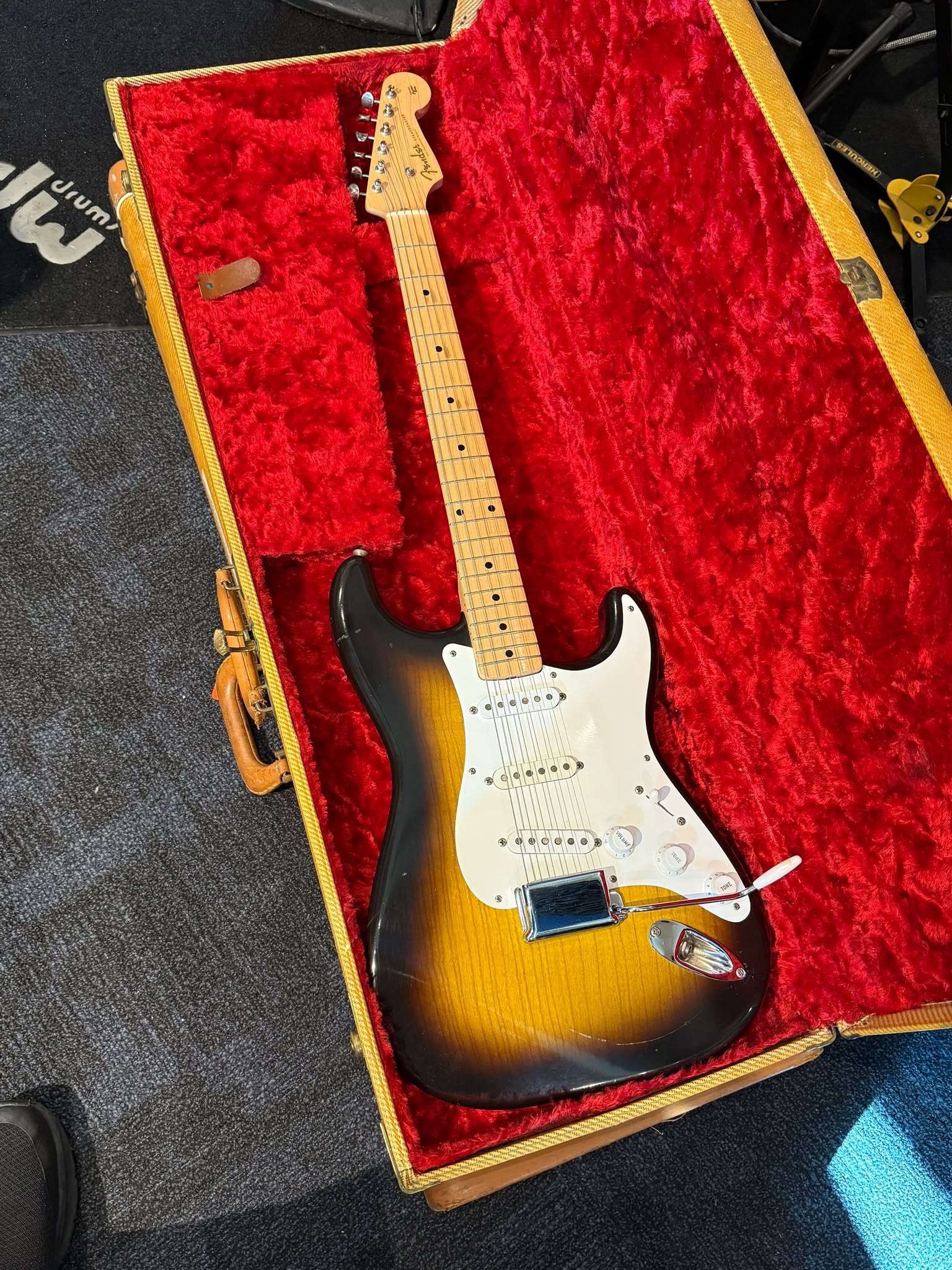
Why the 1955 Stratocaster Represents Peak Pre-CBS Craftsmanship
The 1955 Fender Stratocaster stands as a watershed moment in electric guitar history—the year when Leo Fender's revolutionary design truly hit its stride. After a year of initial production refinements in 1954, the 1955 models represent the first full year of refined, consistent production where the Stratocaster's legendary features became standardized. These instruments were built during an era when American manufacturing excellence was at its peak, with craftsmen who took genuine pride in their work and materials that would never again be available in such quality.
What distinguishes 1955 from other early Stratocasters is the confluence of perfected manufacturing processes, premium old-growth woods, and the introduction of the iconic V-shaped neck profile that would define the "golden era" of Fender production. These guitars weren't just musical instruments—they were precision tools crafted with aircraft-quality standards during the post-war boom of American ingenuity.
For collectors and players today, a 1955 Stratocaster represents the sweet spot of early Stratocaster production: refined enough to have consistent build quality, yet early enough to possess all the coveted features that make pre-CBS Fenders so desirable.
Key Value Factors Specific to 1955:
Originality Premium: All-original 1955 Stratocasters with matching neck dates, original pickups, pots, and finish command 35-50% more than examples with replaced parts or refinishes. Even a professional refret can reduce value by 10-15%.
Neck Profile: The 1955 V-shaped neck is highly sought after by players who prefer the chunkier feel. Examples with this profile intact (no neck reshaping) are worth more than those that have been modified to modern C profiles.
Body Wood and Weight: Lighter examples (under 7.5 lbs) with resonant alder bodies command premiums. Heavy examples or those with multiple body pieces may sell for 15-20% less than premium lightweight examples.
Recent Notable Sales:
A pristine 1955 sunburst Stratocaster sold at auction in late 2024 for $34,500
A blonde 1955 with original case brought $39,000 at Heritage Auctions
An all-original player-grade example sold privately for $26,000
Important Note: At Edgewater Guitars, we consistently pay 30-40% more than typical guitar shops for premium vintage Fender instruments. While a local shop might offer $18,000-$22,000 for an excellent 1955 Stratocaster, we regularly pay $26,000-$32,000 for comparable examples.
Historical Context: 1955 at Fender
In 1955, Fender was still a relatively small company operating out of Fullerton, California, with Leo Fender personally overseeing production. The Stratocaster, introduced in 1954, was entering its second year of production with several important refinements already implemented based on early user feedback and manufacturing experience.
Manufacturing Developments in 1955:
The most significant change for 1955 was the standardization of the V-shaped neck profile. After experimenting with various neck shapes in 1954, Fender settled on what collectors now call the "boat neck" or "soft V" profile—a comfortable, rounded V-shape that filled the hand and provided excellent playability. This neck profile would remain standard through 1956 and into early 1957.
The tremolo system, which had experienced some early production variations, was fully refined by 1955. The inertia block was consistently manufactured to proper specifications, and the six individual saddles were precision-machined for improved intonation. The tremolo arm itself was standardized with the distinctive white plastic tip that would become iconic.
The Stratocaster's Growing Reputation:
By 1955, professional musicians were beginning to recognize the Stratocaster's advantages. While the Telecaster remained Fender's workhorse, the Stratocaster was gaining traction with players who appreciated its versatility, comfort, and three-pickup configuration. Country and western swing players were early adopters, drawn to the instrument's bright, cutting tone and smooth tremolo action.
The list price for a 1955 Stratocaster was $249.50 with tremolo (or $229.50 without tremolo, though this option was extremely rare). For context, this was nearly double the price of a Telecaster and represented a significant investment for working musicians of the era—equivalent to roughly $2,800 in today's dollars.
Materials and Craftsmanship:
Fender was still using premium materials throughout 1955:
Old-growth alder and ash from virgin forests
Genuine bird's-eye and curly maple for necks
Nitrocellulose lacquer finishes (thin and allowing wood to breathe)
Cloth-covered wiring throughout
Hand-wound pickups with formvar-insulated wire
The factory employed experienced craftsmen, many of whom had worked in aircraft or precision manufacturing during World War II. This level of expertise, combined with Leo Fender's engineering mindset, resulted in instruments built to exacting tolerances that modern CNC manufacturing struggles to replicate with the same character.
Detailed Identification Guide: Authenticating a 1955 Stratocaster
Serial Numbers
1955 Stratocasters typically feature 4-digit serial numbers ranging from approximately 1000 to 7000, stamped into the metal bridge plate on the back of the guitar. The serial number appears on the vibrato cover plate, which must be removed to view it.
Critical Authentication Points:
Serial numbers alone are NOT definitive for dating—always cross-reference with other features
Some late 1954 instruments fall into this range, and some early 1956 instruments do as well
The stamping should show consistent depth and character style typical of Fender's numbering machine
Restamped or altered serial numbers often show inconsistent depth or modern stamping characteristics
Neck Date Stamps
The most reliable dating method is the pencil-written date notation on the butt end of the neck (visible when the neck is removed from the body). 1955 necks typically show:
Format: Month-Year (examples: "3-55", "8-55", "12-55")
Location: Written on the end of the neck heel in pencil, sometimes accompanied by other inspection marks or worker initials
Important Notes:
Neck dates can precede final assembly by weeks or even months
A neck dated "12-54" could easily be on a guitar assembled in early 1955
Conversely, a "1-56" neck might be on a late 1955 assembly
Original pencil dates should appear aged and consistent with other markings
Potentiometer Date Codes
1955 Stratocasters used Stackpole potentiometers with readable date codes that provide excellent verification:
Code Format: 304-YYWW
304 = Stackpole manufacturer code
YY = Last two digits of year (54 or 55 for 1955 instruments)
WW = Week of manufacture (01-52)
Example: 304-5523 = Stackpole potentiometer made in the 23rd week of 1955
What to Look For:
Pots should date from late 1954 through 1955 (codes showing 5401-5552)
All three potentiometers should show date codes within a reasonable timeframe of each other
Replacement pots with later date codes indicate modification
Original pots have a distinctive gray body with brass shaft
Body Date Stamps
Many 1955 Stratocaster bodies have pencil dates written inside the tremolo cavity, visible when the tremolo back cover is removed:
What You'll Find:
Date notations in pencil (month-year format)
Model designations or inspector marks
Occasionally color notations for sunburst guitars
Visual Authentication Features
1. Headstock Logo and Design:
"Spaghetti" style Fender logo (thin script with pointed serifs)
Two patent numbers below the logo: "2,573,254" and "2,960,900" (later number not yet issued but pre-printed)
Small gold "Original Contour Body" decal on headstock face
6-on-a-side Kluson Deluxe tuners with single-line "KLUSON DELUXE" stamps on back of tuner plates
2. Neck Construction:
One-piece maple neck with separate maple fretboard (maple-on-maple)
Walnut "skunk stripe" down the back covering the truss rod channel
V-shaped neck profile (soft V or "boat neck")
21 frets with narrow, low vintage fret wire
Black dot position markers (clay composition, not plastic)
Neck width at nut: 1-5/8" (slightly narrower than modern Strats)
3. Body Features:
Alder body for sunburst finishes (typically 2-3 pieces)
Ash body for blonde finish (1-2 pieces, often with visible grain)
Two-tone sunburst finish (yellow center blending to dark brown/black edges—NO RED)
Thin nitrocellulose lacquer finish (you can see wood grain clearly)
Contoured body with "comfort cuts" on back (belly cut and forearm cut)
Swimming pool-style route in body cavity (large enough for humbucker installation, though single-coils were standard)
4. Pickguard:
Single-ply white pickguard (8 screw holes mounting to body)
Bakelite or early ABS plastic material
Slightly cream-colored (not bright white)
Should show age-appropriate yellowing
Later 1955 examples may show transitional 11-screw mounting pattern
5. Hardware Specifications:
Bridge Assembly:
6-saddle synchronized tremolo with stamped steel bridge plate
Chrome-plated brass saddles (3 total, each accommodating 2 strings)
Adjustable intonation via slotted screws
Steel inertia block (tremolo block) with 5 springs in rear cavity
White plastic tremolo arm tip (early examples may have black)
String Tree:
Round, circular string tree (butterfly-style not introduced until late 1956)
Single screw mounting
Chrome-plated brass
Tuners:
Kluson Deluxe tuners with single-line "KLUSON DELUXE" stamp
Plastic buttons (white or slightly cream-colored)
Single mounting screw per tuner
Split-shaft design
6. Pickup Specifications:
1955 Stratocasters featured hand-wound single-coil pickups with the following characteristics:
Visual Features:
Black fiber bobbin bottoms (flatwork)
Alnico V rod magnets (staggered heights)
Cloth-covered output wires
No visible wax potting (or very light potting)
White or slightly aged plastic covers
Electrical Specifications:
DC Resistance: approximately 5.6k-6.0k ohms per pickup
Formvar-insulated magnet wire (42 AWG)
Asymmetrically wound (hand-guided winding creates irregularities)
Staggered pole pieces to compensate for string volume differences
7. Electronics and Wiring:
Cloth-covered "push-back" wiring throughout
3-way selector switch (Switchcraft brand)
Volume and two tone controls
.05 μF ceramic disc capacitors (some examples may have .1 μF)
Output jack mounted on side of body (chrome cup-style jack plate)
8. Tremolo Cavity Details:
5 tremolo springs in parallel configuration
White or cream-colored plastic tremolo cavity cover (5 screws)
Pencil dates often visible inside cavity
Swimming pool body route visible
Color-Specific Identification
Two-Tone Sunburst (Most Common):
Center: Translucent blonde/yellow
Edges: Dark brown to black
NO red tones (red wasn't added until 1958's three-tone sunburst)
Finish should show amber aging and possibly minor checking
Blonde Finish:
Translucent clear finish over ash body
Grain should be visible and attractive
Often shows more pronounced grain figure than sunburst examples
May have slight amber tinting from aged nitrocellulose
Physical Specifications: What to Measure
Dimensions and Measurements:
Body:
Length: 15.75"
Width (upper bout): 11"
Width (lower bout): 13"
Depth: 1.75" (may vary slightly)
Weight: typically 7-8.5 lbs (alder bodies are lighter; ash bodies can be heavier)
Neck:
Scale length: 25.5"
Nut width: 1-5/8" (slightly narrower than modern 1-11/16")
Neck profile at 1st fret: approximately .82"-.87" (soft V shape)
Neck profile at 12th fret: approximately .92"-.97"
Fretboard radius: 7.25" (very curved by modern standards)
Number of frets: 21
Fret wire: vintage narrow/low profile
Hardware:
Tuner gear ratio: approximately 15:1
String spacing at bridge: approximately 2-1/16"
String spacing at nut: approximately 1-3/8"
Weight Considerations:
Premium 1955 Stratocasters typically weigh between 7.2 and 8.2 pounds. Lighter examples are generally more desirable due to superior resonance and player comfort. Ash-body blonde finish guitars can occasionally exceed 9 pounds, which may reduce value slightly despite the desirable finish.
Tonal Characteristics: The 1955 Stratocaster Sound
The Legendary Strat Tone Profile:
The 1955 Stratocaster's voice is characterized by crystalline highs, muscular midrange, and surprising low-end depth—a tonal palette that would define popular music for decades to come. Unlike the thick, warm tones of humbucker-equipped guitars, the 1955 Strat offers articulate, glassy clarity with a distinctive "bell-like" quality that cuts through any mix.
Pickup Position Characteristics:
Bridge Pickup (Position 1):
Bright, cutting tone with strong treble presence
Excellent for rhythm playing and cutting leads
Slightly nasal character perfect for country and early rock
Percussive attack with quick note decay
Middle Pickup (Position 2):
Balanced tone with present midrange
Slightly scooped character
Clear articulation for rhythm work
Less commonly used as a standalone position
Neck Pickup (Position 3):
Warm, round tone with reduced treble
Excellent for lead playing and blues
Fuller bass response than bridge pickup
Smooth, singing sustain
In-Between Positions: The 3-way switch allows for two "in-between" positions that players quickly discovered:
Bridge + Middle: Hollow, scooped "quack" tone (later popularized in funk and reggae)
Middle + Neck: Thick, warm tone with present midrange
What Makes the 1955 Sound Special:
Unpotted or Lightly Potted Pickups: The 1955 pickups were either completely unpotted or very lightly wax-potted, allowing for maximum harmonic complexity and responsiveness to playing dynamics. This results in:
Greater sensitivity to pick attack
More harmonic overtones and "singing" quality
Slight microphonic character (can feedback at high volumes, but musical)
Immediate response to volume and tone control adjustments
Body Resonance: The thin nitrocellulose finish and carefully selected alder or ash bodies allow the wood to vibrate freely:
Enhanced acoustic resonance contributes to electric tone
Thinner finishes mean less damping of natural wood characteristics
Lighter body weights generally correlate with better resonance
Electronics and Signal Path:
Cloth-covered wiring introduces subtle high-frequency rolloff
Vintage carbon composition resistors and ceramic capacitors shape tone differently than modern components
Direct signal path with minimal components preserves pickup character
250k potentiometers allow more treble through than modern 500k pots
The "Vintage" Factor: After 70 years, several aging factors contribute to the distinctive tone:
Magnet aging (Alnico V magnets lose approximately 10-15% strength over decades)
Dried formvar insulation on pickup wire may contribute to tone
Oxidized solder joints and aged components
Settled and compressed pickup windings
Notable Recordings and Players:
While the Stratocaster wouldn't achieve mainstream dominance until the 1960s British Invasion, several forward-thinking players were using 1955-era Stratocasters:
Buddy Holly began using a Sunburst Stratocaster in 1955-1956
Early rock and roll session players in Los Angeles favored the new design
Country and western swing players appreciated the tremolo and bright tone
Early rhythm and blues players began exploring the Stratocaster's versatility
The tone of these early instruments would later define entire genres when British blues players like Eric Clapton, Jeff Beck, and Jimi Hendrix discovered them in the mid-1960s.
Common Issues and Modifications Found on 1955 Stratocasters
When evaluating a 1955 Stratocaster, understanding typical problems and common modifications is essential for accurate valuation and authentication.
Typical Age-Related Issues:
1. Neck Problems:
Truss Rod Issues: Some early truss rods have seized or broken, though this is less common with proper storage
Neck Twist or Bow: Improper storage can cause neck warping
Worn Frets: After 70 years, most 1955 Stratocasters have been refretted at least once
Fingerboard Wear: Deep grooves under strings from decades of play
2. Finish Issues:
Checking: Fine crack patterns in nitrocellulose finish (often considered desirable)
Finish Wear: Playing wear on back of neck, forearm area, and where body contacts player
UV Fading: Sunburst finishes often fade, with brown tones turning amber
Buckle Rash: Belt buckle scratches on back (very common, somewhat expected)
3. Hardware Corrosion:
Chrome plating wear on bridge saddles and other hardware
Oxidation on steel tremolo springs
Tuner corrosion (can usually be cleaned but affects value if severe)
4. Electronic Issues:
Scratchy potentiometers from decades of use
Failed capacitors (ceramic disc caps can drift out of spec)
Oxidized solder joints causing intermittent connections
Switch contact wear
Common Modifications That Affect Value:
Major Value Reducers:
Refinishing (-40% to -60% of value):
Any refinish dramatically impacts value, even if professionally done
"Relic" finishing to fake age is easily detected by experts
Check for overspray in cavities, under pickguard, and in tremolo cavity
Sanding marks under finish indicate refinish
Replaced Neck (-50% to -70% of value):
Replacement necks destroy collector value
Check neck date against body date and serial number
Wrong neck profile or incorrect features are red flags
Non-matching grain pattern between neck and body
Headstock Repairs (-30% to -50% of value):
Even professionally repaired headstock breaks significantly reduce value
Look for grain irregularities, finish discontinuities, or bulges
Shine UV light to detect finish inconsistencies in repair area
Body Routing Modifications (-40% to -60% of value):
Any additional pickup routes destroy collector value
Humbucker routes on Stratocasters are particularly problematic
Even filled and refinished routes are detectable
Moderate Value Impact:
Refret Job (-10% to -15% of value):
Most 1955 Stratocasters have been refretted
Professional refret with correct vintage-style wire has minimal impact
Amateur refret with modern wire or incorrect crown is more problematic
Original frets (if playable) add premium
Replaced Tuners (-5% to -15% of value):
Grover Rotomatic replacements very common (holes usually enlarged)
Modern Kluson reproductions less damaging if done properly
Original screw holes can sometimes be detected even after tuner replacement
Replaced Electronics (-5% to -20% of value depending on extent):
Modern potentiometers are easily dated by codes
Replacement pickups significantly affect value (modern pickups -20%, vintage replacements -10%)
Modern wiring with plastic-insulated wire is obvious
Orange Drop capacitors are post-1960s replacements
Acceptable or Minor Modifications:
Nut Replacement:
Bone or plastic nut replacement is expected and acceptable
Original nut material often wears significantly
Minimal value impact if properly fitted
Replaced Tremolo Arm:
Tremolo arms are frequently lost or broken
Correct vintage-style replacement has minimal impact
Modern reproduction arms slightly reduce value
Setup Modifications:
Adjusted bridge saddles (expected)
Replaced springs (common and acceptable)
Shielding added to cavities (reversible, minor impact)
Red Flags for Counterfeits:
1. Serial Number Issues:
Restamped numbers (inconsistent depth or modern font)
Serial numbers outside known ranges for 1955
Multiple guitars with identical serial numbers (documented fakes)
2. Anachronistic Features:
Rosewood fingerboards (not available until 1959)
Large headstock (CBS era feature)
Modern fret wire without explanation
Polyurethane finish (wasn't used until late 1960s)
Incorrect logo style or placement
3. Parts Mixing:
Neck and body dates that don't align logically
Pot codes from different decades
Modern reproduction parts claimed as original
Hardware from wrong era
4. Finish Anomalies:
Modern nitrocellulose (lacks proper aging characteristics)
Artificial aging that doesn't match genuine wear patterns
Three-tone sunburst (not introduced until 1958)
Custom colors without documentation (rare in 1955)
Documentation and Provenance:
Original documentation can add 10-15% to value and includes:
Original hardshell case (tweed with pink or orange plush interior)
Original sales receipt or invoice
Early owner photos with the instrument
Correspondence with Fender
Original hang tags or paperwork
Case Identification: 1955 Stratocasters should come with:
Tweed hardshell case (brown fabric covering)
Pink or orange plush interior lining
Fender logo on case (may be worn or missing)
Case candy: tremolo arm, whammy bar tip, tremolo springs, literature
Why Players and Collectors Value 1955 Stratocasters
Playing Characteristics:
The V-Neck Experience: The 1955 soft V-neck profile offers a unique playing experience that many guitarists prefer over modern C-shaped necks:
Fuller grip provides better leverage for bending strings
Reduced hand fatigue during extended playing sessions
Natural thumb placement for rhythm playing
Comfortable for both rhythm and lead playing styles
Vintage Playability:
7.25" radius fingerboard feels natural for chord work
Narrow fret wire allows for precise intonation
Lighter overall weight reduces shoulder strain
Smooth, broken-in feel from decades of play
Tremolo system provides expressive vibrato capabilities
Tonal Versatility: 1955 Stratocasters excel across multiple genres:
Blues: Creamy neck pickup tones with endless sustain
Rock: Aggressive bridge pickup cutting power
Country: Bright, twangy bridge tones and smooth tremolo
Jazz: Warm neck pickup with rolled-off tone control
Funk/R&B: Distinctive "quack" from in-between positions
Investment Perspective:
Historical Appreciation:
1955 Stratocasters have appreciated an average of 8-12% annually over the past 20 years
Outperformed many traditional investment vehicles
All-original examples in excellent condition show strongest appreciation
Rare finishes and features command premium pricing
Supply vs. Demand Dynamics:
Limited original production numbers (estimated 2,500-3,000 total 1955 Stratocasters)
Attrition through damage, modification, and loss
Growing collector base as vintage guitar market expands
International demand from Europe and Asia
Celebrity and investor interest increasing
Market Stability: Unlike some collectibles, vintage Fenders have shown remarkable price stability:
Values dip slightly during recessions but recover quickly
High-grade examples rarely lose value
Strong dealer network ensures liquidity
Established pricing benchmarks through auction results
Historical Significance:
Cultural Impact: The 1955 Stratocaster represents a pivotal moment in American popular culture:
Embodiment of 1950s American optimism and innovation
Bridge between country/western and rock and roll
Design influence extends far beyond guitars (space-age aesthetics)
Symbol of post-war American manufacturing excellence
Influence on Music: While the Stratocaster's full impact wouldn't be felt until the 1960s, 1955 examples were present at the birth of rock and roll:
Studio sessions for early rock records
Country music television appearances
Western swing performances
Early rhythm and blues recordings
Design Excellence: Leo Fender's 1955 Stratocaster demonstrated:
Practical, player-focused design philosophy
Manufacturing efficiency without compromising quality
Innovation in electronics and hardware
Ergonomic comfort and playing ease
Timeless aesthetic that remains relevant 70 years later
Connection to Craftsmanship: 1955 Stratocasters represent a specific moment in manufacturing history:
Hand-crafted with individual attention to detail
Built by craftsmen with pride in their work
Premium materials from sustainable sources
Pre-mass-production techniques
American manufacturing at its finest
Selling Your 1955 Fender Stratocaster to Edgewater Guitars
If you own a 1955 Stratocaster (or suspect you might), Edgewater Guitars offers a superior alternative to consignment, online selling, or trading to local guitar shops.
Why Sell to Edgewater?
1. Premium Valuations: We consistently pay 30-40% more than local guitar shops for vintage Fender instruments. Here's why:
Direct Buying: We purchase for our collection and network, not for resale margin
Expert Authentication: Our in-house expertise means we recognize value others miss
Market Knowledge: We track auction results and private sales globally
Specialty Focus: Vintage Fenders are our primary focus, not a side business
Real Example: A local Toledo shop recently offered a client $22,000 for his 1955 sunburst Stratocaster. After our evaluation, we paid $31,000 for the same instrument—41% more than the shop's offer.
2. Expert Authentication Services: Our team includes specialists who can:
Verify originality of all components
Date neck, body, and electronic components
Assess finish originality and condition
Identify modifications and their impact on value
Provide detailed written appraisals when requested
3. Immediate Cash Payment:
No waiting for consignment sales
No auction fees or seller premiums
No payment processing delays
Cash, check, or wire transfer available
Payment at time of agreement
4. White-Glove Service for High-Value Instruments: For 1955 Stratocasters valued over $25,000:
We travel to you anywhere in Ohio, Michigan, Pennsylvania, Indiana, or West Virginia
Professional photography and documentation
Secure, insured transportation if needed
Private, confidential transactions
Flexible meeting locations (bank vault, attorney's office, etc.)
5. Zero-Hassle Process: Unlike selling privately or through consignment:
No creating listings or taking photos
No fielding calls from tire-kickers
No meeting strangers in parking lots
No shipping risks or insurance concerns
No waiting months for the right buyer
6. Fair Market Evaluation: We provide transparent valuations based on:
Current auction results
Recent private sales data
Condition assessment
Originality verification
Market demand trends
Comparable sales analysis
Our Evaluation Process:
Step 1: Initial Contact Call us at (440) 219-3607 or submit photos through our website. Provide:
Serial number (on tremolo cover plate)
Overall photos of guitar front and back
Close-up photos of headstock, neck heel, and control cavity
Any original documentation or case
Step 2: Preliminary Assessment Within 24 hours, we'll provide:
Initial value range
Authentication questions
Next steps recommendation
Step 3: In-Person Evaluation (for high-value instruments) We'll arrange to meet you at a convenient location to:
Examine the instrument thoroughly
Verify all dating features
Assess condition comprehensively
Discuss value factors
Step 4: Cash Offer If we agree on terms:
Immediate payment
All paperwork handled professionally
Bill of sale provided
Optional appraisal documentation
Comparison: Edgewater vs. Other Selling Methods
Local Guitar Shop:
Typical offer: 40-50% of retail value
Quick transaction
Our advantage: 30-40% higher offers
Consignment:
20-30% commission fees
3-6 month average selling time
No guaranteed sale
Our advantage: Immediate payment, no fees, no uncertainty
Online Marketplaces (Reverb, eBay):
5-15% fees plus payment processing
Shipping risks and costs
Dealing with difficult buyers and returns
Time-consuming listing creation
Our advantage: No fees, no shipping risk, no hassles
Auction Houses:
15-25% seller's premium
4-6 month process from consignment to payment
No guarantee of meeting reserve
Our advantage: Faster process, no fees, often similar net proceeds
Private Sale:
Full value potential
Significant time investment
Safety concerns meeting strangers
Payment fraud risks
Our advantage: Professional transaction, verified payment, no personal risk
Recent 1955 Stratocaster Purchase:
We recently acquired an all-original 1955 two-tone sunburst Stratocaster from an estate in Cleveland Heights. The family had received offers from two local shops ($20,000 and $23,000) but weren't sure if they were fair. After our evaluation revealed:
All-original finish with beautiful natural aging
Matching date codes on neck, body, and pots
Original pickups with correct DC resistance
Minimal modifications (professional refret only)
Original tweed case with full set of springs
We made an immediate cash offer of $32,500—42% more than the highest shop offer. The family appreciated our transparent evaluation, professional approach, and quick payment. The entire process took less than one week from first contact to payment.
What We're Looking For:
We Pay Premium Prices For:
All-original 1955 Stratocasters in any condition
Examples with matching dates and serial numbers
Instruments with original case and documentation
Blonde finish models
Lightweight, resonant examples
Well-preserved finishes
Guitars with interesting provenance or history
We Still Buy:
Modified examples (refretted, replaced parts, etc.)
Refinished instruments (though at reduced prices)
Player-grade examples with wear
Projects needing restoration
Instruments without original cases
Geographic Service Area:
Primary Markets (We Come to You):
Ohio: Cleveland, Columbus, Cincinnati, Toledo, Akron, Youngstown
Michigan: Detroit, Grand Rapids, Ann Arbor, Lansing
Pennsylvania: Pittsburgh, Erie, Johnstown
Indiana: Fort Wayne, South Bend, Evansville
West Virginia: Wheeling, Charleston, Huntington
Extended Service: For exceptional instruments, we'll travel anywhere in the United States.
Get Started Today:
Contact Information:
Phone: (440) 219-3607 (call or text)
Website: www.edgewaterguitars.com/sell
Email: info@edgewaterguitars.com
What to Have Ready:
Photos of your guitar (overall, headstock, serial number, control cavity)
Any documentation or history you know
Original case if available
Your location for scheduling evaluation
Don't settle for lowball offers from local shops or risk the hassles of private sales. Let Edgewater Guitars provide a professional evaluation and premium cash offer for your 1955 Stratocaster.
Related Resources for Vintage Fender Research
Serial Number and Dating Resources:
Fender Serial Number Lookup Tool: Our comprehensive database helps identify and date Fender guitars from 1950-present. Access the tool here
Fender Potentiometer Dating Guide: Learn how to decode pot codes for accurate dating when serial numbers are unclear. Read the guide
Fender Neck Date Decoder: Understanding neck stamps and date formats across different eras. See examples
Early Stratocaster Serial Number Anomalies: Why serial numbers alone don't tell the whole story for 1950s Stratocasters. Learn more
Authentication and Valuation:
How to Spot Refinished Stratocasters: Visual clues and inspection techniques for detecting refinishes. Detection guide
Vintage Fender Pickup Authentication: Identifying original pickups and understanding their specifications. Pickup guide
Pre-CBS Fender Value Guide: Comprehensive pricing and value factors for 1950s and 1960s Fenders. Value information
Related Model Posts:
1954 Fender Stratocaster: The first year of production and what makes it special. Read more
1956 Fender Stratocaster: The butterfly string tree year and late V-neck examples. Read more
1957 Fender Stratocaster: The final year before major changes, featuring the last of the V-necks. Read more
1958-1959 Fender Stratocaster: The maple neck/rosewood board transition years. Read more
General Selling Information:
Main Selling Page: Complete information about Edgewater's buying process and service areas. Visit page
Why Sell to a Dealer Instead of Private Sale: Understanding the advantages of professional transactions. Learn more
Preparing Your Guitar for Sale: Tips for maximizing value and streamlining the selling process. Preparation guide
Closing: Your 1955 Stratocaster Deserves Expert Handling
The 1955 Fender Stratocaster represents more than just a vintage guitar—it's a piece of American manufacturing history, a musical instrument that helped define modern popular music, and potentially a significant financial asset. Whether your 1955 Stratocaster has been in your family for decades, was purchased as an investment, or came to you through inheritance, it deserves to be evaluated by experts who understand its true significance and value.
At Edgewater Guitars, we combine genuine passion for vintage instruments with the market knowledge and financial resources to make premium offers on exceptional guitars. We've built our reputation on fair dealing, expert authentication, and superior offers that reflect the true market value of vintage Fenders.
If you own a 1955 Stratocaster—or any vintage Fender guitar—we invite you to contact us for a free, no-obligation evaluation. We serve guitar owners throughout Ohio, Michigan, Pennsylvania, Indiana, and West Virginia, and we travel to you for high-value instruments like 1955 Stratocasters.
Contact Edgewater Guitars Today:
Phone: (440) 219-3607 (Call or text anytime)
Website: www.edgewaterguitars.com/sell
Email: info@edgewaterguitars.com
Service Areas: Cleveland, Columbus, Cincinnati, Toledo, Akron, Detroit, Pittsburgh, and all surrounding regions
We look forward to helping you understand the value of your vintage Fender and providing a premium cash offer that reflects its true worth in today's market.
About the Author: This article was prepared by the vintage guitar specialists at Edgewater Guitars, Ohio's premier buyer of vintage and collectible guitars. Our team combines decades of experience in guitar authentication, valuation, and purchasing with a genuine passion for preserving American guitar manufacturing heritage. We've evaluated and purchased hundreds of pre-CBS Fender instruments and maintain relationships with collectors, dealers, and auction houses worldwide.