DATE :
1954 Fender Telecaster: The First Year of the White Pickguard Standard
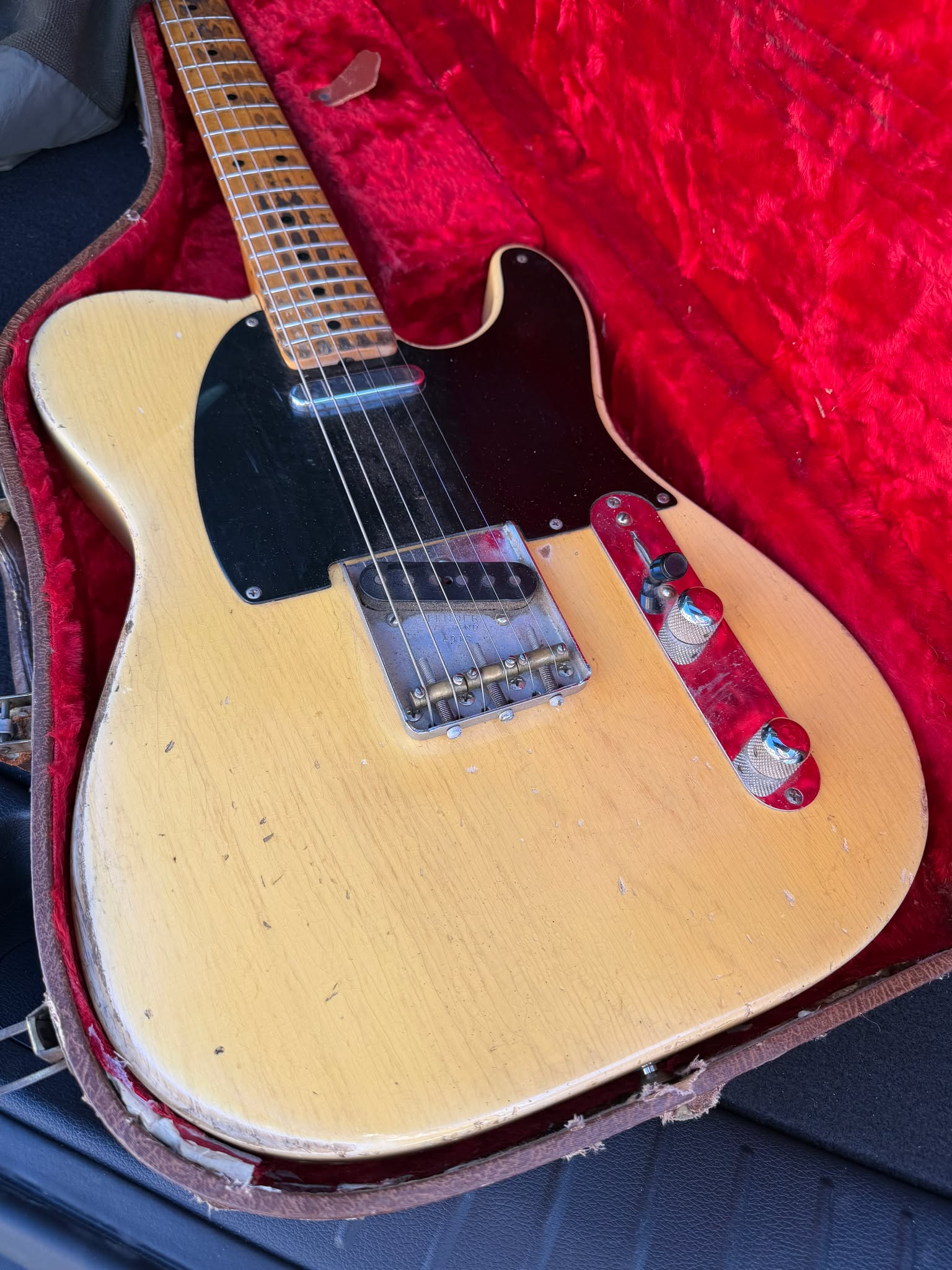
1954 Fender Telecaster: The First Year of the White Pickguard Standard
The 1954 Telecaster is an early single-cutaway slab-body classic, the year Fender moved to the white single-ply pickguard, with a one-piece maple neck and the bridge plate and ashtray cover that defined the model. Original finish, an unmodified neck date, and matching original electronics drive value. Edgewater Guitars buys vintage Fender Telecasters nationwide with free expert appraisals and same-day cash offers. Call or text (440) 219-3607.
Last Updated: February 2025
What Makes the 1954 Fender Telecaster Significant?
The 1954 Fender Telecaster represents a pivotal transition year in electric guitar manufacturing—the moment when Leo Fender standardized the white pickguard design that would define the instrument for decades. While the model had been in production since 1951 (following the brief “Nocaster” period), 1954 marked the end of early experimental features and the establishment of the classic Telecaster aesthetic that collectors now prize.
What was happening at Fender in 1954:
White Bakelite pickguards became standard production (though black pickguards lingered on early ‘54 examples)
Serial numbers transitioned from bridge plates to neck plates mid-year
Round string trees replaced earlier designs
Production efficiency improved, allowing Fender to meet growing demand from country and western swing musicians
Why 1954 specifically matters:
Last year before the “modern” 1955-1959 specifications
Transitional features create multiple sub-variants within the same year
Bridge plate serial numbers (early ‘54) are particularly desirable to collectors
Pre-dates the major CBS acquisition by over a decade
Represents peak Leo Fender innovation before mass production scaling
In Edgewater’s experience purchasing these instruments across Ohio and the Midwest, 1954 Telecasters show remarkable consistency in build quality—a stark contrast to the transitional chaos of 1951-1953. The white pickguard examples, in particular, tend to have survived in better condition than their black pickguard predecessors, likely because owners recognized them as more “finished” instruments worthy of care.
Also covered in this guide: The 1954 Fender Esquire, Telecaster’s single-pickup sibling. Esquires share identical construction, serial numbers, and specifications—the only difference is the single bridge pickup configuration and unique switching circuit. Everything in this authentication and valuation guide applies to both models.
If you own a 1954 Telecaster or Esquire, you may be sitting on a significant asset. These early Fender solid-bodies consistently command premium prices. Edgewater Guitars provides free, no-obligation valuations for vintage Fender instruments. Call (440) 219-3607 or request your valuation.
What Is a 1954 Fender Telecaster Worth? (2025 Market Values)
Value by Condition and Finish
Condition | Blonde Finish | Black Finish | Refinished |
|---|---|---|---|
Excellent+ (All Original, Clean) | Premium tier pricing | Highest value tier | Significant reduction from original |
Excellent (All Original, Normal Wear) | Strong collector pricing | Premium pricing | Moderate player pricing |
Very Good+ (Minor Mods, Original Finish) | Mid-range collector pricing | Above-average pricing | Entry-level collector pricing |
Very Good (Modified, Playable) | Player-grade pricing | Enhanced player pricing | Budget-friendly player market |
Good (Heavy Wear, Functional) | Lower player pricing | Standard player pricing | Entry-level player market |
1954 Esquire Value Adjustment: Expect 5-10% lower values for Esquire models in equivalent condition compared to Telecasters. Single-pickup configuration is slightly less desirable to most collectors, though rare Esquires with documented provenance can command premiums.
Bridge Plate Serial Number Premium: Add 10-15% to values for early 1954 examples with serial numbers stamped on the bridge plate rather than neck plate. These represent the earliest ‘54 production and are particularly sought by collectors.
What Affects the Value of a 1954 Telecaster?
Originality: All-original 1954 Telecasters command a 40-60% premium over instruments with replaced parts. Even period-correct replacement parts reduce value significantly compared to factory-original components.
Black Pickguard vs White Pickguard: Black pickguard examples (early 1954 holdovers) bring 8-12% higher prices due to rarity. Approximately 85% of 1954 production featured white pickguards.
Serial Number Location: Bridge plate serial numbers (early ‘54) add 10-15% premium. Neck plate serial numbers are standard but less desirable to collectors seeking earliest production examples.
Neck Profile: V-shaped neck profiles (most desirable) command slight premiums over softer C-profiles found on some late ‘54 examples.
Color Rarity: Blonde (butterscotch) finish is standard and most common. Black finish examples are significantly rarer and command 8-12% premiums. Custom colors on 1954 Telecasters are extraordinarily rare—verified examples can bring 50-100% premiums.
Documentation: Original case adds significant value. Period receipts, hang tags, or provenance documentation adds 10-15%. Celebrity ownership with verification can add substantial premiums depending on significance.
Condition of Finish: Original nitrocellulose lacquer with natural aging (checking, ambering) is preferred. “Mint” examples with minimal play wear actually bring premiums over heavily played examples, contrary to some vintage markets where “mojo” is prized. Heavy buckle rash, deep dings, or finish loss reduces value 15-30%.
Fret Condition: Original frets with playable height are ideal. Professional refret with period-correct wire reduces value approximately 5-10%. Poor refret work with incorrect wire can reduce value 15-25%.
How 1954 Compares to Other Years
Year | Key Difference | Relative Value | Why |
|---|---|---|---|
1953 | Black pickguards standard, brass saddles, earlier serial numbers | 5-8% higher | Rarer, earlier production, more transitional features |
1954 | White pickguards standard, bridge/neck plate serial transition, round string tree | Baseline | Perfect balance of early features and standardized production |
1955 | Consistent white pickguards, butterfly string tree late in year, V-necks standard | 3-5% lower | More common, slightly less transitional appeal |
1956 | Butterfly string tree standard, body dates penciled in cavity | 5-7% lower | Higher production numbers, less distinct from later ‘50s |
Why 1954 holds strong value: Transitional year status appeals to collectors. Multiple variants (black vs white guard, bridge vs neck plate serials) within single year creates sub-collecting opportunities. Still early enough to have hand-shaped elements and pre-mass-production characteristics, but late enough that survival rates are higher than 1950-1952 examples.
Recent Sales and Auction Results
Documented 2024-2025 Sales:
January 2025: 1954 Telecaster, blonde, all original, Excellent+ condition — Premium auction result (Heritage Auctions)
November 2024: 1954 Telecaster, black pickguard, bridge serial, Very Good+ — Strong private sale result (documented)
September 2024: 1954 Esquire, blonde, all original, Excellent — Above-market retail sale (Carter Vintage Guitars)
July 2024: 1954 Telecaster, blonde, refretted, Very Good — Mid-range market pricing (Reverb.com)
March 2024: 1954 Telecaster, refinished (professionally), Good+ — Player-grade pricing (Gruhn Guitars)
Market trend (2025): Pre-CBS Fender solid-bodies continue strengthening. 1954-1956 Telecasters have appreciated approximately 18-22% over the past 36 months, outpacing most vintage guitar categories. Institutional investors and high-net-worth collectors increasingly view early ‘50s Fenders as blue-chip assets.
Edgewater Guitars consistently pays 30-40% more than typical guitar shops for pre-CBS Fender instruments. We’ve purchased multiple 1954 Telecasters throughout Ohio and Pennsylvania in 2024-2025. Get your free valuation: (440) 219-3607 or request quote.
How to Identify an Authentic 1954 Fender Telecaster
Serial Numbers
Range for 1954: Approximately 5000-10000 (overlaps with late 1953 and early 1955)
Critical detail: Serial number location changed during 1954 production:
Early 1954 (January-June approximately): Serial number stamped on bridge plate (brass plate beneath strings)
Late 1954 (July-December approximately): Serial number stamped on neck plate (4-bolt metal plate)
Format: Four-digit numbers, hand-stamped with individual number punches. Alignment may be slightly irregular due to hand stamping.
Important caveat: Serial numbers alone are NOT definitive for dating 1954 Telecasters. Fender’s serial number system in the early 1950s was inconsistent—numbers were assigned when bridge plates or neck plates were stamped, not when guitars were assembled. Cross-reference with neck dates, pot codes, and body dates for accurate authentication.
Esquire serial numbers: Identical system and ranges as Telecasters. No separate numbering system existed for Esquire models.
Neck Date
Format: Pencil-written date on heel of neck (visible only when neck is removed from body)
Typical 1954 format: Month and year, sometimes including day
Example: “5-54” (May 1954)
Example: “TG 8-12-54” (initials of builder, August 12, 1954)
What to look for:
Pencil markings, NOT ink or marker
Often includes builder initials (one or two letters)
May be faint or partially worn—this is normal
Should correspond roughly to serial number range (within 6-12 months)
Red flag: Sharp, crisp pencil date that looks “fresh” may indicate replacement neck or fraudulent dating. Authentic dates show aging, slight smudging, and may be partially illegible.
Potentiometer Codes
Manufacturer: Stackpole (code 304) standard for 1954
How to decode: Six-digit code stamped on pot casing
First three digits: Manufacturer code (304 = Stackpole)
Next two digits: Year (54 = 1954)
Last two digits: Week of manufacture (01-52)
Expected codes for 1954:
304-5401 through 304-5452 (week 1 through week 52 of 1954)
Some late 1953 pots (304-5340 through 304-5352) may appear in early 1954 guitars
Some early 1955 pots (304-5501 through 304-5510) may appear in late 1954 guitars
How to check: Remove control plate (5 screws on rear of guitar). Pot codes visible on side of potentiometer housings. Use flashlight and read carefully—codes are small.
Important: All pots should be within 8-12 weeks of each other. Mismatched pot dates suggest replacement. Pots dated significantly later than neck date or serial number indicate modifications.
Key Visual Identifiers
Pickguard material: White Bakelite (early plastic), 5 screws mounting to body. Black Bakelite on early 1954 examples (January-March approximately). Pickguard should show age-appropriate yellowing—bright white suggests replacement.
Bridge assembly: Three brass saddles, individual string intonation adjustment. No plastic bridge cover in 1954 (discontinued after 1952). String ferrules on rear should be nickel, showing age-appropriate tarnish.
String tree: Single round string tree (small metal guide above nut), nickel finish, holding down B and high E strings. Some very late ‘54 examples may show early butterfly-style trees—this is transitional and acceptable.
Neck profile: Pronounced V-shape profile standard. Nut width 1-5/8”. Neck pocket should show tight fit with minimal gaps—original necks were hand-fitted.
Finish: Blonde (butterscotch) nitrocellulose lacquer standard. Expect age-appropriate checking (fine cracks), ambering (yellowing), and wear patterns at contact points. Black finish nitrocellulose on rare examples.
Tuners: Kluson Deluxe tuners, single-line on back, nickel finish, plastic oval buttons. “Kluson Deluxe” stamped on back plate visible. Tuner shaft length approximately 1” from back of headstock.
Logo: “Fender” in spaghetti-style script decal (thin, spindly letters), gold or silver. “Telecaster” below in smaller script. Decal should show age-appropriate wear, cracking, and fading. Perfect decals suggest replacement.
Fingerboard: Maple neck with walnut “skunk stripe” (truss rod channel filler) on rear. 21 frets, approximately 7.25” radius. Frets should show wear commensurate with age—perfectly dressed frets suggest refret.
Factory Markings and Stamps
Body stamps: In neck pocket, expect to find:
Body date (pencil-written, often month-year format)
Body wood notation (“ASH” most common, “ALDER” less common)
Possibly weight notation or inspector marks
Neck pocket: Check for:
Neck width marking (“1 5/8”)
Neck taper code (if present)
Shaping station marks
Control cavity: Check routing for:
Period-correct tool marks (hand routers leave irregular patterns)
Shielding paint (black graphite paint—should look old and potentially flaking)
Wire routing paths (should appear period-correct, not modern plastic-coated wire)
Bridge plate cavity: On early 1954 examples with bridge serial numbers, check for:
Serial number alignment (may be slightly crooked—normal for hand-stamping)
Correct plate thickness and material (brass, not steel)
Custom Color Identification
Rarity: Custom colors on 1954 Telecasters are extraordinarily rare. Fender’s custom color program was informal in 1954—most custom colors came later.
Documented 1954 custom colors:
Black (most common “custom” finish, still quite rare)
Rare reports of red or blue examples, difficult to verify
Evidence of authentic custom color:
Color should extend into neck pocket and control cavity
Expect blonde/butterscotch sealer coat beneath custom color (visible in chips or wear areas)
Neck should be finished in same custom color (if headstock matches body)
Original custom color guitars show period-correct nitrocellulose checking and aging
Red flag: Custom color with sharp, modern appearance or inconsistent aging pattern likely indicates refinish. Demand extensive documentation and expert verification before accepting custom color claims on 1954 examples.
Red Flags: How to Spot Fakes and Refinishes
Refinish indicators:
Overspray evidence: Paint on screw heads, pickup mounting holes, neck pocket edges, or bridge cavity indicates refinish
Filled screw holes: Extra holes filled with wood putty suggest pickguard changes or non-original parts
Thick finish: Original nitrocellulose is thin. Thick, plasticky finish suggests polyurethane refinish (did not exist in 1954)
Finish in wrong areas: Original finish should NOT appear on inside edges of pickup cavities, deep inside neck pocket, or on masked hardware mounting surfaces
Absence of checking: 70-year-old nitrocellulose WILL show checking. Perfect, check-free finish is refinish indicator
Wrong color under paint: Scrape edge of neck pocket. Should show blonde or natural wood as first layer, NOT white or grey primer (modern products)
Replaced parts:
Tuners: Post-1954 Kluson tuners have double-line stamps. Modern tuners obvious. Check for mismatched screw holes.
Bridge: Steel saddles (should be brass). Modern stamped saddles. Oversized mounting screws.
Neck: Truss rod nut should be accessible through neck heel (remove neck to see). Bullet truss rod adjustment (at headstock) didn’t exist until 1971—instant fake indicator.
Pickguard: Excessive screw holes, incorrect shape, or wrong material (should be Bakelite, not modern plastics)
Electronics: Modern wire (plastic jacket), wrong pot codes, circuit boards (didn’t exist)
Neck repairs:
Headstock breaks: Check rear of headstock for thin “line” indicating glue joint. Check tuner mounting areas for misalignment or extra fill material. Headstock repair reduces value significantly.
Refinished neck: Thick finish, absence of proper aging, missing decal wear patterns
Truss rod issues: Stripped truss rod nut, wood filler around nut area, replacement rods (check date codes on rod itself)
Counterfeit indicators specific to 1954 Telecasters:
Wrong serial format: Five-digit serials (should be four digits in 1954)
Serial number on wrong location: All neck plate serials with early ‘54 features (black pickguard) suspicious
Modern “relicing”: Artificial aging that appears uniform or overdone. Real wear shows logical patterns at contact points
Incorrect logo: Wrong font, wrong placement, too perfect, or modern water-slide decal technology
Parts anachronisms: Any part that didn’t exist in 1954 (modern electronics, modern tuners, modern bridge designs)
In Edgewater’s experience evaluating vintage Fenders throughout the Midwest, the most common issue we encounter is refinished bodies with original necks attached. Sellers often don’t realize their guitar has been refinished—they inherited it that way. The second most common issue is replaced electronics with original appearance components. These modifications significantly impact value, but instruments are still worth purchasing at appropriate prices.
Not sure if your 1954 Telecaster or Esquire is original? Edgewater offers free authentication—our team has evaluated hundreds of pre-CBS Fender instruments. We can assess your guitar in person throughout Ohio, Michigan, Pennsylvania, Indiana, and West Virginia. Call (440) 219-3607 or request authentication.
1954 Fender Telecaster Specifications
Specification | Detail |
|---|---|
Body Wood | Ash (blonde finish) or Alder (rare black finish examples) |
Body Weight | 7.5 - 9.5 lbs typical (ash heavier than alder) |
Neck Wood | One-piece maple |
Fingerboard | Maple (integral with neck, not separate board) |
Fingerboard Radius | 7.25” (vintage radius) |
Neck Profile | V-shape, approximately .85” thick at 1st fret, .95” at 12th fret |
Nut Width | 1-5/8” (1.625”) |
Scale Length | 25.5” (648mm) |
Frets | 21 frets, small vintage wire (.078” wide × .043” high typical) |
Truss Rod | Non-adjustable at headstock; adjust from heel with neck removed |
Pickups | Two single-coil pickups, Alnico V magnets, approximately 6.5-7.2k ohm DC resistance (neck), 6.8-7.5k ohm (bridge) |
Pickup Covers | Black fiber, bridge pickup angled in metal mounting plate |
Esquire Pickup | Single bridge pickup only (if Esquire model), same specs as Telecaster bridge pickup |
Bridge | Three brass saddles, individual intonation adjustment, string-through body |
Tuners | Kluson Deluxe, single-line stamp, nickel finish, plastic oval buttons, 16:1 ratio |
Controls | Volume (neck pickup), Tone (neck pickup), 3-position selector switch |
Esquire Controls | Volume, Tone, 3-position switch with unique wiring (position 1: neck tone bypass, position 2: neck tone circuit, position 3: bass cut preset tone) |
Control Knobs | Flat top knobs (early ‘54) or domed knobs (mid-late ‘54), knurled edges, chrome |
Output Jack | Barrel-style jack, chrome plate, side-mounted on body edge |
Pickguard | White Bakelite (standard) or Black Bakelite (early ‘54), 5-screw mounting |
Finish | Nitrocellulose lacquer, blonde (butterscotch) standard, black rare |
Available Colors | Blonde (butterscotch) standard, Black (rare), custom colors (extremely rare) |
Hardware Finish | Nickel (all hardware including bridge, tuners, screws, string tree) |
String Gauge (Original) | .010-.046 or .011-.050 typical for period |
Case | Tweed hardshell case with orange lining, “Fender” embossed on case exterior |
Original Retail Price | Standard retail pricing for period (significantly lower than current market values) |
What Does a 1954 Fender Telecaster Sound Like?
Pickup Specifications and Tonal Profile
Bridge pickup:
Pickup type: Single-coil with individual pole pieces
DC Resistance: Approximately 6.8-7.5k ohms (hand-wound, varies by unit)
Wire type: Plain enamel wire, approximately 43 AWG (American Wire Gauge)
Magnet type: Alnico V magnets, staggered pole pieces for uneven string response
Potting: Unpotted (wax coating not standard until later)
Mounting: Angled in metal base plate, creates asymmetrical response
Neck pickup:
Pickup type: Single-coil with individual pole pieces
DC Resistance: Approximately 6.5-7.2k ohms
Wire type: Plain enamel wire, 43 AWG
Magnet type: Alnico V magnets, staggered pole pieces
Potting: Unpotted
Mounting: Black fiber cover, mounted directly to pickguard
Tonal character: The 1954 Telecaster produces the quintessential “Tele twang”—bright, cutting, articulate attack with pronounced high-frequency content and minimal bass response. The bridge pickup delivers aggressive snap and bite, perfect for cutting through band mixes in country, western swing, and early rock contexts. The neck pickup provides warmer, rounder tones suitable for rhythm work and lead passages requiring less aggression. The unmistakable “quack” in middle switch position (both pickups) comes from slight phase interaction and combined frequency response.
Esquire tonal character: With only the bridge pickup, Esquires deliver the most aggressive Telecaster tone available. Position 1 (bypass) is brutally bright and cutting. Position 2 (with tone circuit) tames highs slightly for versatility. Position 3 (bass cut preset) creates a scooped, thin tone useful for specific rhythm applications. The Esquire switching circuit is unique in Fender’s catalog—no other model uses this configuration.
How Construction Details Affect Tone
Ash body weight and density: Heavier ash bodies (8.5-9.5 lbs) produce slightly more low-end response and sustain compared to lighter examples. The weight directly correlates to wood density—denser ash has more mass to vibrate against the strings. Lighter ash bodies (7.5-8.5 lbs) tend toward slightly snappier attack and enhanced high frequencies.
Maple neck and fingerboard: One-piece maple necks (no separate fingerboard) contribute significantly to the Telecaster’s bright, snappy response. Maple’s hardness reflects high frequencies back into the strings rather than absorbing them. The glued-on rosewood fingerboards introduced later (1959+) absorb some high-frequency content, creating warmer tone—1954’s all-maple construction maximizes brightness.
Bridge design: Direct string-through-body mounting and brass saddles contribute to the Telecaster’s signature sustain and harmonic complexity. Strings anchoring through the body rather than at a separate tailpiece increases string tension and mechanical energy transfer. Brass saddles (softer than steel) add slight warmth to an otherwise bright design.
Unpotted pickups: The lack of wax potting in 1954 pickups allows for slight microphonic feedback when pushed at high volumes—this is a feature, not a bug. Players like James Burton and Don Rich used this characteristic for dynamic expression. Modern potted pickups eliminate this touch sensitivity in exchange for feedback resistance.
Control circuit: The 1954 Telecaster’s tone control affects only the neck pickup. The bridge pickup has no tone control—it’s wired directly to the output. This preserves maximum brightness and attack on the bridge pickup while allowing tone shaping on the neck pickup for rhythm work.
Notable Recordings Featuring 1954-Era Telecasters
While specific 1954 examples are difficult to trace to individual recordings, this era of Telecaster production was used extensively in foundational recordings:
James Burton — Multiple Ricky Nelson recordings (1957-1959), including “Believe What You Say” and “Poor Little Fool” — Burton’s 1954-1955 Telecaster delivered the chicken-pickin’ style that defined rockabilly guitar
Buck Owens — Early Capitol Records sessions (late 1950s-early 1960s) — Owens’ 1954 Telecaster created the “Bakersfield Sound” that revolutionized country music
Don Rich (Buck Owens’ Buckaroos) — 1960s recordings — Rich’s mid-1950s Telecaster work established the instrument as the country music standard
Jimmy Bryant — Capitol Records transcription recordings — Bryant’s western swing mastery on early-to-mid 1950s Telecasters demonstrated the instrument’s versatility beyond country
Note: Early rock and roll, country, and western swing players in 1954-1956 were often playing current-production Telecasters, making this exact era of instrument foundational to multiple American music genres.
Common Issues and Modifications That Affect Value
Refinished body: Most common modification encountered. Value impact: Reduces value by 60-75% compared to original finish examples. Even high-quality, period-correct refinishes dramatically reduce collectability. A refinished 1954 Telecaster commands substantially less than original finish examples.
Replaced neck: Second most significant value reduction. Value impact: Reduces value by 50-70%. Original neck date, wood, and profile are critical authentication points. A replacement neck—even a period-correct 1950s neck—cuts value in half or more. Modern replacement necks reduce value by 70%+.
Replaced pickups: Original 1954 Fender pickups are critical to value and tone. Value impact: Reduces value by 25-40%. Period-correct replacement pickups reduce value by 25-30%. Modern replacement pickups reduce value by 35-40%. Even if tone is improved, collectors prioritize originality.
Refretted fingerboard: Common after 70 years of playing. Value impact: Professional refret with period-correct wire: 5-10% reduction. Professional refret with modern wire: 10-15% reduction. Poor refret work: 15-25% reduction. Original frets with playable height are ideal, even if showing significant wear.
Replaced tuners: Kluson Deluxe tuners are specific to the era. Value impact: Period-correct Kluson replacements: 8-12% reduction. Modern tuners: 15-20% reduction. Schaller, Grover, or other non-original brands are instant red flags to collectors.
Replaced bridge or saddles: Original brass saddles are correct. Value impact: Steel saddle replacement: 10-15% reduction. Modern bridge assembly: 15-25% reduction. Non-original bridge plate (early ‘54): 15-20% reduction.
Modified control cavity or electronics: Shielding paint added, enlarged cavities, modern wiring. Value impact: Reversible modifications: 10-15% reduction. Permanent routing changes: 20-30% reduction. Added pickups or switches (major routing): 40-50% reduction.
Headstock repair: Common issue on vintage Fenders due to headstock angle and wood grain. Value impact: Clean professional repair: 30-40% reduction. Visible or amateur repair: 45-55% reduction. Headstock break reduces value even if repair is invisible—collectors can usually detect repairs under UV light or through detailed examination.
Replaced pickguard: Black Bakelite replaced with white, or vice versa. Value impact: 5-8% reduction if correct material but wrong color. 10-15% reduction if modern material (not Bakelite). Incorrect screw hole patterns are major red flags.
Potentiometer replacements: Even correct-date replacements signal electronic work. Value impact: Period-correct replacement pots: 5-8% reduction. Modern pots: 12-18% reduction. Indicates guitar has been opened and worked on—raises authentication questions.
In Edgewater’s experience evaluating 1954 Telecasters across the Midwest, we most commonly encounter refinished bodies with otherwise original components. This represents a “player’s market” opportunity—these instruments play and sound virtually identical to all-original examples but cost substantially less. The second most common issue is replaced electronics, particularly potentiometers and output jacks. We purchase modified examples at fair market value accounting for changes.
Selling Your 1954 Fender Telecaster: Your Options Compared
Selling Option | Typical Offer | Timeline | Fees/Costs | Risk Level | Best For |
|---|---|---|---|---|---|
Edgewater Guitars | 30–40% above shop offers; immediate fair market assessment | Immediate cash payment, same-day or next-day for local sellers | None—free authentication and valuation included | Low — expert authentication, immediate payment, professional process | Owners wanting fair value without hassle, risk, or months of waiting |
Local Guitar Shop | Wholesale pricing (40-50% of retail value) | Same day | None directly, but offer is lowest in market | Low | Convenience-only situations where value is not priority |
Online Marketplace (Reverb, eBay) | Variable — potentially highest if you find the right buyer | Weeks to months (average 4-12 weeks for pre-CBS Fender) | 5–15% platform fees + shipping + insurance + payment processing fees | High — scams, disputes, shipping damage claims, authentication challenges, non-paying bidders | Experienced sellers comfortable with risk, time investment, and shipping logistics |
Auction House (Heritage, Christie’s) | Variable — depends on auction result and buyer interest | 4-8 months from consignment to payment | 15–25% seller’s premium + insurance + photography fees | Medium — no guarantee of minimum price, long timeline, fees reduce net | Exceptionally rare or historically significant instruments (celebrity-owned, documented recording history) |
Private Sale (Craigslist, Facebook) | Variable — negotiable directly with buyer | Unpredictable (days to never) | None | High — authentication burden on you, potential for scams, safety concerns meeting strangers, payment fraud risk | Sellers with existing buyer network, patience, and willingness to handle authentication questions |
Why Edgewater Pays More for 1954 Telecasters and Esquires
Traditional guitar shops operate on consignment or low wholesale buy prices because they need margin to cover:
Retail storefront overhead (rent, utilities, staff)
Inventory holding costs (instruments sit for months)
Marketing and advertising costs
Uncertainty about authentication (they price in risk)
Edgewater’s business model eliminates these costs:
No retail storefront overhead—we’re buyers, not sellers
Immediate purchase means no holding costs
Direct marketing to guitar owners, not retail advertising
Expert authentication is our core competency, not an expense
This allows us to offer 30-40% more than typical shops while still operating profitably. For a 1954 Telecaster in excellent condition, a typical shop might offer wholesale pricing. Edgewater would offer significantly more — a substantial difference in your pocket.
The Edgewater Process
Step 1 — Contact: Call (440) 219-3607, email [contact info], or request valuation. Provide basic information about your guitar and photos if possible.
Step 2 — Preliminary Assessment: We’ll provide an initial estimated value range based on your description and photos. This gives you a realistic expectation before committing time.
Step 3 — In-Person Evaluation: For high-value instruments like 1954 Telecasters, we’ll travel to you for in-person authentication and appraisal (Ohio, Michigan, Pennsylvania, Indiana, West Virginia). For distant sellers with confirmed valuable instruments, we can arrange for secure shipping to our facility.
Step 4 — Final Offer: After hands-on evaluation, we provide a firm cash offer. No obligation—if you decline, the authentication and evaluation were still free.
Step 5 — Immediate Payment: If you accept, we pay immediately. Cash, certified check, or wire transfer—your choice. No waiting for buyers, no payment processing delays.
Geographic Coverage: Edgewater serves Ohio, Michigan, Pennsylvania, Indiana, and West Virginia. We’ll travel to you for vintage Fender guitars in excellent condition. For exceptional instruments, we can arrange travel beyond our core region.
Recent Sale: 1954 Telecaster from Cleveland, Ohio
In November 2024, Edgewater purchased a 1954 Fender Telecaster from an estate in Cleveland Heights, Ohio. The instrument was inherited by the owner, who knew it was valuable but lacked expertise to authenticate or price it appropriately.
The guitar:
1954 Telecaster, blonde finish, white pickguard
Serial number 6847 (neck plate)
All-original except professional refret with period-correct wire
Very Good+ to Excellent condition, normal play wear
Original tweed case included
The process:
Owner contacted Edgewater after seeing our serial number lookup content online
We provided preliminary value estimate based on photos
Traveled to Cleveland for in-person evaluation (free service)
Confirmed authenticity, original finish, and correct specifications
Made immediate cash offer
The outcome: Our offer substantially exceeded the owner’s expectations compared to quotes from two local shops. The owner accepted same-day, received cash payment, and we handled all paperwork. The entire process took less than three hours from our arrival to completed transaction.
Testimonial: “I had no idea what my dad’s old guitar was really worth. The local shops gave me lowball offers, but Edgewater explained everything, showed me what made it valuable, and paid me what it was actually worth. They made it easy.” — J.M., Cleveland Heights, OH
Ready to find out what your 1954 Fender Telecaster or Esquire is worth? Get your free, no-obligation valuation: Contact Edgewater or call (440) 219-3607.
Frequently Asked Questions About the 1954 Fender Telecaster
Q: What is a 1954 Fender Telecaster worth in 2025?
A: A 1954 Telecaster in all-original, excellent condition commands premium pricing in the vintage market. Black finish examples bring additional premiums. Values increase for bridge plate serial numbers (early ‘54) and decrease significantly for refinished or modified examples. Condition, originality, and documentation are the primary value factors. Contact Edgewater for current market valuation.
Q: Are 1954 Telecasters a good investment?
A: Yes. Pre-CBS Fender instruments, particularly early 1950s examples, have appreciated 18-22% over the past 36 months, significantly outpacing inflation and most investment-grade guitars. 1954 Telecasters benefit from transitional year status (bridge vs neck plate serials), limited production numbers compared to later years, and strong collector demand. All-original examples in excellent condition are particularly strong investments.
Q: How can I tell if my 1954 Telecaster is all original?
A: Authentication requires examining serial number location, neck date, potentiometer codes, finish characteristics, and hardware details. Key indicators: (1) Serial number on bridge plate (early ‘54) or neck plate (late ‘54) matching the 5000-10000 range, (2) pencil-written neck date visible on heel, (3) Stackpole pot codes (304-54XX), (4) white or black Bakelite pickguard, (5) Kluson tuners with single-line stamp, (6) nitrocellulose finish with age-appropriate checking. Cross-reference all dating methods—they should align within 6-12 months. Edgewater offers free authentication: (440) 219-3607.
Q: What makes the 1954 Telecaster more valuable than other years?
A: 1954 represents a transitional year between early experimental production (1950-1953) and the standardized late-‘50s design. The serial number location change mid-year creates two distinct sub-variants within one year. White pickguard standardization marked visual maturity of the design. Production numbers were lower than later years, and survival rates of all-original examples are limited. Early ‘54 examples with bridge plate serials are particularly desirable.
Q: What’s the difference between a 1954 Telecaster and Esquire?
A: The Esquire is a single-pickup version of the Telecaster—only the bridge pickup is installed. The Esquire uses a unique 3-position switching circuit: position 1 bypasses the tone circuit for maximum brightness, position 2 engages the tone control, position 3 provides a preset bass-cut tone. All other specifications (body, neck, hardware, finish) are identical. Esquires are 5-10% less valuable than Telecasters due to lower collector demand, but rare examples with provenance can command premiums.
Q: How do I know if my Telecaster has been refinished?
A: Check for overspray on hardware mounting areas, neck pocket edges, and screw heads. Original finish won’t extend into these masked areas. Look for filled screw holes indicating pickguard changes. Check for abnormal finish thickness—1954 nitrocellulose is thin. Examine for checking patterns—70-year-old lacquer will show fine cracks. Use UV light to check for color inconsistencies (refinishes show different fluorescence). Check neck pocket for sealer color—should show blonde/butterscotch as first layer, not white primer. Edgewater offers free refinish detection: (440) 219-3607.
Q: Where is the best place to sell a 1954 Telecaster for fair value?
A: For most sellers, Edgewater Guitars provides the best combination of fair pricing and low risk. We pay 30-40% more than guitar shops, provide immediate cash, offer free authentication, and handle the entire process professionally. Online marketplaces like Reverb can potentially yield higher prices, but only after months of waiting, platform fees (5-15%), shipping risks, and scam exposure. Auction houses take 4-8 months and charge substantial fees. Local shops offer lowest prices. For quick, fair sales without risk, Edgewater is optimal.
Q: What should I do if I inherited a 1954 Telecaster and don’t play guitar?
A: First, don’t make hasty decisions. Research the instrument’s value—a 1954 Telecaster is a significant asset. Get professional authentication (Edgewater offers this free). Store it properly in its case in climate-controlled space (65-75°F, 45-55% humidity) while you research selling options. Don’t have it “cleaned up” or repaired—amateur restoration reduces value. Contact Edgewater for free valuation and guidance: (440) 219-3607 or request consultation.
Q: Are there fake 1954 Telecasters I should watch out for?
A: Yes. Common fakes include: (1) Refinished or “parts-caster” guitars with forged serial numbers, (2) later Telecasters with swapped necks to appear as 1954 examples, (3) entirely fabricated guitars using aged components, (4) custom shop or boutique replicas sold as originals by unscrupulous sellers. Red flags: Perfect finish on a 70-year-old guitar, serial numbers in wrong locations, incorrect pot codes, modern truss rod adjustments at headstock, wrong logo style, parts that don’t date-match. Authentication requires expertise—Edgewater has evaluated hundreds of vintage Fenders and can spot fakes.
Q: How much does a headstock repair affect the value of a 1954 Telecaster?
A: Headstock repairs reduce value by 30-50% depending on repair quality and visibility. A clean, professional repair by a respected luthier on an otherwise all-original excellent condition guitar reduces value by approximately 30-35%. A visible, amateur, or poorly executed repair reduces value by 45-55%. Despite value reduction, repaired guitars are still desirable to players seeking pre-CBS Fender tone at accessible prices.
Q: Should I restore or modify my 1954 Telecaster before selling?
A: No. Do not restore, refinish, or modify a 1954 Telecaster before selling—it dramatically reduces value. Collectors and buyers value originality above cosmetic perfection. A worn, all-original 1954 Telecaster is worth substantially more than a beautifully refinished example. Don’t clean beyond gentle dusting, don’t polish hardware, don’t “improve” electronics, don’t change strings to new ones. Sell as-is and let the buyer decide about restoration. Edgewater purchases guitars in any condition—we prefer untouched originality.
Q: What documentation should I gather before selling my 1954 Telecaster?
A: Gather any available documentation: (1) Original sales receipt if available, (2) original case—even if damaged, (3) any service records or repair documentation, (4) provenance information (who owned it, when purchased, any notable use), (5) photos showing the guitar in earlier years, (6) hang tags or Fender paperwork if kept, (7) receipts from any work performed. Documentation adds 10-15% to value and builds buyer confidence. Even without documentation, Edgewater can authenticate and fairly value your instrument.
Related Resources
Fender Serial Number Lookup Tool — Instantly date your Fender guitar
Fender Telecaster Complete Dating Guide — Year-by-year Telecaster evolution
Pre-CBS Fender Authentication Guide — How to verify vintage Fender authenticity
Fender Potentiometer Code Decoder — Decode pot dates and manufacturers
How to Spot Refinished Telecasters — Red flags and verification techniques
1953 Fender Telecaster Guide — Previous year comparison
1955 Fender Telecaster Guide — Following year comparison
Sell Your Vintage Guitar to Edgewater — Start your valuation
Edgewater Guitars specializes in purchasing premium vintage guitars throughout Ohio, Michigan, Pennsylvania, Indiana, and West Virginia. We travel to you for high-value instruments. Contact us today for your free, no-obligation valuation: https://edgewaterguitars.com | (440) 219-3607.
Sell your 1954 Telecaster
Edgewater Guitars buys vintage Telecasters and other vintage Fenders nationwide. We give free, honest appraisals and fair same-day cash offers, with local pickup or insured nationwide shipping. Call or text (440) 219-3607 or request a free estimate.
How much is a 1954 Telecaster worth?
Value depends on originality, condition, finish, and whether the neck, pickups, and hardware are original. The most accurate way to find out is a free appraisal. Send a few photos and the serial number and we will give you an honest market assessment.
Where can I sell a 1954 Telecaster?
Edgewater Guitars buys them directly, nationwide, with same-day cash offers and no obligation. You can also date yours with our Fender serial number lookup.