DATE :
1953 Fender Telecaster: The Transition Year That Defines Vintage Appeal
1953 Fender Telecaster: The Transition Year That Defines Vintage Appeal
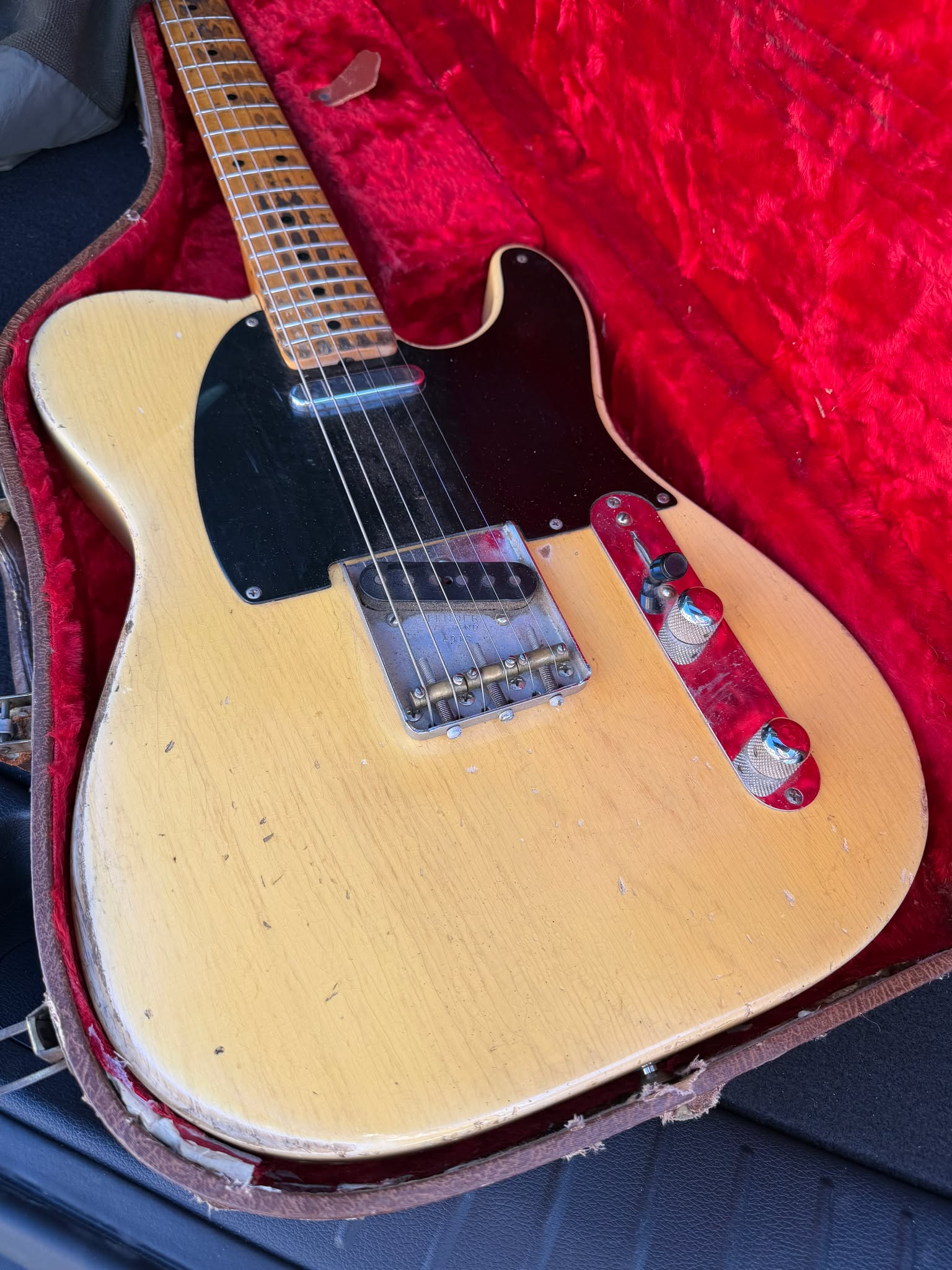
The 1953 Fender Telecaster is an early blackguard-era Tele from the years that defined the model’s bright, cutting tone and slab-body simplicity. Original finish, the blackguard pickguard, period-correct pickups, and overall condition are what move value most on a guitar this early. Edgewater Guitars buys vintage Fender Telecasters nationwide with free expert appraisals and same-day cash offers. Call or text (440) 219-3607.
What Makes a 1953 Telecaster Historically Significant?
The 1953 Fender Telecaster represents a pivotal transition year in the model’s evolution—the period when Leo Fender’s production team began introducing refinements that would define the Telecaster for the next decade. This year marks the gradual shift from black pickguards to white, the introduction of steel bridge saddles alongside traditional brass, and continued refinement of the butterscotch blonde finish that has become iconic in vintage guitar culture.
Quick Identification: A genuine 1953 Telecaster features a serial number between approximately 5000-10000 (stamped on bridge plate), black fiber pickguard (early production) transitioning to white Bakelite pickguard (later production), butterscotch blonde ash body, brass or steel bridge saddles depending on production date, maple neck with black dot position markers, and increasingly standardized manufacturing techniques.
The 1953 Esquire—the single-pickup variant—shares the same evolutionary characteristics, making it equally significant for collectors seeking early Fender solid-body guitars during this important transition period.
Historical Context: 1953 and Fender’s Growing Confidence
Leo Fender’s Design Matures
By 1953, the Telecaster design had proven itself in the marketplace for three full years. Leo Fender and his team had accumulated enough production experience to begin implementing improvements based on real-world feedback from players and manufacturing efficiency considerations.
What Made 1953 Special:
Third year of Telecaster name recognition and market acceptance
Introduction of white pickguard (mid-year transition from black)
Steel saddles begin replacing brass for improved durability
More consistent manufacturing processes and quality control
Growing artist endorsements establishing the model’s credibility
Competition from Gibson’s Les Paul (introduced 1952) driving innovation
The Pickguard Transition Story
The 1953 pickguard transition from black to white represents one of the most significant visual changes in early Telecaster history. This shift occurred gradually throughout the year, creating a fascinating range of transitional instruments:
Black Pickguard Period (Early 1953):
Continuation of 1952 black fiber or Bakelite pickguards
Traditional 5-screw mounting pattern (though patterns varied)
Black material contrasting dramatically with butterscotch blonde finish
Represents last examples of the original Broadcaster/Nocaster aesthetic
Transition Period (Mid-1953):
Some guitars shipped with black pickguards alongside white-guard production
Replacement white pickguards becoming available
Parts inventory depleted as white guards introduced
Serial numbers overlap during this period
White Pickguard Period (Late 1953):
White Bakelite pickguard becomes standard
5-screw or 8-screw mounting patterns
New visual aesthetic that would define Telecasters for decades
Cleaner, more modern appearance appealing to players
The Esquire’s Continued Evolution
The 1953 Fender Esquire underwent the same pickguard transition as its two-pickup sibling, creating equally collectible variants:
Esquire Significance in 1953:
Same construction quality and attention to detail as Telecasters
Pickguard transition mirrors Telecaster timeline
Unique switching circuit continues to provide tonal versatility
Lower price point maintains accessibility to working musicians
Single-pickup simplicity appeals to players seeking focused tone
Comprehensive Identification Guide
Serial Number Verification
1953 Telecaster Serial Number Range:
Approximately 5000 through 10000
Stamped on steel bridge plate (bass side)
Typically 4 digits by mid-1953
Numbers show more consistency than earlier years
Some overlap with late 1952 and early 1954
Serial Number Location and Format: The serial number is stamped into the steel bridge plate between the bridge pickup and saddle assembly. By 1953, Fender’s numbering had become more systematic, though still not perfectly sequential.
Critical Authentication Note: Serial numbers provide a general timeframe but should never be the sole authentication method. Bridge plates could be:
Stamped in batches ahead of guitar assembly
Replaced during repairs or modifications
Transferred between instruments
Missing entirely on some examples
Always cross-reference serial numbers with body dates, neck dates, potentiometer codes, and hardware specifications.
Body Dating Marks
Body Date Location and Format: 1953 Telecasters typically have pencil-written dates inside the body cavity, visible when pickups are removed or through pickup routing:
Common Date Formats:
“Month-Day-Year” (e.g., “4-22-53” for April 22, 1953)
“Month-Year” abbreviated (e.g., “4-53”)
Worker initials often accompany dates
Grease pencil or graphite pencil
Sometimes multiple dates from different production stages
May include routing codes or other factory notations
Neck Date Stamps: 1953 neck dates appear stamped on the butt end of the neck (visible when removed from body):
Month and year format typical
“TG” stamp indicates Tadeo Gomez (prominent early Fender employee)
Some necks dated late 1952 used on early 1953 guitars
Occasional necks have no visible date stamp
Stamping depth and clarity varies
Component Authentication
Potentiometer Code Dating: 1953 Telecasters used potentiometers with manufacturer date codes that provide reliable authentication data:
Code Format: XXX-YYWW
XXX = Manufacturer code
304 = Stackpole (most common in 1953)
137 = CTS (occasionally used)
134 = Centralab (rare in 1953 Telecasters)
YY = Year (52, 53, or 54)
WW = Week of manufacture (01-52)
Example Codes:
“304-5318” = Stackpole, 18th week of 1953
“304-5344” = Stackpole, 44th week of 1953
“304-5208” = Stackpole, 8th week of 1952 (used in early 1953 guitar)
Important Dating Considerations:
Components typically dated weeks or months before guitar assembly
A guitar with late 1952 pots could be early 1953 instrument
Potentiometers frequently replaced over 70+ years
Period-correct replacement pots acceptable if disclosed
Original pots with correct date codes significantly enhance value
Physical Specifications: 1953 Telecaster
Specification | 1953 Detail |
|---|---|
Body Wood | Ash (one-piece or book-matched two-piece) |
Body Finish | Butterscotch blonde (translucent nitrocellulose lacquer) |
Neck Wood | One-piece maple with walnut “skunk stripe” filler |
Fingerboard | Integral maple (not separate fingerboard) |
Position Markers | Black dot inlays |
Fret Wire | Small vintage wire, approximately .078” width |
Nut Width | 1-5/8 inches |
Nut Material | Bone (original) or early plastic |
Scale Length | 25.5 inches |
Pickguard | Black fiber/Bakelite (early) or white Bakelite (late) |
Pickguard Screws | 5-screw pattern typical (8-screw on some white guards) |
Bridge Pickup | Single-coil, slot-head screws (early) or Phillips screws (late) |
Neck Pickup | Single-coil with chrome cover |
Bridge Saddles | Brass (early/mid) or steel (late) |
Bridge Plate | Stamped steel with serial number |
Tuners | Kluson Deluxe with “Kluson Deluxe” stamp |
String Tree | Round metal guide (single) |
Control Layout | 3-way switch, master volume, master tone |
Output Jack | Side-mounted cup jack, chrome or nickel |
Weight Range | 7-9 lbs (ash density varies significantly) |
1953 Esquire Specifications
The 1953 Esquire shared construction with the Telecaster except for pickup configuration:
Feature | Esquire Specification |
|---|---|
Pickups | Bridge pickup only (no neck pickup) |
Body Routing | Often routed for two pickups despite single pickup |
Switching | 3-position with unique bass boost/tone bypass circuit |
Pickguard | Black (early) or white (late) with single pickup cutout |
Tone Circuit | Special capacitor switching on early wiring |
Construction | Identical to Telecaster otherwise |
Esquire Switch Function (1953 standard wiring):
Position 1: Preset bass response (capacitor to ground creates warm rhythm tone)
Position 2: Direct pickup output (bypasses all tone circuitry for maximum brightness)
Position 3: Standard tone control active (variable tone shaping)
Distinguishing 1953 from Adjacent Years
1952 vs. 1953 Differences:
Feature | 1952 | 1953 |
|---|---|---|
Serial Number | 1500-5000 | 5000-10000 |
Pickguard | Black only | Black to white transition |
Bridge Saddles | Brass only | Brass to steel transition |
Bridge Pickup Screws | Slot-head only | Slot to Phillips transition |
Manufacturing | Slightly less standardized | More consistent processes |
1953 vs. 1954 Differences:
Feature | 1953 | 1954 |
|---|---|---|
Serial Number | 5000-10000 | 10000-15000 |
Pickguard | Black to white transition | White standard |
Bridge Saddles | Brass to steel transition | Steel more common |
Bridge Pickup Screws | Slot to Phillips transition | Phillips more common |
Finish | Butterscotch standard | Custom colors appearing |
The Black Pickguard vs. White Pickguard Authentication
Black Pickguard Characteristics (Early 1953):
Black fiber material or black Bakelite
5-screw mounting most common
Screw holes show aging and potential wallowing
Material may show shrinkage, warping, or cracking
High contrast with butterscotch blonde finish
Typically found on guitars with lower serial numbers (5000-7000 range)
White Pickguard Characteristics (Late 1953):
White Bakelite material (ages to cream/yellow)
5-screw or 8-screw mounting patterns
More rigid than black fiber guards
May show yellowing from UV exposure and age
Less dramatic contrast with butterscotch finish
Typically found on higher serial numbers (7000-10000 range)
Transition Period Considerations:
Some early 1953 guitars later fitted with white pickguards (period modification)
Original screw holes may reveal first pickguard color
Multiple screw hole patterns indicate pickguard replacement
Black pickguards slightly more valuable to collectors seeking original aesthetic
Either color correct for 1953 depending on production period
Brass Saddles vs. Steel Saddles Transition
Brass Saddle Identification (Early-Mid 1953):
Brass barrel saddles with threaded adjustment
Three saddles accommodating two strings each
Natural brass aging creates patina (often greenish)
Softer metal shows wear grooves from strings
Warmer tonal characteristics than steel
Typically paired with slot-head bridge pickup screws
Steel Saddle Identification (Late 1953):
Steel barrel saddles (chrome-plated or unplated)
Same three-saddle configuration as brass
More resistant to wear and string grooving
Brighter tonal characteristics
Often paired with Phillips-head bridge pickup screws
Eventually became standard for durability
Why the Transition Occurred:
Brass saddles wore quickly under string tension and playing
Players complained about inconsistent intonation from worn saddles
Steel offered improved durability and tone stability
Manufacturing efficiency improved with standardized steel parts
Collectibility Considerations:
Original brass saddles highly desirable to collectors
Steel saddles period-correct for late 1953
Replacement saddles common after 70+ years
Original saddles with visible wear preferred over replacements
Green brass patina indicates age and originality
Finish Authentication
Butterscotch Blonde Finish Characteristics:
The 1953 Telecaster’s butterscotch blonde finish shows specific characteristics that authenticate originality:
Original Finish Properties:
Translucent nitrocellulose lacquer with amber/yellow tint
Applied directly over bare ash (no primer or sealer)
Wood grain prominently visible through finish
Typically 3-6 coats of lacquer
Natural aging to deeper amber, orange, or honey tones
UV exposure creates uneven darkening patterns
Fine checking (spider web cracks) develops with age
Ash Wood Grain Visibility:
Wide, open grain structure clearly visible
Horizontal grain orientation typical
Book-matched two-piece bodies common (centerline seam visible)
Single-piece bodies exist but less common
Grain pattern should be sharp and clear under finish
Pore structure visible under magnification
Natural Aging Indicators:
Top surface darkens more than back (UV exposure)
Lighter color preserved under pickguard and hardware
Forearm wear area shows original light color underneath
Edge wear reveals lighter wood beneath darkened finish
Buckle rash on back is normal player wear
Finish checking intensity varies by storage conditions
Refinish Warning Signs:
Primer or sealer under topcoat (original had none)
Wrong shade of blonde (too dark, too light, wrong undertone)
Modern polyurethane texture instead of thin nitrocellulose
Overspray visible in control cavity, neck pocket, or on hardware
Filled screw holes or route modifications
Perfectly even color without natural variation
Obscured wood grain from thick finish application
No wear patterns or checking despite claimed age
Detailed Hardware Identification
Bridge Assembly Evolution
Bridge Plate Specifications:
Stamped steel plate approximately .050” thick
Serial number stamped on bass side
Chrome or nickel plating (nickel more common early 1953)
6 mounting screws through body to plate
Pickup mounting screws through plate
Ashtray cover stamped “Fender Pat. Pend.”
Saddle Variations in 1953:
Brass Saddles (Early-Mid 1953):
Three brass barrel saddles
Threaded for individual height adjustment
Slotted for lateral intonation adjustment
Each saddle serves two strings
String grooves develop with playing
Natural patina develops (green oxidation)
Warmer tone than steel equivalents
Steel Saddles (Late 1953):
Three steel barrel saddles
Chrome-plated or raw steel
Same adjustment design as brass
More resistant to string wear
Brighter, more focused tone
Eventually became standard specification
String-Through Design:
Strings pass through ferrules on body back
Steel ferrules pressed into body routing
Chrome or nickel plating on ferrules
Body routed at slight angle for proper string break
Ferrule wear shows authenticity (pressed-in marks)
Pickup Construction and Specifications
Bridge Pickup Details:
Mounted to bridge plate via screws
Slot-head screws (early 1953) or Phillips screws (late 1953)
Black fiber bobbin construction
Alnico III or Alnico V magnets (varied)
Formvar-coated copper wire winding
Copper-plated steel base plate
DC resistance typically 5.5k-7.0k ohms
Hand-wound with slight variations between pickups
Neck Pickup Specifications:
Chrome or nickel cover
Mounted to pickguard via two screws
Black fiber bobbin under cover
Alnico magnets (typically Alnico V)
Formvar wire winding
DC resistance typically 6.0k-7.5k ohms
Slightly warmer voice than bridge pickup
Output slightly lower than later period pickups
Pickup Wire and Routing:
Cloth-covered lead wires from pickups
Push-back wire style (fabric cover pushes back to expose conductor)
Black or yellow cloth covering typical
Wires route through body channels to control cavity
Minimal shielding (copper paint in cavities)
Tuning Machines
1953 Kluson Deluxe Specifications:
“Kluson Deluxe” stamped on housing (critical authentication point)
Single-line vertical orientation
Nickel-plated finish (chrome on very late examples)
Press-fit bushings into headstock holes
Oval plastic buttons (originally cream-colored, age to yellow)
15:1 gear ratio
Split-shaft design
Individual tuners (not plate-mounted)
Authentication Details:
“Kluson Deluxe” stamp should be clear with proper spacing and font
Incorrect stamping indicates reproduction tuners
Original bushings have specific diameter and lip design
Gear tolerances tighter on originals than reproductions
Screw heads show appropriate wear and aging
Plastic buttons show age-related yellowing and possible shrinkage
Common Tuner Issues:
Buttons often replaced due to breakage
Gears may slip if worn
Plating wear shows heavy use
Replacement tuners extremely common (reduces originality value)
Period-correct Kluson replacements acceptable if disclosed
Electronics and Wiring
1953 Telecaster Wiring Configuration:
3-way pickup selector switch
Position 1: Neck pickup
Position 2: Both pickups in parallel
Position 3: Bridge pickup
250k ohm volume potentiometer (audio taper)
250k ohm tone potentiometer (audio taper, primarily affects neck pickup)
.05 mfd capacitor (paper-in-oil or ceramic; later changed to .022 mfd)
Cloth-covered “push-back” wiring throughout
Copper-colored shielding paint in control and pickup cavities
Wiring Route and Layout:
Pickup leads route through body channels to control cavity
Control cavity on bass side of body (right side from back)
Output jack routes to side-mounted cup
Minimal wire length for simple, effective circuit
Solder joints hand-done (irregular compared to modern machine work)
1953 Esquire Wiring (Traditional Configuration):
3-position switch with unique tone circuit
Position 1: Preset bass boost (capacitor to ground)
Position 2: Direct output (bypasses tone control entirely)
Position 3: Tone control active (standard variable tone)
250k volume potentiometer
250k tone potentiometer (engaged only in position 3)
Special capacitor configuration for position 1 bass response
Otherwise identical wiring routing to Telecaster
Tonal Characteristics
The 1953 Telecaster Sound
The 1953 Telecaster produces the classic “Tele tone” that has influenced popular music for over 70 years:
Bridge Pickup Character:
Bright, cutting treble with pronounced “snap”
Excellent note definition and articulation
Aggressive attack cutting through band mix
Limited sustain compared to humbucker-equipped guitars
Slightly nasal midrange character
Minimal bass response (focused in mid and treble range)
Classic “twang” associated with country music
Percussive attack suitable for rhythm playing
Neck Pickup Character:
Warmer, rounder tone than bridge position
Enhanced bass response compared to bridge
Smoother treble (less aggressive than bridge)
Still retains Telecaster clarity and brightness
Jazz-friendly warmth while maintaining definition
Suitable for lead playing requiring less edge
Lower output than bridge typically
Middle Position (Both Pickups):
Hollow, slightly scooped midrange
Increased output from parallel pickup combination
Not perfectly balanced (bridge usually dominates mix)
Unique tonal color useful for specific rhythm applications
Less commonly used than individual pickup positions
No phase cancellation issues due to wiring method
Brass vs. Steel Saddle Tonal Impact
Brass Saddles (Early-Mid 1953):
Warmer overall tone with enhanced midrange
Slightly compressed high-end response
Softer attack compared to steel
Vintage players often prefer brass warmth
Sonic characteristic associated with early rock and country recordings
String-to-saddle contact creates specific harmonic content
Steel Saddles (Late 1953):
Brighter, more focused high-end response
Enhanced clarity and note definition
Slightly longer sustain than brass
More aggressive attack characteristics
Modern players often prefer steel brightness
Eventually became standard for tonal consistency
Real-World Tonal Differences: While debated among players, most experienced ears can detect subtle differences between brass and steel saddles. The impact is less dramatic than pickup or wood changes but contributes to overall vintage character.
Black vs. White Pickguard Tonal Considerations
The Great Pickguard Debate: Some players claim tonal differences between black and white pickguards, though scientific evidence is minimal:
Black Pickguard Theory:
Fiber or Bakelite material composition
Slightly different resonant properties
May dampen specific frequencies differently
Psychological association with “older” tone
White Pickguard Theory:
Bakelite composition potentially different from black
Different density affecting vibration transmission
May enhance brightness perception
Reality: Pickup type, saddle material, wood selection, and electronics have far greater tonal impact than pickguard material. Any differences are extremely subtle and likely inaudible in playing situations.
Why 1953 Telecasters Sound Distinct
Construction Factors Contributing to Tone:
One-piece maple neck provides brightness and attack
Ash body contributes bright resonance with good note separation
Thin nitrocellulose finish allows maximum wood resonance
Simple wiring preserves pickup character without tone loss
Formvar-wound pickups with Alnico magnets create specific harmonic content
Brass or steel saddles contribute subtle tonal coloration
Vintage component aging affects capacitor and resistor values
Historical Recording Context: Many influential 1950s recordings featured Telecasters from this era, establishing the “Telecaster sound” in popular consciousness. The tonal characteristics became benchmarks for country, rockabilly, and early rock and roll.
Common Issues and Modifications
Typical Condition Concerns in 1953 Telecasters
Neck-Related Issues:
One-piece maple necks susceptible to warping and twisting
Humidity changes cause dimensional instability
Fret wear significant after 70+ years of playing
Truss rod may be seized from age and corrosion
Truss rod adjustment limited (early single-action design)
Nut wear or replacement extremely common
Finish wear on neck back (expected player wear)
Headstock cracks relatively uncommon on Telecasters (less angle than Gibson)
Body Condition Concerns:
Buckle rash on body back (cosmetic, normal wear)
Forearm wear through finish on top (reveals original light color)
Finish checking and crazing (normal nitrocellulose aging)
Edge dings, chips, and wear (70+ years of handling)
Route modifications for humbuckers (value-destroying modification)
Control cavity enlargement for modern electronics
Stripped or wallowed screw holes
Hardware Degradation:
Bridge saddles worn from decades of string contact
Tuners may be stiff, loose, or stripped
Pickguard shrinkage, warping, cracking (especially black fiber)
Control knobs often replaced (originals are barrel-style)
Output jack cup damage or loose mounting
Screws replaced with incorrect types (Phillips vs. slot, wrong length)
Bridge plate corrosion or finish wear
Modifications That Significantly Affect Value
Major Value-Reducing Modifications:
Refinishing (40-70% value reduction):
Most severe impact on collectibility
Even professional refinish drastically reduces value
“Closet Classic” refinishes easier to detect than assumed
Original finish wear preferred over refinish
Neck Replacement:
Changes fundamental instrument identity
Vintage Telecaster value heavily dependent on original neck
Even period-correct replacement neck severely impacts value
Neck dating critical to authentication
Route Modifications (25-50% value reduction):
Humbucker routes irreversible and obvious
Additional control holes
Modified pickup cavities
Tremolo routs (some players added Bigsby systems)
Headstock Repair (20-40% value reduction):
Even professional repairs affect value
Structural concern despite quality repair
Must be disclosed to buyers
Less common on Telecasters than Gibsons
Bridge Plate Replacement:
Losing original serial number stamp
Aftermarket plates obvious to experts
Significantly impacts authentication
Sometimes done to “upgrade” serial number (fraud)
Acceptable Period-Appropriate Modifications:
Refret:
Necessary maintenance after decades of playing
Professional work with period-appropriate wire acceptable
Document work and retain original frets if possible
Improper refret work reduces value significantly
Nut Replacement:
Normal wear item requiring replacement
Bone or vintage plastic acceptable materials
Modern synthetic nuts (Tusq, etc.) less desirable
Professional installation important
Tuner Replacement/Upgrade:
Extremely common modification
Grover or Schaller upgrades frequent in 1960s-1970s
Reversible modification (original screw holes preserved)
Period-correct Kluson replacements acceptable
Original Klusons significantly enhance value if retained
Potentiometer Replacement:
Expected after 70+ years of use
Period-correct values (250k) important
Correct manufacturer codes enhance authenticity
Audio taper important for proper function
Saddle Replacement:
Brass saddles wear and need replacement
Period-correct brass replacements acceptable
Steel saddle “upgrades” common but reversible
Original saddles with wear highly desirable
Esquire-Specific Modifications
Telecasterization (Neck Pickup Addition): This period modification is so common it’s well-documented:
Identifying Telecasterized Esquires:
Check for filled neck pickup route (often visible despite refinish)
Examine pickguard for multiple screw hole patterns
Inspect control cavity for wiring changes
Look for control plate modifications
Original Esquire switching components sometimes retained
Collectibility Impact:
Original Esquire configuration more valuable
Period modifications documented and somewhat accepted
Reversible modifications preferable to permanent alterations
Original Esquire parts retained with guitar add value
Complete restoration to original Esquire spec possible but expensive
Authentication Challenges and Common Fakes
Refinished Instruments:
Butterscotch blonde refinishes extremely prevalent
Professional refinishes difficult to detect without hardware removal
Check for overspray in cavities, neck pocket, under hardware
Wrong primer or sealer underneath finish
UV light examination reveals some modern finishes
Remove neck to inspect neck pocket for original finish traces
Parts Guitars:
“Correct period parts” doesn’t equal original configuration
Verify body date matches neck date within reasonable range
All components should show consistent aging patterns
Look for mismatched wear between parts
Pot codes should align with body/neck dates
Multiple screw hole patterns indicate part swaps
Serial Number Concerns:
Bridge plates can be replaced or re-stamped
Verify serial number font, depth, and placement against known examples
Numbers can be artificially aged
“Too perfect” stamping may indicate re-stamp
Serial number should show natural wear and patina
Never rely on serial alone for authentication
Black to White Pickguard Swaps:
Period-correct modification but affects originality
Check screw hole patterns for multiple guards
Original black guards more desirable to collectors
Some instruments shipped with both guards (unverified)
Factory replacement guards available period
Why Collectors Value 1953 Telecasters and Esquires
Historical Significance
Transitional Year Appeal: The 1953 Telecaster occupies a unique position as a transition year between the original black-guard aesthetic and the white-guard standard that followed. This transitional status creates collecting interest:
Last significant numbers of black pickguard instruments
Introduction of white pickguard aesthetic
Brass to steel saddle evolution
Manufacturing process refinement visible
Bridge between “early” and “later” vintage Telecasters
Design Maturity: By 1953, Leo Fender’s team had three years of Telecaster production experience:
Quality control more consistent than 1951-1952
Manufacturing techniques refined and standardized
Parts availability and interchangeability improved
Player feedback incorporated into improvements
Production efficiency increased while maintaining quality
Cultural Context: 1953 Telecasters were present during pivotal moments in American music:
Early rock and roll development
Country music’s electric evolution
Rhythm and blues expansion
Western swing modernization
Foundation period for electric guitar in popular music
Playing Characteristics
Playability Features:
Comfortable C-shape neck profile
Relatively lightweight (7-9 lbs typical)
Excellent upper fret access for 1950s design
Simple, intuitive two-knob, three-way switch control layout
Reliable, roadworthy construction
Easy maintenance and serviceability
Bolt-on neck allows neck replacement if necessary
Professional Appeal Then and Now:
Recording studio clarity and definition
Live performance projection through amplification
Versatility across country, rock, jazz, blues genres
Dependable hardware and electronics
Cost-effective compared to Gibson alternatives (1950s)
Timeless aesthetic that transcends trends
Investment and Collectibility Factors
Rarity Considerations:
Limited 1953 production compared to 1960s-1970s peak years
Survival rate reduced by modifications over 70+ years
All-original examples increasingly scarce
Black pickguard variants rarer than white (early year production)
Brass saddle examples becoming harder to find
Complete originality commanding premium prices
Condition Impact on Value:
All-original instruments with no modifications most valuable
Player-grade examples with reversible mods accessible to musicians
Professional restoration can enhance playability while preserving history
Documentation of original configuration important for modified instruments
Original case, hang tags, and paperwork significantly enhance value
Market Position: 1953 Telecasters occupy middle ground between earliest examples (1950-1952) and later standardized production (1954+). This makes them:
More accessible than Broadcasters and Nocasters
More interesting than later standardized years
Transition year appeal to serious collectors
Player instruments still available at various price points
Esquire Collectibility: 1953 Esquires share similar market position with additional factors:
Single-pickup simplicity appeals to purists
Unique switching provides distinct voice
Often less expensive than equivalent Telecasters
Telecasterized examples create submarkets
Original Esquire configuration increasingly valued
Selling Your 1953 Telecaster or Esquire
Why Choose Edgewater Guitars
At Edgewater Guitars, we specialize in evaluating and purchasing significant vintage Fender instruments, with particular expertise in transition-year models like the 1953 Telecaster and Esquire:
Our Expertise with 1953 Fender Instruments:
Deep knowledge of black vs. white pickguard transitions
Understanding of brass vs. steel saddle changeover timing
Experience with 1953-specific serial number ranges
Familiarity with period modifications vs. value-reducing changes
Recognition of correct hardware and finish characteristics for the year
Our Value Proposition:
Premium Purchase Offers: We consistently pay 30-40% more than typical guitar shops
Expert Authentication: Free evaluation of originality, dating, and period correctness
Immediate Cash Payment: No consignment delays or uncertain timelines
White-Glove Service: In-person evaluation for significant instruments
Discretion and Security: Private, secure transactions for valuable guitars
Fair Treatment: Respectful engagement during emotional selling decisions
Why Edgewater vs. Other Selling Options
Compared to Local Guitar Shops:
Most shops lack expertise in 1950s Fender transition years
Retail margin requirements force low wholesale offers
Consignment ties up your instrument for months with no guarantee
We travel to your location for high-value instruments
Immediate cash vs. waiting for “the right buyer”
No seller fees or commissions
Compared to Online Marketplaces (Reverb, eBay, etc.):
No listing fees, final value fees, or payment processing fees (can total 15-20%)
Eliminate shipping risks for 70+ year old instruments
No dealing with buyers who don’t understand vintage guitars
Avoid fraud, scams, and payment disputes
Professional evaluation prevents accidentally undervaluing rare features
Private transaction if discretion is important
No public price history affecting future sales
Compared to Auction Houses:
No seller’s commission (typically 15-25% of hammer price)
Immediate payment instead of 60-90 day post-auction wait
No reserve price uncertainties or “bought in” disappointments
Personal service throughout process instead of impersonal catalog listing
Direct negotiation vs. hoping for competitive bidding
No public exposure of sale if privacy matters
Contact Information:
Phone: (440) 219-3607
Request Free Evaluation: [Contact Form]
Email: info@edgewaterguitars.com
Geographic Service Area:
Ohio
Michigan
Pennsylvania
Indiana
West Virginia
For exceptional instruments like 1953 Telecasters and Esquires, particularly all-original examples or rare black pickguard variants, we provide in-person evaluation at your location, complete documentation photography, and immediate transaction capability.
Authentication Resources for 1953 Fender Instruments
Free Identification Tools from Edgewater
Comprehensive Dating Resources:
Butterscotch Blonde Finish Authentication Guide
Black vs. White Pickguard Dating Guide
Related Historical Guides:
Physical Verification Checklist for 1953 Authentication
When authenticating a claimed 1953 Telecaster or Esquire, systematically verify:
Visual Inspection Checklist:
[ ] Serial number 5000-10000 range stamped on bridge plate
[ ] Black pickguard (early 1953) or white pickguard (late 1953)
[ ] Butterscotch blonde ash body with visible grain
[ ] One-piece maple neck with walnut skunk stripe
[ ] Black dot position markers
[ ] Brass saddles (early/mid) or steel saddles (late)
[ ] Slot-head bridge pickup screws (early) or Phillips (late)
[ ] Kluson Deluxe tuners with proper stampings
[ ] Telecaster (two pickups) or Esquire (bridge pickup only) configuration
Date Verification Checklist:
[ ] Body date penciled inside pickup or control cavity (should show 1953)
[ ] Neck date stamped on butt end (should show late 1952 or 1953)
[ ] Potentiometer codes show 1952-1953-1954 dates (components dated before assembly)
[ ] All dates fall within reasonable range (within 6-12 months of each other)
[ ] Serial number aligns with body/neck date ranges
Hardware Authentication Checklist:
[ ] “Kluson Deluxe” properly stamped on tuner housings
[ ] Original bridge plate with stamped serial number (not replacement)
[ ] Period-correct control knobs (barrel style, not top hat or dome)
[ ] Correct pickguard screw count and pattern for guard type
[ ] Chrome or nickel hardware plating showing age-appropriate wear
[ ] Output jack cup style and mounting correct for period
Finish and Construction Checklist:
[ ] Translucent butterscotch blonde showing ash grain clearly
[ ] Natural aging and UV darkening patterns (uneven coloring)
[ ] Nitrocellulose checking (fine crack patterns)
[ ] No evidence of refinishing (overspray, wrong primer, modern finish)
[ ] Original body routing patterns (no enlarged cavities or added routes)
[ ] Neck pocket fit and finish appropriate for period
[ ] Natural wear patterns consistent with 70+ years of age
Electronics Verification Checklist:
[ ] Cloth-covered “push-back” style wiring throughout
[ ] Period-correct potentiometer values (250k ohms)
[ ] Capacitor type appropriate for year (.05 mfd typical)
[ ] No modern components (plastic wire jackets, modern caps/resistors)
[ ] Copper-colored shielding paint in cavities
[ ] Solder joints hand-done (irregular vs. machine-perfect)
[ ] Wiring routing through body channels correct
Frequently Asked Questions
Q: How can I tell if my 1953 Telecaster has the original black pickguard or if it was changed to white?
A: Examine the pickguard screw holes closely. If you see multiple hole patterns or filled holes, the pickguard has been changed. Original installations show clean, single-pattern holes with appropriate wear. Remove the pickguard and check the body finish underneath—if it’s significantly lighter than the exposed areas, the current guard has been in place since early in the guitar’s life. Black pickguards (fiber or Bakelite) were used early in 1953, while white Bakelite guards appeared mid-to-late in the year. Serial numbers in the 5000-7000 range more likely had black originally; 8000-10000 range more likely white.
Q: Are brass saddles or steel saddles original to my 1953 Telecaster?
A: Both are period-correct depending on when in 1953 your guitar was built. Brass saddles were standard early in the year, while steel saddles were introduced mid-to-late 1953. Lower serial numbers (5000-7000) more likely had brass; higher numbers (8000-10000) more likely steel. The transition wasn’t abrupt—some guitars may have shipped with whichever saddles were available. Brass saddles show more wear and develop green patina, while steel saddles have chrome plating and resist string wear better.
Q: What’s the difference between a 1952 and 1953 Telecaster?
A: The primary differences are the pickguard and saddle transitions. 1952 Telecasters exclusively have black pickguards and brass saddles. 1953 represents the transition year where black pickguards gave way to white (mid-year), and brass saddles were gradually replaced by steel (also mid-year). Serial numbers provide the clearest distinction: 1952 is approximately 1500-5000, while 1953 is approximately 5000-10000. Some manufacturing processes became more standardized in 1953, though construction quality remained high in both years.
Q: Should bridge pickup screws be slot-head or Phillips-head on a 1953 Telecaster?
A: Early 1953 Telecasters used slot-head screws (flat-head screwdriver), while later 1953 production transitioned to Phillips-head screws. This transition occurred roughly in parallel with the pickguard and saddle changes. Lower serial numbers more likely have slot-head screws; higher serial numbers more likely Phillips. Either is period-correct depending on production date. Screw type is a minor detail compared to other authentication factors.
Q: How do I verify my 1953 Telecaster serial number?
A: The serial number should be stamped into the steel bridge plate on the bass side, between the pickup and saddles. For 1953, expect numbers in the 5000-10000 range, typically four digits. However, serial numbers should never be your only authentication method—verify with body dates (penciled inside), neck dates (stamped on butt end), and potentiometer codes. Bridge plates can be replaced or re-stamped, so cross-reference is essential. The stamping should show natural wear and patina, not fresh re-stamping.
Q: What makes an Esquire different from a Telecaster, and why would someone choose one?
A: The Esquire has only a bridge pickup (no neck pickup), though bodies were often routed for two pickups for manufacturing efficiency. The 3-position switch has unique wiring: Position 1 provides bass boost for warm rhythm tones, Position 2 gives direct output bypassing tone control for maximum brightness, and Position 3 activates standard tone control. This gives surprising versatility from a single pickup. Players chose Esquires for lower cost (originally), simpler operation, focused tone, and the unique switching options. Construction quality and materials are identical to Telecasters.
Q: Can I have my 1953 Telecaster refretted without destroying its value?
A: Professional refret work using period-appropriate wire and techniques is acceptable, as frets are wear items after 70+ years. However, document the work thoroughly, keep the original frets if possible, and ensure a qualified vintage guitar technician performs the work. Proper refret work maintains vintage neck dimensions and respects the fingerboard. Improper work (wrong wire size, damaged fingerboard radius, filled slots, modern materials) can significantly reduce value. Always disclose refret work to potential buyers.
Q: How can I tell if my 1953 Telecaster has been refinished?
A: Remove the neck and examine the neck pocket—original finish shows natural wear but no overspray. Check control and pickup cavities for overspray or finish where it shouldn’t be. Original butterscotch blonde is translucent, showing sharp ash grain, with natural UV darkening creating uneven color (lighter under hardware). Look for finish in screw holes, which indicates refinish. Use a UV light—some modern finishes fluoresce differently than nitrocellulose. Check for primer or sealer under the finish (original had none—lacquer applied directly to bare ash). Professional appraisal recommended for high-value instruments.
Q: What should the potentiometer codes say on my 1953 Telecaster?
A: Expect codes in the format 304-52XX, 304-53XX, or 304-54XX (Stackpole manufacturer, year 52/53/54, week number). The first two digits after the dash indicate year of pot manufacture, which is often months before guitar assembly. A guitar with late 1952 pots could be an early 1953 instrument. The key is that codes should fall within reasonable range—pots dated 1954 on a guitar with 1953 body/neck dates suggests replacement. Original pots significantly enhance value, but period-correct replacements are acceptable if disclosed.
Comparing Early Telecasters: Evolution 1950-1955
Model Evolution Timeline
Year | Model Name | Serial Range | Key Features | Pickguard | Saddles |
|---|---|---|---|---|---|
1950 | Broadcaster | 0001-1000 | First production year | Black fiber | Brass |
1951 | Nocaster | 1000-1500 | No model name (transition) | Black fiber | Brass |
1952 | Telecaster | 1500-5000 | Name established | Black fiber/Bakelite | Brass |
1953 | Telecaster | 5000-10000 | Transition year | Black to white | Brass to steel |
1954 | Telecaster | 10000-15000 | White standard | White Bakelite | Steel common |
1955 | Telecaster | 15000-20000 | Established design | White Bakelite | Steel standard |
1953’s Unique Position: The 1953 Telecaster represents the last year of the original black pickguard aesthetic alongside the introduction of the white pickguard that would become standard. This transition creates collecting interest as guitars from this year can have either configuration, both period-correct.
Production Details and Survival Rates
Estimated Production Volume: While exact 1953 production figures aren’t publicly documented, serial number progression suggests approximately 5,000 instruments (Telecasters and Esquires combined) were produced in calendar year 1953. This represents growing production capacity compared to earlier years but remains modest compared to 1960s-1970s peak production.
Survival and Originality Considerations:
Working instruments subjected to 70+ years of use, modification, and repair
Refinishing extremely common (butterscotch often changed to sunburst)
Hardware upgrades standard (tuners, saddles, pickguards)
Route modifications for humbuckers in 1970s-1980s
Natural attrition from damage, neglect, or parts harvesting
All-original 1953 examples represent small percentage of original production
Current Rarity Assessment: All-original 1953 Telecasters and Esquires, particularly black pickguard examples with brass saddles, are increasingly rare. Most surviving instruments show period modifications or part replacements. Completely unmolested examples command significant premiums.
The 1953 Esquire: Detailed Focus
Single-Pickup Appeal
The 1953 Esquire deserves specific attention as an important variant with distinct characteristics and collectibility:
Historical Importance:
Represented Fender’s entry-level solid-body option
Lower original price point made electric guitars accessible
Single-pickup simplicity appealed to working musicians
Unique switching system created versatile tonal palette
Often preferred by players seeking focused, uncomplicated tone
Construction Parity with Telecaster:
Identical body wood, construction, and finish
Same neck specifications and build quality
Same bridge design and hardware quality
Same manufacturing standards and attention to detail
Shared serial number sequence with Telecasters
Equal investment in quality despite lower price
Esquire Switching System Deep Dive
The Esquire’s unique switching deserves detailed explanation:
Position 1 - Rhythm/Bass Boost:
Tone capacitor switched to ground
Creates significant bass enhancement
Rolls off treble frequencies dramatically
Produces warm, jazz-like rhythm tones
Bypasses standard tone control
Preset voicing (not variable)
Unique to Esquire design
Position 2 - Lead/Direct:
Pickup output directly to volume control
Bypasses all tone circuitry
Maximum brightness and output
No capacitive loading on pickup
Purest pickup voice possible
Preferred by lead players
Most aggressive Esquire tone
Position 3 - Tone Control Active:
Standard tone control engagement
Variable tone shaping from 0-10
Functions like standard Telecaster
Most versatile position
Allows player adjustment
Familiar operation for most players
Circuit Components:
Special capacitor values for position 1 (.05 mfd typical)
Switch routes signal through different paths
Tone pot only active in position 3
Simple, elegant circuit design
Easy to service and understand
Esquire Modifications and Values
Common Period Modifications to Esquires:
Telecasterization (Adding Neck Pickup): This modification is so common it’s documented in Fender literature:
Why Players Modified:
Added neck pickup for more tonal options
Converted switching to standard Telecaster layout
Installed Telecaster pickguard
Modified control cavity for additional wiring
Often done shortly after purchase
Identifying Modified Esquires:
Body often pre-routed for neck pickup from factory (Fender manufacturing efficiency)
Check for filled pickup route or visible routing under pickguard
Control cavity may show modification for additional pickup wiring
Pickguard replacement obvious from screw hole patterns
Original Esquire switching components sometimes retained in cavity
Collectibility of Modified vs. Original Esquires:
Original Esquire configuration significantly more valuable
Period modifications documented and somewhat accepted by collectors
Reversible modifications preferable to permanent alterations
Original Esquire pickguard and wiring add substantial value if retained
Complete restoration to original Esquire spec possible but expensive
Unmodified Esquire Scarcity: Original, unmodified Esquires are increasingly rare because:
Many were Telecasterized in 1960s-1970s
Modification was simple and inexpensive
Players often preferred two-pickup versatility
Original Esquire configuration less understood by subsequent owners
Restoration to Telecaster configuration common even today
Recent Purchase Example: 1953 Black Pickguard Telecaster
We recently acquired an exceptional 1953 Fender Telecaster with original black Bakelite pickguard and brass saddles from a family in Toledo, Ohio. The instrument had belonged to their grandfather, a country musician who purchased it new in 1953 and used it for regional performances throughout the 1950s and 1960s.
Instrument Specifications:
Serial number: 6,847 (stamped on bridge plate)
Body date: “7-53” (July 1953) penciled in bridge pickup cavity
Neck date: “8-53” (August 1953) stamped on neck butt
Original black Bakelite pickguard (5-screw pattern)
Original brass saddles with natural green patina
Slot-head screws on bridge pickup
Period-correct Kluson Deluxe tuners
Original cloth-covered wiring throughout
Pot codes: 304-5326 and 304-5328 (26th and 28th week of 1953)
Condition and Originality:
All-original finish showing natural UV darkening
Extensive checking throughout body and neck
Moderate player wear (forearm wear, buckle rash)
No structural issues or repairs
All hardware original and functional
Original brown Tolex hardshell case with pink lining
Hang tag and original purchase receipt from 1953
Authentication Process: Our comprehensive evaluation verified complete originality through multiple indicators: consistent dating across all components, correct potentiometer codes for mid-1953 production, appropriate black pickguard for serial number range, brass saddles correct for early-mid 1953, original finish with proper aging patterns, and all hardware matching period specifications.
The instrument’s early-year production timing (black pickguard, brass saddles, slot-head screws) made it particularly desirable to collectors seeking the transitional aesthetic before the white pickguard became standard.
Transaction Details: After providing detailed documentation, discussing the instrument’s historical significance with the family, and explaining the collectible transition-year features, we made an immediate cash offer significantly exceeding quotes from local guitar shops and online marketplace estimates.
The family appreciated our knowledge, transparent authentication process, and respectful handling of an instrument with deep personal significance. The transaction was completed in their home with complete documentation and immediate payment.
Own a 1953 Telecaster or Esquire? Contact us for expert evaluation and fair market offer: (440) 219-3607
Preservation Guidelines for 1953 Telecasters
Proper Environmental Control
Temperature Management:
Maintain 65-75°F stable range
Avoid extreme fluctuations (less than 10°F per day)
Keep away from heating vents, air conditioners
Don’t store in attics, basements, or garages
Climate-controlled room ideal
Gradual temperature changes only
Humidity Control (Critical for One-Piece Maple Necks):
Maintain 45-55% relative humidity
Use quality hygrometer to monitor
Room humidifier for dry conditions
Dehumidifier for humid conditions
Avoid extremes below 40% or above 60%
Seasonal adjustments necessary in most climates
Why Environmental Control Matters: One-piece maple necks are particularly sensitive to humidity changes. Too dry causes shrinkage, fret sprout, and cracks. Too humid causes swelling, warping, and finish checking. Stable conditions preserve original condition.
Storage Best Practices
Case Selection:
Original 1953 cases have historical value (preserve even if damaged)
Modern hardshell cases provide superior protection
Tweed or brown Tolex cases period-appropriate
Avoid soft cases for valuable instruments
Store in case when not playing regularly
Case Storage Conditions:
Loosen string tension slightly for long-term storage
Include humidity control packet (D’Addario Humidipak or similar)
Check humidity level monthly
Store case flat or on edge (not stacked under weight)
Clean case interior periodically (remove debris)
Display Considerations:
Wall hangers acceptable for short-term display
Avoid direct sunlight (UV causes finish darkening)
Keep away from heating/cooling sources
Use quality wall mount designed for guitars
Reduce string tension if displayed long-term
Maintenance Best Practices
Cleaning Protocols:
Use only vintage-safe cleaning products
Avoid modern polishes with silicone or abrasives
Microfiber cloths for dusting and cleaning
Clean hardware with appropriate metal cleaners
Never use aggressive cleaning on original finish
Preserve original patina and wear patterns
String Maintenance:
Change strings regularly (every 3-6 months for stored instruments)
Clean fingerboard during string changes (light mineral oil on cloth)
Inspect bridge saddles for string wear
Check tuner function and lubrication annually
Verify intonation after string changes
Setup and Adjustment:
Professional setup by vintage guitar specialist recommended
Preserve original frets when possible (leveling vs. replacement)
Maintain appropriate relief in neck (slight bow)
Set action to playable height without extreme adjustments
Check truss rod annually (minimal adjustment necessary if stored properly)
What NOT to Do:
Don’t use modern guitar polishes (can damage nitrocellulose)
Don’t attempt finish restoration without professional guidance
Don’t over-adjust truss rod (vintage rods have limited range)
Don’t attempt major repairs yourself
Don’t remove patina from hardware (reduces authenticity)
When to Seek Professional Help
Requires Expert Attention:
Neck twist, bow, or warp beyond truss rod correction
Fret leveling or replacement decisions
Finish conservation or touch-up
Electronics troubleshooting beyond basic cleaning
Structural repairs or cracks
Pre-purchase authentication and appraisal
Finding Qualified Technicians:
Seek vintage guitar specialists (not general guitar techs)
Request references from collectors
Verify experience with 1950s Fender instruments
Avoid chain store “guitar centers” for valuable instruments
Ask about their approach to preservation vs. modernization
Get detailed written estimates before authorizing work
Documentation Practices:
Photograph instrument before any work
Request detailed written description of work performed
Keep all replaced parts with instrument
Maintain file of all work done over ownership period
Document original specifications before modifications
Understanding Market Dynamics for 1953 Telecasters
Value Determinants
Originality Premium: All-original instruments command the highest prices:
Original finish most critical factor
Original hardware and electronics significant
Original case and documentation add value
Period-correct replacements acceptable but reduce value
Each non-original component reduces value incrementally
Transition Year Features: Specific 1953 characteristics affect collectibility:
Black pickguard examples rarer and more valuable than white
Brass saddle examples more desirable than steel to many collectors
Slot-head bridge pickup screws indicate early production
Lower serial numbers (5000-7000) often more desirable
Matching original case from 1953 adds significant value
Condition Grading Impact:
Excellent condition with light play wear most desirable
Original wear and patina preferred over restoration
Player-grade instruments accessible to musicians
Structural integrity critical regardless of cosmetic condition
Professional refret acceptable, poor refret work reduces value
Provenance and Documentation:
Original purchase documentation
Verifiable celebrity ownership or recording history
Magazine features or catalog appearances
Chain of ownership records
Historical significance in music
Market Segments
Collector Market:
Seeks all-original, museum-quality examples
Prefers black pickguard and brass saddle variants
Willing to accept minimal play wear
Values documentation and provenance
Less concerned with playability than originality
Typically not playing instruments
Player Market:
Seeks playable instruments regardless of modifications
Accepts period-correct part replacements
Professional refrets, setup work welcomed
Values tone and function over pure originality
Uses instruments for recording and performance
May prefer certain modifications (steel saddles, refrets)
Investment Market:
Treats vintage guitars as alternative assets
Focuses on appreciation potential
Prefers documented, authenticated examples
Avoids heavily modified instruments
Seeks stable or rising value models
May or may not be musicians
Long-Term Value Trends
Historical Appreciation: Vintage Fender instruments from the 1950s have shown consistent appreciation over decades:
Early Telecasters considered blue-chip vintage guitars
All-original examples appreciate faster than modified instruments
Transition year (1953) appeals to serious collectors
Supply shrinks as instruments modified, damaged, or lost
Demand remains strong from multiple market segments
Current Market Observations:
Premium for black pickguard examples increasing
Brass saddle variants valued for vintage tone
Player-grade instruments stable demand from working musicians
Investment-grade examples showing continued appreciation
International market expands collector base
Future Outlook Factors:
Aging collector base may affect demand patterns
Younger players discovering vintage instruments
Investment diversification bringing new buyers
Recording use maintaining functional demand
Museum acquisitions reducing available supply
Contact Edgewater Guitars for Expert Evaluation
Our Evaluation Process
Initial Consultation:
Phone: (440) 219-3607 for immediate discussion
Online Form: Request evaluation through website
Email: info@edgewaterguitars.com with photos
No obligation: Free consultation regardless of sale decision
Information We’ll Request:
Serial number and any visible dates
Overall condition description
Known modifications or repairs
Pickguard color and material
Saddle type (brass or steel)
Original case availability
Your location for potential in-person evaluation
Preliminary Assessment: Based on initial information and photos:
Authentication feedback and dating verification
Originality assessment (what’s original vs. replaced)
Preliminary discussion of market position
Recommendation for next steps
Timeline explanation
In-Person Evaluation (For Significant Instruments): For all-original, black pickguard, or exceptional examples:
We travel to your location (service area: OH, MI, PA, IN, WV)
Comprehensive hands-on authentication
Detailed condition assessment and documentation
Complete originality verification
Immediate cash offer if purchase agreed
On-site transaction completion with full payment
Why Choose Edgewater
Expertise You Can Trust:
Specialized knowledge of 1950s Fender instruments
Understanding of 1953 transition year details
Recognition of period modifications vs. fraud
Network of experts for second opinions
Continuous market research and trend analysis
Fair Market Treatment:
Valuations based on current market conditions
Recognition of rare features (black pickguard, brass saddles)
Premium offers 30-40% above typical guitar shops
Transparent explanation of value assessment
Honest disclosure of any condition concerns
Professional Service:
Respectful, pressure-free consultations
Understanding of emotional attachment to family instruments
Discretion and privacy for significant transactions
Complete documentation and photography
Immediate payment (no waiting, no consignment)
Geographic Convenience:
Serving Ohio, Michigan, Pennsylvania, Indiana, West Virginia
Mobile evaluation for valuable instruments
Secure, in-person transactions
Flexible scheduling around your availability
Take the Next Step
Ready for Professional Evaluation?
Contact Methods:
Call: (440) 219-3607 (Monday-Friday 9AM-6PM, Saturday 10AM-4PM)
Email: info@edgewaterguitars.com
Online Form: [Request Free Evaluation]
What to Prepare:
Serial number from bridge plate
Clear photos of entire guitar (front, back, headstock, serial number)
Photos of pickguard (black or white)
Photos of bridge saddles (brass or steel)
Any known history or documentation
Description of condition and any modifications
No Obligation: Our evaluation service is completely free with no obligation to sell. We provide professional authentication and market insights whether you decide to sell now, later, or not at all.
About the Author:
Stephen Pedone specializes in vintage Fender authentication with particular expertise in early solid-body instruments from the Broadcaster through mid-1950s Telecaster period. His focus on transition years like 1953—when significant design changes occurred—helps owners understand the specific characteristics that make their instruments valuable.
Through Edgewater Guitars, he has evaluated hundreds of 1950s Telecasters and Esquires, helping families navigate the vintage guitar market while ensuring fair compensation for those choosing to sell. His commitment to education through detailed guides preserves the history of these pioneering instruments while helping owners make informed decisions.
Sell your 1953 Fender Telecaster
Edgewater Guitars buys vintage Fender Telecasters and other vintage Fenders nationwide. We give free, honest appraisals and fair same-day cash offers, with local pickup or insured nationwide shipping. Call or text (440) 219-3607 or request a free estimate.
How much is a 1953 Fender Telecaster worth?
A clean, all-original 1953 Fender Telecaster’s value depends on originality, condition, finish, and whether the pickups and hardware are original. Because Edgewater buys directly and resells, we can typically pay more than local shops or pawn stores. The most accurate way to find out is a free appraisal: send a few photos and the serial number and we will give you an honest market assessment.
Where can I sell a 1953 Fender Telecaster?
Edgewater Guitars buys them directly, nationwide, with same-day cash offers and no obligation. You can also date yours with our Fender serial number lookup.