DATE :
1946 Gibson Southern Jumbo: Post-War Excellence and the Birth of a Legend
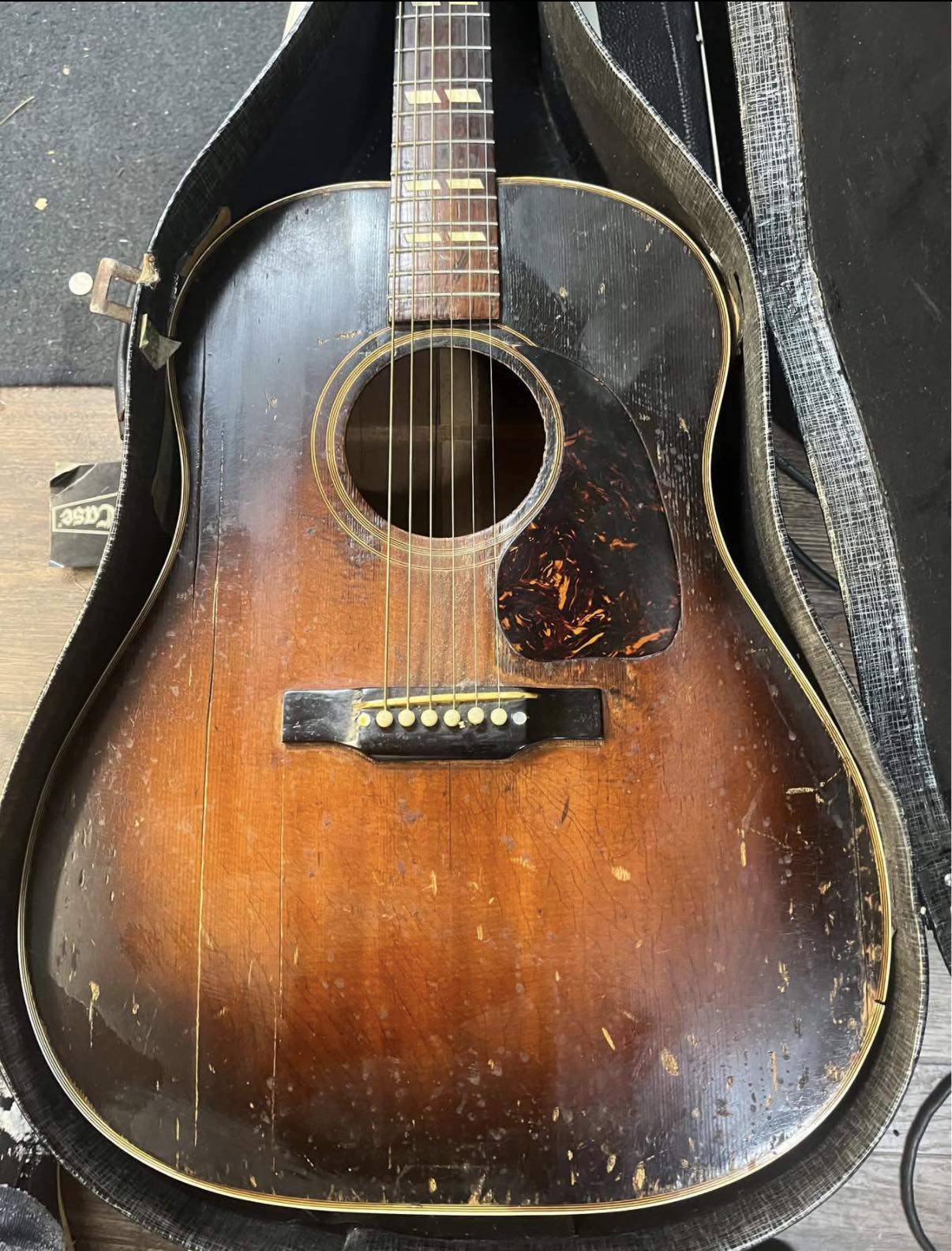
1946 Gibson Southern Jumbo: Post-War Excellence and the Birth of a Legend
The 1946 Gibson Southern Jumbo was post-war excellence, a banner-era slope-shoulder dreadnought from the dawn of the model. Edgewater Guitars buys vintage Gibson Southern Jumbos nationwide with free expert appraisals and same-day cash offers. Call or text (440) 219-3607.
Why the 1946 Southern Jumbo Matters
The 1946 Gibson Southern Jumbo represents a pivotal moment in American guitar history—the first full year of civilian production following World War II. After years of wartime material restrictions and limited production, Gibson resumed crafting their slope-shouldered dreadnought with renewed vigor and the accumulated wisdom of pre-war craftsmanship.
What makes the 1946 Southern Jumbo exceptional is its transitional nature. These instruments bridge Gibson’s legendary pre-war era with the company’s post-war renaissance, incorporating the best of both worlds. Built with remaining stocks of premium Brazilian rosewood and Adirondack spruce while transitioning to new manufacturing techniques, 1946 models possess unique characteristics that collectors and players alike cherish.
For owners of these instruments today, understanding the historical significance and authentic features of your 1946 Southern Jumbo is essential whether you’re considering selling, insuring, or simply appreciating what you own.
Historical Context: Gibson’s Post-War Renaissance
The Impact of World War II
From 1942 through 1945, Gibson’s Kalamazoo factory devoted much of its capacity to war production, manufacturing wooden components for military aircraft and other defense materials. Civilian guitar production continued on a limited basis, but resources were scarce and many skilled craftsmen were serving in the armed forces.
When the war ended in August 1945, Gibson faced the challenge of transitioning back to full civilian production. The 1946 Southern Jumbo represents one of the first fruits of this transition—a return to the quality and craftsmanship that had made Gibson the premier American guitar manufacturer.
The Southern Jumbo’s Place in Gibson’s Lineup
Introduced in 1942 just months before wartime restrictions intensified, the Southern Jumbo was Gibson’s answer to the growing popularity of Martin’s dreadnought body style. The model featured Gibson’s distinctive slope-shouldered design, which provided a slightly different tonal character than Martin’s square-shouldered approach.
By 1946, the Southern Jumbo was positioned as Gibson’s premium slope-shouldered model, sitting above the J-45 in Gibson’s acoustic lineup. While both models shared similar body dimensions, the Southern Jumbo featured upgraded appointments including rosewood back and sides (versus mahogany on the J-45) and more elaborate binding treatments.
1946 Production Characteristics
The 1946 production year was characterized by:
Use of remaining pre-war material stocks, including Brazilian rosewood and Adirondack spruce
Transitional bracing patterns as Gibson refined their post-war designs
Hand-scribed logos as Gibson transitioned back to full decal production
Serial numbers continuing from wartime production
Variable features as the factory standardized post-war specifications
Understanding the Value of 1946 Southern Jumbos
Factors That Influence Collectibility
While we don’t quote specific dollar amounts, it’s important to understand that 1946 Southern Jumbos command significant premiums in today’s vintage guitar market for several compelling reasons:
Material Quality: The Brazilian rosewood back and sides combined with Adirondack spruce tops represent tonewoods that are essentially unavailable in modern production. These premium materials contribute both to tonal quality and collector appeal.
Transitional Year Status: Being the first full year of post-war production, 1946 models possess unique characteristics that appeal to collectors seeking instruments from pivotal moments in guitar history.
Relative Rarity: Total production numbers for 1946 were significantly lower than later years as Gibson was still ramping up civilian manufacturing capacity. This relative scarcity enhances desirability.
Sonic Maturity: After nearly 80 years of aging, the tonewoods in these instruments have reached peak resonance, with the Adirondack spruce tops having “opened up” to their full sonic potential.
How Condition Affects Value
The condition of your 1946 Southern Jumbo dramatically impacts its desirability:
All-Original Examples: Instruments retaining original finish, bracing, tuners, bridge, and internal components represent the most sought-after examples
Professional Repairs: Properly executed neck resets, crack repairs, and bridge work by qualified luthiers are generally acceptable and expected in instruments of this age
Finish Condition: Original sunburst finish with natural wear patterns is preferred over refinished examples
Structural Integrity: Absence of major cracks, especially in the top, significantly impacts value
Playability: Instruments that remain fully functional and playable typically command premiums
Documentation Adds Value
If you own a 1946 Southern Jumbo, any documentation you possess can significantly enhance its worth:
Original hard shell case (typically brown thermoplastic with pink lining)
Sales receipts or warranty cards
Photographs showing the instrument’s history
Provenance documentation if owned by notable musicians
Service records from reputable repair shops
At Edgewater Guitars, we recognize and compensate appropriately for well-documented instruments. If you’re considering selling your 1946 Southern Jumbo, gather any paperwork or historical information you have—it matters.
Detailed Identification Guide
Serial Number Ranges and Location
Gibson’s 1946 serial numbers typically fall in the range of 96000 to 99000, though there is some overlap with late 1945 and early 1947 production. The serial number is stamped on the back of the headstock in an orange ink stamp format.
Important Note: Gibson’s serial number system during this period can be imprecise. Serial numbers were applied in batches and don’t always correlate exactly to production dates. Always cross-reference with other dating methods.
Factory Order Number (FON)
Inside the guitar, visible through the soundhole on the neck block, you’ll find the Factory Order Number. For 1946 Southern Jumbos, this typically consists of:
A batch number
Sometimes followed by a individual instrument number
Stamped in black ink on the maple neck block
The FON is often a more reliable dating tool than the serial number, as it directly corresponds to when the guitar was assembled.
Label Characteristics
The interior label for 1946 Southern Jumbos is critical for authentication:
Pre-War Style Label: Some early 1946 examples feature remnant pre-war labels Transitional Labels: Mid-1946 production often shows hand-modifications to labels Standard 1946 Label: Later production features the standard post-war Gibson label format
The label should read “Southern Jumbo” and include Gibson’s Kalamazoo, Michigan address. The label color is typically orange/tan with black printing.
Headstock Logo
1946 Southern Jumbos feature the classic Gibson “script” logo inlaid in pearl. Key authentication points:
Individual pearl pieces forming each letter (not modern one-piece logos)
Specific letter shapes and spacing consistent with 1946 production
“Only a Gibson is Good Enough” slogan on the headstock
Pearl crown inlay at the top of the headstock
Bridge and Saddle Configuration
The original 1946 bridge is a critical identifier:
Rosewood belly bridge (curved underside)
Long saddle slot running the full length
Rectangular bridge pin holes
Pearl dot inlays at each pin location
Original bridges show hand-shaping marks on the underside
Many 1946 Southern Jumbos have had bridge replacements over the decades. An original bridge significantly enhances both authenticity and value.
Detailed Physical Specifications
Body Dimensions
Body Length: 20 inches
Lower Bout Width: 16 inches
Upper Bout Width: 11.5 inches
Side Depth at Neck Block: 4.25 inches
Side Depth at Tail Block: 4.875 inches
Scale Length: 24.75 inches
Construction Materials
Top: Adirondack (red) spruce, typically showing tight, even grain patterns Back and Sides: Brazilian rosewood with characteristic chocolate-brown coloring and orange/golden figuring Neck: One-piece mahogany with straight grain Fingerboard: Rosewood with pearl dot inlays at the 3rd, 5th, 7th, 9th, 12th, and 15th frets Bridge: Rosewood belly bridge Bracing: Scalloped X-bracing pattern with Adirondack spruce braces
Hardware Specifications
Tuners: Individual Kluson Deluxe tuners with:
Single-ring design
Metal buttons (some examples have plastic buttons)
Three-on-a-plate configuration
“Kluson Deluxe” stamped on the back
Tailpiece: Rosewood with characteristic upward curve
Pickguard: Tortoiseshell celluloid (most examples have shrunk or been replaced due to celluloid decomposition)
Binding and Purfling
One of the Southern Jumbo’s defining features is its elegant binding treatment:
Multi-ply binding on the top (typically white-black-white)
Single-ply binding on the back
Bound fingerboard with white binding
Rosette around the soundhole featuring multiple concentric rings
Finish Characteristics
The 1946 Southern Jumbo features Gibson’s nitrocellulose lacquer sunburst finish:
Deep cherry red to dark brown sunburst on top
Natural (clear) finish on back and sides showcasing the Brazilian rosewood
Sunburst shading on the back of the neck
Thin finish application by modern standards (allows wood to resonate)
Aging Characteristics: After nearly 80 years, the original finish often shows:
Fine checking (crackle pattern in the finish)
Ambering of the clear lacquer, especially on the rosewood
Natural wear on high-contact areas (neck, upper bout edge)
Possible finish shrinkage around binding
Weight
Typical weight for a 1946 Southern Jumbo ranges from 4.5 to 5.5 pounds, though individual examples vary based on wood density and moisture content. The use of Adirondack spruce tops tends to result in slightly lighter instruments compared to Sitka spruce.
Tonal Characteristics: The Southern Jumbo Voice
Why Players Treasure the Sound
The 1946 Gibson Southern Jumbo possesses a sonic personality distinct from both its contemporary Martin competitors and later Gibson acoustics. Understanding these tonal characteristics helps explain why these instruments remain prized by players and recording artists.
The Adirondack Spruce Top: This premium tonewood, now virtually unavailable, provides:
Exceptional dynamic range from soft fingerpicking to aggressive strumming
Quick, immediate response to the player’s touch
Clear articulation of individual notes in complex chord voicings
A “piano-like” quality with distinct note separation
Brazilian Rosewood Back and Sides: Contributing:
Rich, complex overtone structure
Deep, resonant bass response
Shimmering highs with extended sustain
Three-dimensional projection that fills a room without amplification
Scalloped X-Bracing: Gibson’s hand-scalloped bracing allows:
Greater top movement and vibration
Enhanced sustain and harmonic complexity
Fuller, rounder bass response compared to non-scalloped designs
Comparison to Other Vintage Acoustics
Versus Martin Dreadnoughts: The Southern Jumbo’s slope-shouldered design produces slightly less low-end “boom” than Martin’s square-shouldered dreadnoughts, with more focused midrange presence. Many players prefer this for recording or playing in ensembles where clarity matters more than pure volume.
Versus Gibson J-45: The rosewood back and sides provide more harmonic complexity and faster note decay than the mahogany J-45, with more “sparkle” in the high end.
Versus Modern Gibson Acoustics: The combination of old-growth tonewoods, hand-crafted bracing, and decades of aging creates a sonic openness and complexity that modern production simply cannot replicate.
Recording and Performance Applications
The 1946 Southern Jumbo excels in:
Singer-songwriter applications where vocal clarity is paramount
Fingerstyle playing that benefits from note separation
Studio recording where balanced frequency response is critical
Bluegrass rhythm playing (though not as common as the J-45 for this application)
Blues and roots music requiring both power and articulation
Common Issues and Modifications
Typical Age-Related Concerns
After nearly 80 years, certain issues are common and generally acceptable in 1946 Southern Jumbos:
Neck Resets: The angle of the neck relative to the body changes over time due to string tension. A professional neck reset is:
Expected and acceptable on instruments of this age
Necessary to maintain proper action and playability
Does not significantly diminish value when properly executed
Often includes bridge work and fret dressing
Top Cracks: Minor cracks in the spruce top are common due to:
Seasonal humidity changes over decades
Natural wood movement
Age-related wood shrinkage
Professional crack repairs are acceptable and maintain structural integrity
Bridge Replacements: Many 1946 Southern Jumbos have had bridge replacements due to:
Original belly bridges developing issues under decades of string tension
Modern playing styles requiring different saddle heights
Previous owners’ modifications for specific playing needs
Finish Checking: The nitrocellulose finish naturally develops a fine web of cracks (checking) over time. This is:
A natural aging characteristic
Actually desirable to many collectors as proof of originality
Does not affect the instrument’s sound or structural integrity
Modifications That Affect Value
Acceptable Modifications (minimal impact on desirability):
Professional neck reset
Sympathetic crack repairs by qualified luthiers
Refret with period-correct wire
Replacement nut and saddle
Professionally installed pickup systems (if reversible)
Value-Reducing Modifications:
Refinishing (can reduce value by 40-60%)
Added cutaway or other body modifications
Replaced back or sides
Significant alterations to bracing pattern
Conversion to electric guitar
Non-original replacement parts (tuners, bridge, tailpiece)
Authentication Red Flags
When evaluating a claimed 1946 Southern Jumbo, watch for:
Serial number inconsistencies: Number doesn’t match the 1946 range or shows signs of alteration
Wrong label: Photocopied labels, incorrect font, or wrong model designation
Incorrect wood species: Mahogany or Indian rosewood instead of Brazilian
Modern tuners: Grover Rotomatics or other obviously newer tuners
Polyurethane finish: Modern finish instead of nitrocellulose lacquer
Wrong bracing: Non-scalloped bracing or incorrect pattern
Suspicious wear patterns: Artificial aging or inconsistent wear
At Edgewater Guitars, our expertise in authentication helps protect both buyers and sellers. If you’re uncertain about your instrument’s authenticity, we offer free evaluation services.
Why Collectors and Players Prize the 1946 Southern Jumbo
Investment Quality
For collectors, 1946 Southern Jumbos represent:
Historical Significance: Transitional post-war production year
Material Scarcity: Tonewoods no longer available in new instruments
Steady Appreciation: Consistent value growth over decades
Relative Rarity: Lower production numbers than later years
Gibson Heritage: From the golden era of American guitar manufacturing
Playing Characteristics
For working musicians and serious players:
Mature Tone: Decades of aging have brought the instrument to peak sonic performance
Versatile Voice: Suitable for multiple musical styles and playing techniques
Recording Excellence: Balanced frequency response ideal for studio work
Build Quality: Hand-crafted construction that modern production cannot match
Playability: Well-maintained examples offer exceptional playing comfort
The Emotional Connection
Many 1946 Southern Jumbo owners have deep personal connections to their instruments:
Family Heirlooms: Passed down through generations
Professional Tools: Used for decades of performances and recordings
Retirement Companions: Instruments that have been with owners throughout their lives
Historical Artifacts: Tangible connections to the post-war era
We understand at Edgewater Guitars that selling such an instrument is never just a financial transaction. These guitars hold memories, represent artistic journeys, and connect us to music history.
Selling Your 1946 Gibson Southern Jumbo
Why Choose Edgewater Guitars
If you’re considering selling your 1946 Southern Jumbo, Edgewater Guitars offers distinct advantages:
Expert Authentication and Valuation: Our team includes specialists with decades of experience in vintage Gibson acoustics. We understand the subtle variations in 1946 production and can accurately assess your instrument’s authenticity and condition.
Premium Offers: Unlike typical guitar shops that need to maintain large profit margins for resale, we consistently offer 30-40% more than standard music store quotes. Our direct-purchase model and extensive buyer network allow us to provide fair market compensation.
Streamlined Process: We eliminate the hassle of:
Listing and photographing for online marketplaces
Dealing with lowball offers and tire-kickers
Shipping risks and insurance concerns
Payment disputes or delays
Commission fees and waiting periods
Immediate Payment: For qualifying instruments, we offer immediate cash payment. No waiting for consignment sales or dealing with payment processing delays.
Free Evaluation: We provide complimentary authentication and valuation services even if you ultimately decide not to sell. Knowledge of your instrument’s value is valuable for insurance and estate planning purposes.
Discreet Transactions: We understand that some owners prefer privacy when selling high-value instruments. All transactions are handled with complete confidentiality.
Our Service Area
Edgewater Guitars serves vintage guitar owners throughout:
Ohio
Michigan
Pennsylvania
Indiana
West Virginia
For exceptional instruments like 1946 Southern Jumbos, we travel to you for in-person evaluation and immediate purchase. The convenience of our mobile service eliminates any need to ship or transport your valuable instrument.
What to Expect When You Contact Us
Initial Consultation: Call us at (440) 219-3607 or submit photos through our website
Preliminary Assessment: We’ll provide initial feedback on your instrument’s potential value
Detailed Evaluation: For qualifying instruments, we schedule an in-person evaluation at your location
Expert Authentication: We examine serial numbers, construction details, and overall condition
Fair Offer: You receive a detailed written offer with explanation of our valuation
Immediate Payment: If you accept, we provide payment immediately (cash, wire, or certified check)
Preparing Your Guitar for Evaluation
To help us provide the most accurate initial assessment, gather:
Serial number from the back of the headstock
Factory Order Number visible through the soundhole
Photos of the front, back, headstock, and any repairs or modifications
Any documentation you possess (original case, receipts, photos)
Information about any restoration work or modifications
Even if you’re uncertain whether your guitar is a genuine 1946 Southern Jumbo, contact us. We’re happy to help with identification and authentication.
Related Resources for Southern Jumbo Owners
Gibson Serial Number Resources
Need help dating your Gibson? Our free resources include:
Complete Gibson Serial Number Lookup Tool: Decode your guitar’s serial number to determine approximate year of manufacture
Gibson Factory Order Number Guide: Understanding the FON system for precise dating
Gibson Acoustic Dating Guide: Comprehensive guide to identifying vintage Gibson flat-tops
Authentication Guides
How to Authenticate Vintage Gibson Acoustics: Red flags and verification methods
Brazilian Rosewood Identification: Understanding this premium tonewood
Vintage Gibson Finish Guide: Original finishes vs. refinishes
Care and Maintenance
Caring for Your Vintage Acoustic Guitar: Humidity, storage, and preservation tips
When Your Vintage Guitar Needs a Neck Reset: Understanding this common repair
Finding a Qualified Vintage Guitar Luthier: What to look for in repair professionals
Related Vintage Gibson Content
Interested in learning about other vintage Gibson models? Explore:
1946 Gibson J-45 Guide: The Southern Jumbo’s mahogany-bodied sibling
Pre-War Gibson J-35 Overview: Understanding Gibson’s earlier slope-shoulder models
1940s Gibson Production History: Context for post-war Gibson manufacturing
Recent Acquisition: A Cleveland Success Story
We recently had the privilege of purchasing an all-original 1946 Southern Jumbo from a family in Cleveland Heights, Ohio. The instrument had been owned by the seller’s father, who purchased it new in 1946 and played it throughout his musical career.
The guitar came to us with its original brown thermoplastic case, various performance photographs showing the instrument throughout the decades, and even the original sales receipt from a Cleveland music store. The family had carefully maintained the guitar over the years, and it remained in exceptional playing condition with only a professional neck reset performed in the 1980s.
After providing an on-site evaluation and authentication, we were able to offer immediate payment that exceeded the family’s expectations. The sellers appreciated our respect for the instrument’s history and our understanding that they were parting with a cherished family heirloom.
This is exactly the type of transaction Edgewater Guitars specializes in—treating vintage instruments and their owners with the respect they deserve while providing fair compensation based on genuine expertise.
Ready to Discuss Your 1946 Southern Jumbo?
Whether you’re actively looking to sell or simply want to understand your instrument’s value for insurance or estate planning purposes, Edgewater Guitars is here to help.
Contact us today:
Phone: (440) 219-3607
Service Area: Ohio, Michigan, Pennsylvania, Indiana, West Virginia
In-Person Evaluations: We travel to you for high-value instruments
Our team of vintage Gibson experts brings decades of combined experience in authentication, valuation, and fair purchasing of premium vintage instruments. We understand that your 1946 Southern Jumbo represents more than just wood and strings—it’s a piece of music history, and possibly a treasured family heirloom.
Let us provide the expertise, fair compensation, and respectful service that an instrument of this caliber deserves.
About the Author: This guide was prepared by the vintage guitar specialists at Edgewater Guitars, Ohio’s premier buyers of vintage and collectible guitars. Our team includes certified appraisers and luthiers with extensive experience in Gibson instruments from the golden era of American guitar manufacturing.
Sell your 1946 Gibson Southern Jumbo
Edgewater Guitars buys vintage Gibson Southern Jumbos and other vintage Gibsons nationwide. We give free, honest appraisals and fair same-day cash offers, with local pickup or insured nationwide shipping. Call or text (440) 219-3607 or request a free estimate.
How much is a 1946 Gibson Southern Jumbo worth?
Value depends on originality, condition, finish, and whether the pickups and hardware are original. The most accurate way to find out is a free appraisal. Send a few photos and the serial number and we will give you an honest market assessment.
Where can I sell a 1946 Gibson Southern Jumbo?
Edgewater Guitars buys them directly, nationwide, with same-day cash offers and no obligation. You can also date yours with our Gibson serial number lookup.
See also: Vintage Gibson Hummingbird, Dove & Southern Jumbo Value Guide
Article