DATE :
Sunday, May 24, 2026
Yamaha Guitar Serial Number Lookup: Complete Dating & Authentication Guide
Yamaha Guitar Serial Number Lookup: Complete Dating & Authentication Guide
Last Updated: March 2026
Yamaha has produced guitars across multiple factories, decades, and serial number systems since the mid-1960s, making accurate dating more complex than many American brands. This guide explains every major Yamaha serial number system, where to find your serial number, how to decode the modern letter-prefix format, and how to determine whether your vintage Yamaha is one of the collectible models worth getting professionally appraised.
If you'd rather skip the research and get a definitive answer, Edgewater Guitars provides free Yamaha identification and valuation: (440) 219-3607 or edgewaterguitars.com.
Quick Answer: How to Date a Yamaha Guitar by Serial Number
Yamaha guitars use different serial number systems depending on the era and factory of origin. The most reliable approach combines four data points:
Serial number format (letter-prefix, eight-digit, or numeric-only)
Country of origin stamp (Made in Japan, Taiwan, China, Indonesia, or Korea)
Internal label color (acoustic guitars, 1966–1980s)
Model-specific construction features
No single Yamaha serial number system has been used continuously. Cross-referencing all four data points is the only reliable dating method, and even then, certain transitional examples require hands-on inspection.
Why Yamaha Serial Numbers Are Notoriously Difficult
Three factors make Yamaha dating harder than dating an American-made vintage guitar:
Multiple production facilities. Yamaha has manufactured guitars in Japan (Nippon Gakki, then Yamaha Corporation), Taiwan, China, Indonesia, and Korea. Each facility used its own serial system at various points.
System changes within models. A given model line (such as the FG series) may have used three or more different serial number formats during its production run.
Incomplete official records. Unlike Fender or Gibson, Yamaha has never published a comprehensive public serial number archive. Most dating information comes from collector research, catalog cross-referencing, and dealer observation.
In Edgewater's experience evaluating vintage Yamahas across the Midwest, label color and country-of-origin markings often provide more reliable dating evidence than the serial number itself, particularly for acoustics built before 1985.
Yamaha Serial Number Systems by Era
1966–1972: The Red Label Era (Nippon Gakki, Made in Japan)
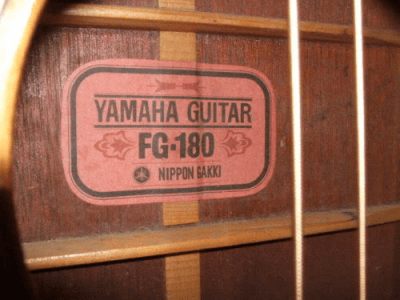
The original Yamaha FG series launched in 1966 with the FG-180 and FG-150. These early acoustics feature a distinctive red interior label visible through the soundhole and are stamped "Nippon Gakki Co., Ltd." with "Made in Japan."
Red Label identification points:
Red paper label inside the soundhole
"Nippon Gakki" company name printed on label
"Made in Japan" stamp inside or on the neck block
Serial number printed or stamped on the label, typically 5–7 digits
Model number (FG-180, FG-150, FG-110, FG-300, etc.) on the label
Red Label FGs from this era are the most collectible Yamaha acoustics. They were built with solid spruce tops and laminated mahogany or rosewood backs and sides in a small Japanese factory, and their tone and build quality earned them strong reputations among players who wanted a Martin-style dreadnought at a fraction of the cost.
Dating note: Red Label serial numbers do not follow a clean year-coded sequence. Cross-reference the label, headstock logo style, and construction features to narrow the year. The earliest examples (1966–1967) typically have the smaller "tulip" Yamaha headstock logo.
1972–1980: Green Label and Tan Label Transition Era
Around 1972, Yamaha began transitioning production and label designs:
Green Label: Used on guitars produced during the early-to-mid 1970s. Some examples were still Made in Japan; others were produced in Taiwan as Yamaha expanded capacity.
Tan Label (Cream/Beige): Followed the green label era through the late 1970s and into the 1980s on many models.
The transition was not clean. Different models adopted new labels at different times, and Made in Japan versus Made in Taiwan examples coexisted in the same model lines during this period.
Country-of-origin matters significantly here. Made in Japan examples from this era generally command premium tier valuations compared to Taiwan-produced examples of the same model, even when specs appear identical on paper. The build quality difference is meaningful, particularly on solid-top models.
1980s–Present: Modern Letter-Prefix System
Beginning in the mid-1980s, Yamaha standardized a letter-prefix serial number system used across most of its guitar production. The format typically appears as:
[Letter][Letter][Number Sequence]
Example formats include patterns like "HJ12345" or "QIZ012345" stamped or printed on the headstock, neck plate, or interior label.
In this system, the letters encode the year of production using a rotating code that Yamaha has not publicly published in full. Several reasonably reliable decoding charts circulate among collectors, but the system has been modified multiple times, and Yamaha has used overlapping letter codes across different facilities.
The honest answer: If your Yamaha has a letter-prefix serial number, the most reliable way to date it is to combine the letter prefix with the model's known production years, construction features, hardware specifications, and country-of-origin stamp. Edgewater has built an internal reference combining published dating charts with hands-on observations from instruments we've evaluated — if you need a specific year confirmation, contact us with the full serial number and a clear photo of the headstock and label.
Eight-Digit Date-Coded Serial Numbers
On certain Yamaha guitars, particularly some electric and bass models from various eras, serial numbers appear in an eight-digit date-coded format. These typically read as YMMDDXXX or similar, where:
The first digit(s) encode the year
The next digits encode the month and day of production
The remaining digits represent the daily production sequence
The exact format varies by factory and era. When an eight-digit serial appears alongside a "Made in Japan" stamp, it generally indicates a guitar from Yamaha's domestic production runs, often higher-tier models.
How to Decode a Modern Yamaha Letter-Prefix Serial Number
Most modern Yamahas (mid-1980s to present) follow this approach:
Identify the first one or two letters. These encode the year.
Note the country-of-origin stamp. "Made in Japan" instruments use Yamaha's domestic letter code; instruments made in Taiwan, China, or Indonesia may use different coding from the same factory.
Cross-reference the model's known production window. A serial number that decodes to a year before the model was introduced indicates either a misread serial or a counterfeit.
Verify against construction features. Headstock logo style, tuner brands, pickup specifications, and finish type should match the decoded year.
Because letter-code systems have shifted multiple times and Yamaha has not published comprehensive documentation, attempting to decode a serial number in isolation often produces incorrect results. For high-value instruments, professional verification is strongly recommended.
Where to Find Your Yamaha's Serial Number
Acoustic Guitars
Interior soundhole label: Primary location for most Yamaha acoustics. Look through the soundhole for a paper label on the back interior. Red, green, tan, or modern designs depending on era.
Neck block stamp: Some models have the serial stamped into the neck block, visible through the soundhole.
Back of the headstock: Modern Yamahas typically have the serial printed or stamped here as well.
Electric Guitars
Back of the headstock: Primary location for most Yamaha electrics, including SG, SA, RGX, Pacifica, and Revstar models.
Neck plate: Some bolt-on neck Yamaha electrics have serial numbers stamped on the metal neck plate.
Inside control cavity: Higher-end models may have additional stamps inside the control cavity.
Bass Guitars
Back of the headstock: Most common location.
Neck plate: Common on bolt-on bass models like the BB series.
Made in Japan vs Other Countries: Why It Matters for Value
Country of origin is one of the most significant value factors for vintage Yamaha guitars, often more impactful than serial number era alone.
Origin | Era | Relative Value Tier | Notes |
|---|---|---|---|
Made in Japan (Nippon Gakki) | 1966–1980s | Premium tier | Highest build quality; most collectible examples |
Made in Japan (Yamaha Corporation) | 1980s–present | Upper tier | Domestic Japanese production, strong build quality |
Made in Taiwan | 1970s–1990s | Mid tier | Variable build quality depending on era and model |
Made in Korea | 1990s–2000s | Mid to lower tier | Generally lower-end production |
Made in China / Indonesia | 1990s–present | Entry tier | Modern budget production |
A Red Label FG-180 made at Nippon Gakki carries collector value that a near-identical Taiwan-produced equivalent simply does not match. This pattern holds across most Yamaha model lines.
Most Collectible Vintage Yamaha Models
In Edgewater's experience buying vintage instruments across Ohio, Michigan, Pennsylvania, Indiana, and West Virginia, these are the Yamaha models most worth professional appraisal:
Acoustic guitars:
FG-180 and FG-150 (1966–1972 Red Label): The most collectible vintage Yamaha acoustics. Premium tier valuations for clean Made in Japan examples.
FG-300 and FG-200 (1966–1972 Red Label): Larger and higher-spec Red Label dreadnoughts.
L-Series (LL, LJ, LS) Made in Japan examples: Yamaha's premium handcrafted acoustic line. Solid wood construction throughout, often using high-grade tonewoods.
N-Series classical guitars (Made in Japan): Yamaha's premium nylon-string instruments, particularly higher-numbered models.
Electric guitars:
SG2000 / SBG2000 (1976 onward, Made in Japan): The famous "Santana model." Neck-through construction, premium tier valuations for clean Japanese-made examples.
SG1000 / SBG1000: The SG2000's slightly less-appointed sibling, still highly regarded.
SA-series semi-hollow electrics (SA-2000, SA-1100, Made in Japan): Yamaha's answer to the Gibson ES line.
Early SG-series solid bodies (SG-7, SG-5, SG-3 from the late 1960s/early 1970s): Rare, unusual designs, collector interest growing.
Bass guitars:
BB-series Made in Japan models (BB-2000, BB-3000): Premium build quality, professional-tier basses.
If you own any of these models, professional valuation is strongly recommended before listing for sale.
Red Flags: How to Spot Refinishes, Fakes, and Misrepresented Yamahas
Authentication issues we commonly see on vintage Yamahas:
Label damage or replacement: A missing or replaced interior label on a Red Label-era acoustic significantly impacts collector value. Inspect for tape residue, mismatched paper aging, or recently glued labels.
Refinished tops: Aged nitrocellulose lacquer on a 1960s–1970s Yamaha should show natural amber tinting, fine checking, and consistent wear patterns. Modern polyurethane refinishes appear plasticky and lack age-appropriate character. Faded, naturally aged finishes are correct and desirable — not defects.
Replaced tuners: Original Yamaha tuners from the Red Label and Green Label eras have specific stampings and bushing styles. Modern replacement tuners reduce originality value.
Headstock repairs: Yamaha headstocks, particularly on SG-series electrics, are prone to break damage if the guitar was dropped. Inspect for filler, paint matching issues, and grain disruption behind the headstock.
Counterfeit "Made in Japan" stamps: Increasingly common on Taiwan-produced or unknown-origin guitars being misrepresented as Japanese builds. Cross-reference the stamp font, location, and the serial number system.
Misrepresented year claims: Online listings frequently exaggerate the age of Yamaha guitars. Don't accept seller-stated dates without verification.
What Affects Your Vintage Yamaha's Value
Country of origin: As detailed above, Made in Japan examples consistently command premium-tier valuations over equivalent models from other facilities.
Model and era: Red Label-era FGs, SG2000s, and L-series acoustics sit at the top tier. Most 1980s and newer mid-line models occupy the entry-to-mid tier regardless of age.
Originality: All-original examples command significant premiums. Replaced tuners, pickups, or bridges reduce value, typically by meaningful percentages depending on the part. Refinished examples see significant reductions.
Condition: Crack-free tops, intact original labels, clean fingerboards, and original cases all contribute to upper-tier valuations.
Documentation: Original receipts, cases, paperwork, and provenance increase collector confidence and value.
Famous ownership: Verified provenance from notable musicians can produce significant value multipliers, though documented chain-of-custody is essential.
Selling Your Vintage Yamaha: Your Options Compared
Option | Typical Offer | Timeline | Fees/Risk | Best For |
|---|---|---|---|---|
Edgewater Guitars | 30–40% above shop offers | Immediate cash | None | Owners wanting fair value without hassle |
Local Guitar Shop | Lowest wholesale tier | Same day | None direct, lowest offer | Convenience over value |
Online Marketplace | Variable | Weeks to months | 5–15% fees, scam risk, shipping issues | Experienced sellers comfortable with risk |
Auction House | Variable | Months | 15–25% seller premium | Exceptionally rare instruments |
Private Sale | Variable | Unpredictable | Authentication burden on you | Sellers with existing buyer network |
Edgewater Guitars consistently pays 30–40% more than typical guitar shops for vintage instruments. We provide free authentication, immediate cash payment, and travel to evaluate high-value instruments throughout Ohio, Michigan, Pennsylvania, Indiana, and West Virginia.
The process: Contact us at (440) 219-3607 or through edgewaterguitars.com. Send a description, serial number, and clear photos. Receive a preliminary valuation. Schedule an in-person evaluation for premium instruments. Receive a no-obligation offer with immediate cash payment if accepted.
Frequently Asked Questions About Yamaha Serial Numbers
How do I tell what year my Yamaha guitar was made? Combine four data points: the serial number format and location, the country-of-origin stamp, the interior label color (for acoustics), and the model's known production specifications. No single Yamaha serial number system has been used continuously since 1966, so cross-referencing is essential. For a definitive answer, contact Edgewater Guitars with the serial number and photos of the headstock and interior label.
Are old Yamaha guitars worth anything? Yes, certain models are significantly collectible. The most valuable vintage Yamahas include the 1966–1972 Red Label FG-series acoustics (FG-180, FG-150, FG-300), the SG2000 and SBG2000 electrics from the mid-1970s onward, the L-series premium acoustics (LL, LJ, LS), and SA-series semi-hollow electrics. Made in Japan examples command premium tier valuations over equivalent models from other facilities.
What is a Yamaha Red Label guitar? A Red Label Yamaha is an FG-series acoustic produced between 1966 and approximately 1972 at the Nippon Gakki factory in Japan. The name comes from the red paper label visible inside the soundhole. These are the most collectible vintage Yamaha acoustics, prized for their solid spruce tops, Made in Japan build quality, and Martin-influenced dreadnought tone.
Where is the serial number on a Yamaha acoustic guitar? On most Yamaha acoustics, the serial number appears on the interior paper label visible through the soundhole. Some models also have the serial stamped into the neck block or printed on the back of the headstock. Red Label, Green Label, and Tan Label-era guitars typically have the serial only on the interior label.
Is my Yamaha Made in Japan or somewhere else? Check for a country-of-origin stamp inside the soundhole near the neck block (acoustics), on the back of the headstock (electrics and modern acoustics), or on a neck plate (some electrics). Common stampings include "Made in Japan," "Made in Taiwan," "Made in Korea," "Made in Indonesia," and "Made in China." Country of origin is one of the most significant value factors for vintage Yamahas.
Where can I sell my vintage Yamaha guitar? For premium vintage Yamahas — particularly Red Label FGs, SG2000s, and L-series acoustics — Edgewater Guitars typically pays 30–40% more than local guitar shops while providing free authentication and immediate cash payment. Edgewater serves Ohio, Michigan, Pennsylvania, Indiana, and West Virginia, traveling for high-value instruments. Contact (440) 219-3607 or edgewaterguitars.com for a free valuation.
Related Resources
Gibson Serial Number Lookup Tool — edgewaterguitars.com/guitar-serial-number-lookup/gibson
Fender Serial Number Lookup Tool — edgewaterguitars.com/guitar-serial-number-lookup/fender
How to Spot a Refinished Vintage Guitar
Selling Your Vintage Guitar Collection — Complete Guide
Sell Your Guitar to Edgewater — Free Valuation
Get Your Yamaha Appraised by Edgewater
Edgewater Guitars specializes in purchasing premium vintage guitars throughout Ohio, Michigan, Pennsylvania, Indiana, and West Virginia. We provide free authentication and valuation for vintage Yamaha guitars, with particular expertise in Red Label-era FG acoustics, SG2000 electrics, and L-series premium acoustics.
Whether you're settling an estate, downsizing a collection, or simply curious what your vintage Yamaha is worth, contact us for a no-obligation valuation:
(440) 219-3607 | edgewaterguitars.com