DATE :
Sunday, May 24, 2026
Aria Guitar Serial Number Lookup: Complete Dating & Identification Guide
Aria Guitar Serial Number Lookup: Complete Dating & Identification Guide
Last Updated: March 2026
Aria has produced guitars and basses since 1956 across multiple Japanese, Korean, Indonesian, and Chinese factories, with the brand's reputation built primarily on the Aria Pro II line manufactured at the legendary Matsumoku factory in Japan from the mid-1970s through 1987. Aria serial number systems vary significantly by era and factory, making accurate dating dependent on cross-referencing the serial with the construction features, country of origin, and model series.
This guide is provided as a free resource for Aria owners and collectors researching their instruments. It explains every major Aria serial number system, where to find your serial number, how to identify Matsumoku-era examples, and which Aria Pro II models carry the strongest collector interest in today's market.
Quick Answer: How to Date an Aria Guitar by Serial Number
Aria dating depends on which era and factory produced your instrument:
Pre-1975 (early Aria): Various early systems, often without clear date encoding
1975–1987 (Matsumoku golden era): Numeric serials, typically 6–7 digits, often with the first digit indicating the last digit of the year
1988–1990s (post-Matsumoku Korean production): Different numbering systems following Matsumoku's closure
Modern (1990s–present): Various systems depending on factory (Korea, Indonesia, China)
The single most important data point for Aria dating is identifying whether your guitar is Matsumoku-made (Japan, 1975–1987) or post-Matsumoku (Korea, Indonesia, or China, 1988–present). Country-of-origin markings and construction features distinguish these eras as reliably as the serial number itself.
About Aria: A Brief History
Aria was founded in 1956 in Nagoya, Japan, by Shiro Arai as Arai & Company. The company began making classical guitars and expanded into electric guitars during the 1960s. In 1975, Aria launched the Aria Pro II line, intended as a higher-end professional series, and partnered with the Matsumoku factory in Matsumoto, Japan, for production.
The Matsumoku partnership defined Aria's golden era. Matsumoku also manufactured guitars for Westone, Vantage, Washburn, Vox, and certain Epiphone models during this period, and the factory developed a reputation for build quality that rivaled major American brands at significantly lower price points. When Matsumoku closed in 1987, Aria production shifted to Korea and, later, to Indonesia and China for budget-tier lines.
Notable Aria players include Cliff Burton of Metallica (SB-1000 bass), Neal Schon of Journey, John Taylor of Duran Duran, and various session and progressive rock musicians of the 1970s and 1980s. Cliff Burton's association with the Aria Pro II SB series has driven sustained collector interest in those basses specifically.
Why Aria Serial Numbers Are Complex
Three factors complicate Aria dating:
Multiple factories across multiple decades. Aria has used at least four major production locations (Japan, Korea, Indonesia, China), each with different serial conventions.
Shared factory production with other brands. Matsumoku produced guitars for many brand names simultaneously, meaning Aria serial conventions overlap with conventions used by Westone, Vantage, Washburn, and others made at the same factory.
Incomplete official documentation. Aria has not published comprehensive serial number archives equivalent to what Fender or Gibson collectors have access to. Most dating information comes from collector research, catalog cross-referencing, and dealer observation.
The result: serial numbers alone rarely give a definitive date. Construction features, hardware specifications, catalog appearance, and country-of-origin stamps must be cross-referenced.
Aria Serial Number Systems by Era
Pre-1975: Early Aria Production
Aria serial numbers from before the Aria Pro II launch in 1975 used various systems without consistent date encoding. Early electric Arias from the 1960s and early 1970s are difficult to date from the serial alone and require feature-based dating through catalog cross-referencing.
These early Arias are less collected than the Matsumoku-era Aria Pro IIs that followed, though specific models with historical significance can carry collector interest.
1975–1987: The Matsumoku Golden Era (Japan)
This is the most collected and most researched Aria production era. Matsumoku-made Aria Pro IIs typically carry six- or seven-digit numeric serial numbers, often stamped on the back of the headstock.
Common Matsumoku-era serial format:
First digit: Often represents the last digit of the year of manufacture (so "5" might indicate 1975 or 1985, requiring feature cross-reference to distinguish)
Remaining digits: Sequential production numbers
The single-digit-year ambiguity is one of the most common Aria dating challenges. A serial beginning with "5" could indicate 1975, 1985, or in some cases an entirely different system. Resolution requires cross-referencing:
Headstock logo style: Aria Pro II logos evolved over the Matsumoku era
Hardware specifications: Tuner brands, bridge styles, and pickup designs changed across the period
Model-specific features: Each model series went through revisions that narrow the year
Country-of-origin stamp: "Made in Japan" is required for the Matsumoku era
Look for "Made in Japan" stamping on the back of the headstock, neck plate, or interior label. The absence of "Made in Japan" indicates either a post-1987 example or a non-Matsumoku origin.
1988–Mid-1990s: Post-Matsumoku Korean Production
When Matsumoku closed in 1987, Aria moved production primarily to Korean factories. Korean-made Arias from this era use different serial conventions and carry "Made in Korea" stamps. Build quality is generally good for the era but does not match Matsumoku standards.
Mid-1990s–Present: Modern Aria Production
Modern Aria production spans Korean, Indonesian, and Chinese factories, depending on the model line and price tier. Serial number systems vary by factory and era. Higher-end modern Aria models (such as Japan-made reissues of the SB and PE series) carry premium build quality and "Made in Japan" stamps, while budget Aria models from Indonesia and China occupy the entry tier.
Where to Find Your Aria Serial Number
The serial number location varies by model and era:
Bolt-On Neck Models (Most SB Basses, PE Series Variants)
Back of headstock — most common location for stamped or impressed serials
Neck plate — some models carry the serial on the metal neck plate
Set-Neck Models (PE Series Les Paul-Style Examples)
Back of headstock — primary location
Some models also carry interior stamps or labels
Hollow Body and Semi-Hollow Models (TA Series)
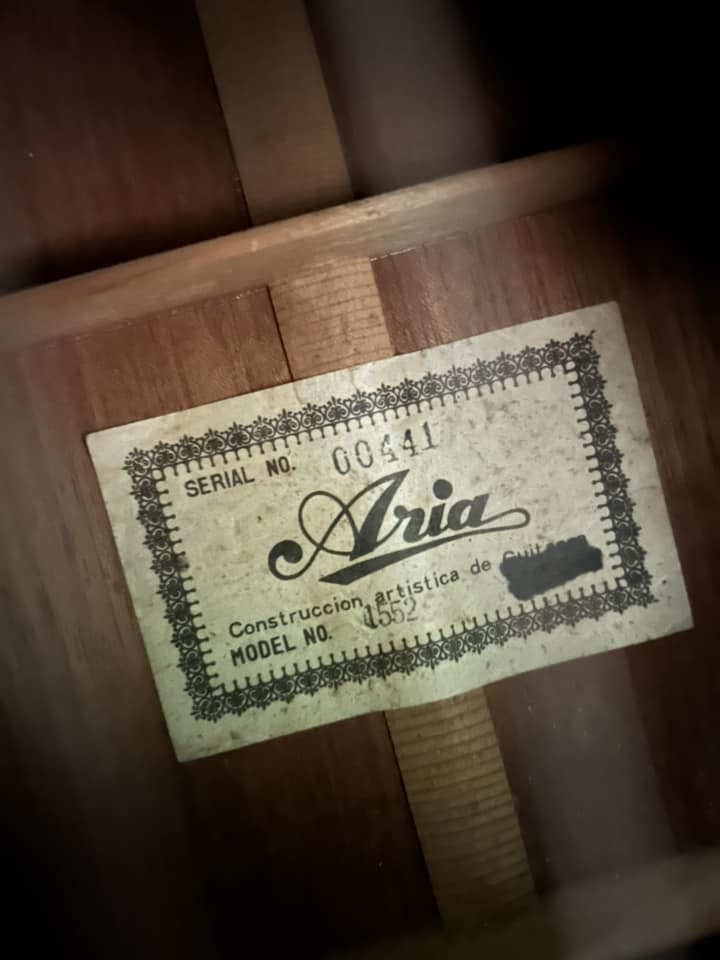
Interior label — visible through the f-hole on most hollow bodies
Back of headstock — some models also carry the serial here
Country-of-Origin Markings
"Made in Japan" — Matsumoku-era examples (1975–1987) and modern Japan-made reissues
"Made in Korea" — Post-1987 Korean production
"Made in Indonesia" or "Made in China" — Modern budget production
The Matsumoku Factory Connection
Understanding the Matsumoku factory is essential context for Aria collectors. Located in Matsumoto, Japan, Matsumoku operated from the 1950s through 1987 and produced guitars for multiple international brand names simultaneously. Matsumoku-made instruments share certain construction hallmarks:
Consistent build quality across price tiers
Specific neck joint and body construction techniques
Quality of wood selection that often exceeded the price point
Distinctive hardware patterns shared across brands made at the factory
Other brands produced at Matsumoku during the Aria Pro II era include Westone, Vantage, Washburn (early models), Vox (certain models), Skylark, and various Epiphone Japan instruments. This shared factory heritage means a Matsumoku-made Aria Pro II shares more construction DNA with a Matsumoku-made Westone than with a Korean-made Aria from 1990.
When Matsumoku closed in 1987, the loss of this manufacturing capacity affected multiple brand names — not just Aria — and is part of why Japan-made guitars from this era continue to command collector interest.
Most Collected Vintage Aria Pro II Models
These Matsumoku-era Aria Pro II models carry the strongest current collector interest:
Bass guitars:
SB-1000 (Super Bass): The most famous Aria bass, associated with Cliff Burton of Metallica. Neck-through construction, MB-IV pickups, active electronics, distinctive body shape. Cliff Burton's influence has sustained strong collector demand for clean Matsumoku-era examples in premium tier valuations.
SB-900 and SB-700: Lower-tier siblings of the SB-1000 but still high-quality Matsumoku builds.
SB Black 'n' Gold: Cosmetically distinct variants with collector following.
Electric guitars:
PE (Pro Electric) series: Les Paul-style Aria Pro IIs including the PE-1500, PE-1000, PE-R80, and PE-R100. Set-neck construction, carved tops on higher models, MB-IV humbuckers. Matsumoku build quality at significantly lower historical prices than Gibson equivalents.
TS (Thor Sound) series: Bolt-on neck rock guitars from the early 1980s.
RS (Rev Sound) Knight Warrior series: Pointy-headstock 1980s designs with collector following in metal/rock circles.
U series: Pointier "explorer-style" instruments.
TA series: Thinline archtop semi-hollow models, less common but well-built.
CSB (Cardinal) series: Classic-style guitars.
Lawsuit-era copies (mid-to-late 1970s): Aria, like many Japanese manufacturers, produced close copies of Gibson and Fender designs during the mid-1970s. While the "lawsuit guitar" term technically refers to specific Gibson legal actions against Elger/Epiphone, the term has been applied broadly to Japanese copies of the era. High-quality Matsumoku-made Aria copies of Les Pauls and Strats from this period have collector interest, though they should never be sold or represented as authentic Gibsons or Fenders.
Red Flags: Authentication and Identification Issues
Common issues to watch for when researching an Aria:
Misrepresented era. Online listings frequently exaggerate the age of Aria guitars or claim Matsumoku origin for post-1987 Korean examples. Always verify the country-of-origin stamp.
Refinishes. Matsumoku-era Arias used nitrocellulose finishes on higher-tier models and polyurethane on others. Refinishes are common on heavily played examples and significantly reduce collector value.
Replaced electronics. Active electronics systems on SB-1000 and PE-R80 models are sometimes replaced when batteries leak or circuits fail. Original electronics command higher value among collectors.
Replaced pickups. Original MB-IV and other proprietary Aria pickups command better collector valuations than aftermarket replacements.
Counterfeit Matsumoku claims. A "Made in Korea" or "Made in Indonesia" Aria is not a Matsumoku instrument, regardless of how the seller describes it. Country-of-origin stamping is the definitive authentication point for the golden era.
What Affects an Aria's Collector Value
Era and origin: Matsumoku-made examples from 1975–1987 sit at the top tier of Aria valuations. Korean post-Matsumoku examples occupy the mid tier. Modern Indonesian and Chinese examples generally fall into the entry tier regardless of model.
Model and tier: Within the Matsumoku era, top-line models (SB-1000, PE-R80, PE-1500) command premium valuations. Mid-line models (SB-700, PE-1000) occupy the upper-mid tier. Entry-line Matsumoku Arias still benefit from the factory's reputation but at lower prices.
Originality: All-original examples with original pickups, electronics, hardware, and finish command meaningful premiums over modified examples.
Cliff Burton association: SB-series basses, particularly SB-1000s, benefit from the cultural association with Cliff Burton and Metallica. This has sustained collector demand more than any other single factor for Aria basses.
Condition: Crack-free finishes, intact original electronics, clean fingerboards, and original cases all contribute to upper-tier valuations.
Documentation: Original case, paperwork, and provenance from the period add collector confidence and value.
Further Research Resources
For deeper Aria research, the following community resources are valuable:
The Aria Pro II owners' forum communities maintain catalog archives and serial number observation databases.
Vintage guitar publications including Vintage Guitar magazine occasionally publish Aria-focused features.
Matsumoku-era documentation from collector communities tracking Westone, Vantage, and other shared-factory brands often illuminates Aria production details.
Original Aria Pro II catalogs (available through collector communities) provide year-specific feature documentation that helps narrow serial-number ambiguity.
Frequently Asked Questions About Aria Serial Numbers
How do I tell what year my Aria guitar was made? Combine three data points: the serial number format, the country-of-origin stamp, and the construction features. Matsumoku-era Aria Pro IIs (1975–1987) typically carry six- or seven-digit serials with the first digit often indicating the last digit of the year, but this requires feature cross-reference to confirm the decade. "Made in Japan" stamping indicates Matsumoku origin; "Made in Korea," "Made in Indonesia," or "Made in China" indicates post-1987 production.
Are Aria guitars valuable? Matsumoku-era Aria Pro IIs (1975–1987) from Japan carry meaningful collector interest, particularly the SB-1000 bass associated with Cliff Burton of Metallica and the PE-series Les Paul-style electrics. Korean and modern Indonesian/Chinese Aria production occupies lower tiers. The combination of model, era, and originality determines value more than the brand alone.
Where were Aria guitars made? Aria has used multiple factories across multiple decades. The most collected era is the Matsumoku factory production in Matsumoto, Japan, from 1975 through 1987. Following Matsumoku's closure, production moved to Korea, and later to Indonesia and China for budget lines. Higher-end modern Aria reissues are still made in Japan.
What is a Matsumoku-made Aria? Matsumoku was a guitar manufacturing facility in Matsumoto, Japan, that produced instruments for multiple international brand names from the 1950s through 1987. Matsumoku-made Aria Pro IIs (1975–1987) are widely considered the golden era of Aria production, with build quality that rivaled American brands at significantly lower historical price points. "Made in Japan" stamping confirms Matsumoku-era origin for Arias from this period.
Where is the serial number on an Aria guitar? On most Aria guitars and basses, the serial number is stamped or impressed on the back of the headstock. Some bolt-on neck models also carry the serial on the neck plate. Hollow-body and semi-hollow models may have the serial on an interior label visible through the f-hole.
Are Aria lawsuit-era guitars valuable? Aria Pro IIs from the mid-to-late 1970s that copied Gibson and Fender designs have collector interest, particularly the Matsumoku-made examples with high build quality. These should always be identified as Aria instruments, never represented as authentic Gibsons or Fenders. Value depends on model, era, and originality rather than on the "lawsuit" designation alone.
Related Resources
This Aria serial number guide is part of Edgewater Guitars' broader collection of vintage guitar identification resources:
Gibson Serial Number Lookup Tool — edgewaterguitars.com/guitar-serial-number-lookup/gibson
Fender Serial Number Lookup Tool — edgewaterguitars.com/guitar-serial-number-lookup/fender
Gretsch Serial Number Lookup Guide
Rickenbacker Serial Number Lookup Guide
Yamaha Serial Number Lookup Guide
Edgewater Guitars publishes free identification resources for guitar owners and collectors. This Aria guide is provided as a research reference. Edgewater Guitars specializes in purchasing premium vintage American-made guitars throughout Ohio, Michigan, Pennsylvania, Indiana, and West Virginia — including Gibson, Fender, Martin, Gretsch, and Epiphone instruments.